Project CostProject Cost
ManagementManagement
Sections of this presentation were adaptedSections of this presentation were adapted
fromfrom A Guide to the Project ManagementA Guide to the Project Management
Body of KnowledgeBody of Knowledge 44thth
Edition, ProjectEdition, Project
Management Institute Inc., © 2009Management Institute Inc., © 2009
Project Cost ManagementProject Cost Management
““The processes involved in planning,The processes involved in planning,
estimating, budgeting, and controllingestimating, budgeting, and controlling
costs so that the budget can be completedcosts so that the budget can be completed
within the approved budget”within the approved budget”
Why Do We Manage Cost?Why Do We Manage Cost?
Part of triple constraint, can’t manage one withoutPart of triple constraint, can’t manage one without
the others (scope, time, and quality)the others (scope, time, and quality)
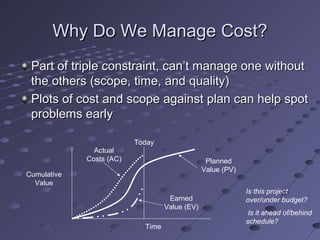
Plots of cost and scope against plan can help spotPlots of cost and scope against plan can help spot
problems earlyproblems early
Cumulative
Value
Time
Planned
Value (PV)
Actual
Costs (AC)
Earned
Value (EV)
Today
Is this project
over/under budget?
Is it ahead of/behind
schedule?
Cost Management Key TermsCost Management Key Terms
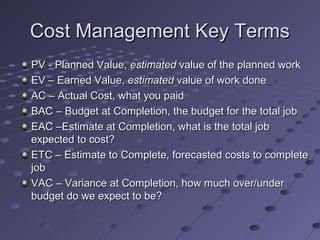
PV - Planned Value,PV - Planned Value, estimatedestimated value of the planned workvalue of the planned work
EV – Earned Value,EV – Earned Value, estimatedestimated value of work donevalue of work done
AC – Actual Cost, what you paidAC – Actual Cost, what you paid
BAC – Budget at Completion, the budget for the total jobBAC – Budget at Completion, the budget for the total job
EAC –Estimate at Completion, what is the total jobEAC –Estimate at Completion, what is the total job
expected to cost?expected to cost?
ETC – Estimate to Complete, forecasted costs to completeETC – Estimate to Complete, forecasted costs to complete
jobjob
VAC – Variance at Completion, how much over/underVAC – Variance at Completion, how much over/under
budget do we expect to be?budget do we expect to be?
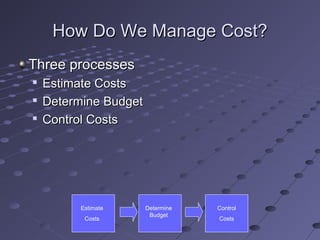
How Do We Manage Cost?How Do We Manage Cost?
Three processesThree processes

Estimate CostsEstimate Costs

Determine BudgetDetermine Budget

Control CostsControl Costs
Estimate
Costs
Determine
Budget
Control
Costs
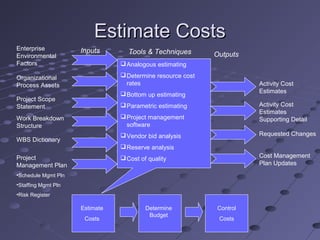
Estimate CostsEstimate Costs
Enterprise
Environmental
Factors
Organizational
Process Assets
Project Scope
Statement
Analogous estimating
Determine resource cost
rates
Bottom up estimating
Parametric estimating
Project management
software
Vendor bid analysis
Reserve analysis
Cost of quality
Inputs
OutputsTools & Techniques
Work Breakdown
Structure
WBS Dictionary
Project
Management Plan
•Schedule Mgmt Pln
•Staffing Mgmt Pln
•Risk Register
Activity Cost
Estimates
Activity Cost
Estimates
Supporting Detail
Requested Changes
Cost Management
Plan Updates
Estimate
Costs
Determine
Budget
Control
Costs
Estimating MethodsEstimating Methods
Analogous (Top Down) estimatingAnalogous (Top Down) estimating – Managers– Managers
use expert judgment or similar project costsuse expert judgment or similar project costs
[quick, less accurate][quick, less accurate]
Bottom-Up estimatingBottom-Up estimating – People doing work– People doing work
estimate based on WBS, rolled up into projectestimate based on WBS, rolled up into project
estimate [slow, most accurate]estimate [slow, most accurate]
Parametric estimatingParametric estimating – Use mathematical model– Use mathematical model
(i.e. cost per sq ft). [accuracy varies](i.e. cost per sq ft). [accuracy varies] Two types:Two types:
Regression analysis – based on analysis of multipleRegression analysis – based on analysis of multiple
data pointsdata points
Learning Curve – The first unit costs more than theLearning Curve – The first unit costs more than the
100100thth
, forecasts efficiency gains, forecasts efficiency gains
Estimating MethodsEstimating Methods
Vendor Bid AnalysisVendor Bid Analysis – Estimating using bids +– Estimating using bids +
allowances for gaps in bid scope [slow, accuracyallowances for gaps in bid scope [slow, accuracy
depends on gaps]depends on gaps]
Reserve AnalysisReserve Analysis – Adding contingency to each– Adding contingency to each
activity cost estimates as zero duration item [slow,activity cost estimates as zero duration item [slow,
overstates cost]overstates cost]
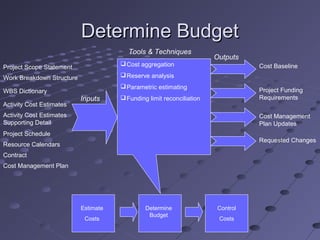
Determine BudgetDetermine Budget
Project Scope Statement
Cost aggregation
Reserve analysis
Parametric estimating
Funding limit reconciliationInputs
Outputs
Tools & Techniques
Cost Baseline
Project Funding
Requirements
Cost Management
Plan Updates
Requested Changes
Work Breakdown Structure
WBS Dictionary
Activity Cost Estimates
Supporting Detail
Project Schedule
Resource Calendars
Contract
Cost Management Plan
Estimate
Costs
Determine
Budget
Control
Costs
Determine BudgetDetermine Budget
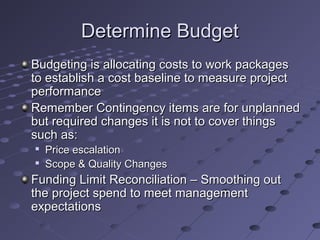
Budgeting is allocating costs to work packagesBudgeting is allocating costs to work packages
to establish a cost baseline to measure projectto establish a cost baseline to measure project
performanceperformance
Remember Contingency items are for unplannedRemember Contingency items are for unplanned
but required changes it is not to cover thingsbut required changes it is not to cover things
such as:such as:

Price escalationPrice escalation

Scope & Quality ChangesScope & Quality Changes
Funding Limit Reconciliation – Smoothing outFunding Limit Reconciliation – Smoothing out
the project spend to meet managementthe project spend to meet management
expectationsexpectations
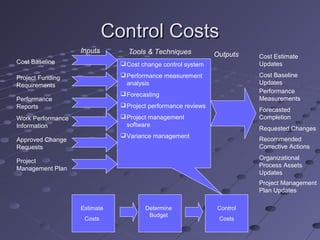
Control CostsControl Costs
Cost Baseline
Project Funding
Requirements
Performance
Reports
Cost change control system
Performance measurement
analysis
Forecasting
Project performance reviews
Project management
software
Variance management
Inputs
OutputsTools & Techniques
Work Performance
Information
Approved Change
Requests
Project
Management Plan
Cost Estimate
Updates
Cost Baseline
Updates
Performance
Measurements
Forecasted
Completion
Requested Changes
Recommended
Corrective Actions
Organizational
Process Assets
Updates
Project Management
Plan Updates
Estimate
Costs
Determine
Budget
Control
Costs
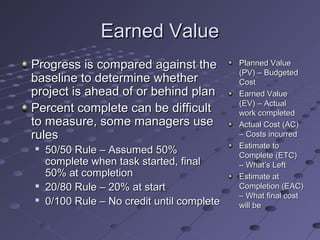
Earned ValueEarned Value
Progress is compared against theProgress is compared against the
baseline to determine whetherbaseline to determine whether
project is ahead of or behind planproject is ahead of or behind plan
Percent complete can be difficultPercent complete can be difficult
to measure, some managers useto measure, some managers use
rulesrules

50/50 Rule – Assumed 50%50/50 Rule – Assumed 50%
complete when task started, finalcomplete when task started, final
50% at completion50% at completion

20/80 Rule – 20% at start20/80 Rule – 20% at start

0/100 Rule – No credit until complete0/100 Rule – No credit until complete
Planned ValuePlanned Value
(PV) – Budgeted(PV) – Budgeted
CostCost
Earned ValueEarned Value
(EV) – Actual(EV) – Actual
work completedwork completed
Actual Cost (AC)Actual Cost (AC)
– Costs incurred– Costs incurred
Estimate toEstimate to
Complete (ETC)Complete (ETC)
– What’s Left– What’s Left
Estimate atEstimate at
Completion (EAC)Completion (EAC)
– What final cost– What final cost
will bewill be
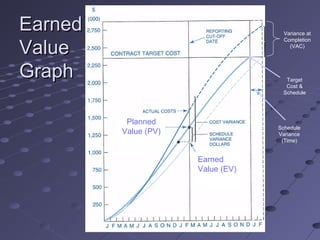
EarnedEarned
ValueValue
GraphGraph
Variance at
Completion
(VAC)
Target
Cost &
Schedule
Schedule
Variance
(Time)
Planned
Value (PV)
Earned
Value (EV)
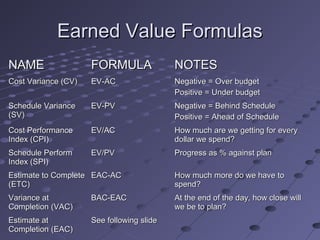
Earned Value FormulasEarned Value Formulas
NAMENAME FORMULAFORMULA NOTESNOTES
Cost Variance (CV)Cost Variance (CV) EV-ACEV-AC Negative = Over budgetNegative = Over budget
Positive = Under budgetPositive = Under budget
Schedule VarianceSchedule Variance
(SV)(SV)
EV-PVEV-PV Negative = Behind ScheduleNegative = Behind Schedule
Positive = Ahead of SchedulePositive = Ahead of Schedule
Cost PerformanceCost Performance
Index (CPI)Index (CPI)
EV/ACEV/AC How much are we getting for everyHow much are we getting for every
dollar we spend?dollar we spend?
Schedule PerformSchedule Perform
Index (SPI)Index (SPI)
EV/PVEV/PV Progress as % against planProgress as % against plan
Estimate to CompleteEstimate to Complete
(ETC)(ETC)
EAC-ACEAC-AC How much more do we have toHow much more do we have to
spend?spend?
Variance atVariance at
Completion (VAC)Completion (VAC)
BAC-EACBAC-EAC At the end of the day, how close willAt the end of the day, how close will
we be to plan?we be to plan?
Estimate atEstimate at
Completion (EAC)Completion (EAC)
See following slideSee following slide
Earned Value Formulas (Cont’d)Earned Value Formulas (Cont’d)
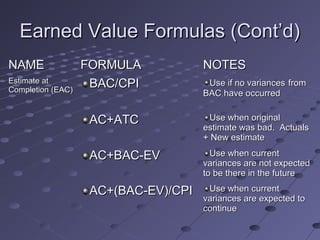
NAMENAME FORMULAFORMULA NOTESNOTES
Estimate atEstimate at
Completion (EAC)Completion (EAC)
BAC/CPIBAC/CPI Use if no variancesUse if no variances fromfrom
BAC have occurredBAC have occurred
AC+ATCAC+ATC Use when originalUse when original
estimate was bad. Actualsestimate was bad. Actuals
+ New estimate+ New estimate
AC+BAC-EVAC+BAC-EV Use when currentUse when current
variances are not expectedvariances are not expected
to be there in the futureto be there in the future
AC+(BAC-EV)/CPIAC+(BAC-EV)/CPI Use when currentUse when current
variances are expected tovariances are expected to
continuecontinue
Tricks for Earned ValueTricks for Earned Value
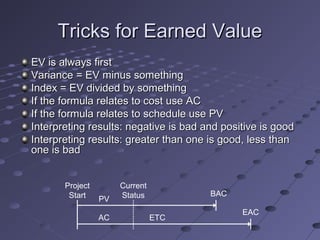
EV is always firstEV is always first
Variance = EV minus somethingVariance = EV minus something
Index = EV divided by somethingIndex = EV divided by something
If the formula relates to cost use ACIf the formula relates to cost use AC
If the formula relates to schedule use PVIf the formula relates to schedule use PV
Interpreting results: negative is bad and positive is goodInterpreting results: negative is bad and positive is good
Interpreting results: greater than one is good, less thanInterpreting results: greater than one is good, less than
one is badone is bad
PV
AC ETC
EAC
BAC
Project
Start
Current
Status
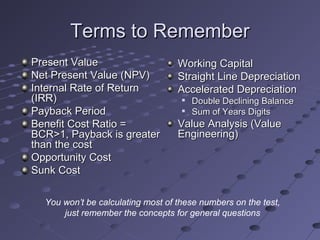
Terms to RememberTerms to Remember
Present ValuePresent Value
Net Present Value (NPV)Net Present Value (NPV)
Internal Rate of ReturnInternal Rate of Return
(IRR)(IRR)
Payback PeriodPayback Period
Benefit Cost Ratio =Benefit Cost Ratio =
BCR>1, Payback is greaterBCR>1, Payback is greater
than the costthan the cost
Opportunity CostOpportunity Cost
Sunk CostSunk Cost
Working CapitalWorking Capital
Straight Line DepreciationStraight Line Depreciation
Accelerated DepreciationAccelerated Depreciation

Double Declining BalanceDouble Declining Balance

Sum of Years DigitsSum of Years Digits
Value Analysis (ValueValue Analysis (Value
Engineering)Engineering)
You won’t be calculating most of these numbers on the test,
just remember the concepts for general questions

Project cost management

  • 1.
    Project CostProject Cost ManagementManagement Sectionsof this presentation were adaptedSections of this presentation were adapted fromfrom A Guide to the Project ManagementA Guide to the Project Management Body of KnowledgeBody of Knowledge 44thth Edition, ProjectEdition, Project Management Institute Inc., © 2009Management Institute Inc., © 2009
  • 2.
    Project Cost ManagementProjectCost Management ““The processes involved in planning,The processes involved in planning, estimating, budgeting, and controllingestimating, budgeting, and controlling costs so that the budget can be completedcosts so that the budget can be completed within the approved budget”within the approved budget”
  • 3.
    Why Do WeManage Cost?Why Do We Manage Cost? Part of triple constraint, can’t manage one withoutPart of triple constraint, can’t manage one without the others (scope, time, and quality)the others (scope, time, and quality) Plots of cost and scope against plan can help spotPlots of cost and scope against plan can help spot problems earlyproblems early Cumulative Value Time Planned Value (PV) Actual Costs (AC) Earned Value (EV) Today Is this project over/under budget? Is it ahead of/behind schedule?
  • 4.
    Cost Management KeyTermsCost Management Key Terms PV - Planned Value,PV - Planned Value, estimatedestimated value of the planned workvalue of the planned work EV – Earned Value,EV – Earned Value, estimatedestimated value of work donevalue of work done AC – Actual Cost, what you paidAC – Actual Cost, what you paid BAC – Budget at Completion, the budget for the total jobBAC – Budget at Completion, the budget for the total job EAC –Estimate at Completion, what is the total jobEAC –Estimate at Completion, what is the total job expected to cost?expected to cost? ETC – Estimate to Complete, forecasted costs to completeETC – Estimate to Complete, forecasted costs to complete jobjob VAC – Variance at Completion, how much over/underVAC – Variance at Completion, how much over/under budget do we expect to be?budget do we expect to be?
  • 5.
    How Do WeManage Cost?How Do We Manage Cost? Three processesThree processes  Estimate CostsEstimate Costs  Determine BudgetDetermine Budget  Control CostsControl Costs Estimate Costs Determine Budget Control Costs
  • 6.
    Estimate CostsEstimate Costs Enterprise Environmental Factors Organizational ProcessAssets Project Scope Statement Analogous estimating Determine resource cost rates Bottom up estimating Parametric estimating Project management software Vendor bid analysis Reserve analysis Cost of quality Inputs OutputsTools & Techniques Work Breakdown Structure WBS Dictionary Project Management Plan •Schedule Mgmt Pln •Staffing Mgmt Pln •Risk Register Activity Cost Estimates Activity Cost Estimates Supporting Detail Requested Changes Cost Management Plan Updates Estimate Costs Determine Budget Control Costs
  • 7.
    Estimating MethodsEstimating Methods Analogous(Top Down) estimatingAnalogous (Top Down) estimating – Managers– Managers use expert judgment or similar project costsuse expert judgment or similar project costs [quick, less accurate][quick, less accurate] Bottom-Up estimatingBottom-Up estimating – People doing work– People doing work estimate based on WBS, rolled up into projectestimate based on WBS, rolled up into project estimate [slow, most accurate]estimate [slow, most accurate] Parametric estimatingParametric estimating – Use mathematical model– Use mathematical model (i.e. cost per sq ft). [accuracy varies](i.e. cost per sq ft). [accuracy varies] Two types:Two types: Regression analysis – based on analysis of multipleRegression analysis – based on analysis of multiple data pointsdata points Learning Curve – The first unit costs more than theLearning Curve – The first unit costs more than the 100100thth , forecasts efficiency gains, forecasts efficiency gains
  • 8.
    Estimating MethodsEstimating Methods VendorBid AnalysisVendor Bid Analysis – Estimating using bids +– Estimating using bids + allowances for gaps in bid scope [slow, accuracyallowances for gaps in bid scope [slow, accuracy depends on gaps]depends on gaps] Reserve AnalysisReserve Analysis – Adding contingency to each– Adding contingency to each activity cost estimates as zero duration item [slow,activity cost estimates as zero duration item [slow, overstates cost]overstates cost]
  • 9.
    Determine BudgetDetermine Budget ProjectScope Statement Cost aggregation Reserve analysis Parametric estimating Funding limit reconciliationInputs Outputs Tools & Techniques Cost Baseline Project Funding Requirements Cost Management Plan Updates Requested Changes Work Breakdown Structure WBS Dictionary Activity Cost Estimates Activity Cost Estimates Supporting Detail Project Schedule Resource Calendars Contract Cost Management Plan Estimate Costs Determine Budget Control Costs
  • 10.
    Determine BudgetDetermine Budget Budgetingis allocating costs to work packagesBudgeting is allocating costs to work packages to establish a cost baseline to measure projectto establish a cost baseline to measure project performanceperformance Remember Contingency items are for unplannedRemember Contingency items are for unplanned but required changes it is not to cover thingsbut required changes it is not to cover things such as:such as:  Price escalationPrice escalation  Scope & Quality ChangesScope & Quality Changes Funding Limit Reconciliation – Smoothing outFunding Limit Reconciliation – Smoothing out the project spend to meet managementthe project spend to meet management expectationsexpectations
  • 11.
    Control CostsControl Costs CostBaseline Project Funding Requirements Performance Reports Cost change control system Performance measurement analysis Forecasting Project performance reviews Project management software Variance management Inputs OutputsTools & Techniques Work Performance Information Approved Change Requests Project Management Plan Cost Estimate Updates Cost Baseline Updates Performance Measurements Forecasted Completion Requested Changes Recommended Corrective Actions Organizational Process Assets Updates Project Management Plan Updates Estimate Costs Determine Budget Control Costs
  • 12.
    Earned ValueEarned Value Progressis compared against theProgress is compared against the baseline to determine whetherbaseline to determine whether project is ahead of or behind planproject is ahead of or behind plan Percent complete can be difficultPercent complete can be difficult to measure, some managers useto measure, some managers use rulesrules  50/50 Rule – Assumed 50%50/50 Rule – Assumed 50% complete when task started, finalcomplete when task started, final 50% at completion50% at completion  20/80 Rule – 20% at start20/80 Rule – 20% at start  0/100 Rule – No credit until complete0/100 Rule – No credit until complete Planned ValuePlanned Value (PV) – Budgeted(PV) – Budgeted CostCost Earned ValueEarned Value (EV) – Actual(EV) – Actual work completedwork completed Actual Cost (AC)Actual Cost (AC) – Costs incurred– Costs incurred Estimate toEstimate to Complete (ETC)Complete (ETC) – What’s Left– What’s Left Estimate atEstimate at Completion (EAC)Completion (EAC) – What final cost– What final cost will bewill be
  • 13.
  • 14.
    Earned Value FormulasEarnedValue Formulas NAMENAME FORMULAFORMULA NOTESNOTES Cost Variance (CV)Cost Variance (CV) EV-ACEV-AC Negative = Over budgetNegative = Over budget Positive = Under budgetPositive = Under budget Schedule VarianceSchedule Variance (SV)(SV) EV-PVEV-PV Negative = Behind ScheduleNegative = Behind Schedule Positive = Ahead of SchedulePositive = Ahead of Schedule Cost PerformanceCost Performance Index (CPI)Index (CPI) EV/ACEV/AC How much are we getting for everyHow much are we getting for every dollar we spend?dollar we spend? Schedule PerformSchedule Perform Index (SPI)Index (SPI) EV/PVEV/PV Progress as % against planProgress as % against plan Estimate to CompleteEstimate to Complete (ETC)(ETC) EAC-ACEAC-AC How much more do we have toHow much more do we have to spend?spend? Variance atVariance at Completion (VAC)Completion (VAC) BAC-EACBAC-EAC At the end of the day, how close willAt the end of the day, how close will we be to plan?we be to plan? Estimate atEstimate at Completion (EAC)Completion (EAC) See following slideSee following slide
  • 15.
    Earned Value Formulas(Cont’d)Earned Value Formulas (Cont’d) NAMENAME FORMULAFORMULA NOTESNOTES Estimate atEstimate at Completion (EAC)Completion (EAC) BAC/CPIBAC/CPI Use if no variancesUse if no variances fromfrom BAC have occurredBAC have occurred AC+ATCAC+ATC Use when originalUse when original estimate was bad. Actualsestimate was bad. Actuals + New estimate+ New estimate AC+BAC-EVAC+BAC-EV Use when currentUse when current variances are not expectedvariances are not expected to be there in the futureto be there in the future AC+(BAC-EV)/CPIAC+(BAC-EV)/CPI Use when currentUse when current variances are expected tovariances are expected to continuecontinue
  • 16.
    Tricks for EarnedValueTricks for Earned Value EV is always firstEV is always first Variance = EV minus somethingVariance = EV minus something Index = EV divided by somethingIndex = EV divided by something If the formula relates to cost use ACIf the formula relates to cost use AC If the formula relates to schedule use PVIf the formula relates to schedule use PV Interpreting results: negative is bad and positive is goodInterpreting results: negative is bad and positive is good Interpreting results: greater than one is good, less thanInterpreting results: greater than one is good, less than one is badone is bad PV AC ETC EAC BAC Project Start Current Status
  • 17.
    Terms to RememberTermsto Remember Present ValuePresent Value Net Present Value (NPV)Net Present Value (NPV) Internal Rate of ReturnInternal Rate of Return (IRR)(IRR) Payback PeriodPayback Period Benefit Cost Ratio =Benefit Cost Ratio = BCR>1, Payback is greaterBCR>1, Payback is greater than the costthan the cost Opportunity CostOpportunity Cost Sunk CostSunk Cost Working CapitalWorking Capital Straight Line DepreciationStraight Line Depreciation Accelerated DepreciationAccelerated Depreciation  Double Declining BalanceDouble Declining Balance  Sum of Years DigitsSum of Years Digits Value Analysis (ValueValue Analysis (Value Engineering)Engineering) You won’t be calculating most of these numbers on the test, just remember the concepts for general questions