Karan Singh Khokhar
1891054
MBA (3RD A)
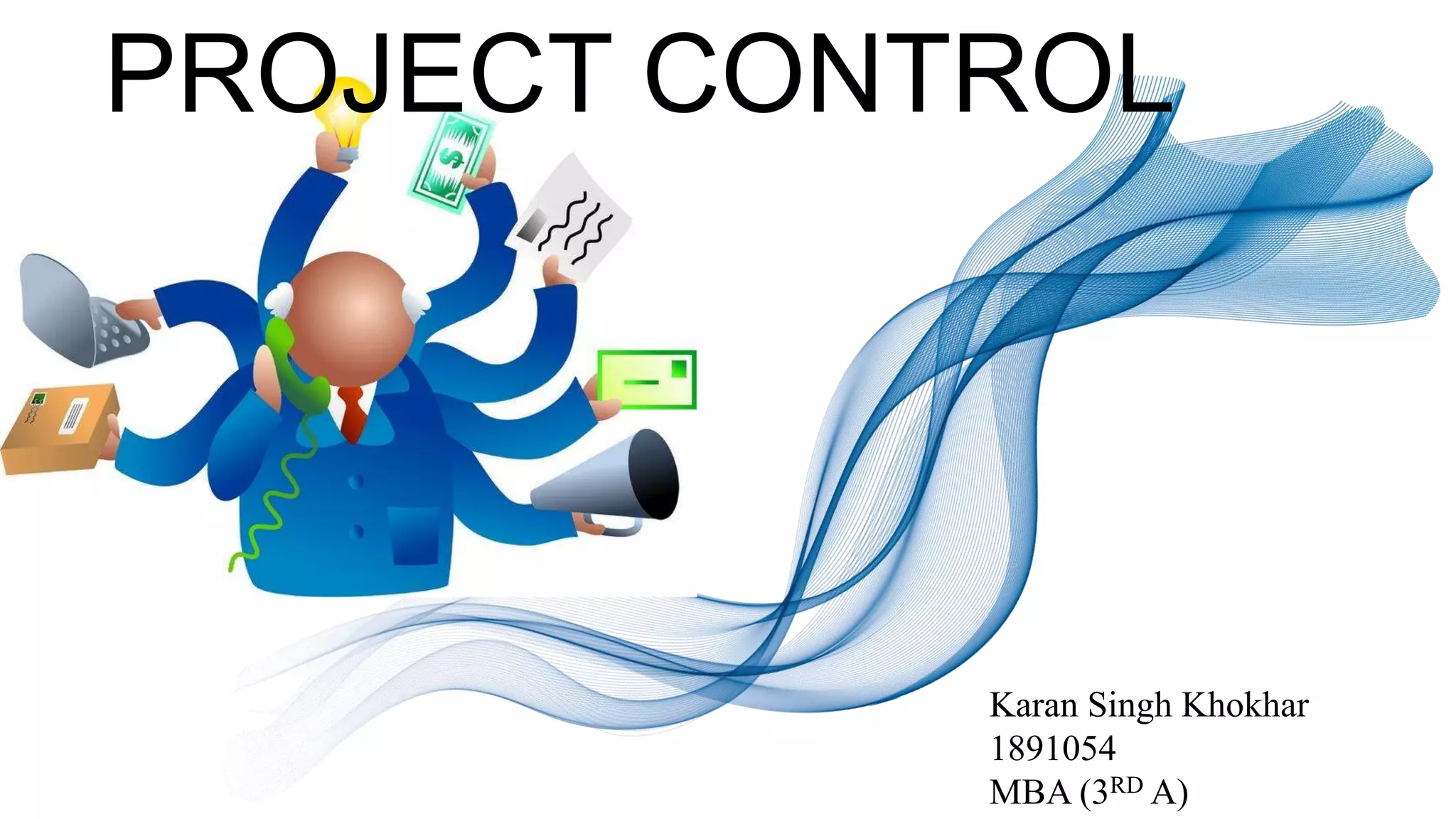
PROJECT CONTROL
CONTENS
Project Control01
Progress control02
Performance Control
03
Schedule Control04
Cost Control
05
PROJECT CONTROL
• Control is one of the key functions of any management process.
The uncontrolled or unexamined project is not worth much.
However effective the project plan may be without regular
reviews during the life of the project neither the project progress
nor the reality of the plan can be assessed. An effective and
efficient control system enables! the project manager to answer
the question. "How are we doing on the project ?" at any stage
of the project.
• According to Henry Fayol "The control means seeing that
everything occurs in conformity with established rules and
expressed command."
CONT
• Project control is the process of monitoring evaluating and
compared planned results with actual results to determine the
progress toward the project cost, schedule and technical
performance objectives, as well as the projects strategic fit with
the objectives of the organisation.
• Project control consists of two things:
1. Establishment of controls
2. Controlling the ongoing activities using above controls
CONT
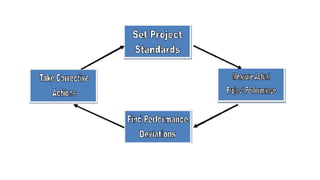
• The four steps should follow each other till the work is
completed. Scope of project control includes the following
Progress Control
Performance Control
Schedule Control
Cost Control
PART 01
PROGRESS CONTROL
• The primary objective of project control is completion of work. A
project has to be completed 100%, no lapse in this regard is
acceptable. The basis for progress control should be the control of
the tasks which occur at the last level of the work breakdown
structure. Completion of tasks leads to completion of next higher
level of work and ultimately the whole project. By ensuring
completion of the tasks, the completion of project itself can be
ensured
• Various instruments of progress control are
1. Task lists
2. Progress measurement
3. Expediting and follow up
4. Overall project progress control
PART 02
PERFORMANCE CONTROL
• After progress control, the most haunting thought in the minds of
project authorities is whether the project will perform ?" Failure of the
project to meet the time and budget standards may be condoned,
but failure to perform can never be condoned.
• Performance control starts with identification of performance
parameters. Which performance parameters are critical for viability of
the project must be established in' clear terms. Various performance
parameters can be
1. Output certainty
2. Raw material and power consumption per unit of production etc.
PART 03
SCHEDULE CONTROL
• Scheduling and scheduling system have to form an separate part of
the project execution for exercise of schedule control. Schedule
control is to ensures when adherence to the agreed time schedule of
the project. This is however not an independent activity, Schedule
has to be used as a basis of direction, coordination, communication
and progress control or else there can be no schedule control
exercise of schedule control.
• There are certain species which are required:
1. Predictive Schedule Control
2. Preventive Schedule Control
3. Schedule Status/Reviews
PART 04
Cost control
• Cost control calls for answering the following questions:
1. Has the cost of the project as a whole and its individual parts
been as per budget estimates, less than the budget estimates
or more than budget estimates?
2. If there is a variation, where did it occur, why did it occur?
3. Who is responsible for the variation ?
4. What would be the implications of the variation ?
CONT
• Budgeted Cost for Work Schedule (BCWS
BCWS represents the total of three component
1. Budgets of all schedules to be completed
2. Budgets for the portion of in-process work scheduled to be
accomplished
3. Budgets for the overheads of the project
• Budgeted Cost for Work Performed (BCWP)
BCWP is the sum total of three components
1. Budgets for work packages already completed
2. Budgets applicable to completed work in process
3. Overhead budgets
CONT
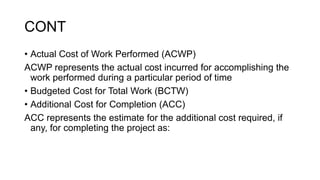
• Actual Cost of Work Performed (ACWP)
ACWP represents the actual cost incurred for accomplishing the
work performed during a particular period of time
• Budgeted Cost for Total Work (BCTW)
• Additional Cost for Completion (ACC)
ACC represents the estimate for the additional cost required, if
any, for completing the project as:
CONT
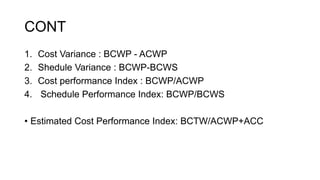
1. Cost Variance : BCWP - ACWP
2. Shedule Variance : BCWP-BCWS
3. Cost performance Index : BCWP/ACWP
4. Schedule Performance Index: BCWP/BCWS
• Estimated Cost Performance Index: BCTW/ACWP+ACC
THANKS

Project control wps office

  • 1.
    Karan Singh Khokhar 1891054 MBA(3RD A) PROJECT CONTROL
  • 2.
    CONTENS Project Control01 Progress control02 PerformanceControl 03 Schedule Control04 Cost Control 05
  • 3.
    PROJECT CONTROL • Controlis one of the key functions of any management process. The uncontrolled or unexamined project is not worth much. However effective the project plan may be without regular reviews during the life of the project neither the project progress nor the reality of the plan can be assessed. An effective and efficient control system enables! the project manager to answer the question. "How are we doing on the project ?" at any stage of the project. • According to Henry Fayol "The control means seeing that everything occurs in conformity with established rules and expressed command."
  • 4.
    CONT • Project controlis the process of monitoring evaluating and compared planned results with actual results to determine the progress toward the project cost, schedule and technical performance objectives, as well as the projects strategic fit with the objectives of the organisation. • Project control consists of two things: 1. Establishment of controls 2. Controlling the ongoing activities using above controls
  • 6.
    CONT • The foursteps should follow each other till the work is completed. Scope of project control includes the following Progress Control Performance Control Schedule Control Cost Control
  • 7.
  • 8.
    PROGRESS CONTROL • Theprimary objective of project control is completion of work. A project has to be completed 100%, no lapse in this regard is acceptable. The basis for progress control should be the control of the tasks which occur at the last level of the work breakdown structure. Completion of tasks leads to completion of next higher level of work and ultimately the whole project. By ensuring completion of the tasks, the completion of project itself can be ensured • Various instruments of progress control are 1. Task lists 2. Progress measurement 3. Expediting and follow up 4. Overall project progress control
  • 9.
  • 10.
    PERFORMANCE CONTROL • Afterprogress control, the most haunting thought in the minds of project authorities is whether the project will perform ?" Failure of the project to meet the time and budget standards may be condoned, but failure to perform can never be condoned. • Performance control starts with identification of performance parameters. Which performance parameters are critical for viability of the project must be established in' clear terms. Various performance parameters can be 1. Output certainty 2. Raw material and power consumption per unit of production etc.
  • 11.
  • 12.
    SCHEDULE CONTROL • Schedulingand scheduling system have to form an separate part of the project execution for exercise of schedule control. Schedule control is to ensures when adherence to the agreed time schedule of the project. This is however not an independent activity, Schedule has to be used as a basis of direction, coordination, communication and progress control or else there can be no schedule control exercise of schedule control. • There are certain species which are required: 1. Predictive Schedule Control 2. Preventive Schedule Control 3. Schedule Status/Reviews
  • 13.
  • 14.
    Cost control • Costcontrol calls for answering the following questions: 1. Has the cost of the project as a whole and its individual parts been as per budget estimates, less than the budget estimates or more than budget estimates? 2. If there is a variation, where did it occur, why did it occur? 3. Who is responsible for the variation ? 4. What would be the implications of the variation ?
  • 15.
    CONT • Budgeted Costfor Work Schedule (BCWS BCWS represents the total of three component 1. Budgets of all schedules to be completed 2. Budgets for the portion of in-process work scheduled to be accomplished 3. Budgets for the overheads of the project • Budgeted Cost for Work Performed (BCWP) BCWP is the sum total of three components 1. Budgets for work packages already completed 2. Budgets applicable to completed work in process 3. Overhead budgets
  • 16.
    CONT • Actual Costof Work Performed (ACWP) ACWP represents the actual cost incurred for accomplishing the work performed during a particular period of time • Budgeted Cost for Total Work (BCTW) • Additional Cost for Completion (ACC) ACC represents the estimate for the additional cost required, if any, for completing the project as:
  • 17.
    CONT 1. Cost Variance: BCWP - ACWP 2. Shedule Variance : BCWP-BCWS 3. Cost performance Index : BCWP/ACWP 4. Schedule Performance Index: BCWP/BCWS • Estimated Cost Performance Index: BCTW/ACWP+ACC
  • 18.