Earned Value
Management
What is Earned
Value
Management?
Earned Value Management (EVM) is comprised
of several formulas that provide an analysis of a
project and its current state regarding budget
and schedule.
EARNED VALUE
MANAGEMENT:
DEFINITION OF VALUES
Budget At
Completion
(BAC)
The Planned
Expected Costs to
Complete the Project
Actual Cost
(AC)
The actual amount of
money spent at a
given point
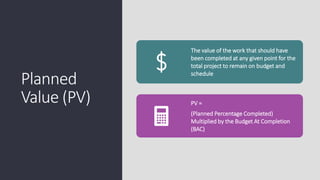
Planned
Value (PV)
The value of the work that should have
been completed at any given point for the
total project to remain on budget and
schedule
PV =
(Planned Percentage Completed)
Multiplied by the Budget At Completion
(BAC)
Planned
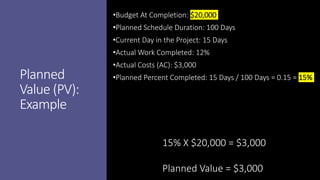
Value (PV):
Example
•Budget At Completion: $20,000
•Planned Schedule Duration: 100 Days
•Current Day in the Project: 15 Days
•Actual Work Completed: 12%
•Actual Costs (AC): $3,000
•Planned Percent Completed: 15 Days / 100 Days = 0.15 = 15%
15% X $20,000 = $3,000
Planned Value = $3,000
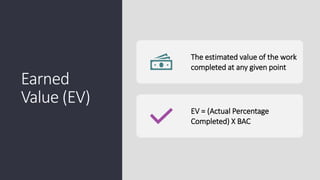
Earned
Value (EV)
The estimated value of the work
completed at any given point
EV = (Actual Percentage
Completed) X BAC
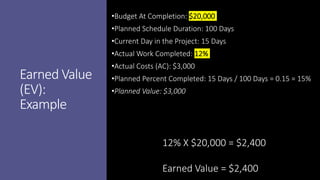
Earned Value
(EV):
Example
•Budget At Completion: $20,000
•Planned Schedule Duration: 100 Days
•Current Day in the Project: 15 Days
•Actual Work Completed: 12%
•Actual Costs (AC): $3,000
•Planned Percent Completed: 15 Days / 100 Days = 0.15 = 15%
•Planned Value: $3,000
12% X $20,000 = $2,400
Earned Value = $2,400
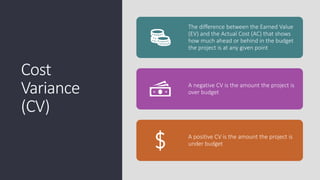
Cost
Variance
(CV)
The difference between the Earned Value
(EV) and the Actual Cost (AC) that shows
how much ahead or behind in the budget
the project is at any given point
A negative CV is the amount the project is
over budget
A positive CV is the amount the project is
under budget
Cost
Variance
(CV):
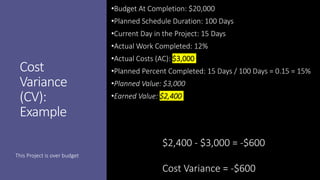
Example
•Budget At Completion: $20,000
•Planned Schedule Duration: 100 Days
•Current Day in the Project: 15 Days
•Actual Work Completed: 12%
•Actual Costs (AC): $3,000
•Planned Percent Completed: 15 Days / 100 Days = 0.15 = 15%
•Planned Value: $3,000
•Earned Value: $2,400
$2,400 - $3,000 = -$600
Cost Variance = -$600
This Project is over budget
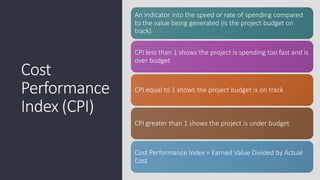
Cost
Performance
Index (CPI)
An indicator into the speed or rate of spending compared
to the value being generated (Is the project budget on
track)
CPI less than 1 shows the project is spending too fast and is
over budget
CPI equal to 1 shows the project budget is on track
CPI greater than 1 shows the project is under budget
Cost Performance Index = Earned Value Divided by Actual
Cost
Cost
Performance
Index (CPI):
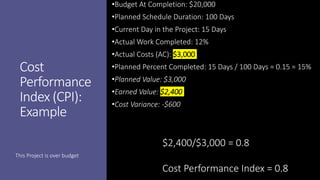
Example
•Budget At Completion: $20,000
•Planned Schedule Duration: 100 Days
•Current Day in the Project: 15 Days
•Actual Work Completed: 12%
•Actual Costs (AC): $3,000
•Planned Percent Completed: 15 Days / 100 Days = 0.15 = 15%
•Planned Value: $3,000
•Earned Value: $2,400
•Cost Variance: -$600
$2,400/$3,000 = 0.8
Cost Performance Index = 0.8
This Project is over budget
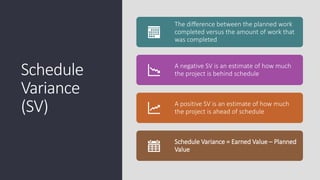
Schedule
Variance
(SV)
The difference between the planned work
completed versus the amount of work that
was completed
A negative SV is an estimate of how much
the project is behind schedule
A positive SV is an estimate of how much
the project is ahead of schedule
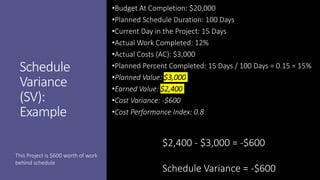
Schedule Variance = Earned Value – Planned
Value
Schedule
Variance
(SV):
Example
•Budget At Completion: $20,000
•Planned Schedule Duration: 100 Days
•Current Day in the Project: 15 Days
•Actual Work Completed: 12%
•Actual Costs (AC): $3,000
•Planned Percent Completed: 15 Days / 100 Days = 0.15 = 15%
•Planned Value: $3,000
•Earned Value: $2,400
•Cost Variance: -$600
•Cost Performance Index: 0.8
$2,400 - $3,000 = -$600
Schedule Variance = -$600
This Project is $600 worth of work
behind schedule
Schedule
Performance
Index (SPI)
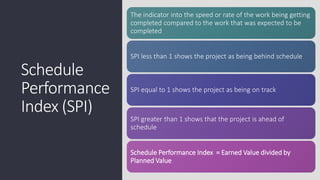
The indicator into the speed or rate of the work being getting
completed compared to the work that was expected to be
completed
SPI less than 1 shows the project as being behind schedule
SPI equal to 1 shows the project as being on track
SPI greater than 1 shows that the project is ahead of
schedule
Schedule Performance Index = Earned Value divided by
Planned Value
Schedule
Performance
Index (SPI):
Example
•Budget At Completion: $20,000
•Planned Schedule Duration: 100 Days
•Current Day in the Project: 15 Days
•Actual Work Completed: 12%
•Actual Costs (AC): $3,000
•Planned Percent Completed: 15 Days / 100 Days = 0.15 = 15%
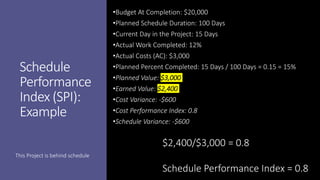
•Planned Value: $3,000
•Earned Value: $2,400
•Cost Variance: -$600
•Cost Performance Index: 0.8
•Schedule Variance: -$600
$2,400/$3,000 = 0.8
Schedule Performance Index = 0.8
This Project is behind schedule
Other EVM Values
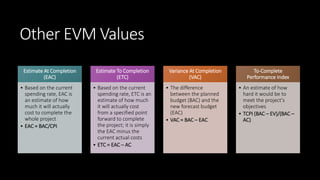
Estimate At Completion
(EAC)
• Based on the current
spending rate, EAC is
an estimate of how
much it will actually
cost to complete the
whole project
• EAC = BAC/CPI
Estimate To Completion
(ETC)
• Based on the current
spending rate, ETC is an
estimate of how much
it will actually cost
from a specified point
forward to complete
the project; it is simply
the EAC minus the
current actual costs
• ETC = EAC – AC
Variance At Completion
(VAC)
• The difference
between the planned
budget (BAC) and the
new forecast budget
(EAC)
• VAC = BAC – EAC
To-Complete
Performance Index
• An estimate of how
hard it would be to
meet the project’s
objectives
• TCPI (BAC – EV)/(BAC –
AC)
Earned Value
Management
Joshua Render
https://agile-mercurial.com
https://twentyfirstcenturyworkfor
ce.com/

Earned value management (EVM)

  • 1.
  • 2.
    What is Earned Value Management? EarnedValue Management (EVM) is comprised of several formulas that provide an analysis of a project and its current state regarding budget and schedule.
  • 3.
  • 4.
  • 5.
    Actual Cost (AC) The actualamount of money spent at a given point
  • 6.
    Planned Value (PV) The valueof the work that should have been completed at any given point for the total project to remain on budget and schedule PV = (Planned Percentage Completed) Multiplied by the Budget At Completion (BAC)
  • 7.
    Planned Value (PV): Example •Budget AtCompletion: $20,000 •Planned Schedule Duration: 100 Days •Current Day in the Project: 15 Days •Actual Work Completed: 12% •Actual Costs (AC): $3,000 •Planned Percent Completed: 15 Days / 100 Days = 0.15 = 15% 15% X $20,000 = $3,000 Planned Value = $3,000
  • 8.
    Earned Value (EV) The estimatedvalue of the work completed at any given point EV = (Actual Percentage Completed) X BAC
  • 9.
    Earned Value (EV): Example •Budget AtCompletion: $20,000 •Planned Schedule Duration: 100 Days •Current Day in the Project: 15 Days •Actual Work Completed: 12% •Actual Costs (AC): $3,000 •Planned Percent Completed: 15 Days / 100 Days = 0.15 = 15% •Planned Value: $3,000 12% X $20,000 = $2,400 Earned Value = $2,400
  • 10.
    Cost Variance (CV) The difference betweenthe Earned Value (EV) and the Actual Cost (AC) that shows how much ahead or behind in the budget the project is at any given point A negative CV is the amount the project is over budget A positive CV is the amount the project is under budget
  • 11.
    Cost Variance (CV): Example •Budget At Completion:$20,000 •Planned Schedule Duration: 100 Days •Current Day in the Project: 15 Days •Actual Work Completed: 12% •Actual Costs (AC): $3,000 •Planned Percent Completed: 15 Days / 100 Days = 0.15 = 15% •Planned Value: $3,000 •Earned Value: $2,400 $2,400 - $3,000 = -$600 Cost Variance = -$600 This Project is over budget
  • 12.
    Cost Performance Index (CPI) An indicatorinto the speed or rate of spending compared to the value being generated (Is the project budget on track) CPI less than 1 shows the project is spending too fast and is over budget CPI equal to 1 shows the project budget is on track CPI greater than 1 shows the project is under budget Cost Performance Index = Earned Value Divided by Actual Cost
  • 13.
    Cost Performance Index (CPI): Example •Budget AtCompletion: $20,000 •Planned Schedule Duration: 100 Days •Current Day in the Project: 15 Days •Actual Work Completed: 12% •Actual Costs (AC): $3,000 •Planned Percent Completed: 15 Days / 100 Days = 0.15 = 15% •Planned Value: $3,000 •Earned Value: $2,400 •Cost Variance: -$600 $2,400/$3,000 = 0.8 Cost Performance Index = 0.8 This Project is over budget
  • 14.
    Schedule Variance (SV) The difference betweenthe planned work completed versus the amount of work that was completed A negative SV is an estimate of how much the project is behind schedule A positive SV is an estimate of how much the project is ahead of schedule Schedule Variance = Earned Value – Planned Value
  • 15.
    Schedule Variance (SV): Example •Budget At Completion:$20,000 •Planned Schedule Duration: 100 Days •Current Day in the Project: 15 Days •Actual Work Completed: 12% •Actual Costs (AC): $3,000 •Planned Percent Completed: 15 Days / 100 Days = 0.15 = 15% •Planned Value: $3,000 •Earned Value: $2,400 •Cost Variance: -$600 •Cost Performance Index: 0.8 $2,400 - $3,000 = -$600 Schedule Variance = -$600 This Project is $600 worth of work behind schedule
  • 16.
    Schedule Performance Index (SPI) The indicatorinto the speed or rate of the work being getting completed compared to the work that was expected to be completed SPI less than 1 shows the project as being behind schedule SPI equal to 1 shows the project as being on track SPI greater than 1 shows that the project is ahead of schedule Schedule Performance Index = Earned Value divided by Planned Value
  • 17.
    Schedule Performance Index (SPI): Example •Budget AtCompletion: $20,000 •Planned Schedule Duration: 100 Days •Current Day in the Project: 15 Days •Actual Work Completed: 12% •Actual Costs (AC): $3,000 •Planned Percent Completed: 15 Days / 100 Days = 0.15 = 15% •Planned Value: $3,000 •Earned Value: $2,400 •Cost Variance: -$600 •Cost Performance Index: 0.8 •Schedule Variance: -$600 $2,400/$3,000 = 0.8 Schedule Performance Index = 0.8 This Project is behind schedule
  • 18.
    Other EVM Values EstimateAt Completion (EAC) • Based on the current spending rate, EAC is an estimate of how much it will actually cost to complete the whole project • EAC = BAC/CPI Estimate To Completion (ETC) • Based on the current spending rate, ETC is an estimate of how much it will actually cost from a specified point forward to complete the project; it is simply the EAC minus the current actual costs • ETC = EAC – AC Variance At Completion (VAC) • The difference between the planned budget (BAC) and the new forecast budget (EAC) • VAC = BAC – EAC To-Complete Performance Index • An estimate of how hard it would be to meet the project’s objectives • TCPI (BAC – EV)/(BAC – AC)
  • 19.