Project Planning & Control
Chapter Coverage 
• What is a project? 
• The project planning and control process 
• Network planning – Critical Path Method (CPM)
Projects: 
A project is a set of activities with a define start 
point and a define end state, which pursues a 
defined goal and uses a define set of resources.
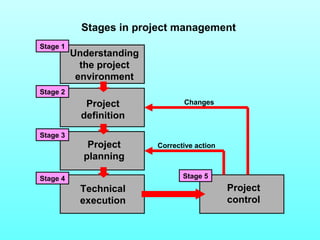
Stages in project management 
Understanding 
the project 
environment 
Project 
definition 
Project 
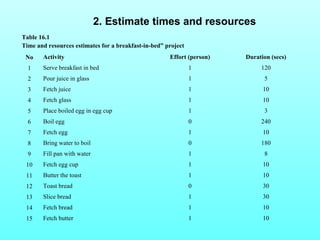
planning 
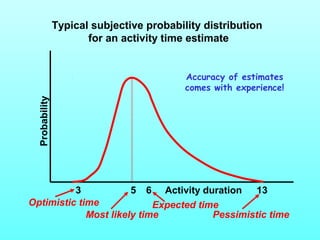
Technical 
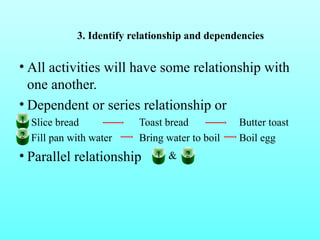
execution 
Project 
control 
Stage 1 
Stage 2 
Stage 3 
Changes 
Corrective action 
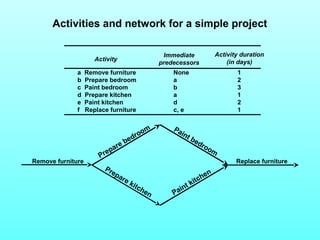
Stage 4 Stage 5
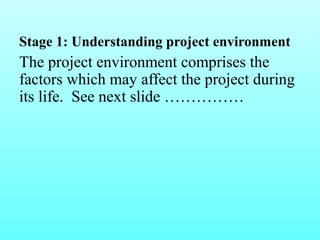
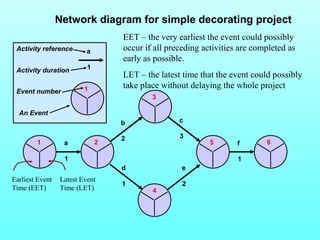
Stage 1: Understanding project environment 
The project environment comprises the 
factors which may affect the project during 
its life. See next slide ……………
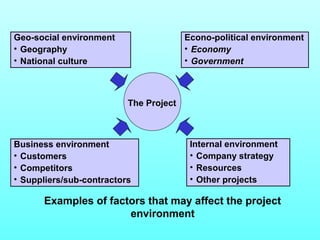
Geo-social environment 
• Geography 
• National culture 
Econo-political environment 
• Economy 
• Government 
Business environment 
• Customers 
• Competitors 
• Suppliers/sub-contractors 
Internal environment 
• Company strategy 
• Resources 
• Other projects 
The Project 
Examples of factors that may affect the project 
environment
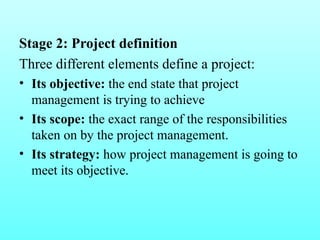
Stage 2: Project definition 
Three different elements define a project: 
• Its objective: the end state that project 
management is trying to achieve 
• Its scope: the exact range of the responsibilities 
taken on by the project management. 
• Its strategy: how project management is going to 
meet its objective.
Project objectives 
The hierarchy of objectives: 
• At the top of the hierarchy is the overall 
objective or goal of the project, lower levels of 
the hierarchy are the objectives of each part of the 
project (big projects consists of many parts). 
• Objectives of each part must be related to its 
overall objective.
Objectives must be clear: 
Good objectives are those which are clear, measurable and, 
preferably, quantifiable. 
One method of clarifying objectives is to break down 
project objectives into three categories: 
– Purpose: to prevent production from failing to meet 
output as forecast. 
– End result: a report which identifies the causes of lost 
production, and which recommends how the target output 
can be met. 
– Success criteria: the report should be completed by 30 
June. The recommendations should enable output to reach 
at east 70 tonnes per year. Cost of the recommendations 
should not exceed RM200,000.
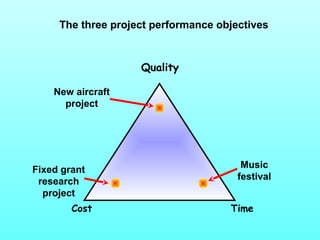
The three project performance objectives 
Quality 
New aircraft 
project 
Fixed grant 
research 
project 
Music 
festival 
Cost Time
Project scope 
- Identifies the work content and the outcomes. 
- Boundary setting exercise – divides work 
content for each part of the project. 
- Important for managing contractors – 
commercial and legal aspect of the scope of 
supply. 
- Can change during the course of the project.
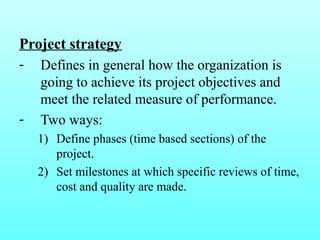
Project strategy 
- Defines in general how the organization is 
going to achieve its project objectives and 
meet the related measure of performance. 
- Two ways: 
1) Define phases (time based sections) of the 
project. 
2) Set milestones at which specific reviews of time, 
cost and quality are made.
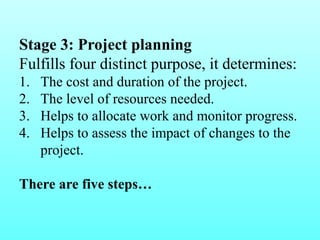
Stage 3: Project planning 
Fulfills four distinct purpose, it determines: 
1. The cost and duration of the project. 
2. The level of resources needed. 
3. Helps to allocate work and monitor progress. 
4. Helps to assess the impact of changes to the 
project. 
There are five steps…
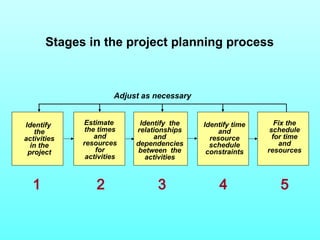
Stages in the project planning process 
Identify 
the 
activities 
in the 
project 
Estimate 
the times 
and 
resources 
for 
activities 
Identify the 
relationships 
and 
dependencies 
between the 
activities 
Identify time 
and 
resource 
schedule 
constraints 
Fix the 
schedule 
for time 
and 
resources 
Adjust as necessary 
1 2 3 4 5
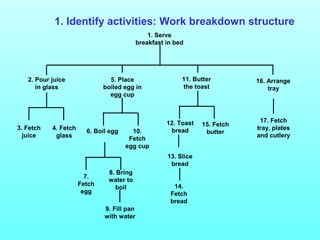
1. Identify activities: Work breakdown structure 
1. Serve 
breakfast in bed 
3. Fetch 
juice 
4. Fetch 
glass 6. Boil egg 10. 
Fetch 
egg cup 
12. Toast 
bread 
15. Fetch 
butter 
16. Arrange 
tray 
17. Fetch 
tray, plates 
and cutlery 
11. Butter 
the toast 
5. Place 
boiled egg in 
egg cup 
2. Pour juice 
in glass 
7. 
Fetch 
egg 
13. Slice 
bread 
8. Bring 
water to 
boil 14. 
Fetch 
bread 
9. Fill pan 
with water
2. Estimate times and resources 

Table 16.1 
Time and resources estimates for a breakfast-in-bed” project 
No Activity Effort (person) Duration (secs) 
1 Serve breakfast in bed 1 120 
2 Pour juice in glass 1 5 
3 Fetch juice 1 10 
4 Fetch glass 1 10 
5 Place boiled egg in egg cup 1 3 
6 Boil egg 0 240 
7 Fetch egg 1 10 
8 Bring water to boil 0 180 
9 Fill pan with water 1 8 
10 Fetch egg cup 1 10 
11 Butter the toast 1 10 
12 Toast bread 0 30 
13 Slice bread 1 30 
14 Fetch bread 1 10 
15 Fetch butter 1 10
Typical subjective probability distribution 
for an activity time estimate 
3 5 6 Activity duration 13 
Optimistic time 
Most likely timeExpected timeP 
essimistic time 
Probability 
Accuracy of estimates 
comes with experience!
3. Identify relationship and dependencies 
• All activities will have some relationship with 
one another. 
• Dependent or series relationship or 
1 
Slice bread Toast bread Butter toast 
2 
Fill pan with water Bring water to boil Boil egg 
• Parallel relationship 
1 & 2
4. Identify schedule constraints 
• Resource constrained – only the available 
resource level are used in resource scheduling 
and are never exceeded hence, project 
completion might slip. 
• Time constrained – priority is to complete the 
project within a given time.
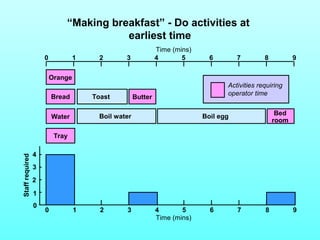
“Making breakfast” - Do activities at 
earliest time 
0 1 2 3 4 5 6 7 8 9 
Orange 
Bread 
Water 
Tray 
Toast 
Boil water Boil egg Bed 
room 
4 
Staff required 0 1 2 3 4 6 7 8 9 5 0 
3 
2 
1 
Butter 
Time (mins) 
Time (mins) 
Activities requiring 
operator time
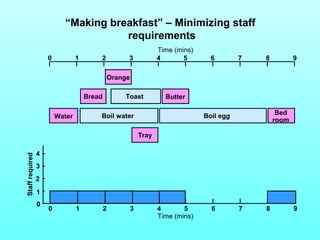
“Making breakfast” – Minimizing staff 
requirements 
Time (mins) 
0 1 2 3 4 5 6 7 8 9 
Orange 
Bread 
Water 
Toast 
Boil water Boil egg Bed 
Tray 
room 
4 
Staff required 0 1 2 3 4 6 7 8 9 5 0 
3 
2 
1 
Butter 
Time (mins)
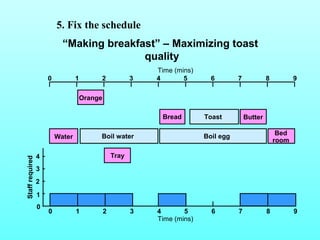
“Making breakfast” – Maximizing toast 
quality 
4 
Time (mins) 
Boil water Boil egg Bed 
Staff required 0 1 2 3 4 6 7 8 9 5 0 
3 
2 
1 
0 1 2 3 4 5 6 7 8 9 
Orange 
Water 
Tray 
room 
Bread Toast Butter 
Time (mins) 
5. Fix the schedule
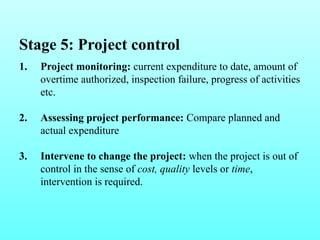
Stage 5: Project control 
1. Project monitoring: current expenditure to date, amount of 
overtime authorized, inspection failure, progress of activities 
etc. 
2. Assessing project performance: Compare planned and 
actual expenditure 
3. Intervene to change the project: when the project is out of 
control in the sense of cost, quality levels or time, 
intervention is required.
Network planning 
1. Use of Gantt chart is the simplest technique that 
supports project planning and control. 
2. More elaborate and detailed techniques are 
collectively called network analysis. 
3. We will consider a network analysis method called 
Critical Path Method (CPM)
Critical Path Method 
1. Represents the project activities diagrammatically. 
2. Project activities are represented by arrows. 
3. At the tail (start) and head (finish) of each activity is a circle 
which represents and event. 
Rules for drawing a network diagram: 
1. An event cannot be reached until all activities leading to it 
are complete. 
2. No activity can start until its tail event is reached . 
3. No two activities can have the same heat and tail events
Activities and network for a simple project 
Activity Immediate 
predecessors 
a Remove furniture None 1 
b Prepare bedroom a 2 
c Paint bedroom b 3 
d Prepare kitchen a 1 
e Paint kitchen d 2 
f Replace furniture c, e 1 
Prepare bedroom 
Paint bedroom 
Remove furniture Replace furniture 
Prepare kitchen 
Paint kitchen 
Activity duration 
(in days)
Network diagram for simple decorating project 
1 2 5 6 
a 
1 
b 
2 
d 
1 
c 
3 
e 
2 
f 
1 
3 
4 
a 
1 
1 
Activity reference 
Activity duration 
Event number 
An Event 
Earliest Event 
Time (EET) 
Latest Event 
Time (LET) 
EET – the very earliest the event could possibly 
occur if all preceding activities are completed as 
early as possible. 
LET – the latest time that the event could possibly 
take place without delaying the whole project
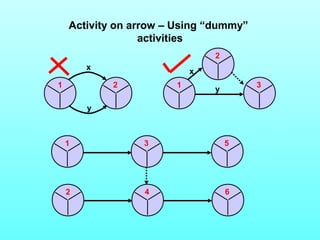
Activity on arrow – Using “dummy” 
2 
x 
x 
activities 
1 2 1 3 
y 
y 
1 3 5 
2 4 6
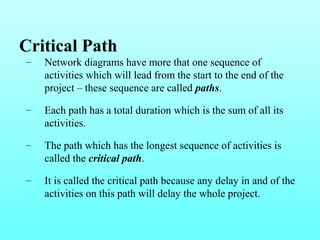
Critical Path 
– Network diagrams have more that one sequence of 
activities which will lead from the start to the end of the 
project – these sequence are called paths. 
– Each path has a total duration which is the sum of all its 
activities. 
– The path which has the longest sequence of activities is 
called the critical path. 
– It is called the critical path because any delay in and of the 
activities on this path will delay the whole project.
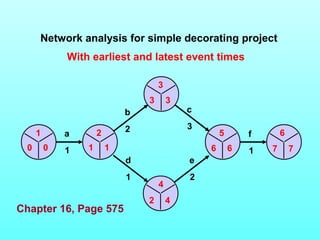
Network analysis for simple decorating project 
With earliest and latest event times 
3 3 
1 
0 0 1 1 6 6 7 7 
a 
1 
b 
2 
2 5 6 
d 
1 
c 
3 
e 
2 
f 
1 
3 
4 
2 4 
Chapter 16, Page 575
Worked Example 
• The chief surveyor of a firm that moves earth 
in preparation for the construction of roads has 
identified the activities and their durations for 
each stage of an operation to prepare a difficult 
stretch of motorway (see table below). The 
surveyor needs to know how long the project 
will take and which are the critical activities.
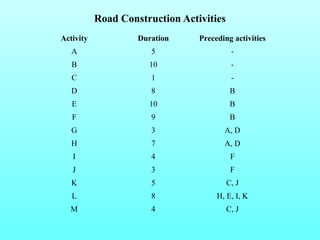
Road Construction Activities 
Activity Duration Preceding activities 
A 5 - 
B 10 - 
C 1 - 
D 8 B 
E 10 B 
F 9 B 
G 3 A, D 
H 7 A, D 
I 4 F 
J 3 F 
K 5 C, J 
L 8 H, E, I, K 
M 4 C, J
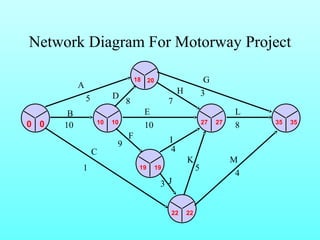
Network Diagram For Motorway Project 
0 0 
18 20 
10 10 
19 19 
22 22 
L 
8 
27 27 35 35 
A 
5 
B 
10 
C 
1 
D 8 
E 
10 
F 
9 
G 
H 3 
7 
I 
4 
3 J 
K M 
5 4
The End

Project planning-and-control

  • 1.
  • 2.
    Chapter Coverage •What is a project? • The project planning and control process • Network planning – Critical Path Method (CPM)
  • 3.
    Projects: A projectis a set of activities with a define start point and a define end state, which pursues a defined goal and uses a define set of resources.
  • 4.
    Stages in projectmanagement Understanding the project environment Project definition Project planning Technical execution Project control Stage 1 Stage 2 Stage 3 Changes Corrective action Stage 4 Stage 5
  • 5.
    Stage 1: Understandingproject environment The project environment comprises the factors which may affect the project during its life. See next slide ……………
  • 6.
    Geo-social environment •Geography • National culture Econo-political environment • Economy • Government Business environment • Customers • Competitors • Suppliers/sub-contractors Internal environment • Company strategy • Resources • Other projects The Project Examples of factors that may affect the project environment
  • 7.
    Stage 2: Projectdefinition Three different elements define a project: • Its objective: the end state that project management is trying to achieve • Its scope: the exact range of the responsibilities taken on by the project management. • Its strategy: how project management is going to meet its objective.
  • 8.
    Project objectives Thehierarchy of objectives: • At the top of the hierarchy is the overall objective or goal of the project, lower levels of the hierarchy are the objectives of each part of the project (big projects consists of many parts). • Objectives of each part must be related to its overall objective.
  • 9.
    Objectives must beclear: Good objectives are those which are clear, measurable and, preferably, quantifiable. One method of clarifying objectives is to break down project objectives into three categories: – Purpose: to prevent production from failing to meet output as forecast. – End result: a report which identifies the causes of lost production, and which recommends how the target output can be met. – Success criteria: the report should be completed by 30 June. The recommendations should enable output to reach at east 70 tonnes per year. Cost of the recommendations should not exceed RM200,000.
  • 10.
    The three projectperformance objectives Quality New aircraft project Fixed grant research project Music festival Cost Time
  • 11.
    Project scope -Identifies the work content and the outcomes. - Boundary setting exercise – divides work content for each part of the project. - Important for managing contractors – commercial and legal aspect of the scope of supply. - Can change during the course of the project.
  • 12.
    Project strategy -Defines in general how the organization is going to achieve its project objectives and meet the related measure of performance. - Two ways: 1) Define phases (time based sections) of the project. 2) Set milestones at which specific reviews of time, cost and quality are made.
  • 13.
    Stage 3: Projectplanning Fulfills four distinct purpose, it determines: 1. The cost and duration of the project. 2. The level of resources needed. 3. Helps to allocate work and monitor progress. 4. Helps to assess the impact of changes to the project. There are five steps…
  • 14.
    Stages in theproject planning process Identify the activities in the project Estimate the times and resources for activities Identify the relationships and dependencies between the activities Identify time and resource schedule constraints Fix the schedule for time and resources Adjust as necessary 1 2 3 4 5
  • 15.
    1. Identify activities:Work breakdown structure 1. Serve breakfast in bed 3. Fetch juice 4. Fetch glass 6. Boil egg 10. Fetch egg cup 12. Toast bread 15. Fetch butter 16. Arrange tray 17. Fetch tray, plates and cutlery 11. Butter the toast 5. Place boiled egg in egg cup 2. Pour juice in glass 7. Fetch egg 13. Slice bread 8. Bring water to boil 14. Fetch bread 9. Fill pan with water
  • 16.
    2. Estimate timesand resources Table 16.1 Time and resources estimates for a breakfast-in-bed” project No Activity Effort (person) Duration (secs) 1 Serve breakfast in bed 1 120 2 Pour juice in glass 1 5 3 Fetch juice 1 10 4 Fetch glass 1 10 5 Place boiled egg in egg cup 1 3 6 Boil egg 0 240 7 Fetch egg 1 10 8 Bring water to boil 0 180 9 Fill pan with water 1 8 10 Fetch egg cup 1 10 11 Butter the toast 1 10 12 Toast bread 0 30 13 Slice bread 1 30 14 Fetch bread 1 10 15 Fetch butter 1 10
  • 17.
    Typical subjective probabilitydistribution for an activity time estimate 3 5 6 Activity duration 13 Optimistic time Most likely timeExpected timeP essimistic time Probability Accuracy of estimates comes with experience!
  • 18.
    3. Identify relationshipand dependencies • All activities will have some relationship with one another. • Dependent or series relationship or 1 Slice bread Toast bread Butter toast 2 Fill pan with water Bring water to boil Boil egg • Parallel relationship 1 & 2
  • 19.
    4. Identify scheduleconstraints • Resource constrained – only the available resource level are used in resource scheduling and are never exceeded hence, project completion might slip. • Time constrained – priority is to complete the project within a given time.
  • 20.
    “Making breakfast” -Do activities at earliest time 0 1 2 3 4 5 6 7 8 9 Orange Bread Water Tray Toast Boil water Boil egg Bed room 4 Staff required 0 1 2 3 4 6 7 8 9 5 0 3 2 1 Butter Time (mins) Time (mins) Activities requiring operator time
  • 21.
    “Making breakfast” –Minimizing staff requirements Time (mins) 0 1 2 3 4 5 6 7 8 9 Orange Bread Water Toast Boil water Boil egg Bed Tray room 4 Staff required 0 1 2 3 4 6 7 8 9 5 0 3 2 1 Butter Time (mins)
  • 22.
    “Making breakfast” –Maximizing toast quality 4 Time (mins) Boil water Boil egg Bed Staff required 0 1 2 3 4 6 7 8 9 5 0 3 2 1 0 1 2 3 4 5 6 7 8 9 Orange Water Tray room Bread Toast Butter Time (mins) 5. Fix the schedule
  • 23.
    Stage 5: Projectcontrol 1. Project monitoring: current expenditure to date, amount of overtime authorized, inspection failure, progress of activities etc. 2. Assessing project performance: Compare planned and actual expenditure 3. Intervene to change the project: when the project is out of control in the sense of cost, quality levels or time, intervention is required.
  • 24.
    Network planning 1.Use of Gantt chart is the simplest technique that supports project planning and control. 2. More elaborate and detailed techniques are collectively called network analysis. 3. We will consider a network analysis method called Critical Path Method (CPM)
  • 25.
    Critical Path Method 1. Represents the project activities diagrammatically. 2. Project activities are represented by arrows. 3. At the tail (start) and head (finish) of each activity is a circle which represents and event. Rules for drawing a network diagram: 1. An event cannot be reached until all activities leading to it are complete. 2. No activity can start until its tail event is reached . 3. No two activities can have the same heat and tail events
  • 26.
    Activities and networkfor a simple project Activity Immediate predecessors a Remove furniture None 1 b Prepare bedroom a 2 c Paint bedroom b 3 d Prepare kitchen a 1 e Paint kitchen d 2 f Replace furniture c, e 1 Prepare bedroom Paint bedroom Remove furniture Replace furniture Prepare kitchen Paint kitchen Activity duration (in days)
  • 27.
    Network diagram forsimple decorating project 1 2 5 6 a 1 b 2 d 1 c 3 e 2 f 1 3 4 a 1 1 Activity reference Activity duration Event number An Event Earliest Event Time (EET) Latest Event Time (LET) EET – the very earliest the event could possibly occur if all preceding activities are completed as early as possible. LET – the latest time that the event could possibly take place without delaying the whole project
  • 28.
    Activity on arrow– Using “dummy” 2 x x activities 1 2 1 3 y y 1 3 5 2 4 6
  • 29.
    Critical Path –Network diagrams have more that one sequence of activities which will lead from the start to the end of the project – these sequence are called paths. – Each path has a total duration which is the sum of all its activities. – The path which has the longest sequence of activities is called the critical path. – It is called the critical path because any delay in and of the activities on this path will delay the whole project.
  • 30.
    Network analysis forsimple decorating project With earliest and latest event times 3 3 1 0 0 1 1 6 6 7 7 a 1 b 2 2 5 6 d 1 c 3 e 2 f 1 3 4 2 4 Chapter 16, Page 575
  • 31.
    Worked Example •The chief surveyor of a firm that moves earth in preparation for the construction of roads has identified the activities and their durations for each stage of an operation to prepare a difficult stretch of motorway (see table below). The surveyor needs to know how long the project will take and which are the critical activities.
  • 32.
    Road Construction Activities Activity Duration Preceding activities A 5 - B 10 - C 1 - D 8 B E 10 B F 9 B G 3 A, D H 7 A, D I 4 F J 3 F K 5 C, J L 8 H, E, I, K M 4 C, J
  • 33.
    Network Diagram ForMotorway Project 0 0 18 20 10 10 19 19 22 22 L 8 27 27 35 35 A 5 B 10 C 1 D 8 E 10 F 9 G H 3 7 I 4 3 J K M 5 4
  • 34.