
7 - Project Cost Management
Project Management Training
Created by ejlp12@gmail.com, June 2010
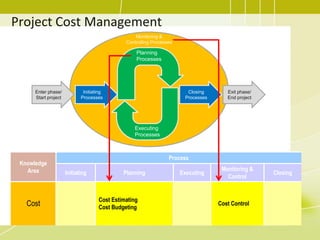
Project Cost Management
Knowledge
Area
Process
Initiating Planning Executing
Monitoring &
Control
Closing
Cost
Cost Estimating
Cost Budgeting
Cost Control
Enter phase/
Start project
Exit phase/
End project
Initiating
Processes
Closing
Processes
Planning
Processes
Executing
Processes
Monitoring &
Controlling Processes
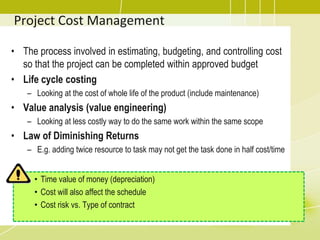
Project Cost Management
• The process involved in estimating, budgeting, and controlling cost
so that the project can be completed within approved budget
• Life cycle costing
– Looking at the cost of whole life of the product (include maintenance)
• Value analysis (value engineering)
– Looking at less costly way to do the same work within the same scope
• Law of Diminishing Returns
– E.g. adding twice resource to task may not get the task done in half cost/time
• Time value of money (depreciation)
• Cost will also affect the schedule
• Cost risk vs. Type of contract
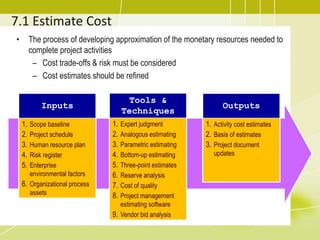
7.1 Estimate Cost
• The process of developing approximation of the monetary resources needed to
complete project activities
– Cost trade-offs & risk must be considered
– Cost estimates should be refined
Inputs
1. Scope baseline
2. Project schedule
3. Human resource plan
4. Risk register
5. Enterprise
environmental factors
6. Organizational process
assets
Tools &
Techniques
1. Expert judgment
2. Analogous estimating
3. Parametric estimating
4. Bottom-up estimating
5. Three-point estimates
6. Reserve analysis
7. Cost of quality
8. Project management
estimating software
9. Vendor bid analysis
Outputs
1. Activity cost estimates
2. Basis of estimates
3. Project document
updates
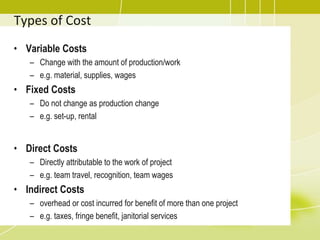
Types of Cost
• Variable Costs
– Change with the amount of production/work
– e.g. material, supplies, wages
• Fixed Costs
– Do not change as production change
– e.g. set-up, rental
• Direct Costs
– Directly attributable to the work of project
– e.g. team travel, recognition, team wages
• Indirect Costs
– overhead or cost incurred for benefit of more than one project
– e.g. taxes, fringe benefit, janitorial services
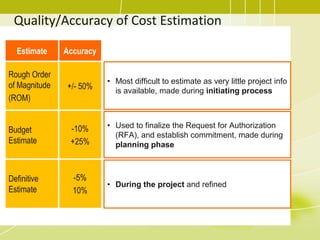
• Most difficult to estimate as very little project info
is available, made during initiating process
Estimate Accuracy
Rough Order
of Magnitude
(ROM)
+/- 50%
Budget
Estimate
-10%
+25%
Definitive
Estimate
-5%
10%
• Used to finalize the Request for Authorization
(RFA), and establish commitment, made during
planning phase
• During the project and refined
Quality/Accuracy of Cost Estimation
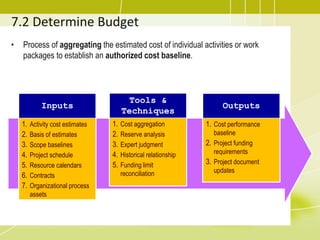
7.2 Determine Budget
• Process of aggregating the estimated cost of individual activities or work
packages to establish an authorized cost baseline.
Inputs
1. Activity cost estimates
2. Basis of estimates
3. Scope baselines
4. Project schedule
5. Resource calendars
6. Contracts
7. Organizational process
assets
Tools &
Techniques
1. Cost aggregation
2. Reserve analysis
3. Expert judgment
4. Historical relationship
5. Funding limit
reconciliation
Outputs
1. Cost performance
baseline
2. Project funding
requirements
3. Project document
updates
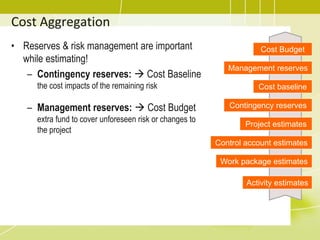
Cost Aggregation
• Reserves & risk management are important
while estimating!
– Contingency reserves:  Cost Baseline
the cost impacts of the remaining risk
– Management reserves:  Cost Budget
extra fund to cover unforeseen risk or changes to
the project
Activity estimates
Work package estimates
Control account estimates
Project estimates
Contingency reserves
Management reserves
Cost baseline
Cost Budget
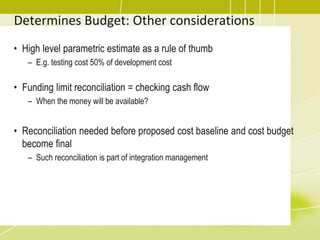
Determines Budget: Other considerations
• High level parametric estimate as a rule of thumb
– E.g. testing cost 50% of development cost
• Funding limit reconciliation = checking cash flow
– When the money will be available?
• Reconciliation needed before proposed cost baseline and cost budget
become final
– Such reconciliation is part of integration management
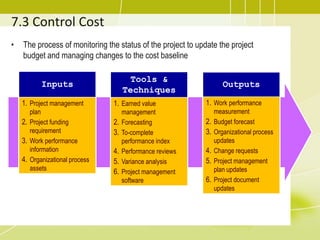
7.3 Control Cost
• The process of monitoring the status of the project to update the project
budget and managing changes to the cost baseline
Inputs
1. Project management
plan
2. Project funding
requirement
3. Work performance
information
4. Organizational process
assets
Tools &
Techniques
1. Earned value
management
2. Forecasting
3. To-complete
performance index
4. Performance reviews
5. Variance analysis
6. Project management
software
Outputs
1. Work performance
measurement
2. Budget forecast
3. Organizational process
updates
4. Change requests
5. Project management
plan updates
6. Project document
updates
How to control cost?
• Follow the cost management plan
• Look at any organizational process asset that are available
• Manage change
– Recording all appropriate change
– Preventing incorrect change
– Ensuring requested changes are agreed upon
– Managing the actual changes when and as they occur
• Measure and measure and measure (monitoring)
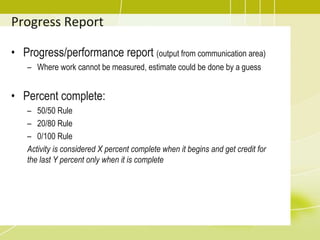
Progress Report
• Progress/performance report (output from communication area)
– Where work cannot be measured, estimate could be done by a guess
• Percent complete:
– 50/50 Rule
– 20/80 Rule
– 0/100 Rule
Activity is considered X percent complete when it begins and get credit for
the last Y percent only when it is complete
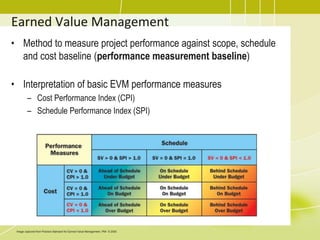
Earned Value Management
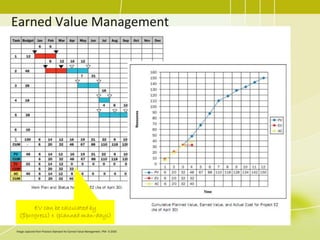
• Method to measure project performance against scope, schedule
and cost baseline (performance measurement baseline)
• Interpretation of basic EVM performance measures
– Cost Performance Index (CPI)
– Schedule Performance Index (SPI)
Image captured from Practice Standard for Earned Value Management, PMI © 2005
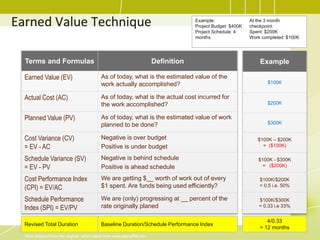
Earned Value Technique
Terms and Formulas Definition
Earned Value (EV) As of today, what is the estimated value of the
work actually accomplished?
Actual Cost (AC) As of today, what is the actual cost incurred for
the work accomplished?
Planned Value (PV) As of today, what is the estimated value of work
planned to be done?
Cost Variance (CV)
= EV - AC
Negative is over budget
Positive is under budget
Schedule Variance (SV)
= EV - PV
Negative is behind schedule
Positive is ahead schedule
Cost Performance Index
(CPI) = EV/AC
We are getting $__ worth of work out of every
$1 spent. Are funds being used efficiently?
Schedule Performance
Index (SPI) = EV/PV
We are (only) progressing at __ percent of the
rate originally planed
Example
$100K
$200K
$300K
$100K – $200K
= ($100K)
$100K - $300K
= ($200K)
$100K/$200K
= 0.5 i.e. 50%
$100K/$300K
= 0.33 i.e 33%
Example:
Project Budget: $400K
Project Schedule: 4
months
At the 3 month
checkpoint:
Spent: $200K
Work completed: $100K
Revised Total Duration Baseline Duration/Schedule Performance Index
4/0.33
= 12 months
Slide adapted from the original which taken from www.alphaPM.com
Earned Value Technique
Terms and Formulas Definition
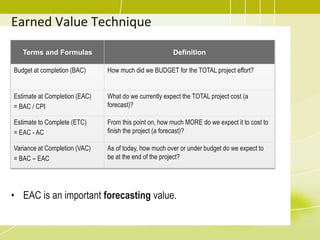
Budget at completion (BAC) How much did we BUDGET for the TOTAL project effort?
Estimate at Completion (EAC)
= BAC / CPI
What do we currently expect the TOTAL project cost (a
forecast)?
Estimate to Complete (ETC)
= EAC - AC
From this point on, how much MORE do we expect it to cost to
finish the project (a forecast)?
Variance at Completion (VAC)
= BAC – EAC
As of today, how much over or under budget do we expect to
be at the end of the project?
• EAC is an important forecasting value.
Earned Value: Graphical Representation
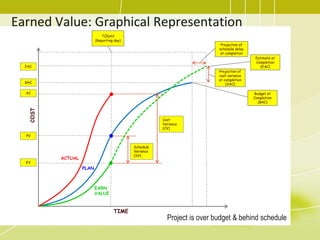
TIME
COST
Schedule
Variance
(SV)
Cost
Variance
(CV)
ACTUAL
PLAN
EARN
VALUE
Estimate at
Completion
(EAC)
Budget at
Completion
(BAC)
Projection of
schedule delay
at completion
Projection of
cost variance
at completion
(VAC)
TODAY
(Reporting day)
BAC
EAC
AC
EV
PV
Project is over budget & behind schedule
Earned Value Management
Image captured from Practice Standard for Earned Value Management, PMI © 2005
EV can be calculated by
(%progress) x (planned man-days)
Exercise
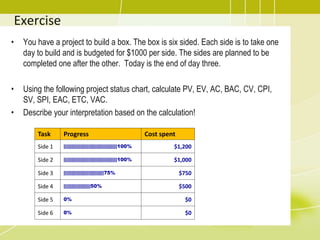
Task Progress Cost spent
Side 1 ||||||||||||||||||||||||||||||||||||||||100% $1,200
Side 2 ||||||||||||||||||||||||||||||||||||||||100% $1,000
Side 3 ||||||||||||||||||||||||||||||75% $750
Side 4 ||||||||||||||||||||50% $500
Side 5 0% $0
Side 6 0% $0
• You have a project to build a box. The box is six sided. Each side is to take one
day to build and is budgeted for $1000 per side. The sides are planned to be
completed one after the other. Today is the end of day three.
• Using the following project status chart, calculate PV, EV, AC, BAC, CV, CPI,
SV, SPI, EAC, ETC, VAC.
• Describe your interpretation based on the calculation!
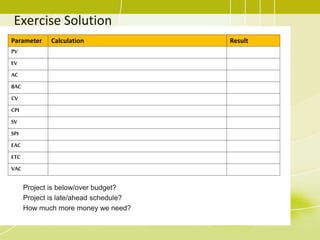
Exercise Solution
Parameter Calculation Result
PV
EV
AC
BAC
CV
CPI
SV
SPI
EAC
ETC
VAC
Project is below/over budget?
Project is late/ahead schedule?
How much more money we need?
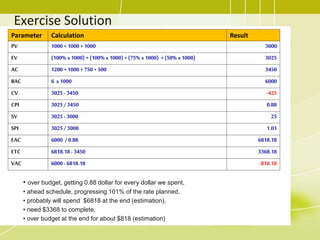
Exercise Solution
Parameter Calculation Result
PV 1000 +1000 +1000 3000
EV (100% x 1000) + (100% x 1000) +(75% x1000) + (50% x 1000) 3025
AC 1200 +1000 +750 +500 3450
BAC 6 x1000 6000
CV 3025 - 3450 -425
CPI 3025 / 3450 0.88
SV 3025 - 3000 25
SPI 3025 / 3000 1.01
EAC 6000 / 0.88 6818.18
ETC 6818.18 - 3450 3368.18
VAC 6000 - 6818.18 -818.18
• over budget, getting 0.88 dollar for every dollar we spent,
• ahead schedule, progressing 101% of the rate planned,
• probably will spend $6818 at the end (estimation),
• need $3368 to complete,
• over budget at the end for about $818 (estimation)
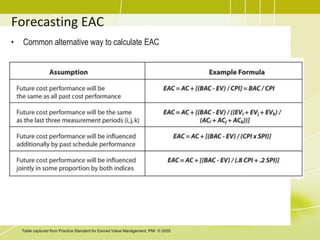
Forecasting EAC
• There are many ways to calculate EAC, depending on the
assumption made.
• Simple EAC calculation (EAC = BAC/CPI) assume that the
cumulative CPI adequately reflects past performance that will
continue to the end of the project.
• AC+(BAC-EV)
– Used when current variances are thought to be atypical of the future
• AC+[(BAC-EV)/(Cumulative CPI + Cumulative SPI)]
– It assumes poor cost performance and need to hit a firm completion date.
To-Complete Performance Index (TCPI)
• Helps the team determine the efficiency that must be achieved on
the remaining work for a project to meet a specified endpoint, such
as BAC or the team’s revised EAC
• TCPI
AC)-(EACor– AC)(BACRemainingFunds
EV)–(BACRemainingWork

BACKUP SLIDES
Forecasting EAC
• Common alternative way to calculate EAC
Table captured from Practice Standard for Earned Value Management, PMI © 2005
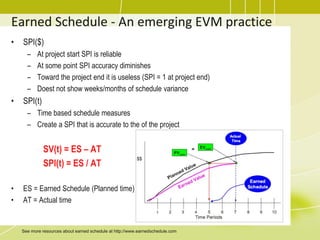
Earned Schedule - An emerging EVM practice
• SPI($)
– At project start SPI is reliable
– At some point SPI accuracy diminishes
– Toward the project end it is useless (SPI = 1 at project end)
– Doest not show weeks/months of schedule variance
• SPI(t)
– Time based schedule measures
– Create a SPI that is accurate to the of the project
SV(t) = ES – AT
SPI(t) = ES / AT
• ES = Earned Schedule (Planned time)
• AT = Actual time
See more resources about earned schedule at http://www.earnedschedule.com
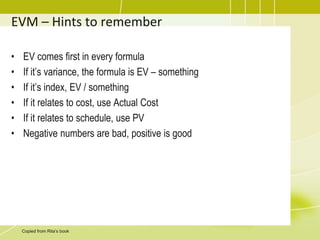
EVM – Hints to remember
• EV comes first in every formula
• If it’s variance, the formula is EV – something
• If it’s index, EV / something
• If it relates to cost, use Actual Cost
• If it relates to schedule, use PV
• Negative numbers are bad, positive is good
Copied from Rita’s book
Thank You
Next topic:
Project Quality Management

07 projectcostmanagement

  • 1.
    7 - ProjectCost Management Project Management Training Created by ejlp12@gmail.com, June 2010
  • 2.
    Project Cost Management Knowledge Area Process InitiatingPlanning Executing Monitoring & Control Closing Cost Cost Estimating Cost Budgeting Cost Control Enter phase/ Start project Exit phase/ End project Initiating Processes Closing Processes Planning Processes Executing Processes Monitoring & Controlling Processes
  • 3.
    Project Cost Management •The process involved in estimating, budgeting, and controlling cost so that the project can be completed within approved budget • Life cycle costing – Looking at the cost of whole life of the product (include maintenance) • Value analysis (value engineering) – Looking at less costly way to do the same work within the same scope • Law of Diminishing Returns – E.g. adding twice resource to task may not get the task done in half cost/time • Time value of money (depreciation) • Cost will also affect the schedule • Cost risk vs. Type of contract
  • 4.
    7.1 Estimate Cost •The process of developing approximation of the monetary resources needed to complete project activities – Cost trade-offs & risk must be considered – Cost estimates should be refined Inputs 1. Scope baseline 2. Project schedule 3. Human resource plan 4. Risk register 5. Enterprise environmental factors 6. Organizational process assets Tools & Techniques 1. Expert judgment 2. Analogous estimating 3. Parametric estimating 4. Bottom-up estimating 5. Three-point estimates 6. Reserve analysis 7. Cost of quality 8. Project management estimating software 9. Vendor bid analysis Outputs 1. Activity cost estimates 2. Basis of estimates 3. Project document updates
  • 5.
    Types of Cost •Variable Costs – Change with the amount of production/work – e.g. material, supplies, wages • Fixed Costs – Do not change as production change – e.g. set-up, rental • Direct Costs – Directly attributable to the work of project – e.g. team travel, recognition, team wages • Indirect Costs – overhead or cost incurred for benefit of more than one project – e.g. taxes, fringe benefit, janitorial services
  • 6.
    • Most difficultto estimate as very little project info is available, made during initiating process Estimate Accuracy Rough Order of Magnitude (ROM) +/- 50% Budget Estimate -10% +25% Definitive Estimate -5% 10% • Used to finalize the Request for Authorization (RFA), and establish commitment, made during planning phase • During the project and refined Quality/Accuracy of Cost Estimation
  • 7.
    7.2 Determine Budget •Process of aggregating the estimated cost of individual activities or work packages to establish an authorized cost baseline. Inputs 1. Activity cost estimates 2. Basis of estimates 3. Scope baselines 4. Project schedule 5. Resource calendars 6. Contracts 7. Organizational process assets Tools & Techniques 1. Cost aggregation 2. Reserve analysis 3. Expert judgment 4. Historical relationship 5. Funding limit reconciliation Outputs 1. Cost performance baseline 2. Project funding requirements 3. Project document updates
  • 8.
    Cost Aggregation • Reserves& risk management are important while estimating! – Contingency reserves:  Cost Baseline the cost impacts of the remaining risk – Management reserves:  Cost Budget extra fund to cover unforeseen risk or changes to the project Activity estimates Work package estimates Control account estimates Project estimates Contingency reserves Management reserves Cost baseline Cost Budget
  • 9.
    Determines Budget: Otherconsiderations • High level parametric estimate as a rule of thumb – E.g. testing cost 50% of development cost • Funding limit reconciliation = checking cash flow – When the money will be available? • Reconciliation needed before proposed cost baseline and cost budget become final – Such reconciliation is part of integration management
  • 10.
    7.3 Control Cost •The process of monitoring the status of the project to update the project budget and managing changes to the cost baseline Inputs 1. Project management plan 2. Project funding requirement 3. Work performance information 4. Organizational process assets Tools & Techniques 1. Earned value management 2. Forecasting 3. To-complete performance index 4. Performance reviews 5. Variance analysis 6. Project management software Outputs 1. Work performance measurement 2. Budget forecast 3. Organizational process updates 4. Change requests 5. Project management plan updates 6. Project document updates
  • 11.
    How to controlcost? • Follow the cost management plan • Look at any organizational process asset that are available • Manage change – Recording all appropriate change – Preventing incorrect change – Ensuring requested changes are agreed upon – Managing the actual changes when and as they occur • Measure and measure and measure (monitoring)
  • 12.
    Progress Report • Progress/performancereport (output from communication area) – Where work cannot be measured, estimate could be done by a guess • Percent complete: – 50/50 Rule – 20/80 Rule – 0/100 Rule Activity is considered X percent complete when it begins and get credit for the last Y percent only when it is complete
  • 13.
    Earned Value Management •Method to measure project performance against scope, schedule and cost baseline (performance measurement baseline) • Interpretation of basic EVM performance measures – Cost Performance Index (CPI) – Schedule Performance Index (SPI) Image captured from Practice Standard for Earned Value Management, PMI © 2005
  • 14.
    Earned Value Technique Termsand Formulas Definition Earned Value (EV) As of today, what is the estimated value of the work actually accomplished? Actual Cost (AC) As of today, what is the actual cost incurred for the work accomplished? Planned Value (PV) As of today, what is the estimated value of work planned to be done? Cost Variance (CV) = EV - AC Negative is over budget Positive is under budget Schedule Variance (SV) = EV - PV Negative is behind schedule Positive is ahead schedule Cost Performance Index (CPI) = EV/AC We are getting $__ worth of work out of every $1 spent. Are funds being used efficiently? Schedule Performance Index (SPI) = EV/PV We are (only) progressing at __ percent of the rate originally planed Example $100K $200K $300K $100K – $200K = ($100K) $100K - $300K = ($200K) $100K/$200K = 0.5 i.e. 50% $100K/$300K = 0.33 i.e 33% Example: Project Budget: $400K Project Schedule: 4 months At the 3 month checkpoint: Spent: $200K Work completed: $100K Revised Total Duration Baseline Duration/Schedule Performance Index 4/0.33 = 12 months Slide adapted from the original which taken from www.alphaPM.com
  • 15.
    Earned Value Technique Termsand Formulas Definition Budget at completion (BAC) How much did we BUDGET for the TOTAL project effort? Estimate at Completion (EAC) = BAC / CPI What do we currently expect the TOTAL project cost (a forecast)? Estimate to Complete (ETC) = EAC - AC From this point on, how much MORE do we expect it to cost to finish the project (a forecast)? Variance at Completion (VAC) = BAC – EAC As of today, how much over or under budget do we expect to be at the end of the project? • EAC is an important forecasting value.
  • 16.
    Earned Value: GraphicalRepresentation TIME COST Schedule Variance (SV) Cost Variance (CV) ACTUAL PLAN EARN VALUE Estimate at Completion (EAC) Budget at Completion (BAC) Projection of schedule delay at completion Projection of cost variance at completion (VAC) TODAY (Reporting day) BAC EAC AC EV PV Project is over budget & behind schedule
  • 17.
    Earned Value Management Imagecaptured from Practice Standard for Earned Value Management, PMI © 2005 EV can be calculated by (%progress) x (planned man-days)
  • 18.
    Exercise Task Progress Costspent Side 1 ||||||||||||||||||||||||||||||||||||||||100% $1,200 Side 2 ||||||||||||||||||||||||||||||||||||||||100% $1,000 Side 3 ||||||||||||||||||||||||||||||75% $750 Side 4 ||||||||||||||||||||50% $500 Side 5 0% $0 Side 6 0% $0 • You have a project to build a box. The box is six sided. Each side is to take one day to build and is budgeted for $1000 per side. The sides are planned to be completed one after the other. Today is the end of day three. • Using the following project status chart, calculate PV, EV, AC, BAC, CV, CPI, SV, SPI, EAC, ETC, VAC. • Describe your interpretation based on the calculation!
  • 19.
    Exercise Solution Parameter CalculationResult PV EV AC BAC CV CPI SV SPI EAC ETC VAC Project is below/over budget? Project is late/ahead schedule? How much more money we need?
  • 20.
    Exercise Solution Parameter CalculationResult PV 1000 +1000 +1000 3000 EV (100% x 1000) + (100% x 1000) +(75% x1000) + (50% x 1000) 3025 AC 1200 +1000 +750 +500 3450 BAC 6 x1000 6000 CV 3025 - 3450 -425 CPI 3025 / 3450 0.88 SV 3025 - 3000 25 SPI 3025 / 3000 1.01 EAC 6000 / 0.88 6818.18 ETC 6818.18 - 3450 3368.18 VAC 6000 - 6818.18 -818.18 • over budget, getting 0.88 dollar for every dollar we spent, • ahead schedule, progressing 101% of the rate planned, • probably will spend $6818 at the end (estimation), • need $3368 to complete, • over budget at the end for about $818 (estimation)
  • 21.
    Forecasting EAC • Thereare many ways to calculate EAC, depending on the assumption made. • Simple EAC calculation (EAC = BAC/CPI) assume that the cumulative CPI adequately reflects past performance that will continue to the end of the project. • AC+(BAC-EV) – Used when current variances are thought to be atypical of the future • AC+[(BAC-EV)/(Cumulative CPI + Cumulative SPI)] – It assumes poor cost performance and need to hit a firm completion date.
  • 22.
    To-Complete Performance Index(TCPI) • Helps the team determine the efficiency that must be achieved on the remaining work for a project to meet a specified endpoint, such as BAC or the team’s revised EAC • TCPI AC)-(EACor– AC)(BACRemainingFunds EV)–(BACRemainingWork 
  • 23.
  • 24.
    Forecasting EAC • Commonalternative way to calculate EAC Table captured from Practice Standard for Earned Value Management, PMI © 2005
  • 25.
    Earned Schedule -An emerging EVM practice • SPI($) – At project start SPI is reliable – At some point SPI accuracy diminishes – Toward the project end it is useless (SPI = 1 at project end) – Doest not show weeks/months of schedule variance • SPI(t) – Time based schedule measures – Create a SPI that is accurate to the of the project SV(t) = ES – AT SPI(t) = ES / AT • ES = Earned Schedule (Planned time) • AT = Actual time See more resources about earned schedule at http://www.earnedschedule.com
  • 26.
    EVM – Hintsto remember • EV comes first in every formula • If it’s variance, the formula is EV – something • If it’s index, EV / something • If it relates to cost, use Actual Cost • If it relates to schedule, use PV • Negative numbers are bad, positive is good Copied from Rita’s book
  • 27.