IS5540 Project Management & Quality Assurance Week 6 -  Project Cost Management Schwalbe: Managing Information Technology Projects, Chapter 7 Adapted by Janet Yu ,  Frank Lo
PMI Framework: 9 Knowledge Areas People Integration Scope Time Cost Quality Communication Risk Procurement
Learning Objectives Explain basic project cost management  principles, concepts,  and  terms Discuss different  types of cost estimates  and methods for preparing them Understand the  processes  involved in cost budgeting and preparing a cost estimate, and budget for an information technology project Understand the benefits of  earned value management  and project portfolio management to assist in cost control
The Importance of Project Cost Management IT projects have a poor track record for meeting budget goals The CHAOS studies found the average  cost overrun  was: 180 percent in 1994 56 percent in 2004 Other studies found overruns to be 33-34 percent
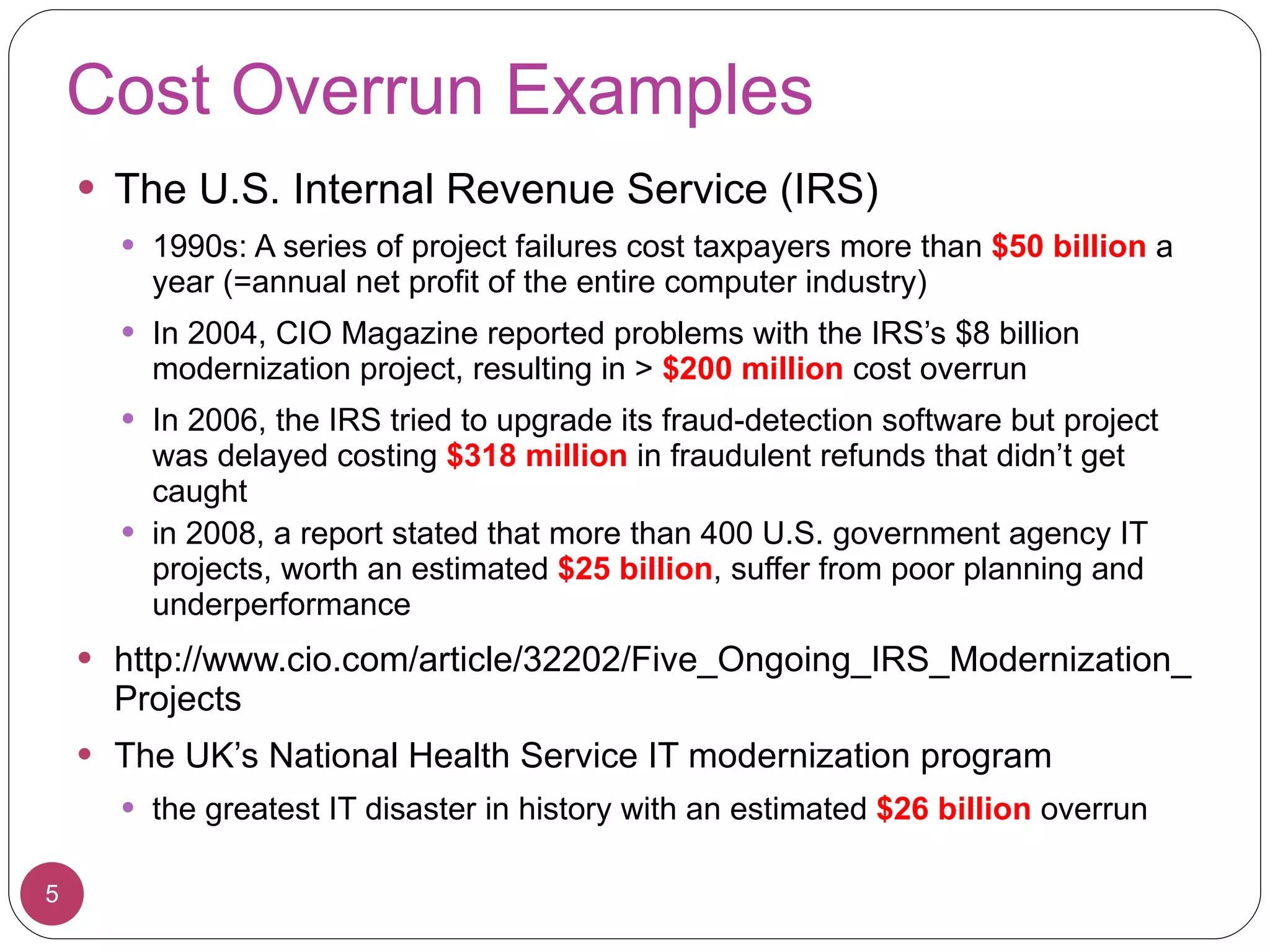
Cost Overrun Examples The U.S. Internal Revenue Service (IRS) 1990s: A series of project failures cost taxpayers more than  $50 billion  a year (=annual net profit of the entire computer industry) In 2004, CIO Magazine reported problems with the IRS’s $8 billion modernization project, resulting in >  $200 million  cost overrun In 2006, the IRS tried to upgrade its fraud-detection software but project was delayed costing  $318 million  in fraudulent refunds that didn’t get caught in 2008, a report stated that more than 400 U.S. government agency IT projects, worth an estimated  $25 billion , suffer from poor planning and underperformance http://www.cio.com/article/32202/Five_Ongoing_IRS_Modernization_Projects The UK’s National Health Service IT modernization program the greatest IT disaster in history with an estimated  $26 billion  overrun
If costs not managed carefully…..
Project Cost Management Processes Estimate costs : developing an approximation or estimate of the costs of the resources needed to complete a project Determine budget : allocating the overall cost estimate to individual work items to establish a  baseline  for measuring performance Control cost : controlling changes to the project budget
Basic Principles & Terminology Profits  are revenues minus expenditures Profit margin   is the ratio of revenues to profits Life cycle costing Considers the total cost of ownership, or development plus support costs, for a project when making financial decisions E.g. Buying a low-cost but low-quality equipment may cost less initially but require a high maintenance fee later on. Cash flow analysis  determines the estimated annual costs and benefits for a project and the resulting annual cash flow
Basic Principles & Terminology Tangible costs  or  benefits  are those costs or benefits that an organization can easily measure in dollars  Intangible costs  or  benefits  are costs or benefits that are difficult to measure in monetary terms, e.g improved company image Direct costs  are costs that can be directly related to producing the products and services of the project  Indirect costs  are costs that are not directly related to the products or services of the project Sunk cost   is money that has been spent in the past; when deciding what projects to invest in or continue, you should  not  include sunk costs
Table 7-1: Costs of Downtime for IT Applications
Learning curve theory  states that when many items are produced repetitively, the unit cost of those items  decreases  in a regular pattern as more units are produced Reserves  are dollars included in a cost estimate to mitigate cost  risk  by allowing for future situations that are difficult to predict Basic Principles of Cost Management
Contingency reserves  allow for future situations that may be partially planned for To cater for  known unknowns E.g. increase in labor and material cost Included in the cost baseline E.g. $10M (Project Budget) + $1M (Contingency Reserve) = $11M (Cost Baseline) Management reserves  allow for future situations that are unpredictable To cater for  unknown unknowns E.g. supplier goes bankrupt, hurricane Not included in the cost baseline, but included in the total cost budget E.g. $11M (Cost Baseline) + $1.1M (Management Reserve) = $12.1M (Cost Budget) Types of Reserves
Table 7-2: Types of Cost Estimates
Cost Management Plan A  Cost Management Plan  is a document that describes  how  the organization will manage cost variance on the project  Produced as part of the Project Management Plan
Estimate Costs
Cost Estimation Tools and Techniques Basic tools and techniques for cost estimates Analogous   or   top-down estimates :   use the actual cost of a previous, similar project as the basis for estimating the cost of the current project. E.g. cost of renovating a house Bottom-up estimates : involve estimating individual work items or activities and summing them to get a project total  Parametric modeling :   uses project characteristics (parameters) in a mathematical model to estimate project costs. E.g. no. of workstations x cost of installation per workstation
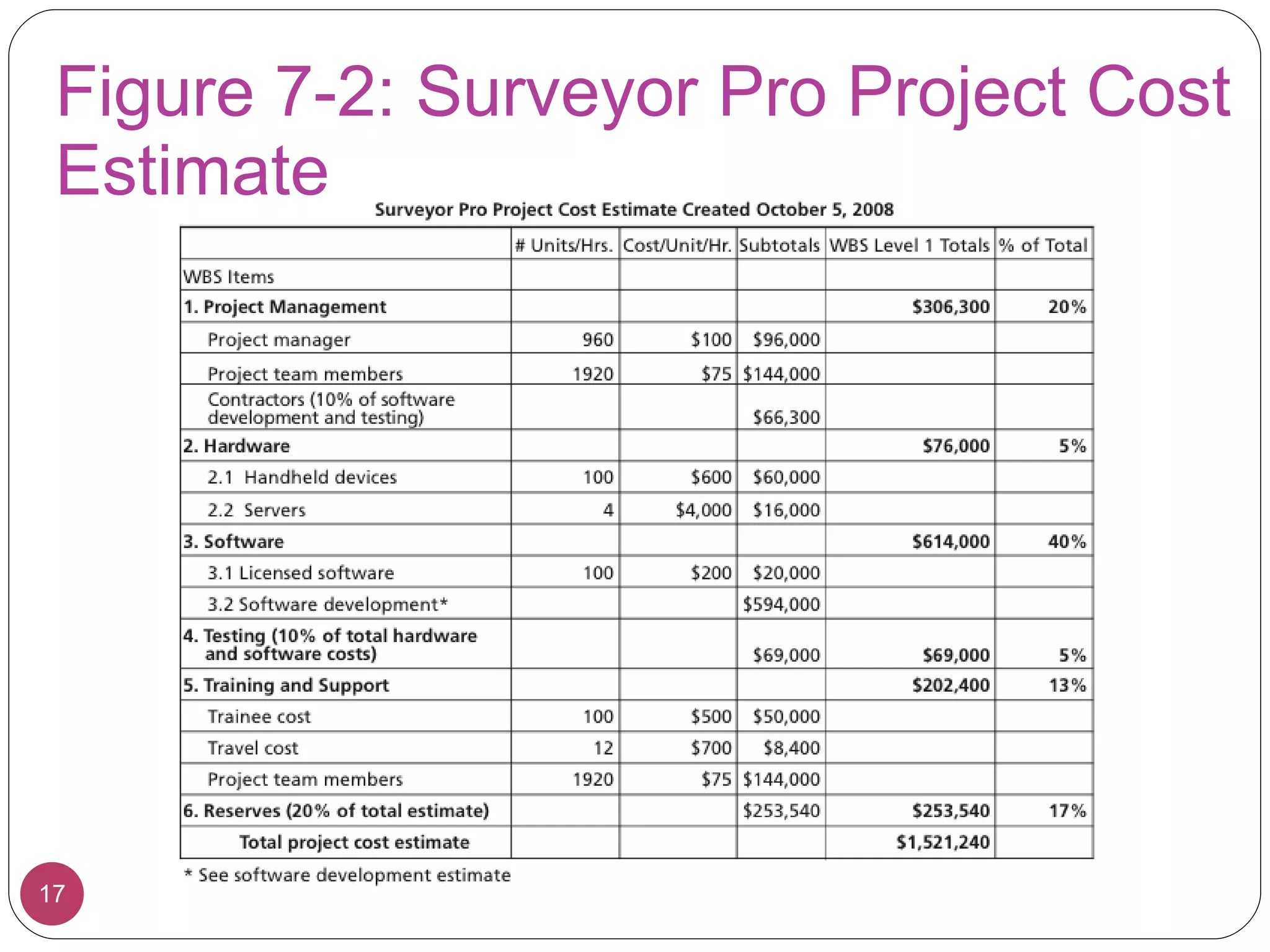
Figure 7-2: Surveyor Pro Project Cost Estimate
Figure 7-3: Surveyor Pro Software Development Estimate
Determine Budgets
Determine Budget An important goal is to produce a  cost baseline A  time-phased budget  that project managers use to measure and monitor cost performance
Figure 7-4: Surveyor Pro Project Cost Baseline *Numbers are rounded, so some totals appear to be off.
Steps to Come Up with a Project Budget? Cost Budget Management Reserve Cost Baseline Contingency Reserve Project Work Packages Activities ? ? ? ? ?
Control Costs
Control Costs Monitoring cost performance Ensuring that only appropriate project changes are included in a revised cost baseline Informing project stakeholders of authorized changes to the project that will affect costs
Earned Value Management (EVM) EVM   is a project performance measurement technique that integrates scope, time, and cost data Given a  baseline  (original plan plus approved changes), you can determine how well the project is meeting its goals You must enter  actual  information periodically to use EVM
Earned Value Management (EVM) Planned Value (PV) How much work should have been done? Earned Value (EV) How much work has been done? Actual Cost (AC) How much has been spent? Budget At Completion (BAC) What was the entire project supposed to cost? Estimate At Completion (EAC) What is the project expected to cost now?
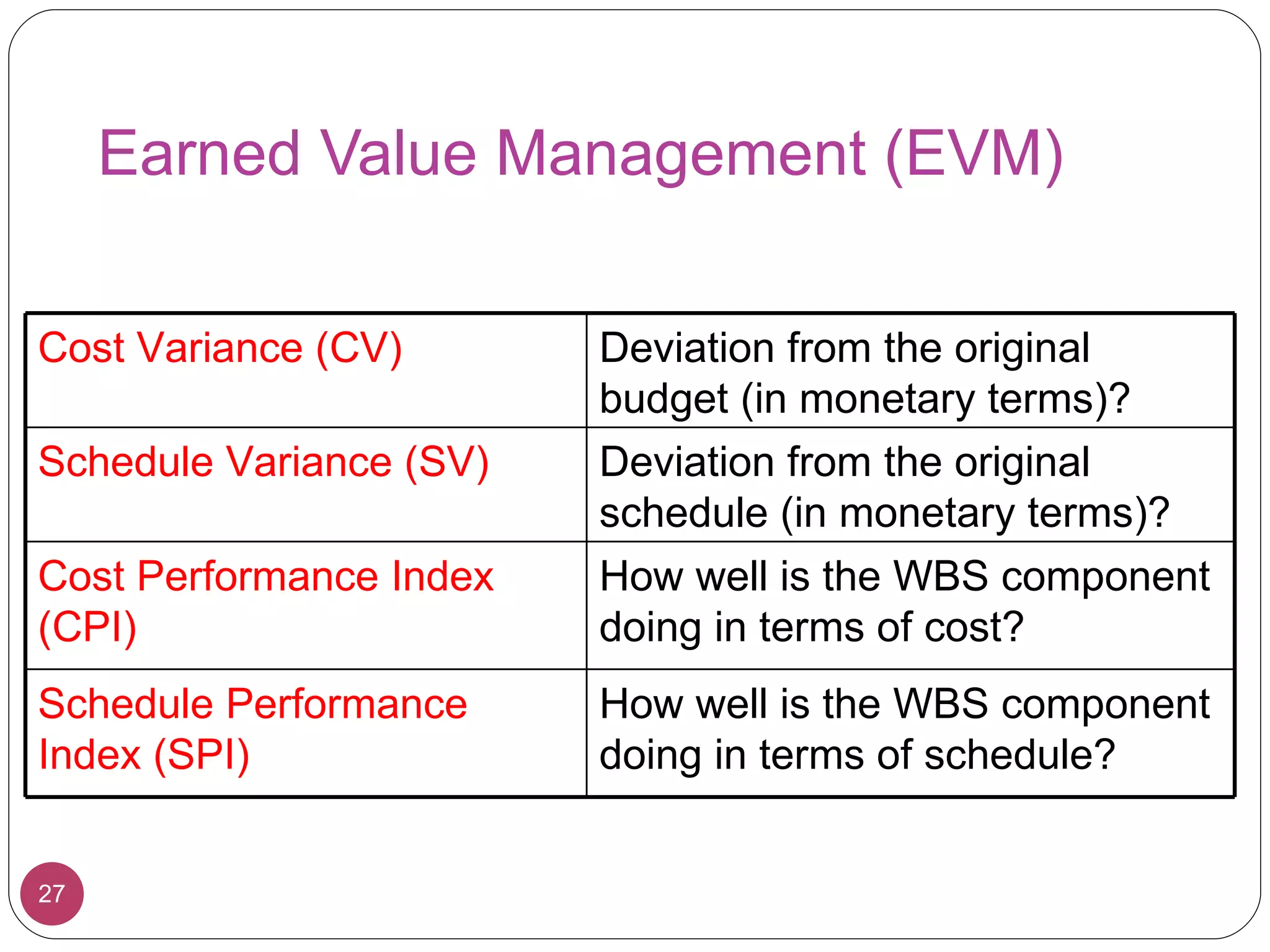
Earned Value Management (EVM) Cost Variance (CV) Deviation from the original budget (in monetary terms)? Schedule Variance (SV) Deviation from the original schedule (in monetary terms)? Cost Performance Index (CPI) How well is the WBS component doing in terms of cost? Schedule Performance Index (SPI) How well is the WBS component doing in terms of schedule?
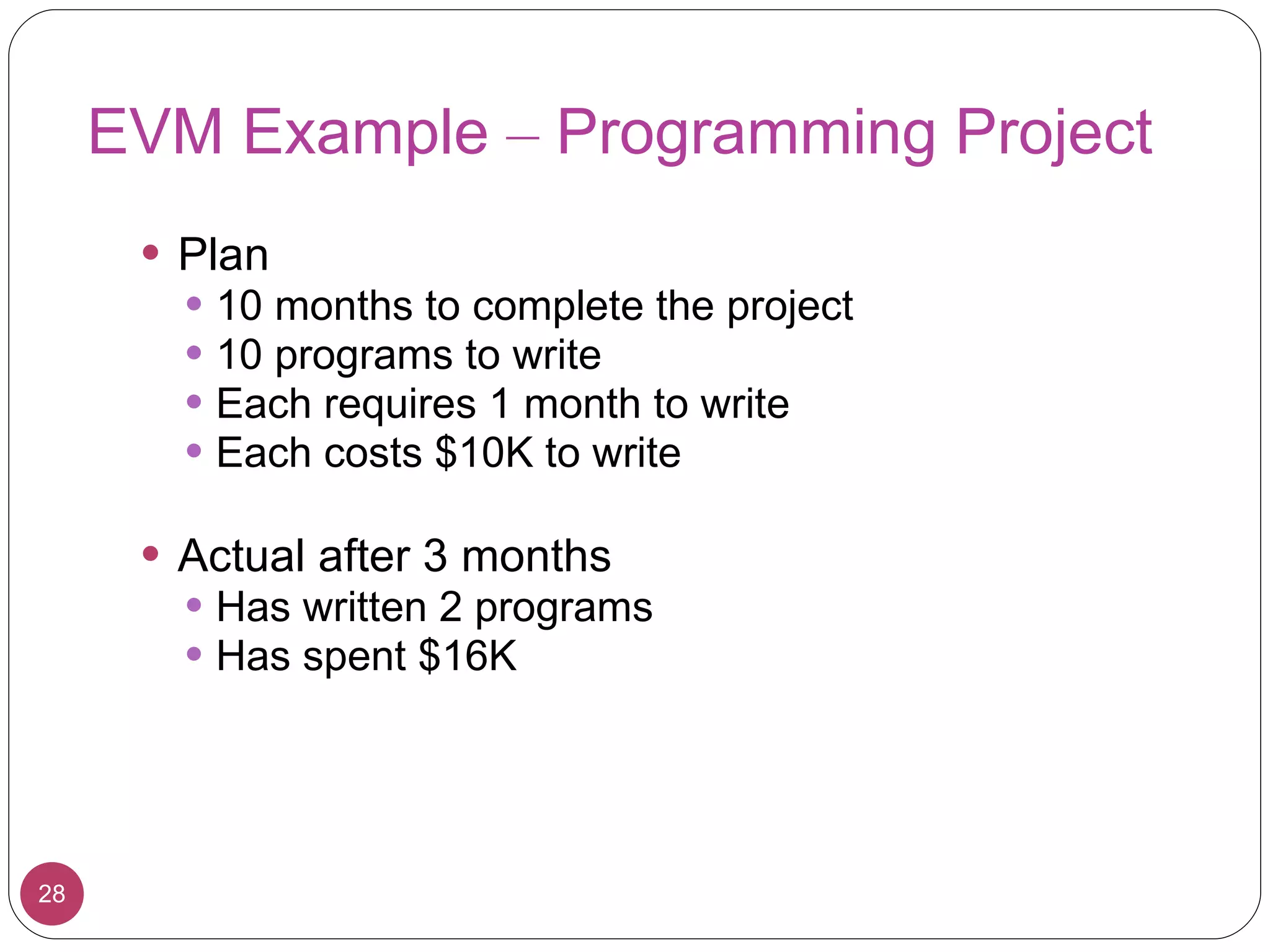
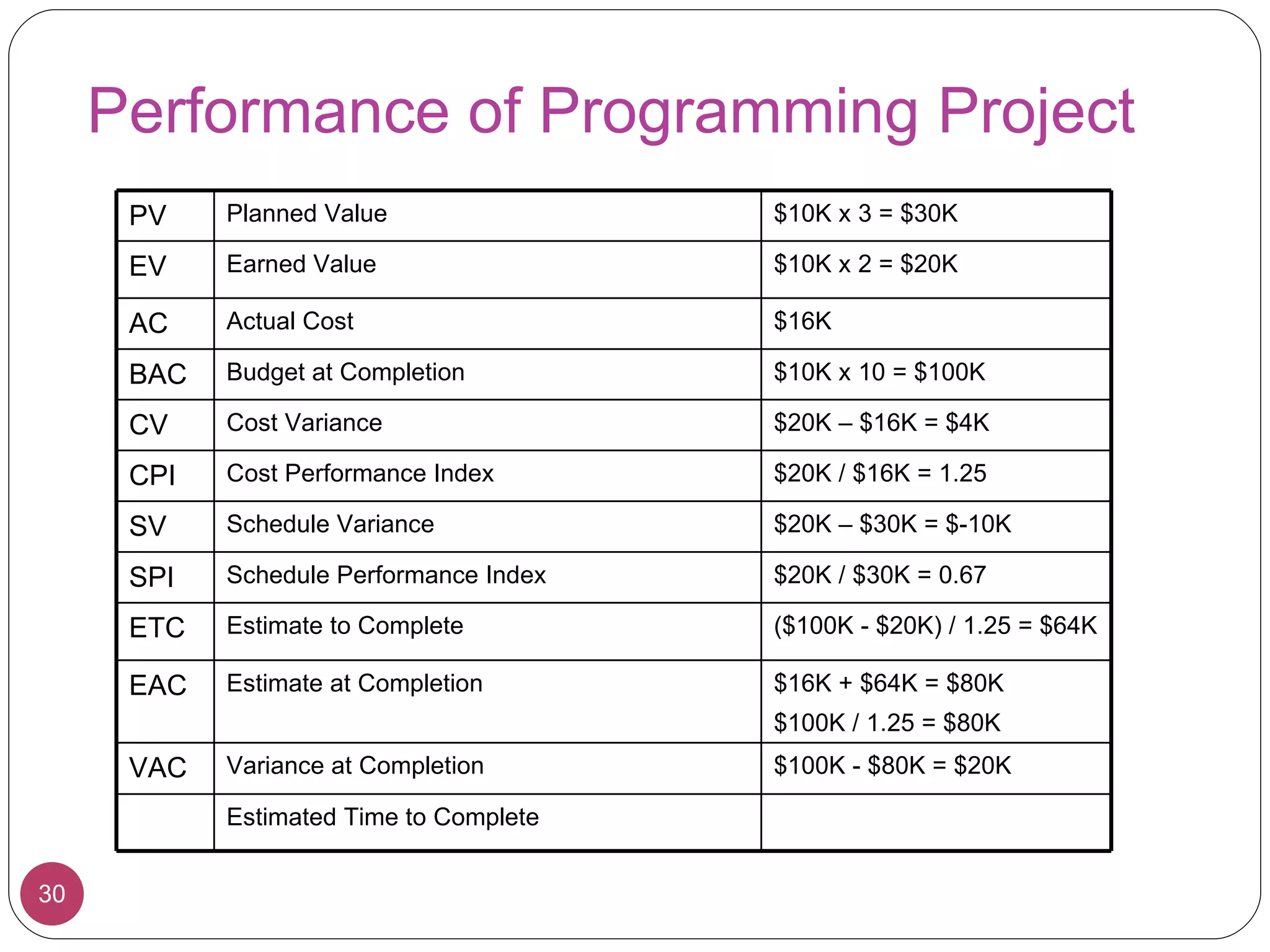
EVM Example  –  Programming Project Plan 10 months to complete the project 10 programs to write Each requires 1 month to write Each costs $10K to write Actual after 3 months Has written 2 programs Has spent $16K
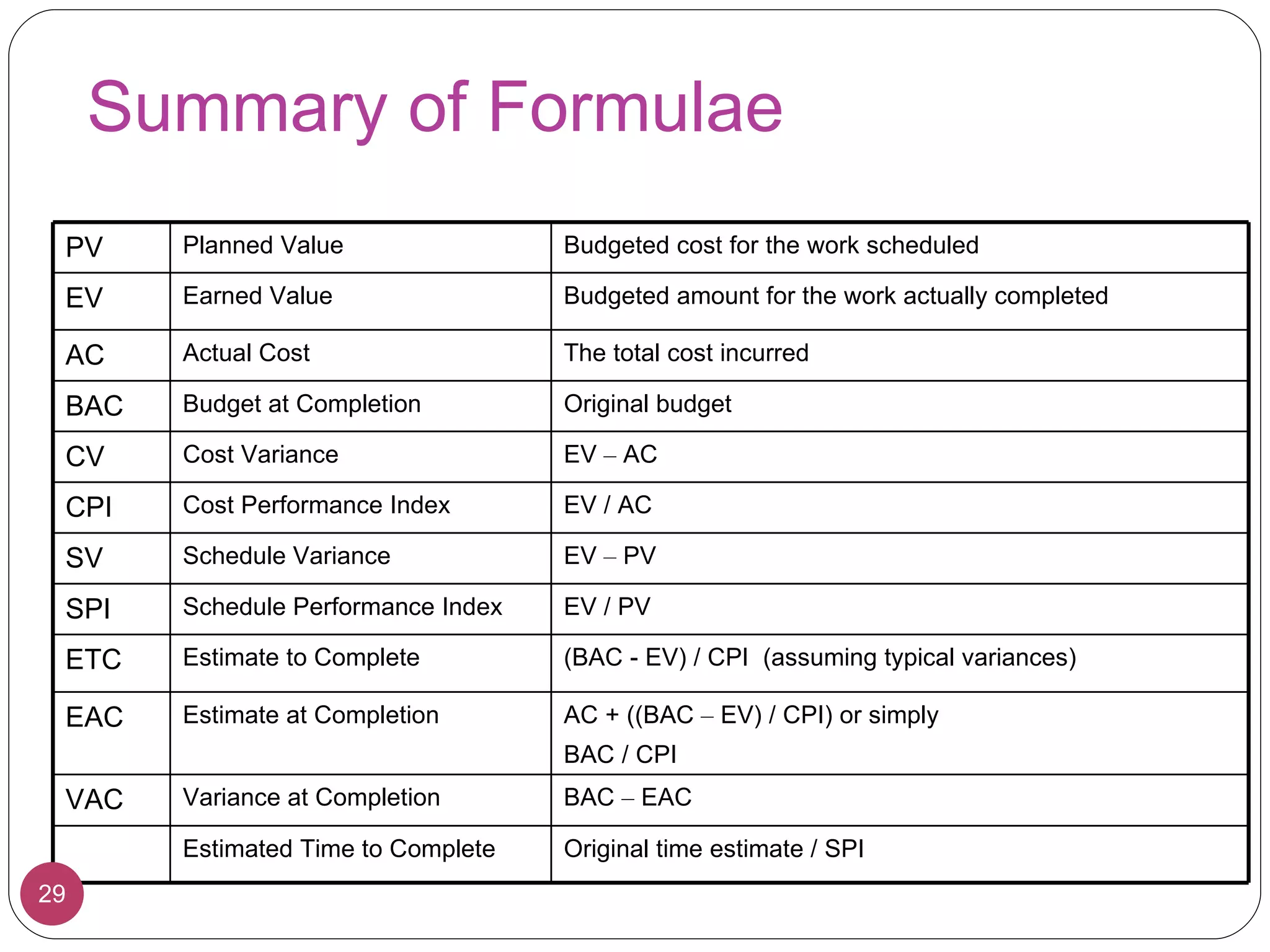
Summary of Formulae PV Planned Value Budgeted cost for the work scheduled EV Earned Value Budgeted amount for the work actually completed AC Actual Cost The total cost incurred BAC  Budget at Completion Original budget CV Cost Variance EV  –  AC CPI Cost Performance Index EV / AC SV Schedule Variance EV  –  PV SPI Schedule Performance Index EV / PV ETC Estimate to Complete (BAC - EV) / CPI  (assuming typical variances) EAC Estimate at Completion AC + ((BAC  –  EV) / CPI) or simply BAC / CPI VAC Variance at Completion BAC  –  EAC Estimated Time to Complete Original time estimate / SPI
Performance of Programming Project PV Planned Value $10K x 3 = $30K EV Earned Value $10K x 2 = $20K AC Actual Cost $16K BAC  Budget at Completion $10K x 10 = $100K CV Cost Variance $20K – $16K = $4K CPI Cost Performance Index $20K / $16K = 1.25 SV Schedule Variance $20K – $30K = $-10K SPI Schedule Performance Index $20K / $30K = 0.67 ETC Estimate to Complete ($100K - $20K) / 1.25 = $64K EAC Estimate at Completion $16K + $64K = $80K $100K / 1.25 = $80K VAC Variance at Completion $100K - $80K = $20K Estimated Time to Complete
Rate of Performance Rate of performance (RP)  = Actual work completed / work planned to have been completed For example, suppose the server installation was halfway completed by the end of week 1 but planned schedule shows the task should be 100% completed Actual work completed 50% Work planned to have been completed 100%    Rate of performance = 50%
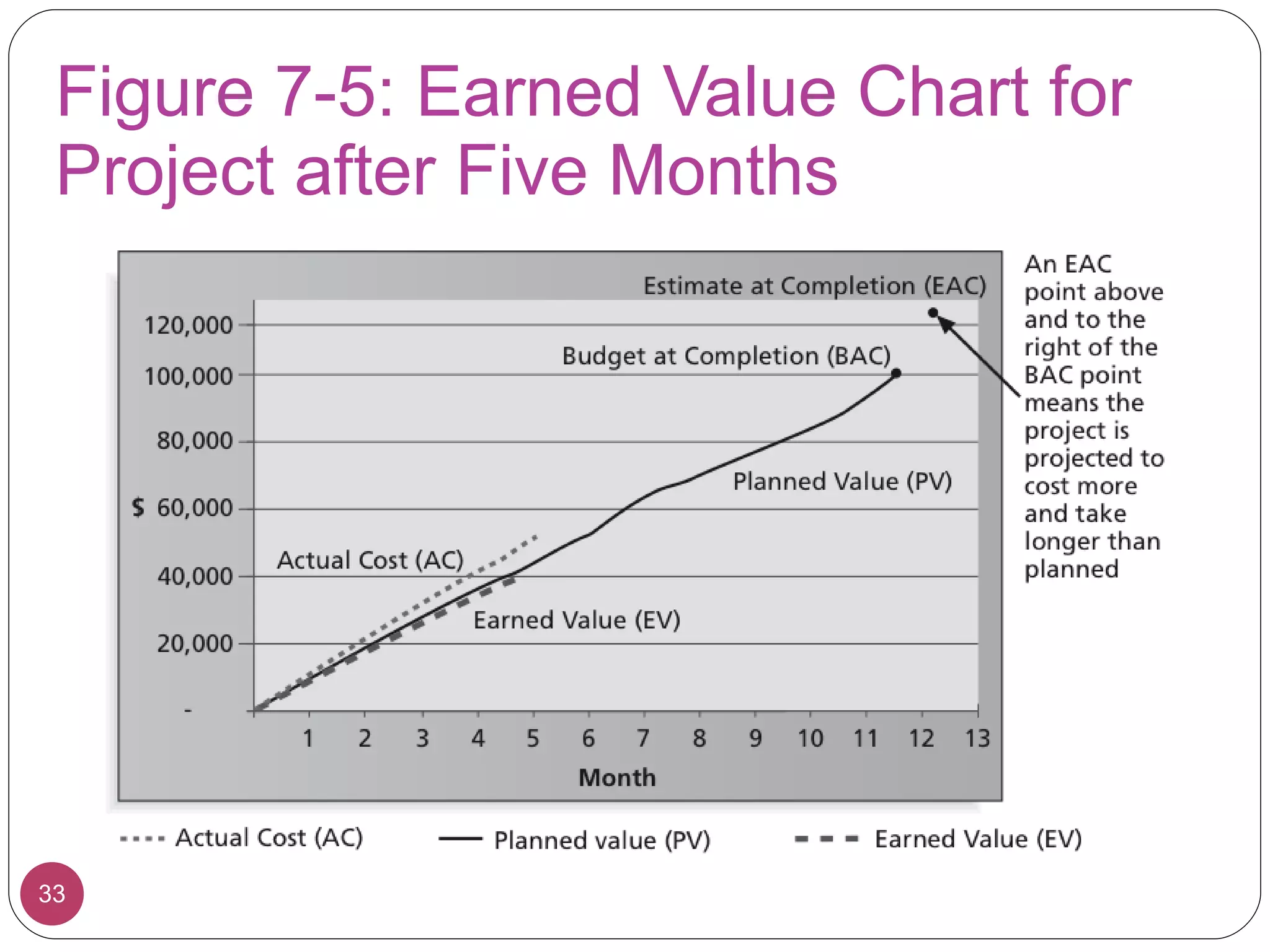
Rules of Thumb for Earned Value Numbers Problem appears when: Negative  numbers for cost or schedule variance CPI or SPI  less than 100% Problems mean the project is costing more than planned (over budget) or taking longer than planned (behind schedule)
Figure 7-5: Earned Value Chart for Project after Five Months
Quick Quiz (1) 1.What kind of cost estimate will you give at the initiation stage of the project? 2.I decided to select a cheaper brand in order to lower the project cost though I understood that the maintenance cost would be much higher than other brands. Which cost management principle did I violate? 3.By carrying out the project, the image of the company can be improved, this is __________ benefit.
Quick Quiz (2) 4.If you are asked to give an accurate cost estimate for your project, which cost estimating method will you use? 5.The approved total cost estimate for the project is called the ___________. 6.A time-phased budget for the project for measuring performance is called the __________. 7.The technique that you’ll use in cost control is called __________. 8.Which reserve is not part of the cost baseline?
Steps to Come Up with a Project Budget? Cost Budget Management Reserve Cost Baseline Contingency Reserve Project Work Packages Activities 10 + 20 30 + 40 30 70 100 100 x 10% = 10 100 +  10 = 110 (time-phased) 110 x 10% = 11 110 + 11 =  121 $
Revision Concepts and terminology Life cycle costing Cash flow analysis Tangible Vs intangible costs Direct Vs indirect costs Sunk cost Order of magnitude Vs Budgetary Vs Definitive Reserves Contingency reserves Management reserves Cost estimating methods Analogous / top-down Bottom-up Parametric modeling Cost Baseline Earned Value Management (EVM)
Appendix on Function Point
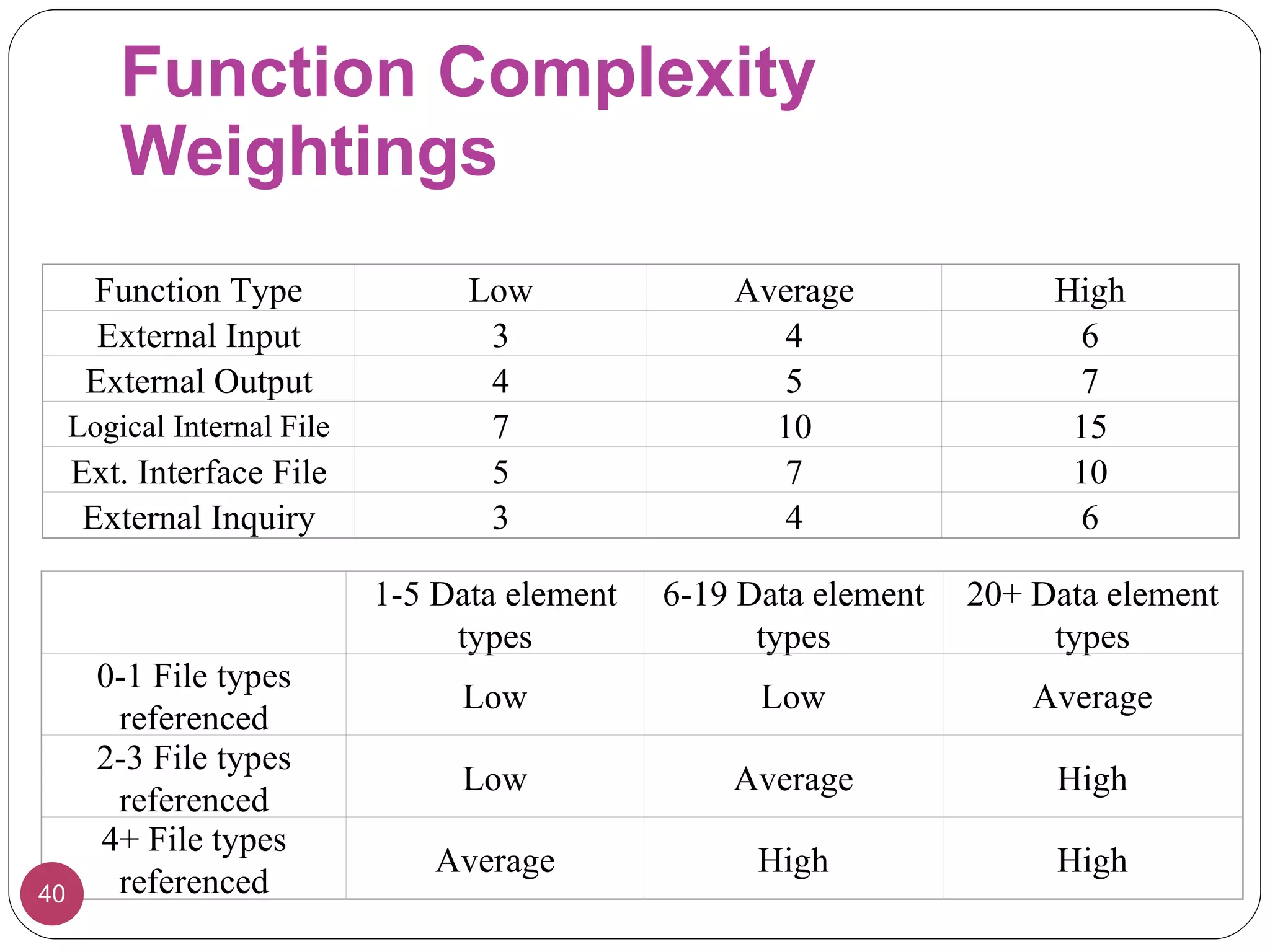
Basic Functions Classification outputs ( OT ):  data items produced for the external world inputs (IT):  data items from external world to software inquiries (QT):  inputs that cause some database lookup and response files (FT):  externally observable data stores interfaces (EI):  connections to other systems
Function Complexity Weightings Function Type Low Average High External Input 3 4 6 External Output 4 5 7 Logical Internal File 7 10 15 Ext. Interface File 5 7 10 External Inquiry 3 4 6 1-5 Data element types 6-19 Data element types 20+ Data element types 0-1 File types referenced Low Low Average 2-3 File types referenced Low Average High 4+ File types referenced Average High High
Computing Raw FP Count Raw FP Count = 4*OTs  + 5*OTa  + 7*OTc + 3*ITs + 4*ITa + 6*ITc + 3*QTs + 4*QTa + 6*QTc + 7*FTs + 10*FTa + 15*FTc + 5*EIs + 7*EIa + 10*EIc
Complexity Adjustment Factors Data Communications Distributed Functions Performance Heavily Used Configuration Transaction Rate Online Data Entry End User Efficiency Online Update Complex Processing Re-useability Installation Ease Operational Ease Multiple Sites Facilitate Change 0 (not important) to 5 (very important)
Computing the Function Point Value UFP  = raw FP count CAFP  = 0.65 + (Complexity Adjustment Score) / 100  AFP  = UFP  * CAFP Size of Project = AFP * LOC of a given language (LOC is adjusted by individual organization) UFP: Unadjusted Function Point CAF: Complexity Adjustment Function Point AFP: Adjusted Function Point
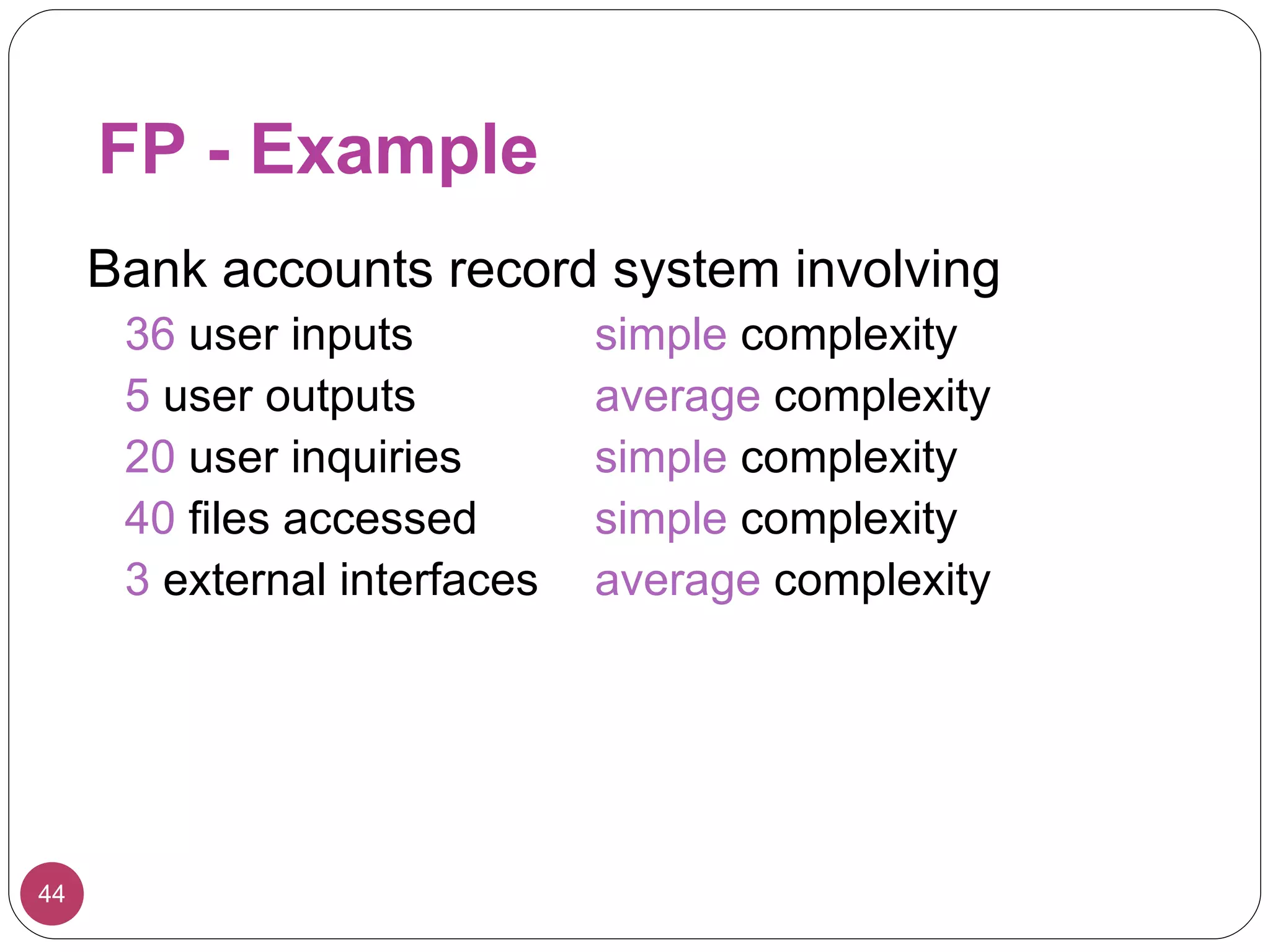
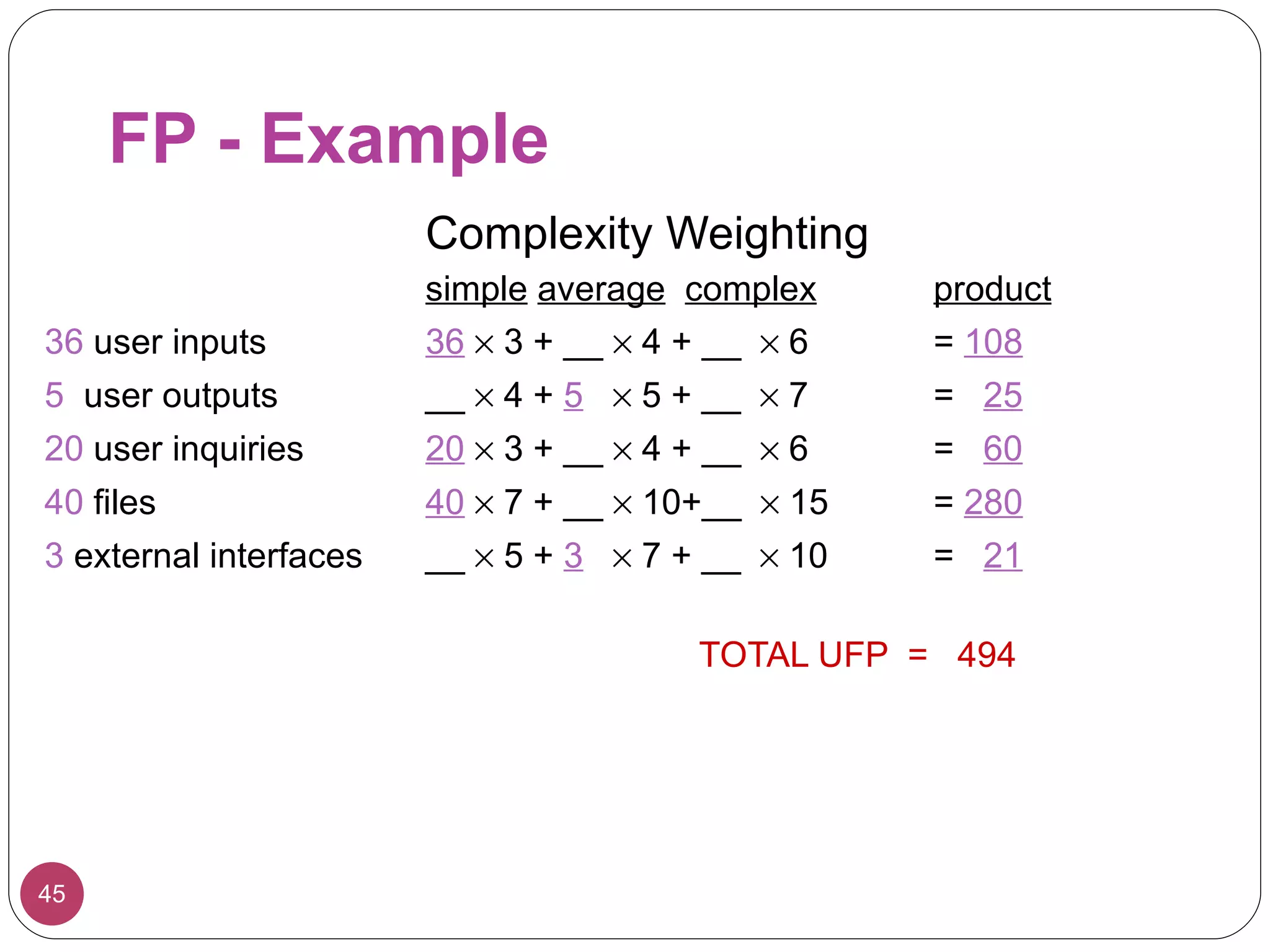
FP - Example Bank accounts record system involving 36  user inputs simple  complexity 5  user outputs average  complexity 20  user inquiries simple  complexity 40  files accessed simple  complexity 3  external interfaces average  complexity
FP - Example Complexity Weighting simple   average   complex product 36  user inputs 36     3 + __    4 + __    6 =  108 5   user outputs __    4 +  5     5 + __    7 =  25   20  user inquiries 20     3 + __    4 + __    6 =  60 40  files 40     7 + __    10+__    15 =  280 3  external interfaces __    5 +  3     7 + __    10 =  21   TOTAL UFP  =  494
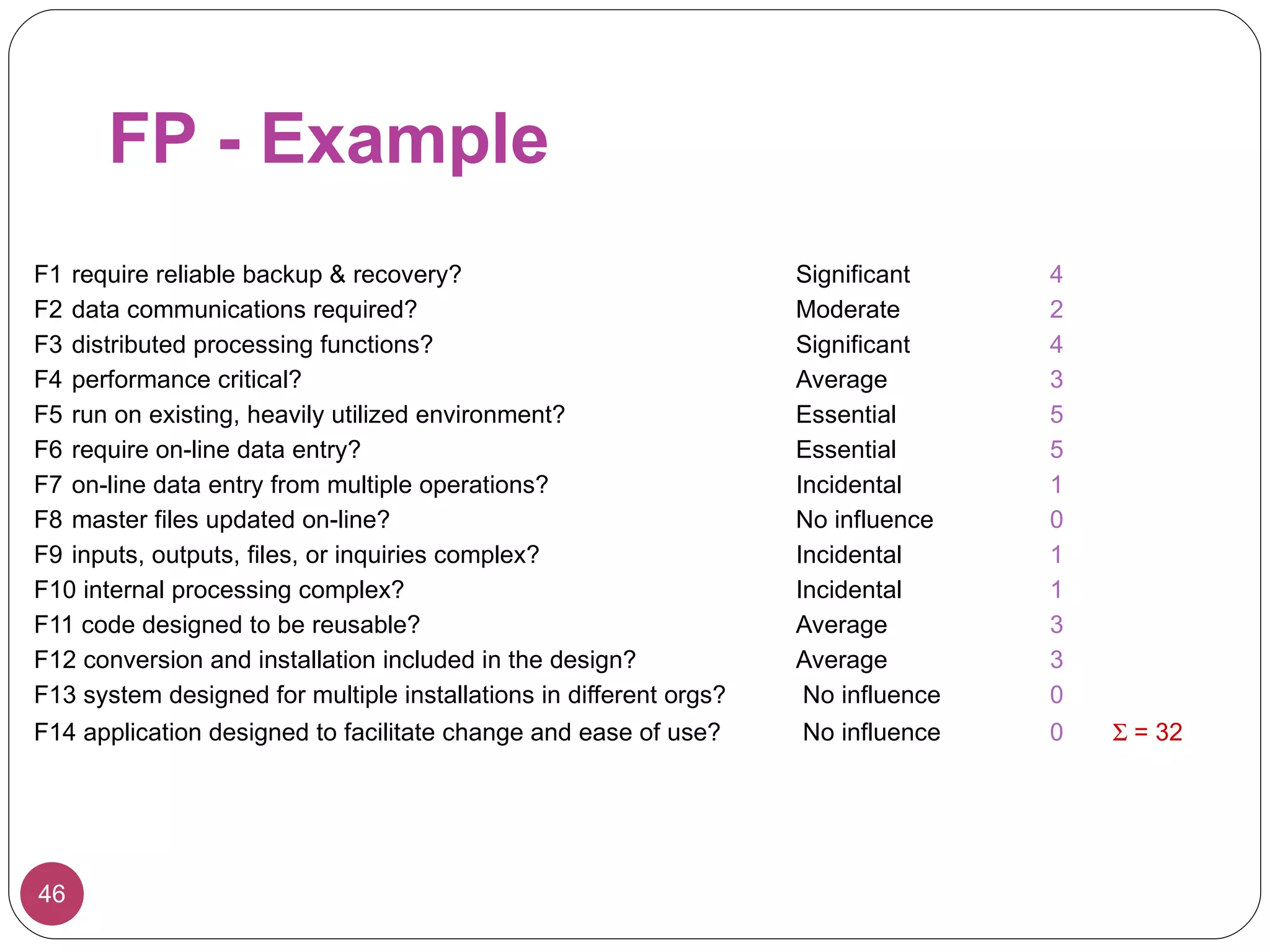
FP - Example F1 require reliable backup & recovery? Significant  4 F2 data communications required? Moderate   2 F3 distributed processing functions? Significant  4 F4 performance critical? Average   3 F5 run on existing, heavily utilized environment? Essential   5 F6 require on-line data entry? Essential   5 F7 on-line data entry from multiple operations? Incidental   1 F8 master files updated on-line? No influence  0 F9 inputs, outputs, files, or inquiries complex? Incidental   1 F10 internal processing complex? Incidental   1 F11 code designed to be reusable? Average   3 F12 conversion and installation included in the design? Average   3 F13 system designed for multiple installations in different orgs?   No influence  0 F14 application designed to facilitate change and ease of use?   No influence  0     = 32
FP - Example AFP = UFP    [0.65 + 0.01       F i  ] =  494     [0.65 + 0.01     32  ] =  479.18 Size of Project = AFP * LOC of a given language = 479.18    106 (COBOL) = 50,793 If it costs $10 for a professional programmer to write 1 LOC, the cost of the system is:  10    50,793 = $507,930
Sites on Function Point An introductory article to function point counting www.davidconsultinggrup.com/articles/pbfpart.htm Freebies on function point www.softwaremetrics.com/freestuff.htm IT Metrics and Productivity Institute www.itmpi.org International Function Point Users Group www.ifpug.org On-line tool for calculating function points http://www.smlab.de/webapplications.html

L06 cost management

  • 1.
    IS5540 Project Management& Quality Assurance Week 6 - Project Cost Management Schwalbe: Managing Information Technology Projects, Chapter 7 Adapted by Janet Yu , Frank Lo
  • 2.
    PMI Framework: 9Knowledge Areas People Integration Scope Time Cost Quality Communication Risk Procurement
  • 3.
    Learning Objectives Explainbasic project cost management principles, concepts, and terms Discuss different types of cost estimates and methods for preparing them Understand the processes involved in cost budgeting and preparing a cost estimate, and budget for an information technology project Understand the benefits of earned value management and project portfolio management to assist in cost control
  • 4.
    The Importance ofProject Cost Management IT projects have a poor track record for meeting budget goals The CHAOS studies found the average cost overrun was: 180 percent in 1994 56 percent in 2004 Other studies found overruns to be 33-34 percent
  • 5.
    Cost Overrun ExamplesThe U.S. Internal Revenue Service (IRS) 1990s: A series of project failures cost taxpayers more than $50 billion a year (=annual net profit of the entire computer industry) In 2004, CIO Magazine reported problems with the IRS’s $8 billion modernization project, resulting in > $200 million cost overrun In 2006, the IRS tried to upgrade its fraud-detection software but project was delayed costing $318 million in fraudulent refunds that didn’t get caught in 2008, a report stated that more than 400 U.S. government agency IT projects, worth an estimated $25 billion , suffer from poor planning and underperformance http://www.cio.com/article/32202/Five_Ongoing_IRS_Modernization_Projects The UK’s National Health Service IT modernization program the greatest IT disaster in history with an estimated $26 billion overrun
  • 6.
    If costs notmanaged carefully…..
  • 7.
    Project Cost ManagementProcesses Estimate costs : developing an approximation or estimate of the costs of the resources needed to complete a project Determine budget : allocating the overall cost estimate to individual work items to establish a baseline for measuring performance Control cost : controlling changes to the project budget
  • 8.
    Basic Principles &Terminology Profits are revenues minus expenditures Profit margin is the ratio of revenues to profits Life cycle costing Considers the total cost of ownership, or development plus support costs, for a project when making financial decisions E.g. Buying a low-cost but low-quality equipment may cost less initially but require a high maintenance fee later on. Cash flow analysis determines the estimated annual costs and benefits for a project and the resulting annual cash flow
  • 9.
    Basic Principles &Terminology Tangible costs or benefits are those costs or benefits that an organization can easily measure in dollars Intangible costs or benefits are costs or benefits that are difficult to measure in monetary terms, e.g improved company image Direct costs are costs that can be directly related to producing the products and services of the project Indirect costs are costs that are not directly related to the products or services of the project Sunk cost is money that has been spent in the past; when deciding what projects to invest in or continue, you should not include sunk costs
  • 10.
    Table 7-1: Costsof Downtime for IT Applications
  • 11.
    Learning curve theory states that when many items are produced repetitively, the unit cost of those items decreases in a regular pattern as more units are produced Reserves are dollars included in a cost estimate to mitigate cost risk by allowing for future situations that are difficult to predict Basic Principles of Cost Management
  • 12.
    Contingency reserves allow for future situations that may be partially planned for To cater for known unknowns E.g. increase in labor and material cost Included in the cost baseline E.g. $10M (Project Budget) + $1M (Contingency Reserve) = $11M (Cost Baseline) Management reserves allow for future situations that are unpredictable To cater for unknown unknowns E.g. supplier goes bankrupt, hurricane Not included in the cost baseline, but included in the total cost budget E.g. $11M (Cost Baseline) + $1.1M (Management Reserve) = $12.1M (Cost Budget) Types of Reserves
  • 13.
    Table 7-2: Typesof Cost Estimates
  • 14.
    Cost Management PlanA Cost Management Plan is a document that describes how the organization will manage cost variance on the project Produced as part of the Project Management Plan
  • 15.
  • 16.
    Cost Estimation Toolsand Techniques Basic tools and techniques for cost estimates Analogous or top-down estimates : use the actual cost of a previous, similar project as the basis for estimating the cost of the current project. E.g. cost of renovating a house Bottom-up estimates : involve estimating individual work items or activities and summing them to get a project total Parametric modeling : uses project characteristics (parameters) in a mathematical model to estimate project costs. E.g. no. of workstations x cost of installation per workstation
  • 17.
    Figure 7-2: SurveyorPro Project Cost Estimate
  • 18.
    Figure 7-3: SurveyorPro Software Development Estimate
  • 19.
  • 20.
    Determine Budget Animportant goal is to produce a cost baseline A time-phased budget that project managers use to measure and monitor cost performance
  • 21.
    Figure 7-4: SurveyorPro Project Cost Baseline *Numbers are rounded, so some totals appear to be off.
  • 22.
    Steps to ComeUp with a Project Budget? Cost Budget Management Reserve Cost Baseline Contingency Reserve Project Work Packages Activities ? ? ? ? ?
  • 23.
  • 24.
    Control Costs Monitoringcost performance Ensuring that only appropriate project changes are included in a revised cost baseline Informing project stakeholders of authorized changes to the project that will affect costs
  • 25.
    Earned Value Management(EVM) EVM is a project performance measurement technique that integrates scope, time, and cost data Given a baseline (original plan plus approved changes), you can determine how well the project is meeting its goals You must enter actual information periodically to use EVM
  • 26.
    Earned Value Management(EVM) Planned Value (PV) How much work should have been done? Earned Value (EV) How much work has been done? Actual Cost (AC) How much has been spent? Budget At Completion (BAC) What was the entire project supposed to cost? Estimate At Completion (EAC) What is the project expected to cost now?
  • 27.
    Earned Value Management(EVM) Cost Variance (CV) Deviation from the original budget (in monetary terms)? Schedule Variance (SV) Deviation from the original schedule (in monetary terms)? Cost Performance Index (CPI) How well is the WBS component doing in terms of cost? Schedule Performance Index (SPI) How well is the WBS component doing in terms of schedule?
  • 28.
    EVM Example – Programming Project Plan 10 months to complete the project 10 programs to write Each requires 1 month to write Each costs $10K to write Actual after 3 months Has written 2 programs Has spent $16K
  • 29.
    Summary of FormulaePV Planned Value Budgeted cost for the work scheduled EV Earned Value Budgeted amount for the work actually completed AC Actual Cost The total cost incurred BAC Budget at Completion Original budget CV Cost Variance EV – AC CPI Cost Performance Index EV / AC SV Schedule Variance EV – PV SPI Schedule Performance Index EV / PV ETC Estimate to Complete (BAC - EV) / CPI (assuming typical variances) EAC Estimate at Completion AC + ((BAC – EV) / CPI) or simply BAC / CPI VAC Variance at Completion BAC – EAC Estimated Time to Complete Original time estimate / SPI
  • 30.
    Performance of ProgrammingProject PV Planned Value $10K x 3 = $30K EV Earned Value $10K x 2 = $20K AC Actual Cost $16K BAC Budget at Completion $10K x 10 = $100K CV Cost Variance $20K – $16K = $4K CPI Cost Performance Index $20K / $16K = 1.25 SV Schedule Variance $20K – $30K = $-10K SPI Schedule Performance Index $20K / $30K = 0.67 ETC Estimate to Complete ($100K - $20K) / 1.25 = $64K EAC Estimate at Completion $16K + $64K = $80K $100K / 1.25 = $80K VAC Variance at Completion $100K - $80K = $20K Estimated Time to Complete
  • 31.
    Rate of PerformanceRate of performance (RP) = Actual work completed / work planned to have been completed For example, suppose the server installation was halfway completed by the end of week 1 but planned schedule shows the task should be 100% completed Actual work completed 50% Work planned to have been completed 100%  Rate of performance = 50%
  • 32.
    Rules of Thumbfor Earned Value Numbers Problem appears when: Negative numbers for cost or schedule variance CPI or SPI less than 100% Problems mean the project is costing more than planned (over budget) or taking longer than planned (behind schedule)
  • 33.
    Figure 7-5: EarnedValue Chart for Project after Five Months
  • 34.
    Quick Quiz (1)1.What kind of cost estimate will you give at the initiation stage of the project? 2.I decided to select a cheaper brand in order to lower the project cost though I understood that the maintenance cost would be much higher than other brands. Which cost management principle did I violate? 3.By carrying out the project, the image of the company can be improved, this is __________ benefit.
  • 35.
    Quick Quiz (2)4.If you are asked to give an accurate cost estimate for your project, which cost estimating method will you use? 5.The approved total cost estimate for the project is called the ___________. 6.A time-phased budget for the project for measuring performance is called the __________. 7.The technique that you’ll use in cost control is called __________. 8.Which reserve is not part of the cost baseline?
  • 36.
    Steps to ComeUp with a Project Budget? Cost Budget Management Reserve Cost Baseline Contingency Reserve Project Work Packages Activities 10 + 20 30 + 40 30 70 100 100 x 10% = 10 100 + 10 = 110 (time-phased) 110 x 10% = 11 110 + 11 = 121 $
  • 37.
    Revision Concepts andterminology Life cycle costing Cash flow analysis Tangible Vs intangible costs Direct Vs indirect costs Sunk cost Order of magnitude Vs Budgetary Vs Definitive Reserves Contingency reserves Management reserves Cost estimating methods Analogous / top-down Bottom-up Parametric modeling Cost Baseline Earned Value Management (EVM)
  • 38.
  • 39.
    Basic Functions Classificationoutputs ( OT ): data items produced for the external world inputs (IT): data items from external world to software inquiries (QT): inputs that cause some database lookup and response files (FT): externally observable data stores interfaces (EI): connections to other systems
  • 40.
    Function Complexity WeightingsFunction Type Low Average High External Input 3 4 6 External Output 4 5 7 Logical Internal File 7 10 15 Ext. Interface File 5 7 10 External Inquiry 3 4 6 1-5 Data element types 6-19 Data element types 20+ Data element types 0-1 File types referenced Low Low Average 2-3 File types referenced Low Average High 4+ File types referenced Average High High
  • 41.
    Computing Raw FPCount Raw FP Count = 4*OTs + 5*OTa + 7*OTc + 3*ITs + 4*ITa + 6*ITc + 3*QTs + 4*QTa + 6*QTc + 7*FTs + 10*FTa + 15*FTc + 5*EIs + 7*EIa + 10*EIc
  • 42.
    Complexity Adjustment FactorsData Communications Distributed Functions Performance Heavily Used Configuration Transaction Rate Online Data Entry End User Efficiency Online Update Complex Processing Re-useability Installation Ease Operational Ease Multiple Sites Facilitate Change 0 (not important) to 5 (very important)
  • 43.
    Computing the FunctionPoint Value UFP = raw FP count CAFP = 0.65 + (Complexity Adjustment Score) / 100 AFP = UFP * CAFP Size of Project = AFP * LOC of a given language (LOC is adjusted by individual organization) UFP: Unadjusted Function Point CAF: Complexity Adjustment Function Point AFP: Adjusted Function Point
  • 44.
    FP - ExampleBank accounts record system involving 36 user inputs simple complexity 5 user outputs average complexity 20 user inquiries simple complexity 40 files accessed simple complexity 3 external interfaces average complexity
  • 45.
    FP - ExampleComplexity Weighting simple average complex product 36 user inputs 36  3 + __  4 + __  6 = 108 5 user outputs __  4 + 5  5 + __  7 = 25 20 user inquiries 20  3 + __  4 + __  6 = 60 40 files 40  7 + __  10+__  15 = 280 3 external interfaces __  5 + 3  7 + __  10 = 21 TOTAL UFP = 494
  • 46.
    FP - ExampleF1 require reliable backup & recovery? Significant 4 F2 data communications required? Moderate 2 F3 distributed processing functions? Significant 4 F4 performance critical? Average 3 F5 run on existing, heavily utilized environment? Essential 5 F6 require on-line data entry? Essential 5 F7 on-line data entry from multiple operations? Incidental 1 F8 master files updated on-line? No influence 0 F9 inputs, outputs, files, or inquiries complex? Incidental 1 F10 internal processing complex? Incidental 1 F11 code designed to be reusable? Average 3 F12 conversion and installation included in the design? Average 3 F13 system designed for multiple installations in different orgs? No influence 0 F14 application designed to facilitate change and ease of use? No influence 0  = 32
  • 47.
    FP - ExampleAFP = UFP  [0.65 + 0.01   F i ] = 494  [0.65 + 0.01  32 ] = 479.18 Size of Project = AFP * LOC of a given language = 479.18  106 (COBOL) = 50,793 If it costs $10 for a professional programmer to write 1 LOC, the cost of the system is: 10  50,793 = $507,930
  • 48.
    Sites on FunctionPoint An introductory article to function point counting www.davidconsultinggrup.com/articles/pbfpart.htm Freebies on function point www.softwaremetrics.com/freestuff.htm IT Metrics and Productivity Institute www.itmpi.org International Function Point Users Group www.ifpug.org On-line tool for calculating function points http://www.smlab.de/webapplications.html

Editor's Notes

  • #6 The United Kingdom’s National Health Service (NHS) IT modernization program A ten-year program started in 2002 to provide An electronic patient records system Appointment booking A prescription drug system Was called the greatest IT disaster in history by a London columnist Estimate to cost > $55 billion, with an estimated $26 billion overrun