Why Project Planning ? History of Project Management Meaning of a Project Types of Projects Definition of a Project Advantages of project based approach What happens if the project consciousness is not there? Planning & Project Planning Project Plan Characteristics of a project Elements of a Project Project Objectives Project Plan components What are the differences between projects and operations (regular administration) ? What is Project Management? Definition of Project Management Project Management Tools .. activities What is a successful project? Problem & Objective Analysis  Project Life Cycle Phases Conception Phase  Definition Phase  Programming / organizing Phase Implementation Phase Termination Phase Project Sustainability
Why Project Planning ?  One Of the most important administrative developments in the developed as well as in developing countries has been the initiation and growth of a large number of new programs/projects in every field like agriculture, irrigation, industry, community development, health & social welfare etc.. The principle aims and objectives of all these programs have been to bring about overall changes in the existing socio-economic structure in the country providing thereby dignified way of life to a citizen as a unit and socio-economic upliftment of the society. So most of the administrators are directly concerned with the program / project administration than other activities.  The capability of administrative system to formulate and implement, relevant and in viable programs effectively constitutes a crucial element in the process of development.  Development requires planning and planning includes a lot of programs / projects.
History of Project Management As a discipline, Project Management developed from different fields of application including construction, engineering, and defense. In the United States, the forefather of project management is Henry Gantt, called the father of planning and control techniques, who is famously known for his use of the "Gantt" chart as a project management tool. He was associated with Frederick Winslow Taylor's theories of scientific management and for his study of the work and management of Navy ship building. His work is the forerunner to many modern project management tools including the work breakdown structure (WBS) and resource allocation. The 1950s marked the beginning of the modern project management era. Again, in the United States, prior to the 1950s, projects were managed on an ad hoc basis using mostly Gantt Charts, and informal techniques and tools. At that time, two mathematical project scheduling models were developed: (1) the "Program Evaluation and Review Technique" or PERT, developed by Booz-Allen & Hamilton as part of the United States Navy's (in conjunction with the Lockheed Corporation) Polaris missile submarine program; and (2) the "Critical Path Method" (CPM) developed in a joint venture by both DuPont Corporation and Remington Rand Corporation for managing plant maintenance projects. These mathematical techniques quickly spread into many private enterprises.
Meaning of a Project Origin The word project comes from the Latin word projectum from projicere, "to throw something forwards" which in turn comes from pro-, which denotes something that precedes the action of the next part of the word in time (paralleling the Greek πρό) and jacere, "to throw". The word "project" thus originally meant "something that comes before anything else is done". When the word was initially adopted, it referred to a plan of something, not to the act of actually carrying this plan out. Something performed in accordance with a project was called an object. This use of "project" changed in the 1950s when several techniques for project management were introduced. With this advent the word slightly changed meaning to cover both projects and objects. However in certain projects there may still exist so called objects and object leaders.
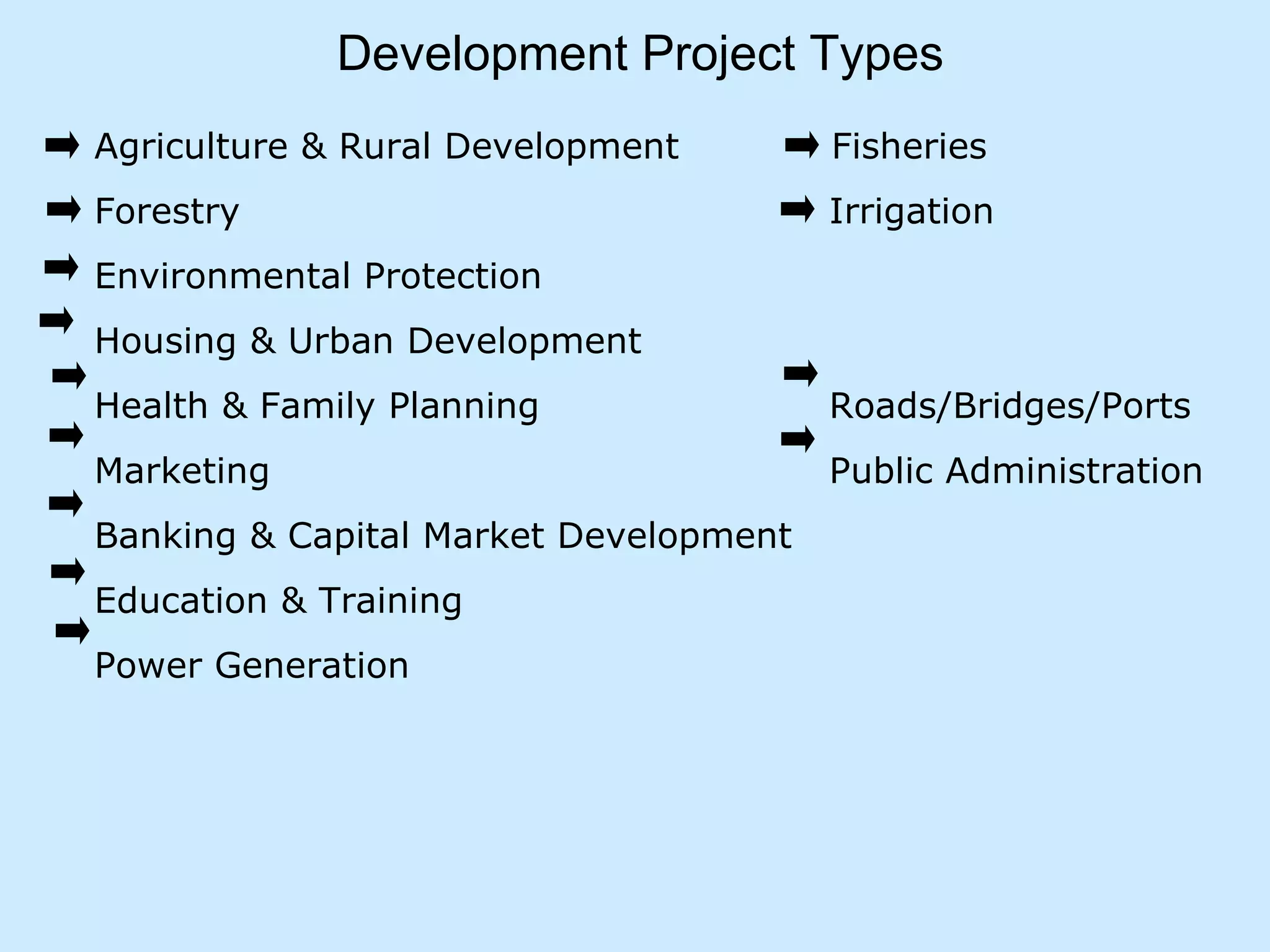
Development   Project Types Agriculture   & Rural Development    Fisheries  Forestry    Irrigation  Environmental Protection  Housing & Urban Development Health & Family Planning   Roads/Bridges/Ports Marketing    Public Administration Banking & Capital Market Development   Education & Training Power Generation
Types of Projects
Example of AGRICULTURAL Projects  PROJECT :  Immediate Deliverables Irrigation Systems  Built Irrigation Service Associations  Formed Technical Extension Services  Provided   Farmers  Trained   Seed, Fertilizer, Credit  Provided   PROGRAM :  Sustainable Results Intended Increased  Productivity  &  Production Increased   Farm  Family  Incomes Increased   Food  Availability
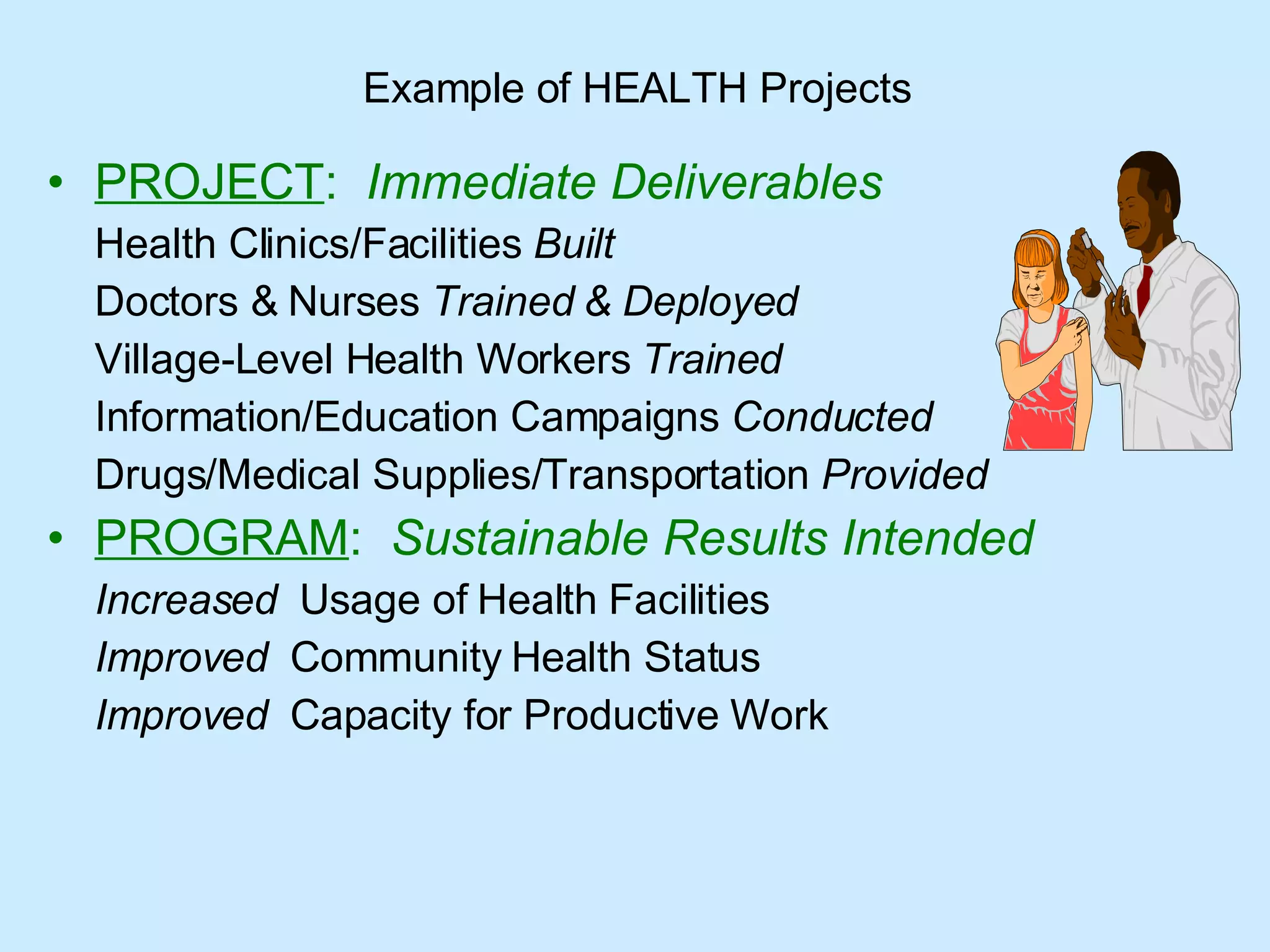
Example of HEALTH Projects PROJECT :  Immediate Deliverables Health Clinics/Facilities  Built Doctors & Nurses  Trained & Deployed   Village-Level Health Workers  Trained Information/Education Campaigns  Conducted Drugs/Medical Supplies/Transportation  Provided PROGRAM :  Sustainable Results Intended Increased   Usage of Health Facilities Improved   Community Health Status Improved   Capacity for Productive Work
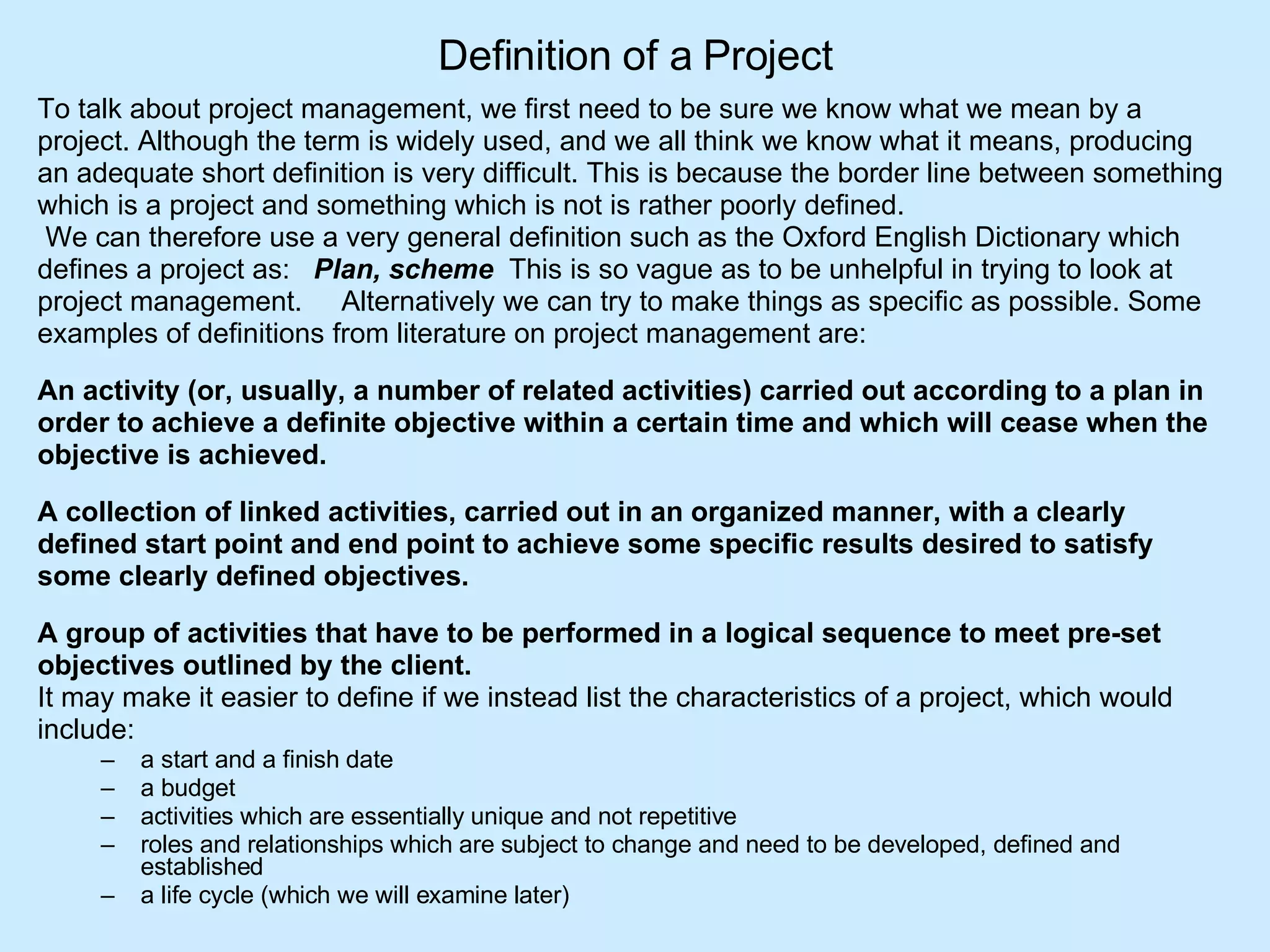
Definition of a Project To talk about project management, we first need to be sure we know what we mean by a  project. Although the term is widely used, and we all think we know what it means, producing  an adequate short definition is very difficult. This is because the border line between something  which is a project and something which is not is rather poorly defined.  We can therefore use a very general definition such as the Oxford English Dictionary which  defines a project as:    Plan, scheme   This is so vague as to be unhelpful in trying to look at  project management.     Alternatively we can try to make things as specific as possible. Some  examples of definitions from literature on project management are:  An activity (or, usually, a number of related activities) carried out according to a plan in  order to achieve a definite objective within a certain time and which will cease when the  objective is achieved.   A collection of linked activities, carried out in an organized manner, with a clearly  defined start point and end point to achieve some specific results desired to satisfy  some clearly defined objectives.      A group of activities that have to be performed in a logical sequence to meet pre-set  objectives outlined by the client.   It may make it easier to define if we instead list the characteristics of a project, which would  include: a start and a finish date  a budget  activities which are essentially unique and not repetitive  roles and relationships which are subject to change and need to be developed, defined and established  a life cycle (which we will examine later)
Definition of a Project…  2 Programs / Projects are tools to achieve the plan goals . E.g. Plan goal – Removal of poverty. Plan tool – IRDP, JRY, TRYSEM etc. A project is an investment of resources in a package of interrelated time found activities.  Thus a project becomes a time found task.  A Project should have definite beginning and an end. A project can be defined as a scientifically evolved work plan devised to achieve specific objectives within a specific period of time. A project is a temporary endeavour undertaken to create a product or service   Something with a beginning, middle and end. Something that has a clear objective and somebody responsible for it. Something that can be measured and achieved.
Definition of a Project…  3 Work undertaken to achieve an objective “ A temporary endeavour undertaken to create a unique product, service or result.” Temporary -Every project has a definite beginning and a definite end  Unique -Projects produce things that have not been produced before Work involving a certain degree of uncertainty (i.e. risk) Work that must be progressively elaborated Examples of projects are: Development of a new product or service A planned action of social intervention Development and execution of an advocacy campaign
Project  ….explanations  -   Performed by people. - Constrained by limited resources.   - Planned, executed, and controlled. example:  . Developing a new or service. . Effecting a change in structure, staffing, or style of an organization. . Designing a new transportation route. . Developing or acquiring a new or modified information system. . Constructing a building or facility. . Building a water system for a community. . Running a campaign for political office. . Implementing a new service procedure or process.
What is a Project? Output (Objective & Scope) Time (Duration) Resource (Man power, Facilities,  Money…) What are the requirements? How much the cost? Benefit Basis Three Elements of Project Start Date End Date ? What is the Output ? Purpose & Scope Service Performance specification
Advantages of project based approach Project based approach is particularly liked by Western business, which are characterized by a modern matrix organization and a cooperative culture. In case of authoritarian, bureaucratic organizations with rigid, hierarchical structure project based work is less popular, or does not work as expected due to the conflict between different cultures.
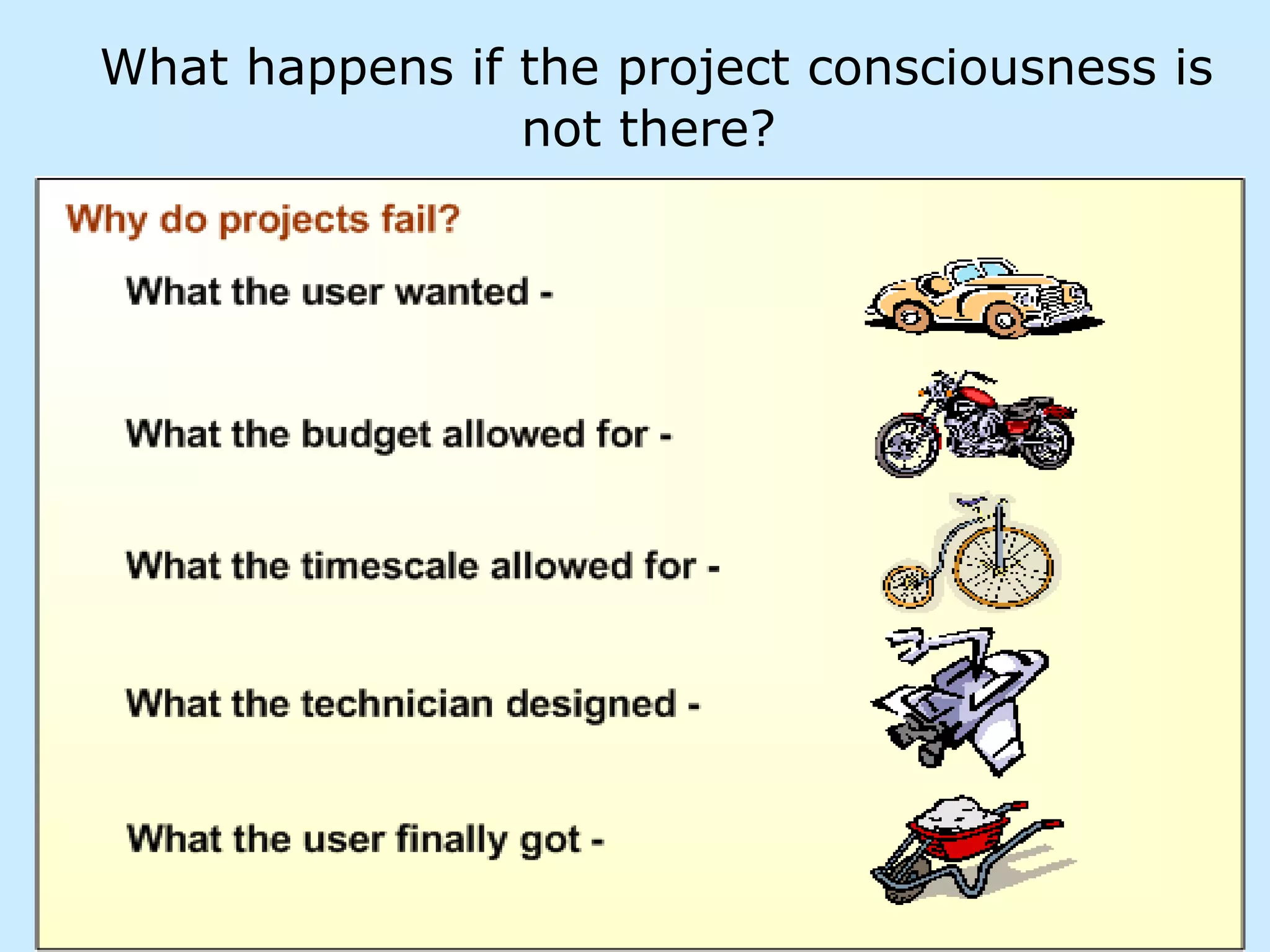
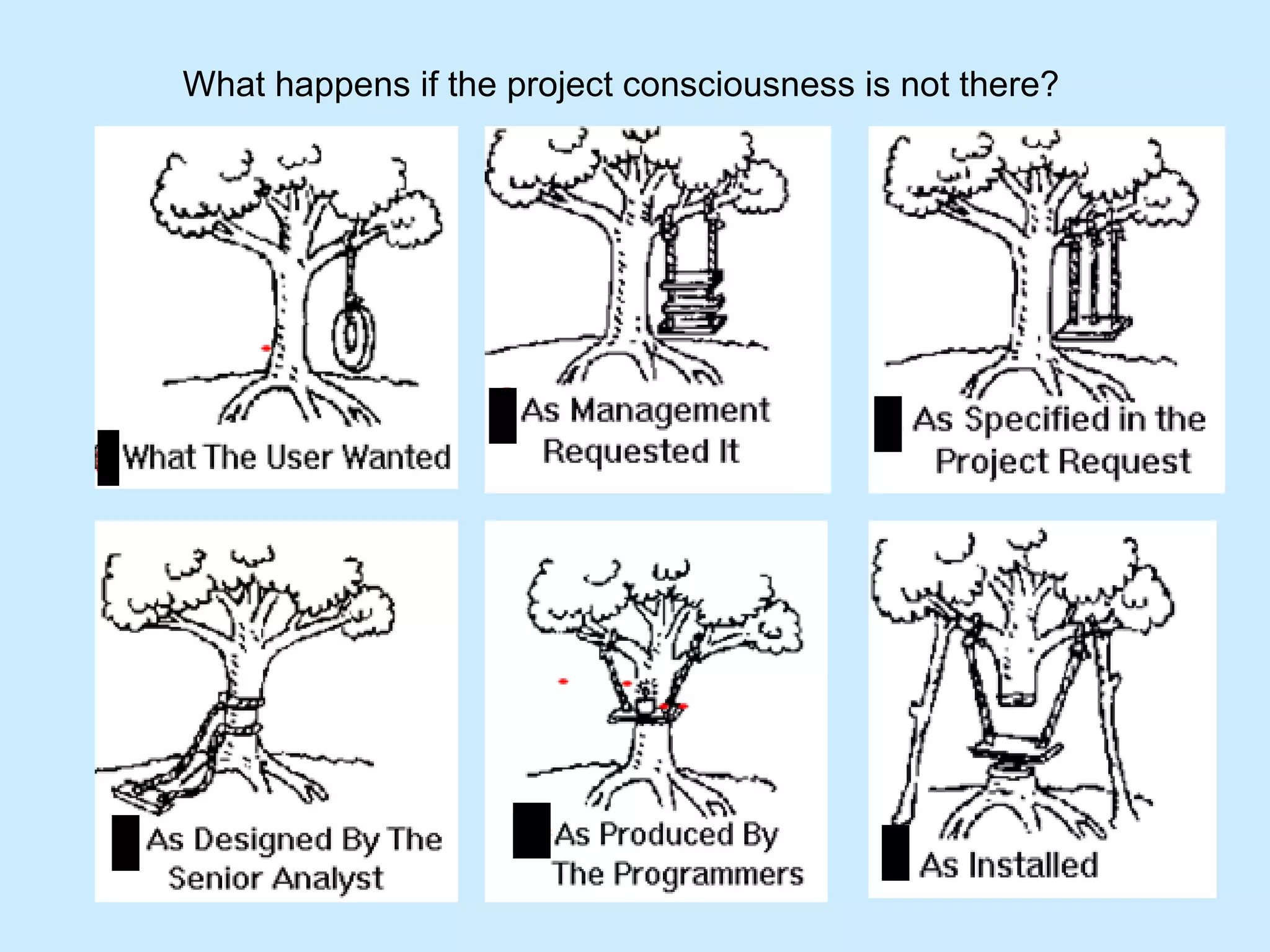
What happens if the project consciousness is not there?
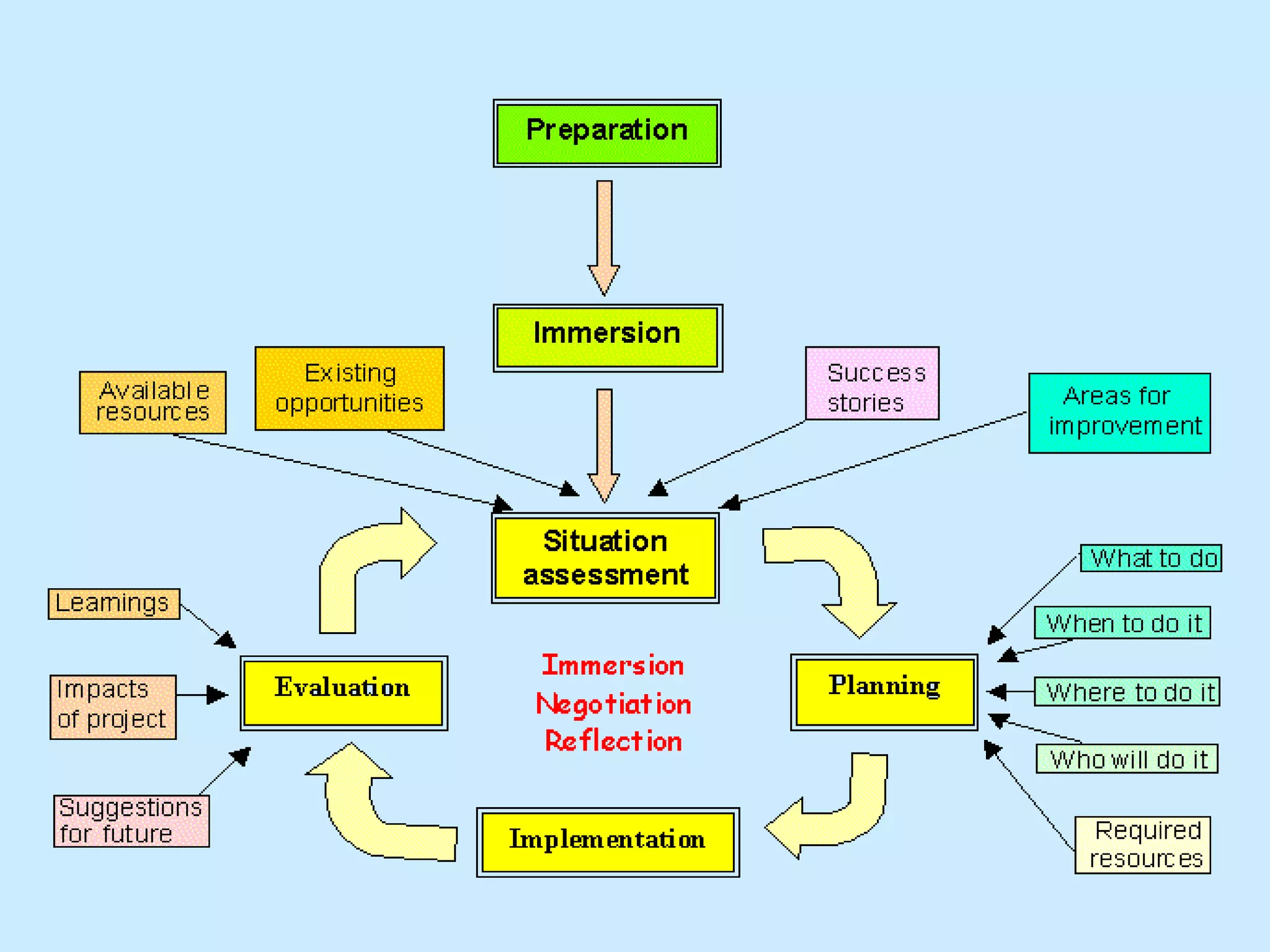
Planning & Project Planning  What is a plan?  What is planning? Why should we plan at all? What benefits does it provide? How much planning we need or don’t need? How does one plan? What are some useful planning models? What are some basic obstacles to planning? How do we confront them? Plan and Planning: A plan is a set of decisions made on actions to be taken to reach a goal. It is the product of the process of planning. Planning is an active process and it is opposite of simply allowing events to unfold. A plan can be said to exist when a point in the planning process has been reached. Plan (appoint in the planning process) is coherent set of operations designed to meet a given goal. It is determined with sufficient clarity that may be acted upon. A plan can be a very formal document, or it can simply be the clear understanding of the actions you are going to undertake. Both plan and planning is a never-ending activity. Your plan will be shaped and reshaped by new forces and new information you discover as you proceed with your action. Planning involves vision, discovery, decision-making and action. It is a purposeful way of looking at the future with the intent to shape it.
Project Plan A  project plan  is "A formal, approved document used to guide both project execution and project control. The primary uses of the project plan are to document planning assumptions and decisions, facilitate communication among stakeholders, and document approved scope, cost, and schedule baselines. A project plan may be summary or detailed." "a statement of how and when a project's objectives are to be achieved, by showing the major products, milestones, activities and resources required on the project”.
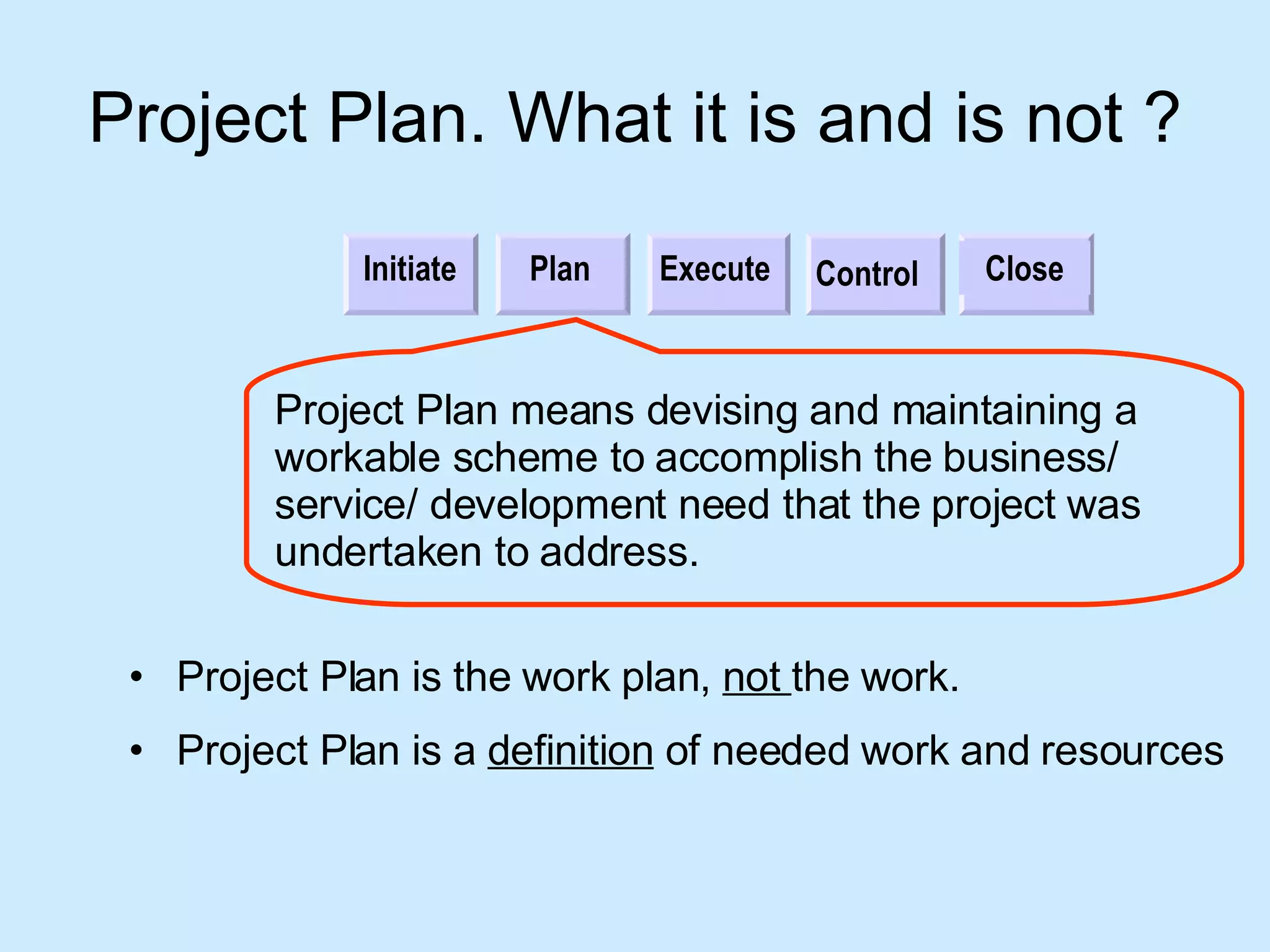
Project Plan. What it is and is not ? Initiate Plan Execute Control Close Project Plan means devising and maintaining a workable scheme to accomplish the business/ service/ development need that the project was undertaken to address.  Project Plan  is the work plan,  not  the work. Project Plan  is a  definition  of needed work and resources
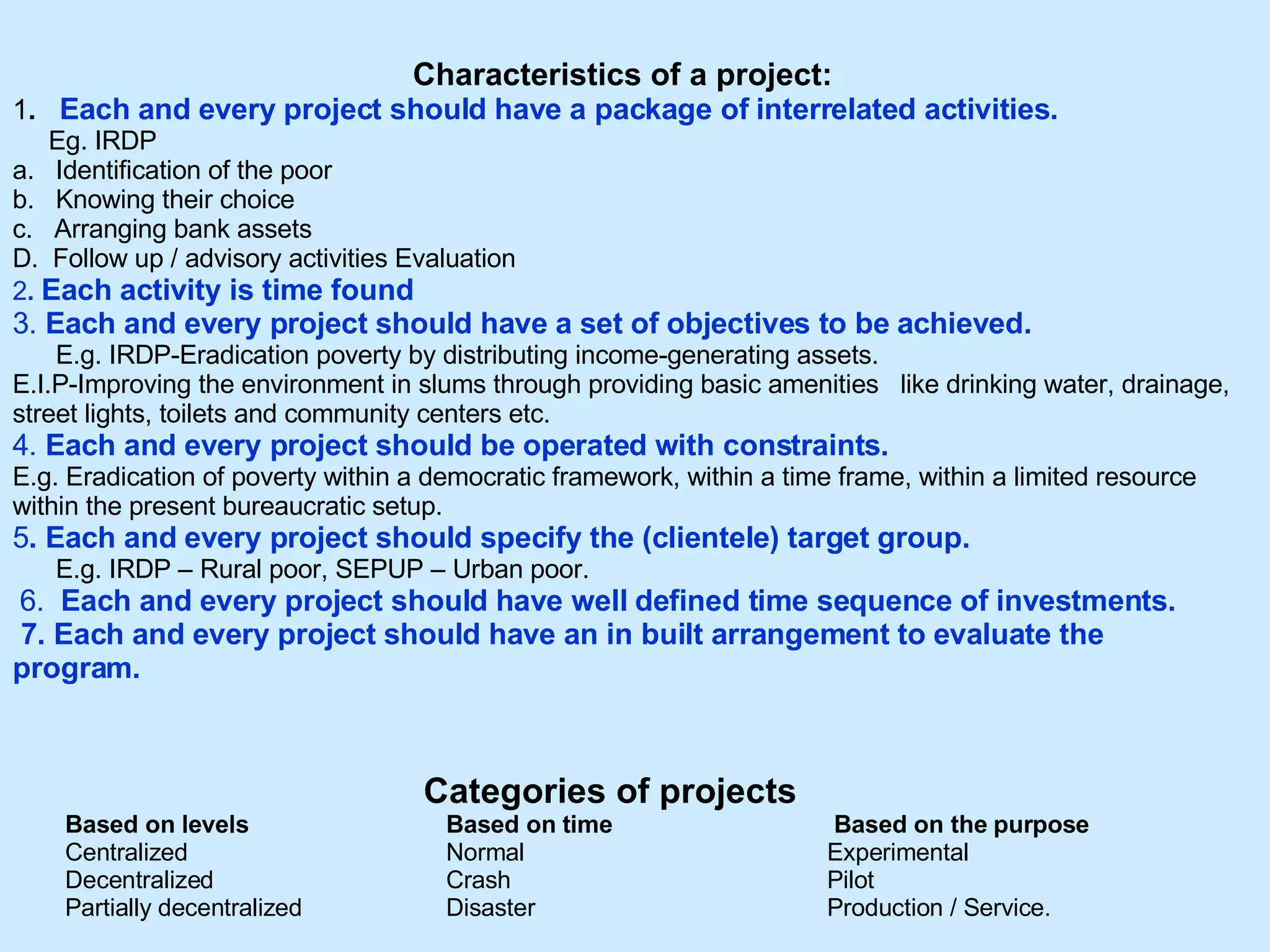
Characteristics of a project: 1 .  Each and every project should have a package of interrelated activities. Eg. IRDP  a.  Identification of the poor b.  Knowing their choice c.  Arranging bank assets D.  Follow up / advisory activities Evaluation 2 .   Each activity is time found 3.  Each and every project should have a set of objectives to be achieved. E.g. IRDP-Eradication poverty by distributing income-generating assets. E.I.P-Improving the environment in slums through providing basic amenities  like drinking water, drainage, street lights, toilets and community centers etc. 4.  Each and every project should be operated with constraints. E.g. Eradication of poverty within a democratic framework, within a time frame, within a limited resource within the present bureaucratic setup.  5 . Each and every project should specify the (clientele) target group. E.g. IRDP – Rural poor, SEPUP – Urban poor. 6.  Each and every project should have well defined time sequence of investments. 7. Each and every project should have an in built arrangement to evaluate the program. Categories of projects Based on levels  Based on time   Based on the purpose   Centralized  Normal  Experimental  Decentralized  Crash Pilot  Partially decentralized  Disaster Production / Service.
Elements of Projects Complex , one-time processes Limited  by budget, schedule, and resources Developed to resolve a  clear goal  or set of goals Customer / Client -focused General Project Characteristics Ad-hoc  endeavors with a clear life cycle Building blocks  in the design and execution of organizational  strategies Responsible for the  newest  and most improved  products , services, and organizational  processes Provide a philosophy and strategy for the  management of change Entail  crossing  functional and organization  boundaries Traditional management functions  of planning, organizing, motivating, directing, and controlling apply  Principal outcomes are the  satisfaction of customer  requirements within  technical ,  cost , and  schedule   constraints Terminated  upon successful completion
Project   Objectives Project objectives define target status at the end of the project, reaching of which is considered necessary for the achievement of planned benefits. They can be formulated as  S.M.A.R.T. S pecific,  M easurable (or at least evaluable) achievement,  A chievable (recently Acceptable is used regularly as well),  R ealistic and  T ime terminated (bounded).  The evaluation (measurement) occurs at the project closure. However a continuous guard on the project progress should be kept by monitoring and evaluating.
Project Plan components Project Formulation: Project formulation means developing our ideas in a good shape so as to present it to decision-makers to take correct investment decisions.  Thus, project formulation refers to a series of steps to be taken to convert an idea or aspiration into a feasible plan of action . A Project Plan contains information that will help complete the project successfully. Success factors can be quickly summarized by answering the following questions: What and Why? - A project plan will contain a description of the project, what is the Vision and why the project is being executed.  Who? - Who will be involved and what will be their responsibilities within the project  When? - When will the project happen and also major milestones  How? - How the project will be executed, meaning how it will be executed and controlled. Normally this information refers mostly to the controlling of the project as the detailed project actions will be detailed in other documents such as the IT plan, the Procurement plan, the Construction plan, etc.
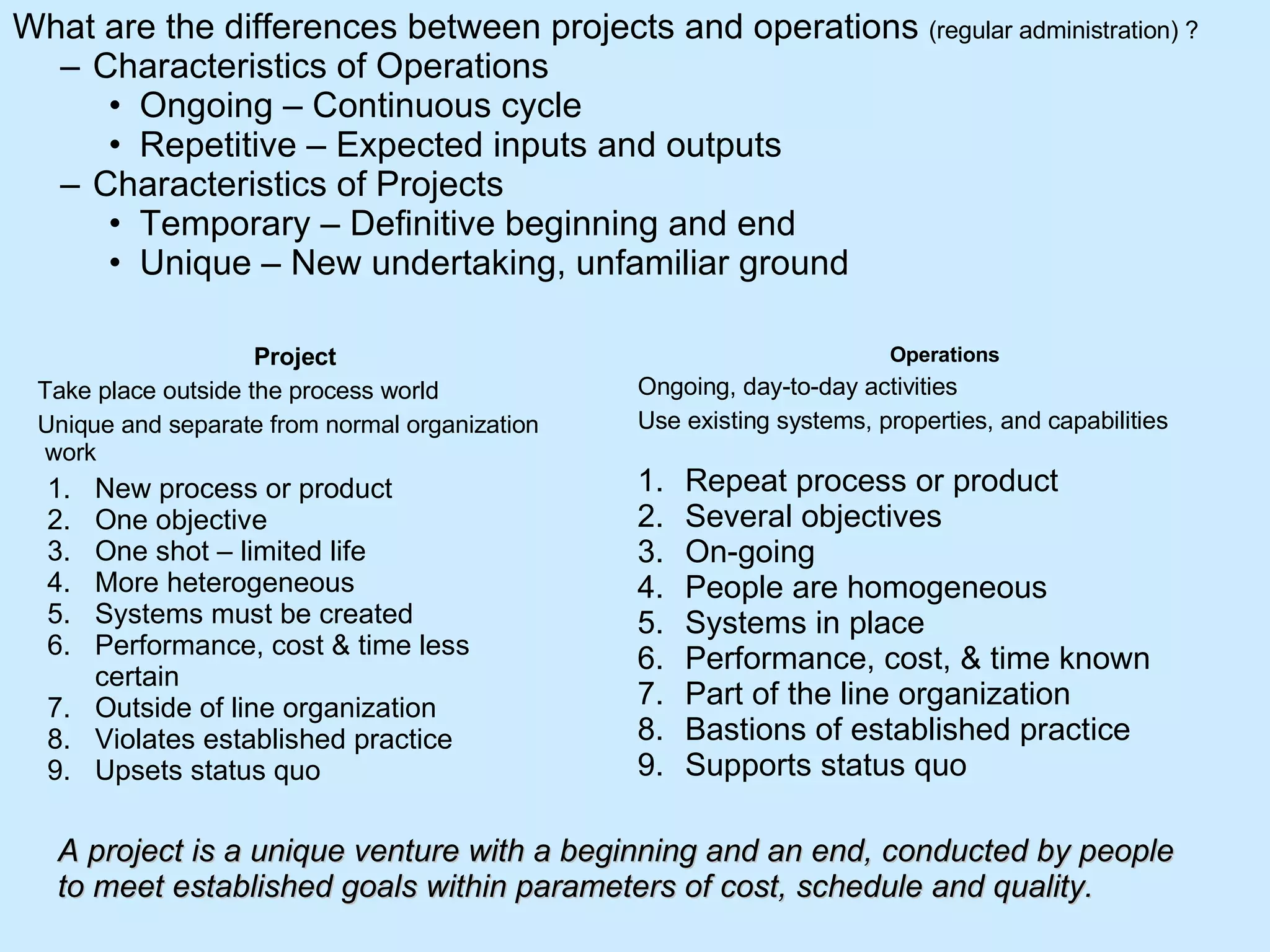
What are the differences between projects and operations  (regular administration) ? Characteristics of Operations Ongoing – Continuous cycle Repetitive – Expected inputs and outputs Characteristics of Projects Temporary – Definitive beginning and end Unique – New undertaking, unfamiliar ground Project Take place outside the process world Unique and separate from normal organization work Operations  Ongoing, day-to-day activities Use existing systems, properties, and capabilities A project is a unique venture with a beginning and an end, conducted by people to meet established goals within parameters of cost, schedule and quality. Repeat process or product Several objectives On-going People are homogeneous Systems in place  Performance, cost, & time known Part of the line organization Bastions of established practice Supports status quo New process or product One objective One shot – limited life More heterogeneous Systems must be created Performance, cost & time less certain Outside of line organization Violates established practice Upsets status quo
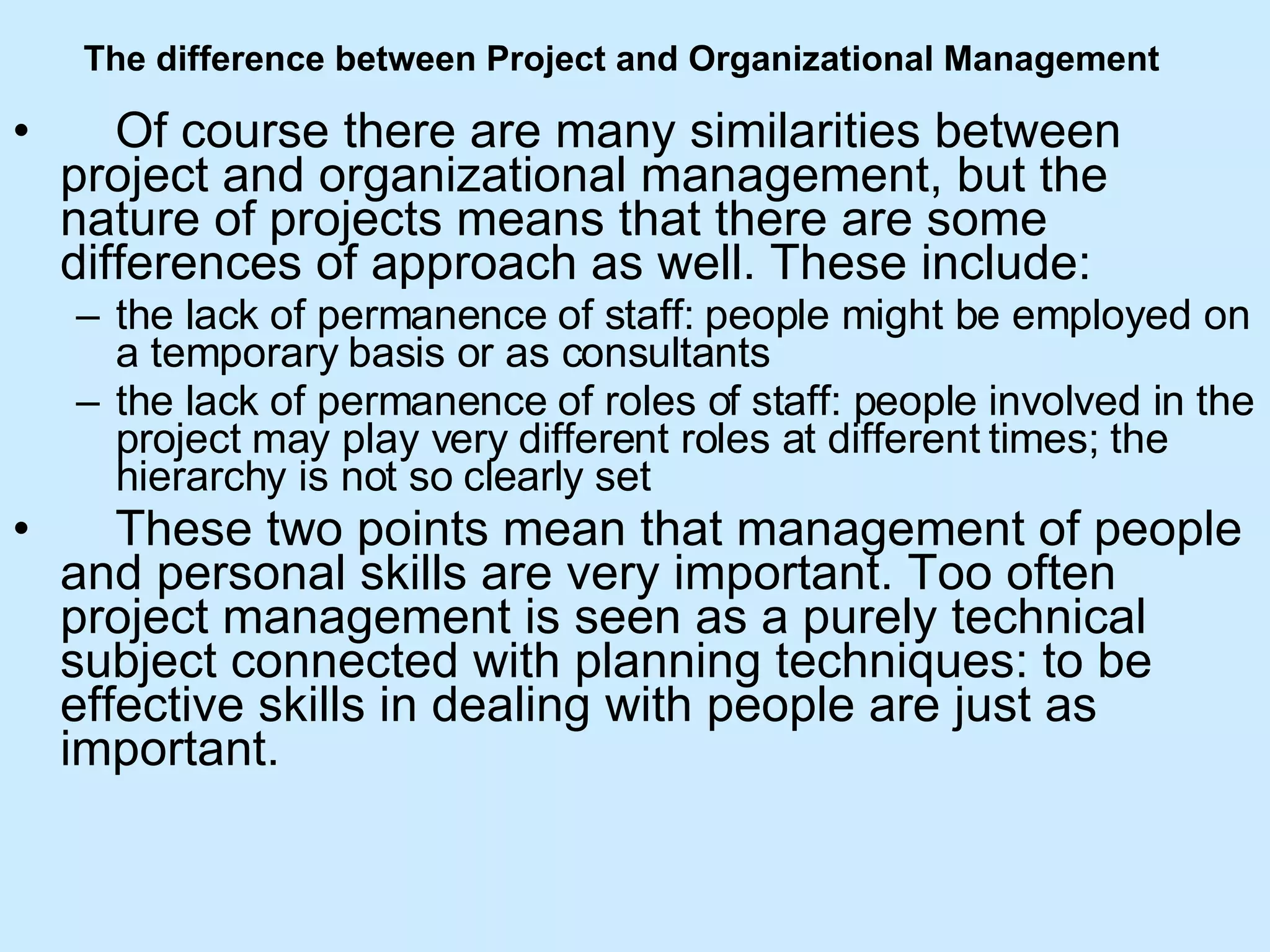
The difference between Project and Organizational Management        Of course there are many similarities between project and organizational management, but the nature of projects means that there are some differences of approach as well. These include: the lack of permanence of staff: people might be employed on a temporary basis or as consultants  the lack of permanence of roles of staff: people involved in the project may play very different roles at different times; the hierarchy is not so clearly set       These two points mean that management of people and personal skills are very important. Too often project management is seen as a purely technical subject connected with planning techniques: to be effective skills in dealing with people are just as important.
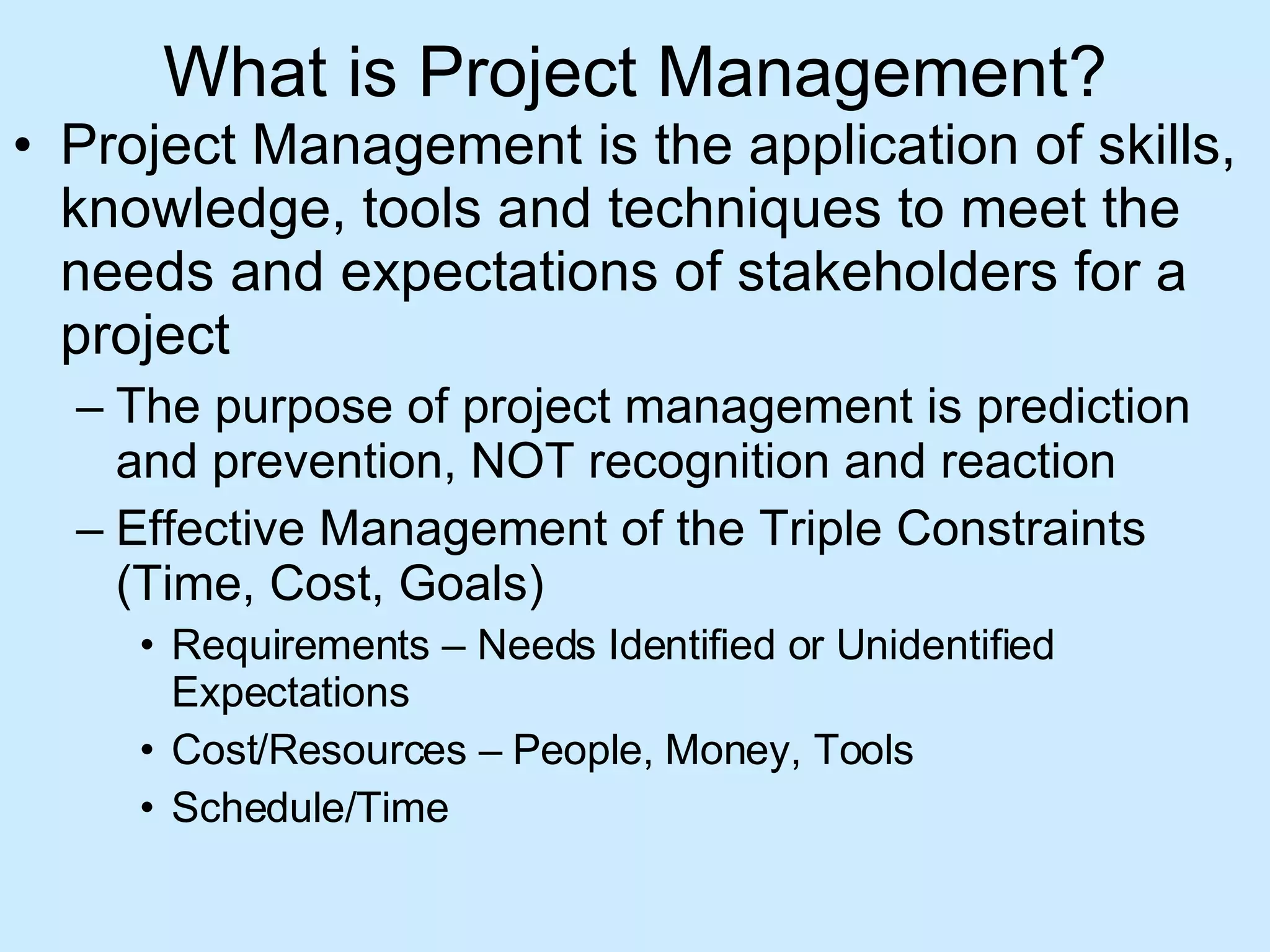
What is Project Management? Project Management is the application of skills, knowledge, tools and techniques to meet the needs and expectations of stakeholders for a project The purpose of project management is prediction and prevention, NOT recognition and reaction Effective Management of the Triple Constraints (Time, Cost, Goals) Requirements – Needs Identified or Unidentified Expectations Cost/Resources – People, Money, Tools Schedule/Time
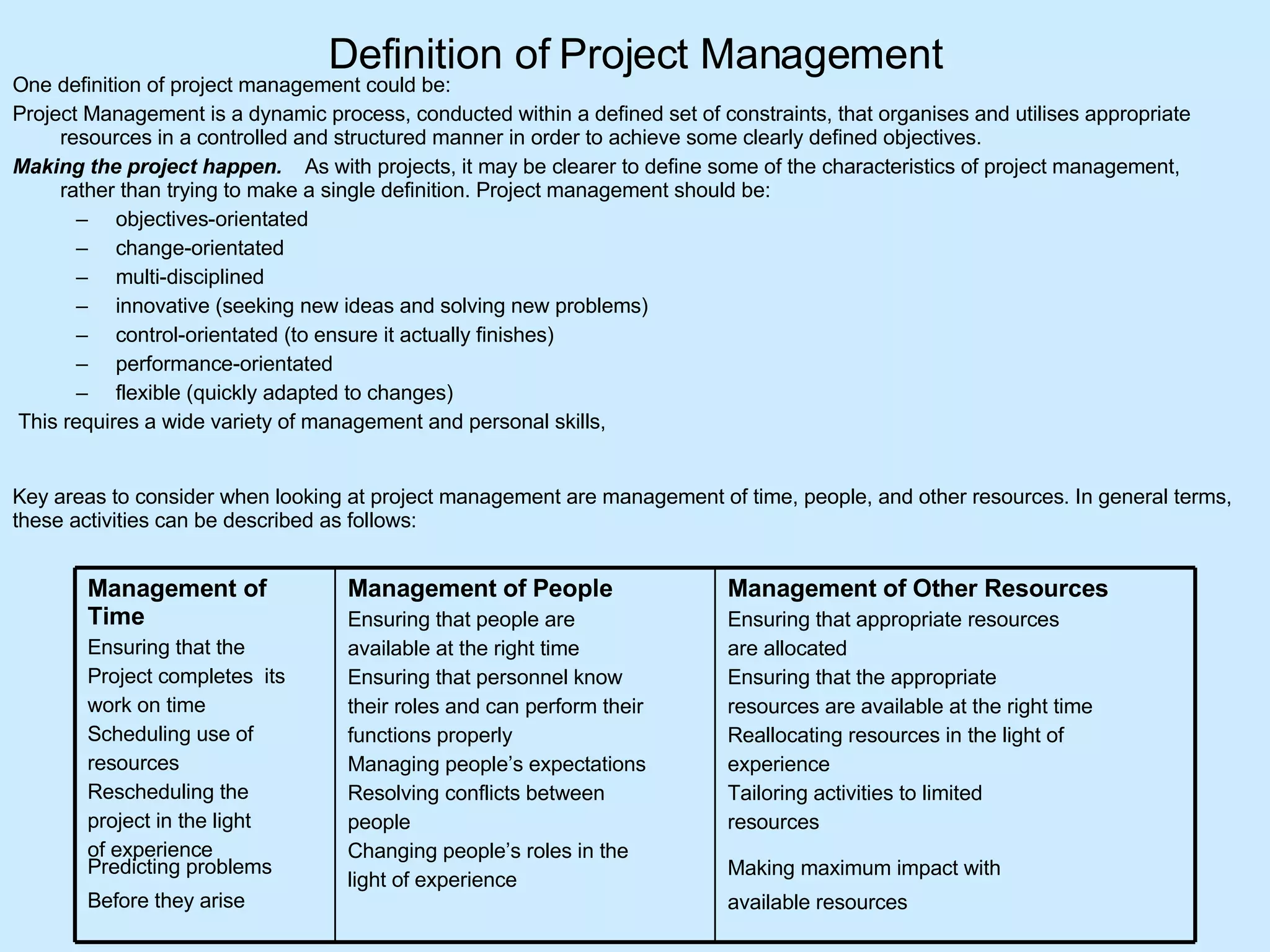
Definition of Project Management One definition of project management could be:  Project Management is a dynamic process, conducted within a defined set of constraints, that organises and utilises appropriate resources in a controlled and structured manner in order to achieve some clearly defined objectives. Making the project happen.     As with projects, it may be clearer to define some of the characteristics of project management, rather than trying to make a single definition. Project management should be: objectives-orientated  change-orientated  multi-disciplined  innovative (seeking new ideas and solving new problems)  control-orientated (to ensure it actually finishes)  performance-orientated  flexible (quickly adapted to changes)  This requires a wide variety of management and personal skills, Key areas to consider when looking at project management are management of time, people, and other resources. In general terms, these activities can be described as follows:  Management of Other Resources Ensuring that appropriate resources are allocated  Ensuring that the appropriate resources are available at the right time  Reallocating resources in the light of experience  Tailoring activities to limited resources  Making maximum impact with available resources Management of People Ensuring that people are available at the right time Ensuring that personnel know  their roles and can perform their  functions properly Managing people’s expectations  Resolving conflicts between people  Changing people’s roles in the light of experience  Management of Time Ensuring that the Project completes  its work on time  Scheduling use of resources  Rescheduling the project in the light of experience  Predicting problems Before they arise
Project Planning & Management Project Management  in the context of projects involves:  organizing the work,  deciding who does what, when, how and for whom,  determining the resources required,  allocating responsibility  communicating among all those involved in a project, coordinating activities and people involved,  controlling progress,  estimating term of completion and handling unexpected events and changes.
Project Management Tools Financial Tools  Cause and Effect Charts  PRA - Participatory Rural Appraisal - Participatory Impact Pathways Analysis (An approach for developing common understanding and consensus amongst project participants and stakeholders as to how the project will achieve its goal)  Program Evaluation and Review Technique (PERT) Gantt Charts  Logical framework Analysis (LFA) Event Chain Diagrams  Force Field Analysis. Delphi technique. Nominal  Group Technique. Project management software
Project Management activities Project Management is composed of several different types of activities such as: Planning the work or objectives  Analysis & design of objectives and events  Assessing and controlling risk (or Risk Management)  Estimating resources  Allocation of resources  Organizing the work  Acquiring human and material resources  Assigning tasks  Directing activities  Controlling project execution  Tracking and reporting progress  Analyzing the results based on the facts achieved  Forecasting future trends in the project  Quality Management  Issues management  Issue solving  Defect prevention  Identifying, managing & controlling changes  Project closure  Communicating to stakeholders
What is the project management process? A set of five process groups: Initiating processes performed to authorize and define the scope of a new phase or project or that can result in the continuation of halted project work Planning processes performed to define and mature the project scope, develop the project management plan, and identify and schedule the project activities within the project   Executing processes performed to complete the work defined in the project management plan to accomplish the project's objectives defined in the project scope statement   Monitoring and controlling processes performed to measure and monitor project execution so that corrective action can be taken when necessary to control the execution of the phase or project   Closing processes performed to finalize all activities across all of the project process groups to formally close the project or phase
Project Life Cycle Phases: All projects have to pass through certain phases.  The attention that a particular project receives is again not uniformly distributed throughout its life span, but it varies from phase to phase.  At a particular phase appropriate attention has to be paid. Following are the general phases of a project. Conception phase Definition phase Planning and organizing people  Implementation phase Project clean up phase The above phases won’t follow a sequence … rather they overlap; sometimes this overlapping is done deliberately in the interest of compressing the overall project schedule.  There are others who would encourage natural growth.
Project Life Cycle Phases Conception phase: Phase in which the project idea germinates. This phase is also known as Identification of the problem, identifying the performance gap. It we avoid or truncate this phase, the project will have innate defects and may eventually become a liability for the investors. How to implement the project is not the botheration of this phase.  It we start thinking about the implementation during this phase, it will unnecessary delays this phase. Definition Phase: The definition phase of the project will develop the idea generated during the conception phase and produce a document describing the project in sufficient details covering all aspects necessary for the customer or investors to make up their minds on the project idea.
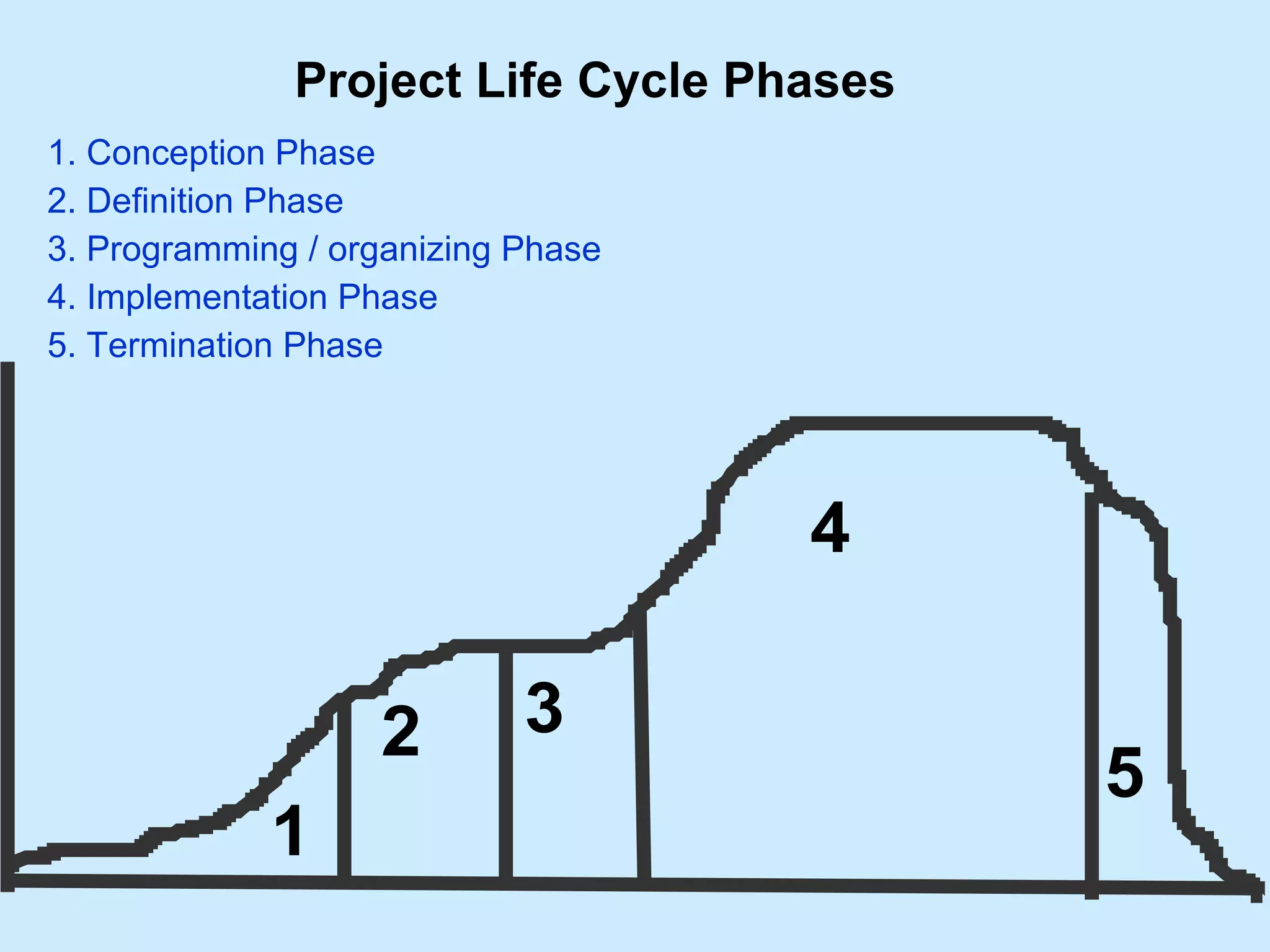
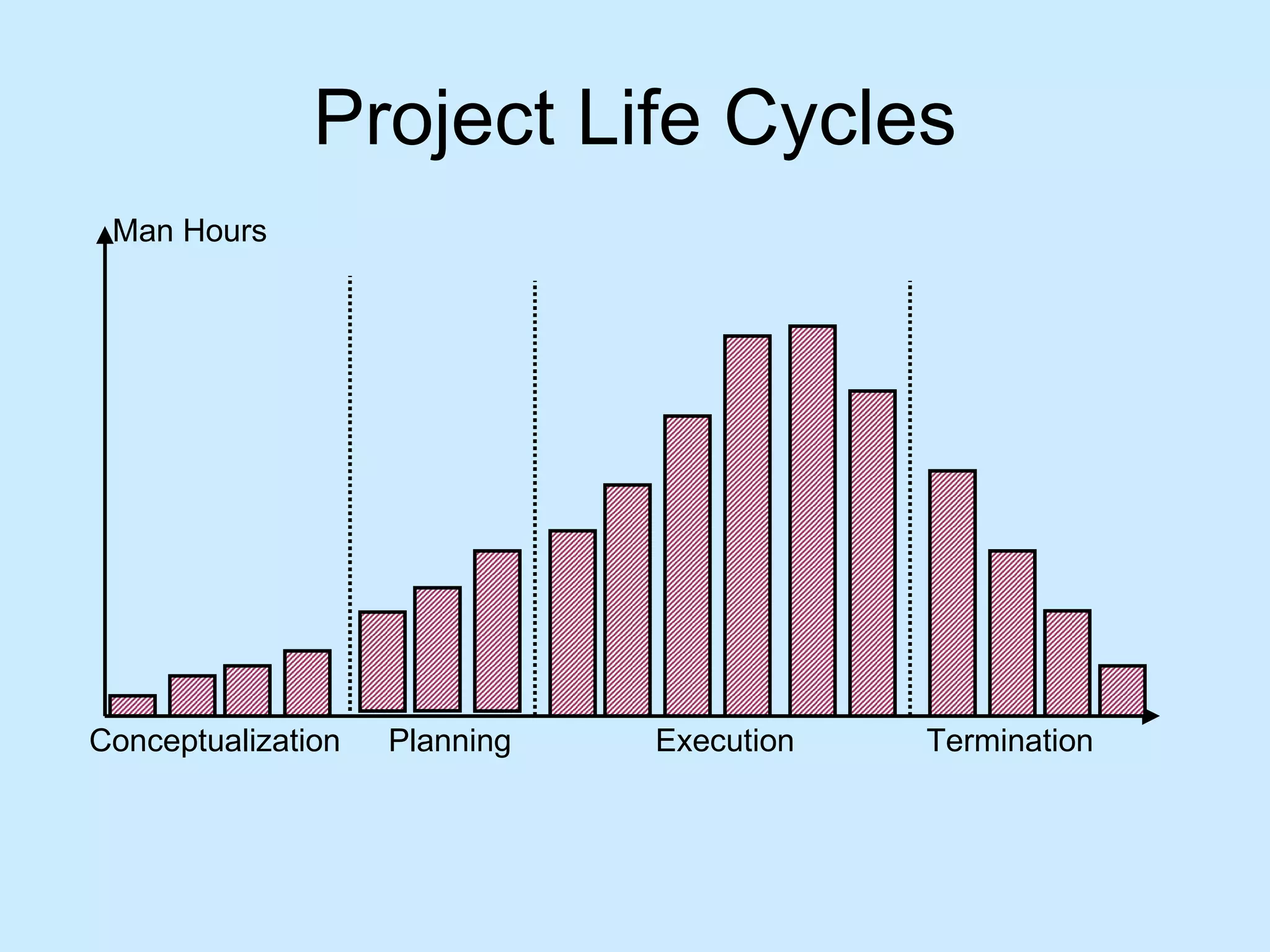
Project Life Cycle Phases Planning and organizing phase: This phase can effectively start only after definition phase, but in practice it start much earlier, almost immediately after the conception phase.  This phase overlaps so much with the definition and also with implementation phases.  That is why no formal recognition is given to this by most organizations. Implementation phase: Period of hectic activity for the project.  It is during this period, something starts growing in the field and people for the first time can see the project. Project clean up phase: Completion and handing over the project. The curve in the above diagram shows that effort to build up a project is very slow, but effort to withdraw is very sharp.  It can also be seen that time taken for the formative and clean up stage & implementation stage.  While this pattern is true for all the projects, the percentage of effort in different phases would not be the same for all projects.  However for the same class projects the curve may be more or less the same.  A life cycle curve can thus represent a class of projects.
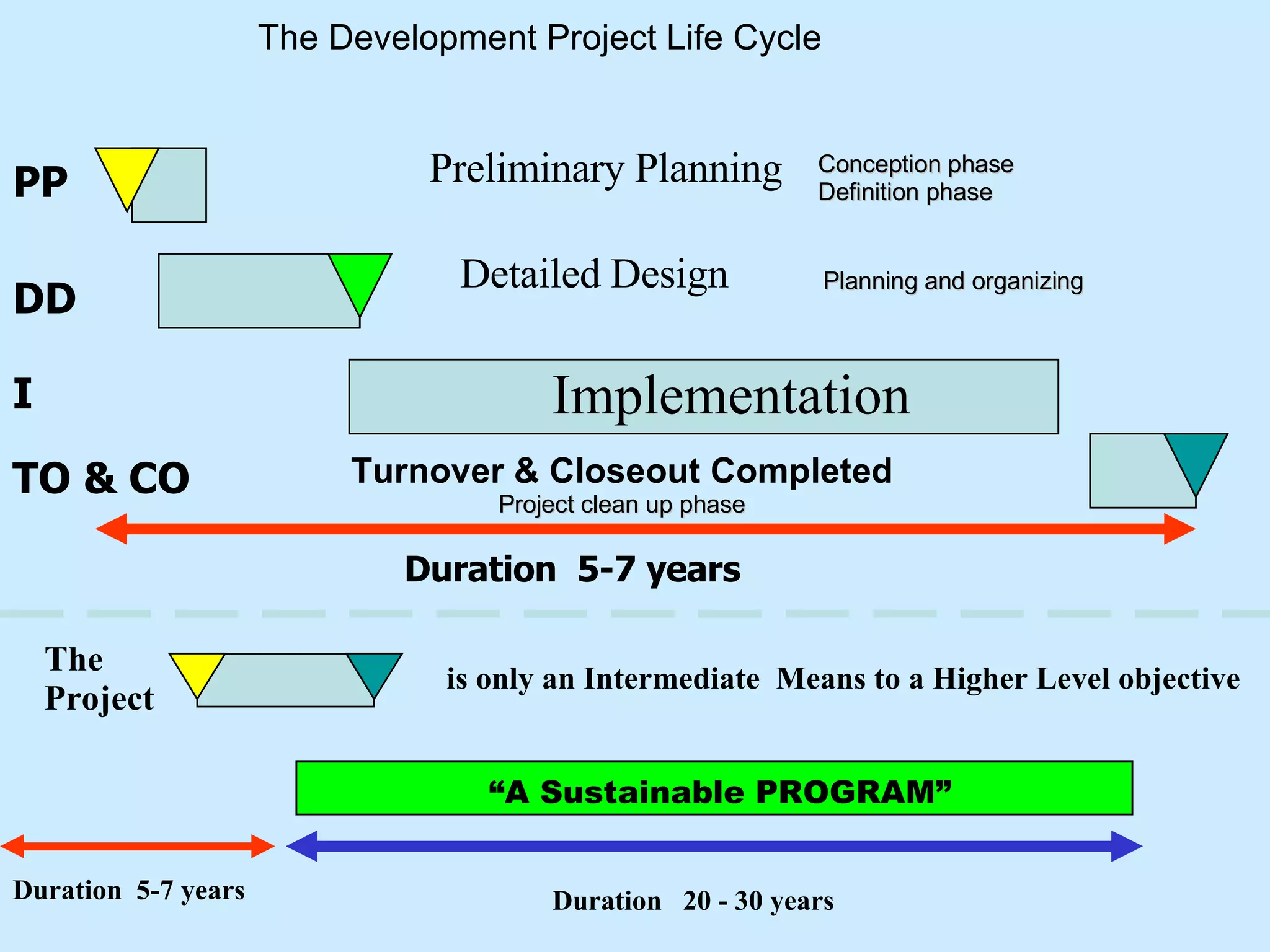
The Development Project Life Cycle PP DD I Preliminary Planning Detailed Design Implementation Implementation TO & CO Turnover & Closeout Completed Project clean up phase Duration  5-7 years Duration  20 - 30 years Duration  5-7 years “ A Sustainable PROGRAM” Conception phase Definition phase Planning and organizing The Project is only an Intermediate  Means to a Higher Level objective
 
Project Life Cycle Phases Conception Phase  Definition Phase  Programming / organizing Phase Implementation Phase Termination Phase
Project Life Cycles Man Hours Conceptualization Planning Execution Termination
The Project Cycle  Implementation Identification Programming Evaluation Financing Appraisal Political acceptability  Financial feasibility Economic viability Technical feasibility
The Project Life Cycle 2 CLOSE -OUT EXECUTE ORGANISE PLAN DEFINE FEASABILITY PHASE sometimes called scoping risk is assessed feasibility tested “ GO ” or “ NO GO ” decision made. If  “GO”   PLANNING PHASE tasks sequencing milestones estimating budgeting PROJECT  PLAN ORGANISING PHASE resources tools reviews reporting communications IMPLEM- ENTATION PHASE activities monitoring: costs progress controlling quality COMPLETION PHASE client “hand-over  (= acceptance) complete documentation. review: sign off post implementation audit maintenance “ value assessment” R E V I E W 1. 2. 4. 3. 5. PLAN Implementation Phase
 
Spatial Data   Temporal Data Social/Institutional Information   Discrete data   Indigenous or local data Stakeholders Analysis,   Strengths, Weaknesses, Opportunities and Threats (SWOT) analysis  Problem-Alternative-Objective tree  Micro-Finance,  Co-operative and Group Formation,  Indigenous Forest Management Participatory Monitoring and Evaluation  Participatory Impact Monitoring  Monitoring Exercise  The Logical Framework The Work Breakdown structure The Gantt chart The Critical Path Method (CPM) Exit strategies for project ending
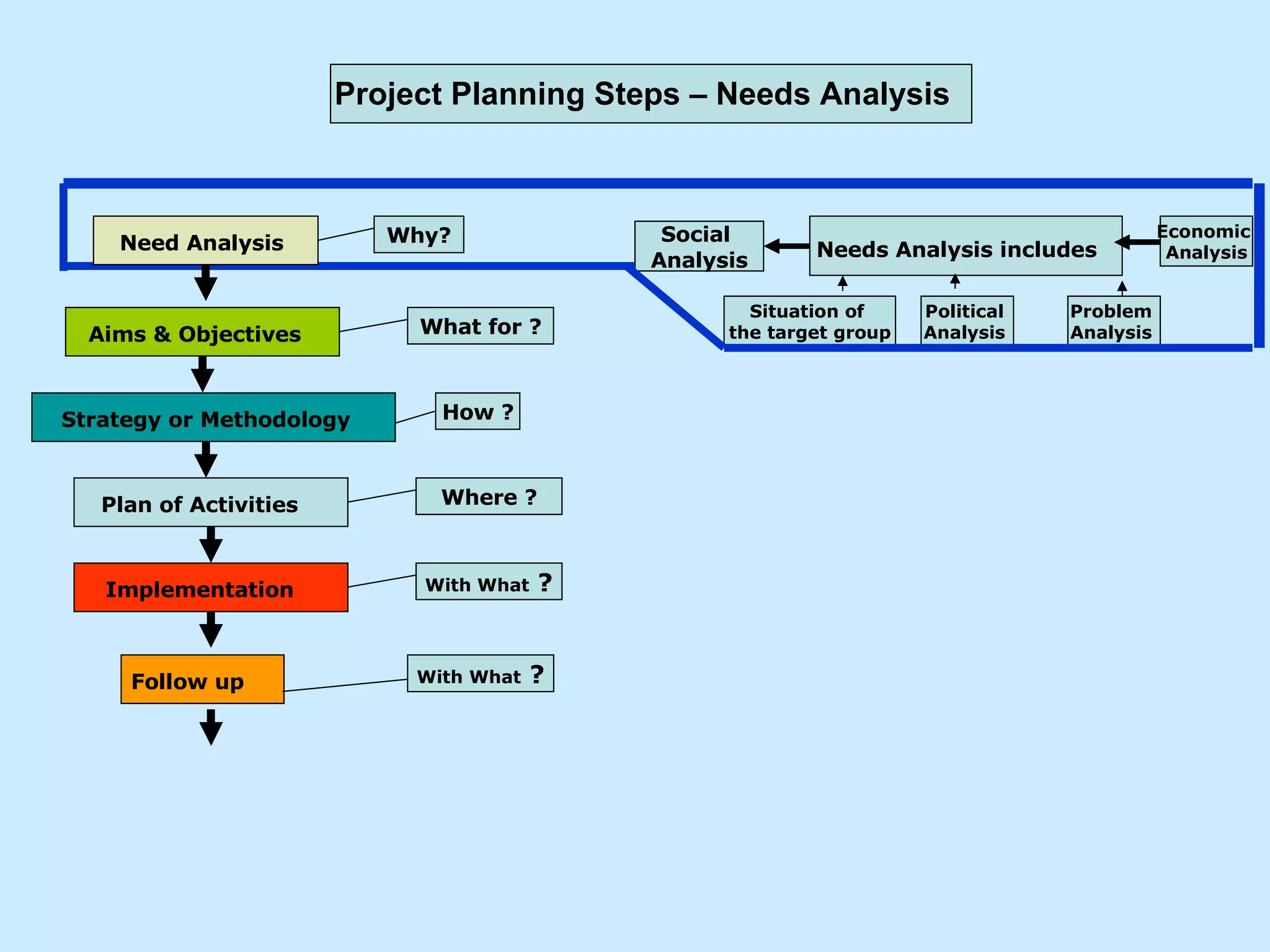
Strategy or Methodology  Needs Analysis includes   Social  Analysis Situation of  the target group Political  Analysis  Problem  Analysis  Economic  Analysis Project Planning Steps – Needs Analysis   Need Analysis   Why? Aims & Objectives  What for ? How ? Plan of Activities  Where ? Implementation  With What  ? Follow up  With What  ?
Problem Tree Objective Tree Overall objectives Project Purpose Results Problem Tree Effects Focal problem Causes
High infant &  Maternal  mortality rates   High rates of  infection among  babies & infants  High incidence of  acute birth  complications  High rates of post- partum & neo- natal infection  Poor nutritional  status of babies &  infants  Birth complications  diagnosed late or not at all  Few babies &  Infants vaccinated Low standards of  hygiene & patient  care by staff Effects  Problem Tree   Commercial  pressure to use  milk supplements  Poor seasonal  availability of high  protein foods  Mothers unwilling to attend clinics   Infrequent &  inadequate  coverage of clinics  Shortage of drugs  Low staff skills   Low attendance  at rural clinics   Causes
Means  Problem tree Objective  tree Problem & Objective Analysis   Problems Identified   Soil erosion  on hill slopes  Rice production in  low lands decreasing  Irrigation water  does not reach field  in desired quantity  High incidence of malnutrition Food shortages   Food production in  hills decreasing  High immigration  rates  Irregular supply  of inputs for rice  cultivation  Soil fertility on  hill slopes is  decreasing  Ethnic clashes in neighboring  districts  Canals are  blocked  Dikes are  degraded  Poor maintenance  system for  irrigation facilities  Cause  Effect Soil erosion  on hill slopes  reduced  Rice production in  low lands improved   Sufficient Irrigation water reaches the  field  Incidence of  Malnutrition reduced  Improved food situation  Food production in  hills increased   Lower  immigration  rates  Regular supply  of inputs for rice  cultivation  Soil fertility on  hill slopes is  increased Less Ethnic clashes in neighboring  districts  Canals cleared Dikes are  upgraded   Maintenance  system for irrigation facilities improved  Ends
Drivers  are  courteous Regular  Workday Fair  Salaries Financial situation of the  company  improved Increased use of  the CBS by the public Service offered by  the CBS is reliable   Number of  wounded  passengers  decreased Fewer delays   Scheduling & utilization of buses is improved Drivers  Drive well Safety  precautions & inspection  system  implemented  Incentive system implemented  Bus drivers trained   Schedule for  replacement  of buses  established  Roads are in good  condition  Good  road  maintenance   Redesign &  recondition  of roads   Bus fleet in  good condition   Fewer bus  accidents Good bus  maintenance   City Bus Service –Objective Tree City Bus Service –Problem Tree Drivers drive  poorly  Bus fleet in  poor condition  Frequent  delays  Bus fleet in old  Poor bus  maintenance  Poor  topography Roads are  poor  Long  workday Low  salaries  Use of CBS by the population decreases Service offered  by the CBS  unreliable Many  passengers  wounded  Frequent bus accidents  Drivers are  rude
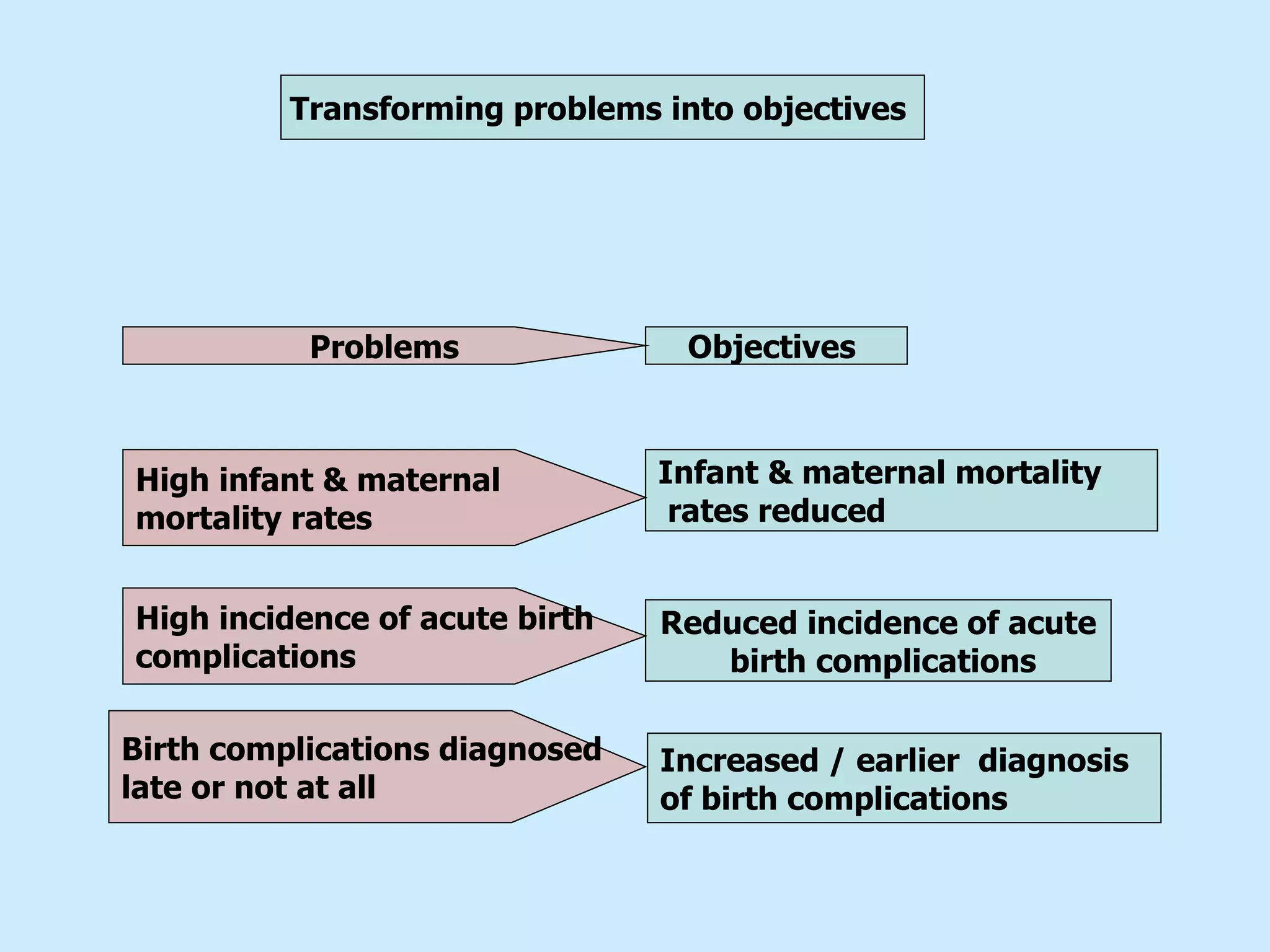
Objectives  Infant & maternal mortality rates reduced  Reduced incidence of acute birth complications Increased / earlier  diagnosis  of birth complications Transforming problems into objectives  High infant & maternal  mortality rates  High incidence of acute birth  complications Birth complications diagnosed late or not at all Problems
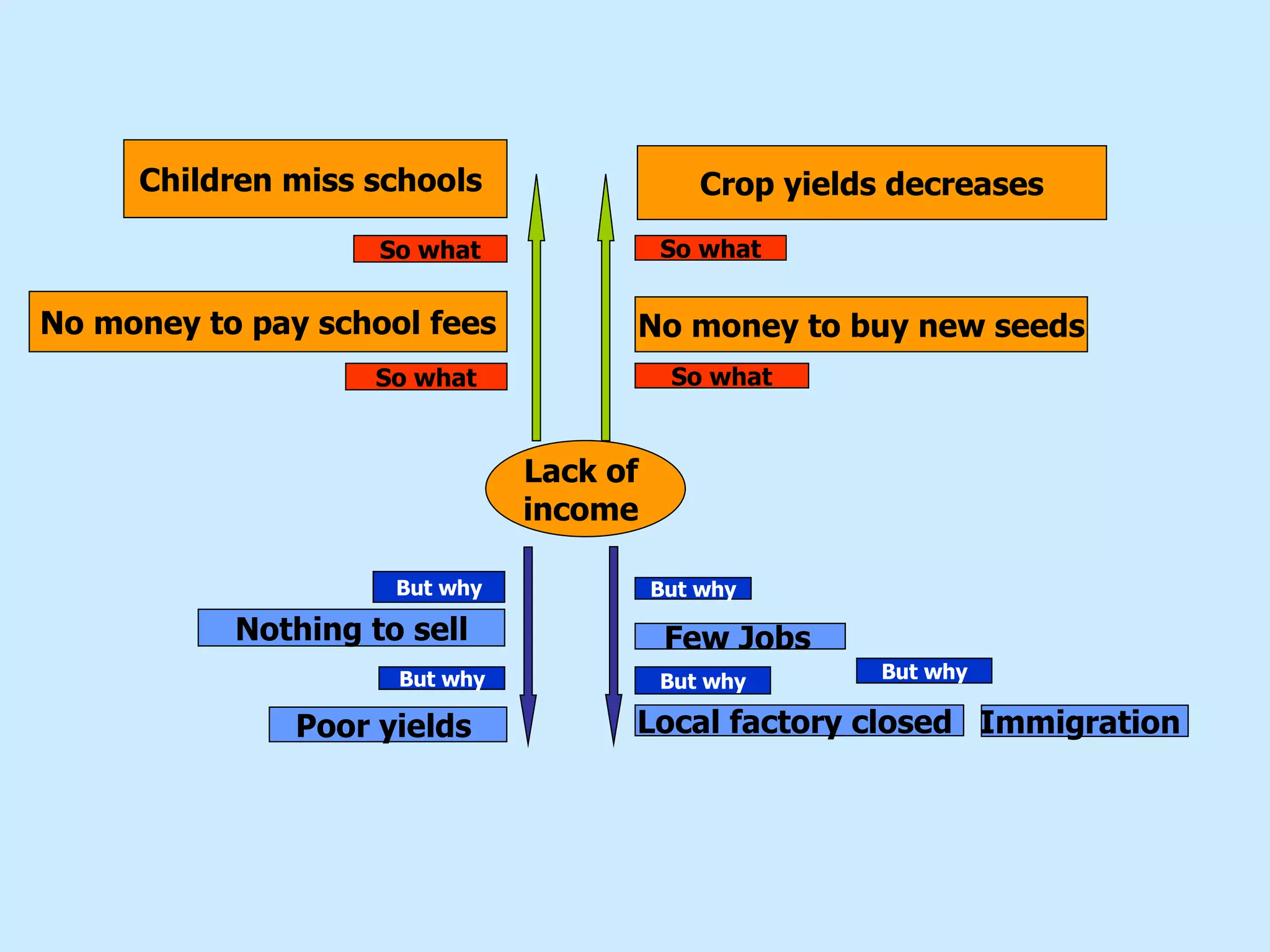
Lack of  income  No money to buy new seeds Crop yields decreases No money to pay school fees Children miss schools  Few Jobs   Poor yields  Local factory closed  Immigration  But why But why But why But why So what But why So what So what So what Nothing to sell
Strategies  Incidence of  malnutrition  reduced  Improved  food  situation  Rice production  in low lands  increased  Food  Production  on  hills increased  Lower  Immigration rates  Sufficient  irrigation water  reaches field  Regular supply  of inputs for  rice production  Soil fertility  on hill slopes  increased  Less ethinic  clashes on hill slopes  Soil erosion of  hill slopes  reduced  Canals  cleared  Dikes are  upgraded Maintenance of  irrigation  facilities  improved  Agricultural inputs  Soil fertility   Immigration  Irrigation system
Work Breakdown Structure Work breakdown structure for the recruitment of a new person to fill a vacant post.
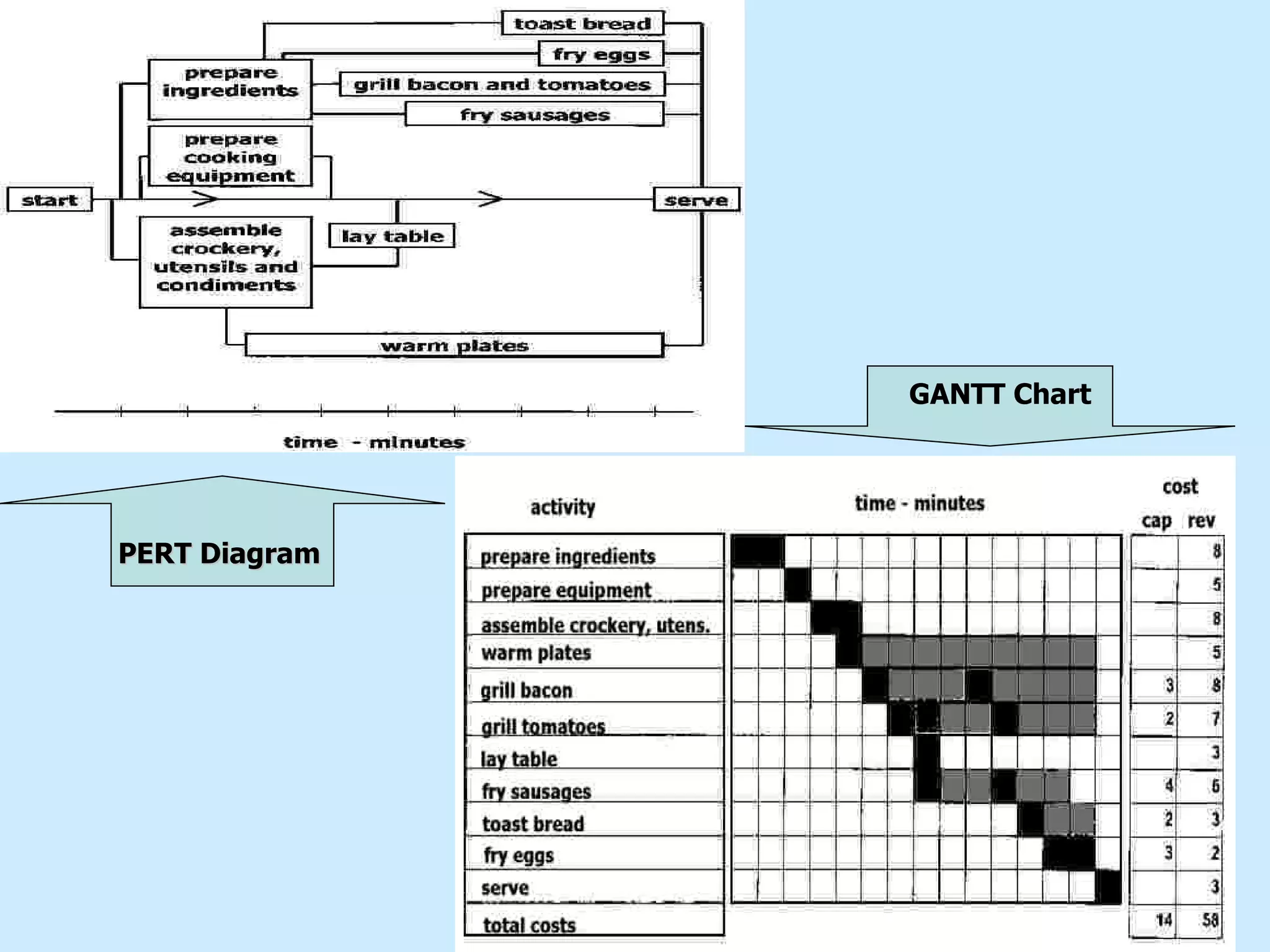
Project Evaluation Review Technique CRITICAL PATH Network diagram for the recruitment of a new person to fill a vacant post. PERT Chart
GANTT Chart for the recruitment of a new person to fill a vacant post GANTT charts are a user-friendly  visual  version of ‘network diagrams’, designed to be easily understood and applied by non - ‘chart-ographers’ !
GANTT Chart PERT Diagram
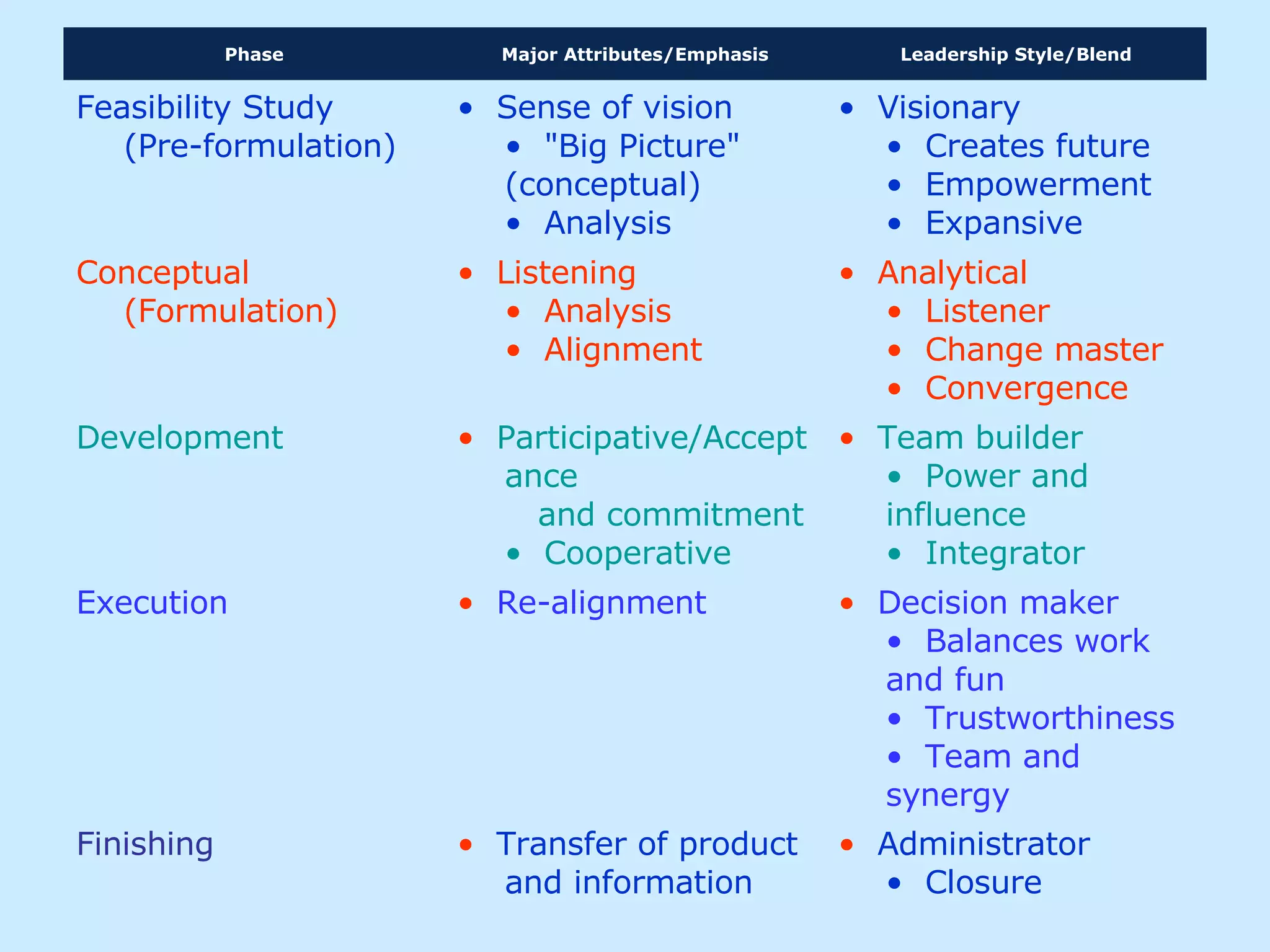
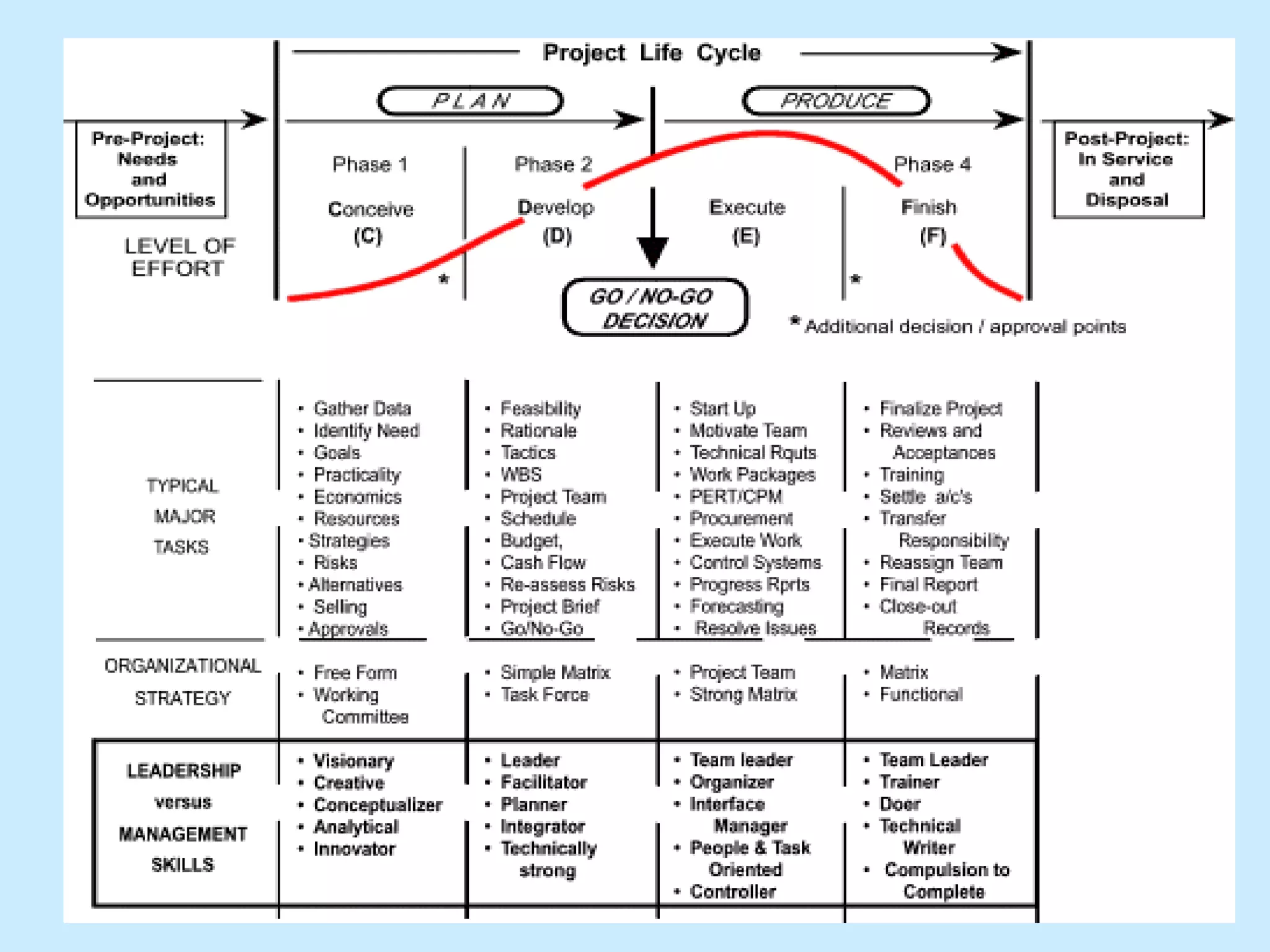
•   Administrator •  Closure •    Transfer of product and information Finishing •    Decision maker •  Balances work and fun •  Trustworthiness •  Team and synergy  •   Re-alignment Execution •    Team builder •  Power and influence •  Integrator •   Participative/Acceptance     and commitment •  Cooperative Development •   Analytical •  Listener •  Change master •  Convergence  •   Listening •  Analysis •  Alignment Conceptual (Formulation) •   Visionary •  Creates future •  Empowerment •  Expansive •   Sense of vision •  "Big Picture" (conceptual)  •  Analysis Feasibility Study (Pre-formulation) Leadership Style/Blend Major Attributes/Emphasis Phase
 
Success of a Project Good / Careful  Planning Parties  involved  stick to  their  commitments  Fair  allocation  of costs &  benefits  between  men & women Fair  representation of different interests through  participation Success of a  Project Efficient project management   Competent &  Motivated project team Project  addresses the  real problems of the  target groups  Beneficiaries  are clearly  identified by  gender &  socio economic group Organizational  capacity
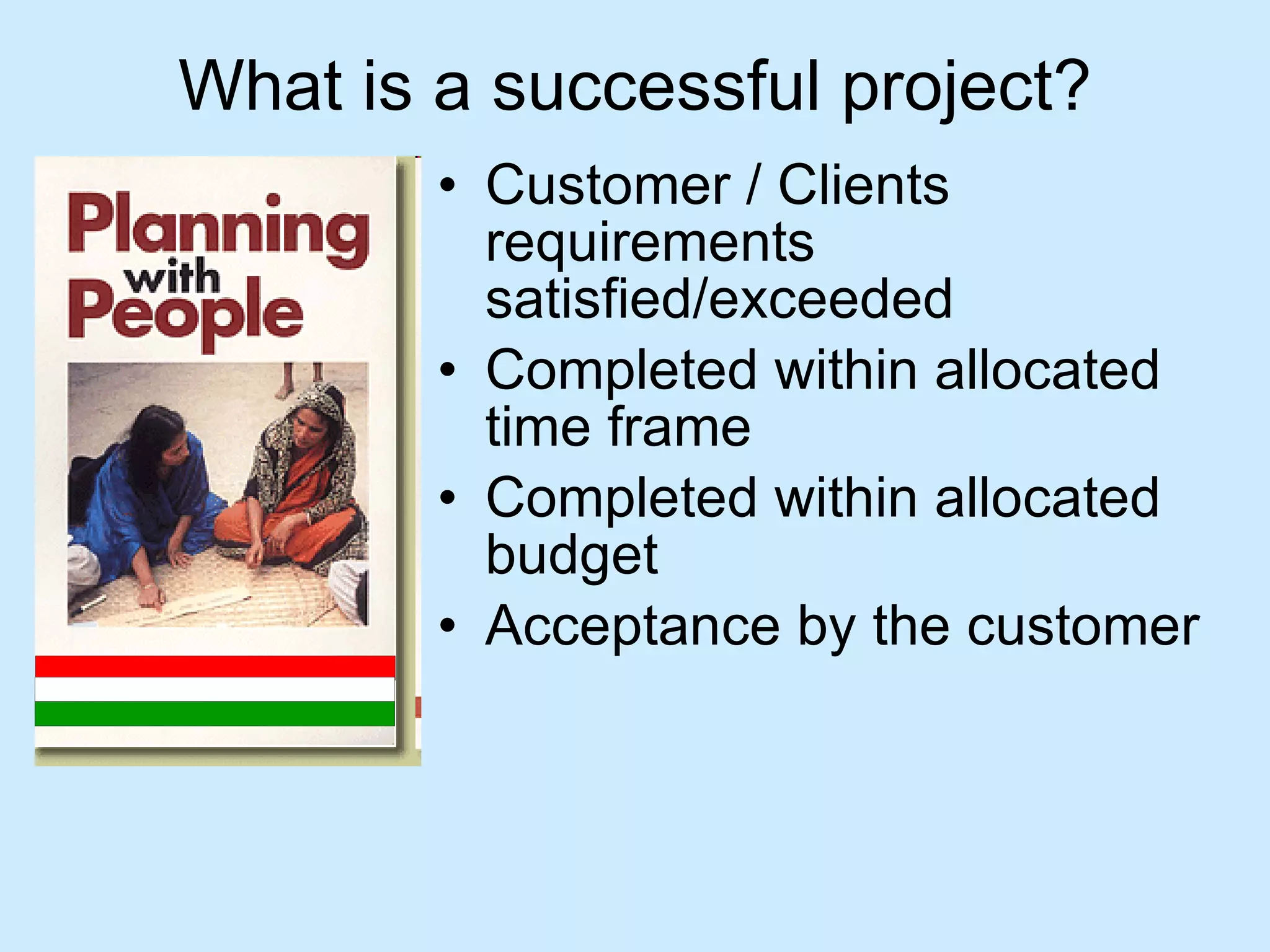
What is a successful project? Customer / Clients requirements satisfied/exceeded Completed within allocated time frame Completed within allocated budget Acceptance by the customer
Project Sustainability
Sustainability Defined To keep in existence; maintain (The American Heritage) The ability of a system of any kind to endure and be healthy over the long term. A “sustainable society” is one that is healthy, vital, resilient, and able to creatively adapt to changing conditions over time. (Top 10 by 2010, Southwest Louisiana) The ability of an organization to develop a strategy of growth and development that continues to function indefinitely. (Dorothy A. Johnson Center for Philanthropy & Leadership)
Project Sustainability Defined What project sustainability means Maintaining the outcomes, goals and products Institutionalizing the process What project sustainability doesn’t mean Maintaining staff positions Maintaining all activities Depending on grant funding
Project Sustainability: Ask the right questions What are we doing?  Do other people know what we’re doing? What outcomes do we want to sustain?  Is there data to support our results? What are the fiscal needs? What are the management needs? Who champions this initiative? Who else do these outcomes affect?  Whose interests does this support?
Strategies for Sustainability Develop broad-based relationships/partnerships that foster collaboration. Involve all stakeholders:  parents, students, business, politicians, community leaders, school administrations, funders. Nurture community involvement. Develop a core of supporters. Be visible.  Develop an outreach plan. Link evaluation to project success and then to marketing. Be flexible.  Modify the project based on evaluation and feedback. Communicate, communicate, communicate. Share resources.  Share expertise.  Share successes.

Project Planning

  • 1.
  • 2.
    Why Project Planning? History of Project Management Meaning of a Project Types of Projects Definition of a Project Advantages of project based approach What happens if the project consciousness is not there? Planning & Project Planning Project Plan Characteristics of a project Elements of a Project Project Objectives Project Plan components What are the differences between projects and operations (regular administration) ? What is Project Management? Definition of Project Management Project Management Tools .. activities What is a successful project? Problem & Objective Analysis Project Life Cycle Phases Conception Phase Definition Phase Programming / organizing Phase Implementation Phase Termination Phase Project Sustainability
  • 3.
    Why Project Planning? One Of the most important administrative developments in the developed as well as in developing countries has been the initiation and growth of a large number of new programs/projects in every field like agriculture, irrigation, industry, community development, health & social welfare etc.. The principle aims and objectives of all these programs have been to bring about overall changes in the existing socio-economic structure in the country providing thereby dignified way of life to a citizen as a unit and socio-economic upliftment of the society. So most of the administrators are directly concerned with the program / project administration than other activities. The capability of administrative system to formulate and implement, relevant and in viable programs effectively constitutes a crucial element in the process of development. Development requires planning and planning includes a lot of programs / projects.
  • 4.
    History of ProjectManagement As a discipline, Project Management developed from different fields of application including construction, engineering, and defense. In the United States, the forefather of project management is Henry Gantt, called the father of planning and control techniques, who is famously known for his use of the "Gantt" chart as a project management tool. He was associated with Frederick Winslow Taylor's theories of scientific management and for his study of the work and management of Navy ship building. His work is the forerunner to many modern project management tools including the work breakdown structure (WBS) and resource allocation. The 1950s marked the beginning of the modern project management era. Again, in the United States, prior to the 1950s, projects were managed on an ad hoc basis using mostly Gantt Charts, and informal techniques and tools. At that time, two mathematical project scheduling models were developed: (1) the "Program Evaluation and Review Technique" or PERT, developed by Booz-Allen & Hamilton as part of the United States Navy's (in conjunction with the Lockheed Corporation) Polaris missile submarine program; and (2) the "Critical Path Method" (CPM) developed in a joint venture by both DuPont Corporation and Remington Rand Corporation for managing plant maintenance projects. These mathematical techniques quickly spread into many private enterprises.
  • 5.
    Meaning of aProject Origin The word project comes from the Latin word projectum from projicere, "to throw something forwards" which in turn comes from pro-, which denotes something that precedes the action of the next part of the word in time (paralleling the Greek πρό) and jacere, "to throw". The word "project" thus originally meant "something that comes before anything else is done". When the word was initially adopted, it referred to a plan of something, not to the act of actually carrying this plan out. Something performed in accordance with a project was called an object. This use of "project" changed in the 1950s when several techniques for project management were introduced. With this advent the word slightly changed meaning to cover both projects and objects. However in certain projects there may still exist so called objects and object leaders.
  • 6.
    Development Project Types Agriculture & Rural Development Fisheries Forestry Irrigation Environmental Protection Housing & Urban Development Health & Family Planning Roads/Bridges/Ports Marketing Public Administration Banking & Capital Market Development Education & Training Power Generation
  • 7.
  • 8.
    Example of AGRICULTURALProjects PROJECT : Immediate Deliverables Irrigation Systems Built Irrigation Service Associations Formed Technical Extension Services Provided Farmers Trained Seed, Fertilizer, Credit Provided PROGRAM : Sustainable Results Intended Increased Productivity & Production Increased Farm Family Incomes Increased Food Availability
  • 9.
    Example of HEALTHProjects PROJECT : Immediate Deliverables Health Clinics/Facilities Built Doctors & Nurses Trained & Deployed Village-Level Health Workers Trained Information/Education Campaigns Conducted Drugs/Medical Supplies/Transportation Provided PROGRAM : Sustainable Results Intended Increased Usage of Health Facilities Improved Community Health Status Improved Capacity for Productive Work
  • 10.
    Definition of aProject To talk about project management, we first need to be sure we know what we mean by a project. Although the term is widely used, and we all think we know what it means, producing an adequate short definition is very difficult. This is because the border line between something which is a project and something which is not is rather poorly defined. We can therefore use a very general definition such as the Oxford English Dictionary which defines a project as:   Plan, scheme   This is so vague as to be unhelpful in trying to look at project management.     Alternatively we can try to make things as specific as possible. Some examples of definitions from literature on project management are: An activity (or, usually, a number of related activities) carried out according to a plan in order to achieve a definite objective within a certain time and which will cease when the objective is achieved.  A collection of linked activities, carried out in an organized manner, with a clearly defined start point and end point to achieve some specific results desired to satisfy some clearly defined objectives.     A group of activities that have to be performed in a logical sequence to meet pre-set objectives outlined by the client.   It may make it easier to define if we instead list the characteristics of a project, which would include: a start and a finish date a budget activities which are essentially unique and not repetitive roles and relationships which are subject to change and need to be developed, defined and established a life cycle (which we will examine later)
  • 11.
    Definition of aProject… 2 Programs / Projects are tools to achieve the plan goals . E.g. Plan goal – Removal of poverty. Plan tool – IRDP, JRY, TRYSEM etc. A project is an investment of resources in a package of interrelated time found activities. Thus a project becomes a time found task. A Project should have definite beginning and an end. A project can be defined as a scientifically evolved work plan devised to achieve specific objectives within a specific period of time. A project is a temporary endeavour undertaken to create a product or service Something with a beginning, middle and end. Something that has a clear objective and somebody responsible for it. Something that can be measured and achieved.
  • 12.
    Definition of aProject… 3 Work undertaken to achieve an objective “ A temporary endeavour undertaken to create a unique product, service or result.” Temporary -Every project has a definite beginning and a definite end Unique -Projects produce things that have not been produced before Work involving a certain degree of uncertainty (i.e. risk) Work that must be progressively elaborated Examples of projects are: Development of a new product or service A planned action of social intervention Development and execution of an advocacy campaign
  • 13.
    Project ….explanations - Performed by people. - Constrained by limited resources. - Planned, executed, and controlled. example: . Developing a new or service. . Effecting a change in structure, staffing, or style of an organization. . Designing a new transportation route. . Developing or acquiring a new or modified information system. . Constructing a building or facility. . Building a water system for a community. . Running a campaign for political office. . Implementing a new service procedure or process.
  • 14.
    What is aProject? Output (Objective & Scope) Time (Duration) Resource (Man power, Facilities, Money…) What are the requirements? How much the cost? Benefit Basis Three Elements of Project Start Date End Date ? What is the Output ? Purpose & Scope Service Performance specification
  • 15.
    Advantages of projectbased approach Project based approach is particularly liked by Western business, which are characterized by a modern matrix organization and a cooperative culture. In case of authoritarian, bureaucratic organizations with rigid, hierarchical structure project based work is less popular, or does not work as expected due to the conflict between different cultures.
  • 16.
    What happens ifthe project consciousness is not there?
  • 17.
    What happens ifthe project consciousness is not there?
  • 18.
    Planning & ProjectPlanning What is a plan? What is planning? Why should we plan at all? What benefits does it provide? How much planning we need or don’t need? How does one plan? What are some useful planning models? What are some basic obstacles to planning? How do we confront them? Plan and Planning: A plan is a set of decisions made on actions to be taken to reach a goal. It is the product of the process of planning. Planning is an active process and it is opposite of simply allowing events to unfold. A plan can be said to exist when a point in the planning process has been reached. Plan (appoint in the planning process) is coherent set of operations designed to meet a given goal. It is determined with sufficient clarity that may be acted upon. A plan can be a very formal document, or it can simply be the clear understanding of the actions you are going to undertake. Both plan and planning is a never-ending activity. Your plan will be shaped and reshaped by new forces and new information you discover as you proceed with your action. Planning involves vision, discovery, decision-making and action. It is a purposeful way of looking at the future with the intent to shape it.
  • 19.
    Project Plan A project plan is "A formal, approved document used to guide both project execution and project control. The primary uses of the project plan are to document planning assumptions and decisions, facilitate communication among stakeholders, and document approved scope, cost, and schedule baselines. A project plan may be summary or detailed." "a statement of how and when a project's objectives are to be achieved, by showing the major products, milestones, activities and resources required on the project”.
  • 20.
    Project Plan. Whatit is and is not ? Initiate Plan Execute Control Close Project Plan means devising and maintaining a workable scheme to accomplish the business/ service/ development need that the project was undertaken to address. Project Plan is the work plan, not the work. Project Plan is a definition of needed work and resources
  • 21.
    Characteristics of aproject: 1 . Each and every project should have a package of interrelated activities. Eg. IRDP a. Identification of the poor b. Knowing their choice c. Arranging bank assets D. Follow up / advisory activities Evaluation 2 . Each activity is time found 3. Each and every project should have a set of objectives to be achieved. E.g. IRDP-Eradication poverty by distributing income-generating assets. E.I.P-Improving the environment in slums through providing basic amenities like drinking water, drainage, street lights, toilets and community centers etc. 4. Each and every project should be operated with constraints. E.g. Eradication of poverty within a democratic framework, within a time frame, within a limited resource within the present bureaucratic setup. 5 . Each and every project should specify the (clientele) target group. E.g. IRDP – Rural poor, SEPUP – Urban poor. 6. Each and every project should have well defined time sequence of investments. 7. Each and every project should have an in built arrangement to evaluate the program. Categories of projects Based on levels Based on time Based on the purpose Centralized Normal Experimental Decentralized Crash Pilot Partially decentralized Disaster Production / Service.
  • 22.
    Elements of ProjectsComplex , one-time processes Limited by budget, schedule, and resources Developed to resolve a clear goal or set of goals Customer / Client -focused General Project Characteristics Ad-hoc endeavors with a clear life cycle Building blocks in the design and execution of organizational strategies Responsible for the newest and most improved products , services, and organizational processes Provide a philosophy and strategy for the management of change Entail crossing functional and organization boundaries Traditional management functions of planning, organizing, motivating, directing, and controlling apply Principal outcomes are the satisfaction of customer requirements within technical , cost , and schedule constraints Terminated upon successful completion
  • 23.
    Project Objectives Project objectives define target status at the end of the project, reaching of which is considered necessary for the achievement of planned benefits. They can be formulated as S.M.A.R.T. S pecific, M easurable (or at least evaluable) achievement, A chievable (recently Acceptable is used regularly as well), R ealistic and T ime terminated (bounded). The evaluation (measurement) occurs at the project closure. However a continuous guard on the project progress should be kept by monitoring and evaluating.
  • 24.
    Project Plan componentsProject Formulation: Project formulation means developing our ideas in a good shape so as to present it to decision-makers to take correct investment decisions. Thus, project formulation refers to a series of steps to be taken to convert an idea or aspiration into a feasible plan of action . A Project Plan contains information that will help complete the project successfully. Success factors can be quickly summarized by answering the following questions: What and Why? - A project plan will contain a description of the project, what is the Vision and why the project is being executed. Who? - Who will be involved and what will be their responsibilities within the project When? - When will the project happen and also major milestones How? - How the project will be executed, meaning how it will be executed and controlled. Normally this information refers mostly to the controlling of the project as the detailed project actions will be detailed in other documents such as the IT plan, the Procurement plan, the Construction plan, etc.
  • 25.
    What are thedifferences between projects and operations (regular administration) ? Characteristics of Operations Ongoing – Continuous cycle Repetitive – Expected inputs and outputs Characteristics of Projects Temporary – Definitive beginning and end Unique – New undertaking, unfamiliar ground Project Take place outside the process world Unique and separate from normal organization work Operations Ongoing, day-to-day activities Use existing systems, properties, and capabilities A project is a unique venture with a beginning and an end, conducted by people to meet established goals within parameters of cost, schedule and quality. Repeat process or product Several objectives On-going People are homogeneous Systems in place Performance, cost, & time known Part of the line organization Bastions of established practice Supports status quo New process or product One objective One shot – limited life More heterogeneous Systems must be created Performance, cost & time less certain Outside of line organization Violates established practice Upsets status quo
  • 26.
    The difference betweenProject and Organizational Management     Of course there are many similarities between project and organizational management, but the nature of projects means that there are some differences of approach as well. These include: the lack of permanence of staff: people might be employed on a temporary basis or as consultants the lack of permanence of roles of staff: people involved in the project may play very different roles at different times; the hierarchy is not so clearly set     These two points mean that management of people and personal skills are very important. Too often project management is seen as a purely technical subject connected with planning techniques: to be effective skills in dealing with people are just as important.
  • 27.
    What is ProjectManagement? Project Management is the application of skills, knowledge, tools and techniques to meet the needs and expectations of stakeholders for a project The purpose of project management is prediction and prevention, NOT recognition and reaction Effective Management of the Triple Constraints (Time, Cost, Goals) Requirements – Needs Identified or Unidentified Expectations Cost/Resources – People, Money, Tools Schedule/Time
  • 28.
    Definition of ProjectManagement One definition of project management could be: Project Management is a dynamic process, conducted within a defined set of constraints, that organises and utilises appropriate resources in a controlled and structured manner in order to achieve some clearly defined objectives. Making the project happen.     As with projects, it may be clearer to define some of the characteristics of project management, rather than trying to make a single definition. Project management should be: objectives-orientated change-orientated multi-disciplined innovative (seeking new ideas and solving new problems) control-orientated (to ensure it actually finishes) performance-orientated flexible (quickly adapted to changes) This requires a wide variety of management and personal skills, Key areas to consider when looking at project management are management of time, people, and other resources. In general terms, these activities can be described as follows: Management of Other Resources Ensuring that appropriate resources are allocated Ensuring that the appropriate resources are available at the right time Reallocating resources in the light of experience Tailoring activities to limited resources Making maximum impact with available resources Management of People Ensuring that people are available at the right time Ensuring that personnel know their roles and can perform their functions properly Managing people’s expectations Resolving conflicts between people Changing people’s roles in the light of experience Management of Time Ensuring that the Project completes its work on time Scheduling use of resources Rescheduling the project in the light of experience Predicting problems Before they arise
  • 29.
    Project Planning &Management Project Management in the context of projects involves: organizing the work, deciding who does what, when, how and for whom, determining the resources required, allocating responsibility communicating among all those involved in a project, coordinating activities and people involved, controlling progress, estimating term of completion and handling unexpected events and changes.
  • 30.
    Project Management ToolsFinancial Tools Cause and Effect Charts PRA - Participatory Rural Appraisal - Participatory Impact Pathways Analysis (An approach for developing common understanding and consensus amongst project participants and stakeholders as to how the project will achieve its goal) Program Evaluation and Review Technique (PERT) Gantt Charts Logical framework Analysis (LFA) Event Chain Diagrams Force Field Analysis. Delphi technique. Nominal Group Technique. Project management software
  • 31.
    Project Management activitiesProject Management is composed of several different types of activities such as: Planning the work or objectives Analysis & design of objectives and events Assessing and controlling risk (or Risk Management) Estimating resources Allocation of resources Organizing the work Acquiring human and material resources Assigning tasks Directing activities Controlling project execution Tracking and reporting progress Analyzing the results based on the facts achieved Forecasting future trends in the project Quality Management Issues management Issue solving Defect prevention Identifying, managing & controlling changes Project closure Communicating to stakeholders
  • 32.
    What is theproject management process? A set of five process groups: Initiating processes performed to authorize and define the scope of a new phase or project or that can result in the continuation of halted project work Planning processes performed to define and mature the project scope, develop the project management plan, and identify and schedule the project activities within the project Executing processes performed to complete the work defined in the project management plan to accomplish the project's objectives defined in the project scope statement Monitoring and controlling processes performed to measure and monitor project execution so that corrective action can be taken when necessary to control the execution of the phase or project Closing processes performed to finalize all activities across all of the project process groups to formally close the project or phase
  • 33.
    Project Life CyclePhases: All projects have to pass through certain phases. The attention that a particular project receives is again not uniformly distributed throughout its life span, but it varies from phase to phase. At a particular phase appropriate attention has to be paid. Following are the general phases of a project. Conception phase Definition phase Planning and organizing people Implementation phase Project clean up phase The above phases won’t follow a sequence … rather they overlap; sometimes this overlapping is done deliberately in the interest of compressing the overall project schedule. There are others who would encourage natural growth.
  • 34.
    Project Life CyclePhases Conception phase: Phase in which the project idea germinates. This phase is also known as Identification of the problem, identifying the performance gap. It we avoid or truncate this phase, the project will have innate defects and may eventually become a liability for the investors. How to implement the project is not the botheration of this phase. It we start thinking about the implementation during this phase, it will unnecessary delays this phase. Definition Phase: The definition phase of the project will develop the idea generated during the conception phase and produce a document describing the project in sufficient details covering all aspects necessary for the customer or investors to make up their minds on the project idea.
  • 35.
    Project Life CyclePhases Planning and organizing phase: This phase can effectively start only after definition phase, but in practice it start much earlier, almost immediately after the conception phase. This phase overlaps so much with the definition and also with implementation phases. That is why no formal recognition is given to this by most organizations. Implementation phase: Period of hectic activity for the project. It is during this period, something starts growing in the field and people for the first time can see the project. Project clean up phase: Completion and handing over the project. The curve in the above diagram shows that effort to build up a project is very slow, but effort to withdraw is very sharp. It can also be seen that time taken for the formative and clean up stage & implementation stage. While this pattern is true for all the projects, the percentage of effort in different phases would not be the same for all projects. However for the same class projects the curve may be more or less the same. A life cycle curve can thus represent a class of projects.
  • 36.
    The Development ProjectLife Cycle PP DD I Preliminary Planning Detailed Design Implementation Implementation TO & CO Turnover & Closeout Completed Project clean up phase Duration 5-7 years Duration 20 - 30 years Duration 5-7 years “ A Sustainable PROGRAM” Conception phase Definition phase Planning and organizing The Project is only an Intermediate Means to a Higher Level objective
  • 37.
  • 38.
    Project Life CyclePhases Conception Phase Definition Phase Programming / organizing Phase Implementation Phase Termination Phase
  • 39.
    Project Life CyclesMan Hours Conceptualization Planning Execution Termination
  • 40.
    The Project Cycle Implementation Identification Programming Evaluation Financing Appraisal Political acceptability Financial feasibility Economic viability Technical feasibility
  • 41.
    The Project LifeCycle 2 CLOSE -OUT EXECUTE ORGANISE PLAN DEFINE FEASABILITY PHASE sometimes called scoping risk is assessed feasibility tested “ GO ” or “ NO GO ” decision made. If “GO”  PLANNING PHASE tasks sequencing milestones estimating budgeting PROJECT PLAN ORGANISING PHASE resources tools reviews reporting communications IMPLEM- ENTATION PHASE activities monitoring: costs progress controlling quality COMPLETION PHASE client “hand-over (= acceptance) complete documentation. review: sign off post implementation audit maintenance “ value assessment” R E V I E W 1. 2. 4. 3. 5. PLAN Implementation Phase
  • 42.
  • 43.
    Spatial Data Temporal Data Social/Institutional Information Discrete data Indigenous or local data Stakeholders Analysis, Strengths, Weaknesses, Opportunities and Threats (SWOT) analysis Problem-Alternative-Objective tree Micro-Finance, Co-operative and Group Formation, Indigenous Forest Management Participatory Monitoring and Evaluation Participatory Impact Monitoring Monitoring Exercise The Logical Framework The Work Breakdown structure The Gantt chart The Critical Path Method (CPM) Exit strategies for project ending
  • 44.
    Strategy or Methodology Needs Analysis includes Social Analysis Situation of the target group Political Analysis Problem Analysis Economic Analysis Project Planning Steps – Needs Analysis Need Analysis Why? Aims & Objectives What for ? How ? Plan of Activities Where ? Implementation With What ? Follow up With What ?
  • 45.
    Problem Tree ObjectiveTree Overall objectives Project Purpose Results Problem Tree Effects Focal problem Causes
  • 46.
    High infant & Maternal mortality rates High rates of infection among babies & infants High incidence of acute birth complications High rates of post- partum & neo- natal infection Poor nutritional status of babies & infants Birth complications diagnosed late or not at all Few babies & Infants vaccinated Low standards of hygiene & patient care by staff Effects Problem Tree Commercial pressure to use milk supplements Poor seasonal availability of high protein foods Mothers unwilling to attend clinics Infrequent & inadequate coverage of clinics Shortage of drugs Low staff skills Low attendance at rural clinics Causes
  • 47.
    Means Problemtree Objective tree Problem & Objective Analysis Problems Identified Soil erosion on hill slopes Rice production in low lands decreasing Irrigation water does not reach field in desired quantity High incidence of malnutrition Food shortages Food production in hills decreasing High immigration rates Irregular supply of inputs for rice cultivation Soil fertility on hill slopes is decreasing Ethnic clashes in neighboring districts Canals are blocked Dikes are degraded Poor maintenance system for irrigation facilities Cause Effect Soil erosion on hill slopes reduced Rice production in low lands improved Sufficient Irrigation water reaches the field Incidence of Malnutrition reduced Improved food situation Food production in hills increased Lower immigration rates Regular supply of inputs for rice cultivation Soil fertility on hill slopes is increased Less Ethnic clashes in neighboring districts Canals cleared Dikes are upgraded Maintenance system for irrigation facilities improved Ends
  • 48.
    Drivers are courteous Regular Workday Fair Salaries Financial situation of the company improved Increased use of the CBS by the public Service offered by the CBS is reliable Number of wounded passengers decreased Fewer delays Scheduling & utilization of buses is improved Drivers Drive well Safety precautions & inspection system implemented Incentive system implemented Bus drivers trained Schedule for replacement of buses established Roads are in good condition Good road maintenance Redesign & recondition of roads Bus fleet in good condition Fewer bus accidents Good bus maintenance City Bus Service –Objective Tree City Bus Service –Problem Tree Drivers drive poorly Bus fleet in poor condition Frequent delays Bus fleet in old Poor bus maintenance Poor topography Roads are poor Long workday Low salaries Use of CBS by the population decreases Service offered by the CBS unreliable Many passengers wounded Frequent bus accidents Drivers are rude
  • 49.
    Objectives Infant& maternal mortality rates reduced Reduced incidence of acute birth complications Increased / earlier diagnosis of birth complications Transforming problems into objectives High infant & maternal mortality rates High incidence of acute birth complications Birth complications diagnosed late or not at all Problems
  • 50.
    Lack of income No money to buy new seeds Crop yields decreases No money to pay school fees Children miss schools Few Jobs Poor yields Local factory closed Immigration But why But why But why But why So what But why So what So what So what Nothing to sell
  • 51.
    Strategies Incidenceof malnutrition reduced Improved food situation Rice production in low lands increased Food Production on hills increased Lower Immigration rates Sufficient irrigation water reaches field Regular supply of inputs for rice production Soil fertility on hill slopes increased Less ethinic clashes on hill slopes Soil erosion of hill slopes reduced Canals cleared Dikes are upgraded Maintenance of irrigation facilities improved Agricultural inputs Soil fertility Immigration Irrigation system
  • 52.
    Work Breakdown StructureWork breakdown structure for the recruitment of a new person to fill a vacant post.
  • 53.
    Project Evaluation ReviewTechnique CRITICAL PATH Network diagram for the recruitment of a new person to fill a vacant post. PERT Chart
  • 54.
    GANTT Chart forthe recruitment of a new person to fill a vacant post GANTT charts are a user-friendly visual version of ‘network diagrams’, designed to be easily understood and applied by non - ‘chart-ographers’ !
  • 55.
  • 56.
    •   Administrator •  Closure•    Transfer of product and information Finishing •    Decision maker •  Balances work and fun •  Trustworthiness •  Team and synergy •   Re-alignment Execution •    Team builder •  Power and influence •  Integrator •   Participative/Acceptance    and commitment •  Cooperative Development •   Analytical •  Listener •  Change master •  Convergence •   Listening •  Analysis •  Alignment Conceptual (Formulation) •   Visionary •  Creates future •  Empowerment •  Expansive •   Sense of vision •  "Big Picture" (conceptual) •  Analysis Feasibility Study (Pre-formulation) Leadership Style/Blend Major Attributes/Emphasis Phase
  • 57.
  • 58.
    Success of aProject Good / Careful Planning Parties involved stick to their commitments Fair allocation of costs & benefits between men & women Fair representation of different interests through participation Success of a Project Efficient project management Competent & Motivated project team Project addresses the real problems of the target groups Beneficiaries are clearly identified by gender & socio economic group Organizational capacity
  • 59.
    What is asuccessful project? Customer / Clients requirements satisfied/exceeded Completed within allocated time frame Completed within allocated budget Acceptance by the customer
  • 60.
  • 61.
    Sustainability Defined Tokeep in existence; maintain (The American Heritage) The ability of a system of any kind to endure and be healthy over the long term. A “sustainable society” is one that is healthy, vital, resilient, and able to creatively adapt to changing conditions over time. (Top 10 by 2010, Southwest Louisiana) The ability of an organization to develop a strategy of growth and development that continues to function indefinitely. (Dorothy A. Johnson Center for Philanthropy & Leadership)
  • 62.
    Project Sustainability DefinedWhat project sustainability means Maintaining the outcomes, goals and products Institutionalizing the process What project sustainability doesn’t mean Maintaining staff positions Maintaining all activities Depending on grant funding
  • 63.
    Project Sustainability: Askthe right questions What are we doing? Do other people know what we’re doing? What outcomes do we want to sustain? Is there data to support our results? What are the fiscal needs? What are the management needs? Who champions this initiative? Who else do these outcomes affect? Whose interests does this support?
  • 64.
    Strategies for SustainabilityDevelop broad-based relationships/partnerships that foster collaboration. Involve all stakeholders: parents, students, business, politicians, community leaders, school administrations, funders. Nurture community involvement. Develop a core of supporters. Be visible. Develop an outreach plan. Link evaluation to project success and then to marketing. Be flexible. Modify the project based on evaluation and feedback. Communicate, communicate, communicate. Share resources. Share expertise. Share successes.