PROJECT CONTROL 
PROCESS 
SUBMITTED TO 
Dr VINAYAK R C N 
SUBMITTED BY 
AKASH P S 
FINAL YEAR “A” 
SECTION
WHAT IS A PROJECT? 
 A project is a temporary endeavour designed to 
produce a unique product, service or result with a 
defined beginning and end (usually time-constrained, 
and often constrained by funding or 
deliverables), undertaken to meet unique goals 
and objectives, typically to bring about beneficial 
change or added value
PROJECT MANAGEMENT 
 It is the process and activity of planning, 
organizing, motivating, and controlling resources, 
procedures and protocols to achieve specific 
goals in scientific or daily problems 
 The primary challenge is to achieve all of the 
project goals and objectives while honouring the 
preconceived constraints 
 The primary constraints are scope, time, quality 
and budget. 
 The secondary — and more ambitious — 
challenge is to optimize the allocation of 
necessary inputs and integrate them to meet pre-defined 
objectives.
PROJECT CONTROL 
 Project Controls can be defined as - Management 
action, either preplanned to achieve the desired 
result or taken as a corrective measure prompted 
by the monitoring process. 
 Project controls is mainly concerned with the 
metrics of the project, such as quantities, time, 
cost, and other resources
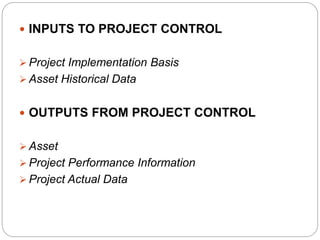
 INPUTS TO PROJECT CONTROL 
 Project Implementation Basis 
 Asset Historical Data 
 OUTPUTS FROM PROJECT CONTROL 
 Asset 
 Project Performance Information 
 Project Actual Data
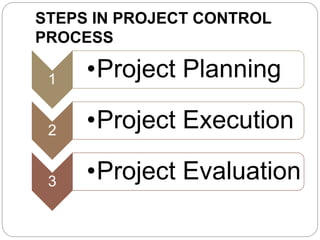
STEPS IN PROJECT CONTROL 
PROCESS 
1 •Project Planning 
2 •Project Execution 
3 •Project Evaluation
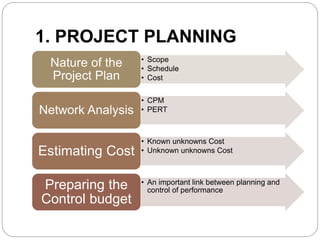
1. PROJECT PLANNING 
• Scope 
• Schedule 
• Cost 
Nature of the 
Project Plan 
• CPM 
Network Analysis • PERT 
• Known unknowns Cost 
Estimating Cost • Unknown unknowns Cost 
• An important link between planning and 
control of performance Preparing the 
Control budget
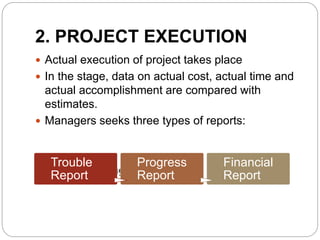
2. PROJECT EXECUTION 
 Actual execution of project takes place 
 In the stage, data on actual cost, actual time and 
actual accomplishment are compared with 
estimates. 
 Managers seeks three types of reports: 
Trouble 
Report 
 Project Auditing 
Progress 
Report 
Financial 
Report
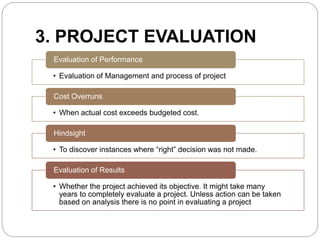
3. PROJECT EVALUATION 
Evaluation of Performance 
• Evaluation of Management and process of project 
Cost Overruns 
• When actual cost exceeds budgeted cost. 
Hindsight 
• To discover instances where “right” decision was not made. 
Evaluation of Results 
• Whether the project achieved its objective. It might take many 
years to completely evaluate a project. Unless action can be taken 
based on analysis there is no point in evaluating a project
THANK - YOU

PROJECT CONTROL PROCESS

  • 1.
    PROJECT CONTROL PROCESS SUBMITTED TO Dr VINAYAK R C N SUBMITTED BY AKASH P S FINAL YEAR “A” SECTION
  • 2.
    WHAT IS APROJECT?  A project is a temporary endeavour designed to produce a unique product, service or result with a defined beginning and end (usually time-constrained, and often constrained by funding or deliverables), undertaken to meet unique goals and objectives, typically to bring about beneficial change or added value
  • 3.
    PROJECT MANAGEMENT It is the process and activity of planning, organizing, motivating, and controlling resources, procedures and protocols to achieve specific goals in scientific or daily problems  The primary challenge is to achieve all of the project goals and objectives while honouring the preconceived constraints  The primary constraints are scope, time, quality and budget.  The secondary — and more ambitious — challenge is to optimize the allocation of necessary inputs and integrate them to meet pre-defined objectives.
  • 4.
    PROJECT CONTROL Project Controls can be defined as - Management action, either preplanned to achieve the desired result or taken as a corrective measure prompted by the monitoring process.  Project controls is mainly concerned with the metrics of the project, such as quantities, time, cost, and other resources
  • 5.
     INPUTS TOPROJECT CONTROL  Project Implementation Basis  Asset Historical Data  OUTPUTS FROM PROJECT CONTROL  Asset  Project Performance Information  Project Actual Data
  • 6.
    STEPS IN PROJECTCONTROL PROCESS 1 •Project Planning 2 •Project Execution 3 •Project Evaluation
  • 7.
    1. PROJECT PLANNING • Scope • Schedule • Cost Nature of the Project Plan • CPM Network Analysis • PERT • Known unknowns Cost Estimating Cost • Unknown unknowns Cost • An important link between planning and control of performance Preparing the Control budget
  • 8.
    2. PROJECT EXECUTION  Actual execution of project takes place  In the stage, data on actual cost, actual time and actual accomplishment are compared with estimates.  Managers seeks three types of reports: Trouble Report  Project Auditing Progress Report Financial Report
  • 9.
    3. PROJECT EVALUATION Evaluation of Performance • Evaluation of Management and process of project Cost Overruns • When actual cost exceeds budgeted cost. Hindsight • To discover instances where “right” decision was not made. Evaluation of Results • Whether the project achieved its objective. It might take many years to completely evaluate a project. Unless action can be taken based on analysis there is no point in evaluating a project
  • 10.