CHAPTER 4
Earned Value Analysis(EVA)
in construction
How is project health measured?
 Project Manager evaluates project’s triple constraint
of scope, time and cost
 Key Questions
– Is the project performing to budget?
– Is the project on schedule to deliver the agreed
scope?
 Typically Summarize Project Health using Green,
Yellow, Red Status (Traffic Light Reporting)
CONT’D….
 Earned value analysis in its various forms is the most
commonly used method of performance measurement.
 Earned Value Analysis is an objective method to measure
project performance in terms of scope, time and cost
 integrates scope, cost (or resource), and schedule measures to
help the project management team assess project performance.
 Use EVA metrics are used to measure project health and
project performance
3
The Earned Value
Concept
• Experienced project managers are familiar with the problems of using
only partial information, such as only costs or time to track the
status of a project.
• To illustrate, half of a project budget may be expended by the mid-
point of the scheduled duration, but only 20% of the work may
be accomplished.
• A monitoring of only time and cost would indicate the project is going
well;
• however, upon completion of the project there would likely be a
cost overrun and a delay in schedule because the measurement of
work was not included in the project control system.
The Earned Value
Concept
• Thus, a project manager must develop an integrated cost /
schedule / work system which provides meaningful feedback
during the project rather than afterwards.
• The status of a project can then be determined and
corrective actions taken when corrections can be made
at the least cost.
• It is one thing to meet a project deadline at any cost. It is
another to do it for a reasonable cost.
The Earned Value Concept
• Project cost control is concerned with ensuring that projects
stay within their budgets, while getting the work done
on time and at the correct quality.
• A variance is defined as any schedule, technical performance,
or cost deviation from a specific plan. Variances must
be tracked and reported.
• They should be mitigated through corrective actions and not
eliminated through a baseline change unless there is
a good reason.
Earned Value Characteristics
How much work did you PLAN to complete? (Planned Value)
How much work did you ACTUALLY complete? (Earned Value)
How much did you spend to complete the work? (Actual Cost)
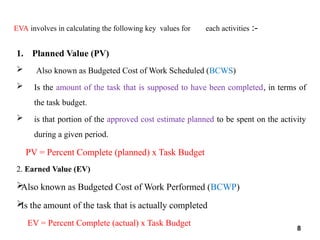
EVA involves in calculating the following key values for each activities :-
1. Planned Value (PV)
 Also known as Budgeted Cost of Work Scheduled (BCWS)
 Is the amount of the task that is supposed to have been completed, in terms of
the task budget.
 is that portion of the approved cost estimate planned to be spent on the activity
during a given period.
PV = Percent Complete (planned) x Task Budget
2. Earned Value (EV)

Also known as Budgeted Cost of Work Performed (BCWP)

Is the amount of the task that is actually completed
EV = Percent Complete (actual) x Task Budget
8
Cont’d………
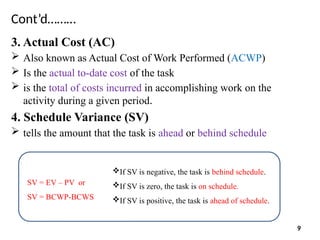
3. Actual Cost (AC)
 Also known as Actual Cost of Work Performed (ACWP)
 Is the actual to-date cost of the task
 is the total of costs incurred in accomplishing work on the
activity during a given period.
4. Schedule Variance (SV)
 tells the amount that the task is ahead or behind schedule
SV = EV – PV or
SV = BCWP-BCWS
If SV is negative, the task is behind schedule.
If SV is zero, the task is on schedule.
If SV is positive, the task is ahead of schedule.
9
Cont’d……
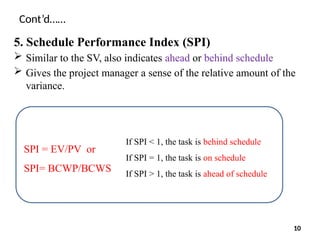
5. Schedule Performance Index (SPI)
 Similar to the SV, also indicates ahead or behind schedule
 Gives the project manager a sense of the relative amount of the
variance.
SPI = EV/PV or
SPI= BCWP/BCWS
If SPI < 1, the task is behind schedule
If SPI = 1, the task is on schedule
If SPI > 1, the task is ahead of schedule
10
Cont’d…...
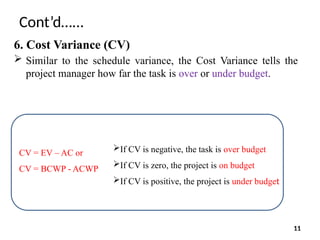
6. Cost Variance (CV)
 Similar to the schedule variance, the Cost Variance tells the
project manager how far the task is over or under budget.
CV = EV – AC or
CV = BCWP - ACWP
If CV is negative, the task is over budget
If CV is zero, the project is on budget
If CV is positive, the project is under budget
11
Cont’d….
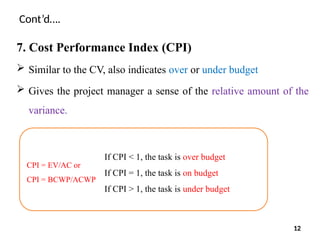
7. Cost Performance Index (CPI)
 Similar to the CV, also indicates over or under budget
 Gives the project manager a sense of the relative amount of the
variance.
CPI = EV/AC or
CPI = BCWP/ACWP
If CPI < 1, the task is over budget
If CPI = 1, the task is on budget
If CPI > 1, the task is under budget
12
Cont’d…..
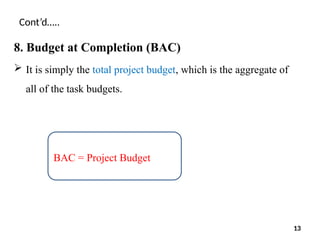
8. Budget at Completion (BAC)
 It is simply the total project budget, which is the aggregate of
all of the task budgets.
BAC = Project Budget
13
Cont’d…
9. Estimate at Completion (EAC)
 This value tells the project manager what the overall project
budget will be if everything else went according to plan
 It is the extrapolation of the current project status to the end of
the project
EAC = BAC/CPI
EAC = AC + [(BAC – EV)/(SPI x CPI)]
EAC = AC + ETC 14
Cont’d….
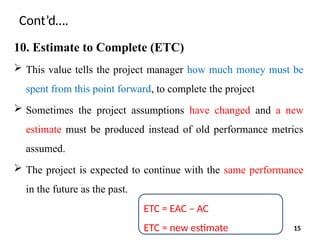
10. Estimate to Complete (ETC)
 This value tells the project manager how much money must be
spent from this point forward, to complete the project
 Sometimes the project assumptions have changed and a new
estimate must be produced instead of old performance metrics
assumed.
 The project is expected to continue with the same performance
in the future as the past.
ETC = EAC – AC
ETC = new estimate 15
Cont’d…..
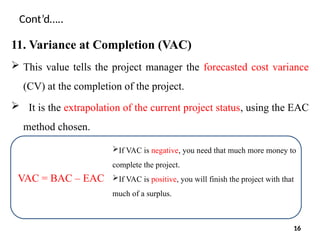
11. Variance at Completion (VAC)
 This value tells the project manager the forecasted cost variance
(CV) at the completion of the project.
 It is the extrapolation of the current project status, using the EAC
method chosen.
VAC = BAC – EAC
If VAC is negative, you need that much more money to
complete the project.
If VAC is positive, you will finish the project with that
much of a surplus.
16
Cont’d….
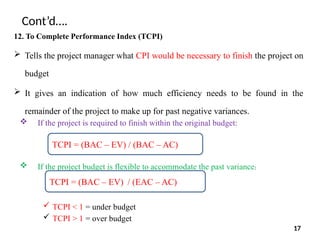
12. To Complete Performance Index (TCPI)
 Tells the project manager what CPI would be necessary to finish the project on
budget
 It gives an indication of how much efficiency needs to be found in the
remainder of the project to make up for past negative variances.
 If the project is required to finish within the original budget:
 If the project budget is flexible to accommodate the past variance:
 TCPI < 1 = under budget
 TCPI > 1 = over budget
TCPI = (BAC – EV) / (BAC – AC)
TCPI = (BAC – EV) / (EAC – AC)
17
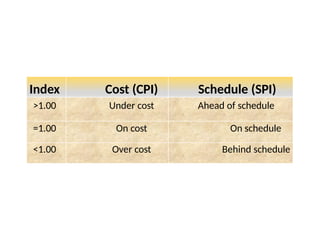
Index Cost (CPI) Schedule (SPI)
>1.00 Under cost Ahead of schedule
=1.00 On cost On schedule
<1.00 Over cost Behind schedule
19
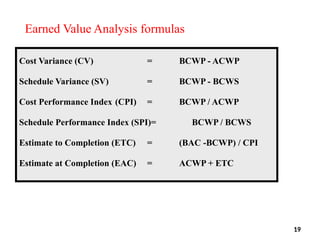
Cost Variance (CV) = BCWP - ACWP
Schedule Variance (SV) = BCWP - BCWS
Cost Performance Index (CPI) = BCWP / ACWP
Schedule Performance Index (SPI)= BCWP / BCWS
Estimate to Completion (ETC) = (BAC -BCWP) / CPI
Estimate at Completion (EAC) = ACWP + ETC
Earned Value Analysis formulas
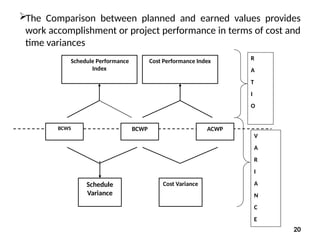
The Comparison between planned and earned values provides
work accomplishment or project performance in terms of cost and
time variances
20
Schedule Performance
Index
Cost Performance Index R
A
T
I
O
BCWS BCWP ACWP
Schedule
Variance
Cost Variance
V
A
R
I
A
N
C
E
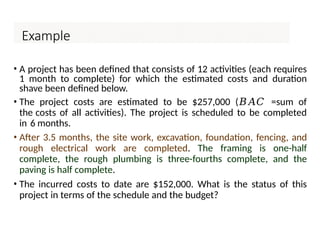
Example
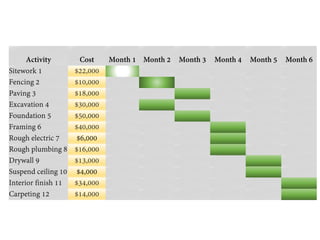
• A project has been defined that consists of 12 activities (each requires
1 month to complete) for which the estimated costs and duration
shave been defined below.
• The project costs are estimated to be $257,000 (𝐵𝐴𝐶 =sum of
the costs of all activities). The project is scheduled to be completed
in 6 months.
• After 3.5 months, the site work, excavation, foundation, fencing, and
rough electrical work are completed. The framing is one-half
complete, the rough plumbing is three-fourths complete, and the
paving is half complete.
• The incurred costs to date are $152,000. What is the status of this
project in terms of the schedule and the budget?
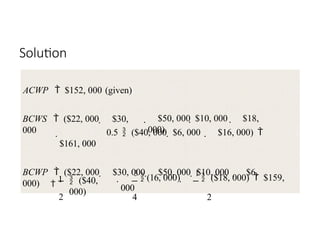
Solution
ACWP  $152, 000 (given)
BCWS  ($22, 000  $30,
000
 $50, 000  $10, 000  $18,
000)
 0.5  ($40, 000  $6, 000  $16, 000) 
$161, 000
BCWP  ($22, 000  $30, 000  $50, 000  $10, 000  $6,
000) 
1
2
 ($40,
000)

3
 (16, 000) 
1
 ($18, 000)  $159,
000
4 2
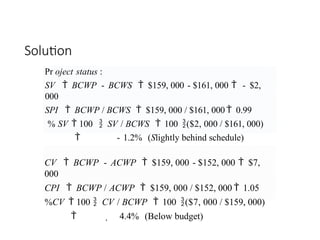
Solution
Pr oject status :
SV  BCWP - BCWS  $159, 000 - $161, 000  - $2,
000
SPI  BCWP / BCWS  $159, 000 / $161, 000  0.99
% SV  100  SV / BCWS  100 ($2, 000 / $161, 000)
 - 1.2% (Slightly behind schedule)
CV  BCWP - ACWP  $159, 000 - $152, 000  $7,
000
CPI  BCWP / ACWP  $159, 000 / $152, 000  1.05
%CV  100  CV / BCWP  100 ($7, 000 / $159, 000)
  4.4% (Below budget)
Solution
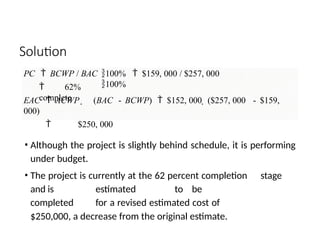
100%  $159, 000 / $257, 000
100%
PC  BCWP / BAC
 62%
complete
EAC  ACWP  (BAC - BCWP)  $152, 000  ($257, 000 - $159,
000)
 $250, 000
• Although the project is slightly behind schedule, it is performing
under budget.
• The project is currently at the 62 percent completion stage
and is estimated to be
completed for a revised estimated cost of
$250,000, a decrease from the original estimate.
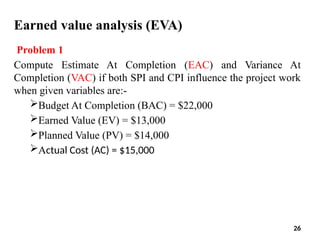
Earned value analysis (EVA)
Problem 1
Compute Estimate At Completion (EAC) and Variance At
Completion (VAC) if both SPI and CPI influence the project work
when given variables are:-
Budget At Completion (BAC) = $22,000
Earned Value (EV) = $13,000
Planned Value (PV) = $14,000
Actual Cost (AC) = $15,000
26
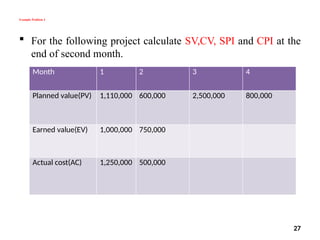
Example Problem 2
 For the following project calculate SV,CV, SPI and CPI at the
end of second month.
Month 1 2 3 4
Planned value(PV) 1,110,000 600,000 2,500,000 800,000
Earned value(EV) 1,000,000 750,000
Actual cost(AC) 1,250,000 500,000
27
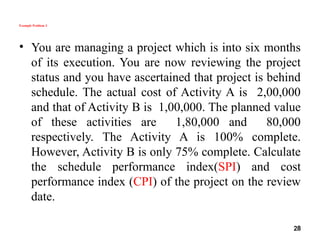
Example Problem 3
• You are managing a project which is into six months
of its execution. You are now reviewing the project
status and you have ascertained that project is behind
schedule. The actual cost of Activity A is 2,00,000
and that of Activity B is 1,00,000. The planned value
of these activities are 1,80,000 and 80,000
respectively. The Activity A is 100% complete.
However, Activity B is only 75% complete. Calculate
the schedule performance index(SPI) and cost
performance index (CPI) of the project on the review
date.
28
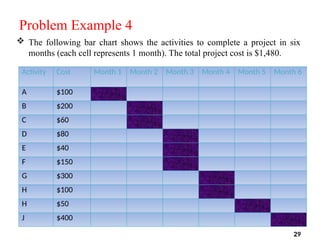
Problem Example 4
 The following bar chart shows the activities to complete a project in six
months (each cell represents 1 month). The total project cost is $1,480.
Activity Cost Month 1 Month 2 Month 3 Month 4 Month 5 Month 6
A $100
B $200
C $60
D $80
E $40
F $150
G $300
H $100
H $50
J $400
29
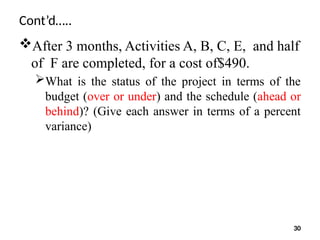
Cont’d…..
After 3 months, Activities A, B, C, E, and half
of F are completed, for a cost of$490.
What is the status of the project in terms of the
budget (over or under) and the schedule (ahead or
behind)? (Give each answer in terms of a percent
variance)
30
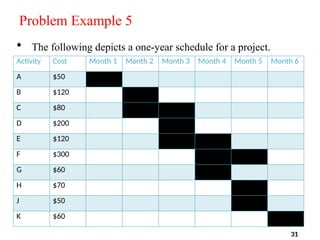
Problem Example 5
• The following depicts a one-year schedule for a project.
Activity Cost Month 1 Month 2 Month 3 Month 4 Month 5 Month 6
A $50
B $120
C $80
D $200
E $120
F $300
G $60
H $70
J $50
K $60
31
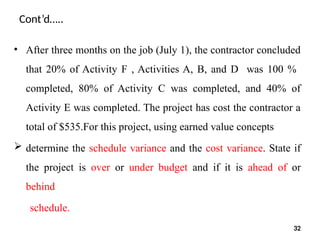
Cont’d…..
• After three months on the job (July 1), the contractor concluded
that 20% of Activity F , Activities A, B, and D was 100 %
completed, 80% of Activity C was completed, and 40% of
Activity E was completed. The project has cost the contractor a
total of $535.For this project, using earned value concepts
 determine the schedule variance and the cost variance. State if
the project is over or under budget and if it is ahead of or
behind
schedule.
32
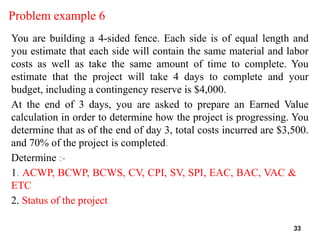
Problem example 6
You are building a 4-sided fence. Each side is of equal length and
you estimate that each side will contain the same material and labor
costs as well as take the same amount of time to complete. You
estimate that the project will take 4 days to complete and your
budget, including a contingency reserve is $4,000.
At the end of 3 days, you are asked to prepare an Earned Value
calculation in order to determine how the project is progressing. You
determine that as of the end of day 3, total costs incurred are $3,500.
and 70% of the project is completed.
Determine :-
1. ACWP, BCWP, BCWS, CV, CPI, SV, SPI, EAC, BAC, VAC &
ETC
2. Status of the project
33
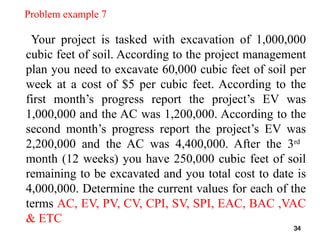
Problem example 7
Your project is tasked with excavation of 1,000,000
cubic feet of soil. According to the project management
plan you need to excavate 60,000 cubic feet of soil per
week at a cost of $5 per cubic feet. According to the
first month’s progress report the project’s EV was
1,000,000 and the AC was 1,200,000. According to the
second month’s progress report the project’s EV was
2,200,000 and the AC was 4,400,000. After the 3rd
month (12 weeks) you have 250,000 cubic feet of soil
remaining to be excavated and you total cost to date is
4,000,000. Determine the current values for each of the
terms AC, EV, PV, CV, CPI, SV, SPI, EAC, BAC ,VAC
& ETC
34
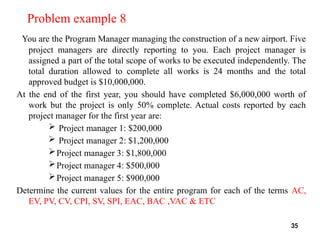
Problem example 8
You are the Program Manager managing the construction of a new airport. Five
project managers are directly reporting to you. Each project manager is
assigned a part of the total scope of works to be executed independently. The
total duration allowed to complete all works is 24 months and the total
approved budget is $10,000,000.
At the end of the first year, you should have completed $6,000,000 worth of
work but the project is only 50% complete. Actual costs reported by each
project manager for the first year are:
 Project manager 1: $200,000
 Project manager 2: $1,200,000
Project manager 3: $1,800,000
Project manager 4: $500,000
Project manager 5: $900,000
Determine the current values for the entire program for each of the terms AC,
EV, PV, CV, CPI, SV, SPI, EAC, BAC ,VAC & ETC
35
THANK YOU!
•
ተፈፀመ
•
Thank you very Mach for your
attention and respect over all the
course.

Earned Value Analysis in construction projects

  • 1.
    CHAPTER 4 Earned ValueAnalysis(EVA) in construction
  • 2.
    How is projecthealth measured?  Project Manager evaluates project’s triple constraint of scope, time and cost  Key Questions – Is the project performing to budget? – Is the project on schedule to deliver the agreed scope?  Typically Summarize Project Health using Green, Yellow, Red Status (Traffic Light Reporting)
  • 3.
    CONT’D….  Earned valueanalysis in its various forms is the most commonly used method of performance measurement.  Earned Value Analysis is an objective method to measure project performance in terms of scope, time and cost  integrates scope, cost (or resource), and schedule measures to help the project management team assess project performance.  Use EVA metrics are used to measure project health and project performance 3
  • 4.
    The Earned Value Concept •Experienced project managers are familiar with the problems of using only partial information, such as only costs or time to track the status of a project. • To illustrate, half of a project budget may be expended by the mid- point of the scheduled duration, but only 20% of the work may be accomplished. • A monitoring of only time and cost would indicate the project is going well; • however, upon completion of the project there would likely be a cost overrun and a delay in schedule because the measurement of work was not included in the project control system.
  • 5.
    The Earned Value Concept •Thus, a project manager must develop an integrated cost / schedule / work system which provides meaningful feedback during the project rather than afterwards. • The status of a project can then be determined and corrective actions taken when corrections can be made at the least cost. • It is one thing to meet a project deadline at any cost. It is another to do it for a reasonable cost.
  • 6.
    The Earned ValueConcept • Project cost control is concerned with ensuring that projects stay within their budgets, while getting the work done on time and at the correct quality. • A variance is defined as any schedule, technical performance, or cost deviation from a specific plan. Variances must be tracked and reported. • They should be mitigated through corrective actions and not eliminated through a baseline change unless there is a good reason.
  • 7.
    Earned Value Characteristics Howmuch work did you PLAN to complete? (Planned Value) How much work did you ACTUALLY complete? (Earned Value) How much did you spend to complete the work? (Actual Cost)
  • 8.
    EVA involves incalculating the following key values for each activities :- 1. Planned Value (PV)  Also known as Budgeted Cost of Work Scheduled (BCWS)  Is the amount of the task that is supposed to have been completed, in terms of the task budget.  is that portion of the approved cost estimate planned to be spent on the activity during a given period. PV = Percent Complete (planned) x Task Budget 2. Earned Value (EV)  Also known as Budgeted Cost of Work Performed (BCWP)  Is the amount of the task that is actually completed EV = Percent Complete (actual) x Task Budget 8
  • 9.
    Cont’d……… 3. Actual Cost(AC)  Also known as Actual Cost of Work Performed (ACWP)  Is the actual to-date cost of the task  is the total of costs incurred in accomplishing work on the activity during a given period. 4. Schedule Variance (SV)  tells the amount that the task is ahead or behind schedule SV = EV – PV or SV = BCWP-BCWS If SV is negative, the task is behind schedule. If SV is zero, the task is on schedule. If SV is positive, the task is ahead of schedule. 9
  • 10.
    Cont’d…… 5. Schedule PerformanceIndex (SPI)  Similar to the SV, also indicates ahead or behind schedule  Gives the project manager a sense of the relative amount of the variance. SPI = EV/PV or SPI= BCWP/BCWS If SPI < 1, the task is behind schedule If SPI = 1, the task is on schedule If SPI > 1, the task is ahead of schedule 10
  • 11.
    Cont’d…... 6. Cost Variance(CV)  Similar to the schedule variance, the Cost Variance tells the project manager how far the task is over or under budget. CV = EV – AC or CV = BCWP - ACWP If CV is negative, the task is over budget If CV is zero, the project is on budget If CV is positive, the project is under budget 11
  • 12.
    Cont’d…. 7. Cost PerformanceIndex (CPI)  Similar to the CV, also indicates over or under budget  Gives the project manager a sense of the relative amount of the variance. CPI = EV/AC or CPI = BCWP/ACWP If CPI < 1, the task is over budget If CPI = 1, the task is on budget If CPI > 1, the task is under budget 12
  • 13.
    Cont’d….. 8. Budget atCompletion (BAC)  It is simply the total project budget, which is the aggregate of all of the task budgets. BAC = Project Budget 13
  • 14.
    Cont’d… 9. Estimate atCompletion (EAC)  This value tells the project manager what the overall project budget will be if everything else went according to plan  It is the extrapolation of the current project status to the end of the project EAC = BAC/CPI EAC = AC + [(BAC – EV)/(SPI x CPI)] EAC = AC + ETC 14
  • 15.
    Cont’d…. 10. Estimate toComplete (ETC)  This value tells the project manager how much money must be spent from this point forward, to complete the project  Sometimes the project assumptions have changed and a new estimate must be produced instead of old performance metrics assumed.  The project is expected to continue with the same performance in the future as the past. ETC = EAC – AC ETC = new estimate 15
  • 16.
    Cont’d….. 11. Variance atCompletion (VAC)  This value tells the project manager the forecasted cost variance (CV) at the completion of the project.  It is the extrapolation of the current project status, using the EAC method chosen. VAC = BAC – EAC If VAC is negative, you need that much more money to complete the project. If VAC is positive, you will finish the project with that much of a surplus. 16
  • 17.
    Cont’d…. 12. To CompletePerformance Index (TCPI)  Tells the project manager what CPI would be necessary to finish the project on budget  It gives an indication of how much efficiency needs to be found in the remainder of the project to make up for past negative variances.  If the project is required to finish within the original budget:  If the project budget is flexible to accommodate the past variance:  TCPI < 1 = under budget  TCPI > 1 = over budget TCPI = (BAC – EV) / (BAC – AC) TCPI = (BAC – EV) / (EAC – AC) 17
  • 18.
    Index Cost (CPI)Schedule (SPI) >1.00 Under cost Ahead of schedule =1.00 On cost On schedule <1.00 Over cost Behind schedule
  • 19.
    19 Cost Variance (CV)= BCWP - ACWP Schedule Variance (SV) = BCWP - BCWS Cost Performance Index (CPI) = BCWP / ACWP Schedule Performance Index (SPI)= BCWP / BCWS Estimate to Completion (ETC) = (BAC -BCWP) / CPI Estimate at Completion (EAC) = ACWP + ETC Earned Value Analysis formulas
  • 20.
    The Comparison betweenplanned and earned values provides work accomplishment or project performance in terms of cost and time variances 20 Schedule Performance Index Cost Performance Index R A T I O BCWS BCWP ACWP Schedule Variance Cost Variance V A R I A N C E
  • 21.
    Example • A projecthas been defined that consists of 12 activities (each requires 1 month to complete) for which the estimated costs and duration shave been defined below. • The project costs are estimated to be $257,000 (𝐵𝐴𝐶 =sum of the costs of all activities). The project is scheduled to be completed in 6 months. • After 3.5 months, the site work, excavation, foundation, fencing, and rough electrical work are completed. The framing is one-half complete, the rough plumbing is three-fourths complete, and the paving is half complete. • The incurred costs to date are $152,000. What is the status of this project in terms of the schedule and the budget?
  • 23.
    Solution ACWP  $152,000 (given) BCWS  ($22, 000  $30, 000  $50, 000  $10, 000  $18, 000)  0.5  ($40, 000  $6, 000  $16, 000)  $161, 000 BCWP  ($22, 000  $30, 000  $50, 000  $10, 000  $6, 000)  1 2  ($40, 000)  3  (16, 000)  1  ($18, 000)  $159, 000 4 2
  • 24.
    Solution Pr oject status: SV  BCWP - BCWS  $159, 000 - $161, 000  - $2, 000 SPI  BCWP / BCWS  $159, 000 / $161, 000  0.99 % SV  100  SV / BCWS  100 ($2, 000 / $161, 000)  - 1.2% (Slightly behind schedule) CV  BCWP - ACWP  $159, 000 - $152, 000  $7, 000 CPI  BCWP / ACWP  $159, 000 / $152, 000  1.05 %CV  100  CV / BCWP  100 ($7, 000 / $159, 000)   4.4% (Below budget)
  • 25.
    Solution 100%  $159,000 / $257, 000 100% PC  BCWP / BAC  62% complete EAC  ACWP  (BAC - BCWP)  $152, 000  ($257, 000 - $159, 000)  $250, 000 • Although the project is slightly behind schedule, it is performing under budget. • The project is currently at the 62 percent completion stage and is estimated to be completed for a revised estimated cost of $250,000, a decrease from the original estimate.
  • 26.
    Earned value analysis(EVA) Problem 1 Compute Estimate At Completion (EAC) and Variance At Completion (VAC) if both SPI and CPI influence the project work when given variables are:- Budget At Completion (BAC) = $22,000 Earned Value (EV) = $13,000 Planned Value (PV) = $14,000 Actual Cost (AC) = $15,000 26
  • 27.
    Example Problem 2 For the following project calculate SV,CV, SPI and CPI at the end of second month. Month 1 2 3 4 Planned value(PV) 1,110,000 600,000 2,500,000 800,000 Earned value(EV) 1,000,000 750,000 Actual cost(AC) 1,250,000 500,000 27
  • 28.
    Example Problem 3 •You are managing a project which is into six months of its execution. You are now reviewing the project status and you have ascertained that project is behind schedule. The actual cost of Activity A is 2,00,000 and that of Activity B is 1,00,000. The planned value of these activities are 1,80,000 and 80,000 respectively. The Activity A is 100% complete. However, Activity B is only 75% complete. Calculate the schedule performance index(SPI) and cost performance index (CPI) of the project on the review date. 28
  • 29.
    Problem Example 4 The following bar chart shows the activities to complete a project in six months (each cell represents 1 month). The total project cost is $1,480. Activity Cost Month 1 Month 2 Month 3 Month 4 Month 5 Month 6 A $100 B $200 C $60 D $80 E $40 F $150 G $300 H $100 H $50 J $400 29
  • 30.
    Cont’d….. After 3 months,Activities A, B, C, E, and half of F are completed, for a cost of$490. What is the status of the project in terms of the budget (over or under) and the schedule (ahead or behind)? (Give each answer in terms of a percent variance) 30
  • 31.
    Problem Example 5 •The following depicts a one-year schedule for a project. Activity Cost Month 1 Month 2 Month 3 Month 4 Month 5 Month 6 A $50 B $120 C $80 D $200 E $120 F $300 G $60 H $70 J $50 K $60 31
  • 32.
    Cont’d….. • After threemonths on the job (July 1), the contractor concluded that 20% of Activity F , Activities A, B, and D was 100 % completed, 80% of Activity C was completed, and 40% of Activity E was completed. The project has cost the contractor a total of $535.For this project, using earned value concepts  determine the schedule variance and the cost variance. State if the project is over or under budget and if it is ahead of or behind schedule. 32
  • 33.
    Problem example 6 Youare building a 4-sided fence. Each side is of equal length and you estimate that each side will contain the same material and labor costs as well as take the same amount of time to complete. You estimate that the project will take 4 days to complete and your budget, including a contingency reserve is $4,000. At the end of 3 days, you are asked to prepare an Earned Value calculation in order to determine how the project is progressing. You determine that as of the end of day 3, total costs incurred are $3,500. and 70% of the project is completed. Determine :- 1. ACWP, BCWP, BCWS, CV, CPI, SV, SPI, EAC, BAC, VAC & ETC 2. Status of the project 33
  • 34.
    Problem example 7 Yourproject is tasked with excavation of 1,000,000 cubic feet of soil. According to the project management plan you need to excavate 60,000 cubic feet of soil per week at a cost of $5 per cubic feet. According to the first month’s progress report the project’s EV was 1,000,000 and the AC was 1,200,000. According to the second month’s progress report the project’s EV was 2,200,000 and the AC was 4,400,000. After the 3rd month (12 weeks) you have 250,000 cubic feet of soil remaining to be excavated and you total cost to date is 4,000,000. Determine the current values for each of the terms AC, EV, PV, CV, CPI, SV, SPI, EAC, BAC ,VAC & ETC 34
  • 35.
    Problem example 8 Youare the Program Manager managing the construction of a new airport. Five project managers are directly reporting to you. Each project manager is assigned a part of the total scope of works to be executed independently. The total duration allowed to complete all works is 24 months and the total approved budget is $10,000,000. At the end of the first year, you should have completed $6,000,000 worth of work but the project is only 50% complete. Actual costs reported by each project manager for the first year are:  Project manager 1: $200,000  Project manager 2: $1,200,000 Project manager 3: $1,800,000 Project manager 4: $500,000 Project manager 5: $900,000 Determine the current values for the entire program for each of the terms AC, EV, PV, CV, CPI, SV, SPI, EAC, BAC ,VAC & ETC 35
  • 36.
    THANK YOU! • ተፈፀመ • Thank youvery Mach for your attention and respect over all the course.