UNIT-I
Cloud Computing Overview
WHAT IS CLOUD COMPUTING
• Cloud Computing is a model for enabling convenient on demand network access to
shared pool of configurable computing resources that can be rapidly provisioned
and released with minimal management effort or service provider interaction.
CHARACTERISTICS OF CLOUD
• On-demand self service:
• A consumer can unilaterally provision computing capabilities, such as server time and network
storage, as needed automatically without requiring human interaction with each service
provider.
• Broad Network Access
• Capabilities are available over the network and accessed through standard mechanisms that
promote use by heterogeneous thin or thick client platforms.
• Resource Pooling
• The provider's computing resources are pooled to serve multiple consumers using a multi-
tenant model, with different physical and virtual resources dynamically assigned and reassigned
according to consumer demand. There is a sense of location independence in that the customer
generally has no control or knowledge over the exact location of the provided resources but may
be able to specify location at a higher level of abstraction (e.g., country, state or datacenter).
Examples of resources include storage, processing, memory and network bandwidth.
…
• Rapid Elasticity
• Capabilities can be elastically provisioned and released, in some cases automatically, to scale
rapidly outward and inward commensurate with demand. To the consumer, the capabilities
available for provisioning often appear to be unlimited and can be appropriated in any quantity
at any time.
• Measured Service
• Cloud systems automatically control and optimize resource use by leveraging a metering
capability at some level of abstraction appropriate to the type of service (e.g., storage,
processing, bandwidth and active user accounts). Resource usage can be monitored, controlled
and reported, providing transparency for the provider and consumer.
WHY USE CLOUDS
• Reduction of costs – unlike on-site hosting the price of deploying applications in
the cloud can be less due to lower hardware costs from more effective use of
physical resources.
• Universal access - cloud computing can allow remotely located employees to
access applications and work via the internet.
• Up to date software - a cloud provider will also be able to upgrade software
keeping in mind feedback from previous software releases
…
• Choice of applications- allows flexibility for cloud users to experiment and choose
the best option for their needs. Cloud computing also allows a business to use,
access and pay only for what they use, with a fast implementation time.
• Potential to be greener and more economical - the average amount of energy
needed for a computational action carried out in the cloud is far less than the
average amount for an on-site deployment.
• Flexibility – cloud computing allows users to switch applications easily and rapidly,
using the one that suits their needs best.
HOW CLOUDS ARE CHANGING
• Creating new business models
• The use of clouds changes how resources are procured, sourced, and delivered. Hardware and
software can be rented on a pay-per-use basis.
• Enabling innovation
• Cloud computing uses the power of the Internet and grid computing to move towards a virtual
enterprise that is not limited by hardware constraints.
• Reengineering of business processes
• Applications need to be built to be machine independent, container-managed, with small
memory footprints.
• Support for new levels of collaboration
• Collaboration using the cloud is not restricted to a single geographical location.
…
Changing the economics of IT:
• Cloud computing is driving operational efficiencies in IT through better use of resources.
• Automating service delivery:
• The term self service means that developers and testers can directly procure the resources they need
to complete their tasks without going through lengthy procurement chains. This results in a
significantly shortened procurement period, and it means that developers and testers can quickly get
to the task at hand.
• Exploiting standardization:
• Access to clouds is through standard Internet transports and protocols, providing access to a range of
user devices.
• Rapidly deploying new capabilities:
• Test and operation teams may have different conventions and configurations from development
teams, and this can lead to unintended application behavior and delays in
…
• Entertainment: Streaming Audio and Video and Storing Video Purchases in the Cloud
• Education: Online Distance Learning, Meeting with group of people.
• Healthcare: Today, the biggest impact is electronic medical records, meaning that all of your
healthcare data lives online so that other professionals who need access to it can do so
without sending paper forms all over the place. You have a legal right (in the U.S. at least) to
view your own medical records any time.
• File Storage and Sharing: Google Drive, Dropbox, OneDrive, Box
…
• Backup and Disaster Recovery: iCloud Backup, Android Backup
• Mobile Apps: Microsoft office is truly cloud using storage of cloud, Google Docs
• Social Media: Twitter, Facebook,
• Internet of Things (IoT): Washing machine status, Air Conditioned functions, Alexa
• Home Security: Apple Home Kit, Webo.
• E-Commerce: Flipkart and Amazon needs more processing at the time of sale
DRIVING FACTORS TOWARDS
CLOUD
NGA distinguishes 6 major technological and economic challenges tackled by cloudsourcing
• The consumerization of technology
• Not that long ago, technology was controlled exclusively by IT departments. The rise of cloud
technology has drastically changed this; almost everybody can effortlessly use cloud-based services
to search for, manage and share information.
• Economic uncertainty
• Due to the recent economic downturn and uncertainty caused by events such as Brexit, organizations
face intensifying pressure to justify expenses and cost-to-value ratios. Technology and HR
expenditures are, of course, among them. HR outsourcing through cloud-based platforms reduces
some of the acquisition and deployment costs and provides organizations with the necessary
flexibility to adapt the services - and the related operating costs - to the changing business
conditions.
…
NGA distinguishes 6 major technological and economic challenges tackled by cloudsourcing
• Continued Globalization
• An increasing number of companies employ people on different countries and continents and
require global oversight over their workforce, for compliance and/or performance reasons.
Thanks to global cloud-based solutions, employees around the world are interconnected and
can count on the same support, on the same technology platform
• A shrinking workforce
• As more and more of the world’s population ages and moves into retirement, organizations
suddenly find themselves with critical skill gaps in competences and workforce. The
combination of cloud-based technology platforms and outsourced HR processes enables talent
management across different regions, laws, cultures and languages.
• The rise of analytics & data
…
BY FORBES
• Linking systems of records with next-generation systems of engagement.
• Companies are integrating the systems that underpin the internal operations of a company — such as
HR, finance, or warehouse management — to the systems, such as email, social networking or
collaboration hubs, which are used to connect with employees, partners and customers. The idea is
to make the most productive and the most creative use of all the data that companies are collecting.
The cloud, as a nimble, scalable platform, is helping propel this trend.
• Using clouds to speed innovation:
• The cloud is creating a foundation for a flexible assembly model, not only to tap into past tech
investments that organizations have made, but also to enable them to transform their business
models quickly. Companies are taking services and data and linking them together to create new and
innovative applications or business processes. By using an open cloud environment that is secure,
their information is protected.
• Automating services in a hybrid cloud environment:
• Large organizations can actually see and control how their services are being used to protect the
security and privacy of their organizations by automating services in the cloud. They can develop
apps, create tech-based business models, or work with collaborative communities. That’s a new way
of thinking from past approaches in cloud computing where organizations thought they were losing
control over their resources that were housed in large centralized data centers. Now it’s much easier
for organizations to be nimble.
…
• Poorly utilized resources driving up hardware and labor costs
• Setting up a new environment is expensive; there is an incentive to hold on to them “just in
case”
• Each new project requisitions new hardware instead of recycling unused hardware; this takes
time and money
• Takes too long to create middleware infrastructures
• Average lead time to get a new application environment is 4-6 weeks
• Approvals, procurement, shipment, hardware installation, license procurement, OS installation,
configuration, application installation
• Creating middleware infrastructures is a manual process and error prone
• Minor differences in configurations can introduce errors or bugs that are difficult to detect
• Often only emerge when moving from test to production
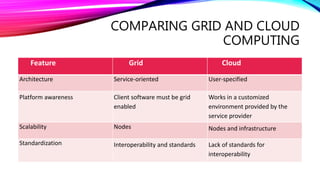
COMPARING GRID AND CLOUD
COMPUTING
Feature Grid Cloud
Architecture Service-oriented User-specified
Platform awareness Client software must be grid
enabled
Works in a customized
environment provided by the
service provider
Scalability Nodes Nodes and infrastructure
Standardization Interoperability and standards Lack of standards for
interoperability
CONCERNS RELATED TO CLOUD
COMPUTING
• Maturity
• Is the technology ready for production-level deployment?
• Standards
• Still being developed
• Security concerns
• Multiple customers sharing the same resources
• Interoperability
• Many different vendor APIs
• Control of data
• Organizational level of comfort with data being outside traditional IT

Overview of Cloud Computing

  • 1.
  • 2.
    WHAT IS CLOUDCOMPUTING • Cloud Computing is a model for enabling convenient on demand network access to shared pool of configurable computing resources that can be rapidly provisioned and released with minimal management effort or service provider interaction.
  • 3.
    CHARACTERISTICS OF CLOUD •On-demand self service: • A consumer can unilaterally provision computing capabilities, such as server time and network storage, as needed automatically without requiring human interaction with each service provider. • Broad Network Access • Capabilities are available over the network and accessed through standard mechanisms that promote use by heterogeneous thin or thick client platforms. • Resource Pooling • The provider's computing resources are pooled to serve multiple consumers using a multi- tenant model, with different physical and virtual resources dynamically assigned and reassigned according to consumer demand. There is a sense of location independence in that the customer generally has no control or knowledge over the exact location of the provided resources but may be able to specify location at a higher level of abstraction (e.g., country, state or datacenter). Examples of resources include storage, processing, memory and network bandwidth.
  • 4.
    … • Rapid Elasticity •Capabilities can be elastically provisioned and released, in some cases automatically, to scale rapidly outward and inward commensurate with demand. To the consumer, the capabilities available for provisioning often appear to be unlimited and can be appropriated in any quantity at any time. • Measured Service • Cloud systems automatically control and optimize resource use by leveraging a metering capability at some level of abstraction appropriate to the type of service (e.g., storage, processing, bandwidth and active user accounts). Resource usage can be monitored, controlled and reported, providing transparency for the provider and consumer.
  • 5.
    WHY USE CLOUDS •Reduction of costs – unlike on-site hosting the price of deploying applications in the cloud can be less due to lower hardware costs from more effective use of physical resources. • Universal access - cloud computing can allow remotely located employees to access applications and work via the internet. • Up to date software - a cloud provider will also be able to upgrade software keeping in mind feedback from previous software releases
  • 6.
    … • Choice ofapplications- allows flexibility for cloud users to experiment and choose the best option for their needs. Cloud computing also allows a business to use, access and pay only for what they use, with a fast implementation time. • Potential to be greener and more economical - the average amount of energy needed for a computational action carried out in the cloud is far less than the average amount for an on-site deployment. • Flexibility – cloud computing allows users to switch applications easily and rapidly, using the one that suits their needs best.
  • 7.
    HOW CLOUDS ARECHANGING • Creating new business models • The use of clouds changes how resources are procured, sourced, and delivered. Hardware and software can be rented on a pay-per-use basis. • Enabling innovation • Cloud computing uses the power of the Internet and grid computing to move towards a virtual enterprise that is not limited by hardware constraints. • Reengineering of business processes • Applications need to be built to be machine independent, container-managed, with small memory footprints. • Support for new levels of collaboration • Collaboration using the cloud is not restricted to a single geographical location.
  • 8.
    … Changing the economicsof IT: • Cloud computing is driving operational efficiencies in IT through better use of resources. • Automating service delivery: • The term self service means that developers and testers can directly procure the resources they need to complete their tasks without going through lengthy procurement chains. This results in a significantly shortened procurement period, and it means that developers and testers can quickly get to the task at hand. • Exploiting standardization: • Access to clouds is through standard Internet transports and protocols, providing access to a range of user devices. • Rapidly deploying new capabilities: • Test and operation teams may have different conventions and configurations from development teams, and this can lead to unintended application behavior and delays in
  • 9.
    … • Entertainment: StreamingAudio and Video and Storing Video Purchases in the Cloud • Education: Online Distance Learning, Meeting with group of people. • Healthcare: Today, the biggest impact is electronic medical records, meaning that all of your healthcare data lives online so that other professionals who need access to it can do so without sending paper forms all over the place. You have a legal right (in the U.S. at least) to view your own medical records any time. • File Storage and Sharing: Google Drive, Dropbox, OneDrive, Box
  • 10.
    … • Backup andDisaster Recovery: iCloud Backup, Android Backup • Mobile Apps: Microsoft office is truly cloud using storage of cloud, Google Docs • Social Media: Twitter, Facebook, • Internet of Things (IoT): Washing machine status, Air Conditioned functions, Alexa • Home Security: Apple Home Kit, Webo. • E-Commerce: Flipkart and Amazon needs more processing at the time of sale
  • 11.
    DRIVING FACTORS TOWARDS CLOUD NGAdistinguishes 6 major technological and economic challenges tackled by cloudsourcing • The consumerization of technology • Not that long ago, technology was controlled exclusively by IT departments. The rise of cloud technology has drastically changed this; almost everybody can effortlessly use cloud-based services to search for, manage and share information. • Economic uncertainty • Due to the recent economic downturn and uncertainty caused by events such as Brexit, organizations face intensifying pressure to justify expenses and cost-to-value ratios. Technology and HR expenditures are, of course, among them. HR outsourcing through cloud-based platforms reduces some of the acquisition and deployment costs and provides organizations with the necessary flexibility to adapt the services - and the related operating costs - to the changing business conditions.
  • 12.
    … NGA distinguishes 6major technological and economic challenges tackled by cloudsourcing • Continued Globalization • An increasing number of companies employ people on different countries and continents and require global oversight over their workforce, for compliance and/or performance reasons. Thanks to global cloud-based solutions, employees around the world are interconnected and can count on the same support, on the same technology platform • A shrinking workforce • As more and more of the world’s population ages and moves into retirement, organizations suddenly find themselves with critical skill gaps in competences and workforce. The combination of cloud-based technology platforms and outsourced HR processes enables talent management across different regions, laws, cultures and languages. • The rise of analytics & data
  • 13.
    … BY FORBES • Linkingsystems of records with next-generation systems of engagement. • Companies are integrating the systems that underpin the internal operations of a company — such as HR, finance, or warehouse management — to the systems, such as email, social networking or collaboration hubs, which are used to connect with employees, partners and customers. The idea is to make the most productive and the most creative use of all the data that companies are collecting. The cloud, as a nimble, scalable platform, is helping propel this trend. • Using clouds to speed innovation: • The cloud is creating a foundation for a flexible assembly model, not only to tap into past tech investments that organizations have made, but also to enable them to transform their business models quickly. Companies are taking services and data and linking them together to create new and innovative applications or business processes. By using an open cloud environment that is secure, their information is protected. • Automating services in a hybrid cloud environment: • Large organizations can actually see and control how their services are being used to protect the security and privacy of their organizations by automating services in the cloud. They can develop apps, create tech-based business models, or work with collaborative communities. That’s a new way of thinking from past approaches in cloud computing where organizations thought they were losing control over their resources that were housed in large centralized data centers. Now it’s much easier for organizations to be nimble.
  • 14.
    … • Poorly utilizedresources driving up hardware and labor costs • Setting up a new environment is expensive; there is an incentive to hold on to them “just in case” • Each new project requisitions new hardware instead of recycling unused hardware; this takes time and money • Takes too long to create middleware infrastructures • Average lead time to get a new application environment is 4-6 weeks • Approvals, procurement, shipment, hardware installation, license procurement, OS installation, configuration, application installation • Creating middleware infrastructures is a manual process and error prone • Minor differences in configurations can introduce errors or bugs that are difficult to detect • Often only emerge when moving from test to production
  • 15.
    COMPARING GRID ANDCLOUD COMPUTING Feature Grid Cloud Architecture Service-oriented User-specified Platform awareness Client software must be grid enabled Works in a customized environment provided by the service provider Scalability Nodes Nodes and infrastructure Standardization Interoperability and standards Lack of standards for interoperability
  • 16.
    CONCERNS RELATED TOCLOUD COMPUTING • Maturity • Is the technology ready for production-level deployment? • Standards • Still being developed • Security concerns • Multiple customers sharing the same resources • Interoperability • Many different vendor APIs • Control of data • Organizational level of comfort with data being outside traditional IT