iFour ConsultancyProject Monitoring and Control
 Introduction
 Objectives
 Practices
 Monitor Project Against Plan
 Manage Corrective Action to Closure
 Achieve Specific Goals
 Institutionalize a Managed Process
 Institutionalize a Defined Process
 Institutionalize a Quantitatively Managed Process
 Institutionalize an Optimizing Process
 Techniques
 Earned value management
 Critical ratio
 Stakeholders involved
 Recourses
 References
Roadmap
http://www.ifourtechnolab.com/ ASP.NET Software Development Companies India
Project Monitoring and Control
 Involves measuring progress toward project objectives, monitoring deviation from the
plan, and taking correction actions
 Monitoring – collecting, recording, and reporting information concerning project
performance
 Control – Uses monitoring to bring actual performance to planned performance
•A markup language is a set of markup tags
http://www.ifourtechnolab.com/ ASP.NET Software Development Companies India
 Key control objective area
Cost - human and other resources
Time - time to deliver
Quality - value and goals of the project
 Project monitoring and control of project costs
Mainly tracking human resources, or people hours
 Project monitoring and control of the project timeline
Project Timeline – Monitoring time allocated to resources
 Project monitoring and control of the project deliverables
Monitor the quality of work product
Project Monitoring and Control: Objectives
 Actual performance and progress of the project are monitored against the project plan
 Monitor Project Against Plan involves following activities
 Monitor Project Planning Parameters
 Schedule
 Estimated cost
 Work product and task in terms of size and complexity
 Resource provided and actually used
 Knowledge and skills of personnel
 Monitor Commitments
1. Review commitments regularly
2. Identify not satisfied or at risk commitments
3. Document the results
Practices: Monitor Project Against Plan
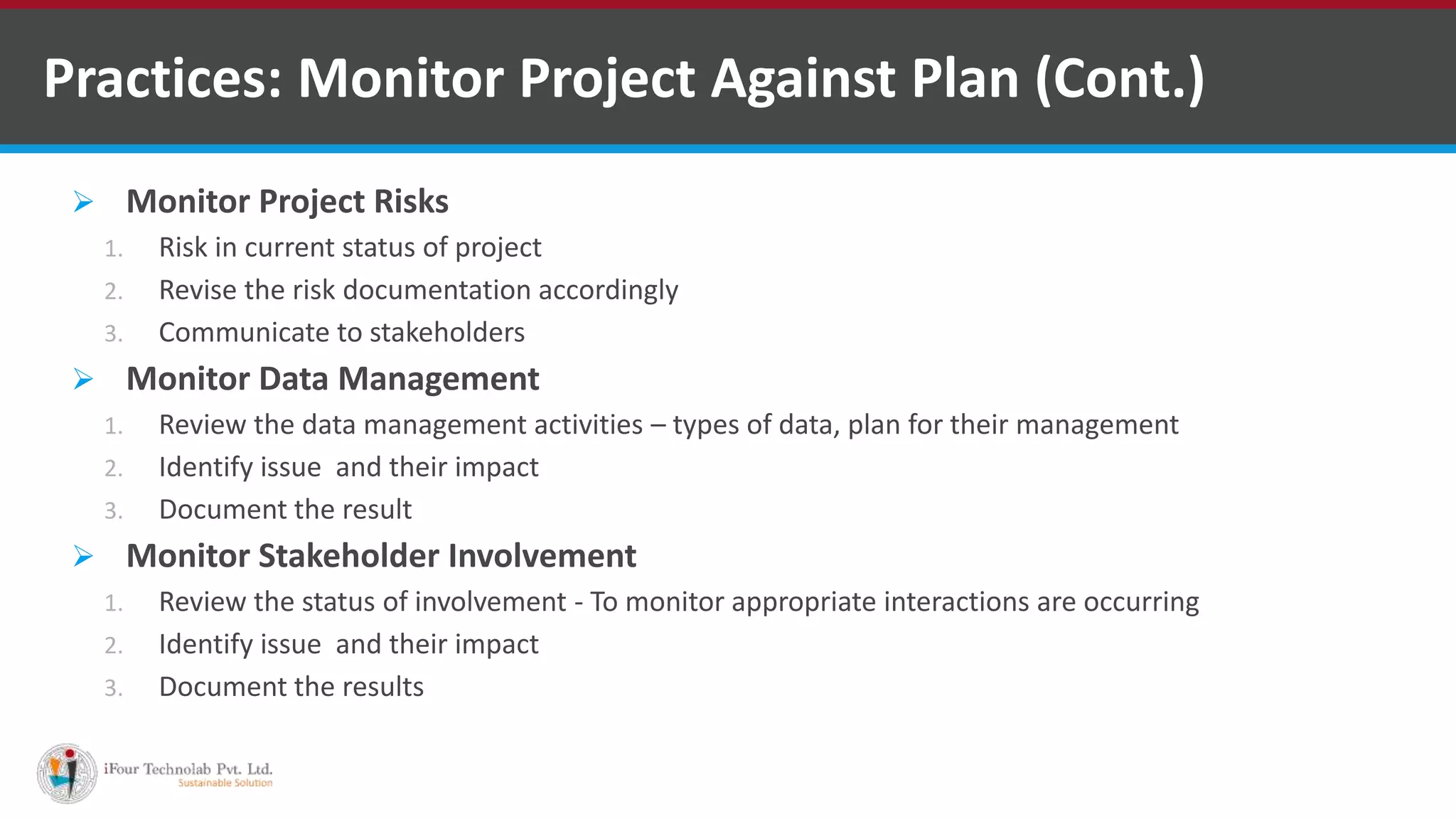
 Monitor Project Risks
1. Risk in current status of project
2. Revise the risk documentation accordingly
3. Communicate to stakeholders
 Monitor Data Management
1. Review the data management activities – types of data, plan for their management
2. Identify issue and their impact
3. Document the result
 Monitor Stakeholder Involvement
1. Review the status of involvement - To monitor appropriate interactions are occurring
2. Identify issue and their impact
3. Document the results
Practices: Monitor Project Against Plan (Cont.)
http://www.ifourtechnolab.com/ ASP.NET Software Development Companies India
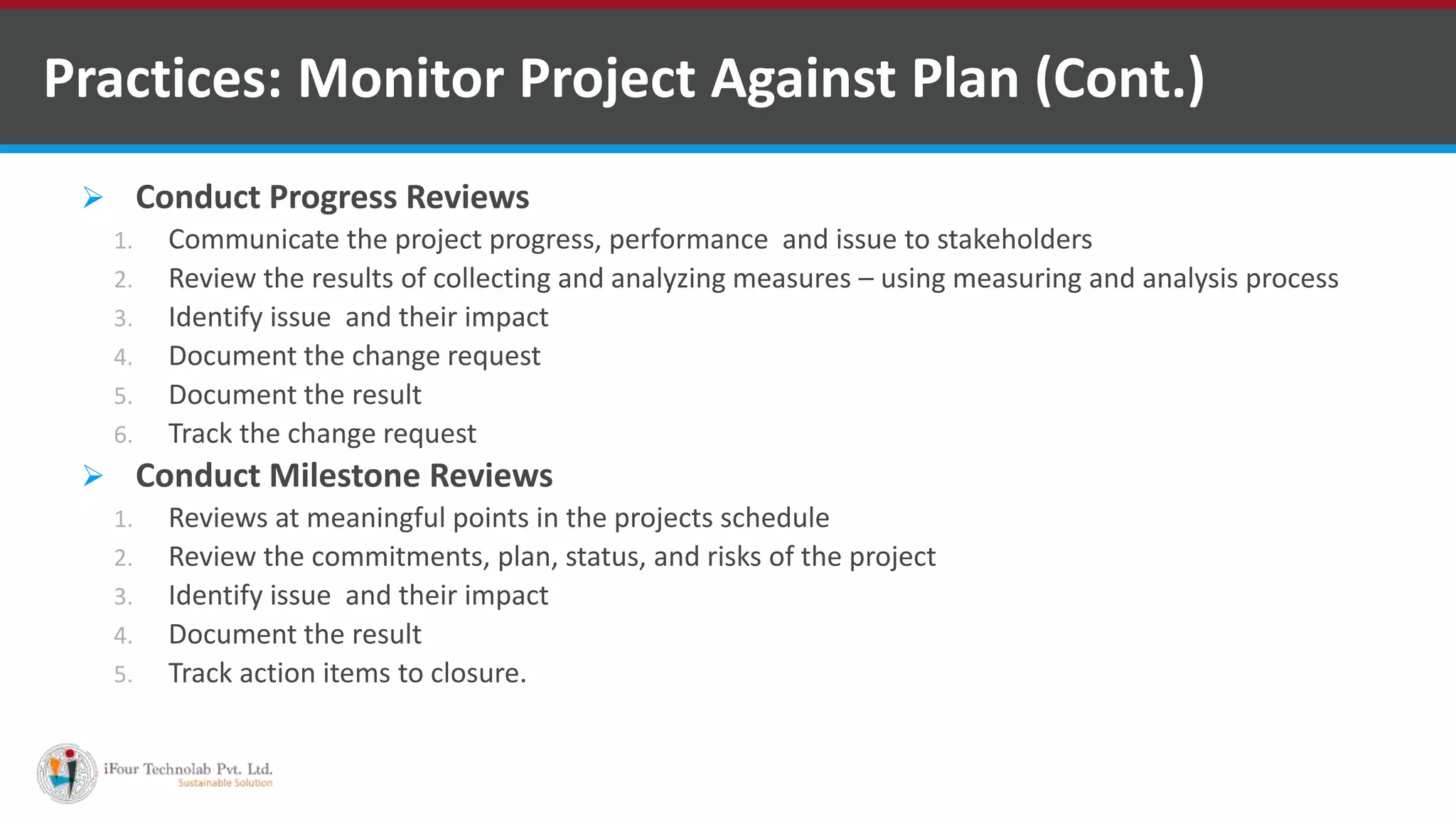
 Conduct Progress Reviews
1. Communicate the project progress, performance and issue to stakeholders
2. Review the results of collecting and analyzing measures – using measuring and analysis process
3. Identify issue and their impact
4. Document the change request
5. Document the result
6. Track the change request
 Conduct Milestone Reviews
1. Reviews at meaningful points in the projects schedule
2. Review the commitments, plan, status, and risks of the project
3. Identify issue and their impact
4. Document the result
5. Track action items to closure.
Practices: Monitor Project Against Plan (Cont.)
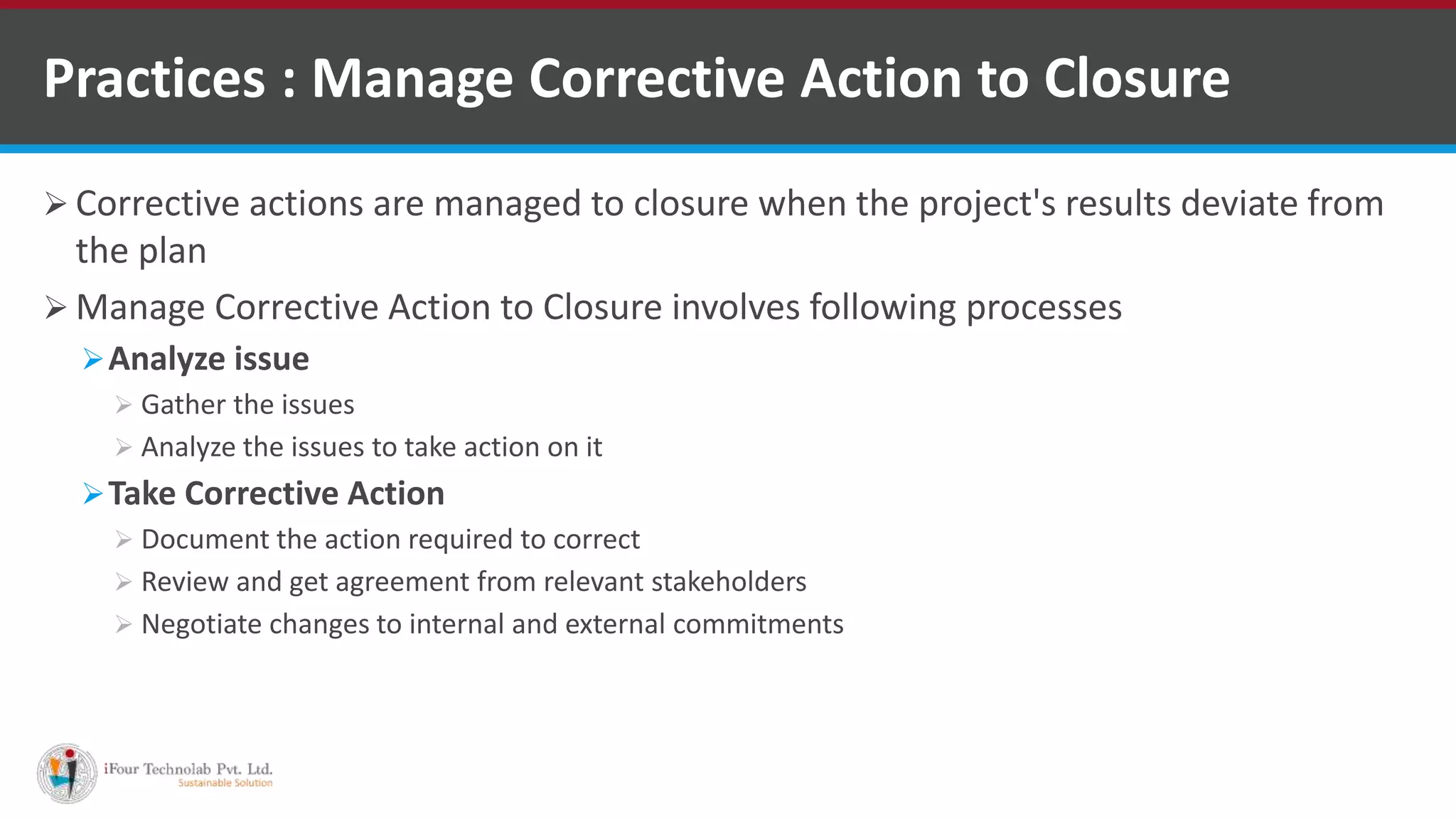
 Corrective actions are managed to closure when the project's results deviate from
the plan
 Manage Corrective Action to Closure involves following processes
Analyze issue
 Gather the issues
 Analyze the issues to take action on it
Take Corrective Action
 Document the action required to correct
 Review and get agreement from relevant stakeholders
 Negotiate changes to internal and external commitments
Practices : Manage Corrective Action to Closure
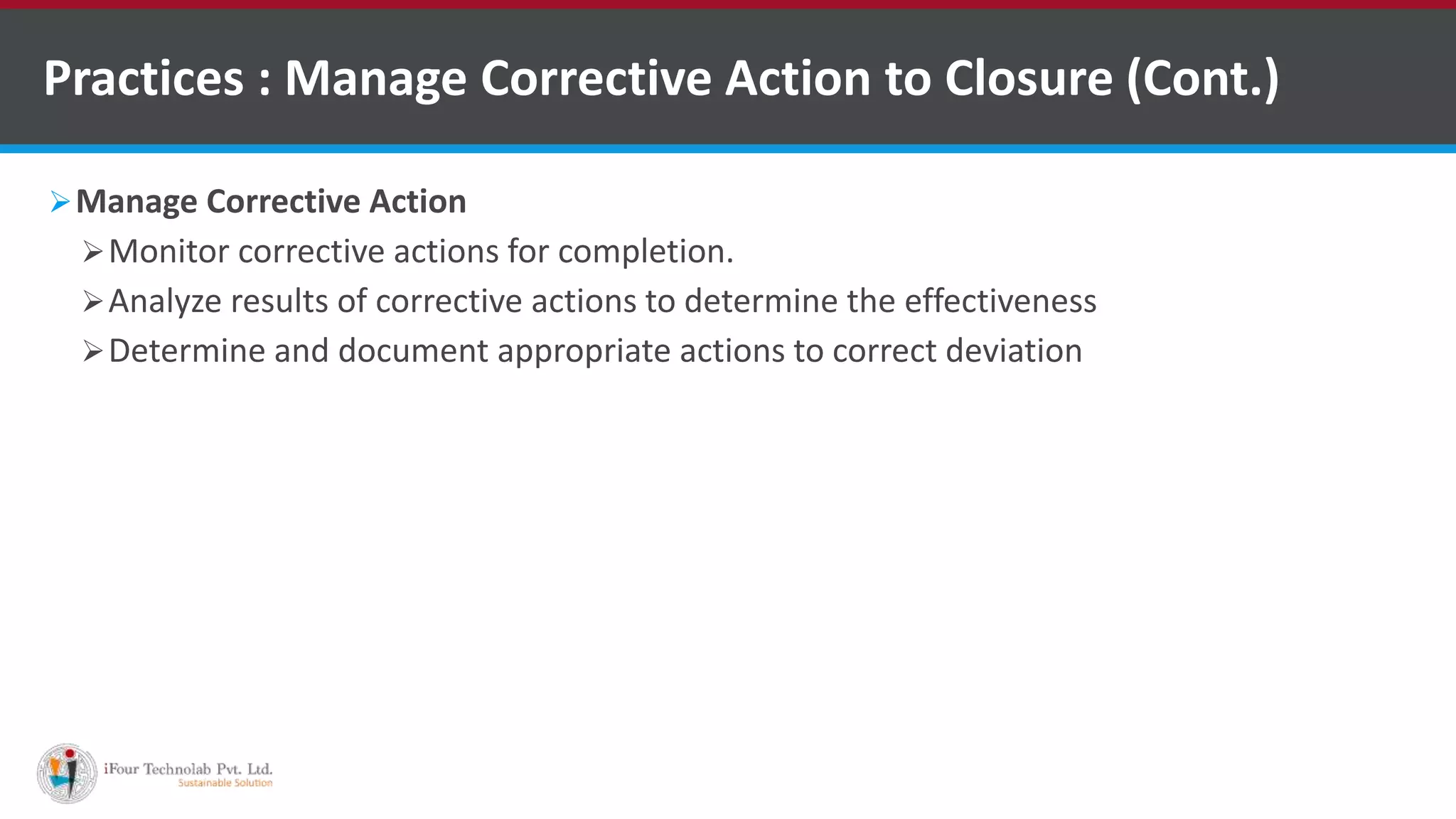
Manage Corrective Action
Monitor corrective actions for completion.
Analyze results of corrective actions to determine the effectiveness
Determine and document appropriate actions to correct deviation
Practices : Manage Corrective Action to Closure (Cont.)
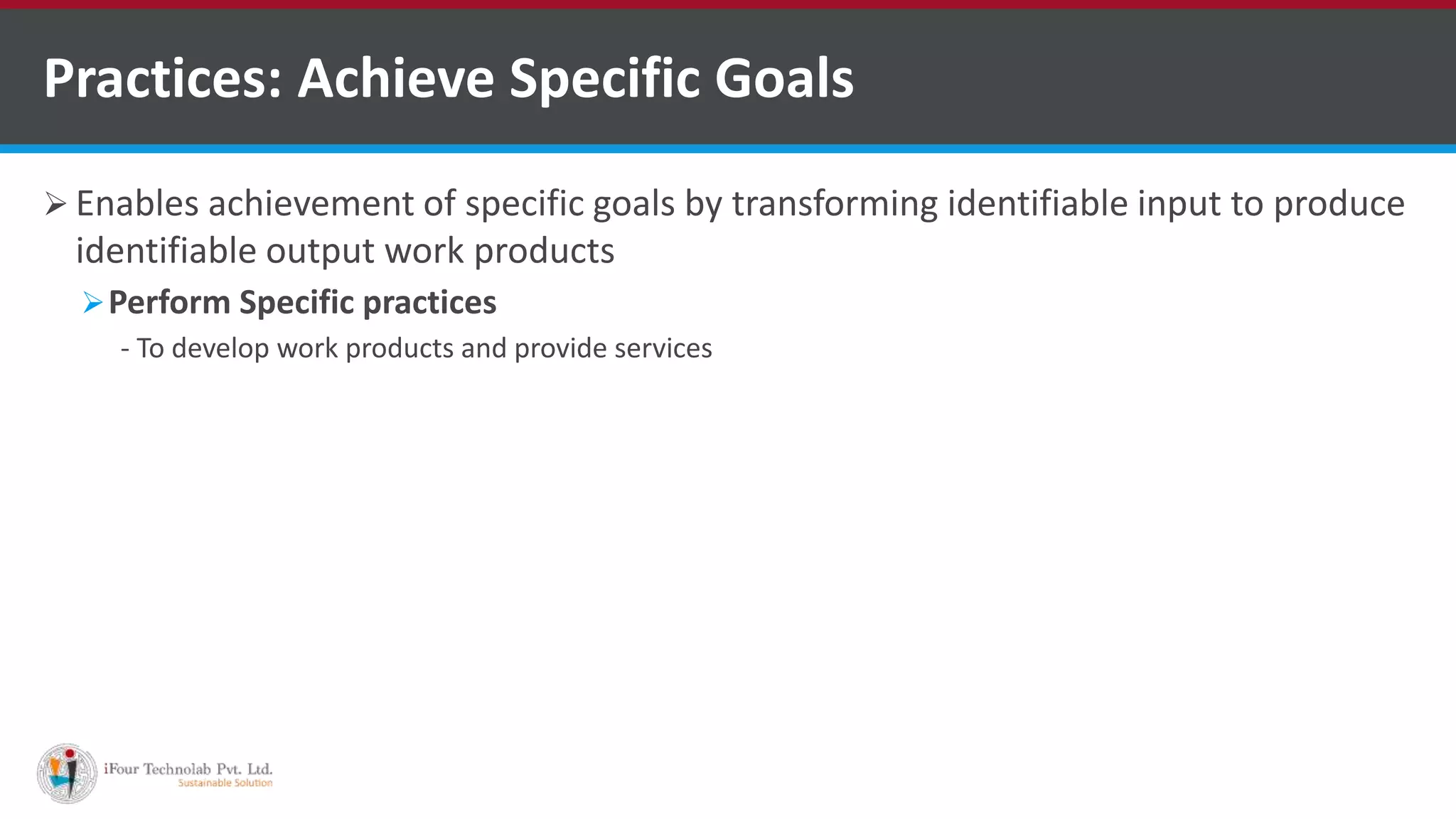
 Enables achievement of specific goals by transforming identifiable input to produce
identifiable output work products
Perform Specific practices
- To develop work products and provide services
Practices: Achieve Specific Goals
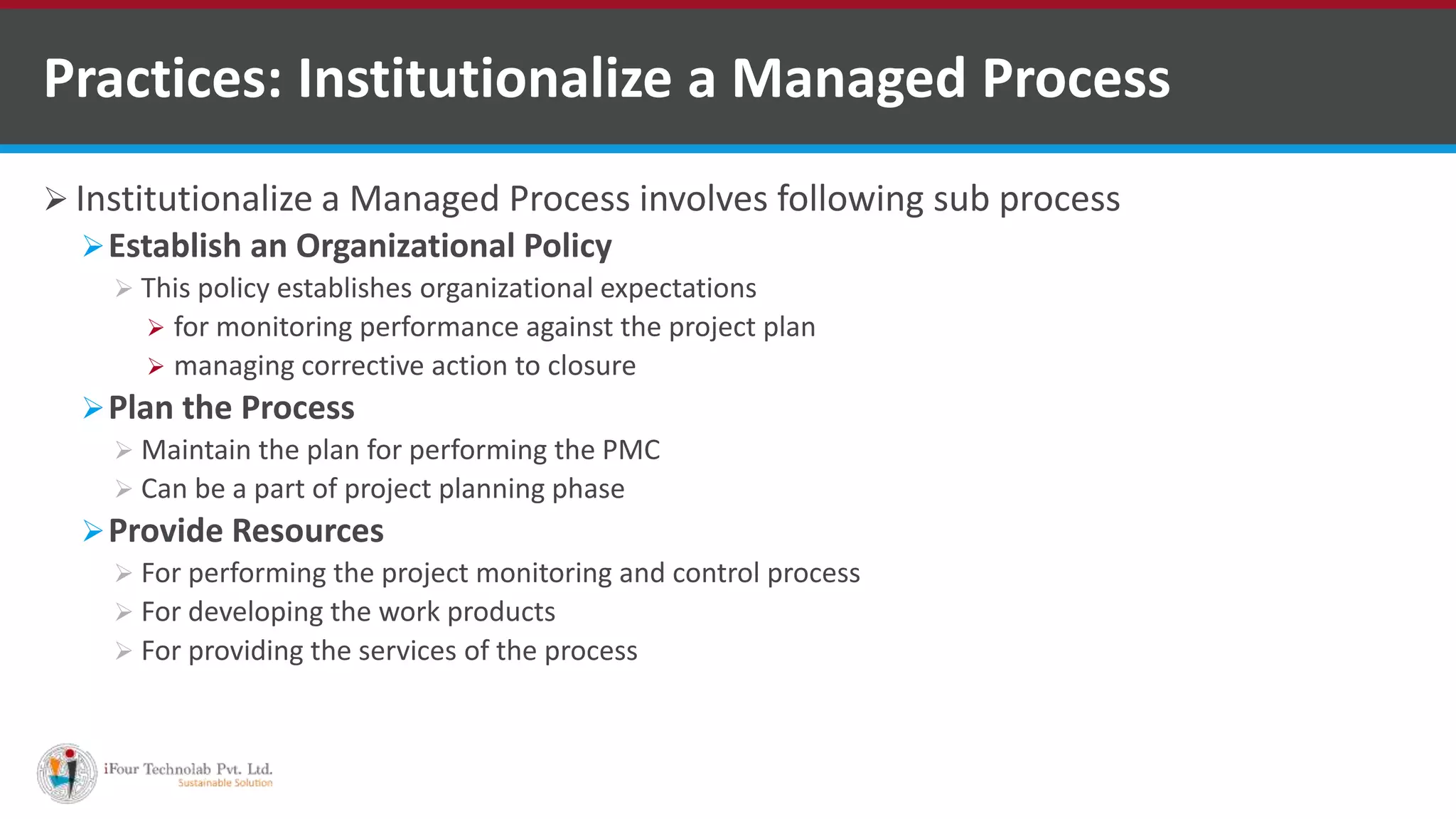
 Institutionalize a Managed Process involves following sub process
Establish an Organizational Policy
 This policy establishes organizational expectations
 for monitoring performance against the project plan
 managing corrective action to closure
Plan the Process
 Maintain the plan for performing the PMC
 Can be a part of project planning phase
Provide Resources
 For performing the project monitoring and control process
 For developing the work products
 For providing the services of the process
Practices: Institutionalize a Managed Process
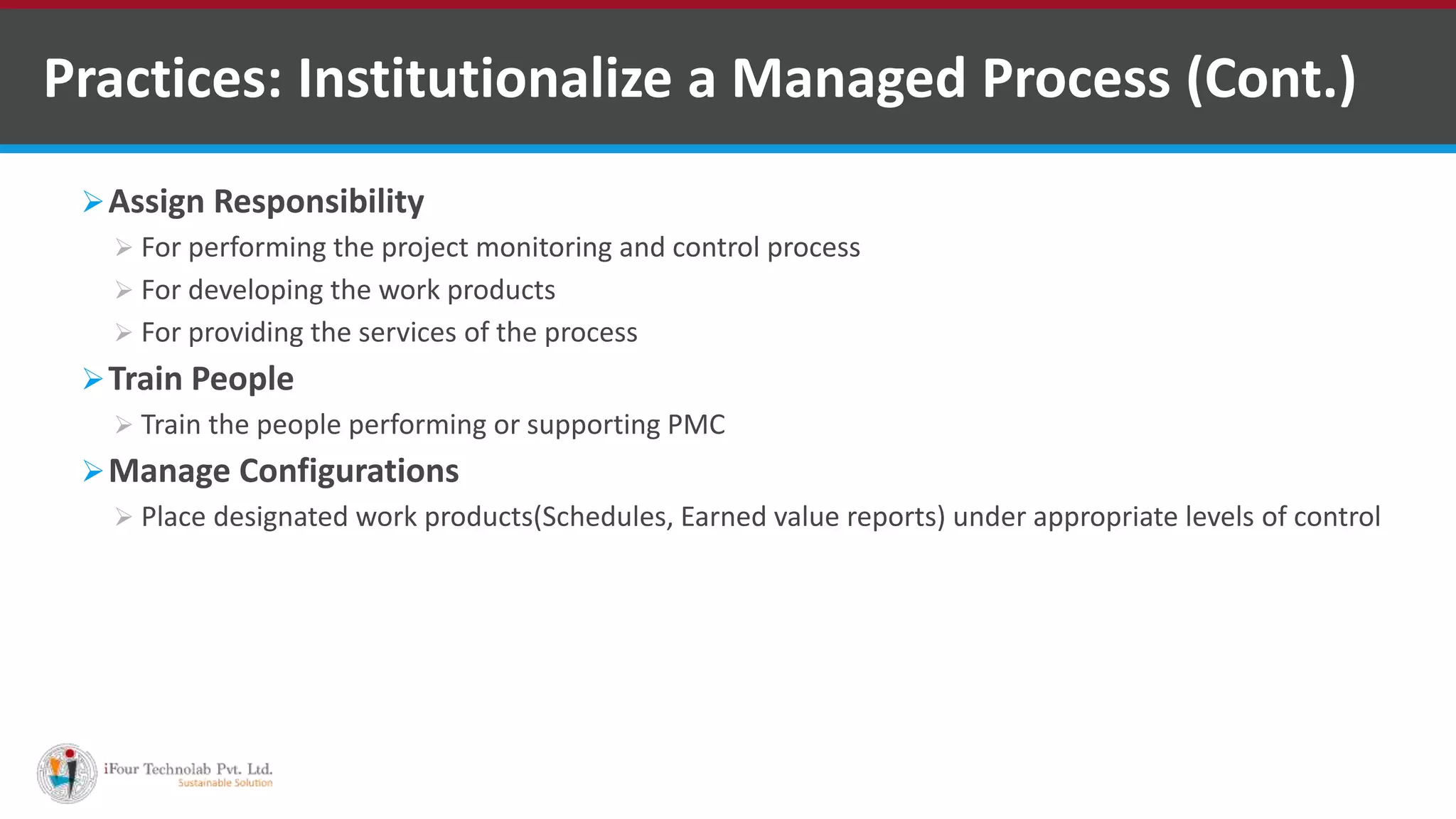
Assign Responsibility
 For performing the project monitoring and control process
 For developing the work products
 For providing the services of the process
Train People
 Train the people performing or supporting PMC
Manage Configurations
 Place designated work products(Schedules, Earned value reports) under appropriate levels of control
Practices: Institutionalize a Managed Process (Cont.)
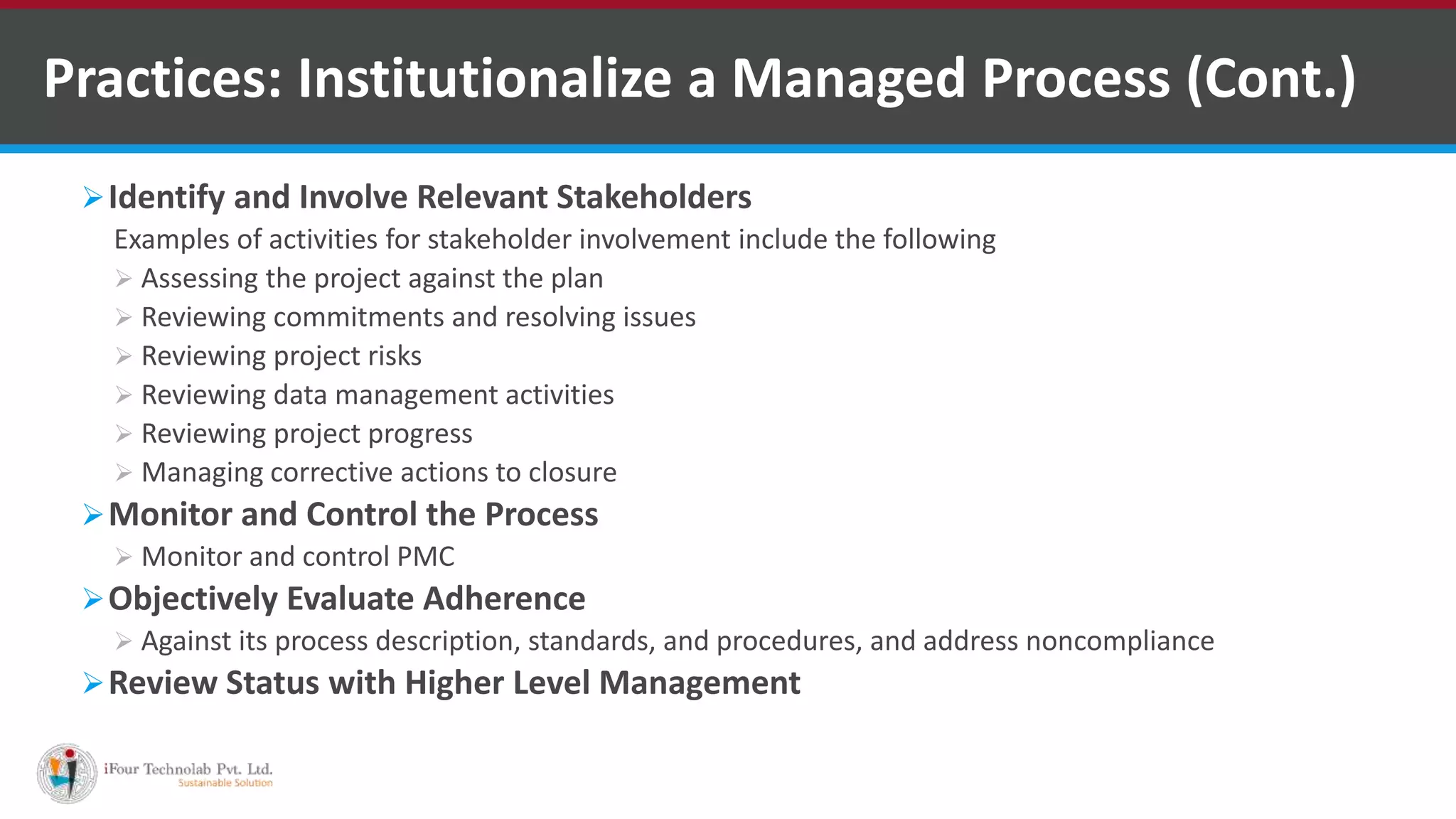
Identify and Involve Relevant Stakeholders
Examples of activities for stakeholder involvement include the following
 Assessing the project against the plan
 Reviewing commitments and resolving issues
 Reviewing project risks
 Reviewing data management activities
 Reviewing project progress
 Managing corrective actions to closure
Monitor and Control the Process
 Monitor and control PMC
Objectively Evaluate Adherence
 Against its process description, standards, and procedures, and address noncompliance
Review Status with Higher Level Management
Practices: Institutionalize a Managed Process (Cont.)
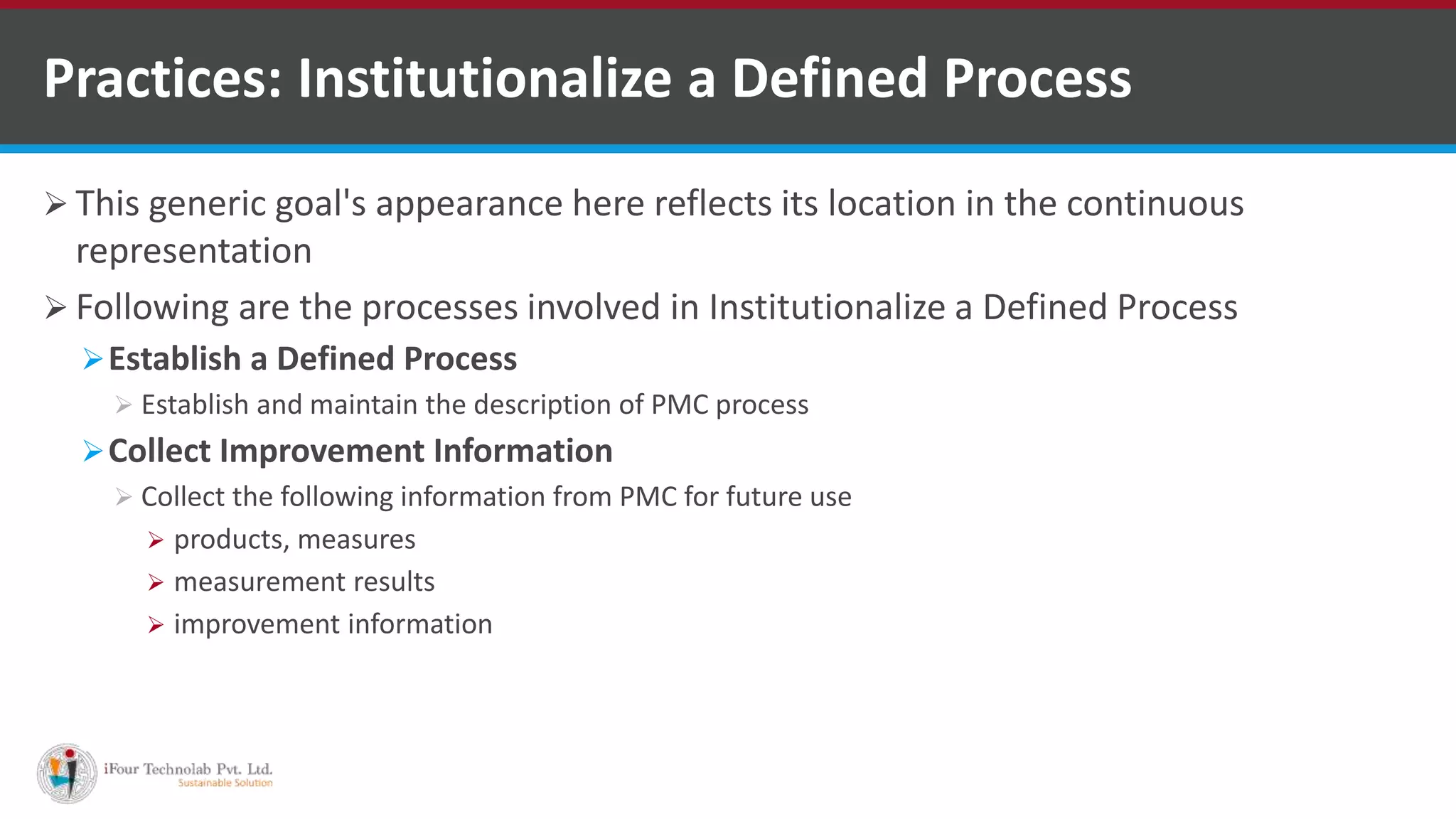
 This generic goal's appearance here reflects its location in the continuous
representation
 Following are the processes involved in Institutionalize a Defined Process
Establish a Defined Process
 Establish and maintain the description of PMC process
Collect Improvement Information
 Collect the following information from PMC for future use
 products, measures
 measurement results
 improvement information
Practices: Institutionalize a Defined Process
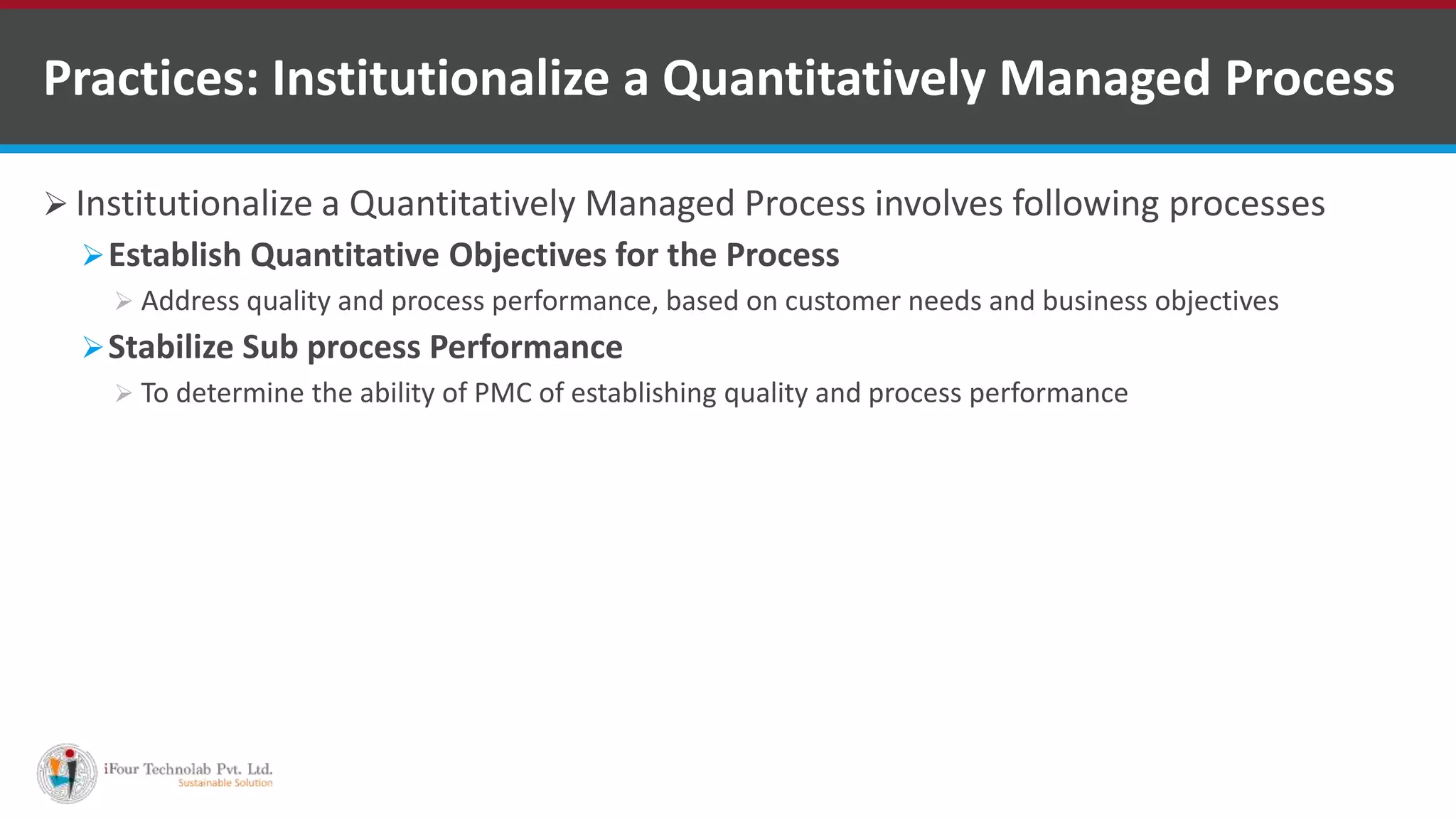
 Institutionalize a Quantitatively Managed Process involves following processes
Establish Quantitative Objectives for the Process
 Address quality and process performance, based on customer needs and business objectives
Stabilize Sub process Performance
 To determine the ability of PMC of establishing quality and process performance
Practices: Institutionalize a Quantitatively Managed Process
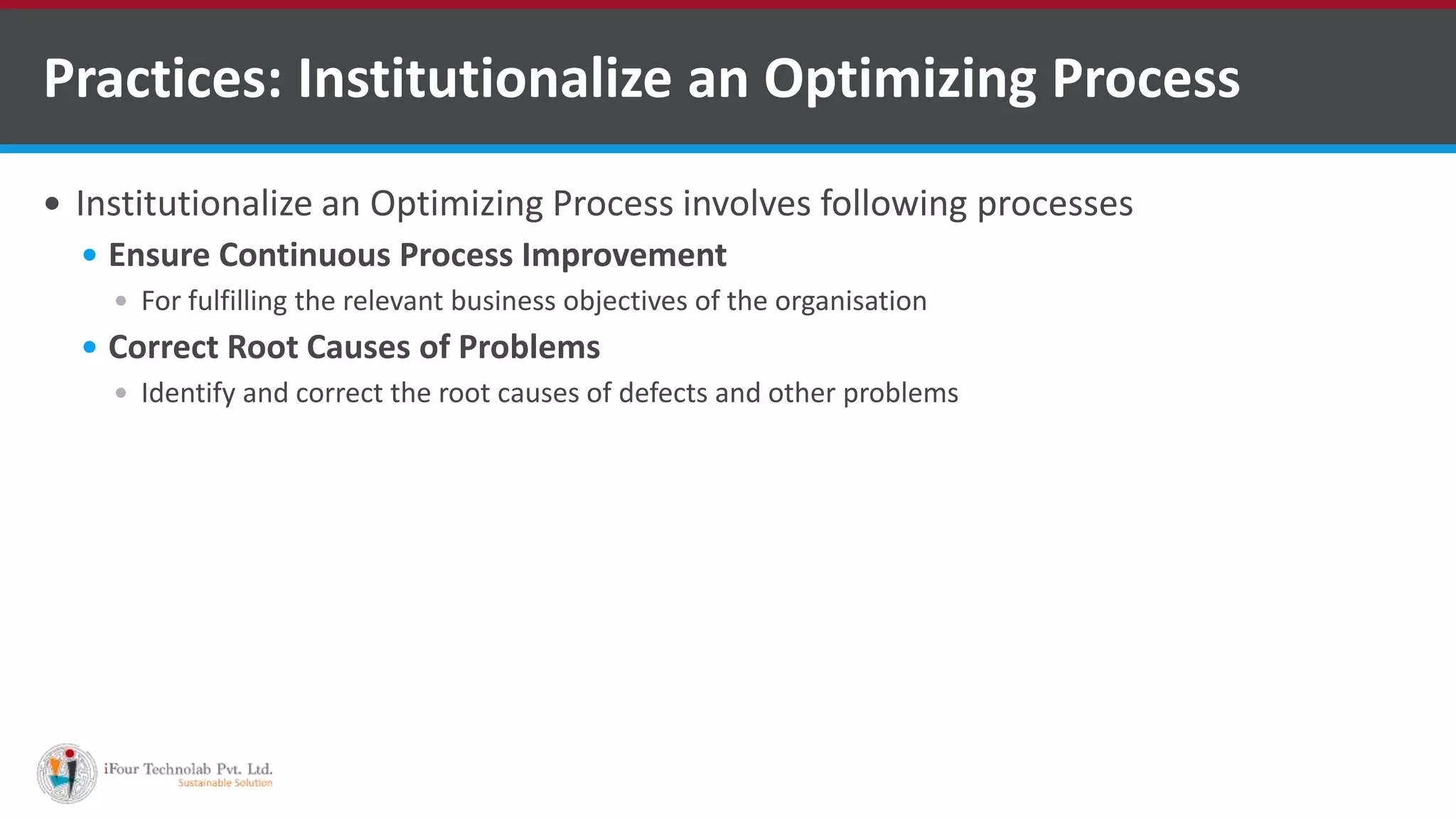
 Institutionalize an Optimizing Process involves following processes
 Ensure Continuous Process Improvement
 For fulfilling the relevant business objectives of the organisation
 Correct Root Causes of Problems
 Identify and correct the root causes of defects and other problems
Practices: Institutionalize an Optimizing Process
Earned value management(EVM)
Critical Ratio
Techniques for monitoring and control
 Way of determining overall performance
Earned value (EV)
formerly called the budgeted cost of work performed (BCWP)
estimate of the value of the physical work actually completed
based on the original planned and the rate it is completing to date
 Baseline cost to completion –referred to as budget at completion (BAC)
 Actual cost to date –referred to as estimated cost at completion (EAC)
Earned value management
 Cost variance (CV) – difference between budgeted cost of work performed (earned
value) (BCWP) and actual cost of that work (ACWP)
 Schedule variance (SV) – difference between earned value (BCWP) and cost of
work we scheduled to perform to date (BCWS)
 Time variance (TV) – difference between time scheduled for work performed
(STWP) and actual time to perform it (ATWP)
Earned value management - Variances
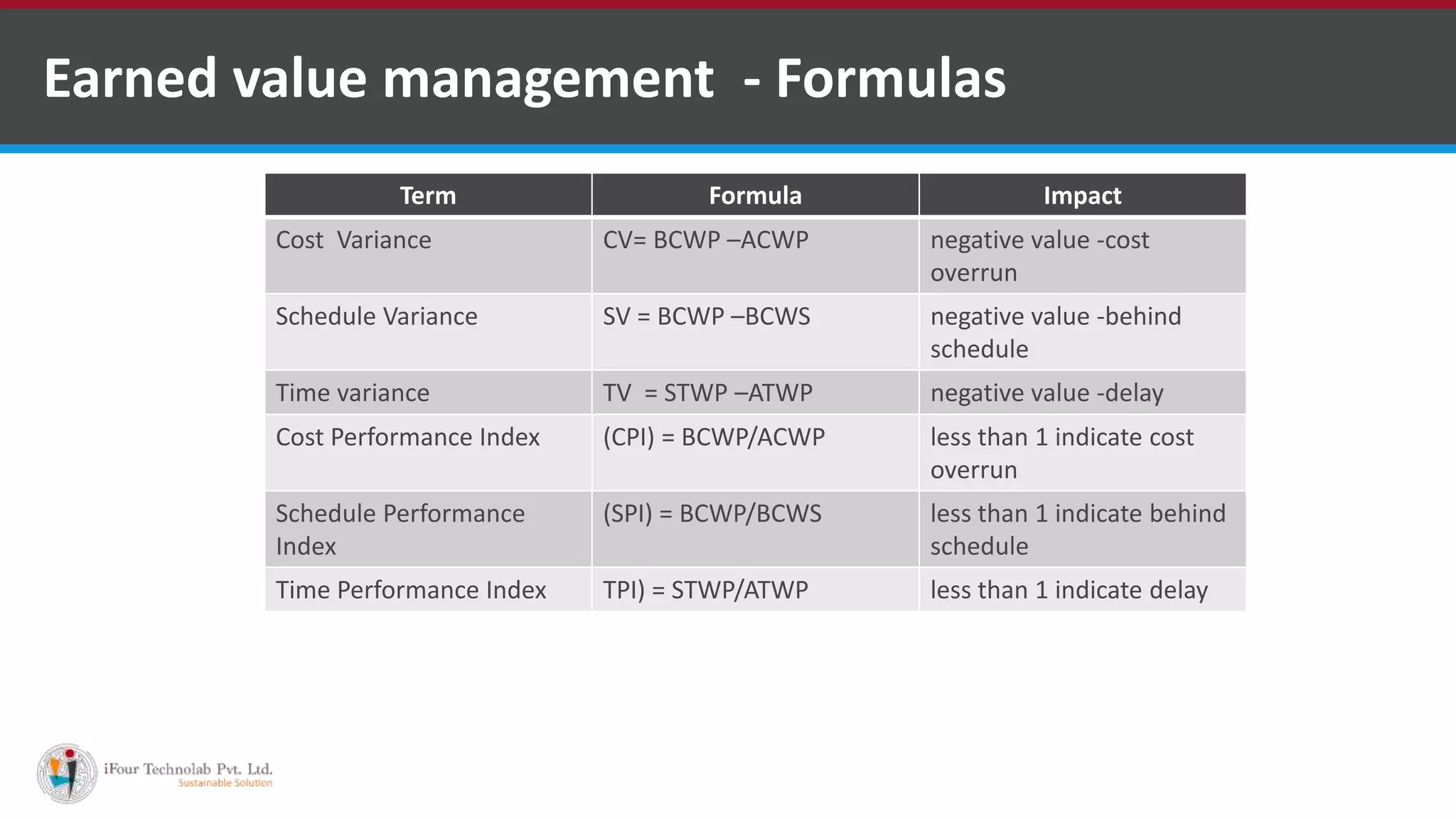
Term Formula Impact
Cost Variance CV= BCWP –ACWP negative value -cost
overrun
Schedule Variance SV = BCWP –BCWS negative value -behind
schedule
Time variance TV = STWP –ATWP negative value -delay
Cost Performance Index (CPI) = BCWP/ACWP less than 1 indicate cost
overrun
Schedule Performance
Index
(SPI) = BCWP/BCWS less than 1 indicate behind
schedule
Time Performance Index TPI) = STWP/ATWP less than 1 indicate delay
Earned value management - Formulas
Earned Value Management (cont.)
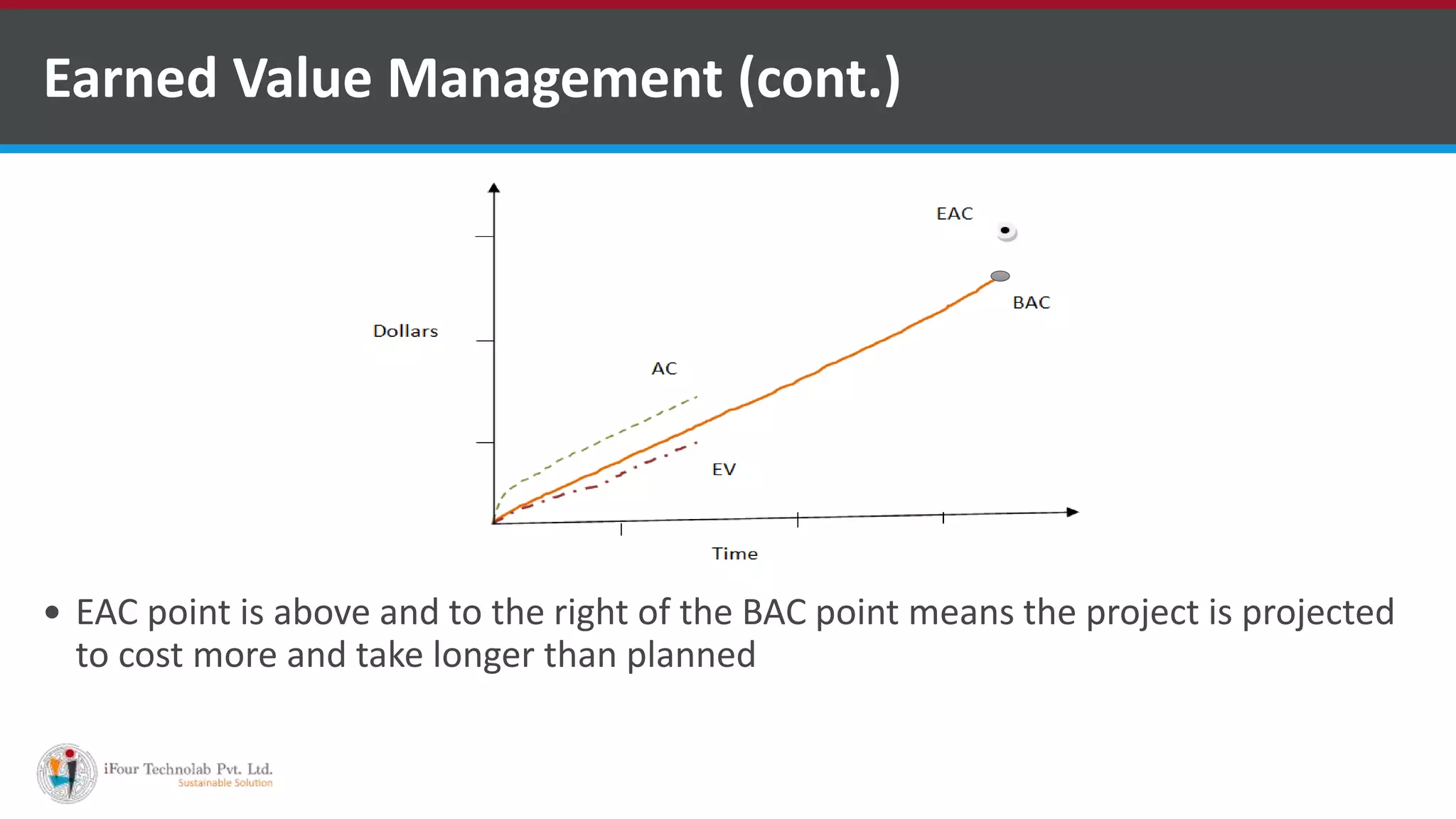
 EAC point is above and to the right of the BAC point means the project is projected
to cost more and take longer than planned
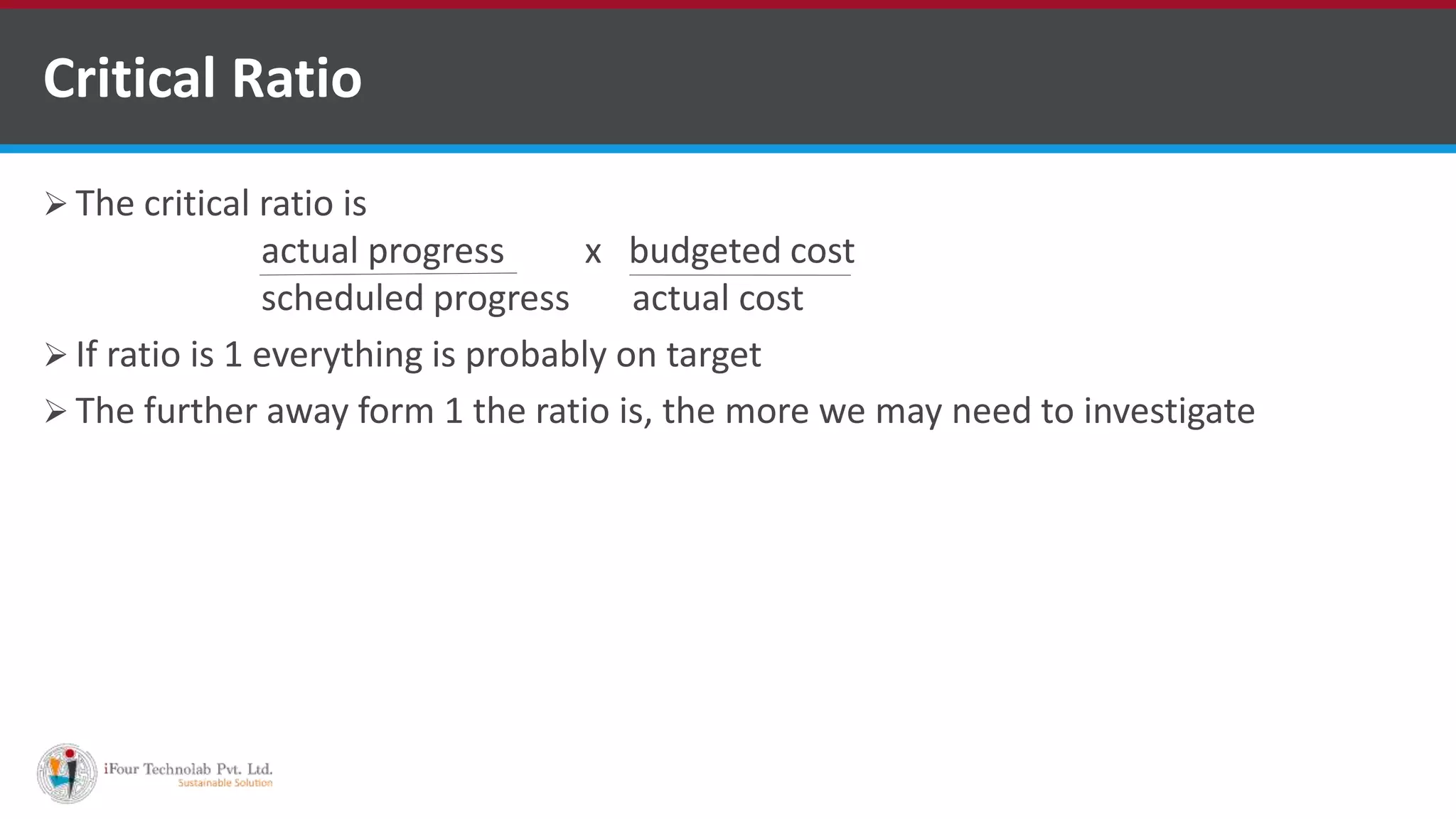
 The critical ratio is
actual progress x budgeted cost
scheduled progress actual cost
 If ratio is 1 everything is probably on target
 The further away form 1 the ratio is, the more we may need to investigate
Critical Ratio
 The project manager
 The project team
 Support staff
 Customers
 Users
 Suppliers
Project Monitoring and Control : Stakeholders
 Input Documents
Project Plan
Project schedule
Project budget
 Result Documents
Records of significant deviations
Risk status document
Project measurement data and analysis
Earned value reports
Corrective action plan
Corrective action results
Project monitoring and Control: Recourses
http://dqsindia.com/cmmi/getting-started/
 https://en.wikipedia.org/wiki/Process_area_(CMMI)
http://www.tutorialspoint.com/cmmi/cmmi-process-areas.htm
http://www.software-quality-assurance.org/cmmi-project-monitoring-and-
control.html#intro
 http://oec.ac.in/images/upload/Project%20Monitoring%20&%20Control.pdf
References
http://www.ifourtechnolab.com/ ASP.NET Software Development Companies India
Questions?
http://www.ifourtechnolab.com/ ASP.NET Software Development Companies India

Project management : Project Monitoring and Control by iFour Technolab Pvt. Ltd.

  • 1.
  • 2.
     Introduction  Objectives Practices  Monitor Project Against Plan  Manage Corrective Action to Closure  Achieve Specific Goals  Institutionalize a Managed Process  Institutionalize a Defined Process  Institutionalize a Quantitatively Managed Process  Institutionalize an Optimizing Process  Techniques  Earned value management  Critical ratio  Stakeholders involved  Recourses  References Roadmap http://www.ifourtechnolab.com/ ASP.NET Software Development Companies India
  • 3.
    Project Monitoring andControl  Involves measuring progress toward project objectives, monitoring deviation from the plan, and taking correction actions  Monitoring – collecting, recording, and reporting information concerning project performance  Control – Uses monitoring to bring actual performance to planned performance •A markup language is a set of markup tags http://www.ifourtechnolab.com/ ASP.NET Software Development Companies India
  • 4.
     Key controlobjective area Cost - human and other resources Time - time to deliver Quality - value and goals of the project  Project monitoring and control of project costs Mainly tracking human resources, or people hours  Project monitoring and control of the project timeline Project Timeline – Monitoring time allocated to resources  Project monitoring and control of the project deliverables Monitor the quality of work product Project Monitoring and Control: Objectives
  • 5.
     Actual performanceand progress of the project are monitored against the project plan  Monitor Project Against Plan involves following activities  Monitor Project Planning Parameters  Schedule  Estimated cost  Work product and task in terms of size and complexity  Resource provided and actually used  Knowledge and skills of personnel  Monitor Commitments 1. Review commitments regularly 2. Identify not satisfied or at risk commitments 3. Document the results Practices: Monitor Project Against Plan
  • 6.
     Monitor ProjectRisks 1. Risk in current status of project 2. Revise the risk documentation accordingly 3. Communicate to stakeholders  Monitor Data Management 1. Review the data management activities – types of data, plan for their management 2. Identify issue and their impact 3. Document the result  Monitor Stakeholder Involvement 1. Review the status of involvement - To monitor appropriate interactions are occurring 2. Identify issue and their impact 3. Document the results Practices: Monitor Project Against Plan (Cont.) http://www.ifourtechnolab.com/ ASP.NET Software Development Companies India
  • 7.
     Conduct ProgressReviews 1. Communicate the project progress, performance and issue to stakeholders 2. Review the results of collecting and analyzing measures – using measuring and analysis process 3. Identify issue and their impact 4. Document the change request 5. Document the result 6. Track the change request  Conduct Milestone Reviews 1. Reviews at meaningful points in the projects schedule 2. Review the commitments, plan, status, and risks of the project 3. Identify issue and their impact 4. Document the result 5. Track action items to closure. Practices: Monitor Project Against Plan (Cont.)
  • 8.
     Corrective actionsare managed to closure when the project's results deviate from the plan  Manage Corrective Action to Closure involves following processes Analyze issue  Gather the issues  Analyze the issues to take action on it Take Corrective Action  Document the action required to correct  Review and get agreement from relevant stakeholders  Negotiate changes to internal and external commitments Practices : Manage Corrective Action to Closure
  • 9.
    Manage Corrective Action Monitorcorrective actions for completion. Analyze results of corrective actions to determine the effectiveness Determine and document appropriate actions to correct deviation Practices : Manage Corrective Action to Closure (Cont.)
  • 10.
     Enables achievementof specific goals by transforming identifiable input to produce identifiable output work products Perform Specific practices - To develop work products and provide services Practices: Achieve Specific Goals
  • 11.
     Institutionalize aManaged Process involves following sub process Establish an Organizational Policy  This policy establishes organizational expectations  for monitoring performance against the project plan  managing corrective action to closure Plan the Process  Maintain the plan for performing the PMC  Can be a part of project planning phase Provide Resources  For performing the project monitoring and control process  For developing the work products  For providing the services of the process Practices: Institutionalize a Managed Process
  • 12.
    Assign Responsibility  Forperforming the project monitoring and control process  For developing the work products  For providing the services of the process Train People  Train the people performing or supporting PMC Manage Configurations  Place designated work products(Schedules, Earned value reports) under appropriate levels of control Practices: Institutionalize a Managed Process (Cont.)
  • 13.
    Identify and InvolveRelevant Stakeholders Examples of activities for stakeholder involvement include the following  Assessing the project against the plan  Reviewing commitments and resolving issues  Reviewing project risks  Reviewing data management activities  Reviewing project progress  Managing corrective actions to closure Monitor and Control the Process  Monitor and control PMC Objectively Evaluate Adherence  Against its process description, standards, and procedures, and address noncompliance Review Status with Higher Level Management Practices: Institutionalize a Managed Process (Cont.)
  • 14.
     This genericgoal's appearance here reflects its location in the continuous representation  Following are the processes involved in Institutionalize a Defined Process Establish a Defined Process  Establish and maintain the description of PMC process Collect Improvement Information  Collect the following information from PMC for future use  products, measures  measurement results  improvement information Practices: Institutionalize a Defined Process
  • 15.
     Institutionalize aQuantitatively Managed Process involves following processes Establish Quantitative Objectives for the Process  Address quality and process performance, based on customer needs and business objectives Stabilize Sub process Performance  To determine the ability of PMC of establishing quality and process performance Practices: Institutionalize a Quantitatively Managed Process
  • 16.
     Institutionalize anOptimizing Process involves following processes  Ensure Continuous Process Improvement  For fulfilling the relevant business objectives of the organisation  Correct Root Causes of Problems  Identify and correct the root causes of defects and other problems Practices: Institutionalize an Optimizing Process
  • 17.
    Earned value management(EVM) CriticalRatio Techniques for monitoring and control
  • 18.
     Way ofdetermining overall performance Earned value (EV) formerly called the budgeted cost of work performed (BCWP) estimate of the value of the physical work actually completed based on the original planned and the rate it is completing to date  Baseline cost to completion –referred to as budget at completion (BAC)  Actual cost to date –referred to as estimated cost at completion (EAC) Earned value management
  • 19.
     Cost variance(CV) – difference between budgeted cost of work performed (earned value) (BCWP) and actual cost of that work (ACWP)  Schedule variance (SV) – difference between earned value (BCWP) and cost of work we scheduled to perform to date (BCWS)  Time variance (TV) – difference between time scheduled for work performed (STWP) and actual time to perform it (ATWP) Earned value management - Variances
  • 20.
    Term Formula Impact CostVariance CV= BCWP –ACWP negative value -cost overrun Schedule Variance SV = BCWP –BCWS negative value -behind schedule Time variance TV = STWP –ATWP negative value -delay Cost Performance Index (CPI) = BCWP/ACWP less than 1 indicate cost overrun Schedule Performance Index (SPI) = BCWP/BCWS less than 1 indicate behind schedule Time Performance Index TPI) = STWP/ATWP less than 1 indicate delay Earned value management - Formulas
  • 21.
    Earned Value Management(cont.)  EAC point is above and to the right of the BAC point means the project is projected to cost more and take longer than planned
  • 22.
     The criticalratio is actual progress x budgeted cost scheduled progress actual cost  If ratio is 1 everything is probably on target  The further away form 1 the ratio is, the more we may need to investigate Critical Ratio
  • 23.
     The projectmanager  The project team  Support staff  Customers  Users  Suppliers Project Monitoring and Control : Stakeholders
  • 24.
     Input Documents ProjectPlan Project schedule Project budget  Result Documents Records of significant deviations Risk status document Project measurement data and analysis Earned value reports Corrective action plan Corrective action results Project monitoring and Control: Recourses
  • 25.
  • 26.

Editor's Notes

  • #2 Software Outsourcing Company India - http://www.ifourtechnolab.com/
  • #3 Software Outsourcing Company India - http://www.ifourtechnolab.com/
  • #4 Software Outsourcing Company India - http://www.ifourtechnolab.com/
  • #5 Software Outsourcing Company India - http://www.ifourtechnolab.com/
  • #6 Software Outsourcing Company India - http://www.ifourtechnolab.com/
  • #7 Software Outsourcing Company India - http://www.ifourtechnolab.com/
  • #8 Software Outsourcing Company India - http://www.ifourtechnolab.com/
  • #9 Software Outsourcing Company India - http://www.ifourtechnolab.com/
  • #10 Software Outsourcing Company India - http://www.ifourtechnolab.com/
  • #11 Software Outsourcing Company India - http://www.ifourtechnolab.com/
  • #12 Software Outsourcing Company India - http://www.ifourtechnolab.com/
  • #13 Software Outsourcing Company India - http://www.ifourtechnolab.com/
  • #14 Software Outsourcing Company India - http://www.ifourtechnolab.com/
  • #15 Software Outsourcing Company India - http://www.ifourtechnolab.com/
  • #16 Software Outsourcing Company India - http://www.ifourtechnolab.com/
  • #19 Software Outsourcing Company India - http://www.ifourtechnolab.com/
  • #20 Software Outsourcing Company India - http://www.ifourtechnolab.com/
  • #21 Software Outsourcing Company India - http://www.ifourtechnolab.com/
  • #22 Software Outsourcing Company India - http://www.ifourtechnolab.com/
  • #23 Software Outsourcing Company India - http://www.ifourtechnolab.com/
  • #24 Software Outsourcing Company India - http://www.ifourtechnolab.com/
  • #25 Software Outsourcing Company India - http://www.ifourtechnolab.com/
  • #26 Software Outsourcing Company India - http://www.ifourtechnolab.com/
  • #27 Software Outsourcing Company India - http://www.ifourtechnolab.com/