EARNED VALUE
ANALYSIS
BY
Prof. Nagesh
Suryawanshi
Advantages
Earned value analysis is the project
management tool that is used to
measure project progress.
 It compares the actual work completed at
any time to the original budget and
schedule.
 It forecasts the final budget and schedule
and analyzes the path to get there.
It gives you the essential early warning
signal that things are going awry (wrong).
2
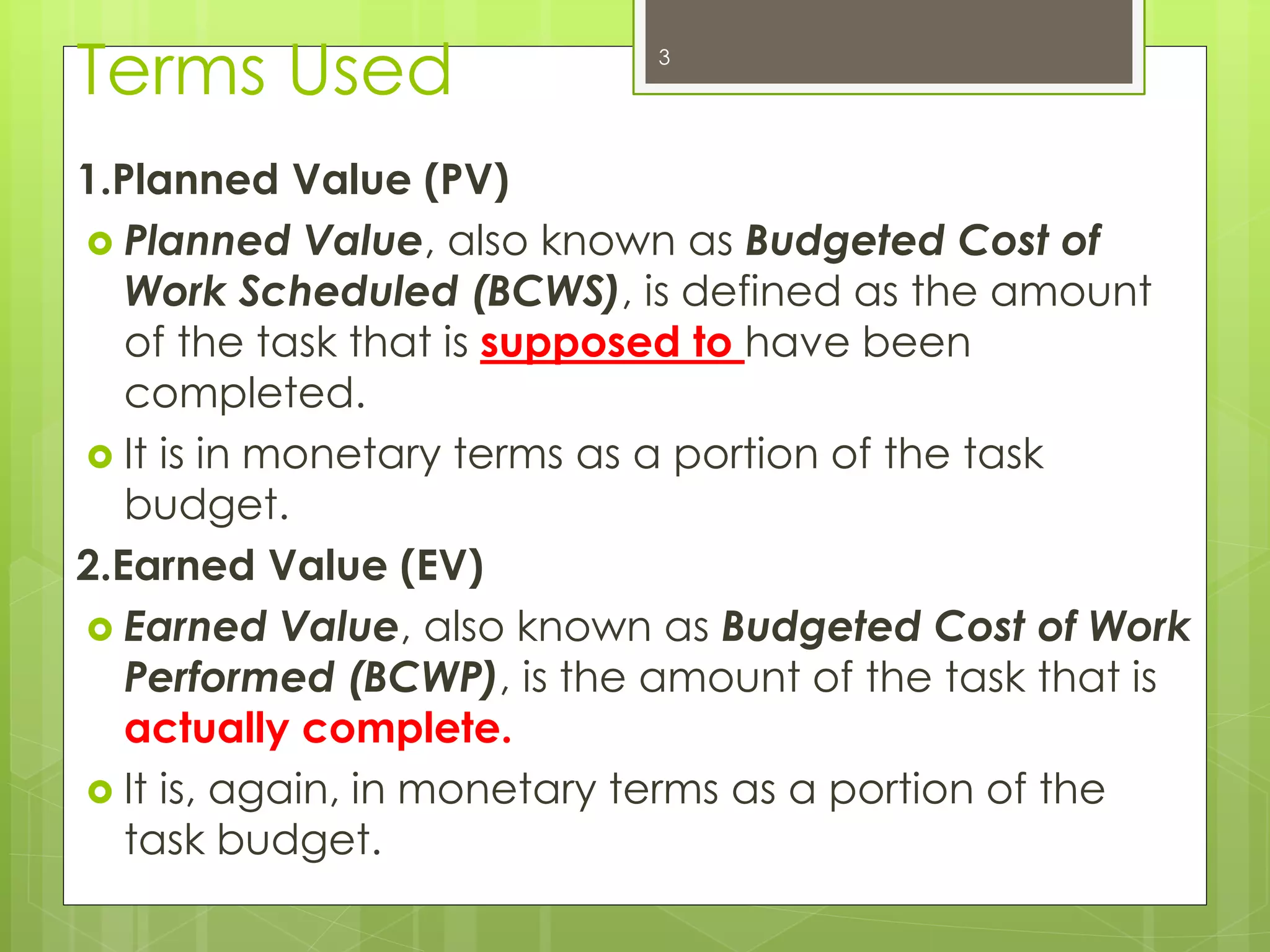
Terms Used
1.Planned Value (PV)
 Planned Value, also known as Budgeted Cost of
Work Scheduled (BCWS), is defined as the amount
of the task that is supposed to have been
completed.
 It is in monetary terms as a portion of the task
budget.
2.Earned Value (EV)
 Earned Value, also known as Budgeted Cost of Work
Performed (BCWP), is the amount of the task that is
actually complete.
 It is, again, in monetary terms as a portion of the
task budget.
3
3. Actual Cost (AC):
 The Actual Cost, also known as Actual
Cost of Work Performed (ACWP), as you
might guess, is the actual cost of the
work.
 Generally employee hours need to be
converted into a cost, and all project
costs need to be added up, such as the
labour cost, material cost , equipment
cost etc.
4
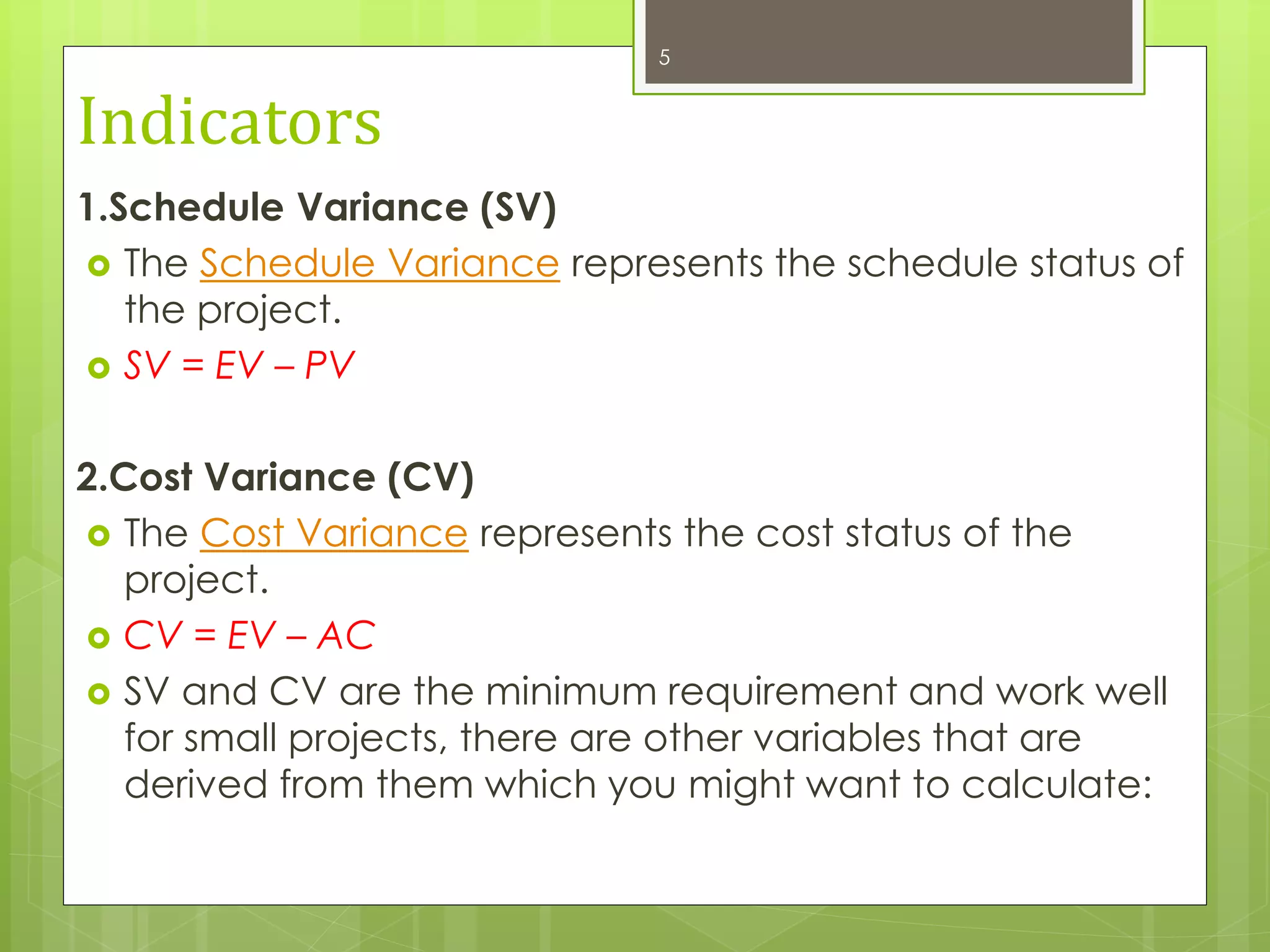
Indicators
1.Schedule Variance (SV)
 The Schedule Variance represents the schedule status of
the project.
 SV = EV – PV
2.Cost Variance (CV)
 The Cost Variance represents the cost status of the
project.
 CV = EV – AC
 SV and CV are the minimum requirement and work well
for small projects, there are other variables that are
derived from them which you might want to calculate:
5
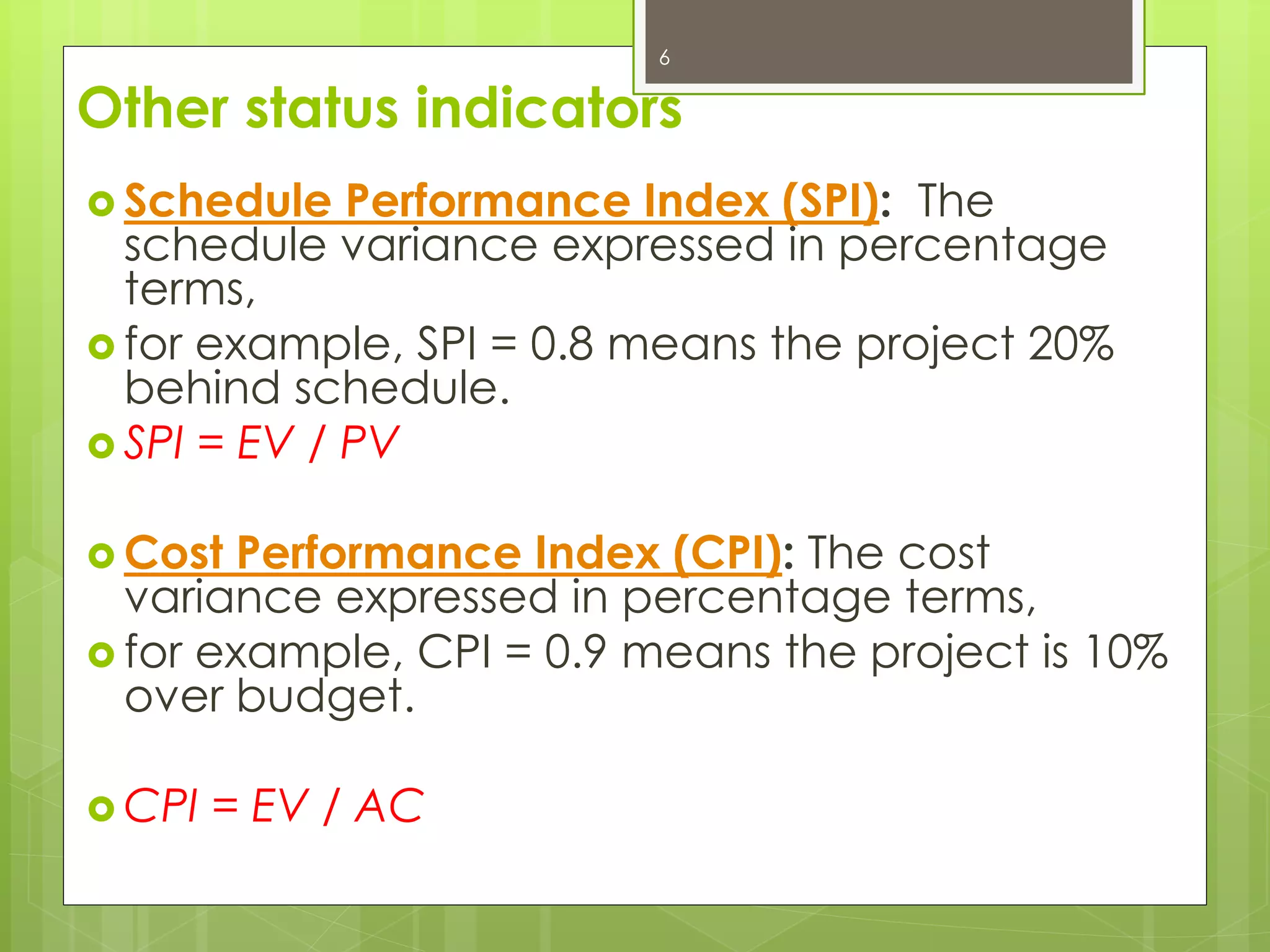
Other status indicators
 Schedule Performance Index (SPI): The
schedule variance expressed in percentage
terms,
 for example, SPI = 0.8 means the project 20%
behind schedule.
 SPI = EV / PV
 Cost Performance Index (CPI): The cost
variance expressed in percentage terms,
 for example, CPI = 0.9 means the project is 10%
over budget.
 CPI = EV / AC
6
Interpretations
The first two calculations (SV and CV)
give you the basic indicator of project
progress.
A negative value indicates an
undesirable situation.
If the schedule variance (SV) is
negative, you are behind schedule.
If the cost variance (CV) is negative,
you are over budget.
7
:
Interpretation of CPI and SPI
 You interpret CPI results as below:
 CPI less than 1.0 indicates the project is
overspending funds.
 CPI equals 1.0 than the project is on target.
 CPI greater than 1.0 says the project is under
budget.
 You interpret SPI results as below:
 SPI less than 1.0 indicates the project is behind the
schedule
 SPI equals 1.0 than the project is as per schedule .
 SPI greater than 1.0 says the project is ahead the
schedule.
8
Indicators and formulae's
9
Que. It was supposed to complete 5 cubic
meter excavation in eight hrs. Review was taken
after 6 hrs., it was expected to complete 75 %
after 6 hrs. but actually work completed is 60 % .
The actual cost spent to complete the work is
Rs.13,000/- assume the cost require to
excavate one cubic meter per hour is Rs.500.
Calculate the different indices and interpret the
result obtained.
Ans: From the given Data:
Task Excavation budget=5 x 500 x 8= Rs.20,000/-
 PV=75/100 x20,000=15,000/-
 EV=60/100 x 20,000=12,000/-
 AC=Rs.13,000/-
Example
10
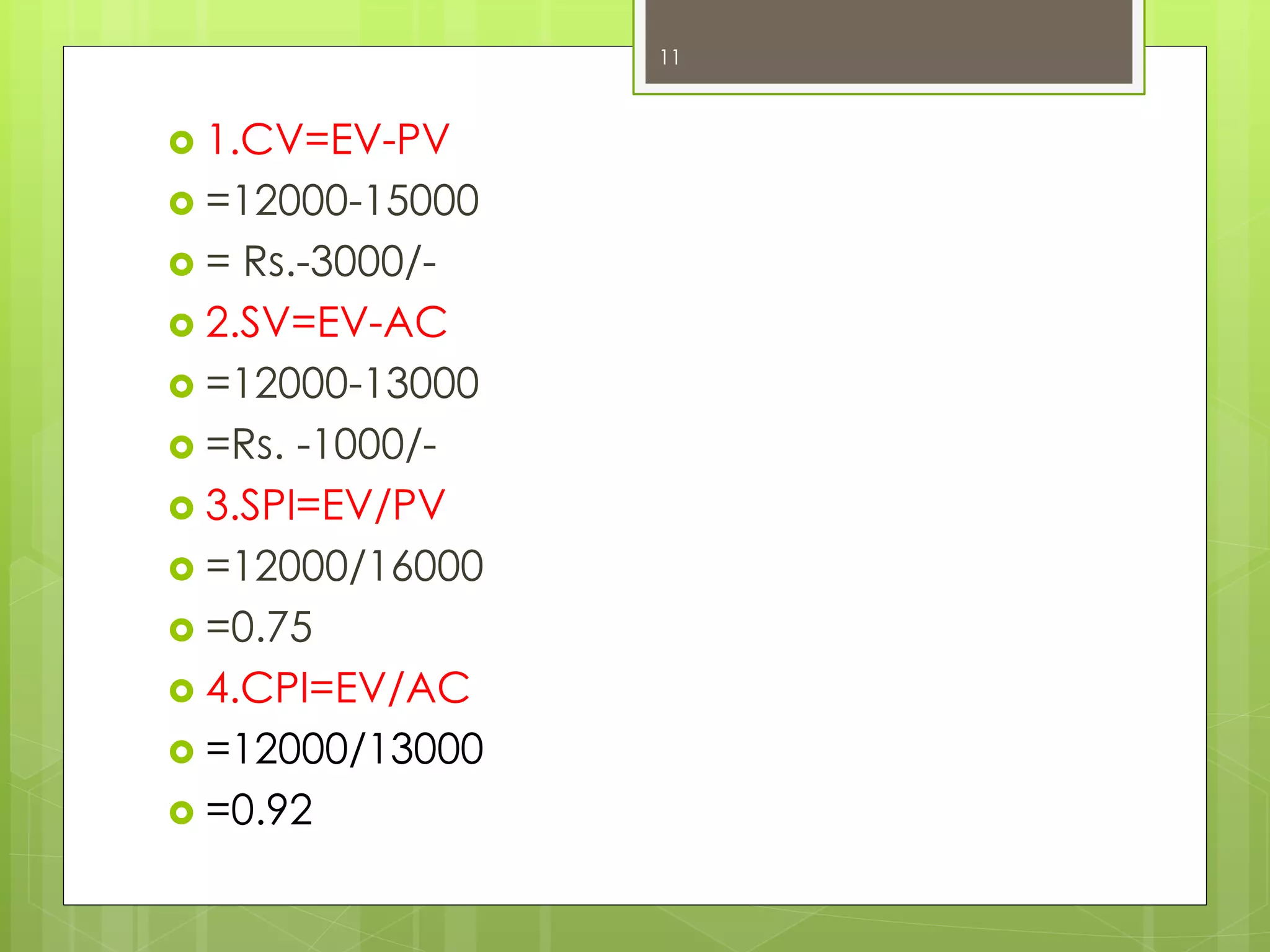
 1.CV=EV-PV
 =12000-15000
 = Rs.-3000/-
 2.SV=EV-AC
 =12000-13000
 =Rs. -1000/-
 3.SPI=EV/PV
 =12000/16000
 =0.75
 4.CPI=EV/AC
 =12000/13000
 =0.92
11
Interpretation of results
 First two indicators:
 CV=Cost variance negative it means the
activity excavation is over the budget.
 SV= Schedule variance is also negative
indicates that activity excavation is
behind the schedule.
 Indicators third and fourth:
 SPI is 0.75 (less than 1), indicates that the
excavation is 25 % behind than the
schedule and
 CPI found 0.92(less than 1),indicates its
over budget by 8%.
12

Earned value analysis

  • 1.
  • 2.
    Advantages Earned value analysisis the project management tool that is used to measure project progress.  It compares the actual work completed at any time to the original budget and schedule.  It forecasts the final budget and schedule and analyzes the path to get there. It gives you the essential early warning signal that things are going awry (wrong). 2
  • 3.
    Terms Used 1.Planned Value(PV)  Planned Value, also known as Budgeted Cost of Work Scheduled (BCWS), is defined as the amount of the task that is supposed to have been completed.  It is in monetary terms as a portion of the task budget. 2.Earned Value (EV)  Earned Value, also known as Budgeted Cost of Work Performed (BCWP), is the amount of the task that is actually complete.  It is, again, in monetary terms as a portion of the task budget. 3
  • 4.
    3. Actual Cost(AC):  The Actual Cost, also known as Actual Cost of Work Performed (ACWP), as you might guess, is the actual cost of the work.  Generally employee hours need to be converted into a cost, and all project costs need to be added up, such as the labour cost, material cost , equipment cost etc. 4
  • 5.
    Indicators 1.Schedule Variance (SV) The Schedule Variance represents the schedule status of the project.  SV = EV – PV 2.Cost Variance (CV)  The Cost Variance represents the cost status of the project.  CV = EV – AC  SV and CV are the minimum requirement and work well for small projects, there are other variables that are derived from them which you might want to calculate: 5
  • 6.
    Other status indicators Schedule Performance Index (SPI): The schedule variance expressed in percentage terms,  for example, SPI = 0.8 means the project 20% behind schedule.  SPI = EV / PV  Cost Performance Index (CPI): The cost variance expressed in percentage terms,  for example, CPI = 0.9 means the project is 10% over budget.  CPI = EV / AC 6
  • 7.
    Interpretations The first twocalculations (SV and CV) give you the basic indicator of project progress. A negative value indicates an undesirable situation. If the schedule variance (SV) is negative, you are behind schedule. If the cost variance (CV) is negative, you are over budget. 7
  • 8.
    : Interpretation of CPIand SPI  You interpret CPI results as below:  CPI less than 1.0 indicates the project is overspending funds.  CPI equals 1.0 than the project is on target.  CPI greater than 1.0 says the project is under budget.  You interpret SPI results as below:  SPI less than 1.0 indicates the project is behind the schedule  SPI equals 1.0 than the project is as per schedule .  SPI greater than 1.0 says the project is ahead the schedule. 8
  • 9.
  • 10.
    Que. It wassupposed to complete 5 cubic meter excavation in eight hrs. Review was taken after 6 hrs., it was expected to complete 75 % after 6 hrs. but actually work completed is 60 % . The actual cost spent to complete the work is Rs.13,000/- assume the cost require to excavate one cubic meter per hour is Rs.500. Calculate the different indices and interpret the result obtained. Ans: From the given Data: Task Excavation budget=5 x 500 x 8= Rs.20,000/-  PV=75/100 x20,000=15,000/-  EV=60/100 x 20,000=12,000/-  AC=Rs.13,000/- Example 10
  • 11.
     1.CV=EV-PV  =12000-15000 = Rs.-3000/-  2.SV=EV-AC  =12000-13000  =Rs. -1000/-  3.SPI=EV/PV  =12000/16000  =0.75  4.CPI=EV/AC  =12000/13000  =0.92 11
  • 12.
    Interpretation of results First two indicators:  CV=Cost variance negative it means the activity excavation is over the budget.  SV= Schedule variance is also negative indicates that activity excavation is behind the schedule.  Indicators third and fourth:  SPI is 0.75 (less than 1), indicates that the excavation is 25 % behind than the schedule and  CPI found 0.92(less than 1),indicates its over budget by 8%. 12