SUSPENSIONS & COLLOIDS
(UNIT TWO, LESSON 2.5)
BY MARGIELENE D. JUDAN
LESSON OUTLINE
Suspensions
Colloids
Properties of Colloids
Summary: Solution, Suspension, Colloid
3 TYPES OF MIXTURES
Solutions
Suspensions
Colloids
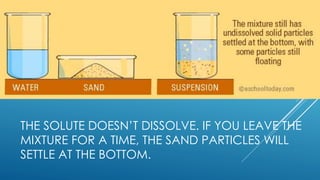
SUSPENSIONS
cloudy and heterogeneous.
Solute doesn’t dissolve and
settle at the bottom
Large particles (can be filtered)
THE SOLUTE DOESN’T DISSOLVE. IF YOU LEAVE THE
MIXTURE FOR A TIME, THE SAND PARTICLES WILL
SETTLE AT THE BOTTOM.
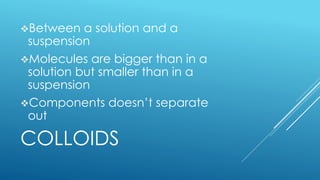
COLLOIDS
Between a solution and a
suspension
Molecules are bigger than in a
solution but smaller than in a
suspension
Components doesn’t separate
out
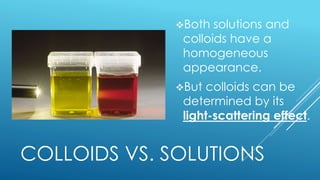
COLLOIDS VS. SOLUTIONS
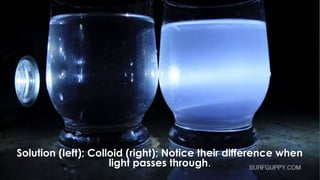
Both solutions and
colloids have a
homogeneous
appearance.
But colloids can be
determined by its
light-scattering effect.
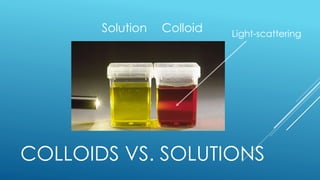
COLLOIDS VS. SOLUTIONS
Solution Colloid Light-scattering
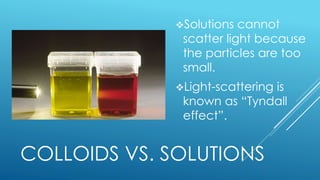
COLLOIDS VS. SOLUTIONS
Solutions cannot
scatter light because
the particles are too
small.
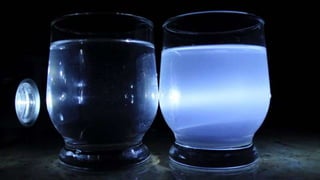
Light-scattering is
known as “Tyndall
effect”.
COLLOIDS
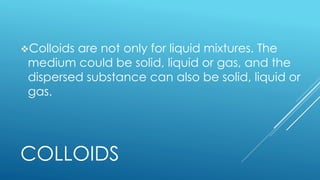
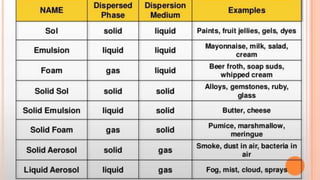
Colloids are not only for liquid mixtures. The
medium could be solid, liquid or gas, and the
dispersed substance can also be solid, liquid or
gas.
Solution (left); Colloid (right); Notice their difference when
light passes through.
PROPERTIES OF COLLOIDS
Tyndall effect
Brownian movement
Adsorption
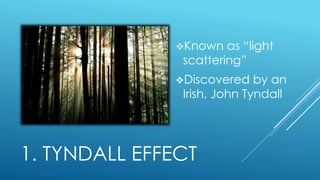
1. TYNDALL EFFECT
Known as “light
scattering”
Discovered by an
Irish, John Tyndall
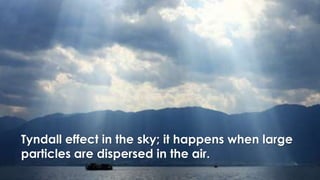
Tyndall effect in the sky; it happens when large
particles are dispersed in the air.
Tyndall effect in the morning.
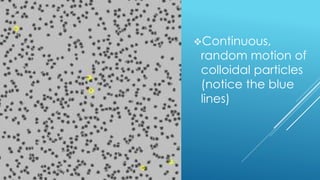
2. BROWNIAN MOVEMENT
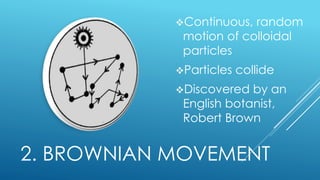
Continuous, random
motion of colloidal
particles
Particles collide
Discovered by an
English botanist,
Robert Brown
Continuous,
random motion of
colloidal particles
(notice the blue
lines)
Q.) If the molecules are larger than of a solution,
why do molecules don’t settle down like
suspension?
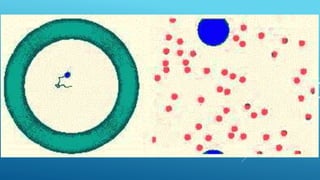
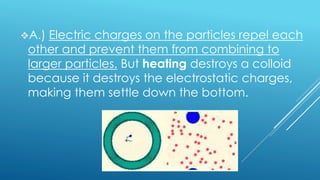
A.) Electric charges on the particles repel each
other and prevent them from combining to
larger particles. But heating destroys a colloid
because it destroys the electrostatic charges,
making them settle down the bottom.
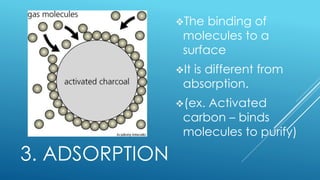
3. ADSORPTION
The binding of
molecules to a
surface
It is different from
absorption.
(ex. Activated
carbon – binds
molecules to purify)
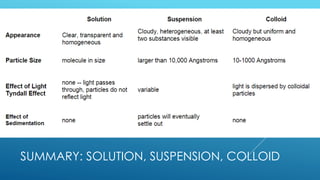
SUMMARY: SOLUTION, SUSPENSION, COLLOID
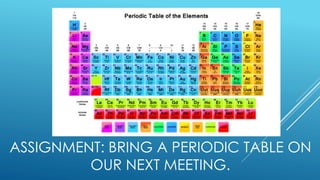
ASSIGNMENT: BRING A PERIODIC TABLE ON
OUR NEXT MEETING.
ANSWER THIS IN A WHOLE
SHEET OF PAPER.
How are colloids important to us? Cite
some of its importance. How does it help
or benefit you in daily life? (refer to p. 62
for some details) Minimum of two
paragraphs (10 pts)
SOURCES:
Science Links 7
http://www.edinformatics.com/math_sci
ence/solutions_suspensions_colloids.htm

Unit 2, Lesson 2.5 - Suspensions and Colloids