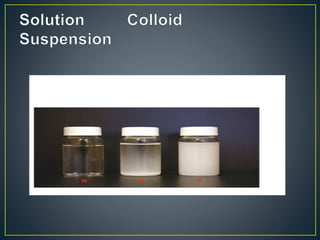
Presented by/
Hassan
Khatab
• I. Definition
• II. Classification of colloidal systems
• III. Structural characteristics
• IV. Preparation of colloidal systems
• V. purification of colloidal systems
• VI. Stability of colloidal dispersions
• VII. Applications of colloids
• a. Uses of Colloidal Silicas
• b. Pharmaceutical Applications
Colloid science
science concerns systems in which one or more of the
components has at least one dimension within the nanometre
(10-9m)to micrometre (lO-6m) range.
Mixture of two phases of matter.
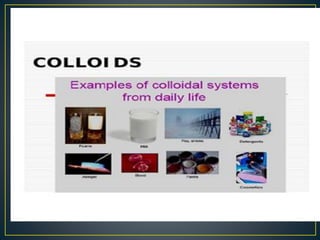
• Aerosols Agrochemicals Cosmetics
• Emulsions Fabrics Foams
• Ink Paint Paper
• Pharmaceuticals Plastics Rubber
1-Colloidal dispersions
thermodynamically unstable and irreversible systems
2-True solutions of macromolecular material
thermodynamically stable and reversible systems
3- Association colloids(micells)
thermodynamically stable
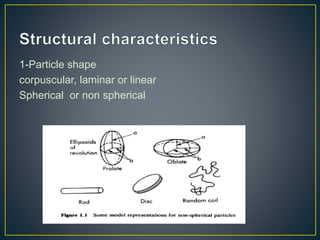
1-Particle shape
corpuscular, laminar or linear
Spherical or non spherical
• Thread-like high-polymer molecules show considerable
flexibility due to rotation about carbon-carbon and other bonds.
In solution, the shape of these molecules alters continuously
under the influence of thermal motion and a rigid rod model is
therefore unsuitable.
• Colloidal particles are usually solvated,
• If all of the solvent becomes mechanically trapped and

immobilised within this network, the system as a whole
takes on a solid appearance and is called a gel


• . Colloidal systems are generally of a poly dispersed
nature - i.e. the molecules or particles in a particular
sample vary in size
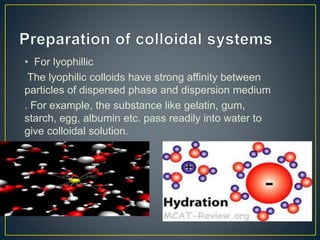
• For lyophillic
The lyophilic colloids have strong affinity between
particles of dispersed phase and dispersion medium
. For example, the substance like gelatin, gum,
starch, egg, albumin etc. pass readily into water to
give colloidal solution.
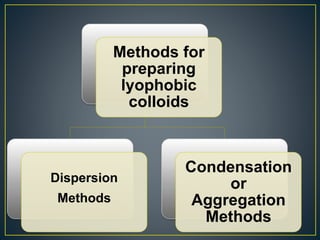
Methods for
preparing
lyophobic
colloids
Dispersion
Methods
Condensation
or
Aggregation
Methods
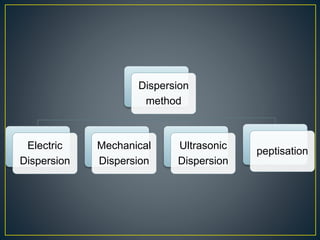
Dispersion
method
Electric
Dispersion
Mechanical
Dispersion
Ultrasonic
Dispersion
peptisation
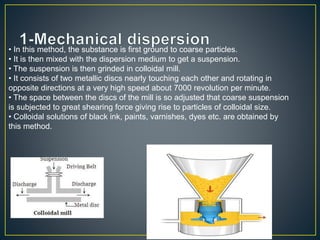
• In this method, the substance is first ground to coarse particles.
• It is then mixed with the dispersion medium to get a suspension.
• The suspension is then grinded in colloidal mill.
• It consists of two metallic discs nearly touching each other and rotating in
opposite directions at a very high speed about 7000 revolution per minute.
• The space between the discs of the mill is so adjusted that coarse suspension
is subjected to great shearing force giving rise to particles of colloidal size.
• Colloidal solutions of black ink, paints, varnishes, dyes etc. are obtained by
this method.
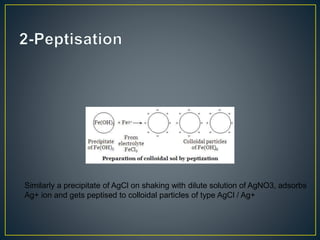
Similarly a precipitate of AgCl on shaking with dilute solution of AgNO3, adsorbs
Ag+ ion and gets peptised to colloidal particles of type AgCl / Ag+
• This method is used to prepare sols of platinum, silver, copper or gold.
• The metal whose sol is to be prepared is made as two electrodes which
immerged in dispersion medium such as water etc.
• The dispersion medium is kept cooled by ice.
• An electric arc is struck between the electrodes.
• The tremendous heat generate by this method and give colloidal solution.
• The colloidal solution prepared is stabilised by adding a small amount of KOH
to it.
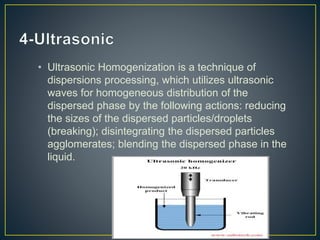
• Ultrasonic Homogenization is a technique of
dispersions processing, which utilizes ultrasonic
waves for homogeneous distribution of the
dispersed phase by the following actions: reducing
the sizes of the dispersed particles/droplets
(breaking); disintegrating the dispersed particles
agglomerates; blending the dispersed phase in the
liquid.
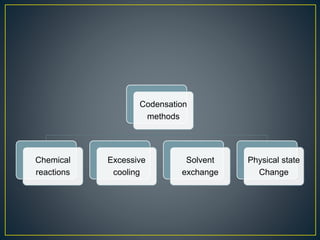
Codensation
methods
Chemical
reactions
Excessive
cooling
Solvent
exchange
Physical state
Change
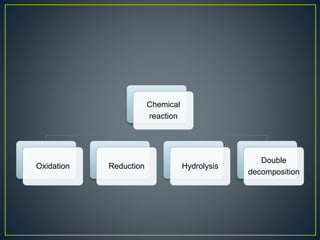
Chemical
reaction
Oxidation Reduction Hydrolysis
Double
decomposition
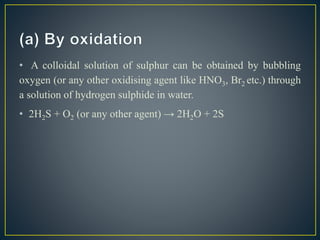
• A colloidal solution of sulphur can be obtained by bubbling
oxygen (or any other oxidising agent like HNO3, Br2 etc.) through
a solution of hydrogen sulphide in water.
• 2H2S + O2 (or any other agent) → 2H2O + 2S
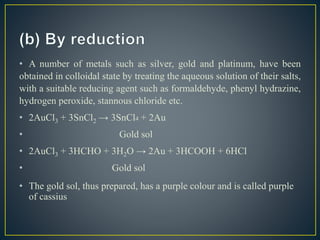
• A number of metals such as silver, gold and platinum, have been
obtained in colloidal state by treating the aqueous solution of their salts,
with a suitable reducing agent such as formaldehyde, phenyl hydrazine,
hydrogen peroxide, stannous chloride etc.
• 2AuCl3 + 3SnCl2 → 3SnCl4 + 2Au
• Gold sol
• 2AuCl3 + 3HCHO + 3H2O → 2Au + 3HCOOH + 6HCl
• Gold sol
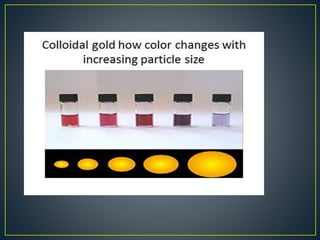
• The gold sol, thus prepared, has a purple colour and is called purple
of cassius
• Many salt solutions are rapidly hydrolysed by boiling dilute
solutions of their salts. For example, ferric hydroxide and
aluminium hydroxide sols are obtained by boiling solutions of the
corresponding chlorides.
• FeCl3 + 3H2O → Fe(OH)3 + 3HCl
• Similarly silicic acid sol is obtained by the hydrolysis of
sodium silicate.
• A sol of arsenic sulphide is obtained by passing hydrogen
sulphide through a cold solution of arsenious oxide in water.
• As2O3 + 3H2S → As2S3 + 3H2O
• (e) By excessive cooling : A colloidal solution of ice in an organic solvent
like ether or chloroform can be prepared by freezing a solution of water in the
solvent. The molecules of water which can no longer be held in solution,
separately combine to form particles of colloidal size.
• (f) By exchange of solvent : Colloidal solution of certain substances such
as sulphur, phosphorus, which are soluble in alcohol but insoluble in water can
be prepared by pouring their alcoholic solution in excess of water. For
example, alcoholic solution of sulphur on pouring into water gives milky
colloidal solution of sulphur.
• (g) By change of physical state : Sols of substances like mercury and
sulphur are prepared by passing their vapour’s through a cold water containing
a suitable stabilizer such as ammonium salt or citrate.
Dialysisis particularly useful for removing small dissolved
molecules from colloidal solutions or dispersions - e.g. extraneous
electrolyte such as KNO3from AgI sol. The process is hastened by stirring
so as to maintain a high concentration gradient of diffusible molecules
across the membrane and by renewing the outer liquid from time to time
(Figure 1.5).
• Ultrafiltrationis the application of pressure or suction to
force the solvent and small particles across a membrane while the
larger particles are retained. The membrane is normally supported
between fine wire screens or deposited in a highly porous support
such as a sintered glass disc. An important application of
ultrafiltration is the so-called reverse osmosis method of water
desalination.
Buchner funnel
used in ultra filtration
• The stability of a colloidal system is defined by particles
remaining suspended in solution at equilibrium. Stability is
hindered by aggregation and sedimentation phenomena,
which are driven by the colloid's tendency to reduce surface
energy
• Electrostatic stabilization is based on the mutual
repulsion of like electrical charges
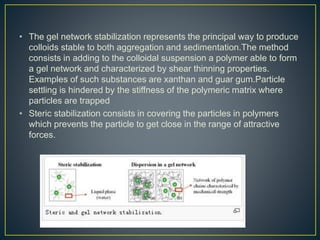
• The gel network stabilization represents the principal way to produce
colloids stable to both aggregation and sedimentation.The method
consists in adding to the colloidal suspension a polymer able to form
a gel network and characterized by shear thinning properties.
Examples of such substances are xanthan and guar gum.Particle
settling is hindered by the stiffness of the polymeric matrix where
particles are trapped
• Steric stabilization consists in covering the particles in polymers
which prevents the particle to get close in the range of attractive
forces.
Since colloids are stable because of their surface
charge, in order to destabilize the particles, it must
neutralize the charge. Such neutralization can take
place by addition of an ion of opposite charge to the
colloid. Since most colloids found in water are
negatively charged, the addition of sodium ions (Na+)
should reduce the charge. higher the concentration of
sodium add, the lower the charge, and therefore the
lower the repelling forces around the colloid. If, instead
of adding a monovalent ion such as sodium, a divalent
or trivalent ion is added, the charge is reduced even
faster
• Colloids have very important application in our daily life
starting from food products to the medicines to industries
like rubber.
• Water Purification: We know that one of the
very popular methods used for water purification is
the addition of electrolytes like potash alum. Addition
of these electrolytes is based on the fact because
the impure water in usually a colloidal system. It
usually contains dispersed colloidal particles which
cannot be removed by filtration. Addition of these
electrolytes results in coagulation of the impurity
which can be separated by filtration then.
• Smoke is also a colloidal system which mainly consists of charged particles of carbon depressed in
air. Smoke is a big problem for environment as it the major source for air pollution. Removal of the
dispersed colloidal particles from the air will solve the problem. For this again the process of
electrophoresis is used. This is done in Cottrell precipitator. Smoke is passed through a chamber
which contains a number of metal plates attached to a metal wire connected to high potential
source. The electrically charged colloidal particles of carbon present in air get discharged when
come in contact with the oppositely charged plates and fall down to the bottom. The clean hot air
leaves the precipitator from an exit near the top.
• Rubber industry: You must know that the rubber is synthesized from the latex
obtained from the rubber trees. This latex is an emulsion in which negatively charged
particles of rubber are dispersed in water. For obtaining rubber, this latex is boiled because
of which the rubber particles get coagulated. This coagulated mass is then vulcanized to
solidify as natural rubber.
• Leather tanning: Tanning is the process of treating the skins of animals to
obtain the leather. Skin of animals is also a colloidal system in which the colloidal particles
are positively charged. During the process, the charged particles of skin are coagulated
using negatively charged material like tannin and some compounds of aluminum and
chromium.
• Cleansing action of soaps: the soap solution is a colloidal
system and it removes the oil and dirt by forming water soluble emulsions.
• Smoke screen: Smoke screens are used to hide something by a layer of
smoke. In generally it is used to hide the movement of troops. The smoke screens are also
colloidal system in which the particles of titanium oxide are dispersed in air
• the sewage water contains impurities like mud and dirt of colloidal size which are
dispersed in the water. Just like any other colloidal system, the colloidal particles
(impurities) of sewage are also charged particles. These charged particles of
impurities present in sewage may be removed by electrophoresis. For this purpose
the sewage water is passed through a tunnel which is fitted with metallic electrodes
and is maintained at a high potential difference. The charged particles of impurity
present in the sewage water migrate to the oppositely charged electrodes which
results in their coagulation.
• Therapy: Colloidal system are used as therapeutic agents in different areas.
• 1. Silver colloid-germicidal
• 2. Copper colloid-anticancer
• 3. Mercury colloid-Antisyphilis
• Stability: As already stated, charges play an important role in determining the
stability of a colloidal system. Colloids, especially lyophobic colloids having like charges on
particle surface repel each other and prevent flocculation in suspensions. e.g Colloidal
dispersion of gelatin is used in coating over tablets and granules which upon drying leaves
a uniform dry film over them and protect them from adverse conditions of the atmosphere.
• Absorption: As colloidal dimensions are small enough ,they have a huge surface
area. Hence, the drug constituted colloidal form is released into the vicinity in large amount.
e.g, sulphur colloid gives a large quantity of sulphur and this often leads to sulphur toxicity.
• Dissolution : Due to huge surface area, the dissolution rate is very large as stated
by Noyes-Whitney equation.
• Targeted Drug Delivery: Liposomes are of colloidal dimensions and are
preferentially taken up by the liver and spleen. Hence, principle of colloids is also used in
targeted drug delivery system.
• Fine particle technology has also been applied to the development of
diagnostic imaging agents for enhancement of X-ray images of soft tissue
and the vasculature. Nanoparticulate compositions of poorly soluble esters of
diatrizoic acid (3,5-diactamido-2,4,6-triiodobenzoic acid) have been shown to
enhance visualization of the lymph nodes after subcutaneous administration,
and can also be used to enhance contrast between the vasculature and
surrounding tissue after intravenous injection. Figure 11 is a computer
enhanced X-ray image of a rabbit after injection with a nanoparticulate ester
of diatrizoic acid (Imcor Pharmaceuticals, Inc),.
• The ability to prepare Stober silica of different properties
makes it possible to use such particles as “storage”
containers for other molecules. For example, drugs can
be stored inside the particle and specific functional
groups on the outer surface of the particle enable one to
target specific areas in the body where the drugs should
be applied
Figure 12 shows an idealized drug release particle, which may contain a magnetic
core ( ) in order to be collected after its useful cycle or for thermal activation
purposes. In addition, the particle could contain dyes or radioactive tracers ( ).
The porous interior structure primarily functions as a storage reservoir for the drug
and specific surface coatings or surface groups ( ), which can be
light, pH, or otherwise sensitive, might facilitate the loading and release of the
drug under controlled conditions. Moreover, the outer particle surface can have
pores of smaller size, to restrict the release rate. The entire particle must also have
a bio-compatible surface layer in order not to be rejected by the biological system.
Last but not least, “key–lock” recognition groups ( ) provide a means to have
the particles attached to specific cells or organs, which will allow for a localized
application of the drug at higher concentrations and without affecting the rest of
the body. Obviously, all these functions may be possible with other materials as
well. However, the ease of controlover physical and chemical properties of
St¨obersilica particles makes them a particular suitable system
Thank you

Colloid

  • 1.
  • 2.
    • I. Definition •II. Classification of colloidal systems • III. Structural characteristics • IV. Preparation of colloidal systems • V. purification of colloidal systems • VI. Stability of colloidal dispersions • VII. Applications of colloids • a. Uses of Colloidal Silicas • b. Pharmaceutical Applications
  • 3.
    Colloid science science concernssystems in which one or more of the components has at least one dimension within the nanometre (10-9m)to micrometre (lO-6m) range. Mixture of two phases of matter.
  • 7.
    • Aerosols AgrochemicalsCosmetics • Emulsions Fabrics Foams • Ink Paint Paper • Pharmaceuticals Plastics Rubber
  • 8.
    1-Colloidal dispersions thermodynamically unstableand irreversible systems 2-True solutions of macromolecular material thermodynamically stable and reversible systems 3- Association colloids(micells) thermodynamically stable
  • 9.
    1-Particle shape corpuscular, laminaror linear Spherical or non spherical
  • 10.
    • Thread-like high-polymermolecules show considerable flexibility due to rotation about carbon-carbon and other bonds. In solution, the shape of these molecules alters continuously under the influence of thermal motion and a rigid rod model is therefore unsuitable.
  • 11.
    • Colloidal particlesare usually solvated, • If all of the solvent becomes mechanically trapped and immobilised within this network, the system as a whole takes on a solid appearance and is called a gel
  • 12.
    • . Colloidalsystems are generally of a poly dispersed nature - i.e. the molecules or particles in a particular sample vary in size
  • 13.
    • For lyophillic Thelyophilic colloids have strong affinity between particles of dispersed phase and dispersion medium . For example, the substance like gelatin, gum, starch, egg, albumin etc. pass readily into water to give colloidal solution.
  • 14.
  • 15.
  • 16.
    • In thismethod, the substance is first ground to coarse particles. • It is then mixed with the dispersion medium to get a suspension. • The suspension is then grinded in colloidal mill. • It consists of two metallic discs nearly touching each other and rotating in opposite directions at a very high speed about 7000 revolution per minute. • The space between the discs of the mill is so adjusted that coarse suspension is subjected to great shearing force giving rise to particles of colloidal size. • Colloidal solutions of black ink, paints, varnishes, dyes etc. are obtained by this method.
  • 17.
    Similarly a precipitateof AgCl on shaking with dilute solution of AgNO3, adsorbs Ag+ ion and gets peptised to colloidal particles of type AgCl / Ag+
  • 18.
    • This methodis used to prepare sols of platinum, silver, copper or gold. • The metal whose sol is to be prepared is made as two electrodes which immerged in dispersion medium such as water etc. • The dispersion medium is kept cooled by ice. • An electric arc is struck between the electrodes. • The tremendous heat generate by this method and give colloidal solution. • The colloidal solution prepared is stabilised by adding a small amount of KOH to it.
  • 19.
    • Ultrasonic Homogenizationis a technique of dispersions processing, which utilizes ultrasonic waves for homogeneous distribution of the dispersed phase by the following actions: reducing the sizes of the dispersed particles/droplets (breaking); disintegrating the dispersed particles agglomerates; blending the dispersed phase in the liquid.
  • 20.
  • 21.
  • 22.
    • A colloidalsolution of sulphur can be obtained by bubbling oxygen (or any other oxidising agent like HNO3, Br2 etc.) through a solution of hydrogen sulphide in water. • 2H2S + O2 (or any other agent) → 2H2O + 2S
  • 23.
    • A numberof metals such as silver, gold and platinum, have been obtained in colloidal state by treating the aqueous solution of their salts, with a suitable reducing agent such as formaldehyde, phenyl hydrazine, hydrogen peroxide, stannous chloride etc. • 2AuCl3 + 3SnCl2 → 3SnCl4 + 2Au • Gold sol • 2AuCl3 + 3HCHO + 3H2O → 2Au + 3HCOOH + 6HCl • Gold sol • The gold sol, thus prepared, has a purple colour and is called purple of cassius
  • 24.
    • Many saltsolutions are rapidly hydrolysed by boiling dilute solutions of their salts. For example, ferric hydroxide and aluminium hydroxide sols are obtained by boiling solutions of the corresponding chlorides. • FeCl3 + 3H2O → Fe(OH)3 + 3HCl • Similarly silicic acid sol is obtained by the hydrolysis of sodium silicate.
  • 25.
    • A solof arsenic sulphide is obtained by passing hydrogen sulphide through a cold solution of arsenious oxide in water. • As2O3 + 3H2S → As2S3 + 3H2O
  • 26.
    • (e) Byexcessive cooling : A colloidal solution of ice in an organic solvent like ether or chloroform can be prepared by freezing a solution of water in the solvent. The molecules of water which can no longer be held in solution, separately combine to form particles of colloidal size. • (f) By exchange of solvent : Colloidal solution of certain substances such as sulphur, phosphorus, which are soluble in alcohol but insoluble in water can be prepared by pouring their alcoholic solution in excess of water. For example, alcoholic solution of sulphur on pouring into water gives milky colloidal solution of sulphur. • (g) By change of physical state : Sols of substances like mercury and sulphur are prepared by passing their vapour’s through a cold water containing a suitable stabilizer such as ammonium salt or citrate.
  • 27.
    Dialysisis particularly usefulfor removing small dissolved molecules from colloidal solutions or dispersions - e.g. extraneous electrolyte such as KNO3from AgI sol. The process is hastened by stirring so as to maintain a high concentration gradient of diffusible molecules across the membrane and by renewing the outer liquid from time to time (Figure 1.5).
  • 28.
    • Ultrafiltrationis theapplication of pressure or suction to force the solvent and small particles across a membrane while the larger particles are retained. The membrane is normally supported between fine wire screens or deposited in a highly porous support such as a sintered glass disc. An important application of ultrafiltration is the so-called reverse osmosis method of water desalination. Buchner funnel used in ultra filtration
  • 29.
    • The stabilityof a colloidal system is defined by particles remaining suspended in solution at equilibrium. Stability is hindered by aggregation and sedimentation phenomena, which are driven by the colloid's tendency to reduce surface energy • Electrostatic stabilization is based on the mutual repulsion of like electrical charges
  • 30.
    • The gelnetwork stabilization represents the principal way to produce colloids stable to both aggregation and sedimentation.The method consists in adding to the colloidal suspension a polymer able to form a gel network and characterized by shear thinning properties. Examples of such substances are xanthan and guar gum.Particle settling is hindered by the stiffness of the polymeric matrix where particles are trapped • Steric stabilization consists in covering the particles in polymers which prevents the particle to get close in the range of attractive forces.
  • 31.
    Since colloids arestable because of their surface charge, in order to destabilize the particles, it must neutralize the charge. Such neutralization can take place by addition of an ion of opposite charge to the colloid. Since most colloids found in water are negatively charged, the addition of sodium ions (Na+) should reduce the charge. higher the concentration of sodium add, the lower the charge, and therefore the lower the repelling forces around the colloid. If, instead of adding a monovalent ion such as sodium, a divalent or trivalent ion is added, the charge is reduced even faster
  • 32.
    • Colloids havevery important application in our daily life starting from food products to the medicines to industries like rubber. • Water Purification: We know that one of the very popular methods used for water purification is the addition of electrolytes like potash alum. Addition of these electrolytes is based on the fact because the impure water in usually a colloidal system. It usually contains dispersed colloidal particles which cannot be removed by filtration. Addition of these electrolytes results in coagulation of the impurity which can be separated by filtration then.
  • 33.
    • Smoke isalso a colloidal system which mainly consists of charged particles of carbon depressed in air. Smoke is a big problem for environment as it the major source for air pollution. Removal of the dispersed colloidal particles from the air will solve the problem. For this again the process of electrophoresis is used. This is done in Cottrell precipitator. Smoke is passed through a chamber which contains a number of metal plates attached to a metal wire connected to high potential source. The electrically charged colloidal particles of carbon present in air get discharged when come in contact with the oppositely charged plates and fall down to the bottom. The clean hot air leaves the precipitator from an exit near the top.
  • 34.
    • Rubber industry:You must know that the rubber is synthesized from the latex obtained from the rubber trees. This latex is an emulsion in which negatively charged particles of rubber are dispersed in water. For obtaining rubber, this latex is boiled because of which the rubber particles get coagulated. This coagulated mass is then vulcanized to solidify as natural rubber. • Leather tanning: Tanning is the process of treating the skins of animals to obtain the leather. Skin of animals is also a colloidal system in which the colloidal particles are positively charged. During the process, the charged particles of skin are coagulated using negatively charged material like tannin and some compounds of aluminum and chromium. • Cleansing action of soaps: the soap solution is a colloidal system and it removes the oil and dirt by forming water soluble emulsions. • Smoke screen: Smoke screens are used to hide something by a layer of smoke. In generally it is used to hide the movement of troops. The smoke screens are also colloidal system in which the particles of titanium oxide are dispersed in air
  • 35.
    • the sewagewater contains impurities like mud and dirt of colloidal size which are dispersed in the water. Just like any other colloidal system, the colloidal particles (impurities) of sewage are also charged particles. These charged particles of impurities present in sewage may be removed by electrophoresis. For this purpose the sewage water is passed through a tunnel which is fitted with metallic electrodes and is maintained at a high potential difference. The charged particles of impurity present in the sewage water migrate to the oppositely charged electrodes which results in their coagulation.
  • 36.
    • Therapy: Colloidalsystem are used as therapeutic agents in different areas. • 1. Silver colloid-germicidal • 2. Copper colloid-anticancer • 3. Mercury colloid-Antisyphilis • Stability: As already stated, charges play an important role in determining the stability of a colloidal system. Colloids, especially lyophobic colloids having like charges on particle surface repel each other and prevent flocculation in suspensions. e.g Colloidal dispersion of gelatin is used in coating over tablets and granules which upon drying leaves a uniform dry film over them and protect them from adverse conditions of the atmosphere. • Absorption: As colloidal dimensions are small enough ,they have a huge surface area. Hence, the drug constituted colloidal form is released into the vicinity in large amount. e.g, sulphur colloid gives a large quantity of sulphur and this often leads to sulphur toxicity. • Dissolution : Due to huge surface area, the dissolution rate is very large as stated by Noyes-Whitney equation. • Targeted Drug Delivery: Liposomes are of colloidal dimensions and are preferentially taken up by the liver and spleen. Hence, principle of colloids is also used in targeted drug delivery system.
  • 37.
    • Fine particletechnology has also been applied to the development of diagnostic imaging agents for enhancement of X-ray images of soft tissue and the vasculature. Nanoparticulate compositions of poorly soluble esters of diatrizoic acid (3,5-diactamido-2,4,6-triiodobenzoic acid) have been shown to enhance visualization of the lymph nodes after subcutaneous administration, and can also be used to enhance contrast between the vasculature and surrounding tissue after intravenous injection. Figure 11 is a computer enhanced X-ray image of a rabbit after injection with a nanoparticulate ester of diatrizoic acid (Imcor Pharmaceuticals, Inc),.
  • 38.
    • The abilityto prepare Stober silica of different properties makes it possible to use such particles as “storage” containers for other molecules. For example, drugs can be stored inside the particle and specific functional groups on the outer surface of the particle enable one to target specific areas in the body where the drugs should be applied
  • 39.
    Figure 12 showsan idealized drug release particle, which may contain a magnetic core ( ) in order to be collected after its useful cycle or for thermal activation purposes. In addition, the particle could contain dyes or radioactive tracers ( ). The porous interior structure primarily functions as a storage reservoir for the drug and specific surface coatings or surface groups ( ), which can be light, pH, or otherwise sensitive, might facilitate the loading and release of the drug under controlled conditions. Moreover, the outer particle surface can have pores of smaller size, to restrict the release rate. The entire particle must also have a bio-compatible surface layer in order not to be rejected by the biological system. Last but not least, “key–lock” recognition groups ( ) provide a means to have the particles attached to specific cells or organs, which will allow for a localized application of the drug at higher concentrations and without affecting the rest of the body. Obviously, all these functions may be possible with other materials as well. However, the ease of controlover physical and chemical properties of St¨obersilica particles makes them a particular suitable system
  • 40.