Science VI
Week 3
Colloids
Gelatin is said to
be a mixture.
What kind of
mixture is it?
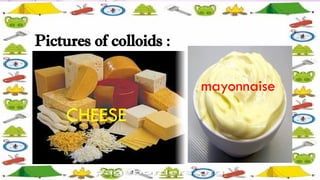
Pictures of colloids :
CHEESE
mayonnaise
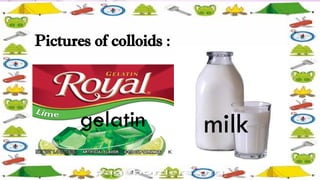
Pictures of colloids :
milk
gelatin
What is common
among these pictures?
SOLID Properties
 Do not change shape easily
 Will not allow another solid to pass
through them easily
 Are usually visible
 Have a definite shape
 Have a definite size
 Becomes liquid when heated
 Remain solid when cooled
Liquid Properties
 Change shape easily (take the shape of the
container)
 Will allow solid to pass through them easily
 May be visible or invisible
 Have a definite size (volume)
 becomes gas when heated
 becomes solid when cooled
COLLOID
 A homogeneous-looking
heterogeneous mixture.
Examples:
 Milk, Office paste (gum),
 Blood,
 Toothpaste,
 Mist (water vapor dispersed in air),
 Jelly
Properties of colloid
Some characteristics properties of colloids are
described below:
 Heterogeneous nature:
A colloid (or sol) is heterogeneous in
nature. The particles in a colloid can be
seen only with a powerful microscope.
 Particle size:
The size of particles in a colloid lies
between 10-9
m – 10-7
m.
 Separation of colloidal particles
by filtration:
Colloidal particles can easily pass
through the pores of a filter paper.
Therefore, colloidal particles cannot
be separated by filtration.
Stability:
Colloids are unstable unless stabilized by
adding suitable stabilizer. The colloidal particles
tend to come together and settle down
 Brownian movement of colloidal particles:
When seen under a microscope, the colloidal
particles in a colloid are seen to be moving in a
random (zigzag) fashion. This zigzag motion of
particles in a colloid is called Brownian motion.
Light scattering by colloidal particles:
Tyndall effect. When a strong beam of light is
passed through a colloid kept in a dark room, the
path of the light beam through the colloid
becomes visible. This occurs due to scattering of
light by the colloidal particles. The scattering of
light by the particles in a colloid is called Tyndall
effect.
True solutions do not scatter light. Therefore, true
solutions do not show Tyndall effect.
Colloids and their applications:
Purification of water
Food Items
Medicine
Artificial rain
Based on the lesson, how can
you characterize the
properties of colloids?
Question:
THANK YOU!

SCIENCE 6-LESSON PRESENTATION-COLLOID-Wk3.pptx

  • 1.
  • 2.
    Gelatin is saidto be a mixture. What kind of mixture is it?
  • 3.
    Pictures of colloids: CHEESE mayonnaise
  • 4.
    Pictures of colloids: milk gelatin
  • 5.
    What is common amongthese pictures?
  • 6.
    SOLID Properties  Donot change shape easily  Will not allow another solid to pass through them easily  Are usually visible  Have a definite shape  Have a definite size  Becomes liquid when heated  Remain solid when cooled
  • 7.
    Liquid Properties  Changeshape easily (take the shape of the container)  Will allow solid to pass through them easily  May be visible or invisible  Have a definite size (volume)  becomes gas when heated  becomes solid when cooled
  • 8.
    COLLOID  A homogeneous-looking heterogeneousmixture. Examples:  Milk, Office paste (gum),  Blood,  Toothpaste,  Mist (water vapor dispersed in air),  Jelly
  • 9.
    Properties of colloid Somecharacteristics properties of colloids are described below:  Heterogeneous nature: A colloid (or sol) is heterogeneous in nature. The particles in a colloid can be seen only with a powerful microscope.  Particle size: The size of particles in a colloid lies between 10-9 m – 10-7 m.
  • 10.
     Separation ofcolloidal particles by filtration: Colloidal particles can easily pass through the pores of a filter paper. Therefore, colloidal particles cannot be separated by filtration.
  • 11.
    Stability: Colloids are unstableunless stabilized by adding suitable stabilizer. The colloidal particles tend to come together and settle down  Brownian movement of colloidal particles: When seen under a microscope, the colloidal particles in a colloid are seen to be moving in a random (zigzag) fashion. This zigzag motion of particles in a colloid is called Brownian motion.
  • 12.
    Light scattering bycolloidal particles: Tyndall effect. When a strong beam of light is passed through a colloid kept in a dark room, the path of the light beam through the colloid becomes visible. This occurs due to scattering of light by the colloidal particles. The scattering of light by the particles in a colloid is called Tyndall effect. True solutions do not scatter light. Therefore, true solutions do not show Tyndall effect.
  • 13.
    Colloids and theirapplications: Purification of water Food Items Medicine Artificial rain
  • 14.
    Based on thelesson, how can you characterize the properties of colloids? Question:
  • 15.