The Seed
Unit Four, Lesson 4.4
By Margielene D. Judan
Lesson Outline
 The Seed
 Parts of a Seed
 Factors Affecting Seed Germination
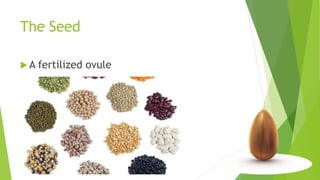
The Seed
 A fertilized ovule
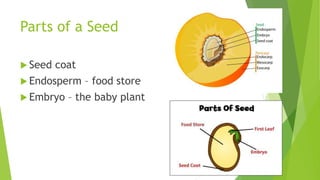
Parts of a Seed
 Seed coat
 Endosperm – food store
 Embryo – the baby plant
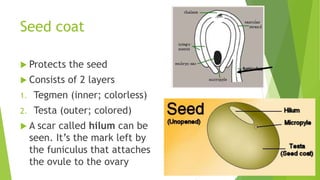
Seed coat
 Protects the seed
 Consists of 2 layers
1. Tegmen (inner; colorless)
2. Testa (outer; colored)
 A scar called hilum can be
seen. It’s the mark left by
the funiculus that attaches
the ovule to the ovary
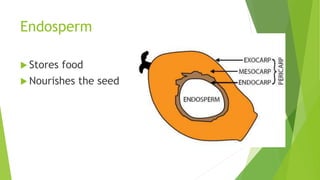
Endosperm
 Stores food
 Nourishes the seed
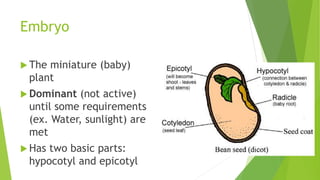
Embryo
 The miniature (baby)
plant
 Dominant (not active)
until some requirements
(ex. Water, sunlight) are
met
 Has two basic parts:
hypocotyl and epicotyl
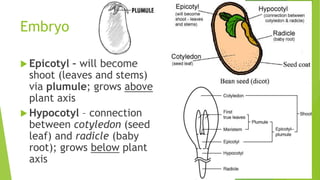
Embryo
 Epicotyl – will become
shoot (leaves and stems)
via plumule; grows above
plant axis
 Hypocotyl – connection
between cotyledon (seed
leaf) and radicle (baby
root); grows below plant
axis
Seed Germination
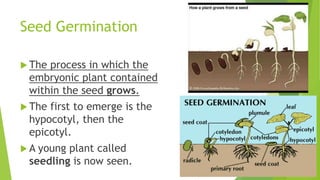
 The process in which the
embryonic plant contained
within the seed grows.
 The first to emerge is the
hypocotyl, then the
epicotyl.
 A young plant called
seedling is now seen.
Factors Affecting Seed Germination
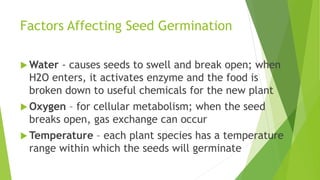
 Water - causes seeds to swell and break open; when
H2O enters, it activates enzyme and the food is
broken down to useful chemicals for the new plant
 Oxygen – for cellular metabolism; when the seed
breaks open, gas exchange can occur
 Temperature – each plant species has a temperature
range within which the seeds will germinate
Seed Germination
 As the seedling emerges from the seed coat
sending out roots and leaves, the stored
food is exhausted (used up).
 The leaves by this time provides its own food
by photosynthesis.
Seed Germination
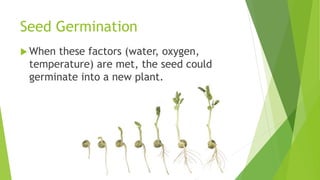
 When these factors (water, oxygen,
temperature) are met, the seed could
germinate into a new plant.
Assignment: Coupon Bond
Art Connection: Refer to p. 141
Deadline: in two days
Sources:
 Science Links 7

Unit 4, Lesson 4.4 - The Seed

  • 1.
    The Seed Unit Four,Lesson 4.4 By Margielene D. Judan
  • 2.
    Lesson Outline  TheSeed  Parts of a Seed  Factors Affecting Seed Germination
  • 3.
    The Seed  Afertilized ovule
  • 4.
    Parts of aSeed  Seed coat  Endosperm – food store  Embryo – the baby plant
  • 5.
    Seed coat  Protectsthe seed  Consists of 2 layers 1. Tegmen (inner; colorless) 2. Testa (outer; colored)  A scar called hilum can be seen. It’s the mark left by the funiculus that attaches the ovule to the ovary
  • 6.
  • 7.
    Embryo  The miniature(baby) plant  Dominant (not active) until some requirements (ex. Water, sunlight) are met  Has two basic parts: hypocotyl and epicotyl
  • 8.
    Embryo  Epicotyl –will become shoot (leaves and stems) via plumule; grows above plant axis  Hypocotyl – connection between cotyledon (seed leaf) and radicle (baby root); grows below plant axis
  • 9.
    Seed Germination  Theprocess in which the embryonic plant contained within the seed grows.  The first to emerge is the hypocotyl, then the epicotyl.  A young plant called seedling is now seen.
  • 10.
    Factors Affecting SeedGermination  Water - causes seeds to swell and break open; when H2O enters, it activates enzyme and the food is broken down to useful chemicals for the new plant  Oxygen – for cellular metabolism; when the seed breaks open, gas exchange can occur  Temperature – each plant species has a temperature range within which the seeds will germinate
  • 11.
    Seed Germination  Asthe seedling emerges from the seed coat sending out roots and leaves, the stored food is exhausted (used up).  The leaves by this time provides its own food by photosynthesis.
  • 12.
    Seed Germination  Whenthese factors (water, oxygen, temperature) are met, the seed could germinate into a new plant.
  • 14.
    Assignment: Coupon Bond ArtConnection: Refer to p. 141 Deadline: in two days
  • 15.