ForceUnit SIX, Lesson 6.1
By Margielene D. Judan
LESSON OUTLINE
Force
Kinds of Forces
Contact Forces (Ex. Friction)
Non-contact Forces
Gravity,Weight, Law of
Universal Gravitation
Magnetic Force
Electrical Force
Magnetism and Electricity
Strong and Weak Nuclear
Forces
Resultant Force
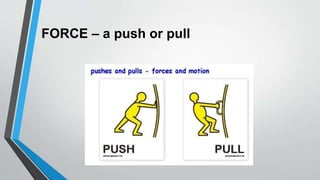
FORCE – a push or pull
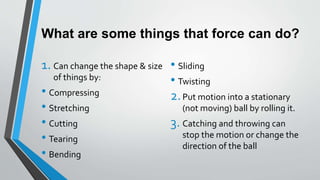
What are some things that force can do?
1. Can change the shape & size
of things by:
• Compressing
• Stretching
• Cutting
• Tearing
• Bending
• Sliding
• Twisting
2.Put motion into a stationary
(not moving) ball by rolling it.
3. Catching and throwing can
stop the motion or change the
direction of the ball
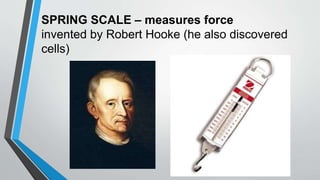
SPRING SCALE – measures force
invented by Robert Hooke (he also discovered
cells)
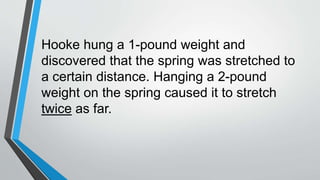
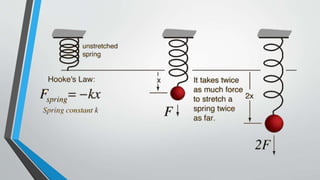
Hooke hung a 1-pound weight and
discovered that the spring was stretched to
a certain distance. Hanging a 2-pound
weight on the spring caused it to stretch
twice as far.
Given the following details, what conclusion
can you make?
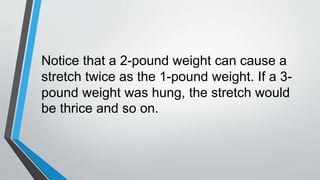
Notice that a 2-pound weight can cause a
stretch twice as the 1-pound weight. If a 3-
pound weight was hung, the stretch would
be thrice and so on.
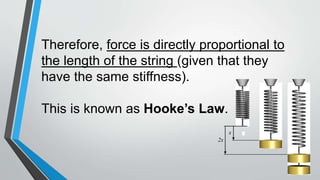
Therefore, force is directly proportional to
the length of the string (given that they
have the same stiffness).
This is known as Hooke’s Law.
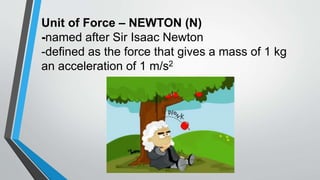
Unit of Force – NEWTON (N)
-named after Sir Isaac Newton
-defined as the force that gives a mass of 1 kg
an acceleration of 1 m/s2
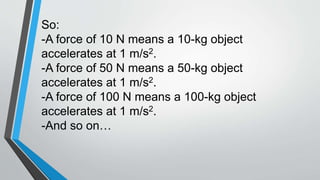
So:
-A force of 10 N means a 10-kg object
accelerates at 1 m/s2.
-A force of 50 N means a 50-kg object
accelerates at 1 m/s2.
-A force of 100 N means a 100-kg object
accelerates at 1 m/s2.
-And so on…
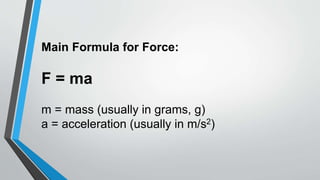
Main Formula for Force:
F = ma
m = mass (usually in grams, g)
a = acceleration (usually in m/s2)
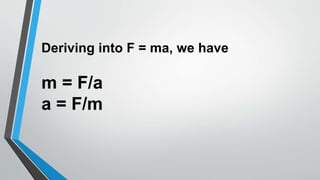
Deriving into F = ma, we have
m = F/a
a = F/m
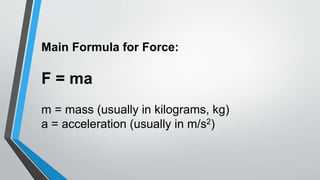
Main Formula for Force:
F = ma
m = mass (usually in kilograms, kg)
a = acceleration (usually in m/s2)
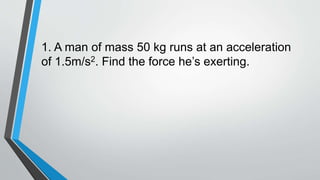
1. A man of mass 50 kg runs at an acceleration
of 1.5m/s2. Find the force he’s exerting.
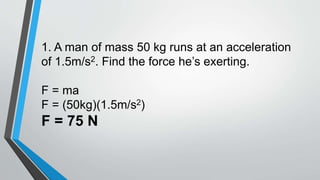
1. A man of mass 50 kg runs at an acceleration
of 1.5m/s2. Find the force he’s exerting.
F = ma
F = (50kg)(1.5m/s2)
F = 75 N
2. A force of 20 N acts upon a 5 kg block.
Calculate the acceleration of the object.
2. A force of 20 N acts upon a 5 kg block.
Calculate the acceleration of the object.
a = F/m
a = (20N)/(5 kg)
a = 4m/s2
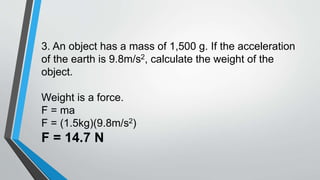
3. An object has a mass of 1,500 g. If the acceleration
of the earth is 9.8m/s2, calculate the weight of the
object.
3. An object has a mass of 1,500 g. If the acceleration
of the earth is 9.8m/s2, calculate the weight of the
object.
Since mass is in grams, we need to convert it into
kilograms:
1,500 g = 1.5 kg (move the decimal 3 places to the left
or divide by 1000)
3. An object has a mass of 1,500 g. If the acceleration
of the earth is 9.8m/s2, calculate the weight of the
object.
Weight is a force.
F = ma
F = (1.5kg)(9.8m/s2)
F = 14.7 N
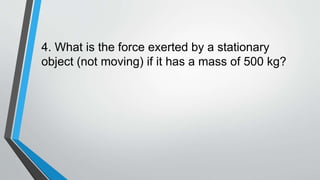
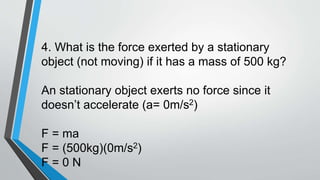
4. What is the force exerted by a stationary
object (not moving) if it has a mass of 500 kg?
4. What is the force exerted by a stationary
object (not moving) if it has a mass of 500 kg?
An stationary object exerts no force since it
doesn’t accelerate (a= 0m/s2)
F = ma
F = (500kg)(0m/s2)
F = 0 N
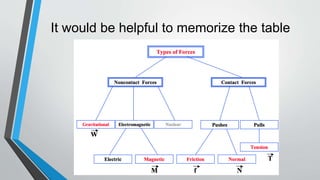
Kinds of Forces
1.Contact Forces
2.Noncontact Forces
It would be helpful to memorize the table
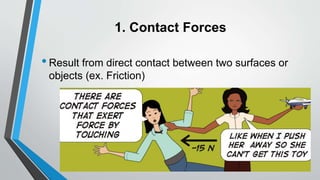
1. Contact Forces
•Result from direct contact between two surfaces or
objects (ex. Friction)
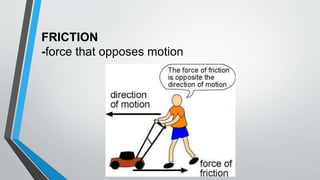
FRICTION
-force that opposes motion
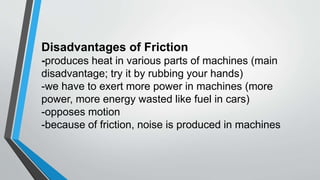
Disadvantages of Friction
-produces heat in various parts of machines (main
disadvantage; try it by rubbing your hands)
-we have to exert more power in machines (more
power, more energy wasted like fuel in cars)
-opposes motion
-because of friction, noise is produced in machines
Advantages of Friction
Without friction, we are handicap
-enables us to walk (w/out friction, we could not walk,
nor move)
-enables us to stop motion (w/out friction, we would
keep moving forward forever)
-We cannot fix the nail in the wood w/out it. Friction
holds the nail.
-A horse cannot pull a cart
-Without friction, you cannot open a can
Without friction, there is no motion!
Without friction, there is no force!
Force and friction, though opposite, acts
together in harmony.
Friction coexists with force. Ironic, doesn’t it?
Real-life application:
-Good exists with evil
-Opposites attract
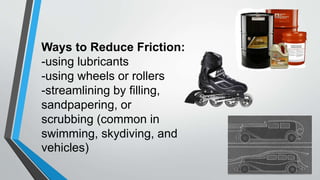
Ways to Reduce Friction:
-using lubricants
-using wheels or rollers
-streamlining by filling,
sandpapering, or
scrubbing (common in
swimming, skydiving, and
vehicles)
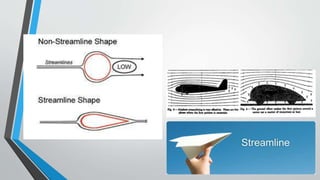
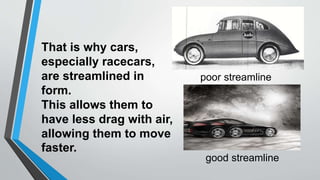
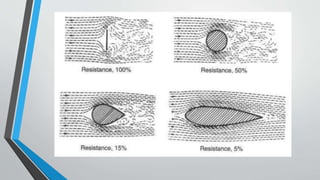
That is why cars,
especially racecars,
are streamlined in
form.
This allows them to
have less drag with air,
allowing them to move
faster.
poor streamline
good streamline
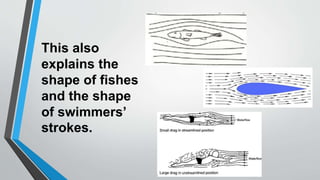
This also
explains the
shape of fishes
and the shape
of swimmers’
strokes.
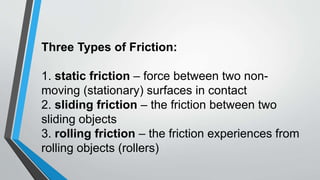
Three Types of Friction:
1. static friction – force between two non-
moving (stationary) surfaces in contact
2. sliding friction – the friction between two
sliding objects
3. rolling friction – the friction experiences from
rolling objects (rollers)
2. Noncontact Forces
• No direct contact
• “Forces acting at a distance”
• They include
1.Gravity
2.Magnetic force
3.Electrical force
4.Nuclear Force
Laboratory 2.5:
Answer p. 189.
Instead of weighing the objects, the values are given below:
oStone – 6 kilograms
oBook – 1.2 kilograms
oBlock of wood – 700 grams
Short Quiz tomorrow: (10 items)
Problem solving (F = ma; m=F/a; a=F/m) – 3 items
Force – 2 items (1 item on Hooke’s law)
Friction – 5 items
Quiz (20 pts)
1. A man has a mass of 40 kg. If the acceleration due to
gravity on earth is 9.8m/s2 and on moon is 1.6m/s2,
calculate the force (weight) of the man in earth and
moon. (3 pts) F = ma
*with solution
Quiz (20 pts)
2. When happy, mother opens the 15-kg door with a force of
10 N.When she is angry, however, she opens the door with
a force of 30 N. Calculate the acceleration of the door when
mother is happy and angry. (3 pts)
a = F/m
*with solution
Quiz (20 pts)
3. A truck is stationary (not moving). If the truck is 10,000
kg in mass, calculate the force it exerts forward. (2 pts)
F = ma
Quiz (20 pts)
4.If the weight of a 10-N bar stretches the string 15 cm, how
far will a 20-N bar stretch the string?
5. The unit of force was named after him.
6.A force that opposes motion.
7. Give one advantage and one disadvantage of friction. (2
pts)
8. Enumerate the three types of friction (3 pts)
Quiz (20 pts)
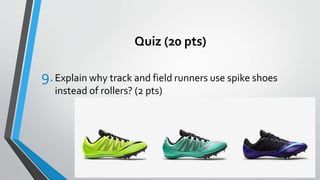
9.Explain why track and field runners use spike shoes
instead of rollers? (2 pts)
Quiz (20 pts)
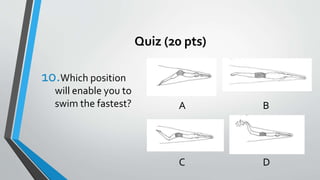
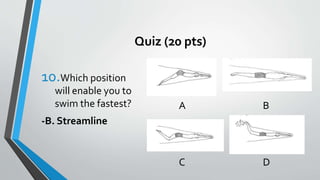
10.Which position
will enable you to
swim the fastest? A B
C D
Answers:
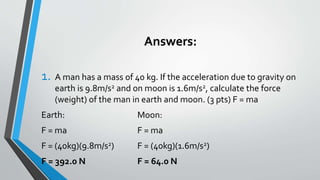
1. A man has a mass of 40 kg. If the acceleration due to gravity on
earth is 9.8m/s2 and on moon is 1.6m/s2, calculate the force
(weight) of the man in earth and moon. (3 pts) F = ma
Earth: Moon:
F = ma F = ma
F = (40kg)(9.8m/s2) F = (40kg)(1.6m/s2)
F = 392.0 N F = 64.0 N
Answers:
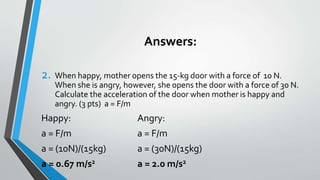
2. When happy, mother opens the 15-kg door with a force of 10 N.
When she is angry, however, she opens the door with a force of 30 N.
Calculate the acceleration of the door when mother is happy and
angry. (3 pts) a = F/m
Happy: Angry:
a = F/m a = F/m
a = (10N)/(15kg) a = (30N)/(15kg)
a = 0.67 m/s2 a = 2.0 m/s2
Answers:
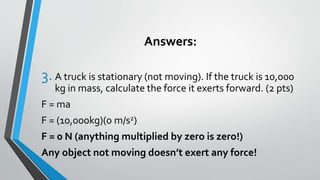
3. A truck is stationary (not moving). If the truck is 10,000
kg in mass, calculate the force it exerts forward. (2 pts)
F = ma
F = (10,000kg)(0 m/s2)
F = 0 N (anything multiplied by zero is zero!)
Any object not moving doesn’t exert any force!
Answers:
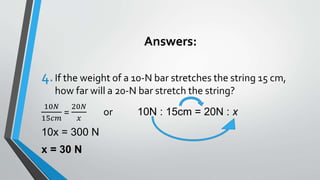
4.If the weight of a 10-N bar stretches the string 15 cm,
how far will a 20-N bar stretch the string?
10𝑁
15𝑐𝑚
=
20𝑁
𝑥
or 10N : 15cm = 20N : x
10x = 300 N
x = 30 N
Answers:
5.The unit of force was named after him.
-Isaac Newton
6.A force that opposes motion.

-Friction
Answers:
7. Give one advantage and one disadvantage of friction. (2
pts)
8.Enumerate the three types of friction (3 pts)
Advantages of Friction
Without friction, we are handicap
-enables us to walk (w/out friction, we could not walk,
nor move)
-enables us to stop motion (w/out friction, we would
keep moving forward forever)
-We cannot fix the nail in the wood w/out it. Friction
holds the nail.
-A horse cannot pull a cart
-Without friction, you cannot open a can
Disadvantages of Friction
-produces heat in various parts of machines (main
disadvantage; try it by rubbing your hands)
-we have to exert more power in machines (more
power, more energy wasted like fuel in cars)
-opposes motion
-because of friction, noise is produced in machines
Quiz (20 pts)
9.Explain why track and field runners use spike shoes
instead of rollers? (2 pts)
-Spike shoes increase the friction between the shoes and
the ground, enabling a better grip for the athlete to run
faster and more efficiently.
Quiz (20 pts)
10.Which position
will enable you to
swim the fastest?
-B. Streamline
A B
C D
2. Noncontact Forces
• No direct contact
• “Forces acting at a distance”
• They include
1.Gravity
2.Magnetic force
3.Electrical force
4.Nuclear Force
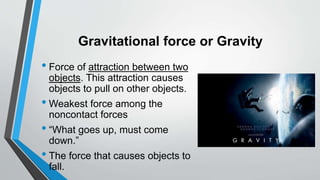
Gravitational force or Gravity
• Force of attraction between two
objects. This attraction causes
objects to pull on other objects.
• Weakest force among the
noncontact forces
• “What goes up, must come
down.”
• The force that causes objects to
fall.
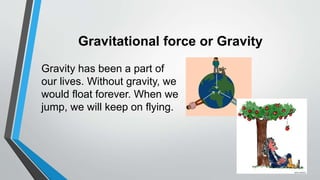
Gravitational force or Gravity
Gravity has been a part of
our lives. Without gravity, we
would float forever. When we
jump, we will keep on flying.
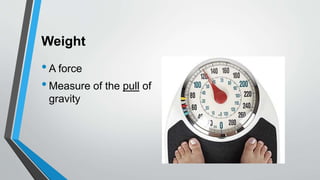
Weight
•A force
•Measure of the pull of
gravity
Mass vs. Weight
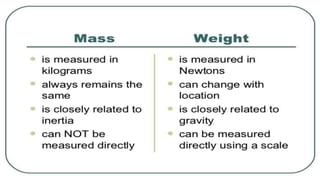
•Mass and weight are not the
same.
•Mass is a measure of inertia
or the amount of matter an
object has.
•Weight is a force which
measures the pull of gravity.
Mass vs. Weight
•The unit of mass is kg, g, etc.
•The unit of weight is N
(Newton).
Mass vs. Weight
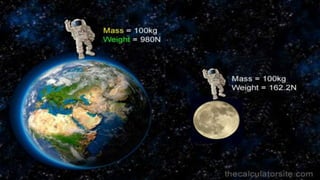
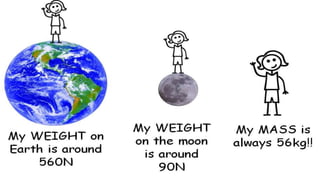
•Mass is constant.
•Weight is changing.
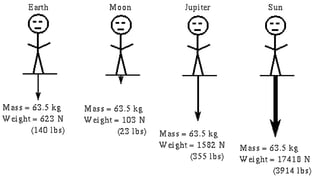
Suppose your mass is 40 kg. If you’re on the earth,
your weight will be different that that of the moon, but
your mass will still be 40 kg.
Weight Formula
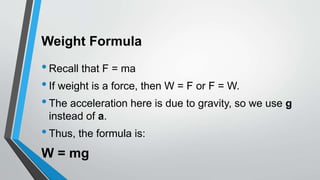
•Recall that F = ma
•If weight is a force, then W = F or F = W.
•The acceleration here is due to gravity, so we use g
instead of a.
•Thus, the formula is:
W = mg
Weight Formula
W = mg
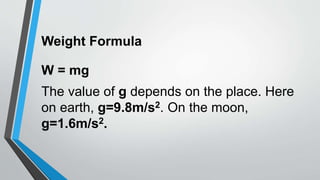
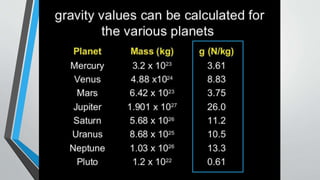
The value of g depends on the place. Here
on earth, g=9.8m/s2. On the moon,
g=1.6m/s2.
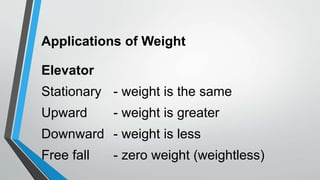
Applications of Weight
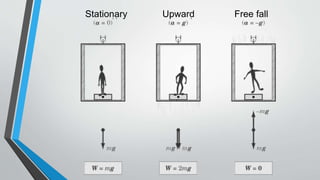
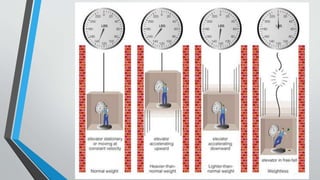
Elevator
Stationary - weight is the same
Upward - weight is greater
Downward - weight is less
Free fall - zero weight (weightless)
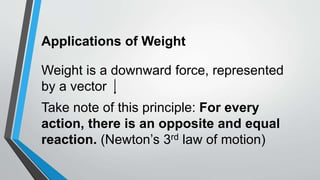
Applications of Weight
Weight is a downward force, represented
by a vector
Take note of this principle: For every
action, there is an opposite and equal
reaction. (Newton’s 3rd law of motion)
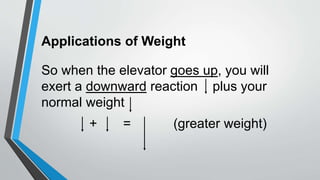
Applications of Weight
So when the elevator goes up, you will
exert a downward reaction plus your
normal weight
+ = (greater weight)
Applications of Weight
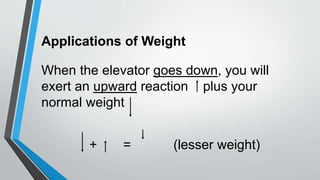
When the elevator goes down, you will
exert an upward reaction plus your
normal weight
+ = (lesser weight)
Applications of Weight
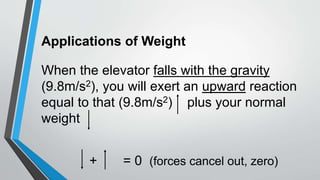
When the elevator falls with the gravity
(9.8m/s2), you will exert an upward reaction
equal to that (9.8m/s2) plus your normal
weight
+ = 0 (forces cancel out, zero)
Stationary Upward Free fall
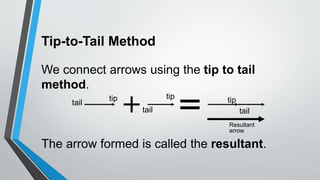
Tip-to-Tail Method
We connect arrows using the tip to tail
method.
The arrow formed is called the resultant.
tip
tail
tip
tail tail
tip
Resultant
arrow
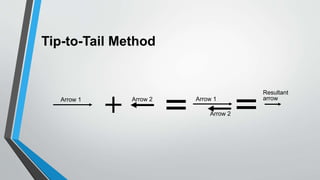
Tip-to-Tail Method
Arrow 1 Arrow 2 Arrow 1
Arrow 2
Resultant
arrow
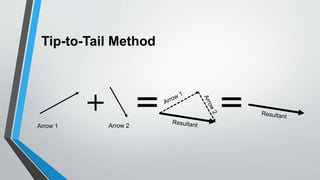
Tip-to-Tail Method
Arrow 1 Arrow 2
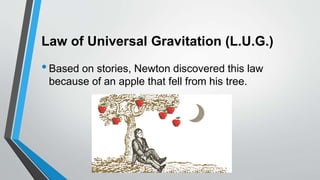
Law of Universal Gravitation (L.U.G.)
•Based on stories, Newton discovered this law
because of an apple that fell from his tree.
Law of Universal Gravitation (L.U.G.)
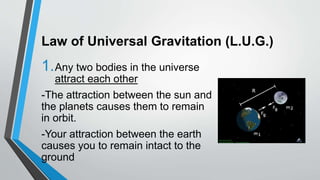
1.Any two bodies in the universe
attract each other
-The attraction between the sun and
the planets causes them to remain
in orbit.
-Your attraction between the earth
causes you to remain intact to the
ground
Law of Universal Gravitation (L.U.G.)
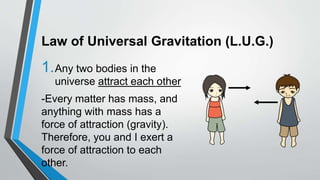
1.Any two bodies in the
universe attract each other
-Every matter has mass, and
anything with mass has a
force of attraction (gravity).
Therefore, you and I exert a
force of attraction to each
other.
Law of Universal Gravitation (L.U.G.)
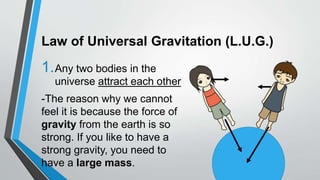
1.Any two bodies in the
universe attract each other
-The reason why we cannot
feel it is because the force of
gravity from the earth is so
strong. If you like to have a
strong gravity, you need to
have a large mass.
Law of Universal Gravitation (L.U.G.)
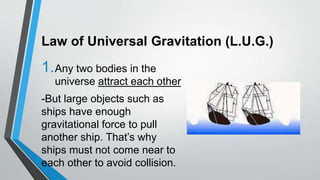
1.Any two bodies in the
universe attract each other
-But large objects such as
ships have enough
gravitational force to pull
another ship. That’s why
ships must not come near to
each other to avoid collision.
Law of Universal Gravitation (L.U.G.)
2.Force is directly proportional to the product of their
masses.
Directly proportional means that:
-if one becomes larger, the other one becomes larger
also
-if one becomes smaller, the other one becomes
smaller also
Law of Universal Gravitation (L.U.G.)
2.Force is directly proportional to the product of their
masses.
So when mass increases, force also increases.
When mass decreases, force also decreases.
Law of Universal Gravitation (L.U.G.)
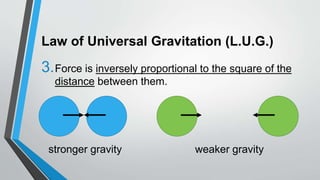
3.Force is inversely proportional to the square of the
distance between them.
Inversely proportional means that:
-if one becomes larger, the other one becomes
smaller
-if one becomes smaller, the other one becomes
larger
Law of Universal Gravitation (L.U.G.)
3.Force is inversely proportional to the square of the
distance between them.
So when the distance increases, the force of gravity
decreases.
When the distance decreases, the force of gravity
increases.
Law of Universal Gravitation (L.U.G.)
3.Force is inversely proportional to the square of the
distance between them.
stronger gravity weaker gravity
Law of Universal Gravitation (L.U.G.)
3.Force is inversely proportional to the square of the
distance between them.
Application: L.D.R.
Law of Universal Gravitation (L.U.G.)
3.Force is inversely proportional to the square of the
distance between them.
Application: Long Distance Relationships (LDR)
What can you say about this? Can distance really
affect a relationship? Explain.
Law of Universal Gravitation (L.U.G.)
To sum up:
•Newton's law of universal gravitation states that
any two bodies in the universe attract each other
with a force that is directly proportional to the product
of their masses and inversely proportional to the
square of the distance between them.
Law of Universal Gravitation (L.U.G.)
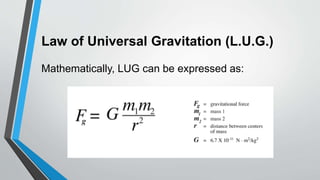
Mathematically, LUG can be expressed as:
g
g
Law of Universal Gravitation (L.U.G.)
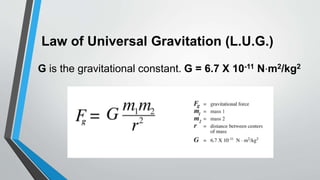
G is the gravitational constant. G = 6.7 X 10⁻¹¹ N⋅m2/kg2
g
g
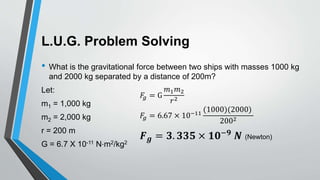
L.U.G. Problem Solving
• What is the gravitational force between two ships with masses 1000 kg
and 2000 kg separated by a distance of 200m?
Let:
m1 = 1,000 kg
m2 = 2,000 kg
r = 200 m
G = 6.7 X 10⁻¹¹ N⋅m2/kg2
𝐹𝑔 = G
𝑚1 𝑚2
𝑟2
𝐹𝑔 = 6.67 × 10⁻¹¹
(1000)(2000)
2002
𝑭 𝒈 = 𝟑. 𝟑𝟑𝟓 × 𝟏𝟎−𝟗
𝑵 (Newton)
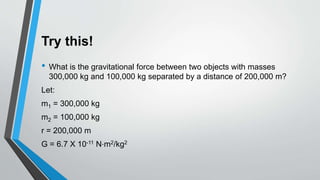
Try this!
• What is the gravitational force between two objects with masses
300,000 kg and 100,000 kg separated by a distance of 200,000 m?
Let:
m1 = 300,000 kg
m2 = 100,000 kg
r = 200,000 m
G = 6.7 X 10⁻¹¹ N⋅m2/kg2
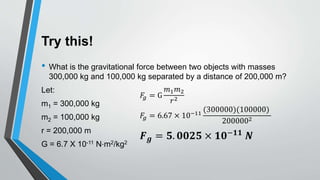
Try this!
• What is the gravitational force between two objects with masses
300,000 kg and 100,000 kg separated by a distance of 200,000 m?
Let:
m1 = 300,000 kg
m2 = 100,000 kg
r = 200,000 m
G = 6.7 X 10⁻¹¹ N⋅m2/kg2
𝐹𝑔 = G
𝑚1 𝑚2
𝑟2
𝐹𝑔 = 6.67 × 10⁻¹¹
(300000)(100000)
2000002
𝑭 𝒈 = 𝟓. 𝟎𝟎𝟐𝟓 × 𝟏𝟎−𝟏𝟏
𝑵
Assignment: (1 whole sheet of paper)
Calculate the force of gravity between the sun and earth
given the mass of the sun is 1.989 X 1030 kg, mass of
earth is 5.972 X 1024 kg, and the distance between them
is 1.496 X 10¹¹ m. (10 pts)
Make a short reaction about L.U.G. Make applications of
it and relate it to spiritual life. Minimum of 5 sentences.
(10 pts)
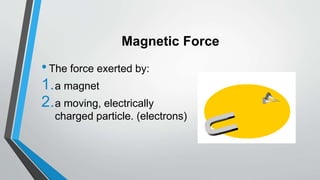
Magnetic Force
•The force exerted by:
1.a magnet
2.a moving, electrically
charged particle. (electrons)
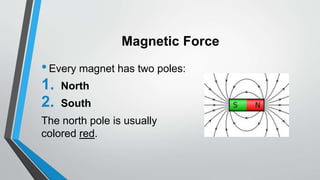
Magnetic Force
•Every magnet has two poles:
1. North
2. South
The north pole is usually
colored red.
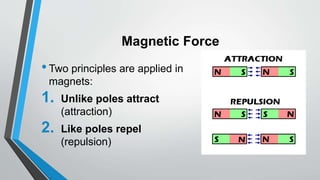
Magnetic Force
•Two principles are applied in
magnets:
1. Unlike poles attract
(attraction)
2. Like poles repel
(repulsion)
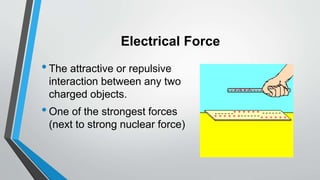
Electrical Force
•The attractive or repulsive
interaction between any two
charged objects.
•One of the strongest forces
(next to strong nuclear force)
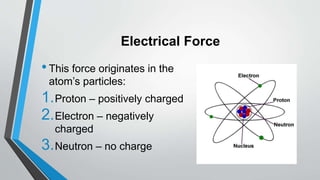
Electrical Force
•This force originates in the
atom’s particles:
1.Proton – positively charged
2.Electron – negatively
charged
3.Neutron – no charge
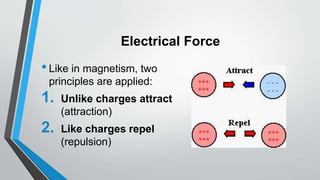
Electrical Force
•Like in magnetism, two
principles are applied:
1. Unlike charges attract
(attraction)
2. Like charges repel
(repulsion)
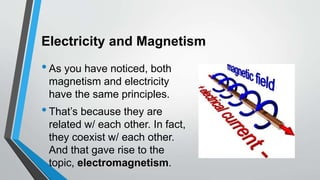
Electricity and Magnetism
•As you have noticed, both
magnetism and electricity
have the same principles.
•That’s because they are
related w/ each other. In fact,
they coexist w/ each other.
And that gave rise to the
topic, electromagnetism.
Electricity and Magnetism
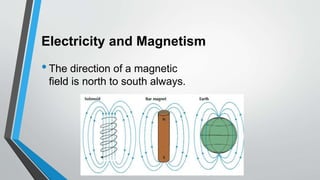
•The direction of a magnetic
field is north to south always.
Electricity and Magnetism
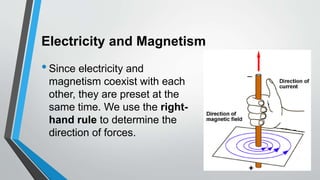
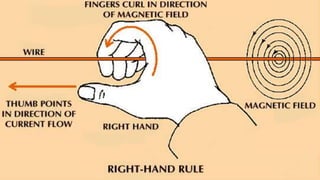
•Since electricity and
magnetism coexist with each
other, they are preset at the
same time. We use the right-
hand rule to determine the
direction of forces.
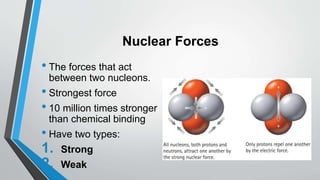
Nuclear Forces
• The forces that act
between two nucleons.
• Strongest force
• 10 million times stronger
than chemical binding
• Have two types:
1. Strong
2. Weak
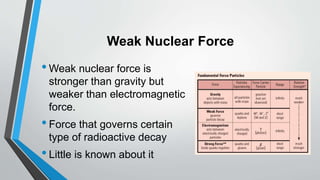
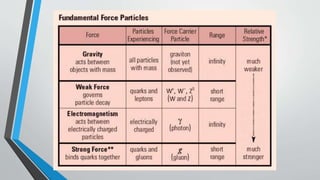
Weak Nuclear Force
•Weak nuclear force is
stronger than gravity but
weaker than electromagnetic
force.
•Force that governs certain
type of radioactive decay
•Little is known about it
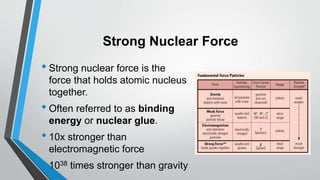
Strong Nuclear Force
• Strong nuclear force is the
force that holds atomic nucleus
together.
• Often referred to as binding
energy or nuclear glue.
• 10x stronger than
electromagnetic force
• 1038 times stronger than gravity
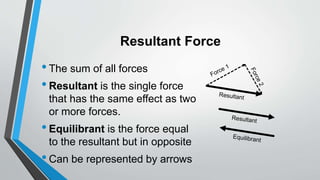
Resultant Force
•The sum of all forces
•Resultant is the single force
that has the same effect as two
or more forces.
•Equilibrant is the force equal
to the resultant but in opposite
•Can be represented by arrows
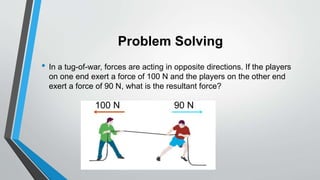
Problem Solving
• In a tug-of-war, forces are acting in opposite directions. If the players
on one end exert a force of 100 N and the players on the other end
exert a force of 90 N, what is the resultant force?
100 N 90 N
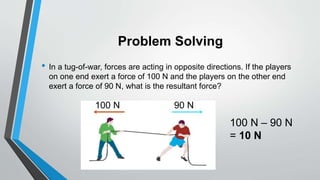
Problem Solving
• In a tug-of-war, forces are acting in opposite directions. If the players
on one end exert a force of 100 N and the players on the other end
exert a force of 90 N, what is the resultant force?
100 N 90 N
100 N – 90 N
= 10 N
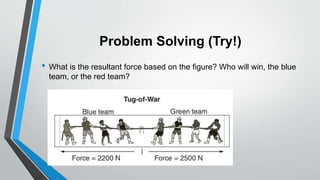
Problem Solving (Try!)
• What is the resultant force based on the figure? Who will win, the blue
team, or the red team?
Problem Solving (Try!)
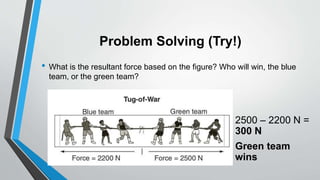
• What is the resultant force based on the figure? Who will win, the blue
team, or the green team?
2500 – 2200 N =
300 N
Green team
wins
Problem Solving (Try!)
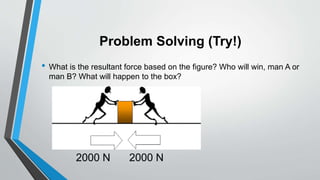
• What is the resultant force based on the figure? Who will win, man A or
man B? What will happen to the box?
2000 N 2000 N
Problem Solving (Try!)
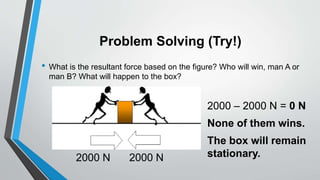
• What is the resultant force based on the figure? Who will win, man A or
man B? What will happen to the box?
2000 – 2000 N = 0 N
None of them wins.
The box will remain
stationary.2000 N 2000 N
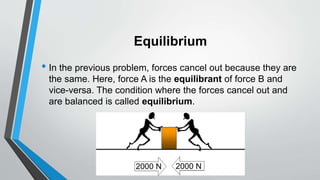
Equilibrium
• In the previous problem, forces cancel out because they are
the same. Here, force A is the equilibrant of force B and
vice-versa. The condition where the forces cancel out and
are balanced is called equilibrium.
2000 N 2000 N
Sources:
Science Links 7
http://www.citycollegiate.com/force_motionXe.htm
http://www.bbc.co.uk/bitesize/ks3/science/energy_electr
icity_forces/forces/activity/

Unit 6, Lesson 1 - Force

  • 1.
    ForceUnit SIX, Lesson6.1 By Margielene D. Judan
  • 2.
    LESSON OUTLINE Force Kinds ofForces Contact Forces (Ex. Friction) Non-contact Forces Gravity,Weight, Law of Universal Gravitation Magnetic Force Electrical Force Magnetism and Electricity Strong and Weak Nuclear Forces Resultant Force
  • 3.
    FORCE – apush or pull
  • 4.
    What are somethings that force can do? 1. Can change the shape & size of things by: • Compressing • Stretching • Cutting • Tearing • Bending • Sliding • Twisting 2.Put motion into a stationary (not moving) ball by rolling it. 3. Catching and throwing can stop the motion or change the direction of the ball
  • 5.
    SPRING SCALE –measures force invented by Robert Hooke (he also discovered cells)
  • 6.
    Hooke hung a1-pound weight and discovered that the spring was stretched to a certain distance. Hanging a 2-pound weight on the spring caused it to stretch twice as far.
  • 7.
    Given the followingdetails, what conclusion can you make?
  • 8.
    Notice that a2-pound weight can cause a stretch twice as the 1-pound weight. If a 3- pound weight was hung, the stretch would be thrice and so on.
  • 9.
    Therefore, force isdirectly proportional to the length of the string (given that they have the same stiffness). This is known as Hooke’s Law.
  • 11.
    Unit of Force– NEWTON (N) -named after Sir Isaac Newton -defined as the force that gives a mass of 1 kg an acceleration of 1 m/s2
  • 12.
    So: -A force of10 N means a 10-kg object accelerates at 1 m/s2. -A force of 50 N means a 50-kg object accelerates at 1 m/s2. -A force of 100 N means a 100-kg object accelerates at 1 m/s2. -And so on…
  • 13.
    Main Formula forForce: F = ma m = mass (usually in grams, g) a = acceleration (usually in m/s2)
  • 14.
    Deriving into F= ma, we have m = F/a a = F/m
  • 15.
    Main Formula forForce: F = ma m = mass (usually in kilograms, kg) a = acceleration (usually in m/s2)
  • 16.
    1. A manof mass 50 kg runs at an acceleration of 1.5m/s2. Find the force he’s exerting.
  • 17.
    1. A manof mass 50 kg runs at an acceleration of 1.5m/s2. Find the force he’s exerting. F = ma F = (50kg)(1.5m/s2) F = 75 N
  • 18.
    2. A forceof 20 N acts upon a 5 kg block. Calculate the acceleration of the object.
  • 19.
    2. A forceof 20 N acts upon a 5 kg block. Calculate the acceleration of the object. a = F/m a = (20N)/(5 kg) a = 4m/s2
  • 20.
    3. An objecthas a mass of 1,500 g. If the acceleration of the earth is 9.8m/s2, calculate the weight of the object.
  • 21.
    3. An objecthas a mass of 1,500 g. If the acceleration of the earth is 9.8m/s2, calculate the weight of the object. Since mass is in grams, we need to convert it into kilograms: 1,500 g = 1.5 kg (move the decimal 3 places to the left or divide by 1000)
  • 22.
    3. An objecthas a mass of 1,500 g. If the acceleration of the earth is 9.8m/s2, calculate the weight of the object. Weight is a force. F = ma F = (1.5kg)(9.8m/s2) F = 14.7 N
  • 23.
    4. What isthe force exerted by a stationary object (not moving) if it has a mass of 500 kg?
  • 24.
    4. What isthe force exerted by a stationary object (not moving) if it has a mass of 500 kg? An stationary object exerts no force since it doesn’t accelerate (a= 0m/s2) F = ma F = (500kg)(0m/s2) F = 0 N
  • 25.
    Kinds of Forces 1.ContactForces 2.Noncontact Forces
  • 26.
    It would behelpful to memorize the table
  • 27.
    1. Contact Forces •Resultfrom direct contact between two surfaces or objects (ex. Friction)
  • 28.
  • 29.
    Disadvantages of Friction -producesheat in various parts of machines (main disadvantage; try it by rubbing your hands) -we have to exert more power in machines (more power, more energy wasted like fuel in cars) -opposes motion -because of friction, noise is produced in machines
  • 30.
    Advantages of Friction Withoutfriction, we are handicap -enables us to walk (w/out friction, we could not walk, nor move) -enables us to stop motion (w/out friction, we would keep moving forward forever) -We cannot fix the nail in the wood w/out it. Friction holds the nail. -A horse cannot pull a cart -Without friction, you cannot open a can
  • 31.
    Without friction, thereis no motion! Without friction, there is no force! Force and friction, though opposite, acts together in harmony. Friction coexists with force. Ironic, doesn’t it? Real-life application: -Good exists with evil -Opposites attract
  • 32.
    Ways to ReduceFriction: -using lubricants -using wheels or rollers -streamlining by filling, sandpapering, or scrubbing (common in swimming, skydiving, and vehicles)
  • 34.
    That is whycars, especially racecars, are streamlined in form. This allows them to have less drag with air, allowing them to move faster. poor streamline good streamline
  • 36.
    This also explains the shapeof fishes and the shape of swimmers’ strokes.
  • 37.
    Three Types ofFriction: 1. static friction – force between two non- moving (stationary) surfaces in contact 2. sliding friction – the friction between two sliding objects 3. rolling friction – the friction experiences from rolling objects (rollers)
  • 39.
    2. Noncontact Forces •No direct contact • “Forces acting at a distance” • They include 1.Gravity 2.Magnetic force 3.Electrical force 4.Nuclear Force
  • 40.
    Laboratory 2.5: Answer p.189. Instead of weighing the objects, the values are given below: oStone – 6 kilograms oBook – 1.2 kilograms oBlock of wood – 700 grams
  • 41.
    Short Quiz tomorrow:(10 items) Problem solving (F = ma; m=F/a; a=F/m) – 3 items Force – 2 items (1 item on Hooke’s law) Friction – 5 items
  • 42.
    Quiz (20 pts) 1.A man has a mass of 40 kg. If the acceleration due to gravity on earth is 9.8m/s2 and on moon is 1.6m/s2, calculate the force (weight) of the man in earth and moon. (3 pts) F = ma *with solution
  • 43.
    Quiz (20 pts) 2.When happy, mother opens the 15-kg door with a force of 10 N.When she is angry, however, she opens the door with a force of 30 N. Calculate the acceleration of the door when mother is happy and angry. (3 pts) a = F/m *with solution
  • 44.
    Quiz (20 pts) 3.A truck is stationary (not moving). If the truck is 10,000 kg in mass, calculate the force it exerts forward. (2 pts) F = ma
  • 45.
    Quiz (20 pts) 4.Ifthe weight of a 10-N bar stretches the string 15 cm, how far will a 20-N bar stretch the string? 5. The unit of force was named after him. 6.A force that opposes motion. 7. Give one advantage and one disadvantage of friction. (2 pts) 8. Enumerate the three types of friction (3 pts)
  • 46.
    Quiz (20 pts) 9.Explainwhy track and field runners use spike shoes instead of rollers? (2 pts)
  • 47.
    Quiz (20 pts) 10.Whichposition will enable you to swim the fastest? A B C D
  • 48.
    Answers: 1. A manhas a mass of 40 kg. If the acceleration due to gravity on earth is 9.8m/s2 and on moon is 1.6m/s2, calculate the force (weight) of the man in earth and moon. (3 pts) F = ma Earth: Moon: F = ma F = ma F = (40kg)(9.8m/s2) F = (40kg)(1.6m/s2) F = 392.0 N F = 64.0 N
  • 49.
    Answers: 2. When happy,mother opens the 15-kg door with a force of 10 N. When she is angry, however, she opens the door with a force of 30 N. Calculate the acceleration of the door when mother is happy and angry. (3 pts) a = F/m Happy: Angry: a = F/m a = F/m a = (10N)/(15kg) a = (30N)/(15kg) a = 0.67 m/s2 a = 2.0 m/s2
  • 50.
    Answers: 3. A truckis stationary (not moving). If the truck is 10,000 kg in mass, calculate the force it exerts forward. (2 pts) F = ma F = (10,000kg)(0 m/s2) F = 0 N (anything multiplied by zero is zero!) Any object not moving doesn’t exert any force!
  • 51.
    Answers: 4.If the weightof a 10-N bar stretches the string 15 cm, how far will a 20-N bar stretch the string? 10𝑁 15𝑐𝑚 = 20𝑁 𝑥 or 10N : 15cm = 20N : x 10x = 300 N x = 30 N
  • 52.
    Answers: 5.The unit offorce was named after him. -Isaac Newton 6.A force that opposes motion. -Friction
  • 53.
    Answers: 7. Give oneadvantage and one disadvantage of friction. (2 pts) 8.Enumerate the three types of friction (3 pts)
  • 54.
    Advantages of Friction Withoutfriction, we are handicap -enables us to walk (w/out friction, we could not walk, nor move) -enables us to stop motion (w/out friction, we would keep moving forward forever) -We cannot fix the nail in the wood w/out it. Friction holds the nail. -A horse cannot pull a cart -Without friction, you cannot open a can
  • 55.
    Disadvantages of Friction -producesheat in various parts of machines (main disadvantage; try it by rubbing your hands) -we have to exert more power in machines (more power, more energy wasted like fuel in cars) -opposes motion -because of friction, noise is produced in machines
  • 56.
    Quiz (20 pts) 9.Explainwhy track and field runners use spike shoes instead of rollers? (2 pts) -Spike shoes increase the friction between the shoes and the ground, enabling a better grip for the athlete to run faster and more efficiently.
  • 57.
    Quiz (20 pts) 10.Whichposition will enable you to swim the fastest? -B. Streamline A B C D
  • 58.
    2. Noncontact Forces •No direct contact • “Forces acting at a distance” • They include 1.Gravity 2.Magnetic force 3.Electrical force 4.Nuclear Force
  • 59.
    Gravitational force orGravity • Force of attraction between two objects. This attraction causes objects to pull on other objects. • Weakest force among the noncontact forces • “What goes up, must come down.” • The force that causes objects to fall.
  • 60.
    Gravitational force orGravity Gravity has been a part of our lives. Without gravity, we would float forever. When we jump, we will keep on flying.
  • 61.
  • 62.
    Mass vs. Weight •Massand weight are not the same. •Mass is a measure of inertia or the amount of matter an object has. •Weight is a force which measures the pull of gravity.
  • 63.
    Mass vs. Weight •Theunit of mass is kg, g, etc. •The unit of weight is N (Newton).
  • 64.
    Mass vs. Weight •Massis constant. •Weight is changing. Suppose your mass is 40 kg. If you’re on the earth, your weight will be different that that of the moon, but your mass will still be 40 kg.
  • 69.
    Weight Formula •Recall thatF = ma •If weight is a force, then W = F or F = W. •The acceleration here is due to gravity, so we use g instead of a. •Thus, the formula is: W = mg
  • 70.
    Weight Formula W =mg The value of g depends on the place. Here on earth, g=9.8m/s2. On the moon, g=1.6m/s2.
  • 72.
    Applications of Weight Elevator Stationary- weight is the same Upward - weight is greater Downward - weight is less Free fall - zero weight (weightless)
  • 73.
    Applications of Weight Weightis a downward force, represented by a vector Take note of this principle: For every action, there is an opposite and equal reaction. (Newton’s 3rd law of motion)
  • 74.
    Applications of Weight Sowhen the elevator goes up, you will exert a downward reaction plus your normal weight + = (greater weight)
  • 75.
    Applications of Weight Whenthe elevator goes down, you will exert an upward reaction plus your normal weight + = (lesser weight)
  • 76.
    Applications of Weight Whenthe elevator falls with the gravity (9.8m/s2), you will exert an upward reaction equal to that (9.8m/s2) plus your normal weight + = 0 (forces cancel out, zero)
  • 77.
  • 79.
    Tip-to-Tail Method We connectarrows using the tip to tail method. The arrow formed is called the resultant. tip tail tip tail tail tip Resultant arrow
  • 80.
    Tip-to-Tail Method Arrow 1Arrow 2 Arrow 1 Arrow 2 Resultant arrow
  • 81.
  • 82.
    Law of UniversalGravitation (L.U.G.) •Based on stories, Newton discovered this law because of an apple that fell from his tree.
  • 83.
    Law of UniversalGravitation (L.U.G.) 1.Any two bodies in the universe attract each other -The attraction between the sun and the planets causes them to remain in orbit. -Your attraction between the earth causes you to remain intact to the ground
  • 84.
    Law of UniversalGravitation (L.U.G.) 1.Any two bodies in the universe attract each other -Every matter has mass, and anything with mass has a force of attraction (gravity). Therefore, you and I exert a force of attraction to each other.
  • 85.
    Law of UniversalGravitation (L.U.G.) 1.Any two bodies in the universe attract each other -The reason why we cannot feel it is because the force of gravity from the earth is so strong. If you like to have a strong gravity, you need to have a large mass.
  • 86.
    Law of UniversalGravitation (L.U.G.) 1.Any two bodies in the universe attract each other -But large objects such as ships have enough gravitational force to pull another ship. That’s why ships must not come near to each other to avoid collision.
  • 87.
    Law of UniversalGravitation (L.U.G.) 2.Force is directly proportional to the product of their masses. Directly proportional means that: -if one becomes larger, the other one becomes larger also -if one becomes smaller, the other one becomes smaller also
  • 88.
    Law of UniversalGravitation (L.U.G.) 2.Force is directly proportional to the product of their masses. So when mass increases, force also increases. When mass decreases, force also decreases.
  • 89.
    Law of UniversalGravitation (L.U.G.) 3.Force is inversely proportional to the square of the distance between them. Inversely proportional means that: -if one becomes larger, the other one becomes smaller -if one becomes smaller, the other one becomes larger
  • 90.
    Law of UniversalGravitation (L.U.G.) 3.Force is inversely proportional to the square of the distance between them. So when the distance increases, the force of gravity decreases. When the distance decreases, the force of gravity increases.
  • 91.
    Law of UniversalGravitation (L.U.G.) 3.Force is inversely proportional to the square of the distance between them. stronger gravity weaker gravity
  • 92.
    Law of UniversalGravitation (L.U.G.) 3.Force is inversely proportional to the square of the distance between them. Application: L.D.R.
  • 93.
    Law of UniversalGravitation (L.U.G.) 3.Force is inversely proportional to the square of the distance between them. Application: Long Distance Relationships (LDR) What can you say about this? Can distance really affect a relationship? Explain.
  • 94.
    Law of UniversalGravitation (L.U.G.) To sum up: •Newton's law of universal gravitation states that any two bodies in the universe attract each other with a force that is directly proportional to the product of their masses and inversely proportional to the square of the distance between them.
  • 95.
    Law of UniversalGravitation (L.U.G.) Mathematically, LUG can be expressed as: g g
  • 96.
    Law of UniversalGravitation (L.U.G.) G is the gravitational constant. G = 6.7 X 10⁻¹¹ N⋅m2/kg2 g g
  • 97.
    L.U.G. Problem Solving •What is the gravitational force between two ships with masses 1000 kg and 2000 kg separated by a distance of 200m? Let: m1 = 1,000 kg m2 = 2,000 kg r = 200 m G = 6.7 X 10⁻¹¹ N⋅m2/kg2 𝐹𝑔 = G 𝑚1 𝑚2 𝑟2 𝐹𝑔 = 6.67 × 10⁻¹¹ (1000)(2000) 2002 𝑭 𝒈 = 𝟑. 𝟑𝟑𝟓 × 𝟏𝟎−𝟗 𝑵 (Newton)
  • 98.
    Try this! • Whatis the gravitational force between two objects with masses 300,000 kg and 100,000 kg separated by a distance of 200,000 m? Let: m1 = 300,000 kg m2 = 100,000 kg r = 200,000 m G = 6.7 X 10⁻¹¹ N⋅m2/kg2
  • 99.
    Try this! • Whatis the gravitational force between two objects with masses 300,000 kg and 100,000 kg separated by a distance of 200,000 m? Let: m1 = 300,000 kg m2 = 100,000 kg r = 200,000 m G = 6.7 X 10⁻¹¹ N⋅m2/kg2 𝐹𝑔 = G 𝑚1 𝑚2 𝑟2 𝐹𝑔 = 6.67 × 10⁻¹¹ (300000)(100000) 2000002 𝑭 𝒈 = 𝟓. 𝟎𝟎𝟐𝟓 × 𝟏𝟎−𝟏𝟏 𝑵
  • 100.
    Assignment: (1 wholesheet of paper) Calculate the force of gravity between the sun and earth given the mass of the sun is 1.989 X 1030 kg, mass of earth is 5.972 X 1024 kg, and the distance between them is 1.496 X 10¹¹ m. (10 pts) Make a short reaction about L.U.G. Make applications of it and relate it to spiritual life. Minimum of 5 sentences. (10 pts)
  • 101.
    Magnetic Force •The forceexerted by: 1.a magnet 2.a moving, electrically charged particle. (electrons)
  • 102.
    Magnetic Force •Every magnethas two poles: 1. North 2. South The north pole is usually colored red.
  • 103.
    Magnetic Force •Two principlesare applied in magnets: 1. Unlike poles attract (attraction) 2. Like poles repel (repulsion)
  • 104.
    Electrical Force •The attractiveor repulsive interaction between any two charged objects. •One of the strongest forces (next to strong nuclear force)
  • 105.
    Electrical Force •This forceoriginates in the atom’s particles: 1.Proton – positively charged 2.Electron – negatively charged 3.Neutron – no charge
  • 106.
    Electrical Force •Like inmagnetism, two principles are applied: 1. Unlike charges attract (attraction) 2. Like charges repel (repulsion)
  • 107.
    Electricity and Magnetism •Asyou have noticed, both magnetism and electricity have the same principles. •That’s because they are related w/ each other. In fact, they coexist w/ each other. And that gave rise to the topic, electromagnetism.
  • 108.
    Electricity and Magnetism •Thedirection of a magnetic field is north to south always.
  • 109.
    Electricity and Magnetism •Sinceelectricity and magnetism coexist with each other, they are preset at the same time. We use the right- hand rule to determine the direction of forces.
  • 112.
    Nuclear Forces • Theforces that act between two nucleons. • Strongest force • 10 million times stronger than chemical binding • Have two types: 1. Strong 2. Weak
  • 113.
    Weak Nuclear Force •Weaknuclear force is stronger than gravity but weaker than electromagnetic force. •Force that governs certain type of radioactive decay •Little is known about it
  • 114.
    Strong Nuclear Force •Strong nuclear force is the force that holds atomic nucleus together. • Often referred to as binding energy or nuclear glue. • 10x stronger than electromagnetic force • 1038 times stronger than gravity
  • 116.
    Resultant Force •The sumof all forces •Resultant is the single force that has the same effect as two or more forces. •Equilibrant is the force equal to the resultant but in opposite •Can be represented by arrows
  • 117.
    Problem Solving • Ina tug-of-war, forces are acting in opposite directions. If the players on one end exert a force of 100 N and the players on the other end exert a force of 90 N, what is the resultant force? 100 N 90 N
  • 118.
    Problem Solving • Ina tug-of-war, forces are acting in opposite directions. If the players on one end exert a force of 100 N and the players on the other end exert a force of 90 N, what is the resultant force? 100 N 90 N 100 N – 90 N = 10 N
  • 119.
    Problem Solving (Try!) •What is the resultant force based on the figure? Who will win, the blue team, or the red team?
  • 120.
    Problem Solving (Try!) •What is the resultant force based on the figure? Who will win, the blue team, or the green team? 2500 – 2200 N = 300 N Green team wins
  • 121.
    Problem Solving (Try!) •What is the resultant force based on the figure? Who will win, man A or man B? What will happen to the box? 2000 N 2000 N
  • 122.
    Problem Solving (Try!) •What is the resultant force based on the figure? Who will win, man A or man B? What will happen to the box? 2000 – 2000 N = 0 N None of them wins. The box will remain stationary.2000 N 2000 N
  • 123.
    Equilibrium • In theprevious problem, forces cancel out because they are the same. Here, force A is the equilibrant of force B and vice-versa. The condition where the forces cancel out and are balanced is called equilibrium. 2000 N 2000 N
  • 124.