COLLOIDAL
DISPERSION
Prepared by
Rohit Kamboj
Assistant Professor
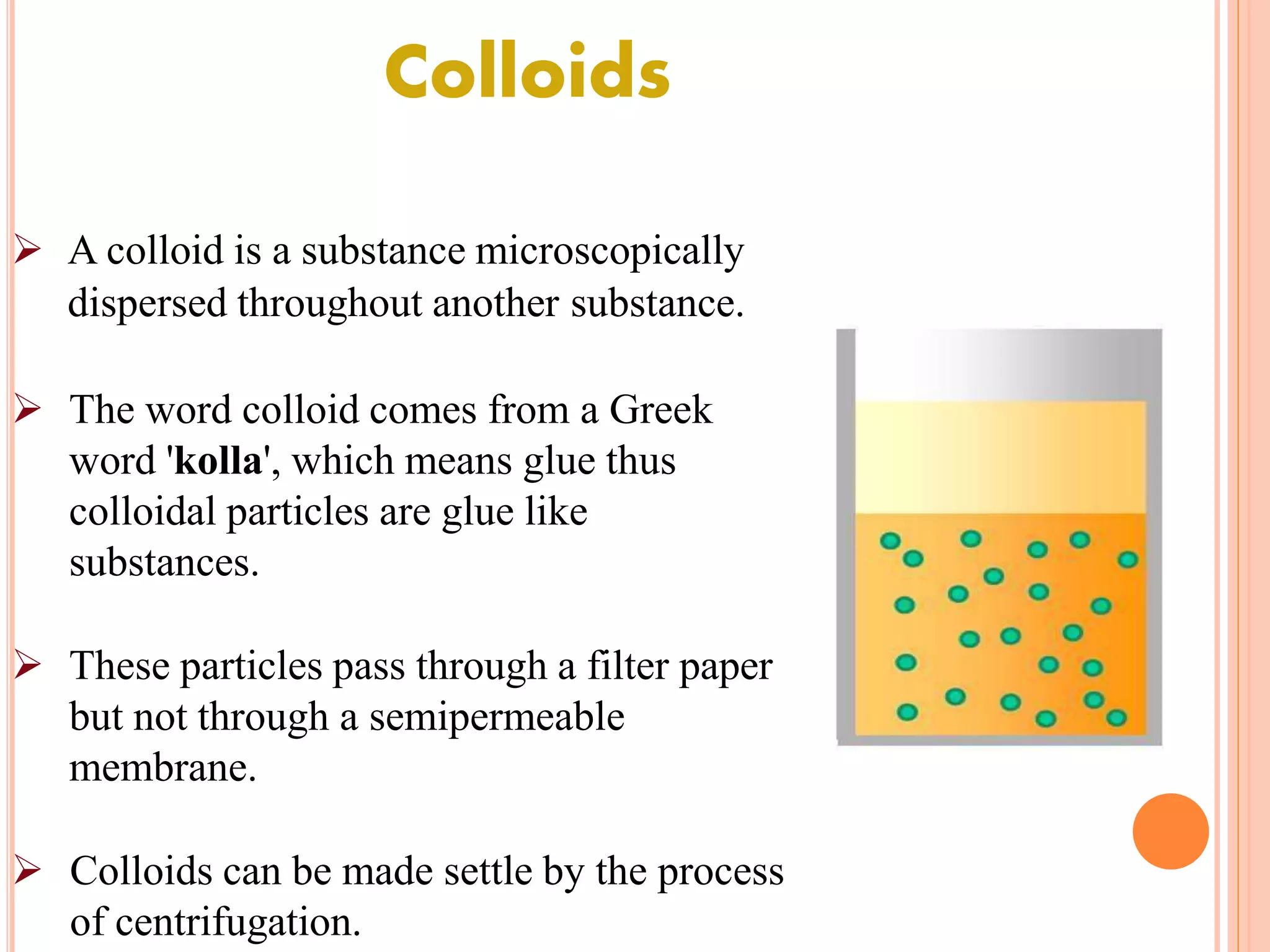
 A colloid is a substance microscopically
dispersed throughout another substance.
 The word colloid comes from a Greek
word 'kolla', which means glue thus
colloidal particles are glue like
substances.
 These particles pass through a filter paper
but not through a semipermeable
membrane.
 Colloids can be made settle by the process
of centrifugation.
Colloids
 The dispersed-phase particles have a diameter of
between approximately 1nm–1000nm.
 Such particles are normally invisible in an optical,
though their presence can be confirmed with the
use of an ultramicroscopeoranelectron microscope.
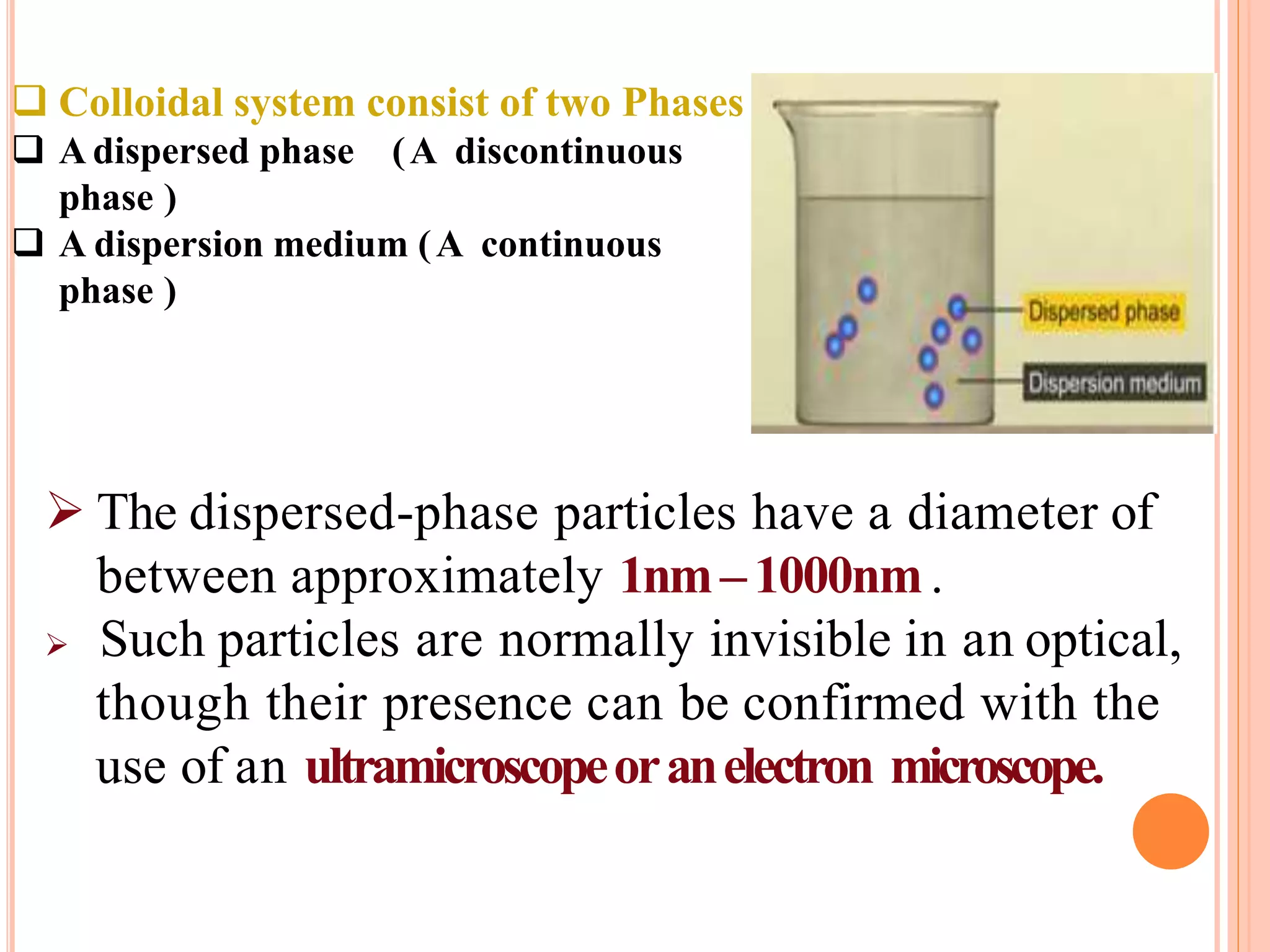
 Colloidal system consist of two Phases
 A dispersed phase (A discontinuous
phase )
 A dispersion medium (A continuous
phase )
SOLUTIONS
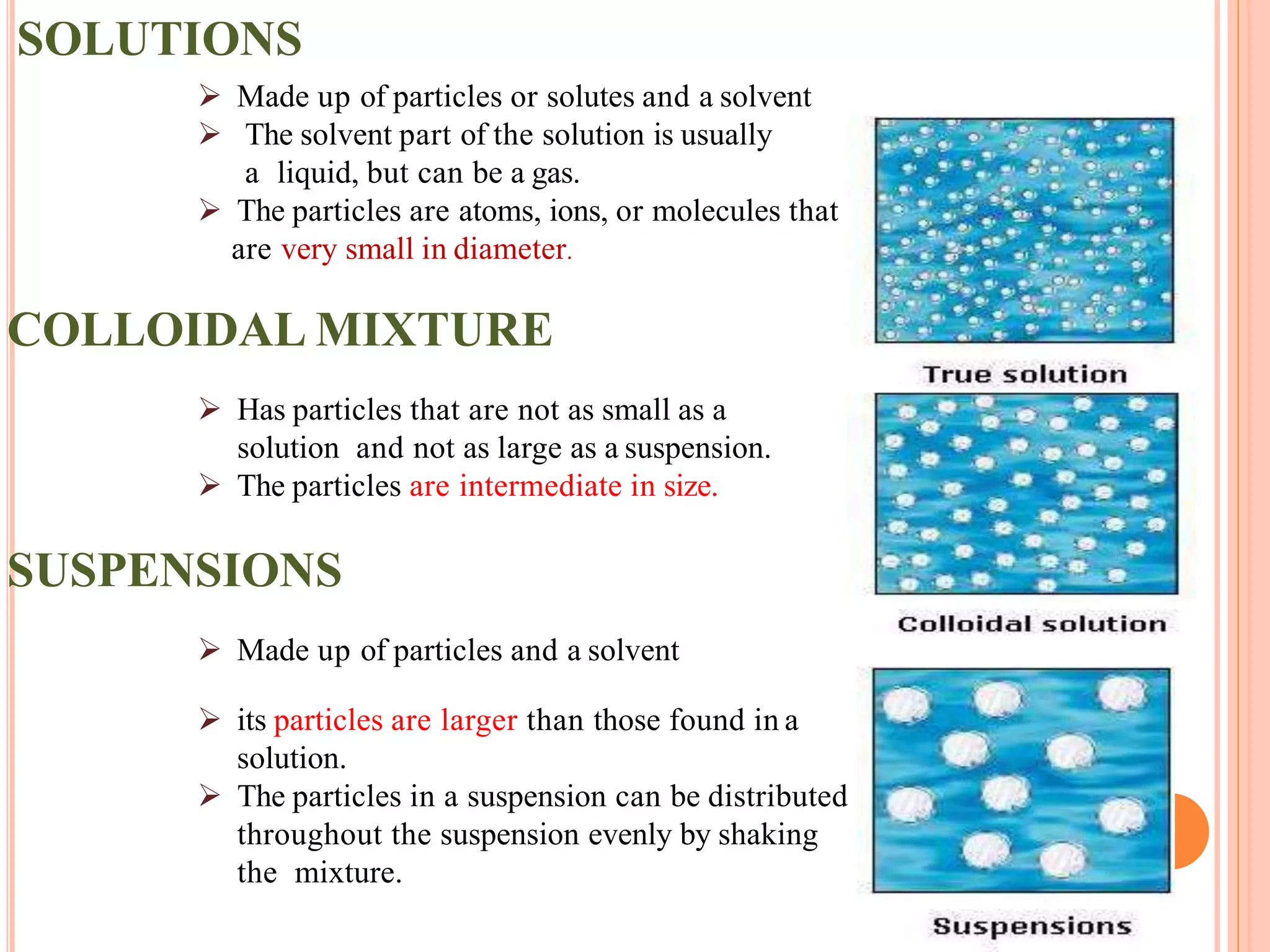
 Made up of particles or solutes and a solvent
 The solvent part of the solution is usually
a liquid, but can be a gas.
 The particles are atoms, ions, or molecules that
are very small in diameter.
COLLOIDAL MIXTURE
 Has particles that are not as small as a
solution and not as large as a suspension.
 The particles are intermediate in size.
SUSPENSIONS
 Made up of particles and a solvent
 its particles are larger than those found in a
solution.
 The particles in a suspension can be distributed
throughout the suspension evenly by shaking
the mixture.
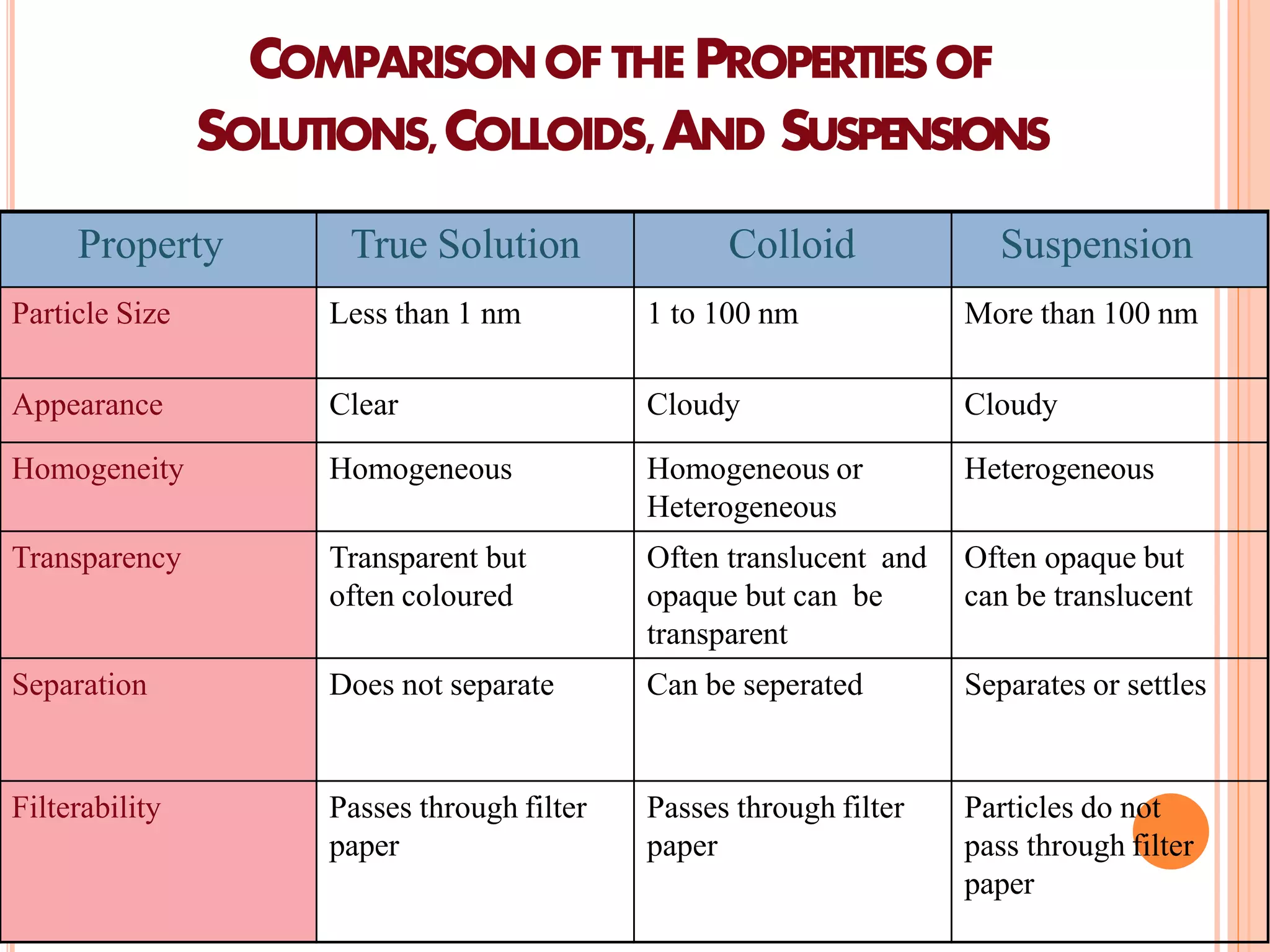
COMPARISONOF THE PROPERTIESOF
SOLUTIONS,COLLOIDS,AND SUSPENSIONS
Property True Solution Colloid Suspension
Particle Size Less than 1 nm 1 to 100 nm More than 100 nm
Appearance Clear Cloudy Cloudy
Homogeneity Homogeneous Homogeneous or
Heterogeneous
Heterogeneous
Transparency Transparent but
often coloured
Often translucent and
opaque but can be
transparent
Often opaque but
can be translucent
Separation Does not separate Can be seperated Separates or settles
Filterability Passes through filter
paper
Passes through filter
paper
Particles do not
pass through filter
paper
APPLICATIONS
 Therapy
 Absorption and toxicity
 Solubility
 Stability
 Targeting of drugs to specific organ
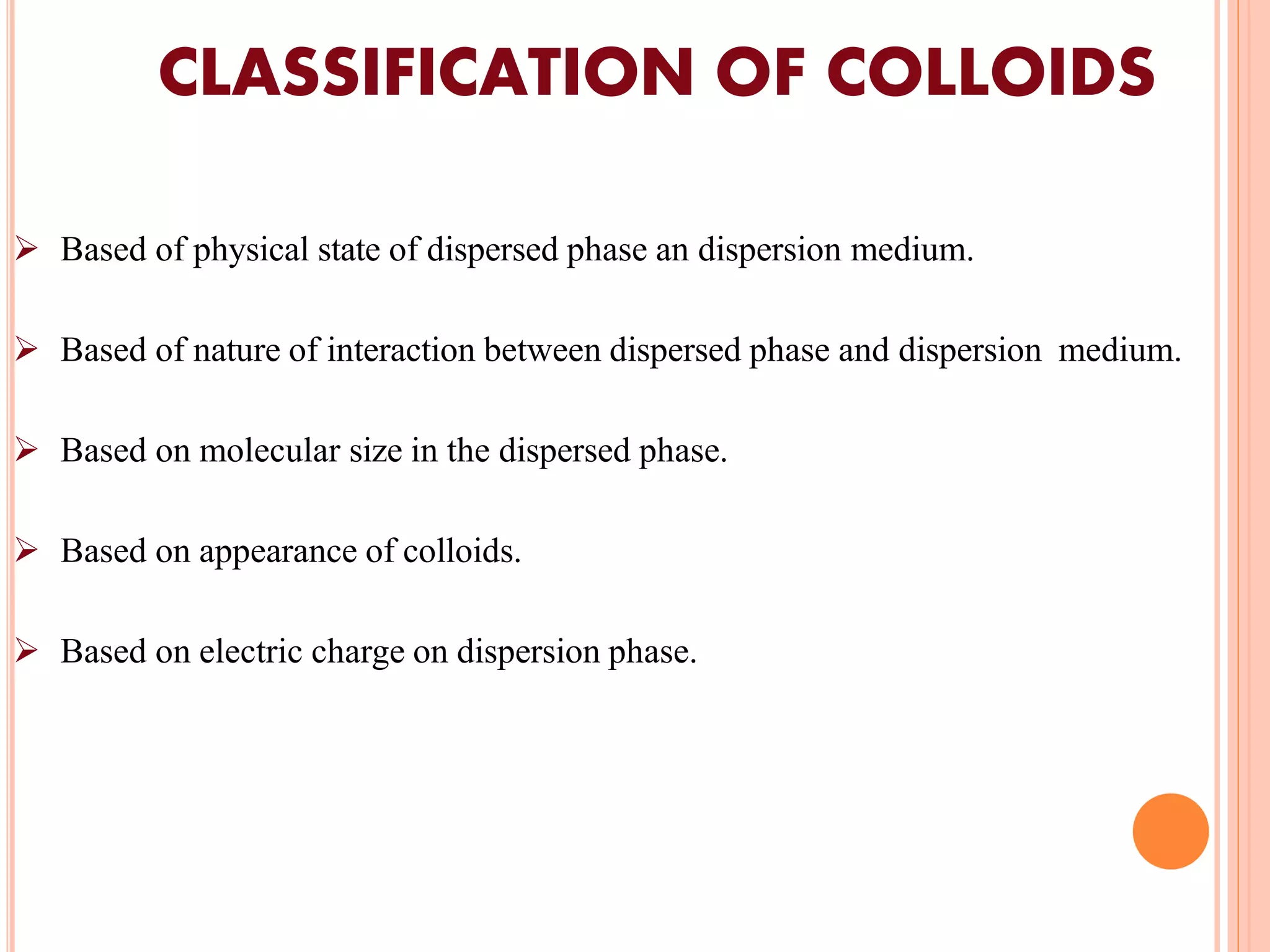
CLASSIFICATION OF COLLOIDS
 Based of physical state of dispersed phase an dispersion medium.
 Based of nature of interaction between dispersed phase and dispersion medium.
 Based on molecular size in the dispersed phase.
 Based on appearance of colloids.
 Based on electric charge on dispersion phase.
BASED ON PHYSICAL STATE OF DISPERSED PHASE
AND DISPERSION MEDIUM
BASED ON NATURE OF INTERACTION BETWEEN
DISPERSED PHASE AND DISPERSION MEDIUM
1. LYOPHILIC COLLOIDS
2. LYOPHOBIC COLLOIDS
3. ASSOCIATED COLLOIDS
1. LYOPHILIC COLLOIDS
 Colloidal solution in which the dispersed phase has a great
affinity for the dispersion medium.
 They are also termed as intrinsic colloids.
 Such substances have tendency to pass into colloidal
solution when brought in contact with dispersion medium.
 If the dispersion medium is water, they are called
hydrophilic or emulsoids.
 The lyophilic colloids are generally self- stabilized.
 Reversible in nature and are heavily hydrated.
 Example of lyophilic colloids are starch, gelatin,
rubber, protein etc.
Dispersion
Medium
Dispersion
Phase
2. LYOPHOBIC COLLOIDS
 Colloidal solutions in which the dispersed phase has no
affinity to the dispersion medium.
 These are also referred as extrinsiccolloids.
 Such substances have no tendency to pass into colloidal solution
when brought in contact with dispersion medium.
 The lyophobic colloids are relativelyunstable.
 They are irreversible by nature and arestabilized by
adding small amount ofelectrolyte.
 They are poorly hydrated.
 If the dispersion medium is water, the lyophobiccolloids are
called hyrophobic or suspenoids.
 Examples: sols of metals like Au,Ag,sols of metal
hyroxides and sols of metal sulphides.
Dispersion
Medium
Dispersion
Phase
3. ASSOCIATED COLLOIDS
• These colloids behave as normal electrolytes at low concentrations but
behave as colloids at higher concentrations.
• These associated colloids are also referred to as micelles.
• Sodium stearate (C18H35NaO2)behave as electrolyte in dilute solution
but colloid in higher concentrations.
• Examples: Soaps , higher alkyl sulphonates , polythene oxide.
Properties of Colloids
A) KINETIC PROPERTIES:
 Which relate to the motion of the particles withinthe dispersion medium as
following:
• Brownian motion.
• Diffusion.
• Sedimentation.
• Viscosity.
1. BROWNIAN MOVEMENT
• The continuous zigzag movement of the colloidal
particles in the dispersion medium in a colloidal
solution is called Brownian movement.
• Brownian movement is due to the unequal
bombardments of the moving molecules of
dispersion medium on colloidalparticles.
• The Brownian movement decreases with an
increase in the size of colloidal particle. This is why
suspensions do not exhibit this type ofmovement.
2) DIFFUSION:
Definition:
 As a result of Brownian motion particles pass (diffuse) from
a region of higher concentration to one with lower conc.
 Rate of diffusion is expressed by;
Fick’s first law:
dm/dt = -DA dc/dx
Where dm is the mass of substance diffusing in time dt across
an area A under the influence of a concentration
gradient dC/dx.
The minus sign denotes that diffusion takes place in
the direction of decreasing concentration.
D is the diffusion coefficient.
3) SEDIMENTATION:
 Stoke’s law;
V = 2r2( p-po) g / 9 η
• v:velocity of sedimentation of spherical particles.
• p:density of the spherical particles.
• po: density of the medium.
•η:viscosity of the medium.
• g: acceleration due to gravity.
At small particle size (less than 0.5 um) Brownian motion is
significant & tend to prevent sedimentation due to gravity &
promote mixing in stead.
•so, we use an ultracentrifuge which provide stronger force so
promote sedimentation in a measurable manner.
4) VISCOSITY
Definition:
 The resistance to flow of a system under an applied
pressure
 Viscosity of colloid allows 1- calculation of the
molecular weight.
2- Provide useful information about the shape of the
colloidal particles.
 Spherocolloidal dispersions are of relatively low viscosity.
 On the other hand Linear colloidal dispersions are of high
viscosity.
 If linear colloidal particles coil up into spheres
The viscosity of the system falls due to changing the shape.
B) OPTICAL PROPERTIES:
1) Light scattering (Tyndall effect).
2) Ultra microscope.
3) Electron microscope.
OPTICAL PROPERTIES OF COLLOIDS
• 1. TYNDALL EFFECT
• When an intense converging beam of light is passed
through a colloidal solution kept in dark, the path of
the beam gets illuminated with a bluish light.
• This phenomenon is called Tyndall effect and the
illuminated path is known as Tyndall cone.
• The Tyndall effect is due to the scattering of light by
colloidal particles.
• Tyndall effect is not exhibited by true solutions. This is
because the particles present in a true solution aretoo
small to scatter light.
• Tyndall effect can be used to distinguish a colloidal
solution from a true solution. The phenomenon has
also been used to devise an instrument known asultra
microscope. The instrument is used for the detection
of the particles of colloidal dimensions.
2) Ultra microscope:
 Particles appear as spots of
light against the dark
background of the microscope.
 Used in the technique of micro
electrophoresis for measuring
particle charge.
 Give actual picture of the
particles (up to 5A).
 Used to observe the size,
shape and structure of sols.
 High energy electron beams
are used. (have greater
resolving power)
 One disadvantage is; only
dried samples can be examined.
Not give information on
solvation.
3) ELECTRON MICROSCOPE:
ELECTRICAL PROPERTIES OF
COLLOIDS
• ELECTROPHORESIS
• The movement of colloidal particles
towards a particular electrode under
the influence of an electric field.
• If the colloidal particles carry positive
charge, they move towards cathode
when subjected to an electric field
and vice versa.
• ELECTROSMOSIS
• The movement of dispersion medium under the influence of an
electric field in the situation when the movement of colloidal
particles is prevented with the help of a suitable membrane.
• During electrosmosis, colloidal particles are checked and it is the
dispersion medium that moves towards the oppositely charged
electrode.
Colloids

Colloids

  • 1.
  • 2.
     A colloidis a substance microscopically dispersed throughout another substance.  The word colloid comes from a Greek word 'kolla', which means glue thus colloidal particles are glue like substances.  These particles pass through a filter paper but not through a semipermeable membrane.  Colloids can be made settle by the process of centrifugation. Colloids
  • 3.
     The dispersed-phaseparticles have a diameter of between approximately 1nm–1000nm.  Such particles are normally invisible in an optical, though their presence can be confirmed with the use of an ultramicroscopeoranelectron microscope.  Colloidal system consist of two Phases  A dispersed phase (A discontinuous phase )  A dispersion medium (A continuous phase )
  • 4.
    SOLUTIONS  Made upof particles or solutes and a solvent  The solvent part of the solution is usually a liquid, but can be a gas.  The particles are atoms, ions, or molecules that are very small in diameter. COLLOIDAL MIXTURE  Has particles that are not as small as a solution and not as large as a suspension.  The particles are intermediate in size. SUSPENSIONS  Made up of particles and a solvent  its particles are larger than those found in a solution.  The particles in a suspension can be distributed throughout the suspension evenly by shaking the mixture.
  • 5.
    COMPARISONOF THE PROPERTIESOF SOLUTIONS,COLLOIDS,ANDSUSPENSIONS Property True Solution Colloid Suspension Particle Size Less than 1 nm 1 to 100 nm More than 100 nm Appearance Clear Cloudy Cloudy Homogeneity Homogeneous Homogeneous or Heterogeneous Heterogeneous Transparency Transparent but often coloured Often translucent and opaque but can be transparent Often opaque but can be translucent Separation Does not separate Can be seperated Separates or settles Filterability Passes through filter paper Passes through filter paper Particles do not pass through filter paper
  • 6.
    APPLICATIONS  Therapy  Absorptionand toxicity  Solubility  Stability  Targeting of drugs to specific organ
  • 7.
    CLASSIFICATION OF COLLOIDS Based of physical state of dispersed phase an dispersion medium.  Based of nature of interaction between dispersed phase and dispersion medium.  Based on molecular size in the dispersed phase.  Based on appearance of colloids.  Based on electric charge on dispersion phase.
  • 8.
    BASED ON PHYSICALSTATE OF DISPERSED PHASE AND DISPERSION MEDIUM
  • 9.
    BASED ON NATUREOF INTERACTION BETWEEN DISPERSED PHASE AND DISPERSION MEDIUM 1. LYOPHILIC COLLOIDS 2. LYOPHOBIC COLLOIDS 3. ASSOCIATED COLLOIDS
  • 10.
    1. LYOPHILIC COLLOIDS Colloidal solution in which the dispersed phase has a great affinity for the dispersion medium.  They are also termed as intrinsic colloids.  Such substances have tendency to pass into colloidal solution when brought in contact with dispersion medium.  If the dispersion medium is water, they are called hydrophilic or emulsoids.  The lyophilic colloids are generally self- stabilized.  Reversible in nature and are heavily hydrated.  Example of lyophilic colloids are starch, gelatin, rubber, protein etc. Dispersion Medium Dispersion Phase
  • 11.
    2. LYOPHOBIC COLLOIDS Colloidal solutions in which the dispersed phase has no affinity to the dispersion medium.  These are also referred as extrinsiccolloids.  Such substances have no tendency to pass into colloidal solution when brought in contact with dispersion medium.  The lyophobic colloids are relativelyunstable.  They are irreversible by nature and arestabilized by adding small amount ofelectrolyte.  They are poorly hydrated.  If the dispersion medium is water, the lyophobiccolloids are called hyrophobic or suspenoids.  Examples: sols of metals like Au,Ag,sols of metal hyroxides and sols of metal sulphides. Dispersion Medium Dispersion Phase
  • 12.
    3. ASSOCIATED COLLOIDS •These colloids behave as normal electrolytes at low concentrations but behave as colloids at higher concentrations. • These associated colloids are also referred to as micelles. • Sodium stearate (C18H35NaO2)behave as electrolyte in dilute solution but colloid in higher concentrations. • Examples: Soaps , higher alkyl sulphonates , polythene oxide.
  • 13.
  • 14.
    A) KINETIC PROPERTIES: Which relate to the motion of the particles withinthe dispersion medium as following: • Brownian motion. • Diffusion. • Sedimentation. • Viscosity.
  • 15.
    1. BROWNIAN MOVEMENT •The continuous zigzag movement of the colloidal particles in the dispersion medium in a colloidal solution is called Brownian movement. • Brownian movement is due to the unequal bombardments of the moving molecules of dispersion medium on colloidalparticles. • The Brownian movement decreases with an increase in the size of colloidal particle. This is why suspensions do not exhibit this type ofmovement.
  • 16.
    2) DIFFUSION: Definition:  Asa result of Brownian motion particles pass (diffuse) from a region of higher concentration to one with lower conc.  Rate of diffusion is expressed by; Fick’s first law: dm/dt = -DA dc/dx Where dm is the mass of substance diffusing in time dt across an area A under the influence of a concentration gradient dC/dx. The minus sign denotes that diffusion takes place in the direction of decreasing concentration. D is the diffusion coefficient.
  • 17.
    3) SEDIMENTATION:  Stoke’slaw; V = 2r2( p-po) g / 9 η • v:velocity of sedimentation of spherical particles. • p:density of the spherical particles. • po: density of the medium. •η:viscosity of the medium. • g: acceleration due to gravity. At small particle size (less than 0.5 um) Brownian motion is significant & tend to prevent sedimentation due to gravity & promote mixing in stead. •so, we use an ultracentrifuge which provide stronger force so promote sedimentation in a measurable manner.
  • 18.
    4) VISCOSITY Definition:  Theresistance to flow of a system under an applied pressure  Viscosity of colloid allows 1- calculation of the molecular weight. 2- Provide useful information about the shape of the colloidal particles.  Spherocolloidal dispersions are of relatively low viscosity.  On the other hand Linear colloidal dispersions are of high viscosity.  If linear colloidal particles coil up into spheres The viscosity of the system falls due to changing the shape.
  • 19.
    B) OPTICAL PROPERTIES: 1)Light scattering (Tyndall effect). 2) Ultra microscope. 3) Electron microscope.
  • 20.
    OPTICAL PROPERTIES OFCOLLOIDS • 1. TYNDALL EFFECT • When an intense converging beam of light is passed through a colloidal solution kept in dark, the path of the beam gets illuminated with a bluish light. • This phenomenon is called Tyndall effect and the illuminated path is known as Tyndall cone. • The Tyndall effect is due to the scattering of light by colloidal particles. • Tyndall effect is not exhibited by true solutions. This is because the particles present in a true solution aretoo small to scatter light. • Tyndall effect can be used to distinguish a colloidal solution from a true solution. The phenomenon has also been used to devise an instrument known asultra microscope. The instrument is used for the detection of the particles of colloidal dimensions.
  • 21.
    2) Ultra microscope: Particles appear as spots of light against the dark background of the microscope.  Used in the technique of micro electrophoresis for measuring particle charge.  Give actual picture of the particles (up to 5A).  Used to observe the size, shape and structure of sols.  High energy electron beams are used. (have greater resolving power)  One disadvantage is; only dried samples can be examined. Not give information on solvation. 3) ELECTRON MICROSCOPE:
  • 22.
    ELECTRICAL PROPERTIES OF COLLOIDS •ELECTROPHORESIS • The movement of colloidal particles towards a particular electrode under the influence of an electric field. • If the colloidal particles carry positive charge, they move towards cathode when subjected to an electric field and vice versa.
  • 23.
    • ELECTROSMOSIS • Themovement of dispersion medium under the influence of an electric field in the situation when the movement of colloidal particles is prevented with the help of a suitable membrane. • During electrosmosis, colloidal particles are checked and it is the dispersion medium that moves towards the oppositely charged electrode.