VectorsUnit SIX, Lesson 6.3
By Margielene D. Judan
LESSON OUTLINE
Vector Representation
Graphical Method
Mathematical Method
PythagoreanTheorem
Component Method
Various quantities in nature can be:
• Scalar quantity – magnitude only
• Vector quantity – magnitude + direction
The length of the arrow represents the
magnitude while the angle where the arrow is
pointed represents the direction.
Thus, a longer vector has a larger
magnitude.
A B C
Which among the vectors has the largest magnitude?
Examples of Vector Representation:
• 30 km/hr East
• 20 km/hr West
• 10 km/hr North
30 km
20 km
10 km
Examples of Vector Representation:
• 50 km/hr NE
• 50 km/hr SE
50 km
50 km
Vectors can also be drawn in a Cartesian
coordinate system.
West
North
East
South
Ex. A force of 80 Newtons east
𝐹 = 80 N east
W
N
E
S
Ex. A velocity of 120 km/hr southwest
𝑣 = 120 km/hr SW
𝜃 = 45°
W
N
E
S
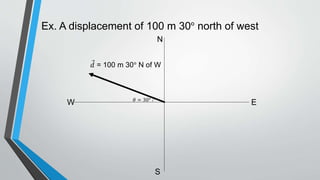
Ex. A displacement of 100 m 30° north of west
𝑑 = 100 m 30° N of W
𝜃 = 30°
W
N
E
S
We use a protractor to measure the angles in
degrees, and a ruler to measure the magnitude.
Vector Addition
We can add vectors using different
methods. The sum of the vectors (vector
sum) is called the resultant vector,
denoted by R.
Vector Addition Methods
• Graphical Method or the Tip-to-Tail Method
• Mathematical Method
1. Pythagorean Theorem
2. Component Method
1. Graphical Method or
Tip-to-Tail Method
Tip-to-Tail Method
Arrow 1 Arrow 2
Review from Lesson 6.1
It is called tip-to-tail because you
connect the arrows from tip to tail
Correct Wrong
tip
tail
tail
tiptip
tail
tail
tail
tail
tip
tip
tip
We can use many arrows.
2. Mathematical Method
Look at the red line. Can you measure its
exact length?
Using the graphical method is easy and
convenient. However, it does not predict
measurements exactly. You cannot
measure 62.5213° on a protractor and
2.617 cm in a ruler exactly.
Thus, we use a more exact method called
the mathematical method.
Note:
Right and Up (+)
Left and Down (-)
Note:
Right and Up (+)
Left and Down (-)
3. Pythagorean Theorem
Note: The Pythagorean Theorem is used
for determining the resultant of two vectors
that makes a right angle to each other.
The formula is given below:
Use the Pythagorean Theorem to
determine the resultant vector below.
Practice A Solution:
𝑅 = 𝑎2 + 𝑏2
𝑅 = 52 + 102
𝑅 = 25 + 100
𝑅 = 125
𝑹 = 𝟏𝟏. 𝟏𝟖 𝒌𝒎
Practice B Solution:
𝑅 = 𝑎2 + 𝑏2
𝑅 = 302 + 402
𝑅 = 900 + 1600
𝑅 = 2500
𝑹 = 𝟓𝟎 𝒌𝒎
Assignment
Answer Laboratory 3.2.
4. Component Method
Most of the times, the vectors given do not
form right angles and the Pythagorean
Theorem is not applicable.
Pythagorean Theorem
applicable
Pythagorean Theorem
not applicable
The Component Method is the best method
to use in all vector problems which vectors
do not form a right angle (Pythagorean
Theorem).
Using this method, vectors are broken
down into its x and y components.
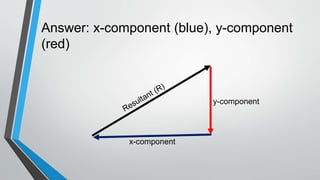
Given the vector (black), find its x and y
components using the graphical method.
Answer: x-component (blue), y-component
(red)
x-component
y-component
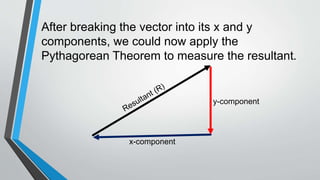
After breaking the vector into its x and y
components, we could now apply the
Pythagorean Theorem to measure the resultant.
x-component
y-component
Using the mathematical method, however,
we have to apply concepts in trigonometry.
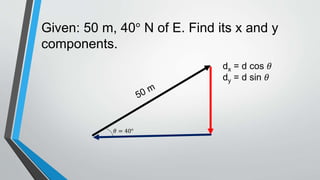
Given: 50 m, 40° N of E. Find its x and y
components.
𝜃 = 40°
Given: 50 m, 40° N of E. Find its x and y
components.
𝜃 = 40°
dx – x component
dy – y component
Given: 50 m, 40° N of E. Find its x and y
components.
𝜃 = 40°
dx = d cos 𝜃
dy = d sin 𝜃
Given: 50 m, 40° N of E. Find its x and y
components.
𝜃 = 40°
dx = d cos 𝜃
dx = 50 cos 40°
dx = 38.30 m
dy = d sin 𝜃
dy = 50 sin 40°
dy = 32.14 m
Given: 50 m, 40° N of E. Find its x and y
components.
𝜃 = 40°
32.14 m
38.30 m
Find the Resultant Using Component
Method (Steps)
1. Make a graphical model of the vectors.
2. Find the x and y components of each vector.
3. Find the sum of all x-components and all y-components.
4. Use the Pythagorean Theorem to find the magnitude of the resultant.
5. Find the direction 𝜃 using tan 𝜃 =
𝑅 𝑦
𝑅 𝑥
.
Example:
Arrow 1 = 3 km 30° N of E
Arrow 2 = 4 km 60° S of W
1. Make a graphical model of the vectors.
Arrow 1 = 3 km 30° N
Arrow 2 = 4 km 60° S of W
𝜃 = 30°
𝜃 = 60°
Note:
Right and Up (+)
Left and Down (-)
+y
+x
-y
-x
2. Find the x and y components of each
vector.
Arrow 1
3 km 30° N
Ax = d cos 𝜃
Ax = -3 cos 30°
Ax = -2.60 km
Ay = d sin 𝜃
Ay = -3 sin 30°
Ay = -1.5 km
Arrow 2
4 km 60° S of W
Bx = d cos 𝜃
Bx = 4 cos 60°
Bx = 2 km
By = d sin 𝜃
By = 4 sin 60°
By = 3.46 km
Negative
because x is
to the left
Negative
because y is
downward
3. Find the sum of all x-components and all
y-components.
x-component total Rx = Ax + Bx
= -2.60 km + 2 km
= -0.6 km
y-component total Ry = Ay + By
= -1.5 km + 3.46 km
= 1.96 km
4. Use the Pythagorean Theorem to find
the magnitude of the resultant.
𝑅 = (𝑅 𝑥)2 + (𝑅 𝑦)2
𝑅 = (−0.6)2+1.962
𝑅 = 0.36 + 3.84
𝑅 = 4.2
𝑹 = 𝟐. 𝟎𝟓 𝒌𝒎 (magnitude of resultant)
5. Find the direction 𝜃 using tan 𝜃 =
𝑅 𝑦
𝑅 𝑥
.
tan 𝜃 =
𝑅 𝑦
𝑅 𝑥
tan 𝜃 =
1.96
−0.60
tan 𝜃 = -3.27
To find 𝜃, remove tan by typing tan-1(-3.27) in
the calculator. (teacher will teach you how)
𝜽 = -73.00°
Answer: The displacement is
2.05 km, -73.00°
Removing the negative sign:
2.05 km, 73.00° S of E
𝜃 = 73°
Whiteboard Work:
Arrow 1 = 20 km 40° S of E
Arrow 2 = 10 km 60° N of E
Assignment: (short coupon bond)
From Calapan City Port, the ship travels 15 km, 30° N
of W and 10 km, 10° E of N before reaching Batangas
City Port. Calculate the displacement between the
ports. How far did the ship travel? Make an illustration
by drawing. (30 pts)
Note: Box your final answers.
Sources:
Science Links 7

Unit 6, Lesson 3 - Vectors

  • 1.
    VectorsUnit SIX, Lesson6.3 By Margielene D. Judan
  • 2.
    LESSON OUTLINE Vector Representation GraphicalMethod Mathematical Method PythagoreanTheorem Component Method
  • 3.
    Various quantities innature can be: • Scalar quantity – magnitude only • Vector quantity – magnitude + direction
  • 4.
    The length ofthe arrow represents the magnitude while the angle where the arrow is pointed represents the direction.
  • 5.
    Thus, a longervector has a larger magnitude. A B C Which among the vectors has the largest magnitude?
  • 6.
    Examples of VectorRepresentation: • 30 km/hr East • 20 km/hr West • 10 km/hr North 30 km 20 km 10 km
  • 7.
    Examples of VectorRepresentation: • 50 km/hr NE • 50 km/hr SE 50 km 50 km
  • 8.
    Vectors can alsobe drawn in a Cartesian coordinate system. West North East South
  • 9.
    Ex. A forceof 80 Newtons east 𝐹 = 80 N east W N E S
  • 10.
    Ex. A velocityof 120 km/hr southwest 𝑣 = 120 km/hr SW 𝜃 = 45° W N E S
  • 11.
    Ex. A displacementof 100 m 30° north of west 𝑑 = 100 m 30° N of W 𝜃 = 30° W N E S
  • 12.
    We use aprotractor to measure the angles in degrees, and a ruler to measure the magnitude.
  • 13.
  • 14.
    We can addvectors using different methods. The sum of the vectors (vector sum) is called the resultant vector, denoted by R.
  • 15.
    Vector Addition Methods •Graphical Method or the Tip-to-Tail Method • Mathematical Method 1. Pythagorean Theorem 2. Component Method
  • 16.
    1. Graphical Methodor Tip-to-Tail Method
  • 17.
    Tip-to-Tail Method Arrow 1Arrow 2 Review from Lesson 6.1
  • 18.
    It is calledtip-to-tail because you connect the arrows from tip to tail Correct Wrong tip tail tail tiptip tail tail tail tail tip tip tip
  • 20.
    We can usemany arrows.
  • 21.
  • 22.
    Look at thered line. Can you measure its exact length?
  • 23.
    Using the graphicalmethod is easy and convenient. However, it does not predict measurements exactly. You cannot measure 62.5213° on a protractor and 2.617 cm in a ruler exactly. Thus, we use a more exact method called the mathematical method.
  • 24.
    Note: Right and Up(+) Left and Down (-)
  • 25.
    Note: Right and Up(+) Left and Down (-)
  • 26.
  • 27.
    Note: The PythagoreanTheorem is used for determining the resultant of two vectors that makes a right angle to each other. The formula is given below:
  • 29.
    Use the PythagoreanTheorem to determine the resultant vector below.
  • 30.
    Practice A Solution: 𝑅= 𝑎2 + 𝑏2 𝑅 = 52 + 102 𝑅 = 25 + 100 𝑅 = 125 𝑹 = 𝟏𝟏. 𝟏𝟖 𝒌𝒎
  • 31.
    Practice B Solution: 𝑅= 𝑎2 + 𝑏2 𝑅 = 302 + 402 𝑅 = 900 + 1600 𝑅 = 2500 𝑹 = 𝟓𝟎 𝒌𝒎
  • 32.
  • 33.
  • 34.
    Most of thetimes, the vectors given do not form right angles and the Pythagorean Theorem is not applicable. Pythagorean Theorem applicable Pythagorean Theorem not applicable
  • 35.
    The Component Methodis the best method to use in all vector problems which vectors do not form a right angle (Pythagorean Theorem). Using this method, vectors are broken down into its x and y components.
  • 36.
    Given the vector(black), find its x and y components using the graphical method.
  • 37.
    Answer: x-component (blue),y-component (red) x-component y-component
  • 38.
    After breaking thevector into its x and y components, we could now apply the Pythagorean Theorem to measure the resultant. x-component y-component
  • 39.
    Using the mathematicalmethod, however, we have to apply concepts in trigonometry.
  • 40.
    Given: 50 m,40° N of E. Find its x and y components. 𝜃 = 40°
  • 41.
    Given: 50 m,40° N of E. Find its x and y components. 𝜃 = 40° dx – x component dy – y component
  • 42.
    Given: 50 m,40° N of E. Find its x and y components. 𝜃 = 40° dx = d cos 𝜃 dy = d sin 𝜃
  • 43.
    Given: 50 m,40° N of E. Find its x and y components. 𝜃 = 40° dx = d cos 𝜃 dx = 50 cos 40° dx = 38.30 m dy = d sin 𝜃 dy = 50 sin 40° dy = 32.14 m
  • 44.
    Given: 50 m,40° N of E. Find its x and y components. 𝜃 = 40° 32.14 m 38.30 m
  • 45.
    Find the ResultantUsing Component Method (Steps) 1. Make a graphical model of the vectors. 2. Find the x and y components of each vector. 3. Find the sum of all x-components and all y-components. 4. Use the Pythagorean Theorem to find the magnitude of the resultant. 5. Find the direction 𝜃 using tan 𝜃 = 𝑅 𝑦 𝑅 𝑥 .
  • 46.
    Example: Arrow 1 =3 km 30° N of E Arrow 2 = 4 km 60° S of W
  • 47.
    1. Make agraphical model of the vectors. Arrow 1 = 3 km 30° N Arrow 2 = 4 km 60° S of W 𝜃 = 30° 𝜃 = 60° Note: Right and Up (+) Left and Down (-) +y +x -y -x
  • 48.
    2. Find thex and y components of each vector. Arrow 1 3 km 30° N Ax = d cos 𝜃 Ax = -3 cos 30° Ax = -2.60 km Ay = d sin 𝜃 Ay = -3 sin 30° Ay = -1.5 km Arrow 2 4 km 60° S of W Bx = d cos 𝜃 Bx = 4 cos 60° Bx = 2 km By = d sin 𝜃 By = 4 sin 60° By = 3.46 km Negative because x is to the left Negative because y is downward
  • 49.
    3. Find thesum of all x-components and all y-components. x-component total Rx = Ax + Bx = -2.60 km + 2 km = -0.6 km y-component total Ry = Ay + By = -1.5 km + 3.46 km = 1.96 km
  • 50.
    4. Use thePythagorean Theorem to find the magnitude of the resultant. 𝑅 = (𝑅 𝑥)2 + (𝑅 𝑦)2 𝑅 = (−0.6)2+1.962 𝑅 = 0.36 + 3.84 𝑅 = 4.2 𝑹 = 𝟐. 𝟎𝟓 𝒌𝒎 (magnitude of resultant)
  • 51.
    5. Find thedirection 𝜃 using tan 𝜃 = 𝑅 𝑦 𝑅 𝑥 . tan 𝜃 = 𝑅 𝑦 𝑅 𝑥 tan 𝜃 = 1.96 −0.60 tan 𝜃 = -3.27 To find 𝜃, remove tan by typing tan-1(-3.27) in the calculator. (teacher will teach you how) 𝜽 = -73.00°
  • 52.
    Answer: The displacementis 2.05 km, -73.00° Removing the negative sign: 2.05 km, 73.00° S of E 𝜃 = 73°
  • 53.
    Whiteboard Work: Arrow 1= 20 km 40° S of E Arrow 2 = 10 km 60° N of E
  • 54.
    Assignment: (short couponbond) From Calapan City Port, the ship travels 15 km, 30° N of W and 10 km, 10° E of N before reaching Batangas City Port. Calculate the displacement between the ports. How far did the ship travel? Make an illustration by drawing. (30 pts) Note: Box your final answers.
  • 55.