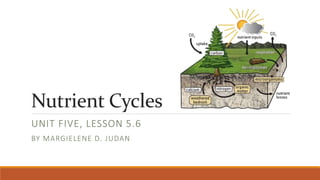
Nutrient Cycles
UNIT FIVE, LESSON 5.6
BY MARGIELENE D. JUDAN
LESSON OUTLINE
Recycling Nutrients
Carbon Cycle (Oxygen to Carbon Dioxide Cycle)
Nitrogen Cycle
Water Cycle
Nutrients are important components of
living organisms. These nutrients take
various forms:
Water (H2O), oxygen (O2), carbon
dioxide (CO2), nitrogen (N2),
phosphorus (P)
But in order for them to be used again,
they need to be recycled.
In order to be recycled, organisms must
return these nutrients to the Earth (soil).
Recycling Nutrients
1. Decomposition
2. Excretion
3. Perspiration and Evapotranspiration
4. Respiration
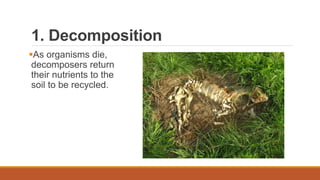
1. Decomposition
As organisms die,
decomposers return
their nutrients to the
soil to be recycled.
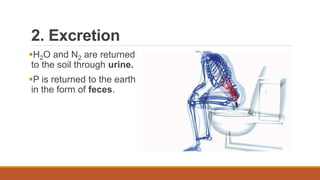
2. Excretion
H2O and N2 are returned
to the soil through urine.
P is returned to the earth
in the form of feces.
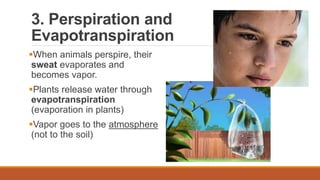
3. Perspiration and
Evapotranspiration
When animals perspire, their
sweat evaporates and
becomes vapor.
Plants release water through
evapotranspiration
(evaporation in plants)
Vapor goes to the atmosphere
(not to the soil)
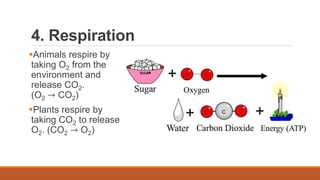
4. Respiration
Animals respire by
taking O2 from the
environment and
release CO2.
(O2 → CO2)
Plants respire by
taking CO2 to release
O2. (CO2 → O2)
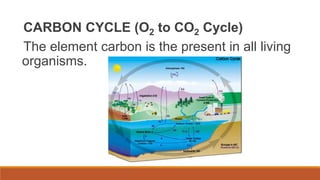
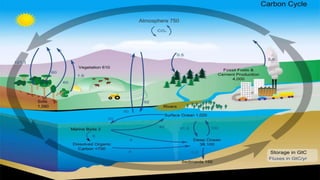
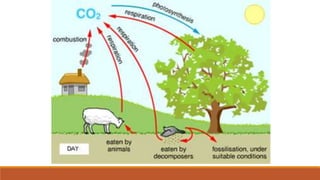
CARBON CYCLE (O2 to CO2 Cycle)
The element carbon is the present in all living
organisms.
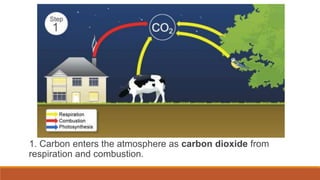
1. Carbon enters the atmosphere as carbon dioxide from
respiration and combustion.
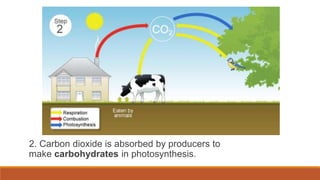
2. Carbon dioxide is absorbed by producers to
make carbohydrates in photosynthesis.
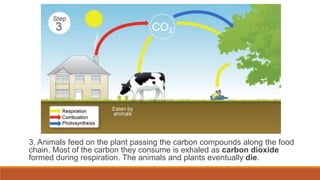
3. Animals feed on the plant passing the carbon compounds along the food
chain. Most of the carbon they consume is exhaled as carbon dioxide
formed during respiration. The animals and plants eventually die.
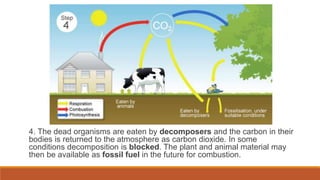
4. The dead organisms are eaten by decomposers and the carbon in their
bodies is returned to the atmosphere as carbon dioxide. In some
conditions decomposition is blocked. The plant and animal material may
then be available as fossil fuel in the future for combustion.
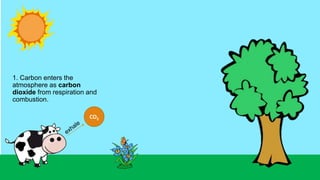
1. Carbon enters the
atmosphere as carbon
dioxide from respiration and
combustion.
CO2
CO2
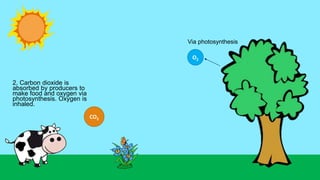
2. Carbon dioxide is
absorbed by producers to
make food and oxygen via
photosynthesis. Oxygen is
inhaled.
O2
Via photosynthesis
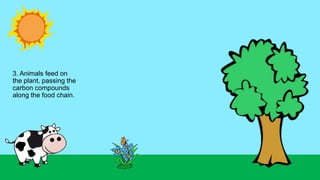
3. Animals feed on
the plant, passing the
carbon compounds
along the food chain.
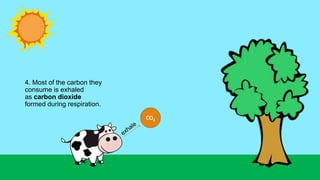
4. Most of the carbon they
consume is exhaled
as carbon dioxide
formed during respiration.
CO2
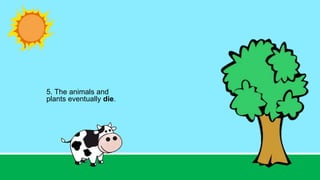
5. The animals and
plants eventually die.
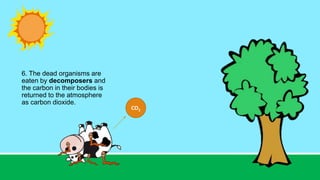
6. The dead organisms are
eaten by decomposers and
the carbon in their bodies is
returned to the atmosphere
as carbon dioxide.
CO2
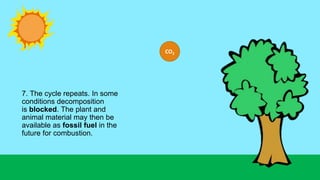
7. The cycle repeats. In some
conditions decomposition
is blocked. The plant and
animal material may then be
available as fossil fuel in the
future for combustion.
CO2
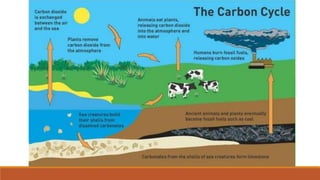
Another activity that contributes to the release
of CO2 is deforestation. When trees are cut,
the CO2 stored in them are released into the
atmosphere.
Burning of fossil fuels and deforestation
are two human activities that have increased
the carbon dioxide content of the atmosphere
in the past hundred years.
This results in rise of atmospheric
pressure.
The greater the pressure, the greater
the temperature.
Thus, a phenomenon called global
warming.
NITROGEN CYCLE
Abundant in air (78% of the volume of Earth’s
atmosphere).
Because N2 is unreactive, it cannot be used
directly by plants to make protein. Only
nitrates are useful to plants, so we are
dependent on other processes to convert
nitrogen to nitrates in the soil.
NITROGEN CYCLE
These processes are:
1. action of nitrogen-fixing bacteria
2. action lightning
NITROGEN CYCLE TERMS
Nitrogen fixation – process by which free nitrogen
(N) in air is converted to other chemical forms
usable to plants
Nitrification – process of converting ammonia to
nitrite, then nitrite to nitrate
Denitrification – process of converting nitrate to
nitrogen gas
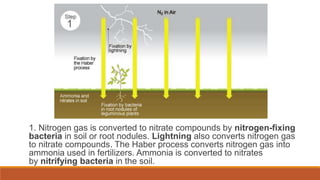
1. Nitrogen gas is converted to nitrate compounds by nitrogen-fixing
bacteria in soil or root nodules. Lightning also converts nitrogen gas
to nitrate compounds. The Haber process converts nitrogen gas into
ammonia used in fertilizers. Ammonia is converted to nitrates
by nitrifying bacteria in the soil.
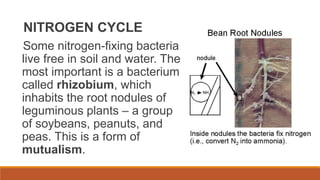
NITROGEN CYCLE
Some nitrogen-fixing bacteria
live free in soil and water. The
most important is a bacterium
called rhizobium, which
inhabits the root nodules of
leguminous plants – a group
of soybeans, peanuts, and
peas. This is a form of
mutualism.
NITROGEN CYCLE
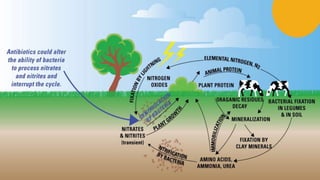
The nitrogen then becomes ammonia (NH3). But
still, NH3 is still unusable to most plants, so it still
needs to be converted.
Nitrifying bacteria do this in a process called
nitrification (process of converting ammonia to
nitrite, then nitrite to nitrate).
Nitrogen > ammonia > nitrite > nitrate
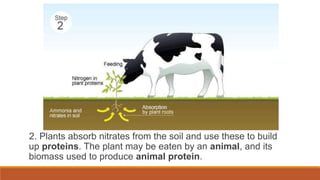
2. Plants absorb nitrates from the soil and use these to build
up proteins. The plant may be eaten by an animal, and its
biomass used to produce animal protein.
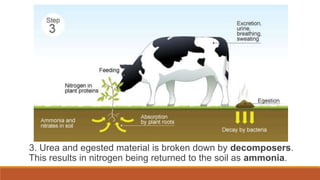
3. Urea and egested material is broken down by decomposers.
This results in nitrogen being returned to the soil as ammonia.
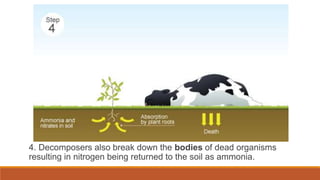
4. Decomposers also break down the bodies of dead organisms
resulting in nitrogen being returned to the soil as ammonia.
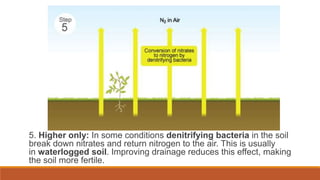
5. Higher only: In some conditions denitrifying bacteria in the soil
break down nitrates and return nitrogen to the air. This is usually
in waterlogged soil. Improving drainage reduces this effect, making
the soil more fertile.
NITROGEN CYCLE
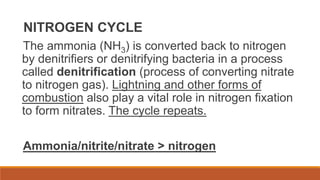
The ammonia (NH3) is converted back to nitrogen
by denitrifiers or denitrifying bacteria in a process
called denitrification (process of converting nitrate
to nitrogen gas). Lightning and other forms of
combustion also play a vital role in nitrogen fixation
to form nitrates. The cycle repeats.
Ammonia/nitrite/nitrate > nitrogen
NITROGEN CYCLE
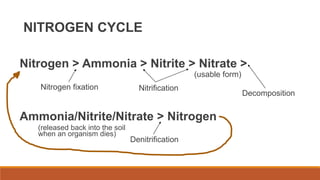
Nitrogen > Ammonia > Nitrite > Nitrate >
Ammonia/Nitrite/Nitrate > Nitrogen
Nitrogen fixation Nitrification
(usable form)
(released back into the soil
when an organism dies)
Denitrification
Decomposition
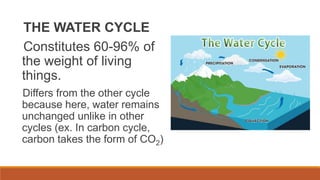
THE WATER CYCLE
Constitutes 60-96% of
the weight of living
things.
Differs from the other cycle
because here, water remains
unchanged unlike in other
cycles (ex. In carbon cycle,
carbon takes the form of CO2)
Water Cycle Steps
1. Evaporation – liquid to gas
2. Condensation – gas to liquid
3. Precipitation – water falls back to the ground either
as rain, snow, or hail
These three are the main processes of the water cycle
Water Cycle Steps
4. Surface Runoff – much of the water that return to
Earth as precipitation runs off the surface of the land,
and flows down hill into streams, rivers, ponds, and
lakes. Small streams flow into larger streams, then
into rivers, and eventually the water flows into the
ocean.
Surface runoff is an important part of the water cycle
because, through surface runoff, much of the water returns
again to the oceans, where a great deal of evaporation
occurs
Water Cycle Steps
5. Infiltration – process where rain water soaks into the
ground, through the soil and underlying rock layers,
Some of this water ultimately returns to the surface at
springs or in low spots downhill. Some of the water
remains underground and is called groundwater. As
the water infiltrates through the soil and rock layers,
many of the impurities in the water are filtered out.
This filtering process helps clean the water.
Water Cycle Steps
6. Transpiration – process where plants remove water
through its stomata in the leaves. This is the process
of evaporation in plants (also called
evapotranspiration).
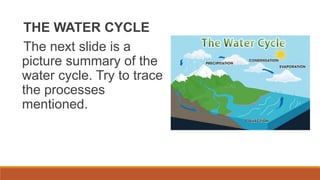
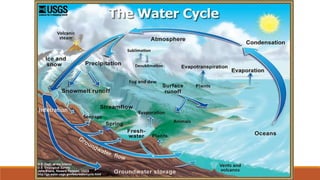
THE WATER CYCLE
The next slide is a
picture summary of the
water cycle. Try to trace
the processes
mentioned.
Quiz tomorrow (20 items = 25 pts)
Carbon Cycle, Nitrogen Cycle, and Water Cycle; pp. 165-167
Memorize especially the forms of nutrients, ways of recycling
nutrients, and the 4 main steps of the Carbon Cycle.
In the nitrogen cycle, understand esp. the different conversion
processes (nitrogen fixation, nitrification, denitrification)
Memorize esp. the 6 steps in the water cycle.
Sources:
Science Links 7
http://www.bbc.co.uk/schools/gcsebitesize/science/add_gatew
ay_pre_2011/greenworld/recyclingrev1.shtml
http://www.mbgnet.net/fresh/cycle/concepts.htm

Unit 5, Lesson 5.6- Nutrient Cycles

  • 1.
    Nutrient Cycles UNIT FIVE,LESSON 5.6 BY MARGIELENE D. JUDAN
  • 2.
    LESSON OUTLINE Recycling Nutrients CarbonCycle (Oxygen to Carbon Dioxide Cycle) Nitrogen Cycle Water Cycle
  • 3.
    Nutrients are importantcomponents of living organisms. These nutrients take various forms: Water (H2O), oxygen (O2), carbon dioxide (CO2), nitrogen (N2), phosphorus (P)
  • 4.
    But in orderfor them to be used again, they need to be recycled. In order to be recycled, organisms must return these nutrients to the Earth (soil).
  • 5.
    Recycling Nutrients 1. Decomposition 2.Excretion 3. Perspiration and Evapotranspiration 4. Respiration
  • 6.
    1. Decomposition As organismsdie, decomposers return their nutrients to the soil to be recycled.
  • 7.
    2. Excretion H2O andN2 are returned to the soil through urine. P is returned to the earth in the form of feces.
  • 8.
    3. Perspiration and Evapotranspiration Whenanimals perspire, their sweat evaporates and becomes vapor. Plants release water through evapotranspiration (evaporation in plants) Vapor goes to the atmosphere (not to the soil)
  • 9.
    4. Respiration Animals respireby taking O2 from the environment and release CO2. (O2 → CO2) Plants respire by taking CO2 to release O2. (CO2 → O2)
  • 10.
    CARBON CYCLE (O2to CO2 Cycle) The element carbon is the present in all living organisms.
  • 11.
    1. Carbon entersthe atmosphere as carbon dioxide from respiration and combustion.
  • 12.
    2. Carbon dioxideis absorbed by producers to make carbohydrates in photosynthesis.
  • 13.
    3. Animals feedon the plant passing the carbon compounds along the food chain. Most of the carbon they consume is exhaled as carbon dioxide formed during respiration. The animals and plants eventually die.
  • 14.
    4. The deadorganisms are eaten by decomposers and the carbon in their bodies is returned to the atmosphere as carbon dioxide. In some conditions decomposition is blocked. The plant and animal material may then be available as fossil fuel in the future for combustion.
  • 18.
    1. Carbon entersthe atmosphere as carbon dioxide from respiration and combustion. CO2
  • 19.
    CO2 2. Carbon dioxideis absorbed by producers to make food and oxygen via photosynthesis. Oxygen is inhaled. O2 Via photosynthesis
  • 20.
    3. Animals feedon the plant, passing the carbon compounds along the food chain.
  • 21.
    4. Most ofthe carbon they consume is exhaled as carbon dioxide formed during respiration. CO2
  • 22.
    5. The animalsand plants eventually die.
  • 23.
    6. The deadorganisms are eaten by decomposers and the carbon in their bodies is returned to the atmosphere as carbon dioxide. CO2
  • 24.
    7. The cyclerepeats. In some conditions decomposition is blocked. The plant and animal material may then be available as fossil fuel in the future for combustion. CO2
  • 25.
    Another activity thatcontributes to the release of CO2 is deforestation. When trees are cut, the CO2 stored in them are released into the atmosphere. Burning of fossil fuels and deforestation are two human activities that have increased the carbon dioxide content of the atmosphere in the past hundred years.
  • 26.
    This results inrise of atmospheric pressure. The greater the pressure, the greater the temperature. Thus, a phenomenon called global warming.
  • 27.
    NITROGEN CYCLE Abundant inair (78% of the volume of Earth’s atmosphere). Because N2 is unreactive, it cannot be used directly by plants to make protein. Only nitrates are useful to plants, so we are dependent on other processes to convert nitrogen to nitrates in the soil.
  • 28.
    NITROGEN CYCLE These processesare: 1. action of nitrogen-fixing bacteria 2. action lightning
  • 29.
    NITROGEN CYCLE TERMS Nitrogenfixation – process by which free nitrogen (N) in air is converted to other chemical forms usable to plants Nitrification – process of converting ammonia to nitrite, then nitrite to nitrate Denitrification – process of converting nitrate to nitrogen gas
  • 31.
    1. Nitrogen gasis converted to nitrate compounds by nitrogen-fixing bacteria in soil or root nodules. Lightning also converts nitrogen gas to nitrate compounds. The Haber process converts nitrogen gas into ammonia used in fertilizers. Ammonia is converted to nitrates by nitrifying bacteria in the soil.
  • 32.
    NITROGEN CYCLE Some nitrogen-fixingbacteria live free in soil and water. The most important is a bacterium called rhizobium, which inhabits the root nodules of leguminous plants – a group of soybeans, peanuts, and peas. This is a form of mutualism.
  • 33.
    NITROGEN CYCLE The nitrogenthen becomes ammonia (NH3). But still, NH3 is still unusable to most plants, so it still needs to be converted. Nitrifying bacteria do this in a process called nitrification (process of converting ammonia to nitrite, then nitrite to nitrate). Nitrogen > ammonia > nitrite > nitrate
  • 34.
    2. Plants absorbnitrates from the soil and use these to build up proteins. The plant may be eaten by an animal, and its biomass used to produce animal protein.
  • 35.
    3. Urea andegested material is broken down by decomposers. This results in nitrogen being returned to the soil as ammonia.
  • 36.
    4. Decomposers alsobreak down the bodies of dead organisms resulting in nitrogen being returned to the soil as ammonia.
  • 37.
    5. Higher only:In some conditions denitrifying bacteria in the soil break down nitrates and return nitrogen to the air. This is usually in waterlogged soil. Improving drainage reduces this effect, making the soil more fertile.
  • 38.
    NITROGEN CYCLE The ammonia(NH3) is converted back to nitrogen by denitrifiers or denitrifying bacteria in a process called denitrification (process of converting nitrate to nitrogen gas). Lightning and other forms of combustion also play a vital role in nitrogen fixation to form nitrates. The cycle repeats. Ammonia/nitrite/nitrate > nitrogen
  • 39.
    NITROGEN CYCLE Nitrogen >Ammonia > Nitrite > Nitrate > Ammonia/Nitrite/Nitrate > Nitrogen Nitrogen fixation Nitrification (usable form) (released back into the soil when an organism dies) Denitrification Decomposition
  • 40.
    THE WATER CYCLE Constitutes60-96% of the weight of living things. Differs from the other cycle because here, water remains unchanged unlike in other cycles (ex. In carbon cycle, carbon takes the form of CO2)
  • 41.
    Water Cycle Steps 1.Evaporation – liquid to gas 2. Condensation – gas to liquid 3. Precipitation – water falls back to the ground either as rain, snow, or hail These three are the main processes of the water cycle
  • 42.
    Water Cycle Steps 4.Surface Runoff – much of the water that return to Earth as precipitation runs off the surface of the land, and flows down hill into streams, rivers, ponds, and lakes. Small streams flow into larger streams, then into rivers, and eventually the water flows into the ocean. Surface runoff is an important part of the water cycle because, through surface runoff, much of the water returns again to the oceans, where a great deal of evaporation occurs
  • 43.
    Water Cycle Steps 5.Infiltration – process where rain water soaks into the ground, through the soil and underlying rock layers, Some of this water ultimately returns to the surface at springs or in low spots downhill. Some of the water remains underground and is called groundwater. As the water infiltrates through the soil and rock layers, many of the impurities in the water are filtered out. This filtering process helps clean the water.
  • 44.
    Water Cycle Steps 6.Transpiration – process where plants remove water through its stomata in the leaves. This is the process of evaporation in plants (also called evapotranspiration).
  • 45.
    THE WATER CYCLE Thenext slide is a picture summary of the water cycle. Try to trace the processes mentioned.
  • 47.
    Quiz tomorrow (20items = 25 pts) Carbon Cycle, Nitrogen Cycle, and Water Cycle; pp. 165-167 Memorize especially the forms of nutrients, ways of recycling nutrients, and the 4 main steps of the Carbon Cycle. In the nitrogen cycle, understand esp. the different conversion processes (nitrogen fixation, nitrification, denitrification) Memorize esp. the 6 steps in the water cycle.
  • 48.