Ianalumab plus
Eltrombopag in Immune
Thrombocytopenia
MODERATOR : DR DEEPJYOTI SAIKIA SIR
ASSISTANT PROFESSOR
DEPT OF GENERAL MEDICINE
PRESENTED BY : DR BIKARNA CHOWDHURY
(PGT 1ST YEAR)
Background – Immune
Thrombocytopenia
Immune thrombocytopenic purpura (ITP) is an acquired
autoimmune disorder characterized by:
• Isolated thrombocytopenia (platelet count <100,000/µL)
• Normal bone marrow (or increased megakaryocytes)
• Absence of other causes of thrombocytopenia
It results from immune-mediated platelet destruction and
impaired platelet production.
Epidemiology and Burden
o Rare but chronic disease
o Incidence: 2–5 per 100,000/year
o Children: Often acute, post-viral, self-limiting
o Adults: Chronic, relapsing course
o Slight female predominance in adults
o High relapse rates with Long-term treatment
burden
Current Treatment Goals
◦ Prevent bleeding
◦ Maintain safe platelet count
◦ Minimize adverse effects
◦ Improve quality of life
First-Line Therapy
• Prednisone: 1 mg/kg/day for 2–4 weeks, then taper
OR
• Dexamethasone: 40 mg/day × 4 days (pulse therapy)
1. Corticosteroids (Mainstay)
• Dose: 1-2 g/kg total given over 1–5 days
• Rapid rise in platelets (24–48 h)
2. Intravenous Immunoglobulin (IVIG)
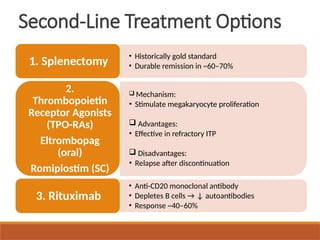
Second-Line Treatment Options
• Historically gold standard
• Durable remission in ~60–70%
1. Splenectomy
 Mechanism:
• Stimulate megakaryocyte proliferation
 Advantages:
• Effective in refractory ITP
 Disadvantages:
• Relapse after discontinuation
2.
Thrombopoietin
Receptor Agonists
(TPO-RAs)
Eltrombopag
(oral)
Romiplostim (SC)
• Anti-CD20 monoclonal antibody
• Depletes B cells → ↓ autoantibodies
• Response ~40–60%
3. Rituximab
Unmet Needs in ITP
◦ Durable remission lacking
◦ Treatment dependency common
◦ Cumulative toxicity
◦ Need for disease-modifying therapy
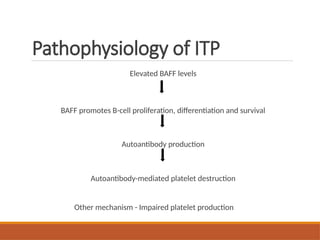
Pathophysiology of ITP
Elevated BAFF levels
BAFF promotes B-cell proliferation, differentiation and survival
Autoantibody production
Autoantibody-mediated platelet destruction
Other mechanism - Impaired platelet production
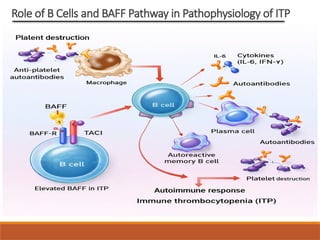
Role of B Cells and BAFF Pathway in Pathophysiology of ITP
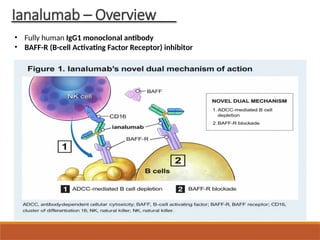
Ianalumab – Overview
• Fully human IgG1 monoclonal antibody
• BAFF-R (B-cell Activating Factor Receptor) inhibitor
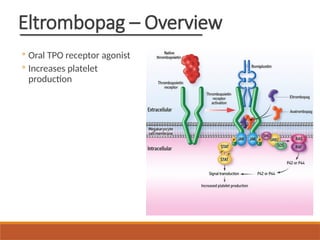
Eltrombopag – Overview
◦ Oral TPO receptor agonist
◦ Increases platelet
production
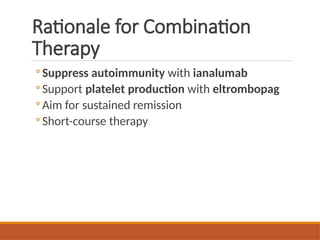
Rationale for Combination
Therapy
◦ Suppress autoimmunity with ianalumab
◦ Support platelet production with eltrombopag
◦ Aim for sustained remission
◦ Short-course therapy
Study Objectives
◦ Evaluate efficacy of ianalumab
◦ Assess safety profile
◦ Compare two doses
◦ Measure sustained response
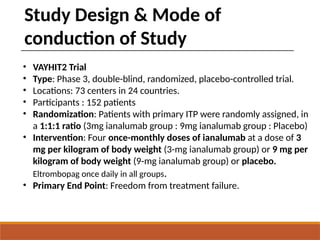
Study Design & Mode of
conduction of Study
• VAYHIT2 Trial
• Type: Phase 3, double-blind, randomized, placebo-controlled trial.
• Locations: 73 centers in 24 countries.
• Participants : 152 patients
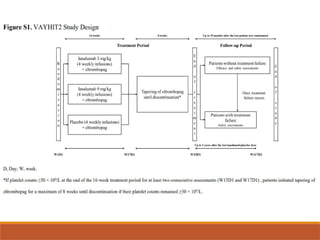
• Randomization: Patients with primary ITP were randomly assigned, in
a 1:1:1 ratio (3mg ianalumab group : 9mg ianalumab group : Placebo)
• Intervention: Four once-monthly doses of ianalumab at a dose of 3
mg per kilogram of body weight (3-mg ianalumab group) or 9 mg per
kilogram of body weight (9-mg ianalumab group) or placebo.
Eltrombopag once daily in all groups.
• Primary End Point: Freedom from treatment failure.
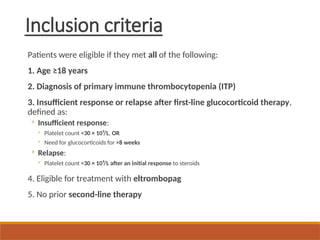
Inclusion criteria
Patients were eligible if they met all of the following:
1. Age ≥18 years
2. Diagnosis of primary immune thrombocytopenia (ITP)
3. Insufficient response or relapse after first-line glucocorticoid therapy,
defined as:
◦ Insufficient response:
◦ Platelet count <30 × 10⁹/L, OR
◦ Need for glucocorticoids for >8 weeks
◦ Relapse:
◦ Platelet count <30 × 10⁹/L after an initial response to steroids
4. Eligible for treatment with eltrombopag
5. No prior second-line therapy
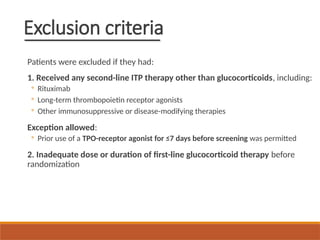
Exclusion criteria
Patients were excluded if they had:
1. Received any second-line ITP therapy other than glucocorticoids, including:
◦ Rituximab
◦ Long-term thrombopoietin receptor agonists
◦ Other immunosuppressive or disease-modifying therapies
Exception allowed:
◦ Prior use of a TPO-receptor agonist for ≤7 days before screening was permitted
2. Inadequate dose or duration of first-line glucocorticoid therapy before
randomization
Primary End Point
 Freedom from treatment failure determined in a time-to-
event analysis with treatment failure defined by -
◦ Platelet count <30,000/microlitre more than 8 weeks after
randomization
◦ initiation of rescue therapy more than 8 weeks after
randomization
◦ inititiation of new ITP therapy
◦ inability to taper or discontinue Eltrombopag because of
inadequate platelet count
◦ death from any cause
 Follow-up up to 12 months
Key Secondary End Point
 Stable response at 6 months defined by Platelets count
≥50,000/µL at ≥75% measurements from the weeks 19
through 25 without the use of rescue therapy.
Other Secondary End Points
A response (platelet count of ≥50,000/microliter without
use of rescue treatment or new ITP therapy).
A complete response (platelet count of
≥1,00,000/microliter without use of rescue treatment or
new ITP therapy).
Successful tapering or discontinuation of Eltrombopag.
Bleeding events as assessed by WHO bleeding .
The degree and duration of B cell depletion.
Statistical Analysis
◦ Kaplan–Meier analysis
◦ Log-rank test
◦ Cox proportional hazards model
◦ Multiplicity adjustment
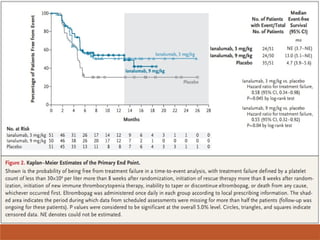
Primary Outcome – Results
Both Ianalumab doses led to a significantly longer
time to treatment failure than placebo
◦ HR for treatment failure (Ianalumab vs placebo) -
0.55 (9 mg/kg group)
◦ HR for treatment failure (Ianalumab vs placebo) -
0.58 (3 mg/kg group)
◦ P < 0.05
Kaplan–Meier Analysis
◦ Higher event-free survival
◦ Sustained benefit at 12 months
◦ Both doses superior to placebo
◦ Clinically meaningful effect
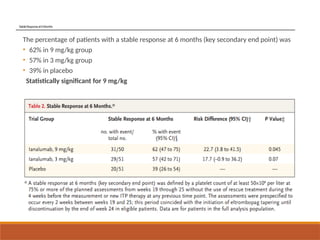
StableResponseat6Months
The percentage of patients with a stable response at 6 months (key secondary end point) was
• 62% in 9 mg/kg group
• 57% in 3 mg/kg group
• 39% in placebo
Statistically significant for 9 mg/kg
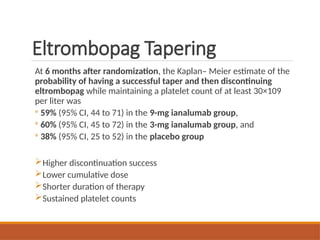
Eltrombopag Tapering
At 6 months after randomization, the Kaplan– Meier estimate of the
probability of having a successful taper and then discontinuing
eltrombopag while maintaining a platelet count of at least 30×109
per liter was
◦ 59% (95% CI, 44 to 71) in the 9-mg ianalumab group,
◦ 60% (95% CI, 45 to 72) in the 3-mg ianalumab group, and
◦ 38% (95% CI, 25 to 52) in the placebo group
Higher discontinuation success
Lower cumulative dose
Shorter duration of therapy
Sustained platelet counts
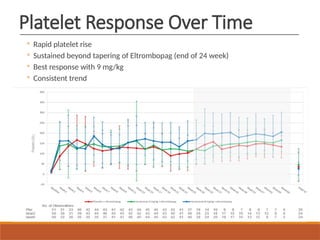
Platelet Response Over Time
◦ Rapid platelet rise
◦ Sustained beyond tapering of Eltrombopag (end of 24 week)
◦ Best response with 9 mg/kg
◦ Consistent trend
Bleeding Outcomes
◦ Reduced bleeding events
◦ Lower WHO bleeding scores
◦ Clinically relevant benefit
◦ Improved safety
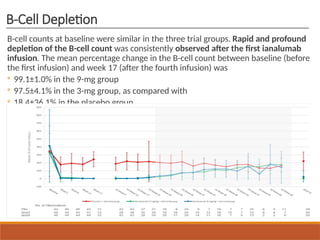
B-Cell Depletion
B-cell counts at baseline were similar in the three trial groups. Rapid and profound
depletion of the B-cell count was consistently observed after the first ianalumab
infusion. The mean percentage change in the B-cell count between baseline (before
the first infusion) and week 17 (after the fourth infusion) was
◦ 99.1±1.0% in the 9-mg group
◦ 97.5±4.1% in the 3-mg group, as compared with
◦ 18.4±36.1% in the placebo group
Quality of Life – Fatigue
◦ PROMIS fatigue improved
◦ ITP-PAQ scores increased
◦ Early and sustained benefit
◦ Patient-centered outcome
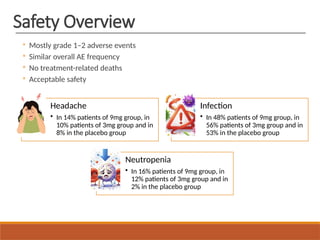
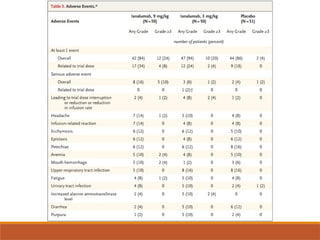
Safety Overview
◦ Mostly grade 1–2 adverse events
◦ Similar overall AE frequency
◦ No treatment-related deaths
◦ Acceptable safety
Headache
• In 14% patients of 9mg group, in
10% patients of 3mg group and in
8% in the placebo group
Infection
• In 48% patients of 9mg group, in
56% patients of 3mg group and in
53% in the placebo group
Neutropenia
• In 16% patients of 9mg group, in
12% patients of 3mg group and in
2% in the placebo group
Clinical Implications
◦ Potential disease-modifying therapy
◦ Reduced treatment burden
◦ Earlier intervention benefit
◦ Practice-changing potential
Limitations
◦ Early-stage ITP only
◦ Limited long-term follow-up
◦ Generalizability uncertain
◦ Ongoing trials awaited
Conclusions
 Ianalumab + eltrombopag is superior than
Plecebo + eltrombopag
 Delays treatment failure
 Enables Eltrombopag discontinuation
 Acceptable safety profile
Take-Home Messages
 Short-course therapy effective
 Targets underlying autoimmunity
 May redefine second-line ITP care
 Promising future option
THANK YOU

Ianalumab_ITP_Journal_Presentation_FULL.pptx

  • 1.
    Ianalumab plus Eltrombopag inImmune Thrombocytopenia MODERATOR : DR DEEPJYOTI SAIKIA SIR ASSISTANT PROFESSOR DEPT OF GENERAL MEDICINE PRESENTED BY : DR BIKARNA CHOWDHURY (PGT 1ST YEAR)
  • 2.
    Background – Immune Thrombocytopenia Immunethrombocytopenic purpura (ITP) is an acquired autoimmune disorder characterized by: • Isolated thrombocytopenia (platelet count <100,000/µL) • Normal bone marrow (or increased megakaryocytes) • Absence of other causes of thrombocytopenia It results from immune-mediated platelet destruction and impaired platelet production.
  • 3.
    Epidemiology and Burden oRare but chronic disease o Incidence: 2–5 per 100,000/year o Children: Often acute, post-viral, self-limiting o Adults: Chronic, relapsing course o Slight female predominance in adults o High relapse rates with Long-term treatment burden
  • 4.
    Current Treatment Goals ◦Prevent bleeding ◦ Maintain safe platelet count ◦ Minimize adverse effects ◦ Improve quality of life
  • 5.
    First-Line Therapy • Prednisone:1 mg/kg/day for 2–4 weeks, then taper OR • Dexamethasone: 40 mg/day × 4 days (pulse therapy) 1. Corticosteroids (Mainstay) • Dose: 1-2 g/kg total given over 1–5 days • Rapid rise in platelets (24–48 h) 2. Intravenous Immunoglobulin (IVIG)
  • 6.
    Second-Line Treatment Options •Historically gold standard • Durable remission in ~60–70% 1. Splenectomy  Mechanism: • Stimulate megakaryocyte proliferation  Advantages: • Effective in refractory ITP  Disadvantages: • Relapse after discontinuation 2. Thrombopoietin Receptor Agonists (TPO-RAs) Eltrombopag (oral) Romiplostim (SC) • Anti-CD20 monoclonal antibody • Depletes B cells → ↓ autoantibodies • Response ~40–60% 3. Rituximab
  • 7.
    Unmet Needs inITP ◦ Durable remission lacking ◦ Treatment dependency common ◦ Cumulative toxicity ◦ Need for disease-modifying therapy
  • 8.
    Pathophysiology of ITP ElevatedBAFF levels BAFF promotes B-cell proliferation, differentiation and survival Autoantibody production Autoantibody-mediated platelet destruction Other mechanism - Impaired platelet production
  • 9.
    Role of BCells and BAFF Pathway in Pathophysiology of ITP
  • 10.
    Ianalumab – Overview •Fully human IgG1 monoclonal antibody • BAFF-R (B-cell Activating Factor Receptor) inhibitor
  • 11.
    Eltrombopag – Overview ◦Oral TPO receptor agonist ◦ Increases platelet production
  • 12.
    Rationale for Combination Therapy ◦Suppress autoimmunity with ianalumab ◦ Support platelet production with eltrombopag ◦ Aim for sustained remission ◦ Short-course therapy
  • 13.
    Study Objectives ◦ Evaluateefficacy of ianalumab ◦ Assess safety profile ◦ Compare two doses ◦ Measure sustained response
  • 14.
    Study Design &Mode of conduction of Study • VAYHIT2 Trial • Type: Phase 3, double-blind, randomized, placebo-controlled trial. • Locations: 73 centers in 24 countries. • Participants : 152 patients • Randomization: Patients with primary ITP were randomly assigned, in a 1:1:1 ratio (3mg ianalumab group : 9mg ianalumab group : Placebo) • Intervention: Four once-monthly doses of ianalumab at a dose of 3 mg per kilogram of body weight (3-mg ianalumab group) or 9 mg per kilogram of body weight (9-mg ianalumab group) or placebo. Eltrombopag once daily in all groups. • Primary End Point: Freedom from treatment failure.
  • 16.
    Inclusion criteria Patients wereeligible if they met all of the following: 1. Age ≥18 years 2. Diagnosis of primary immune thrombocytopenia (ITP) 3. Insufficient response or relapse after first-line glucocorticoid therapy, defined as: ◦ Insufficient response: ◦ Platelet count <30 × 10⁹/L, OR ◦ Need for glucocorticoids for >8 weeks ◦ Relapse: ◦ Platelet count <30 × 10⁹/L after an initial response to steroids 4. Eligible for treatment with eltrombopag 5. No prior second-line therapy
  • 17.
    Exclusion criteria Patients wereexcluded if they had: 1. Received any second-line ITP therapy other than glucocorticoids, including: ◦ Rituximab ◦ Long-term thrombopoietin receptor agonists ◦ Other immunosuppressive or disease-modifying therapies Exception allowed: ◦ Prior use of a TPO-receptor agonist for ≤7 days before screening was permitted 2. Inadequate dose or duration of first-line glucocorticoid therapy before randomization
  • 18.
    Primary End Point Freedom from treatment failure determined in a time-to- event analysis with treatment failure defined by - ◦ Platelet count <30,000/microlitre more than 8 weeks after randomization ◦ initiation of rescue therapy more than 8 weeks after randomization ◦ inititiation of new ITP therapy ◦ inability to taper or discontinue Eltrombopag because of inadequate platelet count ◦ death from any cause  Follow-up up to 12 months
  • 19.
    Key Secondary EndPoint  Stable response at 6 months defined by Platelets count ≥50,000/µL at ≥75% measurements from the weeks 19 through 25 without the use of rescue therapy. Other Secondary End Points A response (platelet count of ≥50,000/microliter without use of rescue treatment or new ITP therapy). A complete response (platelet count of ≥1,00,000/microliter without use of rescue treatment or new ITP therapy). Successful tapering or discontinuation of Eltrombopag. Bleeding events as assessed by WHO bleeding . The degree and duration of B cell depletion.
  • 20.
    Statistical Analysis ◦ Kaplan–Meieranalysis ◦ Log-rank test ◦ Cox proportional hazards model ◦ Multiplicity adjustment
  • 21.
    Primary Outcome –Results Both Ianalumab doses led to a significantly longer time to treatment failure than placebo ◦ HR for treatment failure (Ianalumab vs placebo) - 0.55 (9 mg/kg group) ◦ HR for treatment failure (Ianalumab vs placebo) - 0.58 (3 mg/kg group) ◦ P < 0.05
  • 22.
    Kaplan–Meier Analysis ◦ Higherevent-free survival ◦ Sustained benefit at 12 months ◦ Both doses superior to placebo ◦ Clinically meaningful effect
  • 24.
    StableResponseat6Months The percentage ofpatients with a stable response at 6 months (key secondary end point) was • 62% in 9 mg/kg group • 57% in 3 mg/kg group • 39% in placebo Statistically significant for 9 mg/kg
  • 25.
    Eltrombopag Tapering At 6months after randomization, the Kaplan– Meier estimate of the probability of having a successful taper and then discontinuing eltrombopag while maintaining a platelet count of at least 30×109 per liter was ◦ 59% (95% CI, 44 to 71) in the 9-mg ianalumab group, ◦ 60% (95% CI, 45 to 72) in the 3-mg ianalumab group, and ◦ 38% (95% CI, 25 to 52) in the placebo group Higher discontinuation success Lower cumulative dose Shorter duration of therapy Sustained platelet counts
  • 26.
    Platelet Response OverTime ◦ Rapid platelet rise ◦ Sustained beyond tapering of Eltrombopag (end of 24 week) ◦ Best response with 9 mg/kg ◦ Consistent trend
  • 27.
    Bleeding Outcomes ◦ Reducedbleeding events ◦ Lower WHO bleeding scores ◦ Clinically relevant benefit ◦ Improved safety
  • 28.
    B-Cell Depletion B-cell countsat baseline were similar in the three trial groups. Rapid and profound depletion of the B-cell count was consistently observed after the first ianalumab infusion. The mean percentage change in the B-cell count between baseline (before the first infusion) and week 17 (after the fourth infusion) was ◦ 99.1±1.0% in the 9-mg group ◦ 97.5±4.1% in the 3-mg group, as compared with ◦ 18.4±36.1% in the placebo group
  • 29.
    Quality of Life– Fatigue ◦ PROMIS fatigue improved ◦ ITP-PAQ scores increased ◦ Early and sustained benefit ◦ Patient-centered outcome
  • 30.
    Safety Overview ◦ Mostlygrade 1–2 adverse events ◦ Similar overall AE frequency ◦ No treatment-related deaths ◦ Acceptable safety Headache • In 14% patients of 9mg group, in 10% patients of 3mg group and in 8% in the placebo group Infection • In 48% patients of 9mg group, in 56% patients of 3mg group and in 53% in the placebo group Neutropenia • In 16% patients of 9mg group, in 12% patients of 3mg group and in 2% in the placebo group
  • 32.
    Clinical Implications ◦ Potentialdisease-modifying therapy ◦ Reduced treatment burden ◦ Earlier intervention benefit ◦ Practice-changing potential
  • 33.
    Limitations ◦ Early-stage ITPonly ◦ Limited long-term follow-up ◦ Generalizability uncertain ◦ Ongoing trials awaited
  • 34.
    Conclusions  Ianalumab +eltrombopag is superior than Plecebo + eltrombopag  Delays treatment failure  Enables Eltrombopag discontinuation  Acceptable safety profile
  • 35.
    Take-Home Messages  Short-coursetherapy effective  Targets underlying autoimmunity  May redefine second-line ITP care  Promising future option
  • 36.