1	
  
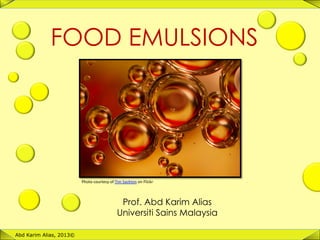
FOOD EMULSIONS
Abd Karim Alias, 2013©
Prof. Abd Karim Alias
Universiti Sains Malaysia
Photo	
  courtesy	
  of	
  Tim	
  Sackton	
  on	
  Flickr	
  	
  
2	
  
} An emulsion consists of two
immiscible liquids (oil & water),
with one of the liquids dispersed
as small spherical droplets in the
other.
} In foods, the diameter of these
droplets usually falls somewhere
in the range 0.1 – 100 µm.
Food Emulsion
Abd Karim Alias, 2013©
3	
  
} Two types of simple emulsion:
} Water-in-oil (w/o): margarine,
butter, spreads
} Oil-in-water (o/w): mayonnaise,
salad dressings, milk, beverages,
cream, soups, sauces
} The dispersed and/or continuous
phase of many food emulsions may
be partly crystalline, rather than
being completely liquid.
Food Emulsion
Abd Karim Alias, 2013©
4	
  
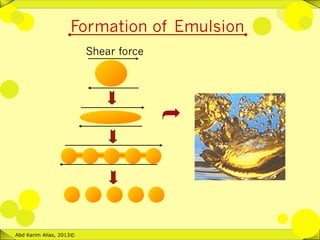
} Emulsion formation requires the
dispersion of one phase into small
droplets ⇒ this results in a massive
increase in interfacial area between the
dispersed & continuous phase.
} Homogenization is the process by which
the dispersed phase is broken into small
droplets; high pressure homogenizers (10
– 100 MPa) are now very common.
Formation of Emulsion
Abd Karim Alias, 2013©
5	
  
Formation of Emulsion
Abd Karim Alias, 2013©
6	
  
Formation of Emulsion
Ì
Shear force
Abd Karim Alias, 2013©
7	
  
Importance of Large Interfacial Area
For a fixed composition:
•  Decrease size, increase number of
particles
•  Increase area of interfacial contact
Increase area
Abd Karim Alias, 2013©
8	
  
Formation of Emulsion
Abd Karim Alias, 2013©

Food emulsion

  • 1.
    1   FOOD EMULSIONS AbdKarim Alias, 2013© Prof. Abd Karim Alias Universiti Sains Malaysia Photo  courtesy  of  Tim  Sackton  on  Flickr    
  • 2.
    2   } An emulsionconsists of two immiscible liquids (oil & water), with one of the liquids dispersed as small spherical droplets in the other. } In foods, the diameter of these droplets usually falls somewhere in the range 0.1 – 100 µm. Food Emulsion Abd Karim Alias, 2013©
  • 3.
    3   } Two typesof simple emulsion: } Water-in-oil (w/o): margarine, butter, spreads } Oil-in-water (o/w): mayonnaise, salad dressings, milk, beverages, cream, soups, sauces } The dispersed and/or continuous phase of many food emulsions may be partly crystalline, rather than being completely liquid. Food Emulsion Abd Karim Alias, 2013©
  • 4.
    4   } Emulsion formationrequires the dispersion of one phase into small droplets ⇒ this results in a massive increase in interfacial area between the dispersed & continuous phase. } Homogenization is the process by which the dispersed phase is broken into small droplets; high pressure homogenizers (10 – 100 MPa) are now very common. Formation of Emulsion Abd Karim Alias, 2013©
  • 5.
    5   Formation ofEmulsion Abd Karim Alias, 2013©
  • 6.
    6   Formation ofEmulsion Ì Shear force Abd Karim Alias, 2013©
  • 7.
    7   Importance ofLarge Interfacial Area For a fixed composition: •  Decrease size, increase number of particles •  Increase area of interfacial contact Increase area Abd Karim Alias, 2013©
  • 8.
    8   Formation ofEmulsion Abd Karim Alias, 2013©