Many things we use are
mixtures. We make mixtures.
We break down mixtures to get
component that we need.
Mixtures are made up of two or
more substances that are not
chemically combined with each
other.
Mixtures are prepared in many
different ways. Proof of this is
the varying degrees of
sweetness of sugar solutions.
Evaporated milk tastes different
from condensed milk.
Cosmetics come in different
colors. There are different
flavors of ice cream.
Different alcoholic drinks have different
biting tastes. There are all sorts of
soaps, shampoos, lotions and
toothpastes available in the market.
These products are prepared in many
different ways.
There are many kinds of mixtures.
Some are naturally occurring mixtures
while others are human-mixed.
https://docs.google.com/forms
/d/e/1FAIpQLSeftnd1ZjPiQ1eEh
1J7MShSkjmwgw5Q8vRBP6Zaht
C42YDdaw/viewform?usp=sf_li
nk
If you got all the answers correct,
congratulations! It shows that you have a wide
range of knowledge when it comes to our topic
on uniform mixtures. You may still review this
topic and learn new things ahead.
If you didn’t get a high score, no worries. This
module will help you learn more the concept
that you may eventually use in your daily life.
Study carefully this topic and you will be able
to answer all the questions in the activities that
lie ahead.
ARE YOU READY?
You may now study Module 1 in uniform mixtures.
How do you define a mixture? A mixture is
two or more materials combined in any
proportion and held together by physical
forces instead of chemical forces. There are
an infinite number of mixtures around you.
Air is a mixture. It is made up of different
gases that vary in amount at different times
of the day. When you prepare coffee powder,
sugar and hot water. The amount of each
component that you put into the mixture
varies according to how you want your coffee
to taste.
1. Homogeneous or uniform mixtures
2. Heterogeneous or non-uniform mixtures
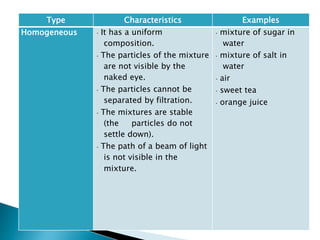
Type Characteristics Examples
Homogeneous · It has a uniform
composition.
· The particles of the mixture
are not visible by the
naked eye.
· The particles cannot be
separated by filtration.
· The mixtures are stable
(the particles do not
settle down).
· The path of a beam of light
is not visible in the
mixture.
· mixture of sugar in
water
· mixture of salt in
water
· air
· sweet tea
· orange juice
In homogeneous or uniform
mixtures, the added component is
called the solute, and the main
ingredient is called the solvent. A
solution is made up of only one phase.
The solid particles in a solution do not
settle to the bottom and are not
retained on a filter. When a beam of
light is focused onto a solution, the
path of the light is not visible.
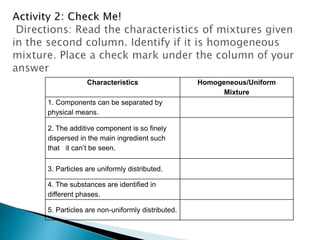
Characteristics Homogeneous/Uniform
Mixture
1. Components can be separated by
physical means.
2. The additive component is so finely
dispersed in the main ingredient such
that it can’t be seen.
3. Particles are uniformly distributed.
4. The substances are identified in
different phases.
5. Particles are non-uniformly distributed.
Do you know how to prepare orange juice?
You can make orange juice by adding
purified cold water, sugar and powdered juice.
The ratio of the amount of sugar and powdered
juice may vary depending on your taste.
Orange juice is a mixture.
Do you know that there are
kinds of mixtures?
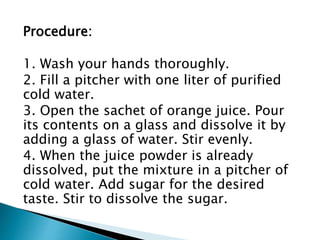
Procedure:
1. Wash your hands thoroughly.
2. Fill a pitcher with one liter of purified
cold water.
3. Open the sachet of orange juice. Pour
its contents on a glass and dissolve it by
adding a glass of water. Stir evenly.
4. When the juice powder is already
dissolved, put the mixture in a pitcher of
cold water. Add sugar for the desired
taste. Stir to dissolve the sugar.
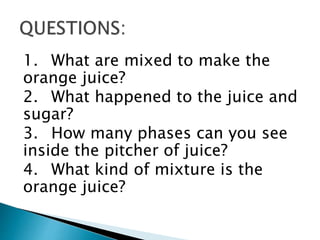
1. What are mixed to make the
orange juice?
2. What happened to the juice and
sugar?
3. How many phases can you see
inside the pitcher of juice?
4. What kind of mixture is the
orange juice?
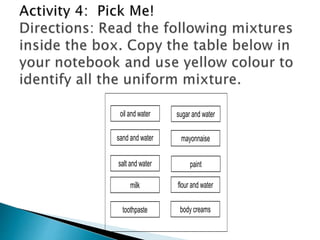
oil and water
sand and water
salt and water
milk
mayonnaise
paint
flour and water
sugar and water
toothpaste body creams
https://docs.google.com/for
ms/d/e/1FAIpQLSfMhAiPDEd
8JEkY5hR3BbB0QY6-
wsoGLQxo5BZ5T4DZCCgMK
Q/viewform?usp=sf_link
https://docs.google.com/for
ms/d/e/1FAIpQLScU_2I5MbS
3dRqDsGslmpI8VRmCcHuLjc
9vtBADNu9cf7BtCw/viewfor
m?usp=sf_link
Cut 10 pictures of an
example of
homogenous mixture
and paste it in a short
bond paper.
The learners, in their notebook, journal, or
portfolio will write their personal insights
about the lesson using the prompts below.
I understand that ___________.
I realize that ______________.

Mixtures and their characteristics

  • 2.
    Many things weuse are mixtures. We make mixtures. We break down mixtures to get component that we need. Mixtures are made up of two or more substances that are not chemically combined with each other.
  • 3.
    Mixtures are preparedin many different ways. Proof of this is the varying degrees of sweetness of sugar solutions. Evaporated milk tastes different from condensed milk. Cosmetics come in different colors. There are different flavors of ice cream.
  • 4.
    Different alcoholic drinkshave different biting tastes. There are all sorts of soaps, shampoos, lotions and toothpastes available in the market. These products are prepared in many different ways. There are many kinds of mixtures. Some are naturally occurring mixtures while others are human-mixed.
  • 5.
  • 6.
    If you gotall the answers correct, congratulations! It shows that you have a wide range of knowledge when it comes to our topic on uniform mixtures. You may still review this topic and learn new things ahead. If you didn’t get a high score, no worries. This module will help you learn more the concept that you may eventually use in your daily life. Study carefully this topic and you will be able to answer all the questions in the activities that lie ahead.
  • 7.
    ARE YOU READY? Youmay now study Module 1 in uniform mixtures.
  • 8.
    How do youdefine a mixture? A mixture is two or more materials combined in any proportion and held together by physical forces instead of chemical forces. There are an infinite number of mixtures around you. Air is a mixture. It is made up of different gases that vary in amount at different times of the day. When you prepare coffee powder, sugar and hot water. The amount of each component that you put into the mixture varies according to how you want your coffee to taste.
  • 9.
    1. Homogeneous oruniform mixtures 2. Heterogeneous or non-uniform mixtures
  • 12.
    Type Characteristics Examples Homogeneous· It has a uniform composition. · The particles of the mixture are not visible by the naked eye. · The particles cannot be separated by filtration. · The mixtures are stable (the particles do not settle down). · The path of a beam of light is not visible in the mixture. · mixture of sugar in water · mixture of salt in water · air · sweet tea · orange juice
  • 13.
    In homogeneous oruniform mixtures, the added component is called the solute, and the main ingredient is called the solvent. A solution is made up of only one phase. The solid particles in a solution do not settle to the bottom and are not retained on a filter. When a beam of light is focused onto a solution, the path of the light is not visible.
  • 15.
    Characteristics Homogeneous/Uniform Mixture 1. Componentscan be separated by physical means. 2. The additive component is so finely dispersed in the main ingredient such that it can’t be seen. 3. Particles are uniformly distributed. 4. The substances are identified in different phases. 5. Particles are non-uniformly distributed.
  • 16.
    Do you knowhow to prepare orange juice? You can make orange juice by adding purified cold water, sugar and powdered juice. The ratio of the amount of sugar and powdered juice may vary depending on your taste. Orange juice is a mixture. Do you know that there are kinds of mixtures?
  • 18.
    Procedure: 1. Wash yourhands thoroughly. 2. Fill a pitcher with one liter of purified cold water. 3. Open the sachet of orange juice. Pour its contents on a glass and dissolve it by adding a glass of water. Stir evenly. 4. When the juice powder is already dissolved, put the mixture in a pitcher of cold water. Add sugar for the desired taste. Stir to dissolve the sugar.
  • 19.
    1. What aremixed to make the orange juice? 2. What happened to the juice and sugar? 3. How many phases can you see inside the pitcher of juice? 4. What kind of mixture is the orange juice?
  • 20.
    oil and water sandand water salt and water milk mayonnaise paint flour and water sugar and water toothpaste body creams
  • 22.
  • 23.
  • 24.
    Cut 10 picturesof an example of homogenous mixture and paste it in a short bond paper.
  • 27.
    The learners, intheir notebook, journal, or portfolio will write their personal insights about the lesson using the prompts below. I understand that ___________. I realize that ______________.