Heterogeneous
and Homogeneous
MIXTURES
Dr. RENUKA RAJASEKARAN
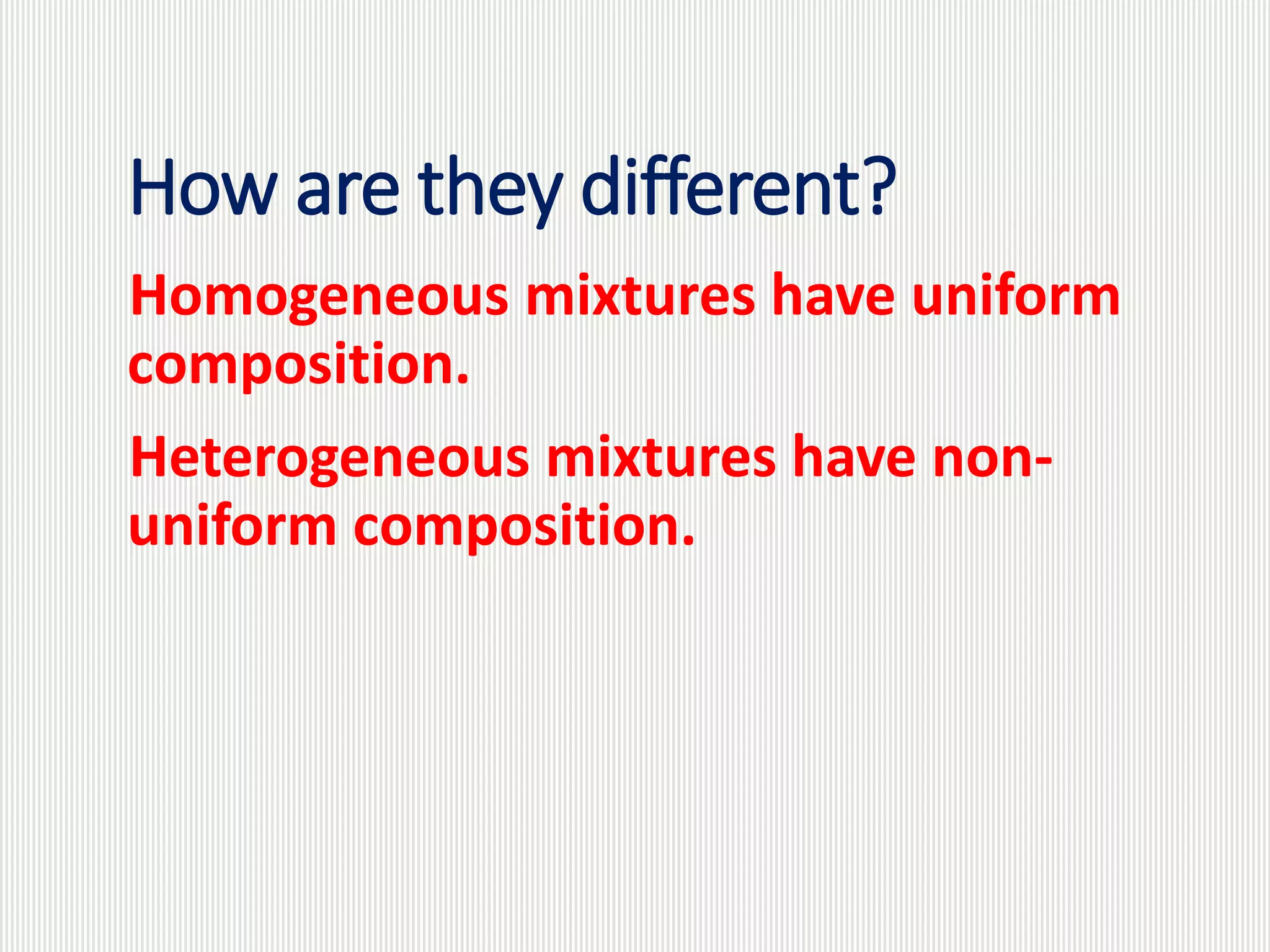
How are they different?
Homogeneous mixtures have uniform
composition.
Heterogeneous mixtures have non-
uniform composition.
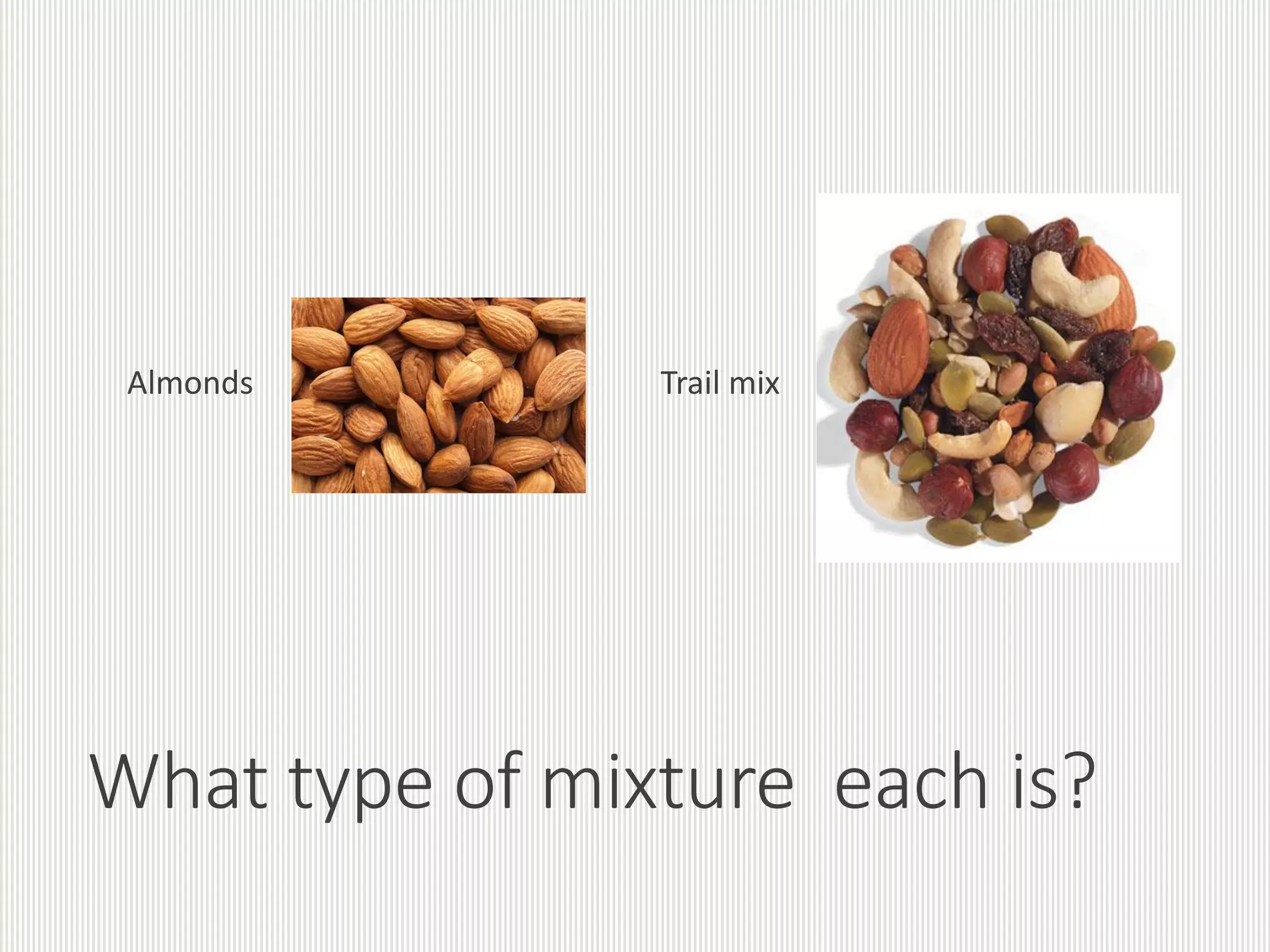
What type of mixture each is?
Almonds Trail mix
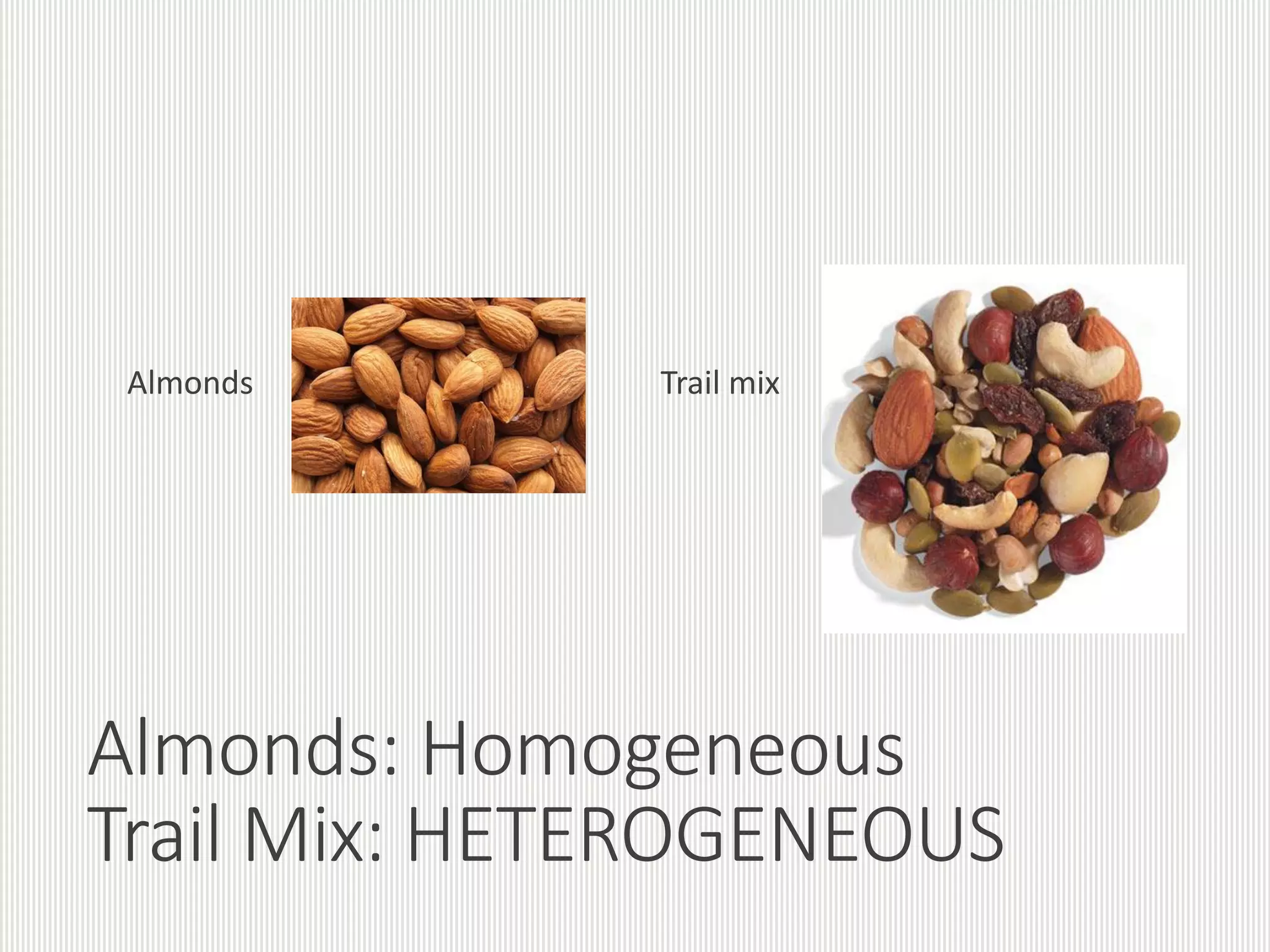
Almonds: Homogeneous
Trail Mix: HETEROGENEOUS
Almonds Trail mix
Techniques to Separate
Heterogeneous Solid Mixtures
SEPARATION TECHNIQUE
1. Hand Picking
2. Sieving
3. Gravity Separation
4. Magnetic Separation
5. Winnowing
6. Froth Flotation
PRINCIPLE
1. Conspicuous differences between different
components
2. Particle size different between
components
3. Specific Gravity difference between
components
4. One or more of the components is
magnetic
5. One of the component is a very light or
dust like material
6. One of the components is hydrophobic
Sieving; Free Image Courtesy:
http://www.ingridscience.ca/n
ode/338
Hand picking; Free Image
Courtesy:
www.shutterstock.com
Gravity Separation. Free Image Courtesy:
https://www.911metallurgist.com/blog/grav
ity-spiral-separator-working-principle/how-
spirals-work#iLightbox[postimages]/0
Magnetic Separation; Free Image Courtesy:
https://infograph.venngage.com/p/44403/separation-
methods; Right: http://www.glogster.com/favianheng/separation-
of-mixtures-prss-1e5-chemistry-/g-6ms3bthoq6926283cl6iua0
Sorting Machine - Skittles
and M&M's
https://www.youtube.com
/watch?v=tSEHDBSynVo
Winnowing: Free Image Courtesy:
Alamy Stock Photos
Froth Flotation: Free
Image
Courtesy:
https://www.911metall
urgist.com/blog/mineral
-processing-froth-
flotation
Solution Based Mixtures
What type of mixtures are these?
1. Apple juice
2. Orange juice with pulp
3. Chocolate dough
4. Italian salad dressing
What type of mixtures are these?
1. Apple juice: Homogeneous
2. Orange juice with pulp: Heterogeneous
3. Chocolate dough: Homogeneous
4. Italian salad dressing: Heterogeneous
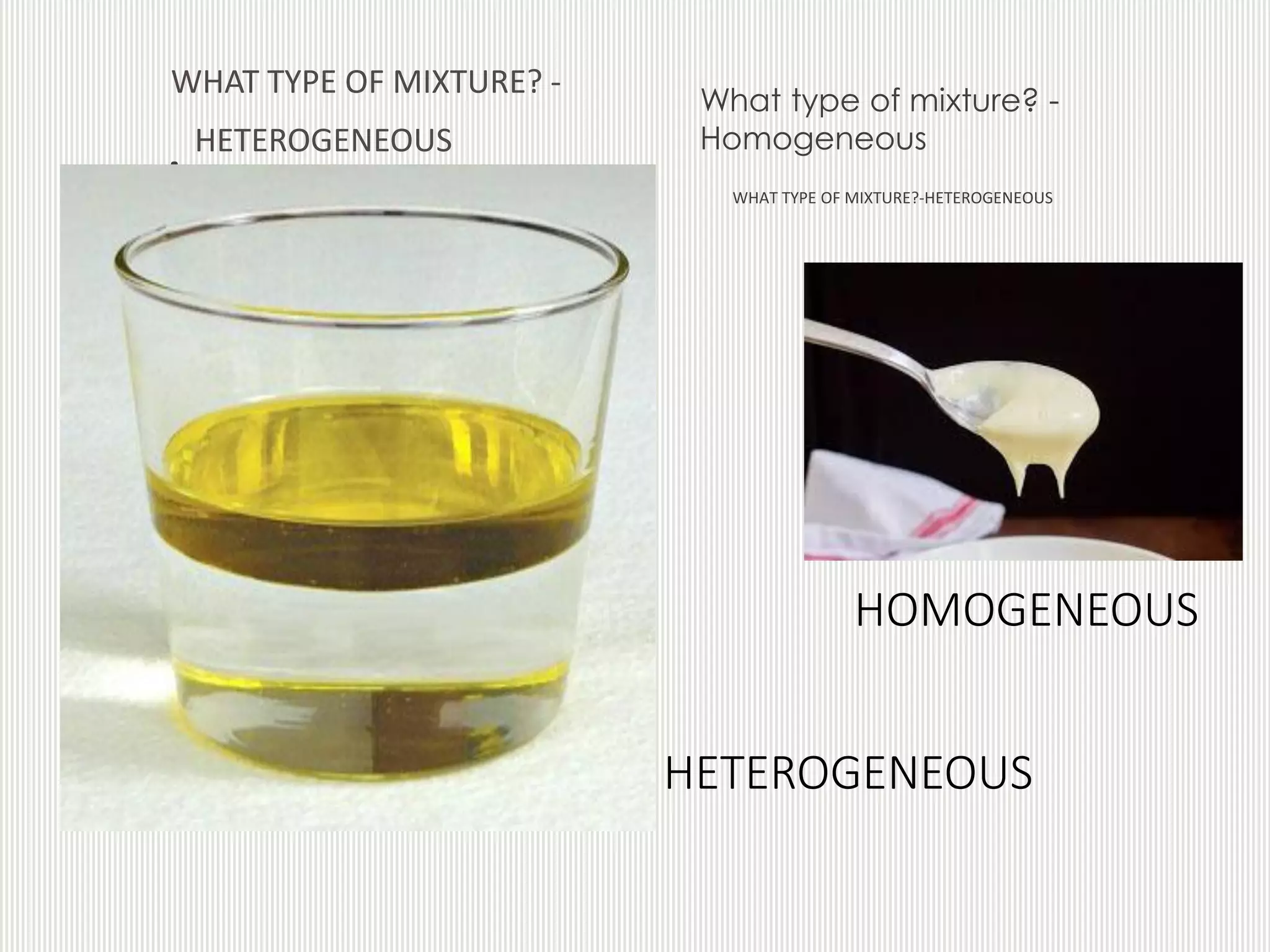
Oil &
Water
WHAT TYPE OF MIXTURE?
MAYONNAISE, WHICH IS
MAINLY MADE OF OIL AND
WATER
.
WHAT TYPE OF MIXTURE? -
HETEROGENEOUS
WHAT TYPE OF MIXTURE?-HETEROGENEOUS
HOMOGENEOUS
What type of mixture? -
Homogeneous
HETEROGENEOUS
Oil &
Water
HOW MANY COMPONENTS/PHASES?
.
MAYONNAISE
MADE OF OIL AND WATER
Water
Oil &
Water
HOW MANY COMPONENTS/PHASES?
.
MAYONNAISE
MADE MANILY OF OIL AND
WATER HAS OTHER
INGREDIENTS AS WELL
Water
Phase
Water
Phase and
Oil Phase
Water
Phase, Oil
Phase,
and many
other
phases
Solution based Mixtures
True Solution
Colloidal Solutions
Suspensions
These solutions typically differ in
the particle size of the solute.
Solution based Mixtures
True Solution: Solute size: <1 nm
Colloidal Solutions: Solute size:
1 nm to 100 nm
Suspensions : Solute size: >100 nm
These solutions typically differ in the
manner in which they are the solutes
reside in the solvent.
Solution based Mixtures
True Solution: Solute is dissolved and is invisible. Example salt
solution. This is a homogeneous mixture.
Colloidal Solutions: Solute is dispersed uniformly throughout
the solution, the presence of the solute is visible but you cannot
lift it out. Example Milk and blood. This is a homogeneous
mixture.
Suspensions : Solute stays outside the solvent – that is, the
solute is suspended. Sand in water.
These solutions typically differ in the manner in which the
solute can be separated from the solvent.
Mixture Separation Techniques
for Solution Based Mixtures
Homogeneous Mixtures Heterogeneous Mixtures
Centrifugation (colloidal particles
are separated out of the solution)
Coagulation (Colloidal particles are
turned into suspension size
particles)
Distillation (Solvents are separated
by boiling and condensation at
different boiling points)
Evaporation (solvent is removed
out of the solute)
Chromatography
Filtration (Insoluble solute(s))
Sedimentation & Decantation
(fine suspended particles settle
down, sediment, and harden when
the liquid clarifies)
Centrifugation; Free Image
Courtesy:
https://www.linkedin.com/pul
se/cell-free-dna-what-ivan-
yong
Coagulation; Free Image Courtesy: Left:
https://www.stockvault.net/photo/148562/coagulation
Right: Coagulated Blood; https://www.dreamstime.com/stock-photo-blood-
sample-tubes-tube-coagulation-testing-image57916276
Filtration: Free Image Courtesy:
https://arcadiaonline.co.za/products/sunbe
am-water-pitcher-with-3x-free-filters
Distillation: Free Image Courtesy:
Shutterstock
Evaporation: Free Image
Courtesy: Alamy Stock
Photo
Sedimentation and
Decantation: Free Image
Courtesy:
http://www.aplustopper
.com/tag/condensation/
Chromatography
Paper Chromatography:
http://inspirationlaboratories.com/chro
matography-christmas-ornaments/
Paper Chromatography:
http://www.scoop.it/t/chromatography-for-vce
Chalk Chromatography: https://www.thoughtco.com/chalk-
chromatography-how-to-605965
Homogeneous
Solid Based Mixtures
Solid Solutions: Alloys
Solid solutions are a solid dissolved in another solid to produce a
homogeneous mixture. Best examples of solid solutions are provided
by alloys, which are homogeneous solutions existing in the solid form.
Steel, Brass, Bronze, Solder alloy are good examples of alloys.
In alloys, the metal that is present in larger quantity acts as a solvent
and the other metals which are present in smaller quantities act as
solute.
The components of an alloy are hard to separate.
Solid Solutions: Homogeneous Mixtures
Brass is composed of 67% Copper and 33% Zinc.
Brass behaves like a single material not as two materials.
Brass is a new metal form although it is made of Copper and Zinc.
Brass is more malleable than both its components namely copper and zinc.
Brass is more lustrous than both its components namely copper and zinc.
Brass has a lower melting point than both its components.
Since brass is a mixture and not a true compound, there is no chemical name for Brass.
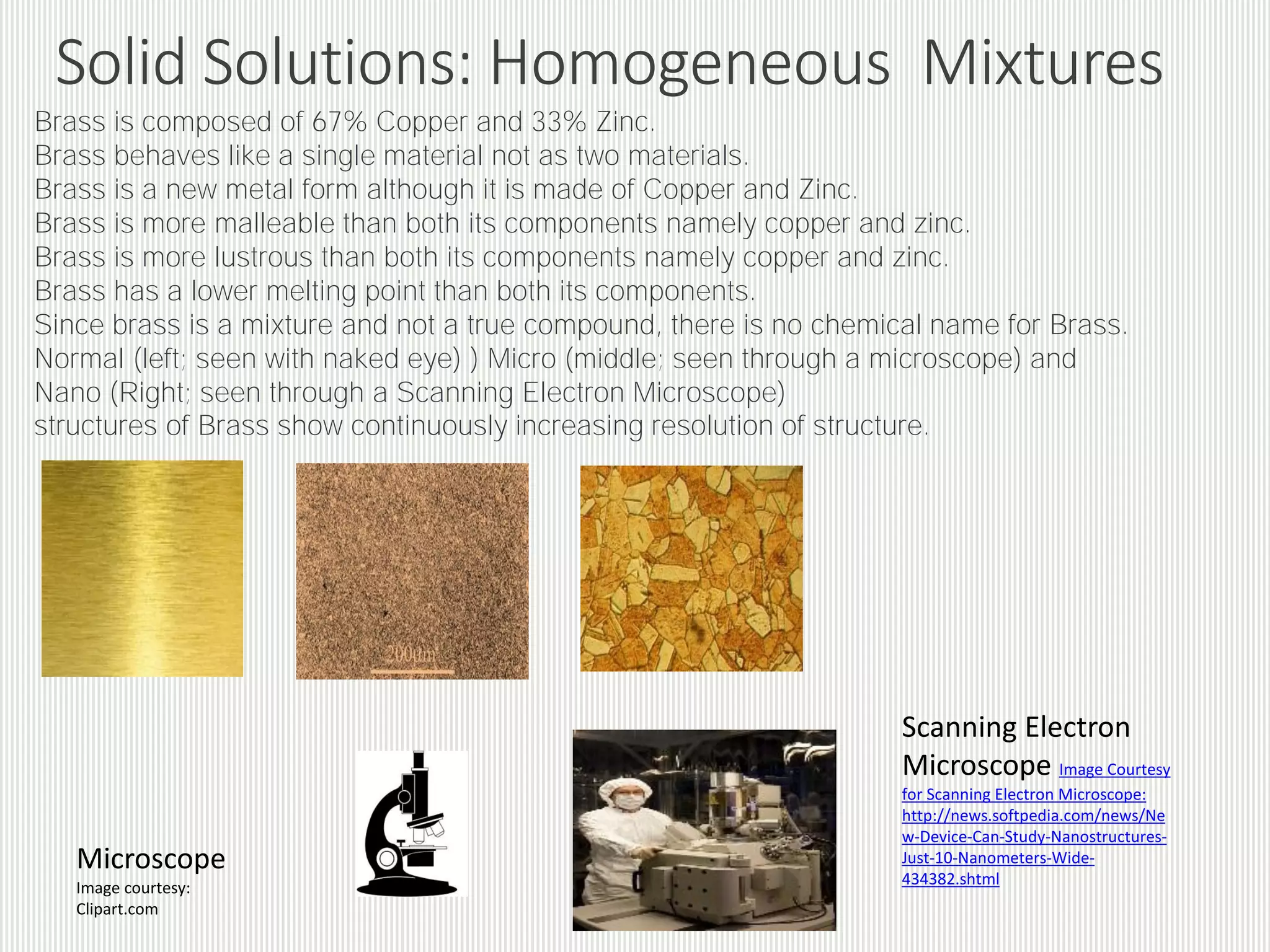
Normal (left; seen with naked eye) ) Micro (middle; seen through a microscope) and
Nano (Right; seen through a Scanning Electron Microscope)
structures of Brass show continuously increasing resolution of structure.
Scanning Electron
Microscope Image Courtesy
for Scanning Electron Microscope:
http://news.softpedia.com/news/Ne
w-Device-Can-Study-Nanostructures-
Just-10-Nanometers-Wide-
434382.shtml
Microscope
Image courtesy:
Clipart.com

Hetrogenous and homogenous mixture ppt

  • 1.
  • 2.
    How are theydifferent? Homogeneous mixtures have uniform composition. Heterogeneous mixtures have non- uniform composition.
  • 3.
    What type ofmixture each is? Almonds Trail mix
  • 4.
    Almonds: Homogeneous Trail Mix:HETEROGENEOUS Almonds Trail mix
  • 5.
    Techniques to Separate HeterogeneousSolid Mixtures SEPARATION TECHNIQUE 1. Hand Picking 2. Sieving 3. Gravity Separation 4. Magnetic Separation 5. Winnowing 6. Froth Flotation PRINCIPLE 1. Conspicuous differences between different components 2. Particle size different between components 3. Specific Gravity difference between components 4. One or more of the components is magnetic 5. One of the component is a very light or dust like material 6. One of the components is hydrophobic
  • 6.
    Sieving; Free ImageCourtesy: http://www.ingridscience.ca/n ode/338 Hand picking; Free Image Courtesy: www.shutterstock.com Gravity Separation. Free Image Courtesy: https://www.911metallurgist.com/blog/grav ity-spiral-separator-working-principle/how- spirals-work#iLightbox[postimages]/0 Magnetic Separation; Free Image Courtesy: https://infograph.venngage.com/p/44403/separation- methods; Right: http://www.glogster.com/favianheng/separation- of-mixtures-prss-1e5-chemistry-/g-6ms3bthoq6926283cl6iua0 Sorting Machine - Skittles and M&M's https://www.youtube.com /watch?v=tSEHDBSynVo Winnowing: Free Image Courtesy: Alamy Stock Photos Froth Flotation: Free Image Courtesy: https://www.911metall urgist.com/blog/mineral -processing-froth- flotation
  • 7.
  • 8.
    What type ofmixtures are these? 1. Apple juice 2. Orange juice with pulp 3. Chocolate dough 4. Italian salad dressing
  • 9.
    What type ofmixtures are these? 1. Apple juice: Homogeneous 2. Orange juice with pulp: Heterogeneous 3. Chocolate dough: Homogeneous 4. Italian salad dressing: Heterogeneous
  • 10.
    Oil & Water WHAT TYPEOF MIXTURE? WHAT TYPE OF MIXTURE? MAYONNAISE, WHICH IS MAINLY MADE OF OIL AND WATER
  • 11.
    . WHAT TYPE OFMIXTURE? - HETEROGENEOUS WHAT TYPE OF MIXTURE?-HETEROGENEOUS HOMOGENEOUS What type of mixture? - Homogeneous HETEROGENEOUS
  • 12.
    Oil & Water HOW MANYCOMPONENTS/PHASES? . MAYONNAISE MADE OF OIL AND WATER Water
  • 13.
    Oil & Water HOW MANYCOMPONENTS/PHASES? . MAYONNAISE MADE MANILY OF OIL AND WATER HAS OTHER INGREDIENTS AS WELL Water Phase Water Phase and Oil Phase Water Phase, Oil Phase, and many other phases
  • 14.
    Solution based Mixtures TrueSolution Colloidal Solutions Suspensions These solutions typically differ in the particle size of the solute.
  • 15.
    Solution based Mixtures TrueSolution: Solute size: <1 nm Colloidal Solutions: Solute size: 1 nm to 100 nm Suspensions : Solute size: >100 nm These solutions typically differ in the manner in which they are the solutes reside in the solvent.
  • 16.
    Solution based Mixtures TrueSolution: Solute is dissolved and is invisible. Example salt solution. This is a homogeneous mixture. Colloidal Solutions: Solute is dispersed uniformly throughout the solution, the presence of the solute is visible but you cannot lift it out. Example Milk and blood. This is a homogeneous mixture. Suspensions : Solute stays outside the solvent – that is, the solute is suspended. Sand in water. These solutions typically differ in the manner in which the solute can be separated from the solvent.
  • 17.
    Mixture Separation Techniques forSolution Based Mixtures Homogeneous Mixtures Heterogeneous Mixtures Centrifugation (colloidal particles are separated out of the solution) Coagulation (Colloidal particles are turned into suspension size particles) Distillation (Solvents are separated by boiling and condensation at different boiling points) Evaporation (solvent is removed out of the solute) Chromatography Filtration (Insoluble solute(s)) Sedimentation & Decantation (fine suspended particles settle down, sediment, and harden when the liquid clarifies)
  • 18.
    Centrifugation; Free Image Courtesy: https://www.linkedin.com/pul se/cell-free-dna-what-ivan- yong Coagulation;Free Image Courtesy: Left: https://www.stockvault.net/photo/148562/coagulation Right: Coagulated Blood; https://www.dreamstime.com/stock-photo-blood- sample-tubes-tube-coagulation-testing-image57916276 Filtration: Free Image Courtesy: https://arcadiaonline.co.za/products/sunbe am-water-pitcher-with-3x-free-filters Distillation: Free Image Courtesy: Shutterstock Evaporation: Free Image Courtesy: Alamy Stock Photo Sedimentation and Decantation: Free Image Courtesy: http://www.aplustopper .com/tag/condensation/
  • 19.
  • 20.
  • 21.
    Solid Solutions: Alloys Solidsolutions are a solid dissolved in another solid to produce a homogeneous mixture. Best examples of solid solutions are provided by alloys, which are homogeneous solutions existing in the solid form. Steel, Brass, Bronze, Solder alloy are good examples of alloys. In alloys, the metal that is present in larger quantity acts as a solvent and the other metals which are present in smaller quantities act as solute. The components of an alloy are hard to separate.
  • 22.
    Solid Solutions: HomogeneousMixtures Brass is composed of 67% Copper and 33% Zinc. Brass behaves like a single material not as two materials. Brass is a new metal form although it is made of Copper and Zinc. Brass is more malleable than both its components namely copper and zinc. Brass is more lustrous than both its components namely copper and zinc. Brass has a lower melting point than both its components. Since brass is a mixture and not a true compound, there is no chemical name for Brass. Normal (left; seen with naked eye) ) Micro (middle; seen through a microscope) and Nano (Right; seen through a Scanning Electron Microscope) structures of Brass show continuously increasing resolution of structure. Scanning Electron Microscope Image Courtesy for Scanning Electron Microscope: http://news.softpedia.com/news/Ne w-Device-Can-Study-Nanostructures- Just-10-Nanometers-Wide- 434382.shtml Microscope Image courtesy: Clipart.com