Principles of Teaching
The Laboratory Method
What is
The Laboratory
Method?
Laboratory Teaching Methods
This methods is one of the important
methods of teaching science and it forms an
integral part of effective science teaching.
Under this methods, teachers encourages the
students to derive various scientific laws and
principle on their own by getting personally
involved in the experiment work.
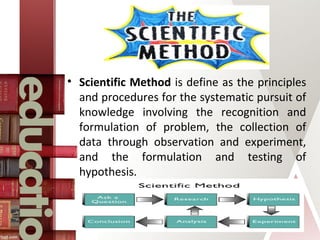
• Scientific Method is define as the principles
and procedures for the systematic pursuit of
knowledge involving the recognition and
formulation of problem, the collection of
data through observation and experiment,
and the formulation and testing of
hypothesis.
2 Major Types of Laboratory Methods
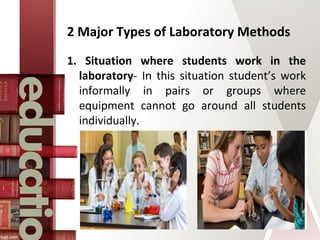
1. Situation where students work in the
laboratory- In this situation student’s work
informally in pairs or groups where
equipment cannot go around all students
individually.
2 Major Types of Laboratory Methods
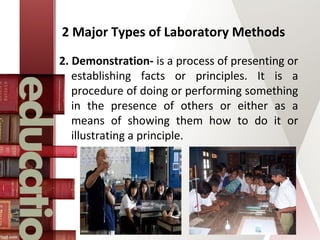
2. Demonstration- is a process of presenting or
establishing facts or principles. It is a
procedure of doing or performing something
in the presence of others or either as a
means of showing them how to do it or
illustrating a principle.
MAJOR GOALS OF LABORATORY
WORKS
Teaching Manuals and Observational
skills relevant to the subject
Improving understanding methods of
scientific inquiry
Developing problem solving and doing
by self skills.
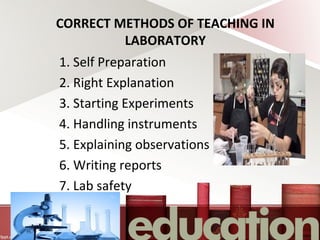
CORRECT METHODS OF TEACHING IN
LABORATORY
1. Self Preparation
2. Right Explanation
3. Starting Experiments
4. Handling instruments
5. Explaining observations
6. Writing reports
7. Lab safety
Advantages of Laboratory Method
1. Students learn by doing and come in contact
with raw data or materials in teaching
learning process.
2. Develops the power of observation and
reasoning.
3.Develops the scientific attitudes
4. Gives an understanding of what research is
and how to apply the scientific method
Advantages of Laboratory Method
5. Gives training in organizing data gathered
from real materials object and how these
objects are manipulated to attain the
objectives.
6. Since students come in contact with real life
situations, it can be a preparation for solving
real life problems
Disadvantages of Laboratory Method
1. Uneconomical way of learning in time and
material.
2. Does not give much training in verbal
expression and when the same equipment
is used most of the time, its use becomes
mechanical i.e., used without much
thinking anymore
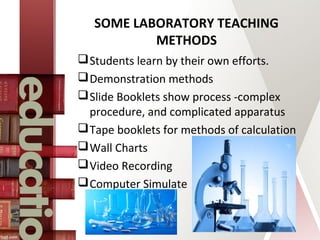
SOME LABORATORY TEACHING
METHODS
Students learn by their own efforts.
Demonstration methods
Slide Booklets show process -complex
procedure, and complicated apparatus
Tape booklets for methods of calculation
Wall Charts
Video Recording
Computer Simulate
Laboratory Safety Tips
Think safety first
Know emergency responses
Know what your working with
Use the smallest possible amounts
Follow all safety procedures
Report dangerous activity or situations
Store and handle hazardous materials safety
If you don’t know ASK!
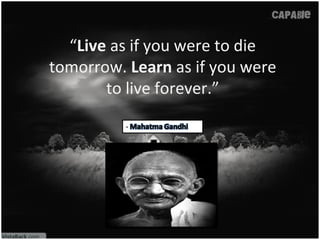
“Live as if you were to die
tomorrow. Learn as if you were
to live forever.”
The laboratory method (Principles of Teaching)

The laboratory method (Principles of Teaching)

  • 1.
    Principles of Teaching TheLaboratory Method
  • 2.
  • 3.
    Laboratory Teaching Methods Thismethods is one of the important methods of teaching science and it forms an integral part of effective science teaching. Under this methods, teachers encourages the students to derive various scientific laws and principle on their own by getting personally involved in the experiment work.
  • 4.
    • Scientific Methodis define as the principles and procedures for the systematic pursuit of knowledge involving the recognition and formulation of problem, the collection of data through observation and experiment, and the formulation and testing of hypothesis.
  • 5.
    2 Major Typesof Laboratory Methods 1. Situation where students work in the laboratory- In this situation student’s work informally in pairs or groups where equipment cannot go around all students individually.
  • 6.
    2 Major Typesof Laboratory Methods 2. Demonstration- is a process of presenting or establishing facts or principles. It is a procedure of doing or performing something in the presence of others or either as a means of showing them how to do it or illustrating a principle.
  • 7.
    MAJOR GOALS OFLABORATORY WORKS Teaching Manuals and Observational skills relevant to the subject Improving understanding methods of scientific inquiry Developing problem solving and doing by self skills.
  • 8.
    CORRECT METHODS OFTEACHING IN LABORATORY 1. Self Preparation 2. Right Explanation 3. Starting Experiments 4. Handling instruments 5. Explaining observations 6. Writing reports 7. Lab safety
  • 9.
    Advantages of LaboratoryMethod 1. Students learn by doing and come in contact with raw data or materials in teaching learning process. 2. Develops the power of observation and reasoning. 3.Develops the scientific attitudes 4. Gives an understanding of what research is and how to apply the scientific method
  • 10.
    Advantages of LaboratoryMethod 5. Gives training in organizing data gathered from real materials object and how these objects are manipulated to attain the objectives. 6. Since students come in contact with real life situations, it can be a preparation for solving real life problems
  • 11.
    Disadvantages of LaboratoryMethod 1. Uneconomical way of learning in time and material. 2. Does not give much training in verbal expression and when the same equipment is used most of the time, its use becomes mechanical i.e., used without much thinking anymore
  • 12.
    SOME LABORATORY TEACHING METHODS Studentslearn by their own efforts. Demonstration methods Slide Booklets show process -complex procedure, and complicated apparatus Tape booklets for methods of calculation Wall Charts Video Recording Computer Simulate
  • 13.
    Laboratory Safety Tips Thinksafety first Know emergency responses Know what your working with Use the smallest possible amounts Follow all safety procedures Report dangerous activity or situations Store and handle hazardous materials safety If you don’t know ASK!
  • 14.
    “Live as ifyou were to die tomorrow. Learn as if you were to live forever.”