Welcome back!
Term 2: XLS0000
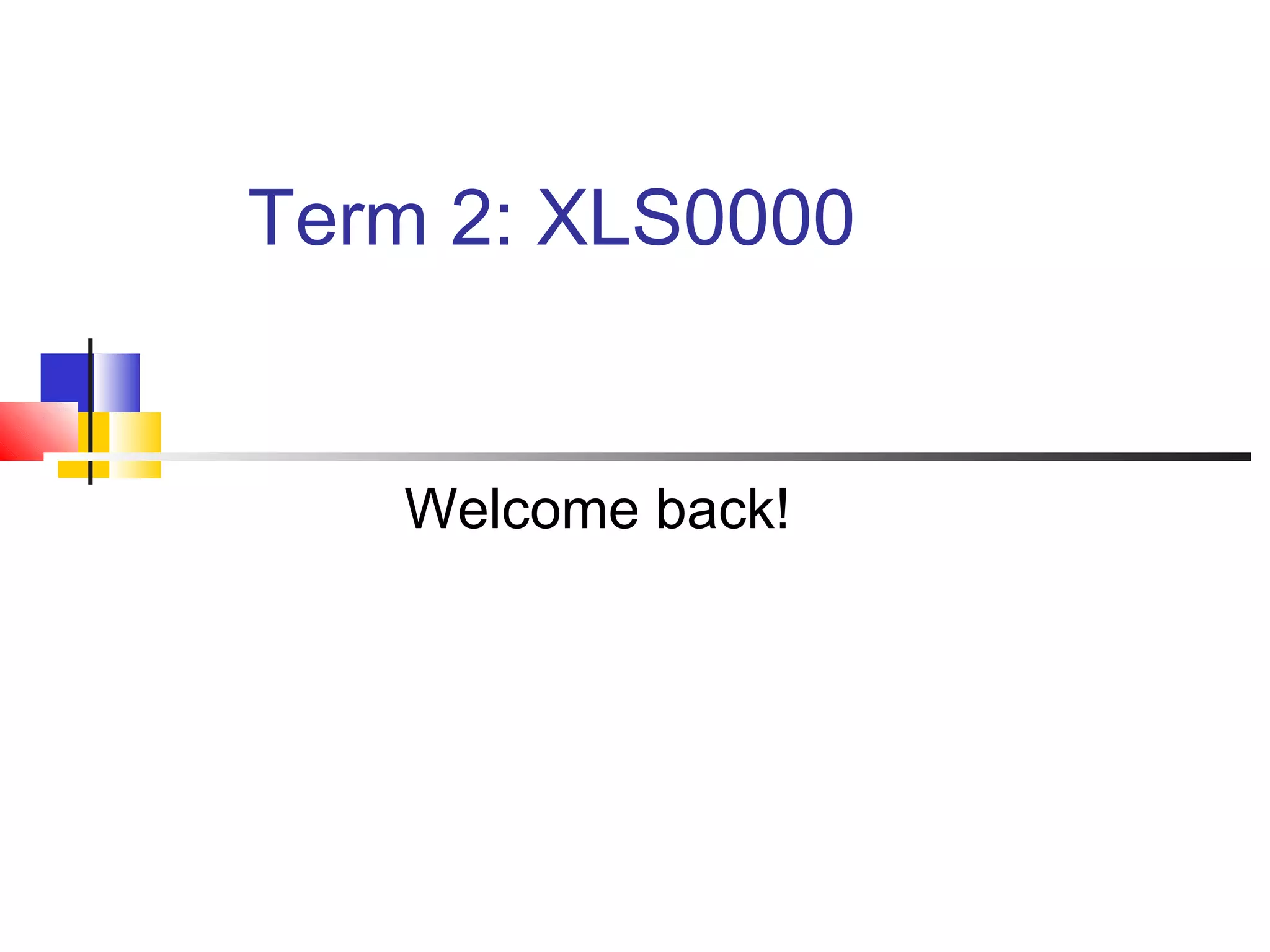
Thanks for your participation
in Achterbergh (PGCE’s)
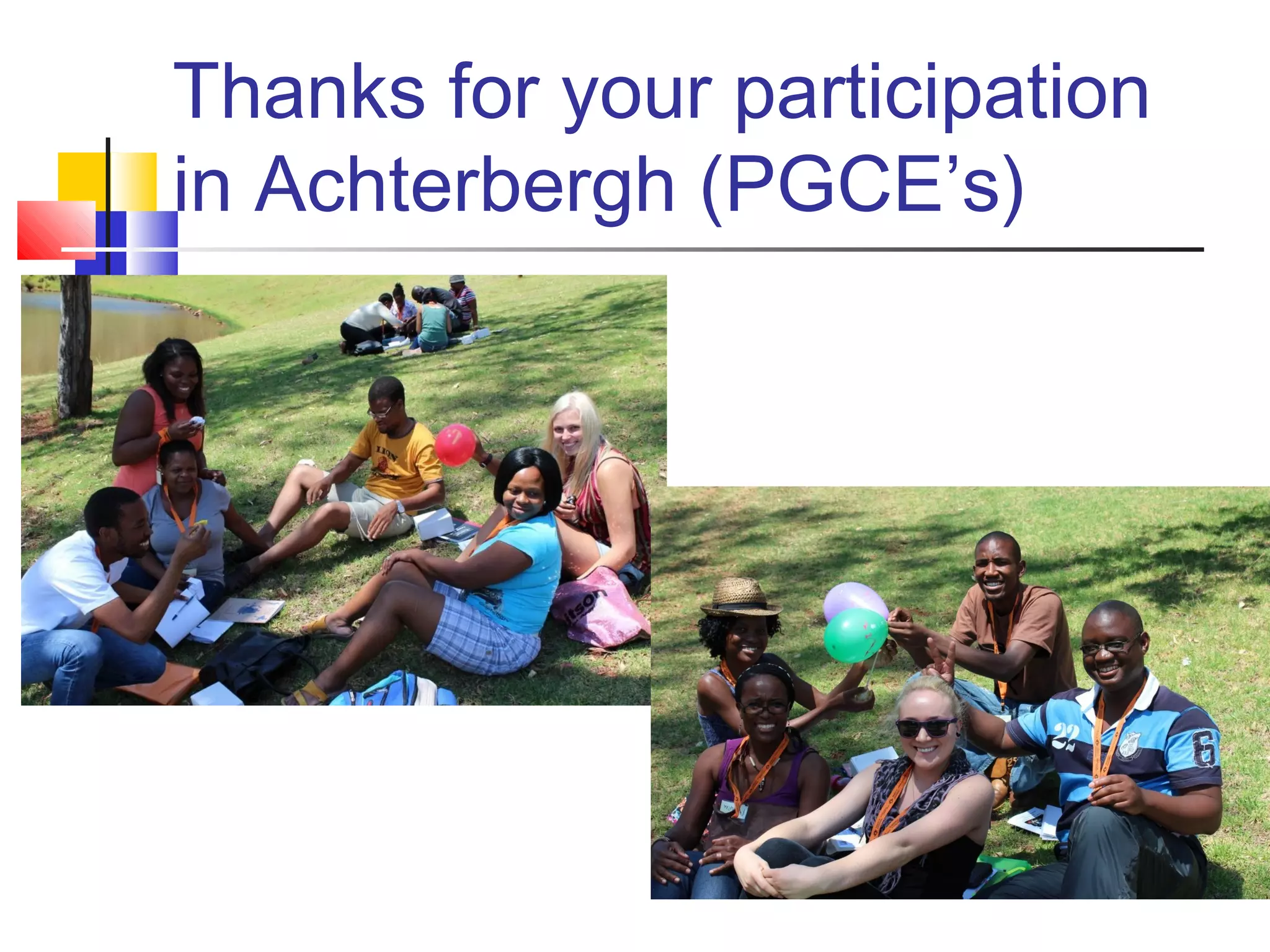
Successful first term with
UJMA learners: average 81%
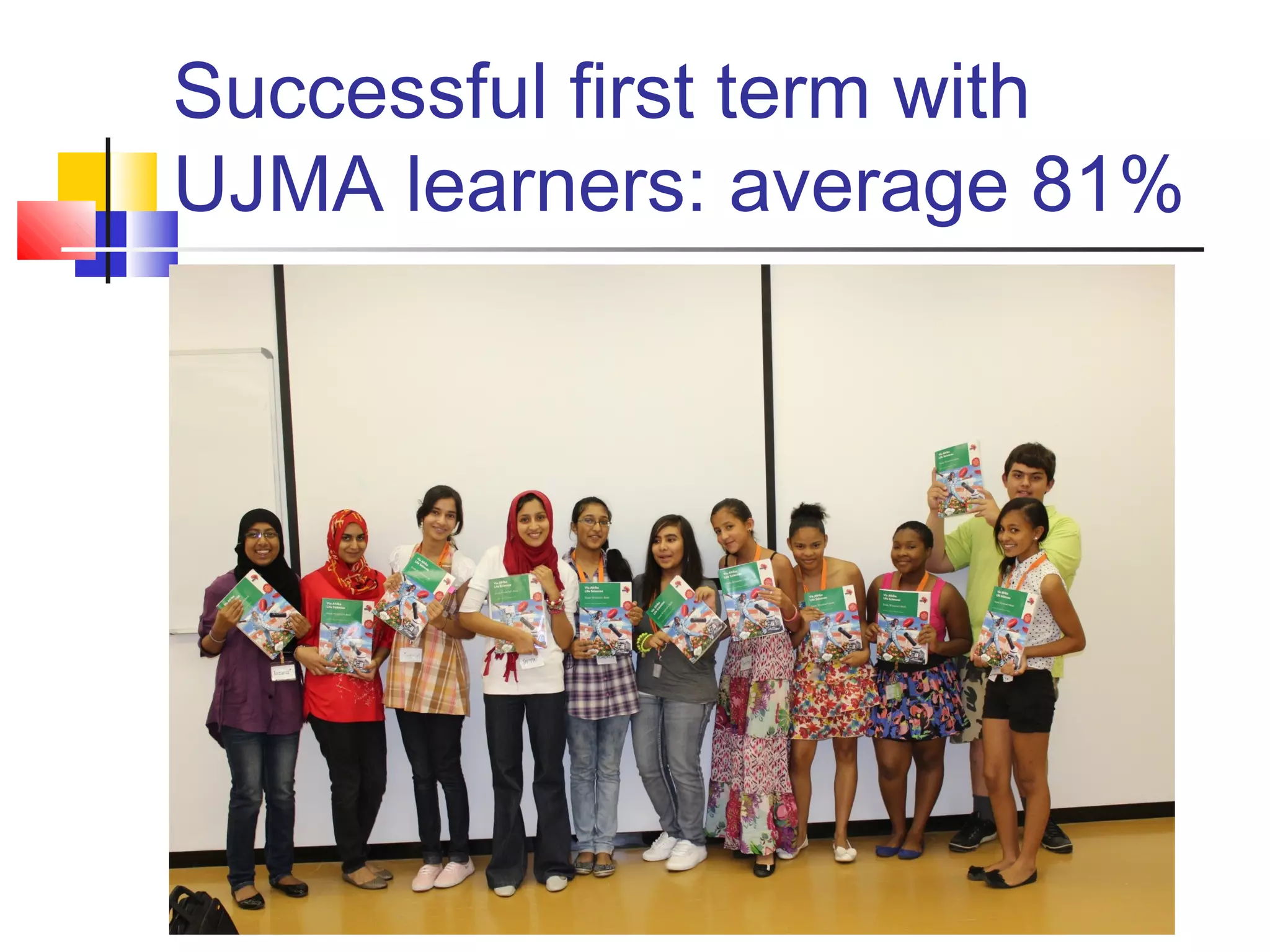
Congratulations, Super-
Teachers!
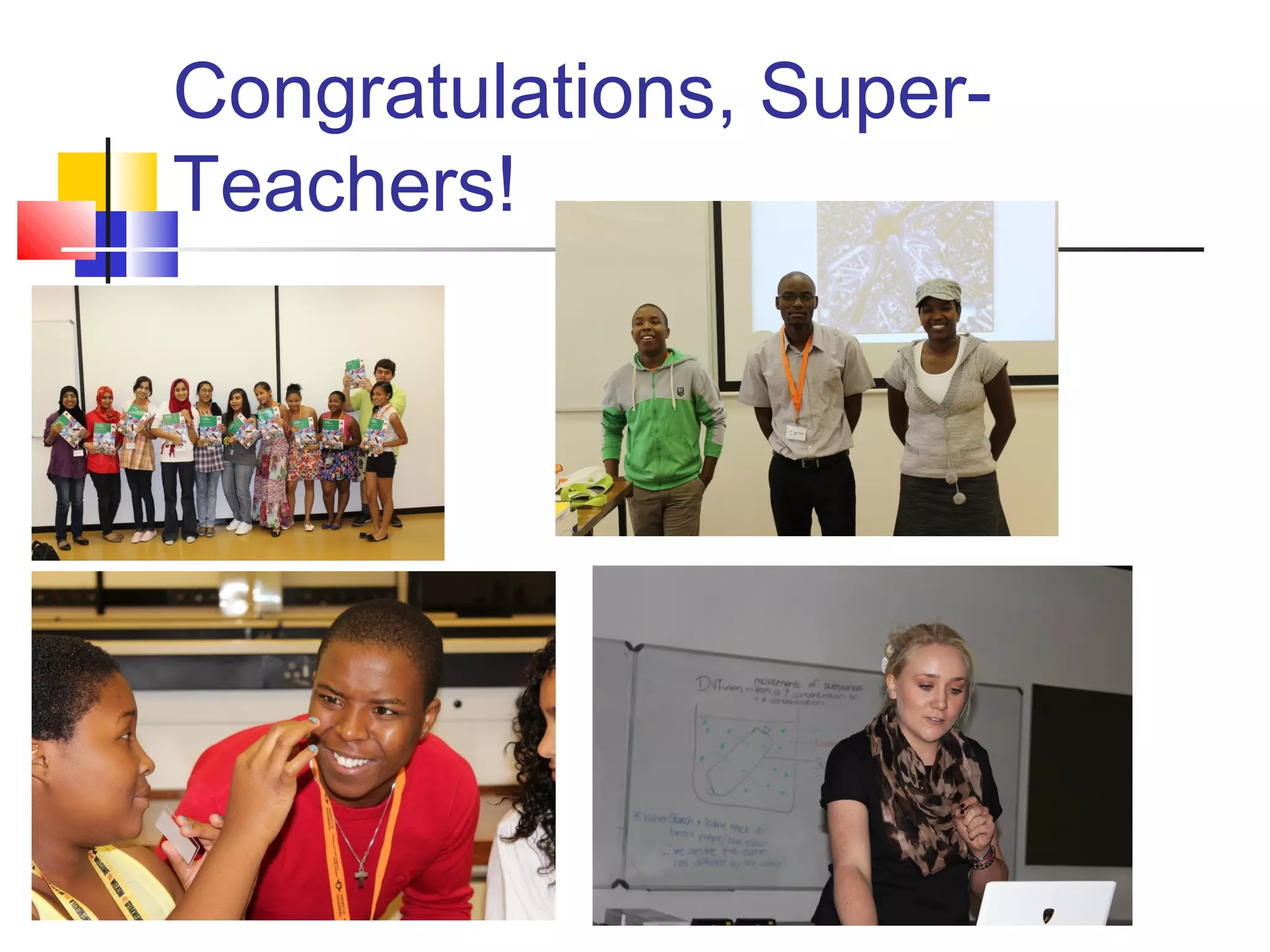
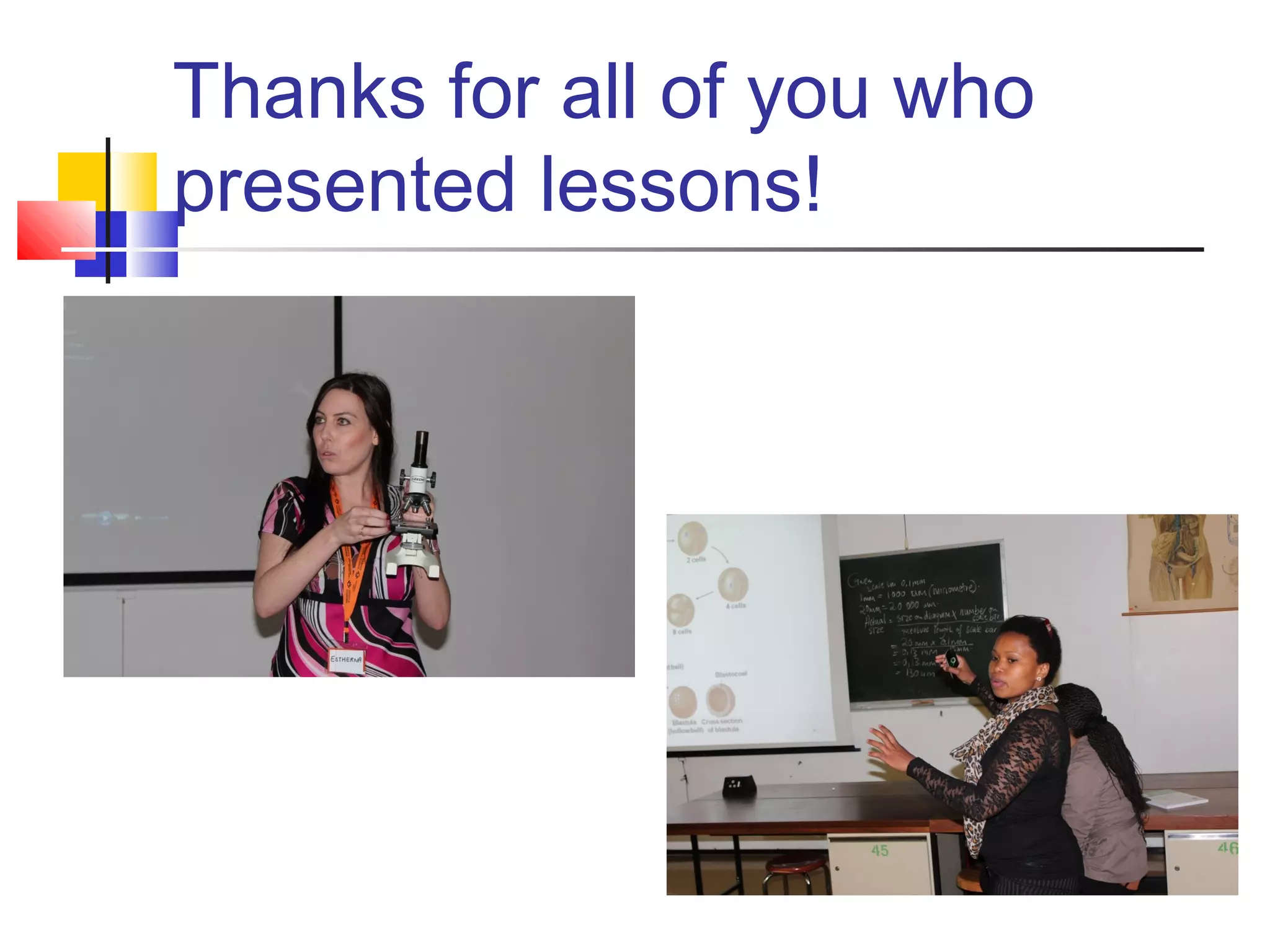
Thanks for all of you who
presented lessons!
Tomorrow’s class
J. Prag
NL Shandu
QV Sibeko
SW Siwela
Observing (teach on 20 Apr)
MM Ntlhane
(Memory) Malope
MG mekwa
OL Ramahali
School experience reflection
 Submit next Friday, 19 April.
 Portfolios due in October, after 6 weeks
prac (see hand-out)
USA
 Provisionally 5 – 16 August (must still
obtain confirmation from GSU)
 See hand-out
Funding
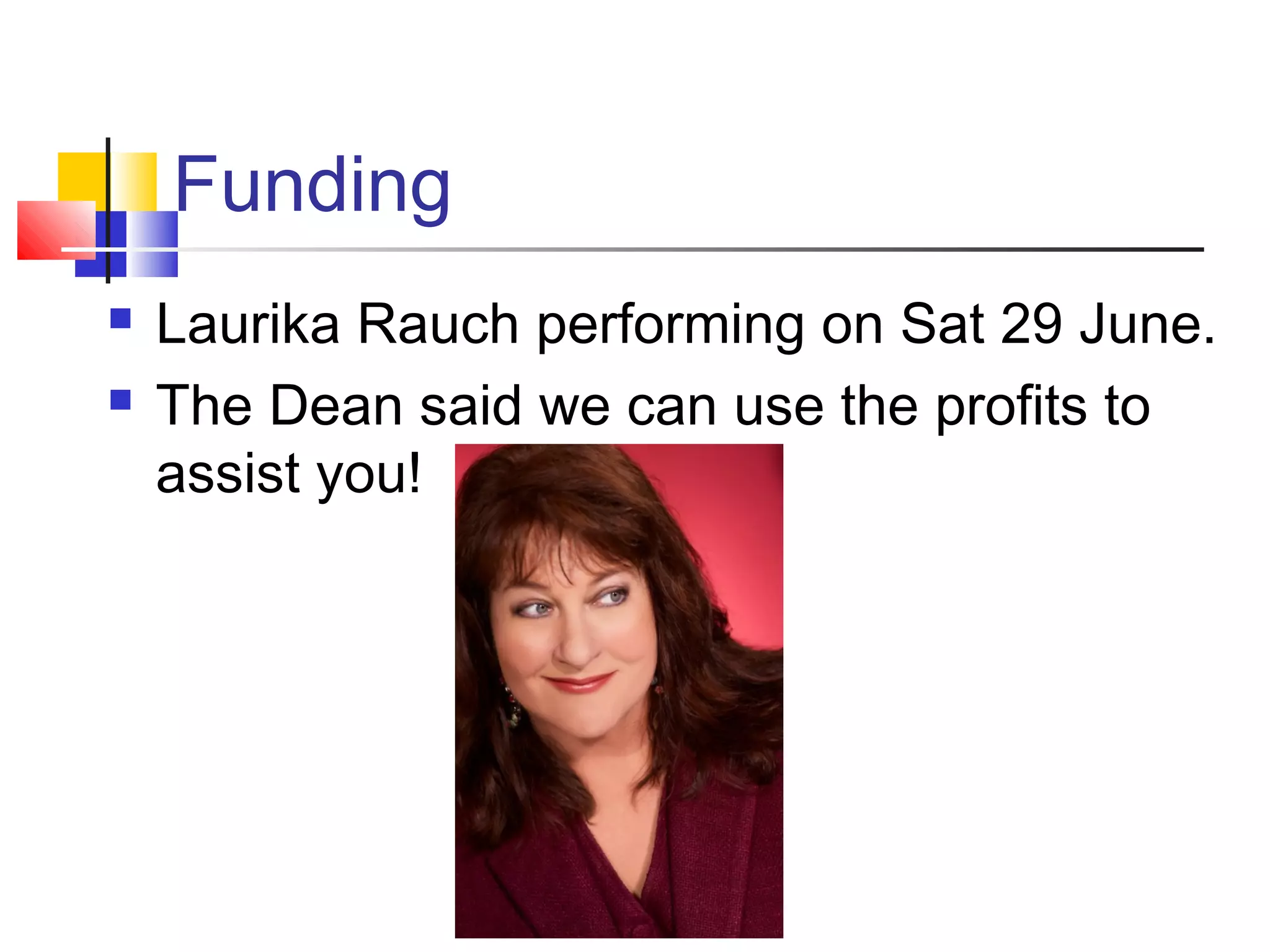
 Laurika Rauch performing on Sat 29 June.
 The Dean said we can use the profits to
assist you!
Visit one Saturday in May to
Sci-Bono
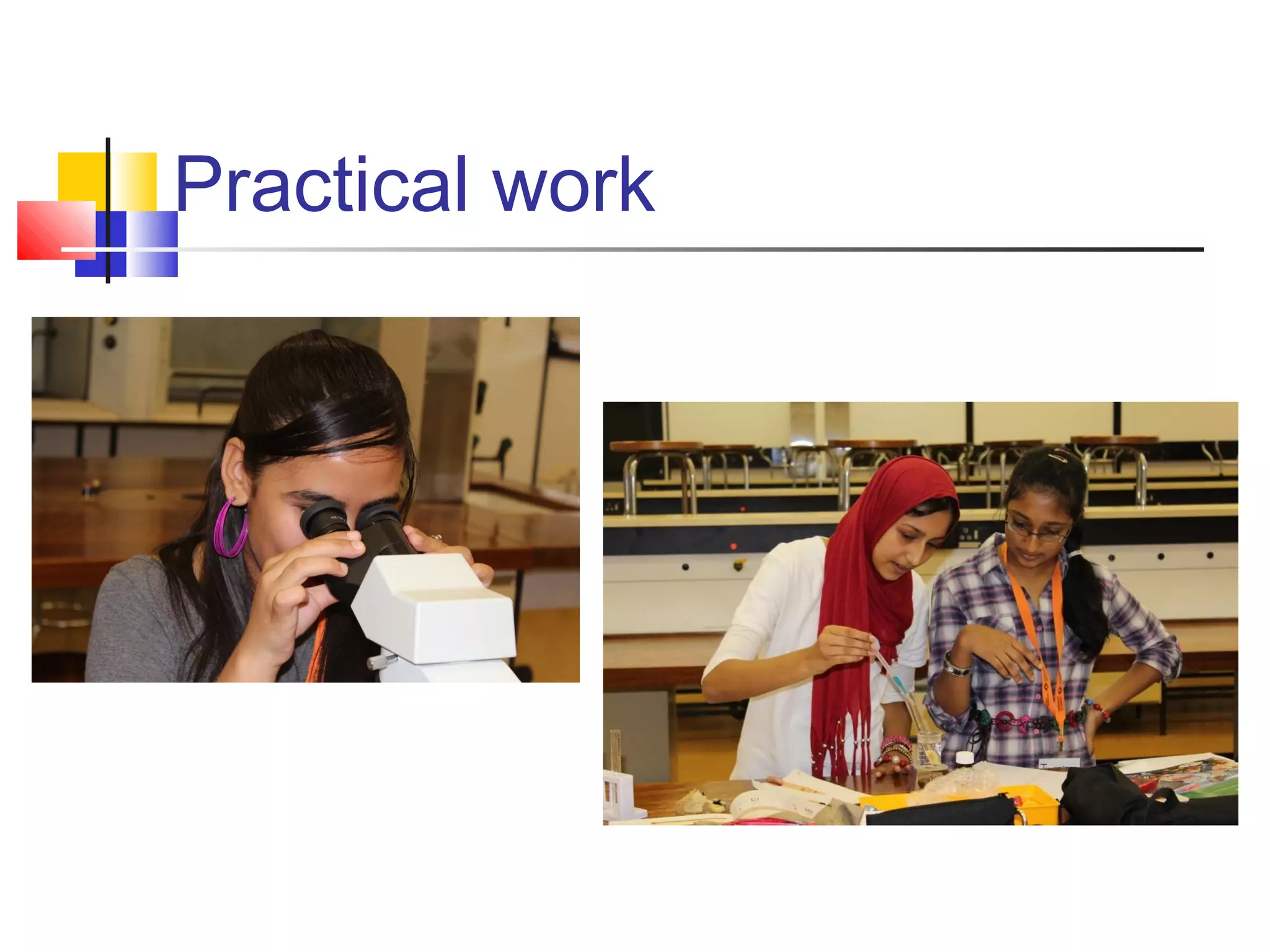
Practical work
What does practical work
involve ?
 ‘practical work’ means any teaching and
learning activity which involves at some
point the students in observing or
manipulating real objects and materials.
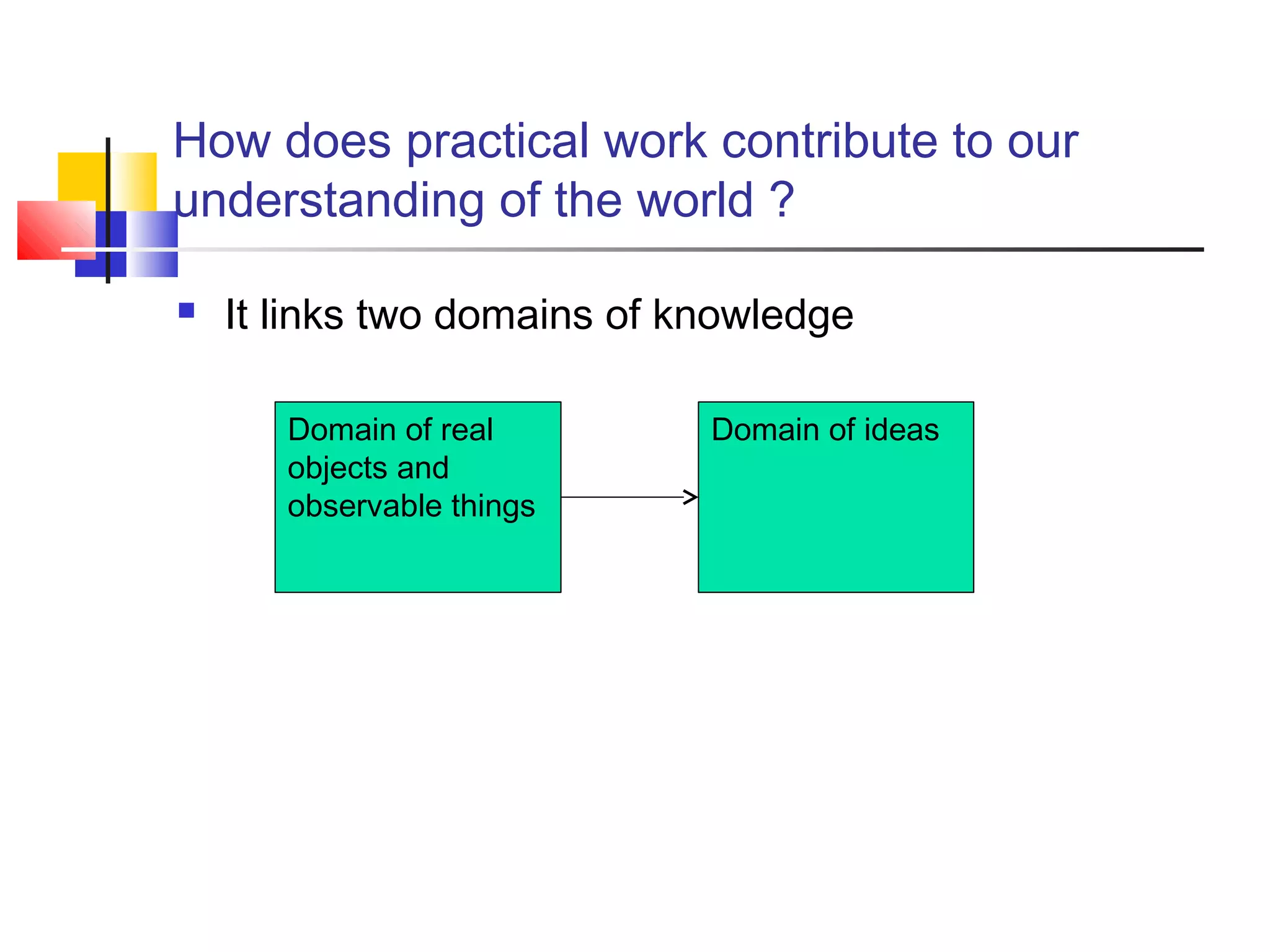
How does practical work contribute to our
understanding of the world ?
 It links two domains of knowledge
Domain of real
objects and
observable things
Domain of ideas
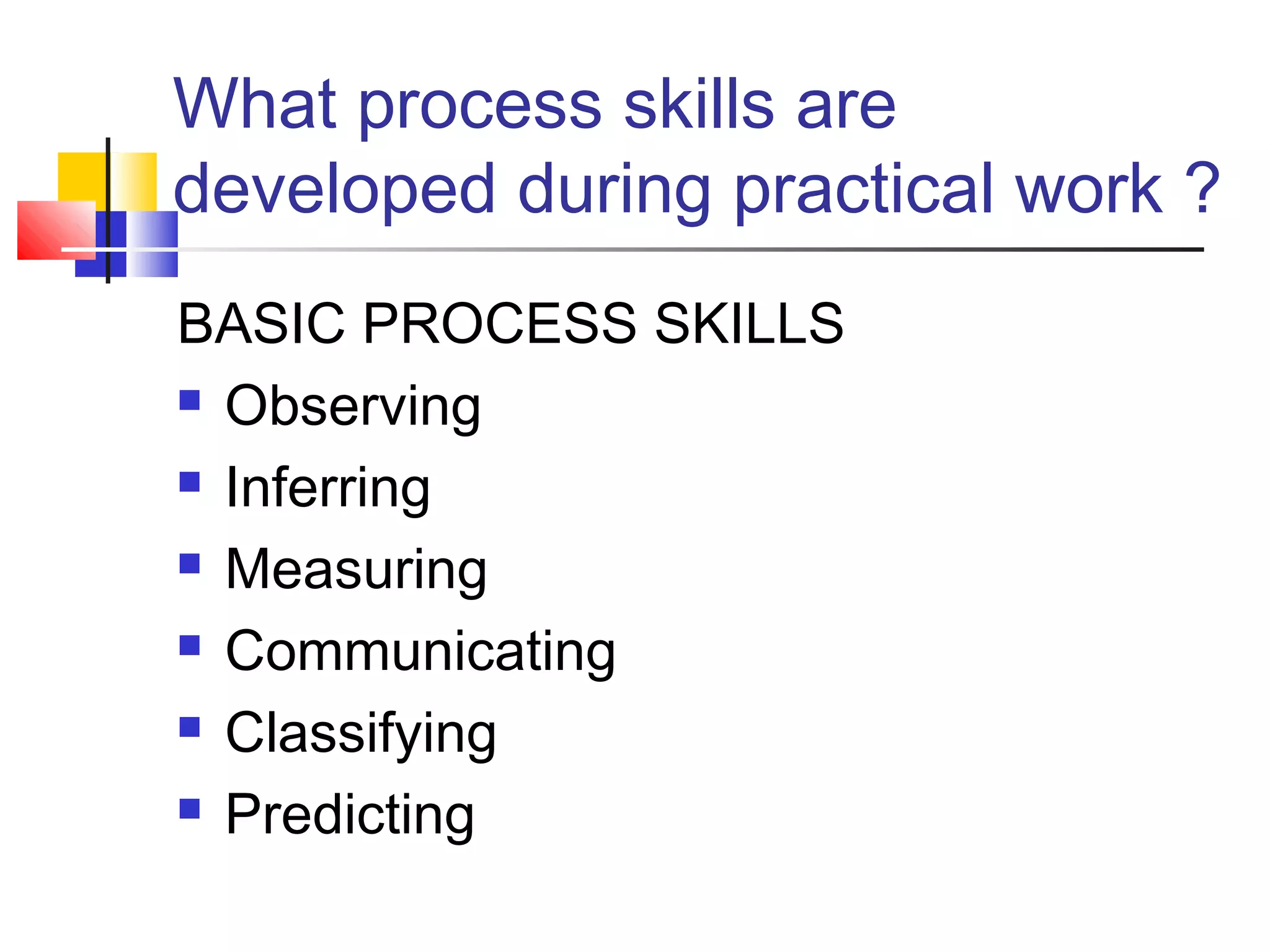
What process skills are
developed during practical work ?
BASIC PROCESS SKILLS
 Observing
 Inferring
 Measuring
 Communicating
 Classifying
 Predicting
What are the benefits of practical
work in science learning ?
 motivate pupils, by stimulating interest and enjoyment
 teach laboratory skills
 enhance the learning of scientific knowledge by
making abstract concepts appear more concrete
 give insight into scientific method and develop
expertise in using it
 Helps to bring about conceptual change when
necessary by convincing learners of the validity of a
scientific idea
What are some of the challenges of doing
practical work ?
 Lack of resources
 Teachers lacking competence
 Learner indiscipline
How can the challenge of a lack of
resources be overcome ?
 Design practical using resources which are
improvised and accessible
 Network with other schools in sharing equipment
 Approach a tertiary institution about providing support
 Enquire about agencies who may have established
resources centres e.g. CASME in KZN
 Enquire about the availability of micro kits for
practical work
How is practical work
addressed in the
NCS/CAPS ?
 The place of practical work is
addressed through the Specific Aim:
“The learner will be able to act
confidently on curiosity about natural
phenomena, and to investigate
relationships and solve problems in
scientific, technological and
environmental contexts”
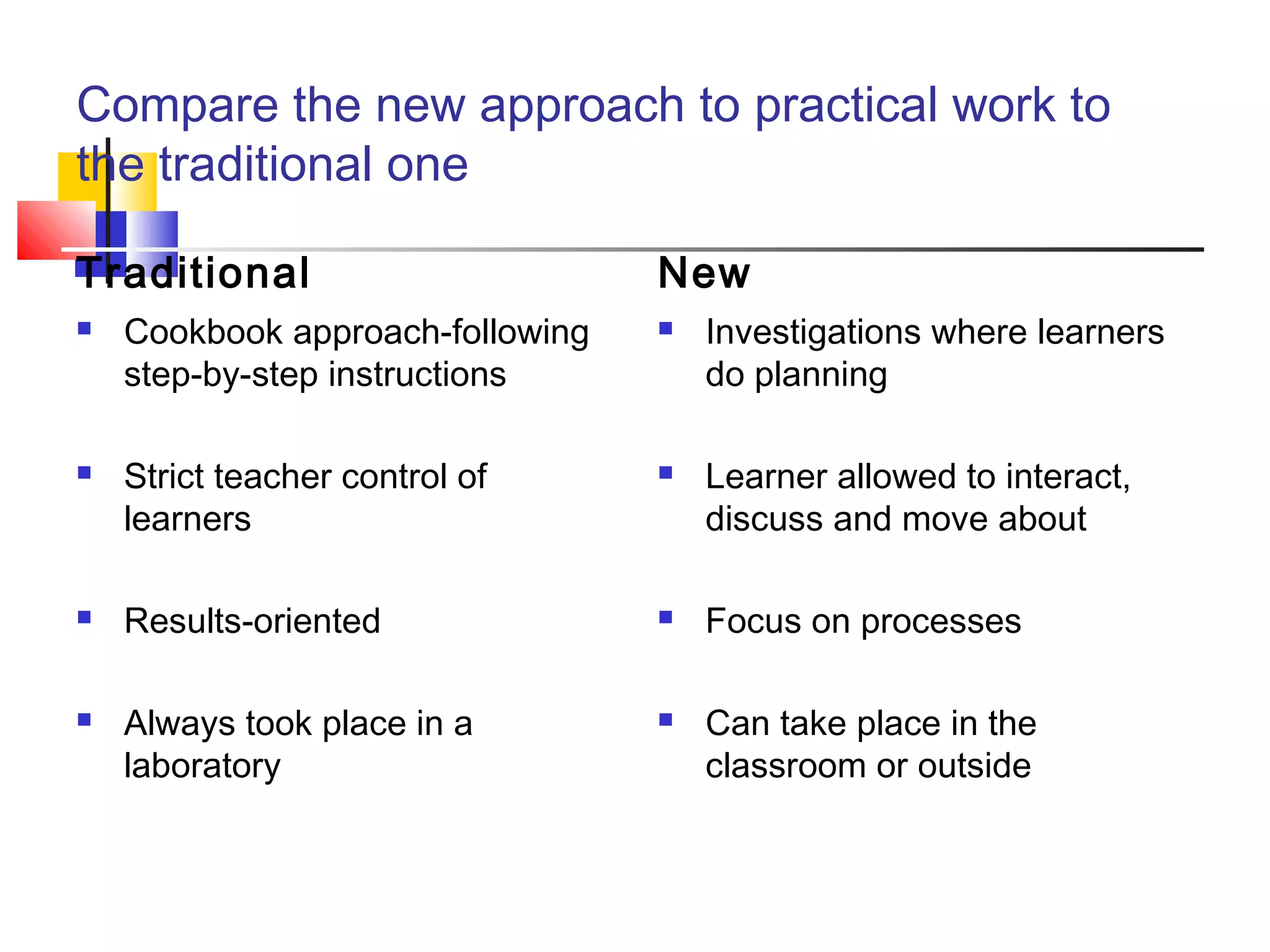
Compare the new approach to practical work to
the traditional one
Traditional
 Cookbook approach-following
step-by-step instructions
 Strict teacher control of
learners
 Results-oriented
 Always took place in a
laboratory
New
 Investigations where learners
do planning
 Learner allowed to interact,
discuss and move about
 Focus on processes
 Can take place in the
classroom or outside
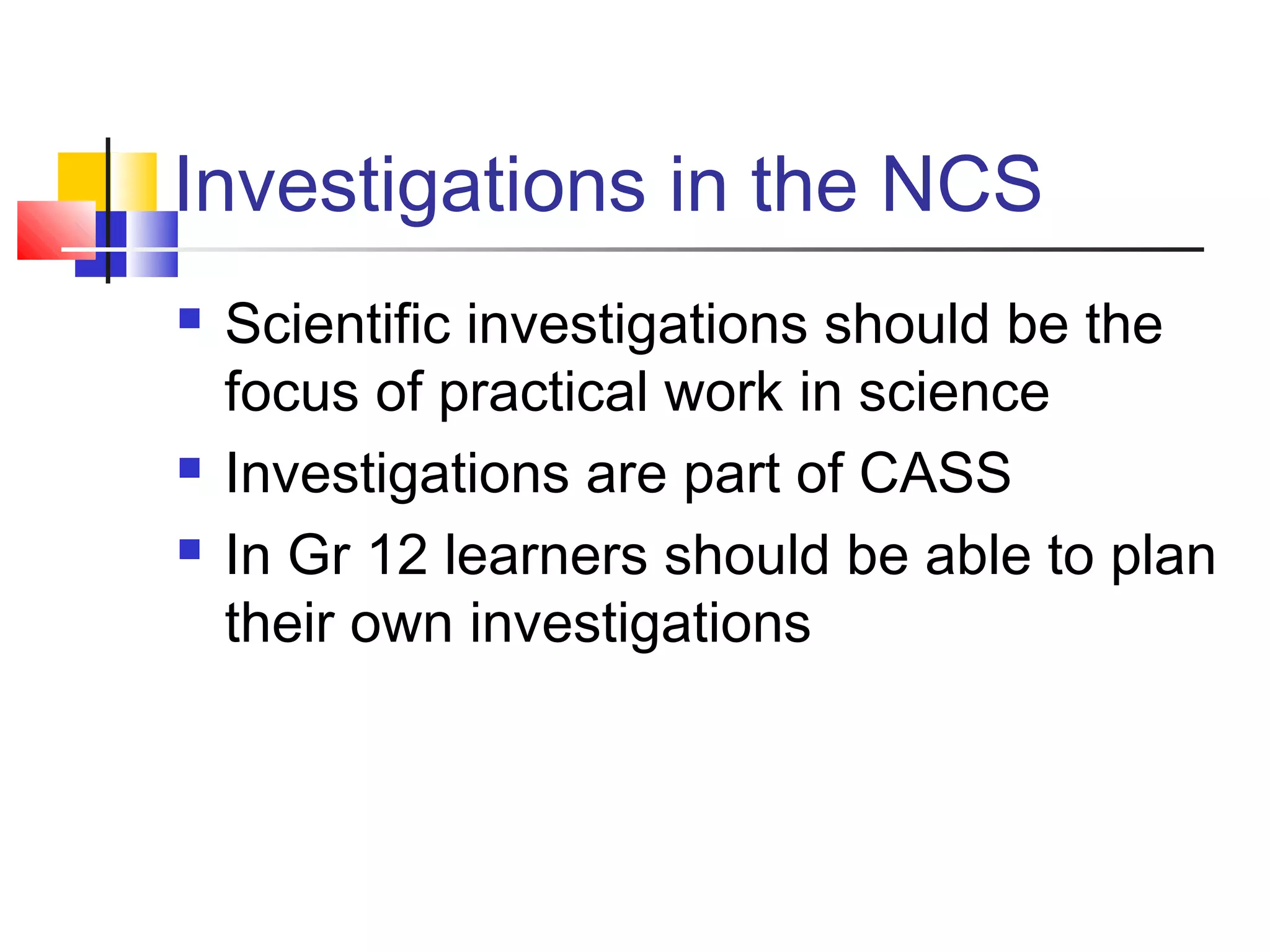
Investigations in the NCS
 Scientific investigations should be the
focus of practical work in science
 Investigations are part of CASS
 In Gr 12 learners should be able to plan
their own investigations
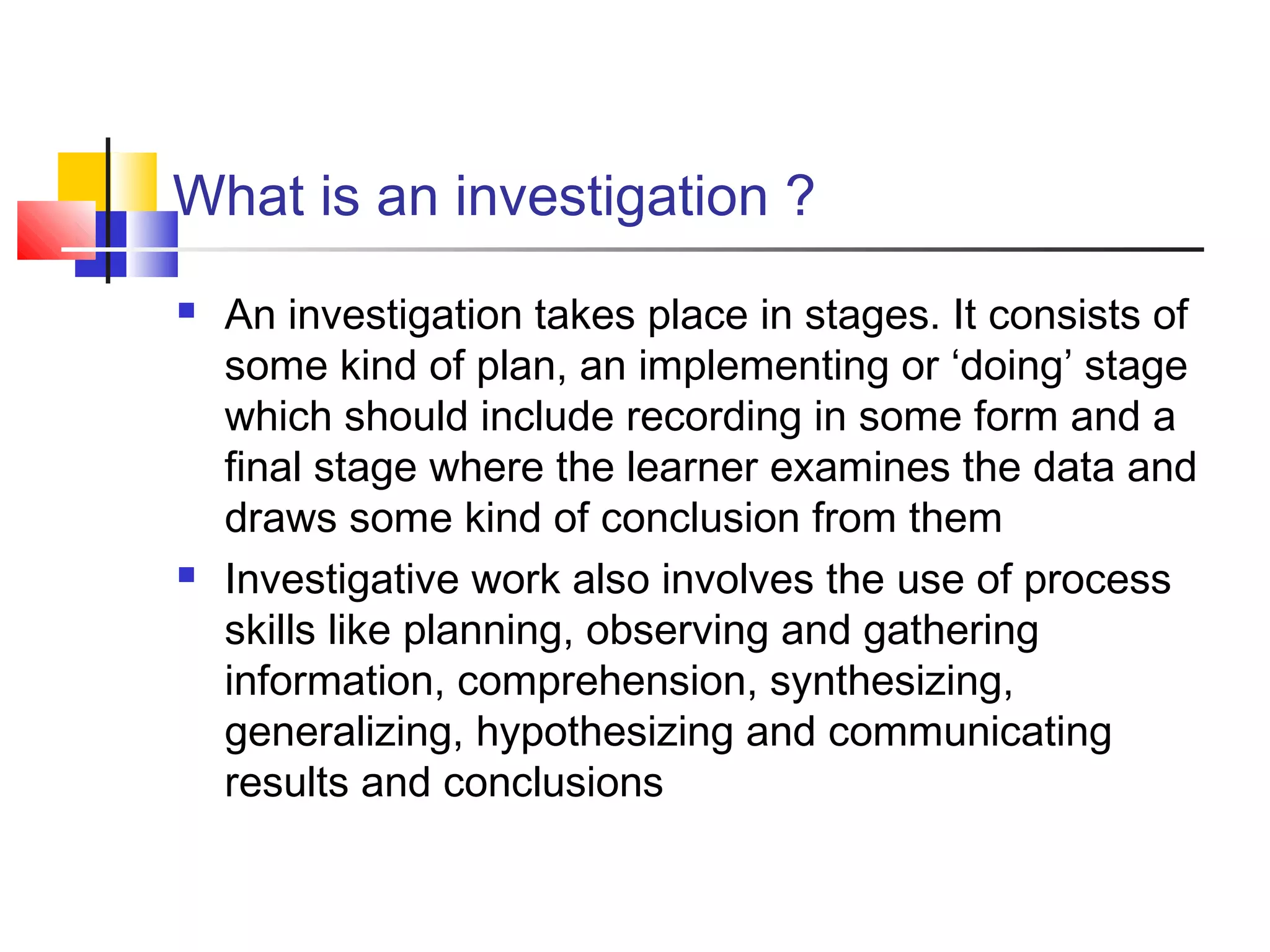
What is an investigation ?
 An investigation takes place in stages. It consists of
some kind of plan, an implementing or ‘doing’ stage
which should include recording in some form and a
final stage where the learner examines the data and
draws some kind of conclusion from them
 Investigative work also involves the use of process
skills like planning, observing and gathering
information, comprehension, synthesizing,
generalizing, hypothesizing and communicating
results and conclusions
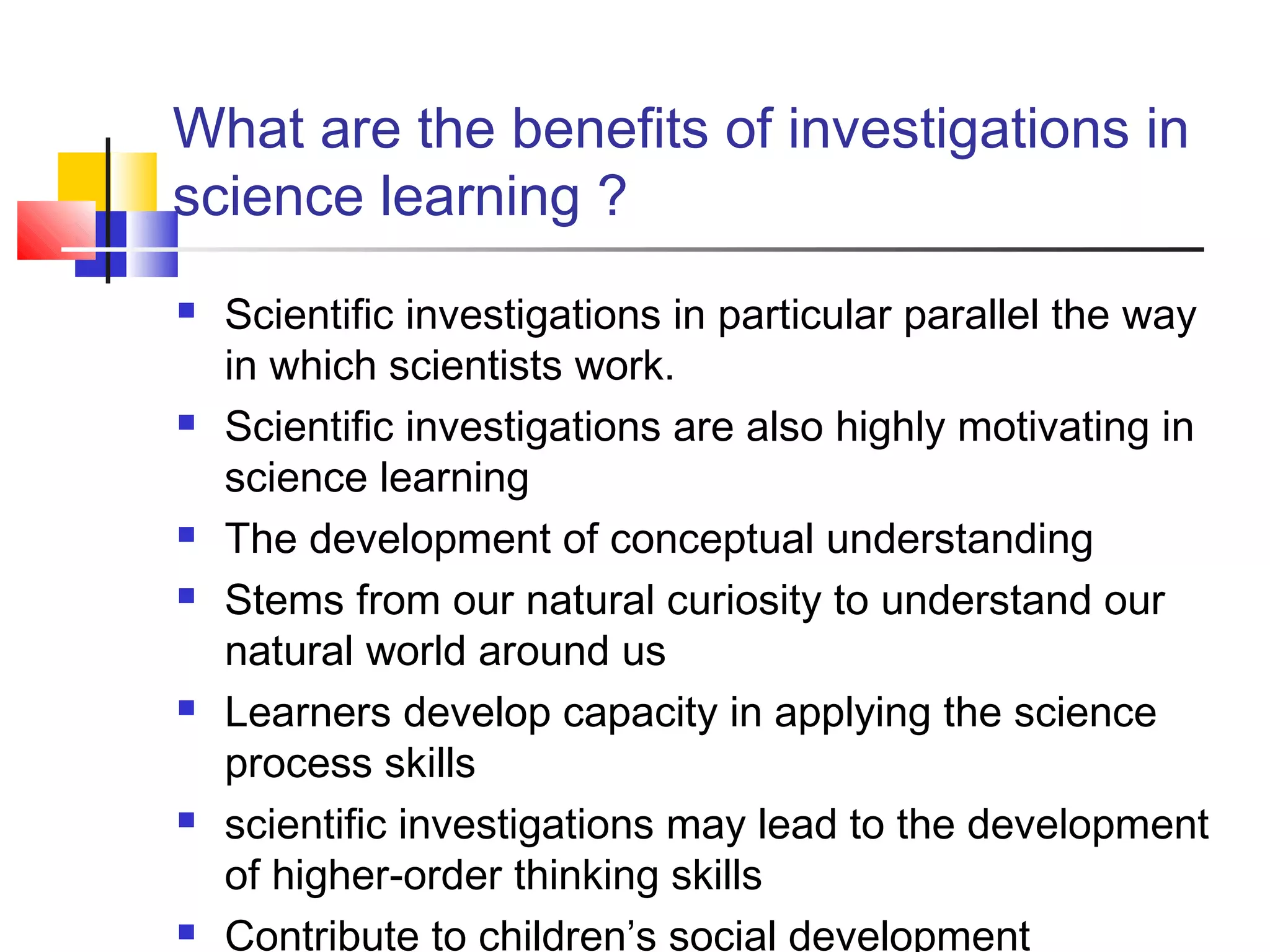
What are the benefits of investigations in
science learning ?
 Scientific investigations in particular parallel the way
in which scientists work.
 Scientific investigations are also highly motivating in
science learning
 The development of conceptual understanding
 Stems from our natural curiosity to understand our
natural world around us
 Learners develop capacity in applying the science
process skills
 scientific investigations may lead to the development
of higher-order thinking skills
 Contribute to children’s social development
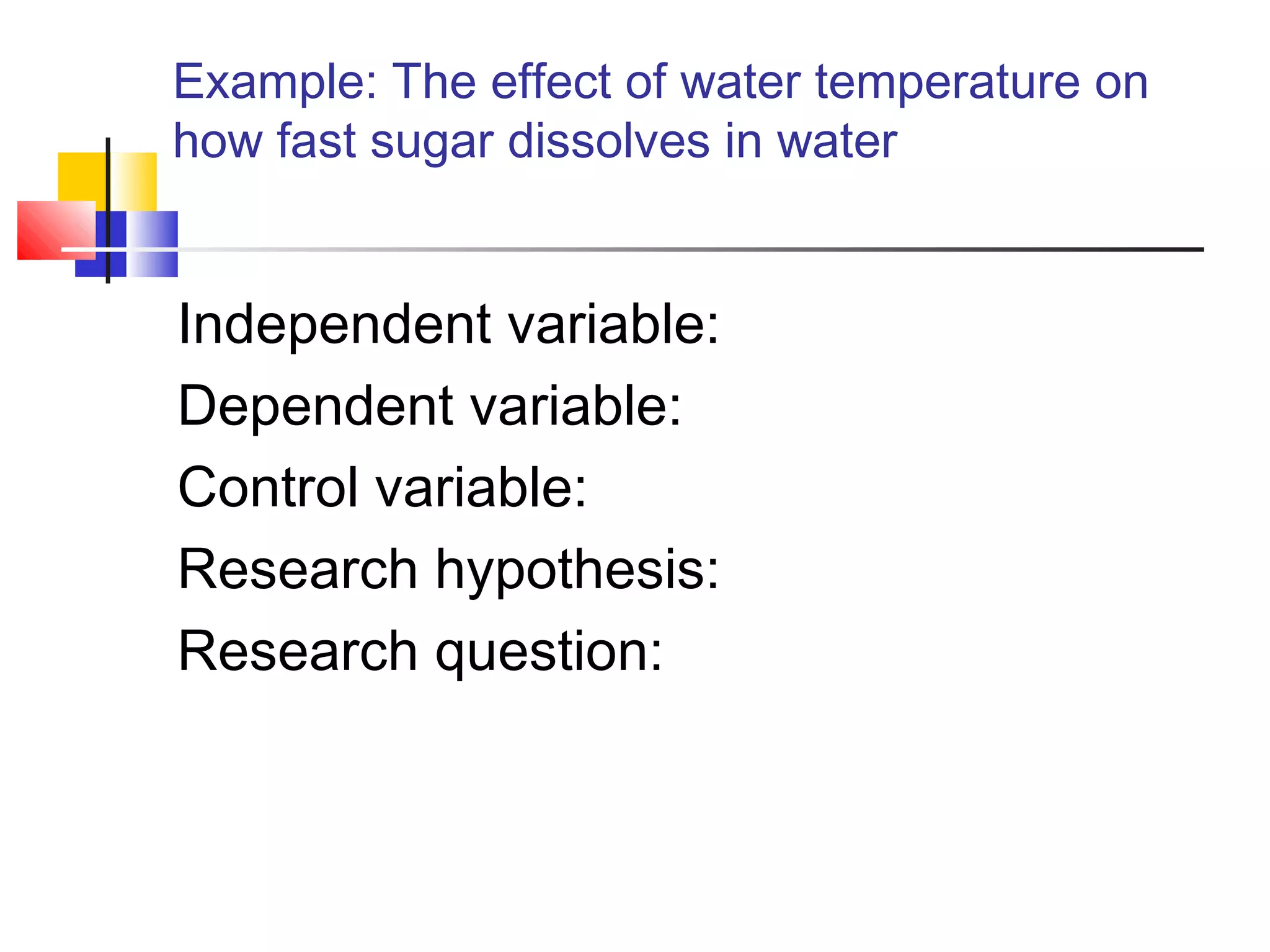
Example: The effect of water temperature on
how fast sugar dissolves in water
Independent variable:
Dependent variable:
Control variable:
Research hypothesis:
Research question:
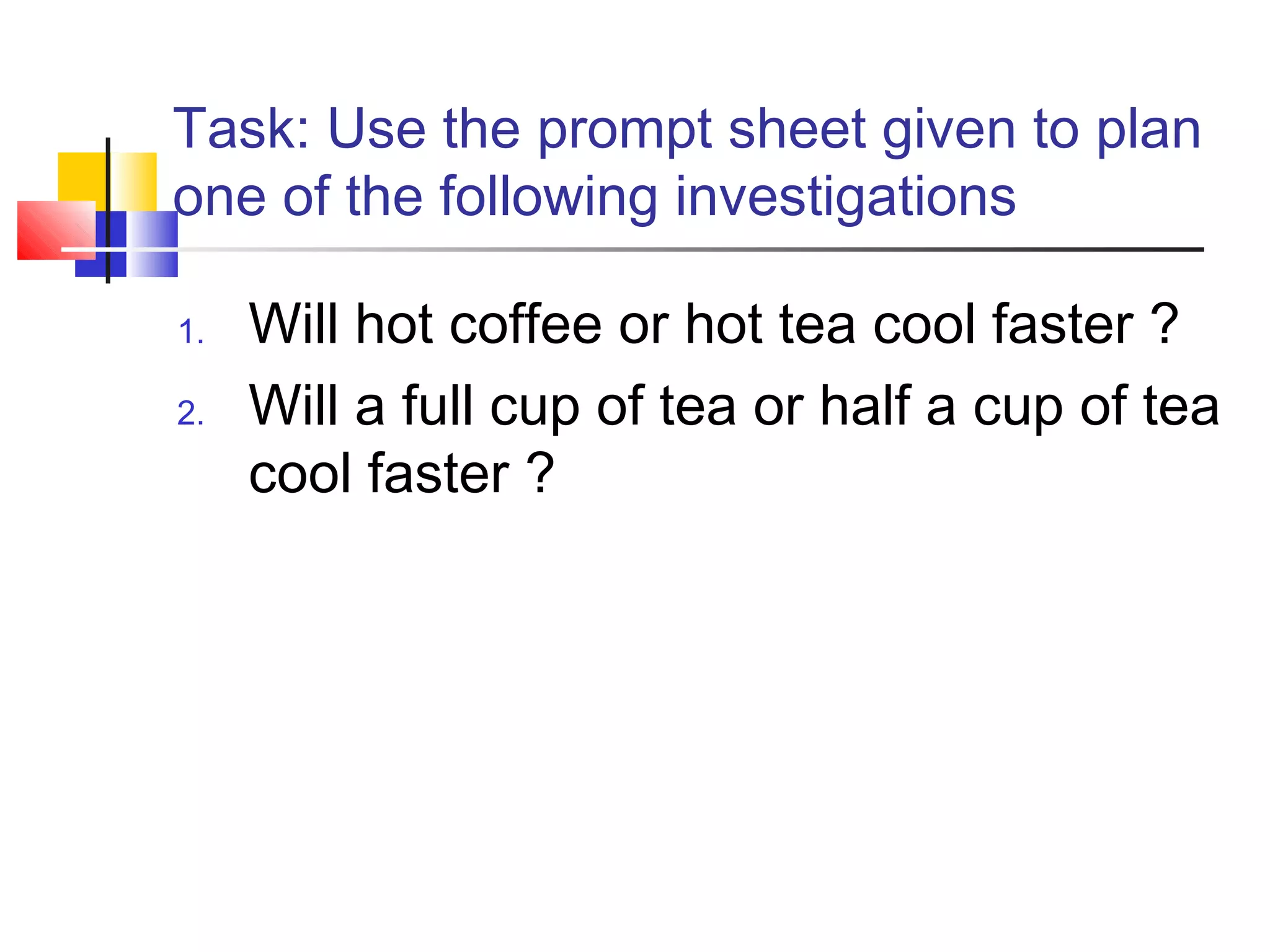
Task: Use the prompt sheet given to plan
one of the following investigations
1. Will hot coffee or hot tea cool faster ?
2. Will a full cup of tea or half a cup of tea
cool faster ?
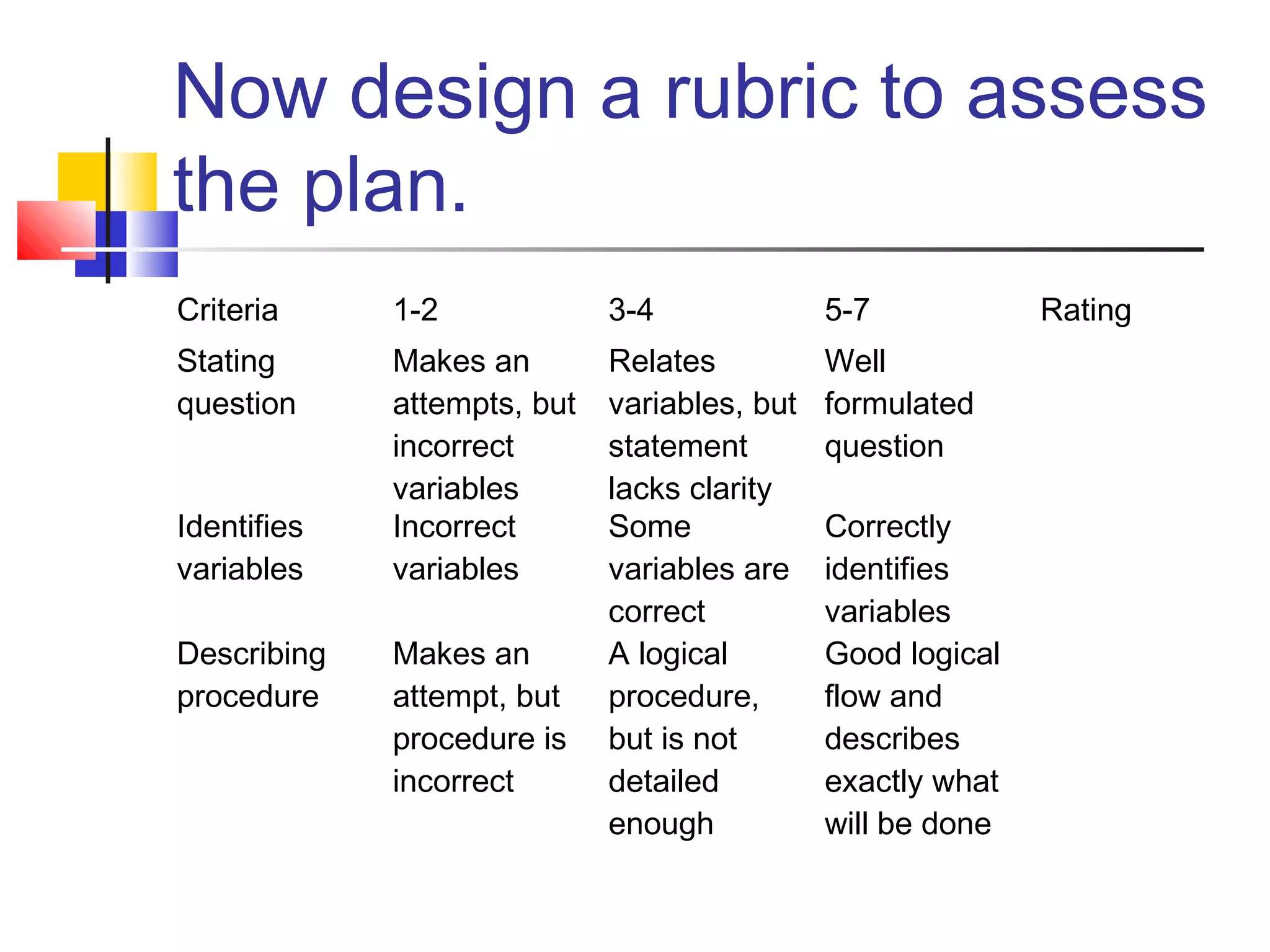
Now design a rubric to assess
the plan.
Criteria 1-2 3-4 5-7 Rating
Stating
question
Makes an
attempts, but
incorrect
variables
Relates
variables, but
statement
lacks clarity
Well
formulated
question
Identifies
variables
Incorrect
variables
Some
variables are
correct
Correctly
identifies
variables
Describing
procedure
Makes an
attempt, but
procedure is
incorrect
A logical
procedure,
but is not
detailed
enough
Good logical
flow and
describes
exactly what
will be done
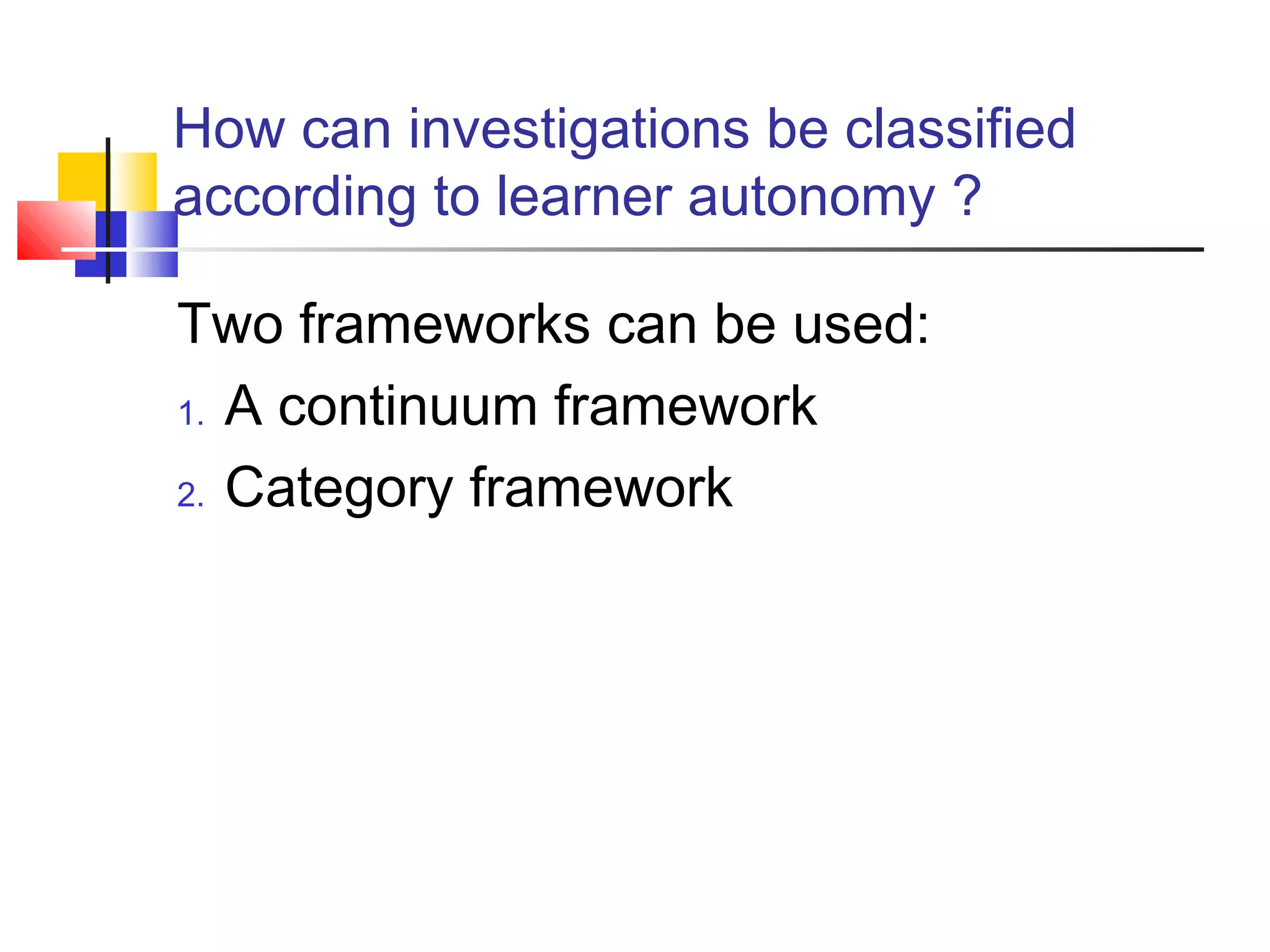
How can investigations be classified
according to learner autonomy ?
Two frameworks can be used:
1. A continuum framework
2. Category framework
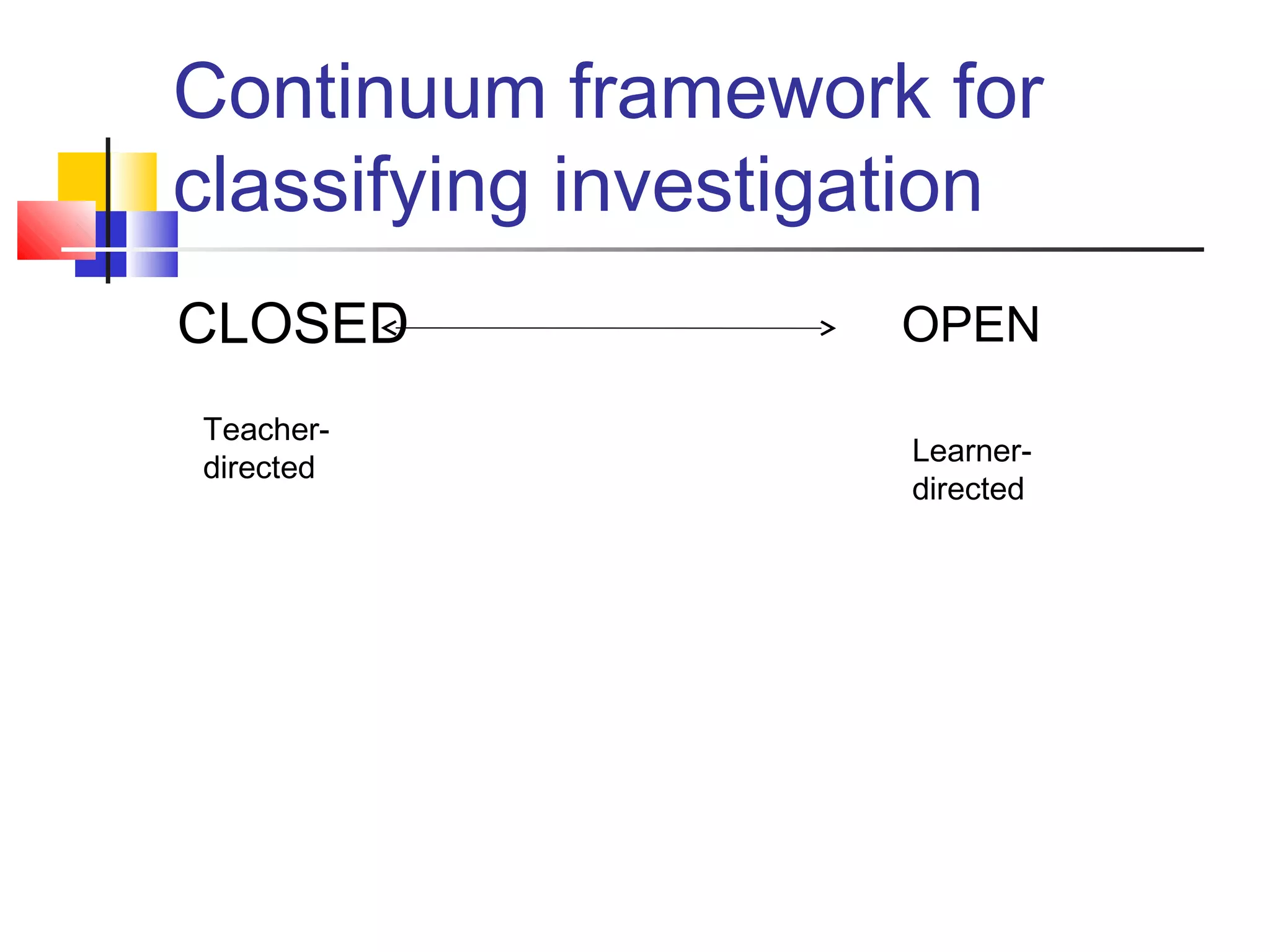
Continuum framework for
classifying investigation
CLOSED OPEN
Teacher-
directed
Learner-
directed
Category framework
Investigation type Stages of investigation
Topic Question Planning Data
collected
Conclusio
n
Structured T T T L L
Guided T T L L L
Open T L L L L
How can the teacher facilitate learner-
centred investigations ?
Teachers support learners in progressing through the
stages of the scientific investigation in the following
ways:
 asking learners questions at all stages of the
investigation
 offering learners suggestions when they are making
no progress in the investigation
 giving learners a prompt sheet which helps focus
them on the stages of the investigation
 instructing learners in the use of practical
techniques.
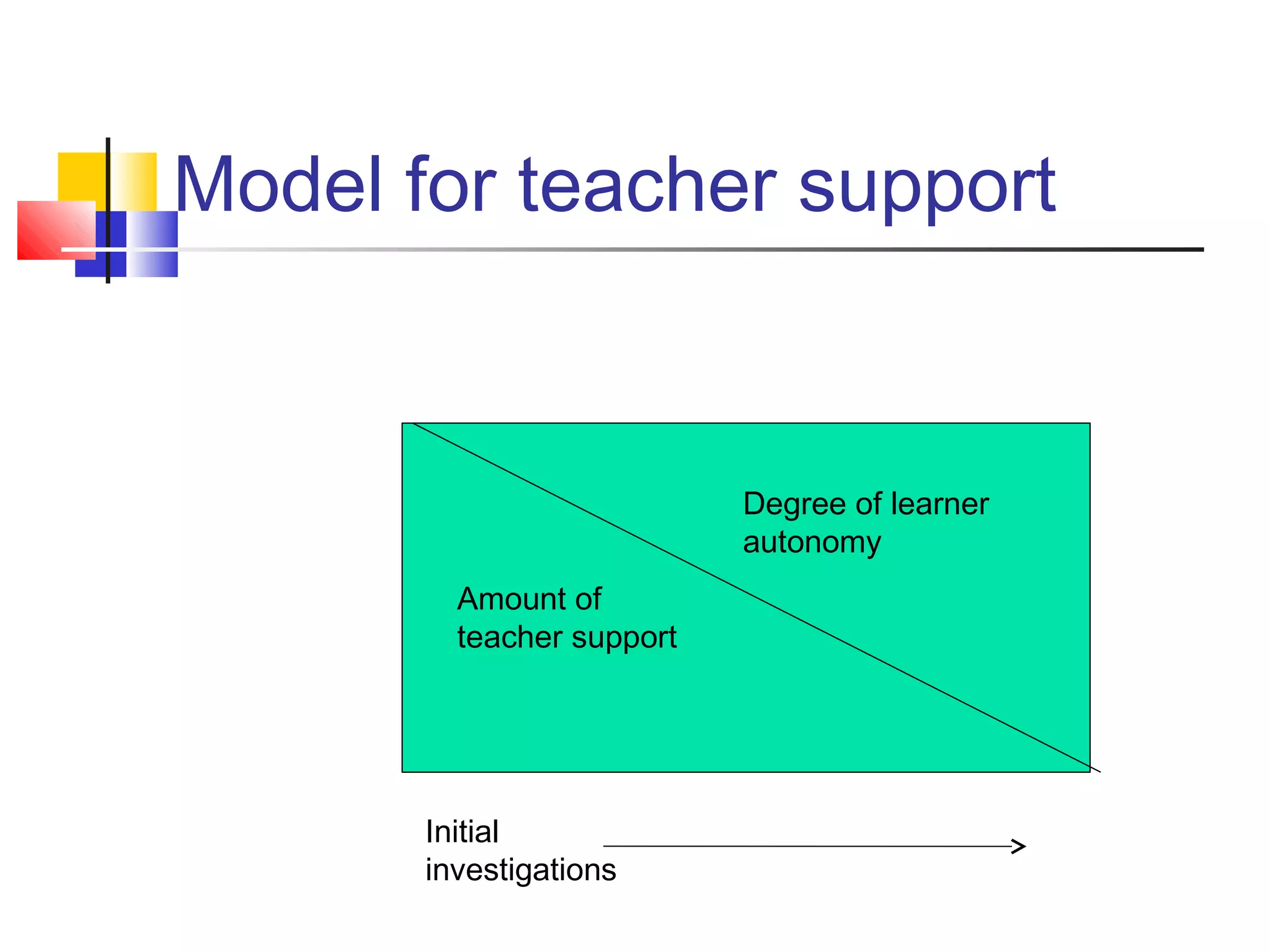
Model for teacher support
Amount of
teacher support
Degree of learner
autonomy
Initial
investigations
What co-curricular activities exist for
science ?
 Science clubs
- Interesting experiments
- A newsletter with interesting information
 Science excursions/field trips
 Science expos/fairs
 Science talks
 Science olympiads
What issues need to be considered when managing a
laboratory ?
 Safety during activities
 First aid in the science classroom
 Care and storage of materials,
chemicals and apparatus
 Stock control and stocktaking
 Ordering scientific equipment and
chemicals
How can the teacher enforce safety in the
laboratory ?
 Draw up a set of rules for learners and ensure they follow it
 Ensure learners are not left unattended in the lab.
 Lock all chemicals away and ensure there are no chemicals left
lying around
 Instruct learners about the dangers of hazardous chemicals
 Allow learners to smell and touch chemicals only under
supervision
 Do not allow learners to perform reactions which should be
demonstrated according to the Dept. guidelines
 Turn off the gas supply after the lesson
 Emergency equipment must be clearly displayed
 A first-aid kit must be accessible
 Before each activity in the laboratory, weigh the potential risk
factors against the educational value.
 Have an understanding of all the potential hazards of the
materials, the process, and the equipment involved in every
laboratory activity.
 Inspect all equipment/apparatus in the laboratory before use.
 Before entering the laboratory, instruct students on all laboratory
procedures that will be conducted.
 Discuss all safety concerns and potential hazards related to the
laboratory work that students will be conducting
Preparing for laboratory activities
General work procedure for the learners
 Never work in the laboratory without the supervision of a teacher.
 Always perform the experiments or work precisely as directed by the teacher.
 Immediately report any spills, accidents, or injuries to a teacher.
 Never leave experiments while in progress.
 Never attempt to catch a falling object.
 Be careful when handling hot glassware and apparatus in the laboratory. Hot
glassware looks just like cold glassware.
 Never point the open end of a test tube containing a substance at yourself or
others.
 Never fill a pipette using mouth suction. Always use a pipetting device.
 Make sure no flammable solvents are in the surrounding area when lighting a
flame.
 Do not leave lit Bunsen burners unattended.
 Turn off all heating apparatus, gas valves, and water faucets when not in use.
 Coats, bags, and other personal items must be stored in designated areas, not
on the bench tops or in the aisle ways.
 Keep the floor clear of all objects (e.g., ice, small objects, spilled liquids).
How should learners handle chemicals ?
 Check the label to verify it is the correct substance before using it.
 Always use a spatula or scoopula to remove a solid reagent from a container.
 Do not directly touch any chemical with your hands.
 Never use a metal spatula when working with peroxides. Metals will decompose
explosively with peroxides.
 Hold containers away from the body when transferring a chemical or solution
from one container to another.
 Use a hot water bath to heat flammable liquids. Never heat directly with a flame.
 Add concentrated acid to water slowly. Never add water to a concentrated acid.
 Weigh out or remove only the amount of chemical you will need. Do not return
the excess to its original container, but properly dispose of it in the appropriate
waste container.
 Never touch, taste, or smell any reagents.
 Never place the container directly under your nose and inhale the vapors.
 Clean up all spills properly and promptly as instructed by the teacher.
 Never handle bottles that are wet or too heavy for you.
Storage of chemicals
Criteria for storage area
Store chemicals inside a closeable cabinet or on a sturdy shelf with a front
edge lip to prevent accidents and chemical spills; a ¾-inch front edge
lip is recommended.
 Secure shelving to the wall or floor.
 Ensure that all storage areas have doors with locks.
 Keep chemical storage areas off limits to all students.
 Ventilate storage areas adequately.
Organization
 Organize chemicals first by COMPATIBILITY—not alphabetic
succession (refer to section entitled Suggested Shelf Storage Pattern—
next page).
 Store alphabetically within compatible groups.
Why use marbles when you can
use stones?
Also looking at “shoestring-
teaching” approaches
The teacher experiencing a lack of
resources (see hand-out)
Scenario: Consider this!
Assume that you accept a position as a teacher at a
rural school. Full of expectations you arrive at the
school. You dream of how you will inspire your
learners with your teaching; how you will teach them
to be critical and creative thinkers. However, a very
unpleasant surprise awaits you. On arrival at the
school, you realize that you do not have a well-
resourced classroom. Basic equipment and apparatus,
such as an overhead projector, laptop and data
projector, are not available. What do you do now?
A strategy to teach more
meaningfully
TIP 1: On arrival at the school you
should investigate all the facilities. Just
because your colleagues are not doing
practical work or hands-on learning
activities, doesn’t necessarily mean that
there is no equipment. It may still be
stored in boxes in a store room
somewhere! Get together with other
teachers in your subject/ learning area,
and develop a strategy to equip the
classrooms over a period of time.
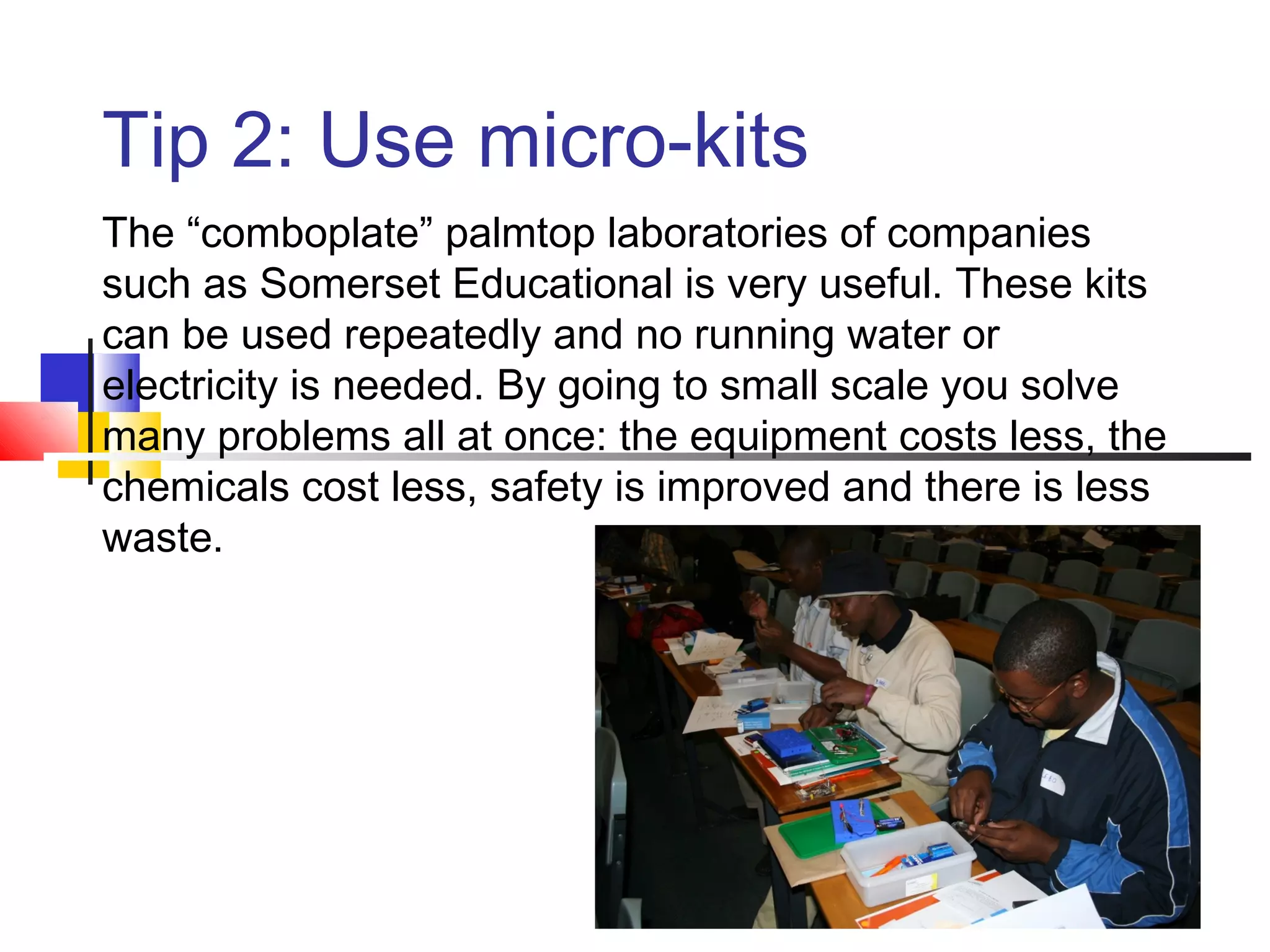
Tip 2: Use micro-kits
The “comboplate” palmtop laboratories of companies
such as Somerset Educational is very useful. These kits
can be used repeatedly and no running water or
electricity is needed. By going to small scale you solve
many problems all at once: the equipment costs less, the
chemicals cost less, safety is improved and there is less
waste.
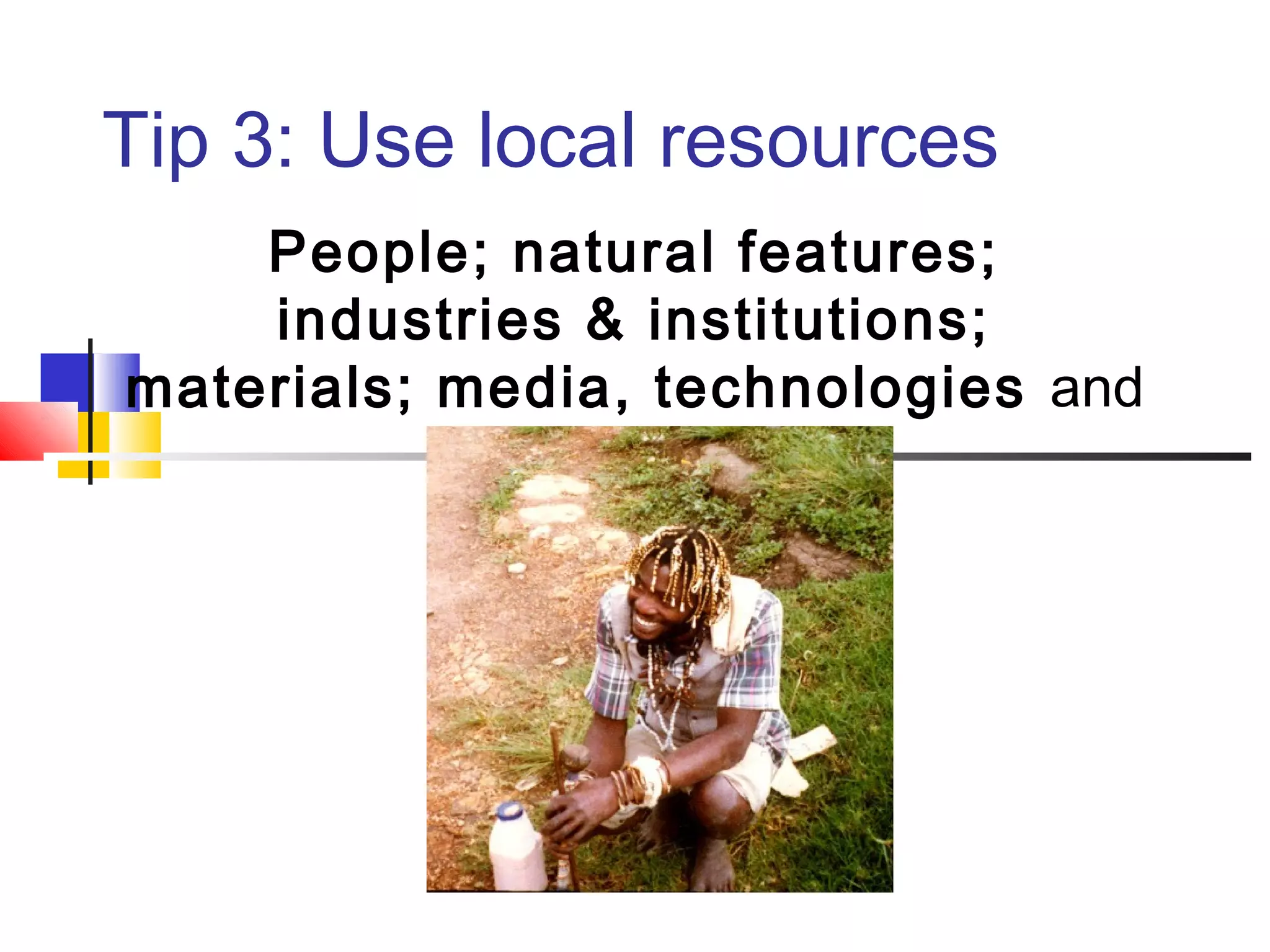
Tip 3: Use local resources
People; natural features;
industries & institutions;
materials; media, technologies and
culture.
A few examples of using local
resources
Invite members (resource persons) from the local community
to visit your classroom, and to talk to the learners. Eg, in Life
Sciences, why not invite a sangoma/ traditional healer to
class?
Visit local industries to see what happens there, and decide
how learners could benefit from a visit. This could also involve
working with a contact person to develop activities.
Identify local problems and attempts which are being made to
solve them.
Ask elders, or experienced people in the community about
local resources, customs and history and perhaps use these
as teaching points.
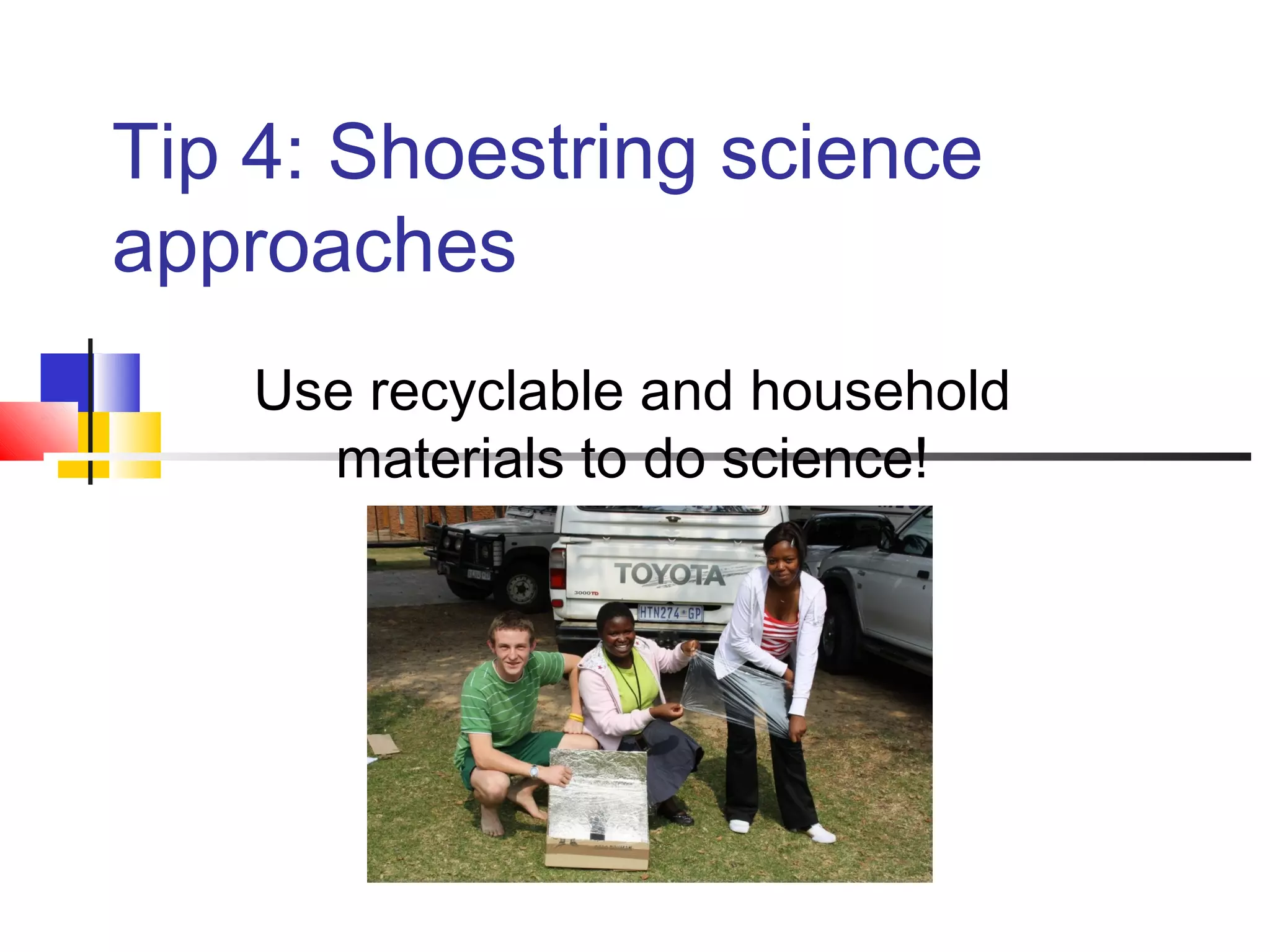
Tip 4: Shoestring science
approaches
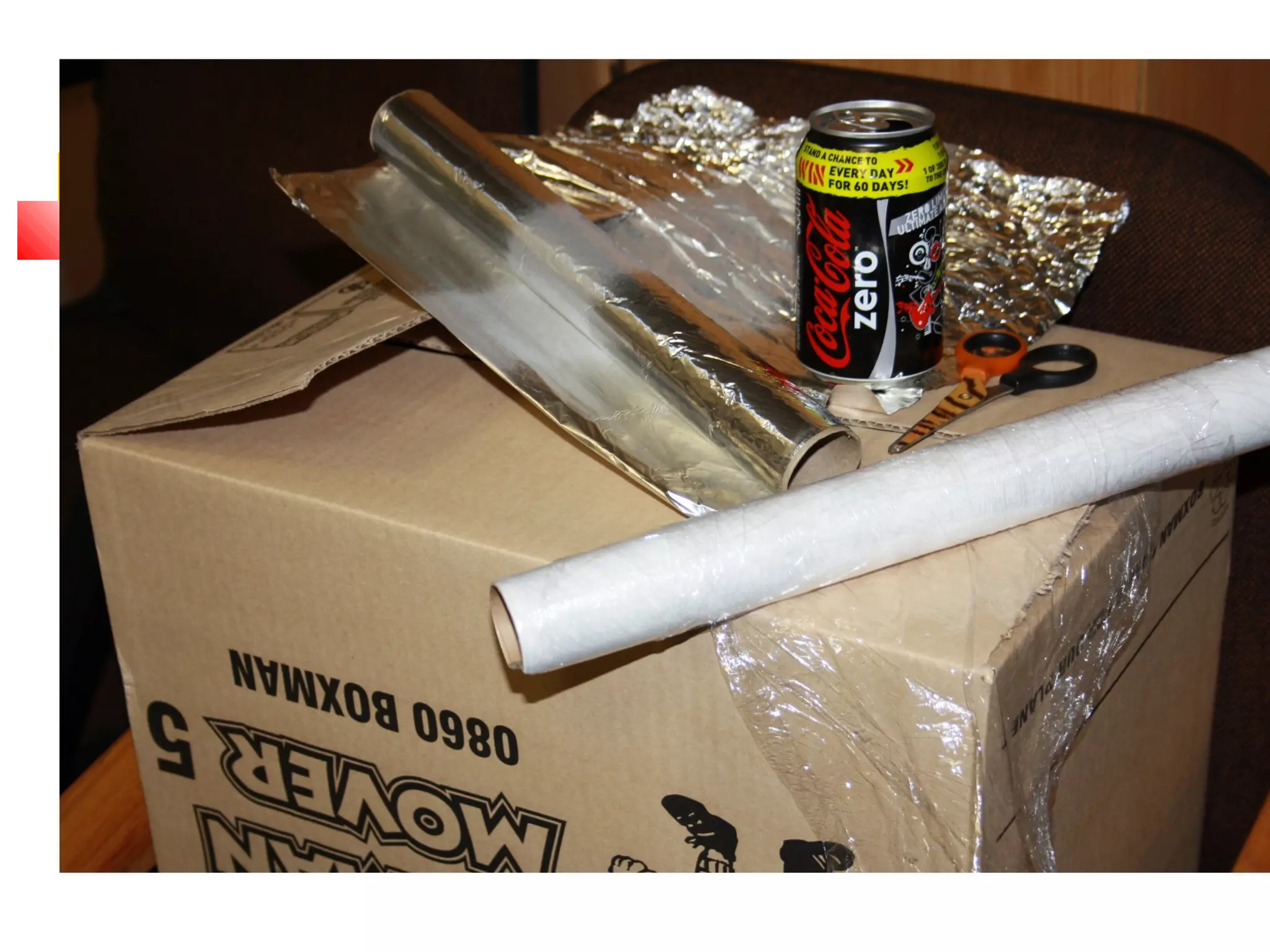
Use recyclable and household
materials to do science!
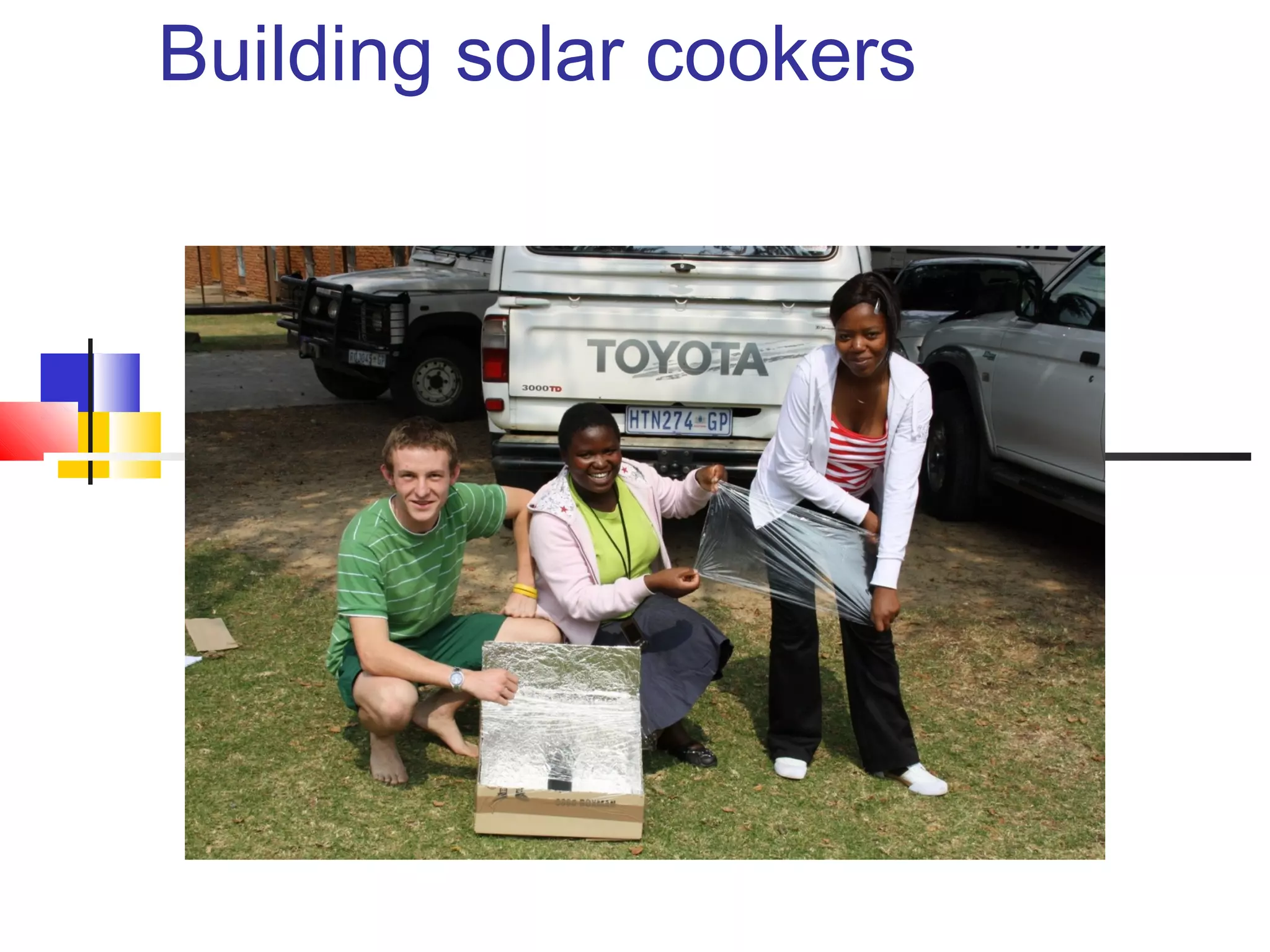
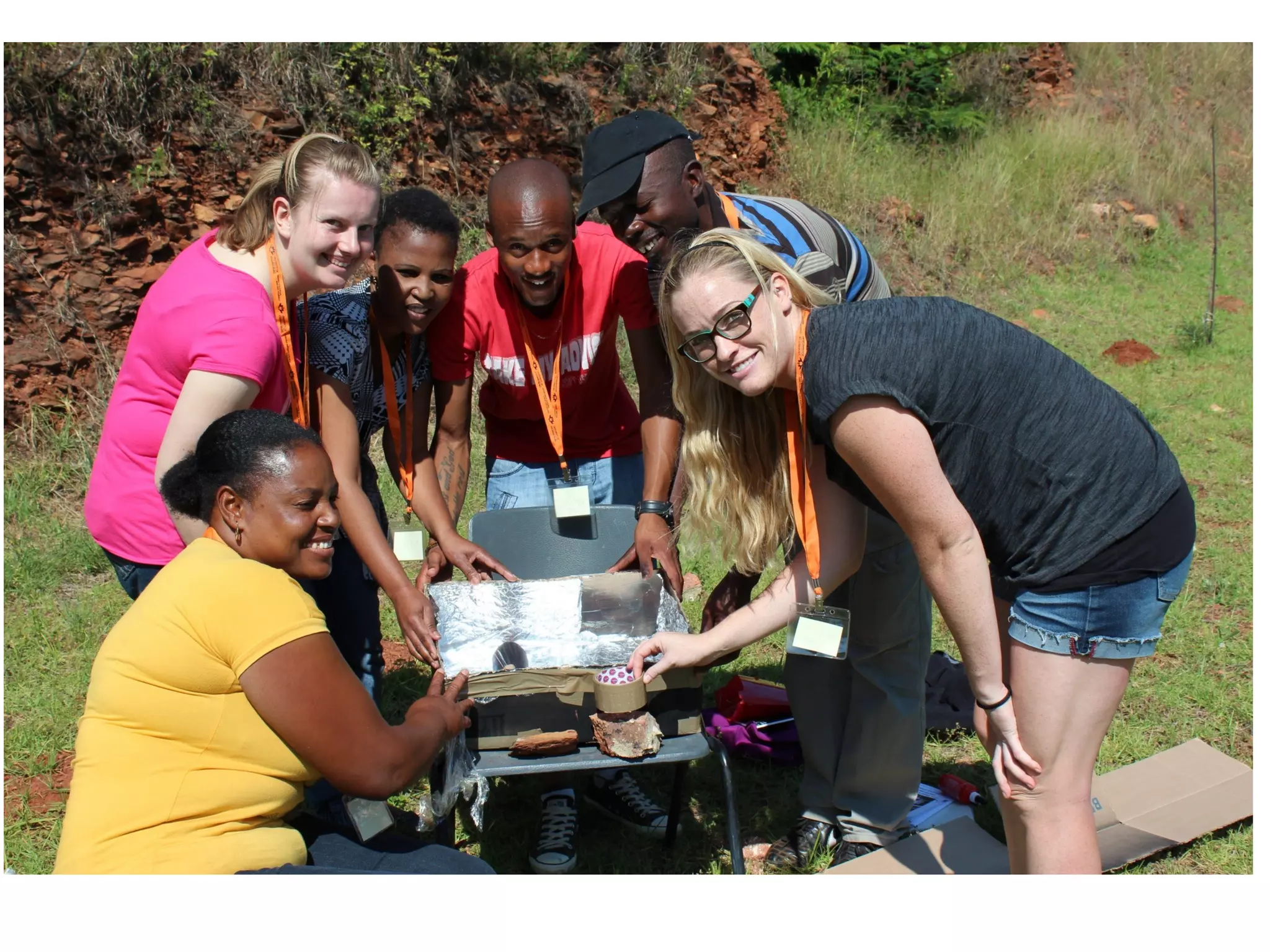
Building solar cookers
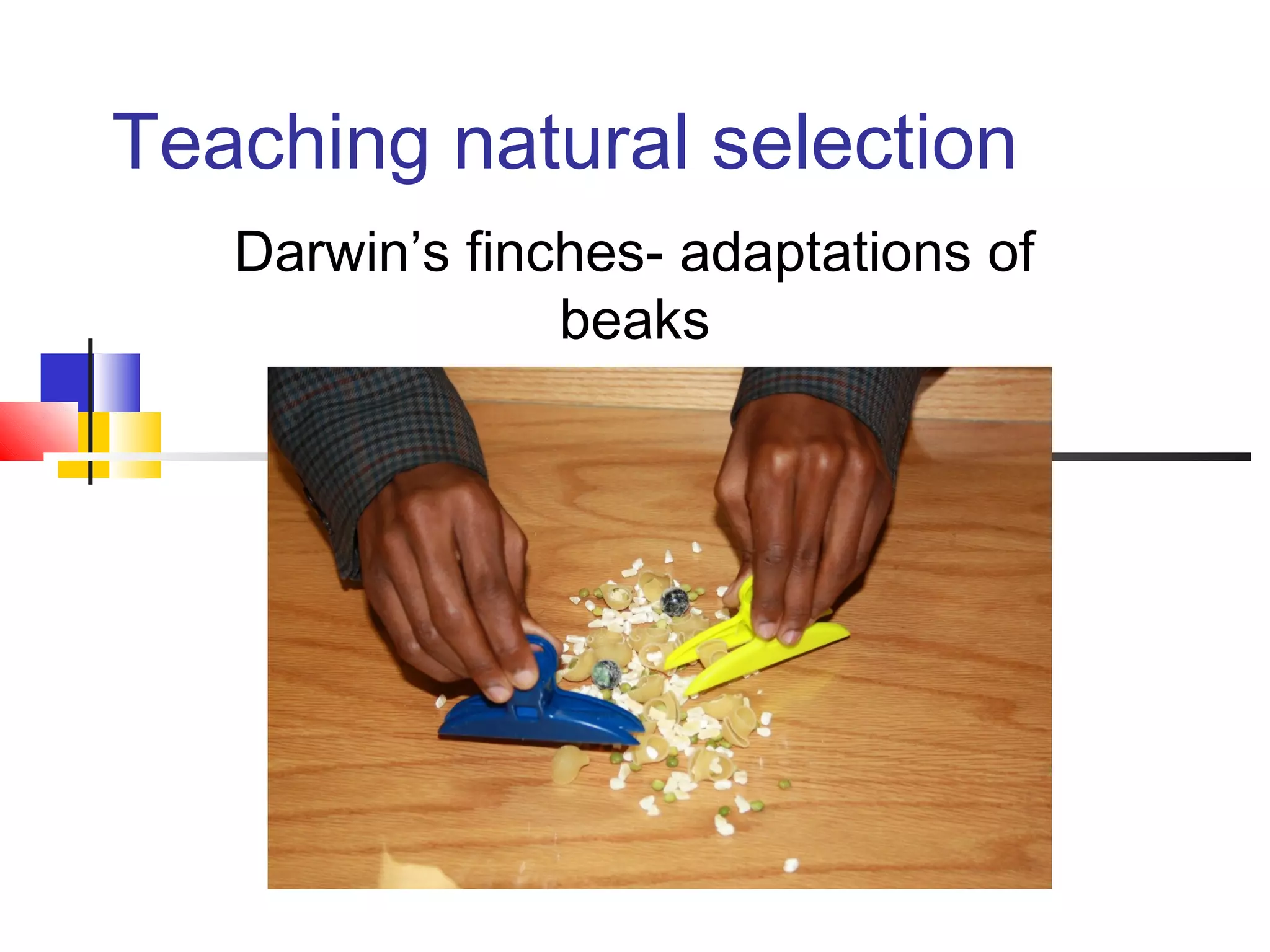
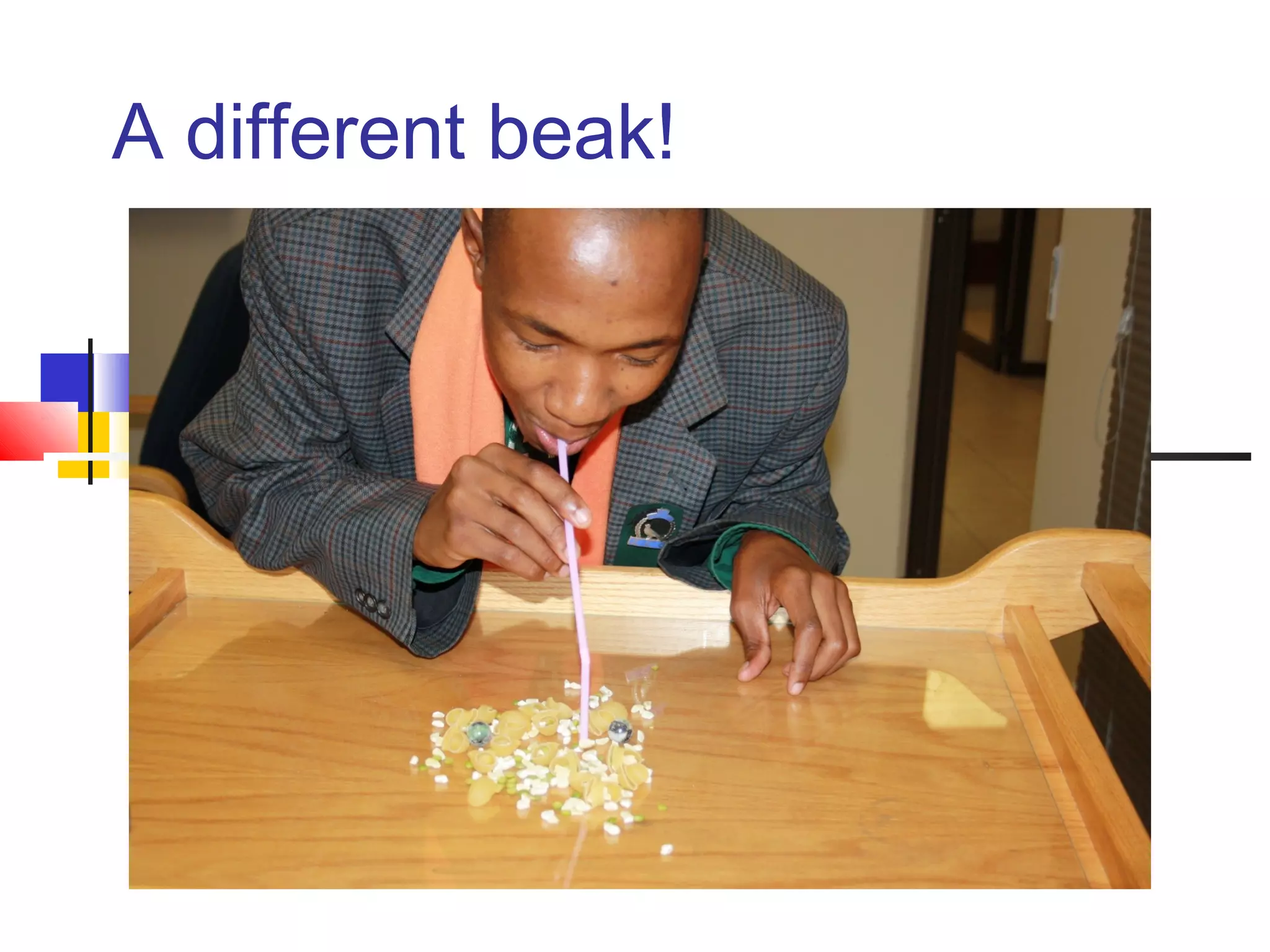
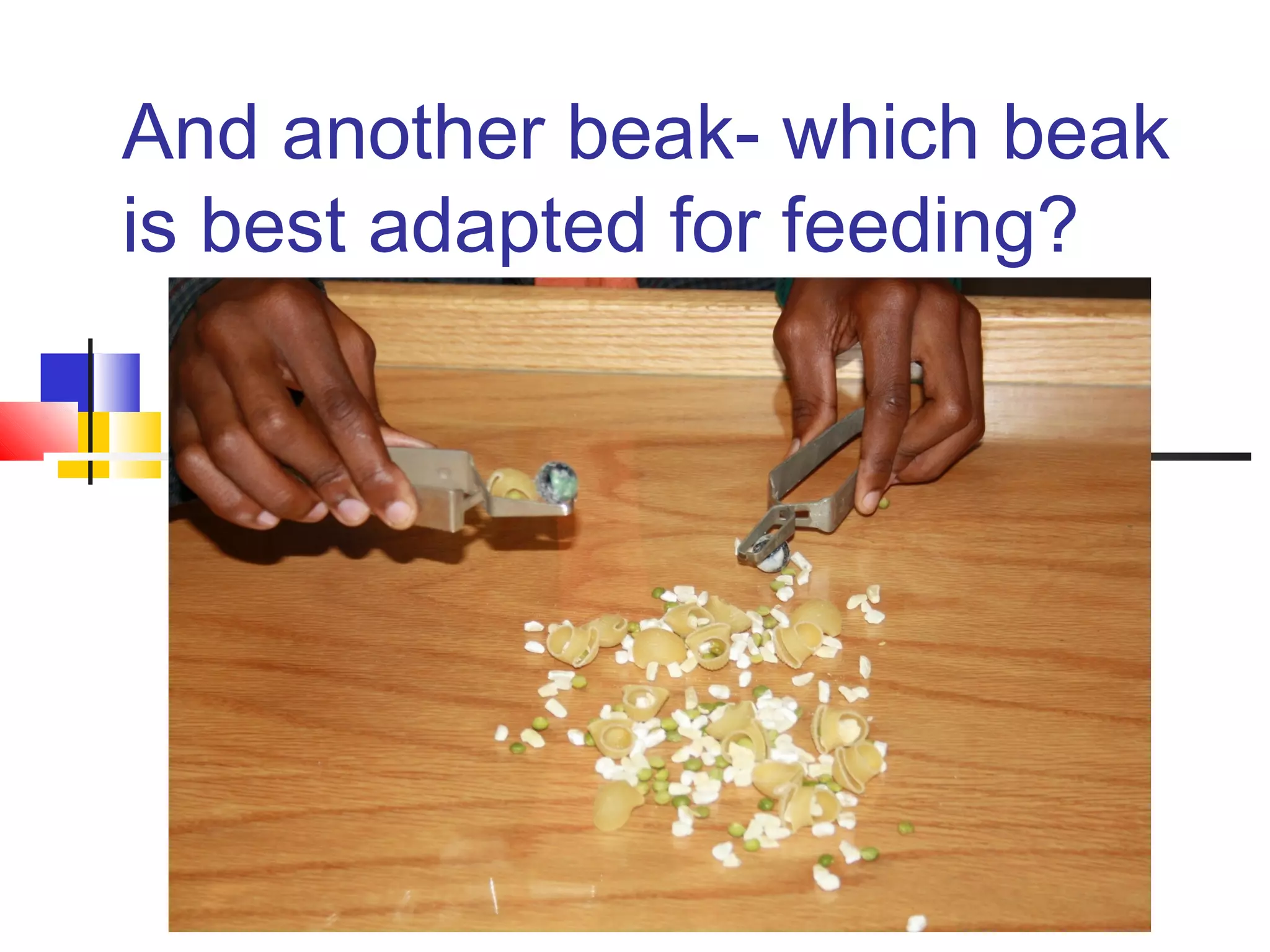
Teaching natural selection
Darwin’s finches- adaptations of
beaks
A different beak!
And another beak- which beak
is best adapted for feeding?
Extracting DNA from a
banana
WHAT YOU NEED:
•A banana
•Methylated spirits
•Sunlight Liquid (dishwasher)
•Table salt
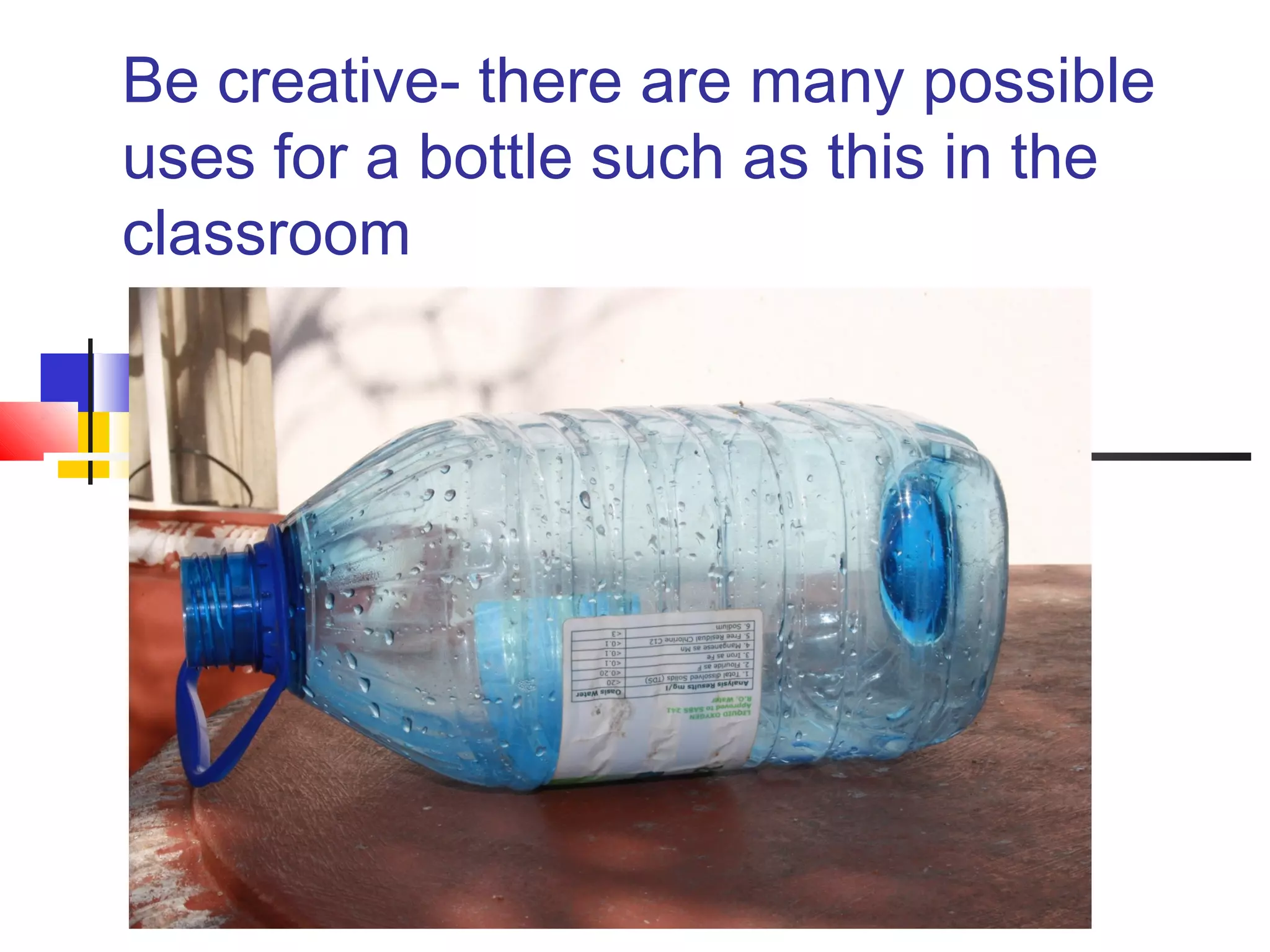
Be creative- there are many possible
uses for a bottle such as this in the
classroom
Science-on-a-shoestring
research project
 See hand-out.
 To be submitted in October, as part of
your portfolio.
 Research question to guide
investigation- e.g. will the intervention
assist learners to better understand the
phenomenon?

Xls issues in life sciences ed 12 april 2013

  • 1.
  • 2.
    Thanks for yourparticipation in Achterbergh (PGCE’s)
  • 3.
    Successful first termwith UJMA learners: average 81%
  • 4.
  • 5.
    Thanks for allof you who presented lessons!
  • 6.
    Tomorrow’s class J. Prag NLShandu QV Sibeko SW Siwela Observing (teach on 20 Apr) MM Ntlhane (Memory) Malope MG mekwa OL Ramahali
  • 7.
    School experience reflection Submit next Friday, 19 April.  Portfolios due in October, after 6 weeks prac (see hand-out)
  • 8.
    USA  Provisionally 5– 16 August (must still obtain confirmation from GSU)  See hand-out
  • 10.
    Funding  Laurika Rauchperforming on Sat 29 June.  The Dean said we can use the profits to assist you!
  • 11.
    Visit one Saturdayin May to Sci-Bono
  • 12.
  • 13.
    What does practicalwork involve ?  ‘practical work’ means any teaching and learning activity which involves at some point the students in observing or manipulating real objects and materials.
  • 14.
    How does practicalwork contribute to our understanding of the world ?  It links two domains of knowledge Domain of real objects and observable things Domain of ideas
  • 15.
    What process skillsare developed during practical work ? BASIC PROCESS SKILLS  Observing  Inferring  Measuring  Communicating  Classifying  Predicting
  • 16.
    What are thebenefits of practical work in science learning ?  motivate pupils, by stimulating interest and enjoyment  teach laboratory skills  enhance the learning of scientific knowledge by making abstract concepts appear more concrete  give insight into scientific method and develop expertise in using it  Helps to bring about conceptual change when necessary by convincing learners of the validity of a scientific idea
  • 17.
    What are someof the challenges of doing practical work ?  Lack of resources  Teachers lacking competence  Learner indiscipline
  • 18.
    How can thechallenge of a lack of resources be overcome ?  Design practical using resources which are improvised and accessible  Network with other schools in sharing equipment  Approach a tertiary institution about providing support  Enquire about agencies who may have established resources centres e.g. CASME in KZN  Enquire about the availability of micro kits for practical work
  • 19.
    How is practicalwork addressed in the NCS/CAPS ?  The place of practical work is addressed through the Specific Aim: “The learner will be able to act confidently on curiosity about natural phenomena, and to investigate relationships and solve problems in scientific, technological and environmental contexts”
  • 20.
    Compare the newapproach to practical work to the traditional one Traditional  Cookbook approach-following step-by-step instructions  Strict teacher control of learners  Results-oriented  Always took place in a laboratory New  Investigations where learners do planning  Learner allowed to interact, discuss and move about  Focus on processes  Can take place in the classroom or outside
  • 21.
    Investigations in theNCS  Scientific investigations should be the focus of practical work in science  Investigations are part of CASS  In Gr 12 learners should be able to plan their own investigations
  • 22.
    What is aninvestigation ?  An investigation takes place in stages. It consists of some kind of plan, an implementing or ‘doing’ stage which should include recording in some form and a final stage where the learner examines the data and draws some kind of conclusion from them  Investigative work also involves the use of process skills like planning, observing and gathering information, comprehension, synthesizing, generalizing, hypothesizing and communicating results and conclusions
  • 23.
    What are thebenefits of investigations in science learning ?  Scientific investigations in particular parallel the way in which scientists work.  Scientific investigations are also highly motivating in science learning  The development of conceptual understanding  Stems from our natural curiosity to understand our natural world around us  Learners develop capacity in applying the science process skills  scientific investigations may lead to the development of higher-order thinking skills  Contribute to children’s social development
  • 24.
    Example: The effectof water temperature on how fast sugar dissolves in water Independent variable: Dependent variable: Control variable: Research hypothesis: Research question:
  • 25.
    Task: Use theprompt sheet given to plan one of the following investigations 1. Will hot coffee or hot tea cool faster ? 2. Will a full cup of tea or half a cup of tea cool faster ?
  • 26.
    Now design arubric to assess the plan. Criteria 1-2 3-4 5-7 Rating Stating question Makes an attempts, but incorrect variables Relates variables, but statement lacks clarity Well formulated question Identifies variables Incorrect variables Some variables are correct Correctly identifies variables Describing procedure Makes an attempt, but procedure is incorrect A logical procedure, but is not detailed enough Good logical flow and describes exactly what will be done
  • 27.
    How can investigationsbe classified according to learner autonomy ? Two frameworks can be used: 1. A continuum framework 2. Category framework
  • 28.
    Continuum framework for classifyinginvestigation CLOSED OPEN Teacher- directed Learner- directed
  • 29.
    Category framework Investigation typeStages of investigation Topic Question Planning Data collected Conclusio n Structured T T T L L Guided T T L L L Open T L L L L
  • 30.
    How can theteacher facilitate learner- centred investigations ? Teachers support learners in progressing through the stages of the scientific investigation in the following ways:  asking learners questions at all stages of the investigation  offering learners suggestions when they are making no progress in the investigation  giving learners a prompt sheet which helps focus them on the stages of the investigation  instructing learners in the use of practical techniques.
  • 31.
    Model for teachersupport Amount of teacher support Degree of learner autonomy Initial investigations
  • 32.
    What co-curricular activitiesexist for science ?  Science clubs - Interesting experiments - A newsletter with interesting information  Science excursions/field trips  Science expos/fairs  Science talks  Science olympiads
  • 33.
    What issues needto be considered when managing a laboratory ?  Safety during activities  First aid in the science classroom  Care and storage of materials, chemicals and apparatus  Stock control and stocktaking  Ordering scientific equipment and chemicals
  • 34.
    How can theteacher enforce safety in the laboratory ?  Draw up a set of rules for learners and ensure they follow it  Ensure learners are not left unattended in the lab.  Lock all chemicals away and ensure there are no chemicals left lying around  Instruct learners about the dangers of hazardous chemicals  Allow learners to smell and touch chemicals only under supervision  Do not allow learners to perform reactions which should be demonstrated according to the Dept. guidelines  Turn off the gas supply after the lesson  Emergency equipment must be clearly displayed  A first-aid kit must be accessible
  • 35.
     Before eachactivity in the laboratory, weigh the potential risk factors against the educational value.  Have an understanding of all the potential hazards of the materials, the process, and the equipment involved in every laboratory activity.  Inspect all equipment/apparatus in the laboratory before use.  Before entering the laboratory, instruct students on all laboratory procedures that will be conducted.  Discuss all safety concerns and potential hazards related to the laboratory work that students will be conducting Preparing for laboratory activities
  • 36.
    General work procedurefor the learners  Never work in the laboratory without the supervision of a teacher.  Always perform the experiments or work precisely as directed by the teacher.  Immediately report any spills, accidents, or injuries to a teacher.  Never leave experiments while in progress.  Never attempt to catch a falling object.  Be careful when handling hot glassware and apparatus in the laboratory. Hot glassware looks just like cold glassware.  Never point the open end of a test tube containing a substance at yourself or others.  Never fill a pipette using mouth suction. Always use a pipetting device.  Make sure no flammable solvents are in the surrounding area when lighting a flame.  Do not leave lit Bunsen burners unattended.  Turn off all heating apparatus, gas valves, and water faucets when not in use.  Coats, bags, and other personal items must be stored in designated areas, not on the bench tops or in the aisle ways.  Keep the floor clear of all objects (e.g., ice, small objects, spilled liquids).
  • 37.
    How should learnershandle chemicals ?  Check the label to verify it is the correct substance before using it.  Always use a spatula or scoopula to remove a solid reagent from a container.  Do not directly touch any chemical with your hands.  Never use a metal spatula when working with peroxides. Metals will decompose explosively with peroxides.  Hold containers away from the body when transferring a chemical or solution from one container to another.  Use a hot water bath to heat flammable liquids. Never heat directly with a flame.  Add concentrated acid to water slowly. Never add water to a concentrated acid.  Weigh out or remove only the amount of chemical you will need. Do not return the excess to its original container, but properly dispose of it in the appropriate waste container.  Never touch, taste, or smell any reagents.  Never place the container directly under your nose and inhale the vapors.  Clean up all spills properly and promptly as instructed by the teacher.  Never handle bottles that are wet or too heavy for you.
  • 38.
    Storage of chemicals Criteriafor storage area Store chemicals inside a closeable cabinet or on a sturdy shelf with a front edge lip to prevent accidents and chemical spills; a ¾-inch front edge lip is recommended.  Secure shelving to the wall or floor.  Ensure that all storage areas have doors with locks.  Keep chemical storage areas off limits to all students.  Ventilate storage areas adequately. Organization  Organize chemicals first by COMPATIBILITY—not alphabetic succession (refer to section entitled Suggested Shelf Storage Pattern— next page).  Store alphabetically within compatible groups.
  • 39.
    Why use marbleswhen you can use stones? Also looking at “shoestring- teaching” approaches The teacher experiencing a lack of resources (see hand-out)
  • 40.
    Scenario: Consider this! Assumethat you accept a position as a teacher at a rural school. Full of expectations you arrive at the school. You dream of how you will inspire your learners with your teaching; how you will teach them to be critical and creative thinkers. However, a very unpleasant surprise awaits you. On arrival at the school, you realize that you do not have a well- resourced classroom. Basic equipment and apparatus, such as an overhead projector, laptop and data projector, are not available. What do you do now?
  • 41.
    A strategy toteach more meaningfully TIP 1: On arrival at the school you should investigate all the facilities. Just because your colleagues are not doing practical work or hands-on learning activities, doesn’t necessarily mean that there is no equipment. It may still be stored in boxes in a store room somewhere! Get together with other teachers in your subject/ learning area, and develop a strategy to equip the classrooms over a period of time.
  • 42.
    Tip 2: Usemicro-kits The “comboplate” palmtop laboratories of companies such as Somerset Educational is very useful. These kits can be used repeatedly and no running water or electricity is needed. By going to small scale you solve many problems all at once: the equipment costs less, the chemicals cost less, safety is improved and there is less waste.
  • 43.
    Tip 3: Uselocal resources People; natural features; industries & institutions; materials; media, technologies and culture.
  • 44.
    A few examplesof using local resources Invite members (resource persons) from the local community to visit your classroom, and to talk to the learners. Eg, in Life Sciences, why not invite a sangoma/ traditional healer to class? Visit local industries to see what happens there, and decide how learners could benefit from a visit. This could also involve working with a contact person to develop activities. Identify local problems and attempts which are being made to solve them. Ask elders, or experienced people in the community about local resources, customs and history and perhaps use these as teaching points.
  • 45.
    Tip 4: Shoestringscience approaches Use recyclable and household materials to do science!
  • 46.
  • 49.
    Teaching natural selection Darwin’sfinches- adaptations of beaks
  • 50.
  • 51.
    And another beak-which beak is best adapted for feeding?
  • 52.
    Extracting DNA froma banana WHAT YOU NEED: •A banana •Methylated spirits •Sunlight Liquid (dishwasher) •Table salt
  • 53.
    Be creative- thereare many possible uses for a bottle such as this in the classroom
  • 54.
    Science-on-a-shoestring research project  Seehand-out.  To be submitted in October, as part of your portfolio.  Research question to guide investigation- e.g. will the intervention assist learners to better understand the phenomenon?