Teaching- methods in Chemistry
Godfrey Muhwezi
EDU 2205 Friday, September 9, 2022
Friday, September 9,
2022
1
Definitions
Teaching methods are approaches made
by a teacher or instructor to help learners
acquire skills, knowledge, positive
attitudes, and values to bring a change in
behavior.
Friday, Septe
mber 9, 2022
2
.
Teacher Demonstration method
• This is where the teacher shows the learners/students how
the experiment is done.
• What does it involve?
• The teacher collects or prepares specimens/apparatus
specimens may be foods, or mixing chemicals. Apparatus may
be test tubes etc.
The teacher prepares the room e.g.
• Setting the apparatus depending on the size of the class
• Prepares the sitting arrangement i.e. the students/pupils should
be in a position to observe clearly
Friday, Septe
mber 9, 2022
3
Teacher demonstration continued
• The teacher shows clearly the learners how the experiment is
done. He demonstrates the experiment as the learners observe.
E.g. the teacher shows learners how oxygen is prepared. Add
hydrogen peroxide to manganese (IV) oxide in a flask and the
learners observe the bubbles in the flask and gas filling gas jar
• The teacher may then ask questions about the experiment
(observation)
• The teacher may again tell learners what has happened
Friday, Septe
mber 9, 2022
4
The pupils/learners
• The teacher may ask pupils to collect specimens/apparatus
• If the experiment is not dangerous, the pupils can be asked to
collect and prepare the apparatus e.g. collecting and washing test t
ubes before the experiment is demonstrated.
• The pupils may be asked to demonstrate the experiment as the
other pupils observe the color changes.
• The teacher then tells what happens during the experiment
• After the experiment, the discussion takes place
Friday, Septe
mber 9, 2022
5
When to use the demonstration method.
 It is used when the specimens/apparatus are not enough
for the whole class i.e. scarcity.
 It is employed when the time is short (minimize time
wastage)
 It is also used when the experiment is very
dangerous/specimen is dangerous/poisonous e.g.
dangerous chemicals include conc. acids, hydrogen
peroxide, etc.
 It is then employed when the experiment is hard or
tough e.g. dissection.
Friday, Septe
mber 9, 2022
6
Advantages of demonstration
 It stimulates or motivates learners hence better underst
anding
 It saves time hence the teacher is able to finish the syll
abus which builds confidence within the learners.
 Delivery of the right material e.g you cant prepare Hyd
rogen gas using the wrong reagents.
 It develops biological or scientific skills like observati
on, recording, and discussion.
 It builds confidence as learners observe the expected c
olor changes and observation of specimens.
Friday, Septe
mber 9, 2022
7
Disadvantages of demonstration
 Sometimes it is teacher-centered; learners are
deprived of the chance to touch the apparatus
etc.
 Being teacher-centered does not help the
pupils think.
 It doesn’t stimulate or motivate learners
because learners don’t touch the
specimens/Apparatus.
Friday, Septe
mber 9, 2022
8
Guided discovery method
This is a generative method that helps
students arrive at the required answers. It
involves the use of prefixes and
incomplete situations which can be
accomplished by the students
Friday, Septe
mber 9, 2022
9
Advantages
 It helps to develop most of the scientific skills i.e.
observation, fact-finding, analyzing, identifying,
conclusion, recommendation, etc.
 Helps students to participate actively i.e. to think
which yields better understanding and hard to forget
 It is student-centered
 It creates a sense of confidence in the pupil
 Develops a sense of speech or communication.
Friday, Septe
mber 9, 2022
10
Disadvantages
 It is time-consuming
 It requires a lot of materials to be effective
i.e. it is inefficient in schools without
materials.
 With the vast expanse of knowledge ever
growing, it is not possible for the student to
discover all laws and principles by himself.
Friday, Septe
mber 9, 2022
11
RESOURCE BASED METHOD/PROJECT METH
OD
This is a way of finding out information
 It is a method whereby learners or students find out info
rmation from various sources i.e. libraries, books, maga
zines, newspapers, charts, diagrams
 Collection of specimens from the local environment e.g.
flowers, leaves, ink, etc.
 Information can be got through discussions
 Audio visuals –radios, TVs, videos (programs)
 Information can be got from museums and zoos.
Friday, Septe
mber 9, 2022
12
ASSIGNMENT METHOD
• This is where students are given a task, q
uiz, or question and they look for the pos
sible answers. Students are encouraged to
make research on their own. This can be
done individually or in groups. Each grou
p may then report the findings for criticis
ms, approvals, and additions.
Friday, Septe
mber 9, 2022
13
QUESTION AND ANSWER TECHNIQUE
• This is the best method of teaching. It is
through questions. The teacher teaches by
questioning pupils who in turn answer the
questions.
• This is the teaching through question and
answer technique by giving pupils questions to
answer. It stimulates the thinking of pupils i.e.
encourages pupils to think for better
understanding. As you teach, there are different
types of questions.
14
Types of questions
Factual/memory questions. These call for recalling
of facts e.g. what is effervescence?
High-order questions. These call for thinking,
stimulating thought. These include why, what, how
e.g. how are acids different from bases? Why is ice
less dense than water?
Probing questions. These are questions that you ask
as you teach. You think about them as you teach.
• Friday, September 9, 2022
15
Questions to avoid while teaching
a) Do you understand?
b) Avoid questions that give chorus
answers e.g. is it clear? Better ask; who
doesn’t understand?
c)Don’t ask questions that have obvious
answers e.g. yes/no.
• Friday, September 9, 2022
16
LECTURE METHOD.
• It is a teacher-centered method. Learners
only listen, they have no chance to talk, or
passively participate, and notes are given by
dictating. He may demonstrate experiments
as learners observe and take notes. The
teacher may only pass handouts, notes can
be sent to a member of the class for
dictating, and films can be seen on certain
topics. 17
.
Advantages of lecture method:
 It is a quick method /time saving
 Students pay attention
 Major points are emphasized
 It gives the teacher confidence
 There is a wider coverage of the syllabus
 Students learn summary note writing
 It may help to stimulate interest/enthusiasm to the
learner by using sweet words, simple words that make
the lecture lively.
 Encourages students to read on their own 18
Disadvantages
 It is teacher-centered
 There is lack of feedback from students
 Only above-average students grasp something
 It can be boring if no sweet language is used and there is
communication skills and use of hard words
 It is not applicable to beginners
 Creates a big gap between the teacher and pupils
 It overworks the teacher
• It is discouraged because learners are not involved in scientif
skills i.e. observing, discussing, analyzing, fact finding, and
identifying
• Friday, September 9, 2022
19
How to improve lecture method
• Friday, September 9, 2022
20
 Use of language-simple, suitable, level to the class and
vocabulary
 Communication should be improved i.e. be straight
forward
 Duration should not be long to avoid monotony
 Use illustrative aids-audio visual aids to supplement
lecture.
 Emphasize or reinforce main ideas
 Use stimulating voice and speed: don’t bark
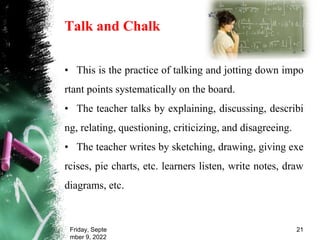
Talk and Chalk
• This is the practice of talking and jotting down impo
rtant points systematically on the board.
• The teacher talks by explaining, discussing, describi
ng, relating, questioning, criticizing, and disagreeing.
• The teacher writes by sketching, drawing, giving exe
rcises, pie charts, etc. learners listen, write notes, draw
diagrams, etc.
Friday, Septe
mber 9, 2022
21
Talk and chalk cont’d
Advantages:
 A good number of senses are use
d e.g. hearing and seeing.
 It is guided teaching therefore cor
rect information is written e.g. cor
rect spelling
 It is good for slow learners.
 Helps students with impaired hear
ing senses
 Material can be copied later.
Disadvantages
 It is teacher-centered since the teacher
talks and writes.
 Language may be hard for the pupils h
ence low understanding
 Hand writing may be the worst hence
wrong information may be written.
 It is time-consuming hence the syllabu
ses may not be completed. Learners m
ay lose passing confidence
 Scientific skills may not be developed.
22
How to improve Talk and chalk
 Emphasis should be put on question asking
 Use valid illustrative teaching materials and
good aids
Friday, Septe
mber 9, 2022
23
Breakout sessions (8 min discussions,5
minutes presentation)
• Group1; Discuss the resources you would use to
teach the Periodic table and the methods you
would use.
• Group2: Discuss the resources you would use to
teach the Preparation of hydrogen and the methods
you would use.
• Group3: Discuss the resources you would use to
teach covalent bonding and the methods you would
use.
Friday, Septe
mber 9, 2022
24
Thank you.
Friday, Septe
mber 9, 2022
25

Teaching methods in Chemistry.pptx

  • 1.
    Teaching- methods inChemistry Godfrey Muhwezi EDU 2205 Friday, September 9, 2022 Friday, September 9, 2022 1
  • 2.
    Definitions Teaching methods areapproaches made by a teacher or instructor to help learners acquire skills, knowledge, positive attitudes, and values to bring a change in behavior. Friday, Septe mber 9, 2022 2
  • 3.
    . Teacher Demonstration method •This is where the teacher shows the learners/students how the experiment is done. • What does it involve? • The teacher collects or prepares specimens/apparatus specimens may be foods, or mixing chemicals. Apparatus may be test tubes etc. The teacher prepares the room e.g. • Setting the apparatus depending on the size of the class • Prepares the sitting arrangement i.e. the students/pupils should be in a position to observe clearly Friday, Septe mber 9, 2022 3
  • 4.
    Teacher demonstration continued •The teacher shows clearly the learners how the experiment is done. He demonstrates the experiment as the learners observe. E.g. the teacher shows learners how oxygen is prepared. Add hydrogen peroxide to manganese (IV) oxide in a flask and the learners observe the bubbles in the flask and gas filling gas jar • The teacher may then ask questions about the experiment (observation) • The teacher may again tell learners what has happened Friday, Septe mber 9, 2022 4
  • 5.
    The pupils/learners • Theteacher may ask pupils to collect specimens/apparatus • If the experiment is not dangerous, the pupils can be asked to collect and prepare the apparatus e.g. collecting and washing test t ubes before the experiment is demonstrated. • The pupils may be asked to demonstrate the experiment as the other pupils observe the color changes. • The teacher then tells what happens during the experiment • After the experiment, the discussion takes place Friday, Septe mber 9, 2022 5
  • 6.
    When to usethe demonstration method.  It is used when the specimens/apparatus are not enough for the whole class i.e. scarcity.  It is employed when the time is short (minimize time wastage)  It is also used when the experiment is very dangerous/specimen is dangerous/poisonous e.g. dangerous chemicals include conc. acids, hydrogen peroxide, etc.  It is then employed when the experiment is hard or tough e.g. dissection. Friday, Septe mber 9, 2022 6
  • 7.
    Advantages of demonstration It stimulates or motivates learners hence better underst anding  It saves time hence the teacher is able to finish the syll abus which builds confidence within the learners.  Delivery of the right material e.g you cant prepare Hyd rogen gas using the wrong reagents.  It develops biological or scientific skills like observati on, recording, and discussion.  It builds confidence as learners observe the expected c olor changes and observation of specimens. Friday, Septe mber 9, 2022 7
  • 8.
    Disadvantages of demonstration Sometimes it is teacher-centered; learners are deprived of the chance to touch the apparatus etc.  Being teacher-centered does not help the pupils think.  It doesn’t stimulate or motivate learners because learners don’t touch the specimens/Apparatus. Friday, Septe mber 9, 2022 8
  • 9.
    Guided discovery method Thisis a generative method that helps students arrive at the required answers. It involves the use of prefixes and incomplete situations which can be accomplished by the students Friday, Septe mber 9, 2022 9
  • 10.
    Advantages  It helpsto develop most of the scientific skills i.e. observation, fact-finding, analyzing, identifying, conclusion, recommendation, etc.  Helps students to participate actively i.e. to think which yields better understanding and hard to forget  It is student-centered  It creates a sense of confidence in the pupil  Develops a sense of speech or communication. Friday, Septe mber 9, 2022 10
  • 11.
    Disadvantages  It istime-consuming  It requires a lot of materials to be effective i.e. it is inefficient in schools without materials.  With the vast expanse of knowledge ever growing, it is not possible for the student to discover all laws and principles by himself. Friday, Septe mber 9, 2022 11
  • 12.
    RESOURCE BASED METHOD/PROJECTMETH OD This is a way of finding out information  It is a method whereby learners or students find out info rmation from various sources i.e. libraries, books, maga zines, newspapers, charts, diagrams  Collection of specimens from the local environment e.g. flowers, leaves, ink, etc.  Information can be got through discussions  Audio visuals –radios, TVs, videos (programs)  Information can be got from museums and zoos. Friday, Septe mber 9, 2022 12
  • 13.
    ASSIGNMENT METHOD • Thisis where students are given a task, q uiz, or question and they look for the pos sible answers. Students are encouraged to make research on their own. This can be done individually or in groups. Each grou p may then report the findings for criticis ms, approvals, and additions. Friday, Septe mber 9, 2022 13
  • 14.
    QUESTION AND ANSWERTECHNIQUE • This is the best method of teaching. It is through questions. The teacher teaches by questioning pupils who in turn answer the questions. • This is the teaching through question and answer technique by giving pupils questions to answer. It stimulates the thinking of pupils i.e. encourages pupils to think for better understanding. As you teach, there are different types of questions. 14
  • 15.
    Types of questions Factual/memoryquestions. These call for recalling of facts e.g. what is effervescence? High-order questions. These call for thinking, stimulating thought. These include why, what, how e.g. how are acids different from bases? Why is ice less dense than water? Probing questions. These are questions that you ask as you teach. You think about them as you teach. • Friday, September 9, 2022 15
  • 16.
    Questions to avoidwhile teaching a) Do you understand? b) Avoid questions that give chorus answers e.g. is it clear? Better ask; who doesn’t understand? c)Don’t ask questions that have obvious answers e.g. yes/no. • Friday, September 9, 2022 16
  • 17.
    LECTURE METHOD. • Itis a teacher-centered method. Learners only listen, they have no chance to talk, or passively participate, and notes are given by dictating. He may demonstrate experiments as learners observe and take notes. The teacher may only pass handouts, notes can be sent to a member of the class for dictating, and films can be seen on certain topics. 17
  • 18.
    . Advantages of lecturemethod:  It is a quick method /time saving  Students pay attention  Major points are emphasized  It gives the teacher confidence  There is a wider coverage of the syllabus  Students learn summary note writing  It may help to stimulate interest/enthusiasm to the learner by using sweet words, simple words that make the lecture lively.  Encourages students to read on their own 18
  • 19.
    Disadvantages  It isteacher-centered  There is lack of feedback from students  Only above-average students grasp something  It can be boring if no sweet language is used and there is communication skills and use of hard words  It is not applicable to beginners  Creates a big gap between the teacher and pupils  It overworks the teacher • It is discouraged because learners are not involved in scientif skills i.e. observing, discussing, analyzing, fact finding, and identifying • Friday, September 9, 2022 19
  • 20.
    How to improvelecture method • Friday, September 9, 2022 20  Use of language-simple, suitable, level to the class and vocabulary  Communication should be improved i.e. be straight forward  Duration should not be long to avoid monotony  Use illustrative aids-audio visual aids to supplement lecture.  Emphasize or reinforce main ideas  Use stimulating voice and speed: don’t bark
  • 21.
    Talk and Chalk •This is the practice of talking and jotting down impo rtant points systematically on the board. • The teacher talks by explaining, discussing, describi ng, relating, questioning, criticizing, and disagreeing. • The teacher writes by sketching, drawing, giving exe rcises, pie charts, etc. learners listen, write notes, draw diagrams, etc. Friday, Septe mber 9, 2022 21
  • 22.
    Talk and chalkcont’d Advantages:  A good number of senses are use d e.g. hearing and seeing.  It is guided teaching therefore cor rect information is written e.g. cor rect spelling  It is good for slow learners.  Helps students with impaired hear ing senses  Material can be copied later. Disadvantages  It is teacher-centered since the teacher talks and writes.  Language may be hard for the pupils h ence low understanding  Hand writing may be the worst hence wrong information may be written.  It is time-consuming hence the syllabu ses may not be completed. Learners m ay lose passing confidence  Scientific skills may not be developed. 22
  • 23.
    How to improveTalk and chalk  Emphasis should be put on question asking  Use valid illustrative teaching materials and good aids Friday, Septe mber 9, 2022 23
  • 24.
    Breakout sessions (8min discussions,5 minutes presentation) • Group1; Discuss the resources you would use to teach the Periodic table and the methods you would use. • Group2: Discuss the resources you would use to teach the Preparation of hydrogen and the methods you would use. • Group3: Discuss the resources you would use to teach covalent bonding and the methods you would use. Friday, Septe mber 9, 2022 24
  • 25.

Editor's Notes

  • #15 Office of the Dean of Teaching and Learning
  • #21 Office of the Dean of Teaching and Learning