PREPARED BY: 
Ma. Fretzi G. Paras 
BSE-PhySci2
Features / Characteristics: 
1. To promote information 
acquisition through 
observation, experimental 
solutions to problems 
guided by reflective 
thinking and acquisition of 
skill in manipulation. 
2. Provides students 
opportunities to conduct or 
participate in original 
research.
Continue… 
3. Develops skill in using 
laboratory equipment and 
instruments. 
4. Enhances higher order 
thinking skills.
MAJOR GOALS OF 
LABORATORY WORKS: 
Teaching Manuals and 
Observational skills relevant 
to the subject. 
Improving understanding of 
methods of scientific inquiry. 
Developing problem 
solving and doing by self 
skills.
GUIDELINES OF USING: 
1. Make use of the power of 
observation and 
reasoning. 
2. Manipulate learning 
equipments. 
3. Make use of reality to 
make learning easier and 
more permanent. 
4. Use of the scientific 
attitudes.
1. Experimental – aims to train 
students in problem solving 
with incidental acquisition of 
information and motor skills, 
emphasis is on discovery, 
original procedure, and 
solution of problems. 
2. Demonstration- is a process 
of presenting or establishing 
facts or principles. It is a 
procedure of doing or 
performing something in the 
presence of others or either 
as a means of showing them 
how to do it or illustrating a 
principle. 
Types of Laboratory 
Method :
ADVANTAGES: 
1. Students learn by doing 
and come in contact with 
raw data or materials object 
in teaching learning 
process. 
2. Develops the power of 
observation and reasoning. 
3.Develops the scientific 
attitudes
continue.. 
4. Gives an understanding 
of what research is and 
how to apply the scientific 
method of research 
5. Gives training in 
organizing data gathered 
from real materials object 
and how these objects are 
manipulated to attain the 
objectives. 
6. Since students come in 
contact with real life 
situations, it can be a 
preparation for solving real 
life problems.
DISADVANTAGES: 
1. Uneconomical way of 
learning in time and 
material. 
2. Does give much training 
in verbal expression and 
when the time equipment is 
used, most of the time, its 
use becomes mechanical, 
i.e. used without much 
thinking anymore
STEPS IN LABORATORY METHOD: 
1. PREPARATION / INTRODUCTORY STEP 
In this step which provides for motivation and 
orientation, the following factors should be taken into 
account. 
(a) Determination of Laboratory work to be done. 
-- the first step is an explanation of the problem or 
other work to be done, This may be called 
presentation. 
-- here is the teacher's opportunity to motivate the 
students. 
But if the work is to be planned co-operatively 
by the students and the teacher, the first step is to 
determine by means of class discussion, the nature of 
the problem or the work to be done.
(b) Determination of the Plan of Work. 
-- the second step is to get clearly in mind what is 
to be done. 
This may be set forth by the teacher who 
gives the necessary directions for both individual 
and group work. Since this work is likely to take 
more time than one period as it consists of various 
activities, written directions in the form of guide 
sheets, manuals, work-books and so on should be 
used. 
The introductory step thus considers the 
problem and the objectives of the work as well as 
of the plan of work to be carried out. After 
considering the first step, we now discuss the 
second one-work period.
2. ACTUAL WORK PERIOD 
-- the laboratory activity should take the form of a supervised 
work-period in which groups or individuals have their 
particular work to do 
-- the students can work individually or collectively on a 
particular problem or on different problems 
-- directions must be very specific 
-- the length of the work periods should be determined by the 
nature of the problems and the objectives 
If the laboratory work occupies several days, it may be 
desirable to have the class meet as group each day, 
preferably at the beginning of the period for a discussion of 
the problems, progress and to receive criticisms, suggestions 
or directions from the teacher.
2. CULMINATING ACTIVITIES 
When the members of a class have completed their 
laboratory work, the class should meet for discussion and 
organization of findings or for presentation of the results of 
individual work. 
The following types of activities may be used: 
1. Students re-state the problem that the group has been working on 
and explain its nature and importance. 
2. Review of the plan for solving the problem and organization of plan 
for recording the data gathered. 
3. Presentation of illustrative material or special contributions by 
students working on special problems. 
…
… 
4. Where students are working on individual projects, special reports 
may be given before the group, together with an exhibition of their 
work. 
5. Note-books and written reports may be completed for final record of 
work. 
6. Work of the class may be exhibited and rated by members of the 
class or by competent judges from outside. 
7. Exhibits of various projects may be set up and explained by then-sponsors. 
8. Tests or examinations may be used as a means of measuring 
achievement relative to certain outcomes. 
Since it would be impracticable to have too great a variety of 
culminating activities, those chosen should be adapted to the particular 
needs of the class, as well as to the time available. Written reports and 
summaries may be required to assure adequate participation of all the 
class in the completion of the work.
SAMPLE LESSON PLAN 
A LESSON PLAN IN SCIENCE 5 
(LABORATORY METHOD) 
PREPARATION / INTRODUCTORY STEP… 
I. OBJECTIVES: 
Through experiments, the pupils with 75% accuracy are expected to 
a. define physical and chemical change 
b. distinguish the difference between physical and chemical change 
c. perform the activity given 
II. SUBJECT MATTER: 
Topic: Physical and Chemical Change 
References: Exploring and Protecting our World by Carmelita Coronel, pp.134-145 
Science for Daily use by Conchinta Tan, pp.126-130 
Science for everyone by Ruth G. de Lara, pp.162-167 
III. MATERIALS: 
Chart, Petri dish,. Wire gauze, alcohol lamp, match, cube of ice, 
Iron filings, sulfur, magnet, clear sheet of paper, metal bottle cover, tongs, burner
PREPARATION… 
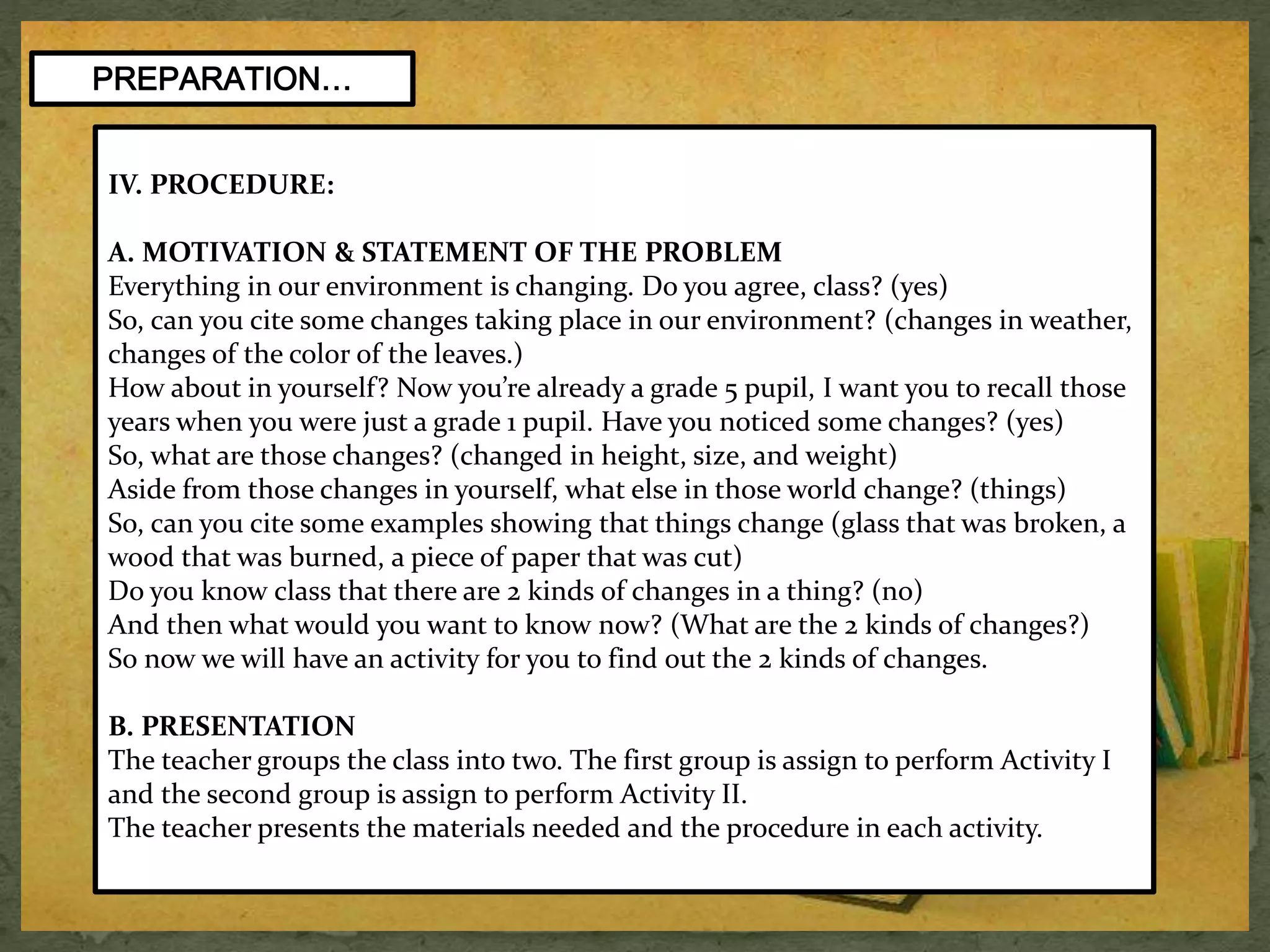
IV. PROCEDURE: 
A. MOTIVATION & STATEMENT OF THE PROBLEM 
Everything in our environment is changing. Do you agree, class? (yes) 
So, can you cite some changes taking place in our environment? (changes in weather, 
changes of the color of the leaves.) 
How about in yourself? Now you’re already a grade 5 pupil, I want you to recall those 
years when you were just a grade 1 pupil. Have you noticed some changes? (yes) 
So, what are those changes? (changed in height, size, and weight) 
Aside from those changes in yourself, what else in those world change? (things) 
So, can you cite some examples showing that things change (glass that was broken, a 
wood that was burned, a piece of paper that was cut) 
Do you know class that there are 2 kinds of changes in a thing? (no) 
And then what would you want to know now? (What are the 2 kinds of changes?) 
So now we will have an activity for you to find out the 2 kinds of changes. 
B. PRESENTATION 
The teacher groups the class into two. The first group is assign to perform Activity I 
and the second group is assign to perform Activity II. 
The teacher presents the materials needed and the procedure in each activity.
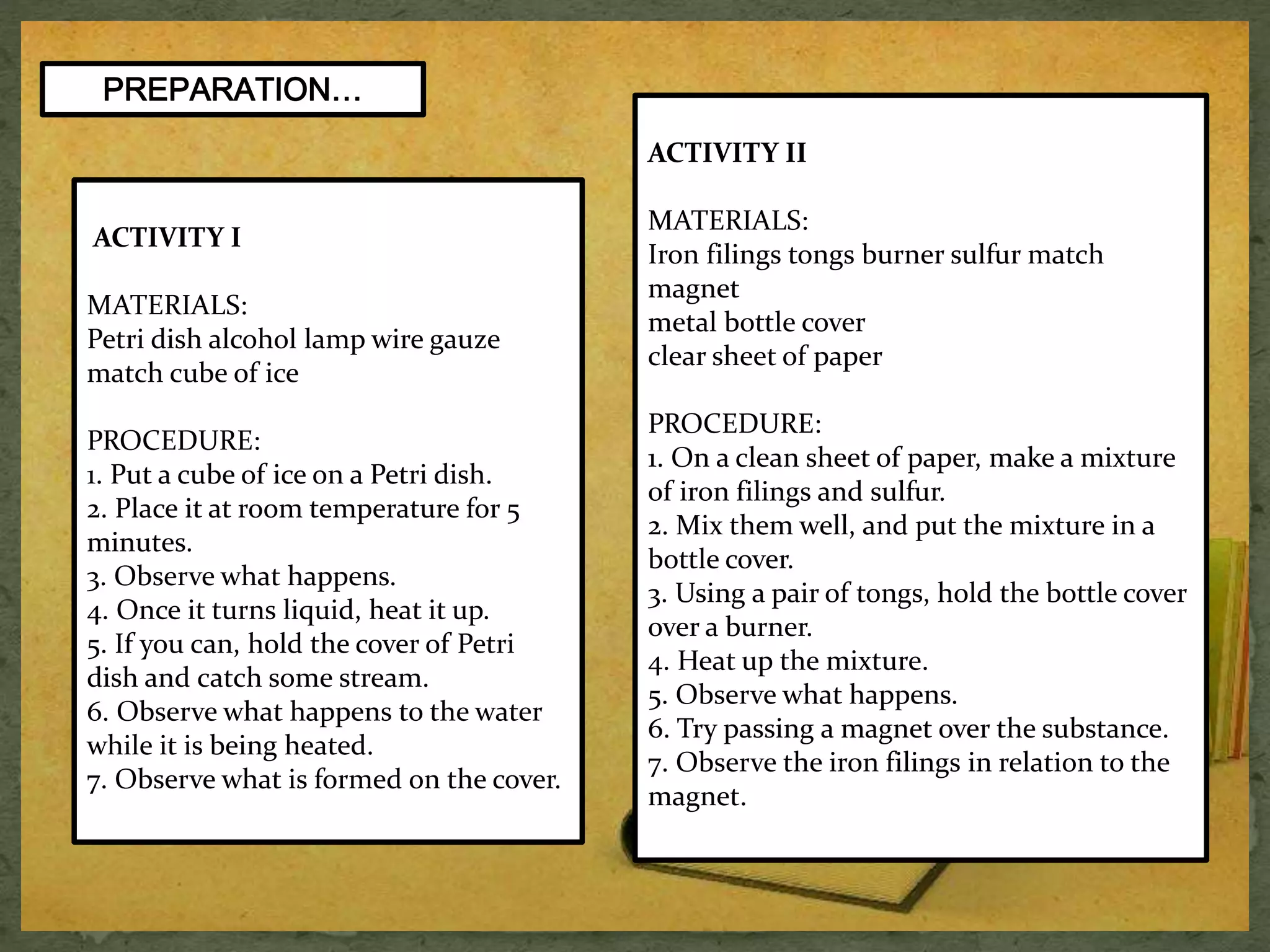
PREPARATION… 
ACTIVITY I 
MATERIALS: 
Petri dish alcohol lamp wire gauze 
match cube of ice 
PROCEDURE: 
1. Put a cube of ice on a Petri dish. 
2. Place it at room temperature for 5 
minutes. 
3. Observe what happens. 
4. Once it turns liquid, heat it up. 
5. If you can, hold the cover of Petri 
dish and catch some stream. 
6. Observe what happens to the water 
while it is being heated. 
7. Observe what is formed on the cover. 
ACTIVITY II 
MATERIALS: 
Iron filings tongs burner sulfur match 
magnet 
metal bottle cover 
clear sheet of paper 
PROCEDURE: 
1. On a clean sheet of paper, make a mixture 
of iron filings and sulfur. 
2. Mix them well, and put the mixture in a 
bottle cover. 
3. Using a pair of tongs, hold the bottle cover 
over a burner. 
4. Heat up the mixture. 
5. Observe what happens. 
6. Try passing a magnet over the substance. 
7. Observe the iron filings in relation to the 
magnet.
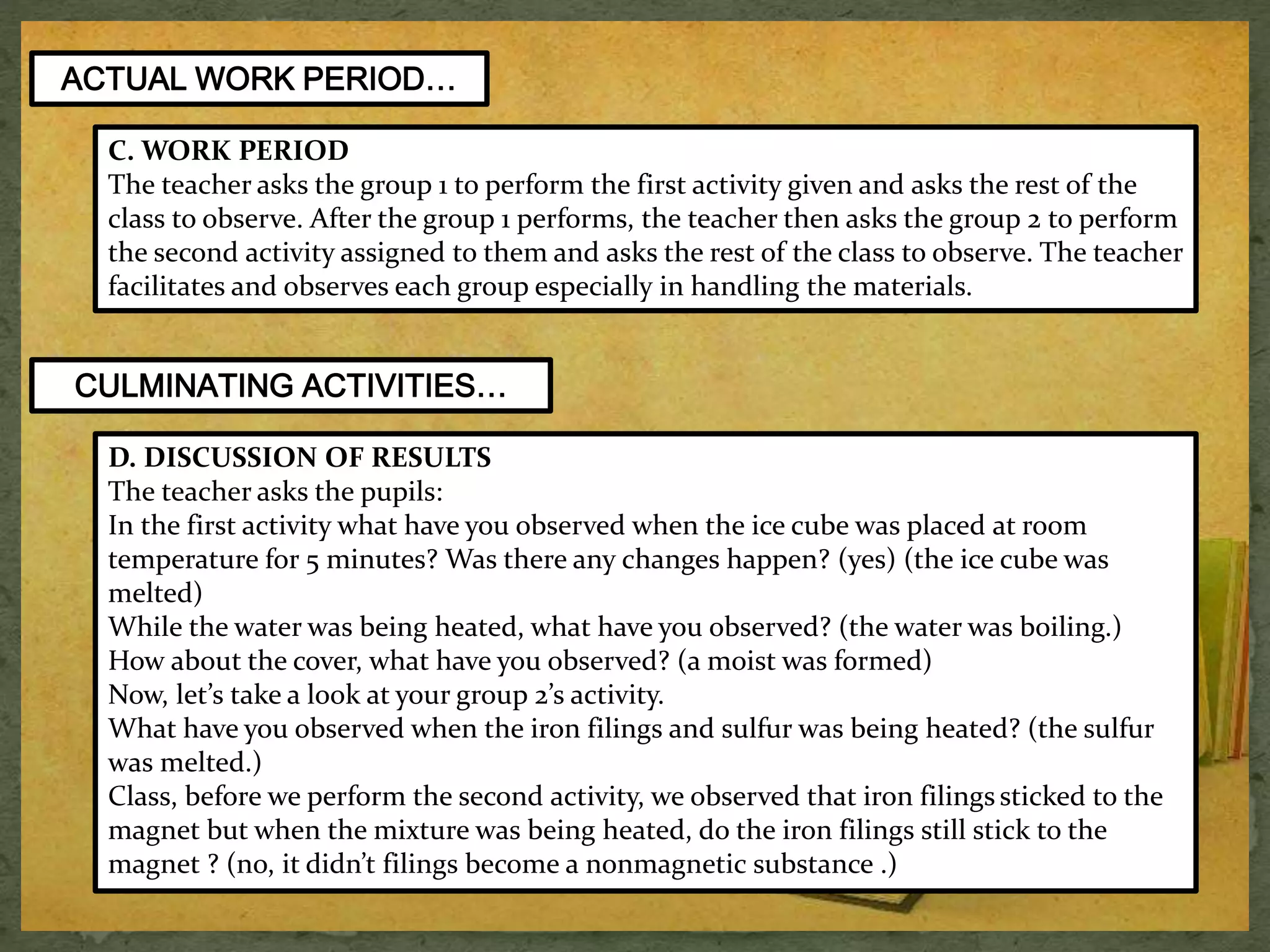
ACTUAL WORK PERIOD… 
C. WORK PERIOD 
The teacher asks the group 1 to perform the first activity given and asks the rest of the 
class to observe. After the group 1 performs, the teacher then asks the group 2 to perform 
the second activity assigned to them and asks the rest of the class to observe. The teacher 
facilitates and observes each group especially in handling the materials. 
CULMINATING ACTIVITIES… 
D. DISCUSSION OF RESULTS 
The teacher asks the pupils: 
In the first activity what have you observed when the ice cube was placed at room 
temperature for 5 minutes? Was there any changes happen? (yes) (the ice cube was 
melted) 
While the water was being heated, what have you observed? (the water was boiling.) 
How about the cover, what have you observed? (a moist was formed) 
Now, let’s take a look at your group 2’s activity. 
What have you observed when the iron filings and sulfur was being heated? (the sulfur 
was melted.) 
Class, before we perform the second activity, we observed that iron filings sticked to the 
magnet but when the mixture was being heated, do the iron filings still stick to the 
magnet ? (no, it didn’t filings become a nonmagnetic substance .)
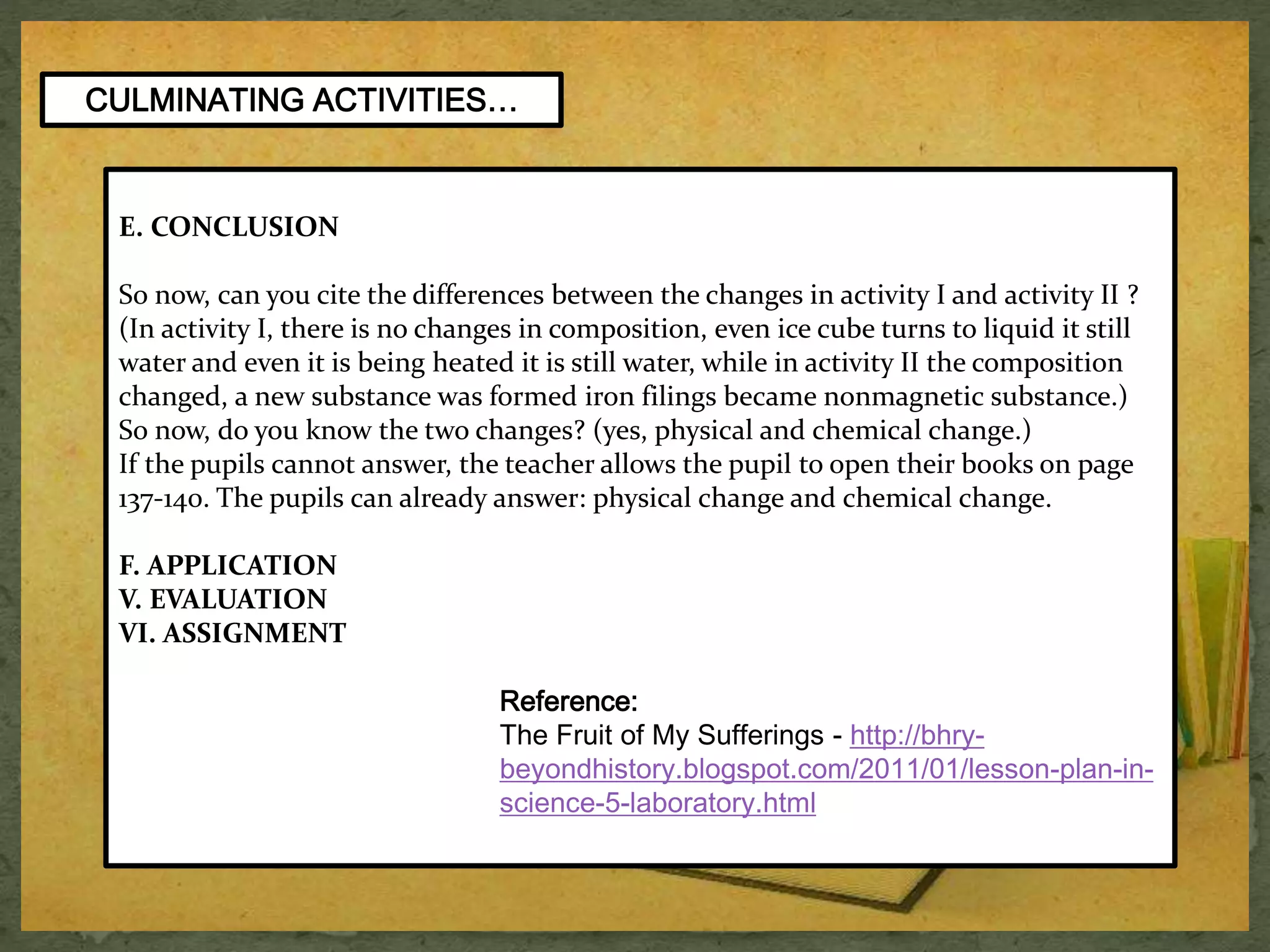
E. CONCLUSION 
So now, can you cite the differences between the changes in activity I and activity II ? 
(In activity I, there is no changes in composition, even ice cube turns to liquid it still 
water and even it is being heated it is still water, while in activity II the composition 
changed, a new substance was formed iron filings became nonmagnetic substance.) 
So now, do you know the two changes? (yes, physical and chemical change.) 
If the pupils cannot answer, the teacher allows the pupil to open their books on page 
137-140. The pupils can already answer: physical change and chemical change. 
F. APPLICATION 
V. EVALUATION 
VI. ASSIGNMENT 
Reference: 
The Fruit of My Sufferings - http://bhry-beyondhistory. 
blogspot.com/2011/01/lesson-plan-in-science- 
5-laboratory.html 
CULMINATING ACTIVITIES…
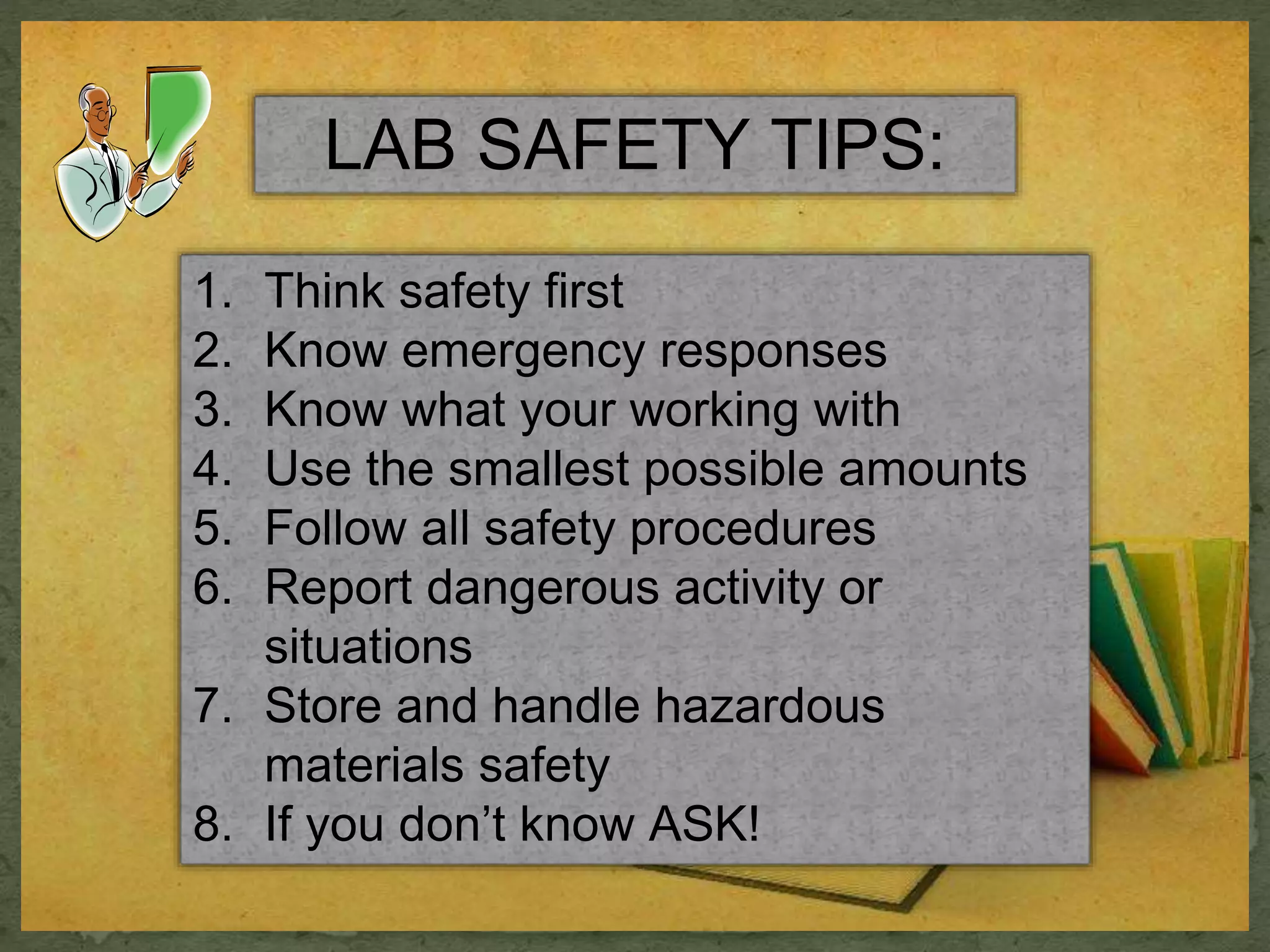
LAB SAFETY TIPS: 
1. Think safety first 
2. Know emergency responses 
3. Know what your working with 
4. Use the smallest possible amounts 
5. Follow all safety procedures 
6. Report dangerous activity or 
situations 
7. Store and handle hazardous 
materials safety 
8. If you don’t know ASK!
References: 
The Laboratory Method of Teaching ppt. 
by R D l. Galiciano and R J A. Tering 
Laboratory Teaching Methods ppt. 
By C. Tunzon, etc. 
Notes on The Laboratory Method of Teaching Natural Sciences - 
http://www.preservearticles.com/2012010920369/notes-on-the-laboratory- 
method-of-teaching-natural-sciences.html 
The Fruit of My Sufferings - http://bhry-beyondhistory. 
blogspot.com/2011/01/lesson-plan-in-science-5- 
laboratory.html 
Principles of Teaching
Laboratory Method of Teaching

Laboratory Method of Teaching

  • 1.
    PREPARED BY: Ma.Fretzi G. Paras BSE-PhySci2
  • 3.
    Features / Characteristics: 1. To promote information acquisition through observation, experimental solutions to problems guided by reflective thinking and acquisition of skill in manipulation. 2. Provides students opportunities to conduct or participate in original research.
  • 4.
    Continue… 3. Developsskill in using laboratory equipment and instruments. 4. Enhances higher order thinking skills.
  • 5.
    MAJOR GOALS OF LABORATORY WORKS: Teaching Manuals and Observational skills relevant to the subject. Improving understanding of methods of scientific inquiry. Developing problem solving and doing by self skills.
  • 6.
    GUIDELINES OF USING: 1. Make use of the power of observation and reasoning. 2. Manipulate learning equipments. 3. Make use of reality to make learning easier and more permanent. 4. Use of the scientific attitudes.
  • 7.
    1. Experimental –aims to train students in problem solving with incidental acquisition of information and motor skills, emphasis is on discovery, original procedure, and solution of problems. 2. Demonstration- is a process of presenting or establishing facts or principles. It is a procedure of doing or performing something in the presence of others or either as a means of showing them how to do it or illustrating a principle. Types of Laboratory Method :
  • 8.
    ADVANTAGES: 1. Studentslearn by doing and come in contact with raw data or materials object in teaching learning process. 2. Develops the power of observation and reasoning. 3.Develops the scientific attitudes
  • 9.
    continue.. 4. Givesan understanding of what research is and how to apply the scientific method of research 5. Gives training in organizing data gathered from real materials object and how these objects are manipulated to attain the objectives. 6. Since students come in contact with real life situations, it can be a preparation for solving real life problems.
  • 10.
    DISADVANTAGES: 1. Uneconomicalway of learning in time and material. 2. Does give much training in verbal expression and when the time equipment is used, most of the time, its use becomes mechanical, i.e. used without much thinking anymore
  • 11.
    STEPS IN LABORATORYMETHOD: 1. PREPARATION / INTRODUCTORY STEP In this step which provides for motivation and orientation, the following factors should be taken into account. (a) Determination of Laboratory work to be done. -- the first step is an explanation of the problem or other work to be done, This may be called presentation. -- here is the teacher's opportunity to motivate the students. But if the work is to be planned co-operatively by the students and the teacher, the first step is to determine by means of class discussion, the nature of the problem or the work to be done.
  • 12.
    (b) Determination ofthe Plan of Work. -- the second step is to get clearly in mind what is to be done. This may be set forth by the teacher who gives the necessary directions for both individual and group work. Since this work is likely to take more time than one period as it consists of various activities, written directions in the form of guide sheets, manuals, work-books and so on should be used. The introductory step thus considers the problem and the objectives of the work as well as of the plan of work to be carried out. After considering the first step, we now discuss the second one-work period.
  • 13.
    2. ACTUAL WORKPERIOD -- the laboratory activity should take the form of a supervised work-period in which groups or individuals have their particular work to do -- the students can work individually or collectively on a particular problem or on different problems -- directions must be very specific -- the length of the work periods should be determined by the nature of the problems and the objectives If the laboratory work occupies several days, it may be desirable to have the class meet as group each day, preferably at the beginning of the period for a discussion of the problems, progress and to receive criticisms, suggestions or directions from the teacher.
  • 14.
    2. CULMINATING ACTIVITIES When the members of a class have completed their laboratory work, the class should meet for discussion and organization of findings or for presentation of the results of individual work. The following types of activities may be used: 1. Students re-state the problem that the group has been working on and explain its nature and importance. 2. Review of the plan for solving the problem and organization of plan for recording the data gathered. 3. Presentation of illustrative material or special contributions by students working on special problems. …
  • 15.
    … 4. Wherestudents are working on individual projects, special reports may be given before the group, together with an exhibition of their work. 5. Note-books and written reports may be completed for final record of work. 6. Work of the class may be exhibited and rated by members of the class or by competent judges from outside. 7. Exhibits of various projects may be set up and explained by then-sponsors. 8. Tests or examinations may be used as a means of measuring achievement relative to certain outcomes. Since it would be impracticable to have too great a variety of culminating activities, those chosen should be adapted to the particular needs of the class, as well as to the time available. Written reports and summaries may be required to assure adequate participation of all the class in the completion of the work.
  • 16.
    SAMPLE LESSON PLAN A LESSON PLAN IN SCIENCE 5 (LABORATORY METHOD) PREPARATION / INTRODUCTORY STEP… I. OBJECTIVES: Through experiments, the pupils with 75% accuracy are expected to a. define physical and chemical change b. distinguish the difference between physical and chemical change c. perform the activity given II. SUBJECT MATTER: Topic: Physical and Chemical Change References: Exploring and Protecting our World by Carmelita Coronel, pp.134-145 Science for Daily use by Conchinta Tan, pp.126-130 Science for everyone by Ruth G. de Lara, pp.162-167 III. MATERIALS: Chart, Petri dish,. Wire gauze, alcohol lamp, match, cube of ice, Iron filings, sulfur, magnet, clear sheet of paper, metal bottle cover, tongs, burner
  • 17.
    PREPARATION… IV. PROCEDURE: A. MOTIVATION & STATEMENT OF THE PROBLEM Everything in our environment is changing. Do you agree, class? (yes) So, can you cite some changes taking place in our environment? (changes in weather, changes of the color of the leaves.) How about in yourself? Now you’re already a grade 5 pupil, I want you to recall those years when you were just a grade 1 pupil. Have you noticed some changes? (yes) So, what are those changes? (changed in height, size, and weight) Aside from those changes in yourself, what else in those world change? (things) So, can you cite some examples showing that things change (glass that was broken, a wood that was burned, a piece of paper that was cut) Do you know class that there are 2 kinds of changes in a thing? (no) And then what would you want to know now? (What are the 2 kinds of changes?) So now we will have an activity for you to find out the 2 kinds of changes. B. PRESENTATION The teacher groups the class into two. The first group is assign to perform Activity I and the second group is assign to perform Activity II. The teacher presents the materials needed and the procedure in each activity.
  • 18.
    PREPARATION… ACTIVITY I MATERIALS: Petri dish alcohol lamp wire gauze match cube of ice PROCEDURE: 1. Put a cube of ice on a Petri dish. 2. Place it at room temperature for 5 minutes. 3. Observe what happens. 4. Once it turns liquid, heat it up. 5. If you can, hold the cover of Petri dish and catch some stream. 6. Observe what happens to the water while it is being heated. 7. Observe what is formed on the cover. ACTIVITY II MATERIALS: Iron filings tongs burner sulfur match magnet metal bottle cover clear sheet of paper PROCEDURE: 1. On a clean sheet of paper, make a mixture of iron filings and sulfur. 2. Mix them well, and put the mixture in a bottle cover. 3. Using a pair of tongs, hold the bottle cover over a burner. 4. Heat up the mixture. 5. Observe what happens. 6. Try passing a magnet over the substance. 7. Observe the iron filings in relation to the magnet.
  • 19.
    ACTUAL WORK PERIOD… C. WORK PERIOD The teacher asks the group 1 to perform the first activity given and asks the rest of the class to observe. After the group 1 performs, the teacher then asks the group 2 to perform the second activity assigned to them and asks the rest of the class to observe. The teacher facilitates and observes each group especially in handling the materials. CULMINATING ACTIVITIES… D. DISCUSSION OF RESULTS The teacher asks the pupils: In the first activity what have you observed when the ice cube was placed at room temperature for 5 minutes? Was there any changes happen? (yes) (the ice cube was melted) While the water was being heated, what have you observed? (the water was boiling.) How about the cover, what have you observed? (a moist was formed) Now, let’s take a look at your group 2’s activity. What have you observed when the iron filings and sulfur was being heated? (the sulfur was melted.) Class, before we perform the second activity, we observed that iron filings sticked to the magnet but when the mixture was being heated, do the iron filings still stick to the magnet ? (no, it didn’t filings become a nonmagnetic substance .)
  • 20.
    E. CONCLUSION Sonow, can you cite the differences between the changes in activity I and activity II ? (In activity I, there is no changes in composition, even ice cube turns to liquid it still water and even it is being heated it is still water, while in activity II the composition changed, a new substance was formed iron filings became nonmagnetic substance.) So now, do you know the two changes? (yes, physical and chemical change.) If the pupils cannot answer, the teacher allows the pupil to open their books on page 137-140. The pupils can already answer: physical change and chemical change. F. APPLICATION V. EVALUATION VI. ASSIGNMENT Reference: The Fruit of My Sufferings - http://bhry-beyondhistory. blogspot.com/2011/01/lesson-plan-in-science- 5-laboratory.html CULMINATING ACTIVITIES…
  • 21.
    LAB SAFETY TIPS: 1. Think safety first 2. Know emergency responses 3. Know what your working with 4. Use the smallest possible amounts 5. Follow all safety procedures 6. Report dangerous activity or situations 7. Store and handle hazardous materials safety 8. If you don’t know ASK!
  • 22.
    References: The LaboratoryMethod of Teaching ppt. by R D l. Galiciano and R J A. Tering Laboratory Teaching Methods ppt. By C. Tunzon, etc. Notes on The Laboratory Method of Teaching Natural Sciences - http://www.preservearticles.com/2012010920369/notes-on-the-laboratory- method-of-teaching-natural-sciences.html The Fruit of My Sufferings - http://bhry-beyondhistory. blogspot.com/2011/01/lesson-plan-in-science-5- laboratory.html Principles of Teaching