METHODS OF TEACHING:
1)LECTURE CUM DEMONSTRATION
METHOD
2)PROJECT METHOD
3)LABORATORY METHOD
By- Prof.Nilima
Kamlu
NEED OF METHODS OF TEACHING???
‱ Single method may not be useful for teaching a single unit.
‱ Consider students age group ,utility of subject , availability of
teaching aids and time.
‱ Consider the students interest and capabilities.
‱ To make teaching effective and successful.
PROJECT METHOD
INTRODUCTION:
‱ According to Sir John Dewey “ What is to be taught should have a direct
relationship with the actual happening in life”, this central idea forms the core basis
of project method.
DEFINITION:
‱ Stevenson (1922), “A project is a problematic act carried to completion in its most
natural setting”.
‱ Kilpatrick (1921), “A project is a whole- hearted purposeful activity proceeding in a
social environment”.
‱ Ballard, H.G. (1936), “A project is a bit of real life that has been imported into school
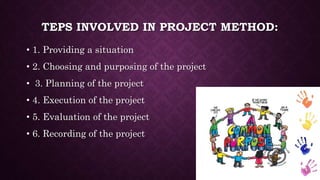
TEPS INVOLVED IN PROJECT METHOD:
‱ 1. Providing a situation
‱ 2. Choosing and purposing of the project
‱ 3. Planning of the project
‱ 4. Execution of the project
‱ 5. Evaluation of the project
‱ 6. Recording of the project
ADVANTAGES:
‱ 1. It arouses and maintains the interest of student
‱ 2. It gives the student freedom of thought and action
‱ 3. It establishes a definite, tangible, ascertainable goal and
what progress is being made and when it is completed
‱ 4. This method allows growth through activity on the part of
the learner
‱ 5. It develop a spirit of cooperation and community interest.
DISADVANTAGES:
‱ Wrong selection of topics
‱ Over consumption of time
‱ Availability and cost of materials
‱ When individual projects are overemphasized, there may
be overdevelopment of individualism and under development
of cooperation and group responsibility
PRINCIPLE
‱ This method is based on “Huxley’s Principle”.
-“Whatever is observed and can be experienced is true and
reliable”
‱ DEMONSTRATION=VERBAL EXPLANATION + LIVE
DISPLAY/ USE OF APPARATUS
A)PLANNING
‱ Identifies the concepts to be explained
‱ Formulate objectives
‱ Rehearsal of the experiment
‱ Questions framing
‱ Collection and arrangement of materials
B)INTRODUCTION OF THE LESSON
 Introduces the lesson by motivating the students
 Students personal experiences or real life situations
 Telling story
 Simple and interesting experiment
C)PRESENTATION OF CONTENT
 Consideration the interest of students
 While demonstration questions should be asked which help the students to understand
 Provide illustration
 Language should be clear and simple
 All material related to demonstration should be clean
 All material should not be display at once
 Demonstration would be clearly visible to all learner
(D) BLACK BOARD WORK
‱ Summarize the principles, facts and important points
TIPS DURING DEMOSTRATION
Know your audience
Set yours objective
Plan your preparation time
Class room arrangement
Be organized
Follow safety precautions
DEMERITS
Lack of opportunity for practical ability
Learners only observe the demonstration
Instructor may follow their own pace while demonstration
Not possible to teach all topic
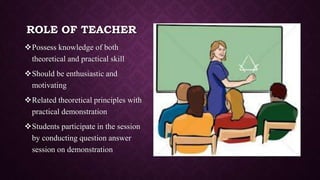
ROLE OF TEACHER
Possess knowledge of both
theoretical and practical skill
Should be enthusiastic and
motivating
Related theoretical principles with
practical demonstration
Students participate in the session
by conducting question answer
session on demonstration
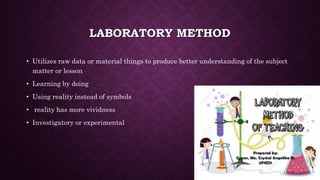
LABORATORY METHOD
‱ Utilizes raw data or material things to produce better understanding of the subject
matter or lesson
‱ Learning by doing
‱ Using reality instead of symbols
‱ reality has more vividness
‱ Investigatory or experimental
OBJECTIVES
‱ 1. Make use of the power of observation and reasoning
‱ 2. Manipulate learning equipment's
‱ 3. Make use of reality to make learning easier and more
permanent
‱ 4. Make use of the scientific attitudes
‱ 5. Use the laboratory method or procedure
ADVANTAGES
‱ Students learn by doing and come in contact with raw data or material objects in the
teaching-learning process.
‱ Develops the power of observation and reasoning.
‱ 3. Develops the scientific attitude.
‱ 4. Gives an understanding of what research is and how to apply the scientific
method of research
‱ 5. Gives training in organizing data gathered from real material objects and how
these objects are manipulated to attain the objectives.
‱ 6. Since students come in contact with real life situations, it can be a preparation for
solving real life problems
DISADVANTAGES
‱ Uneconomical way of learning in time and material.
‱ Does not give much training in verbal expression and when the same equipment is
used most of the time, its use becomes mechanical i.e., used without much thinking
anymore
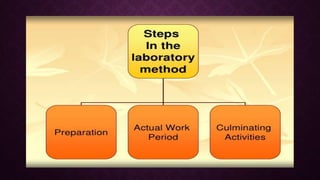
PREPARATION
a.Review of past lesson relevant to the present for
apperception and motivation.
b.Raising and defining the work to be done.
c.expected learning outcomes.
d. Planning. (individually or groups) - what is important is
that everyone knows exactly what he is going to do and to do
it correctly and timely.
ACTUAL WORK PERIOD
‱ Students work under the supervision of the teacher. (Supervised study)
‱ Students may work:
‱ - individually attacking the same problem or different problems
‱ - in groups attacking the same problem
‱ The work may last for a single study period or for days.All works must be recorded
for continuity of the task.Those who work fast may be given additional assignment
for additional credits.If the work is experimental, no-experimental variables must be
constant.
CULMINATING ACTIVITIES
‱ Reporting what is worked on by individuals or groups in
plenary session of the class.
‱ After each report, there is an open forum.Questions,
discussions, generalizations, conclusions are made.
‱ Different reports may be consolidated into one then
photocopies will be given to each member of the class to
review and get ready for a test for evaluation.
THANK YOU

Methods of teaching

  • 1.
    METHODS OF TEACHING: 1)LECTURECUM DEMONSTRATION METHOD 2)PROJECT METHOD 3)LABORATORY METHOD By- Prof.Nilima Kamlu
  • 2.
    NEED OF METHODSOF TEACHING??? ‱ Single method may not be useful for teaching a single unit. ‱ Consider students age group ,utility of subject , availability of teaching aids and time. ‱ Consider the students interest and capabilities. ‱ To make teaching effective and successful.
  • 3.
    PROJECT METHOD INTRODUCTION: ‱ Accordingto Sir John Dewey “ What is to be taught should have a direct relationship with the actual happening in life”, this central idea forms the core basis of project method. DEFINITION: ‱ Stevenson (1922), “A project is a problematic act carried to completion in its most natural setting”. ‱ Kilpatrick (1921), “A project is a whole- hearted purposeful activity proceeding in a social environment”. ‱ Ballard, H.G. (1936), “A project is a bit of real life that has been imported into school
  • 4.
    TEPS INVOLVED INPROJECT METHOD: ‱ 1. Providing a situation ‱ 2. Choosing and purposing of the project ‱ 3. Planning of the project ‱ 4. Execution of the project ‱ 5. Evaluation of the project ‱ 6. Recording of the project
  • 5.
    ADVANTAGES: ‱ 1. Itarouses and maintains the interest of student ‱ 2. It gives the student freedom of thought and action ‱ 3. It establishes a definite, tangible, ascertainable goal and what progress is being made and when it is completed ‱ 4. This method allows growth through activity on the part of the learner ‱ 5. It develop a spirit of cooperation and community interest.
  • 6.
    DISADVANTAGES: ‱ Wrong selectionof topics ‱ Over consumption of time ‱ Availability and cost of materials ‱ When individual projects are overemphasized, there may be overdevelopment of individualism and under development of cooperation and group responsibility
  • 8.
    PRINCIPLE ‱ This methodis based on “Huxley’s Principle”. -“Whatever is observed and can be experienced is true and reliable” ‱ DEMONSTRATION=VERBAL EXPLANATION + LIVE DISPLAY/ USE OF APPARATUS
  • 9.
    A)PLANNING ‱ Identifies theconcepts to be explained ‱ Formulate objectives ‱ Rehearsal of the experiment ‱ Questions framing ‱ Collection and arrangement of materials
  • 10.
    B)INTRODUCTION OF THELESSON  Introduces the lesson by motivating the students  Students personal experiences or real life situations  Telling story  Simple and interesting experiment
  • 11.
    C)PRESENTATION OF CONTENT Consideration the interest of students  While demonstration questions should be asked which help the students to understand  Provide illustration  Language should be clear and simple  All material related to demonstration should be clean  All material should not be display at once  Demonstration would be clearly visible to all learner
  • 12.
    (D) BLACK BOARDWORK ‱ Summarize the principles, facts and important points
  • 13.
    TIPS DURING DEMOSTRATION Knowyour audience Set yours objective Plan your preparation time Class room arrangement Be organized Follow safety precautions
  • 15.
    DEMERITS Lack of opportunityfor practical ability Learners only observe the demonstration Instructor may follow their own pace while demonstration Not possible to teach all topic
  • 16.
    ROLE OF TEACHER Possessknowledge of both theoretical and practical skill Should be enthusiastic and motivating Related theoretical principles with practical demonstration Students participate in the session by conducting question answer session on demonstration
  • 17.
    LABORATORY METHOD ‱ Utilizesraw data or material things to produce better understanding of the subject matter or lesson ‱ Learning by doing ‱ Using reality instead of symbols ‱ reality has more vividness ‱ Investigatory or experimental
  • 18.
    OBJECTIVES ‱ 1. Makeuse of the power of observation and reasoning ‱ 2. Manipulate learning equipment's ‱ 3. Make use of reality to make learning easier and more permanent ‱ 4. Make use of the scientific attitudes ‱ 5. Use the laboratory method or procedure
  • 19.
    ADVANTAGES ‱ Students learnby doing and come in contact with raw data or material objects in the teaching-learning process. ‱ Develops the power of observation and reasoning. ‱ 3. Develops the scientific attitude. ‱ 4. Gives an understanding of what research is and how to apply the scientific method of research
  • 20.
    ‱ 5. Givestraining in organizing data gathered from real material objects and how these objects are manipulated to attain the objectives. ‱ 6. Since students come in contact with real life situations, it can be a preparation for solving real life problems
  • 21.
    DISADVANTAGES ‱ Uneconomical wayof learning in time and material. ‱ Does not give much training in verbal expression and when the same equipment is used most of the time, its use becomes mechanical i.e., used without much thinking anymore
  • 23.
    PREPARATION a.Review of pastlesson relevant to the present for apperception and motivation. b.Raising and defining the work to be done. c.expected learning outcomes. d. Planning. (individually or groups) - what is important is that everyone knows exactly what he is going to do and to do it correctly and timely.
  • 24.
    ACTUAL WORK PERIOD ‱Students work under the supervision of the teacher. (Supervised study) ‱ Students may work: ‱ - individually attacking the same problem or different problems ‱ - in groups attacking the same problem ‱ The work may last for a single study period or for days.All works must be recorded for continuity of the task.Those who work fast may be given additional assignment for additional credits.If the work is experimental, no-experimental variables must be constant.
  • 25.
    CULMINATING ACTIVITIES ‱ Reportingwhat is worked on by individuals or groups in plenary session of the class. ‱ After each report, there is an open forum.Questions, discussions, generalizations, conclusions are made. ‱ Different reports may be consolidated into one then photocopies will be given to each member of the class to review and get ready for a test for evaluation.
  • 26.