







The Laboratory Method of TeachingReynel Dan L. GalicinaoRuscelle Joy A. Tering
Laboratory MethodUtilizes raw data or material things to produce better understanding of the subject matter or lessonLearning by doingUsing reality instead of symbols.		- reality has more vividnessInvestigatory or experimental
Objectives1. Make use of the power of observation and reasoning2. Manipulate learning equipments3. Make use of reality to make learning easier and more permanent4. Make use of the scientific attitudes5. Use the laboratory method or procedure
AdvantagesStudents learn by doing and come in contact with raw data or material objects in the teaching-learning process.Develops the power of observation and reasoning.
Advantages3. Develops the scientific attitude. 4. Gives an understanding of what research is and how to apply the scientific method of research
Advantages5. Gives training in organizing data gathered from real material objects and how these objects are manipulated to attain the objectives.6. Since students come in contact with real life situations, it can be a preparation for solving real life problems.
Disadvantages Uneconomical way of learning in time and material. Does not give much training in verbal expression and when the same equipment is used most of the time, its use becomes mechanical i.e., used without much thinking anymore
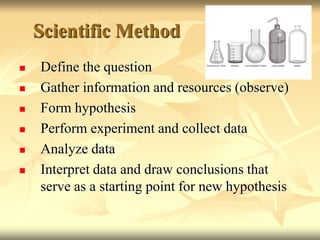
Scientific MethodDefine the question Gather information and resources (observe) Form hypothesis Perform experiment and collect data Analyze data Interpret data and draw conclusions that serve as a starting point for new hypothesis
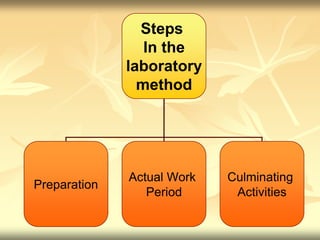
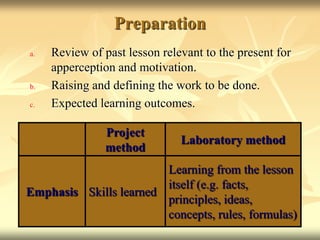
PreparationReview of past lesson relevant to the present for apperception and motivation.Raising and defining the work to be done.Expected learning outcomes.
Preparationd. Planning. (individually or groups)		- what is important is that everyone knows exactly what he is going to do and to do it correctly and timely.
Actual Work PeriodStudents work under the supervision of the teacher. (Supervised study)Students may work:		- individually attacking the same problem or different problems		- in groups attacking the same problem 		- in groups with each group working on a portion, phase or stage of the problem
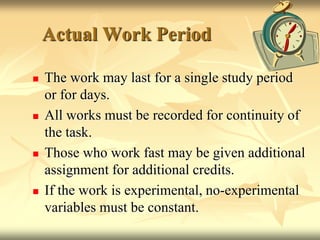
Actual Work PeriodThe work may last for a single study period or for days.All works must be recorded for continuity of the task.Those who work fast may be given additional assignment for additional credits.If the work is experimental, no-experimental variables must be constant.
Culminating ActivitiesReporting what is worked on by individuals or groups in plenary session of the class.After each report, there is an open forum.Questions, discussions, generalizations, conclusions are made.
Culminating ActivityDifferent reports may be consolidated  into one then photocopies will be given to each member of the class to review and get ready for a test for evaluation.
Sample of The Laboratory Method of TeachingVital Signs TakingPreparation: Review on Vital signsSteps in performing vital signs takingExpected Learning OutcomesPlanning
Actual Work PeriodDuring this period, students will work under the supervision of the teacher.Culminating ActivityStudents will report the results of the activity.
Other ExamplesCOPARActual exposure in the Clinical  AreaSuctioningAnd in performing other nursing skills
The laboratory method of teaching

The laboratory method of teaching

  • 1.
    The Laboratory Methodof TeachingReynel Dan L. GalicinaoRuscelle Joy A. Tering
  • 2.
    Laboratory MethodUtilizes rawdata or material things to produce better understanding of the subject matter or lessonLearning by doingUsing reality instead of symbols. - reality has more vividnessInvestigatory or experimental
  • 3.
    Objectives1. Make useof the power of observation and reasoning2. Manipulate learning equipments3. Make use of reality to make learning easier and more permanent4. Make use of the scientific attitudes5. Use the laboratory method or procedure
  • 4.
    AdvantagesStudents learn bydoing and come in contact with raw data or material objects in the teaching-learning process.Develops the power of observation and reasoning.
  • 5.
    Advantages3. Develops thescientific attitude. 4. Gives an understanding of what research is and how to apply the scientific method of research
  • 6.
    Advantages5. Gives trainingin organizing data gathered from real material objects and how these objects are manipulated to attain the objectives.6. Since students come in contact with real life situations, it can be a preparation for solving real life problems.
  • 7.
    Disadvantages Uneconomical wayof learning in time and material. Does not give much training in verbal expression and when the same equipment is used most of the time, its use becomes mechanical i.e., used without much thinking anymore
  • 8.
    Scientific MethodDefine thequestion Gather information and resources (observe) Form hypothesis Perform experiment and collect data Analyze data Interpret data and draw conclusions that serve as a starting point for new hypothesis
  • 10.
    PreparationReview of pastlesson relevant to the present for apperception and motivation.Raising and defining the work to be done.Expected learning outcomes.
  • 11.
    Preparationd. Planning. (individuallyor groups) - what is important is that everyone knows exactly what he is going to do and to do it correctly and timely.
  • 12.
    Actual Work PeriodStudentswork under the supervision of the teacher. (Supervised study)Students may work: - individually attacking the same problem or different problems - in groups attacking the same problem - in groups with each group working on a portion, phase or stage of the problem
  • 13.
    Actual Work PeriodThework may last for a single study period or for days.All works must be recorded for continuity of the task.Those who work fast may be given additional assignment for additional credits.If the work is experimental, no-experimental variables must be constant.
  • 14.
    Culminating ActivitiesReporting whatis worked on by individuals or groups in plenary session of the class.After each report, there is an open forum.Questions, discussions, generalizations, conclusions are made.
  • 15.
    Culminating ActivityDifferent reportsmay be consolidated into one then photocopies will be given to each member of the class to review and get ready for a test for evaluation.
  • 18.
    Sample of TheLaboratory Method of TeachingVital Signs TakingPreparation: Review on Vital signsSteps in performing vital signs takingExpected Learning OutcomesPlanning
  • 19.
    Actual Work PeriodDuringthis period, students will work under the supervision of the teacher.Culminating ActivityStudents will report the results of the activity.
  • 20.
    Other ExamplesCOPARActual exposurein the Clinical AreaSuctioningAnd in performing other nursing skills