BV
EDU 09.8
UNIT 2
Formal and Informal Contexts in Teaching and Learning
SCIENCE LABORATORY – Importance, Organisation, Registers, Rules,
Accidents and First Aid
INTRODUCTION
The laboratory is central to science instruction and is commonly regarded as the heart
of science teaching. It is the place where students learn to handle apparatus, think
independently and draw conclusions on the basis of practical observations. This infuses self
confidence and independent attitude in students.
One of the important functions of the science laboratory is the deepening of the students
understanding that scientific concepts and applications are closely related to his own natural
environment. Practical work in science even at the school stage is important because of the fact
that we ‘learn by doing. Laboratories provide a well arranged and conducive environment for
the students to perform the experiments. It creates a scientific attitude among students. It gives
first hand experience to students and offer better learning.
IMPORTANCE OF LABORATORY
 The achievement of modern science is mainly due to the application of experimental
method. It is in the lab that pupils get a training in this important phase of science study.
 The pupils get a chance for activity; both physical and intellectual and they are learning
by doing.
 Laboratory exercises train them in scientific thinking. They develop scientific attitude
and scientific methods as a result of lab work.
 It helps in the development of manipulative skills.
 The experiments done serve as a source of motivation. The students are interested in
handling materials and doing experiments.
 In the Laboratory, the teacher comes in closer contact with the individual and helps
them to bring out their difficulties.
BV
 The knowledge achieved through experimental work creates a permanent impression
the minds of the students.
 It develops cooperation, discipline qualities in the individual.
ORGANISATION
The following points should be kept in mind for the task of organisation and administration of
a science laboratory effectively.
 Timetables: It is essential that the special requirements of science – with regard to
laboratory timetable and use of double/triple periods are made known and stated
explicitly. The copies of the complete school timetable, lab timetables, timetable for all
science teachers should be displayed on boards.
 Notice board: A notice board should be fixed outside the lab with up-to-date
information. This should contain lab timetables, list of laboratory rules, experiments in
each cycle etc.
 Storage system: A well organised storage system enables easy collection of
apparatus from the store and its transfer. The basic principles to be applied for effective
storage are labelling, accessibility, safety, and indexing and retrieval. Every item must
be assigned a specific place for storage and should be labelled properly. The most
frequently used items should be most accessible. Leftovers should be cleared up and
poisonous chemicals should be placed out of reach. A carefully designed and simple
index system become increasingly important; when the number and range of resources
in the lab increases
 Ancillary staff: It is necessary to have a laboratory assistant who has the following
major responsibilities:
 Organisation of holiday schedule, attendance and time keeping.
 Stock control
 Safety and security including safe disposal, first aid, checking of services,
reporting the damage of equipment.
 Planning laboratory work: Laboratory work should be organised as an
unavoidable and integral part of regular instruction. The students use the laboratory to
find out first hand observation and experiments to solve problems. The problems can
BV
be formulated during classroom discussion and it may be solved with the help of
laboratory work. So, the teacher must plan the science course in detail to include several
significant laboratory problems.
REGISTERS
When the apparatus is received, the articles should be properly checked and entered in the stock
registers. A proper record of science apparatus is very important to check any article at any
time and it also facilitates in giving concrete answers to management during auditing. The type
of registers used are:
(i) Permanent stock register
(ii) Breakable stock register
(iii) Consumable stock register
(iv) Order register
(v) Requirement register
Permanent stock register
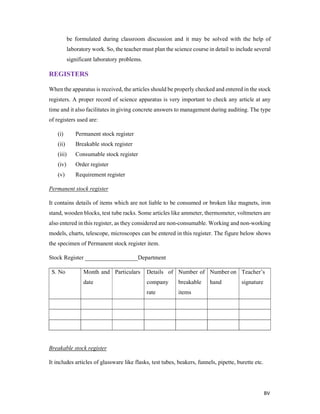
It contains details of items which are not liable to be consumed or broken like magnets, iron
stand, wooden blocks, test tube racks. Some articles like ammeter, thermometer, voltmeters are
also entered in this register, as they considered are non-consumable. Working and non-working
models, charts, telescope, microscopes can be entered in this register. The figure below shows
the specimen of Permanent stock register item.
Stock Register __________________Department
S. No Month and
date
Particulars Details of
company
rate
Number of
breakable
items
Number on
hand
Teacher’s
signature
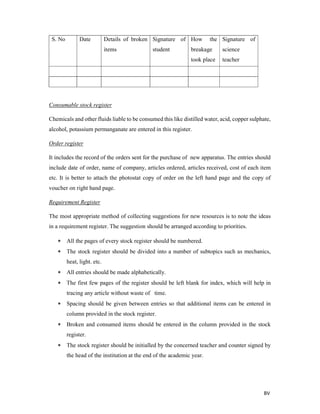
Breakable stock register
It includes articles of glassware like flasks, test tubes, beakers, funnels, pipette, burette etc.
BV
S. No Date Details of broken
items
Signature of
student
How the
breakage
took place
Signature of
science
teacher
Consumable stock register
Chemicals and other fluids liable to be consumed this like distilled water, acid, copper sulphate,
alcohol, potassium permanganate are entered in this register.
Order register
It includes the record of the orders sent for the purchase of new apparatus. The entries should
include date of order, name of company, articles ordered, articles received, cost of each item
etc. It is better to attach the photostat copy of order on the left hand page and the copy of
voucher on right hand page.
Requirement Register
The most appropriate method of collecting suggestions for new resources is to note the ideas
in a requirement register. The suggestion should be arranged according to priorities.
 All the pages of every stock register should be numbered.
 The stock register should be divided into a number of subtopics such as mechanics,
heat, light. etc.
 All entries should be made alphabetically.
 The first few pages of the register should be left blank for index, which will help in
tracing any article without waste of time.
 Spacing should be given between entries so that additional items can be entered in
column provided in the stock register.
 Broken and consumed items should be entered in the column provided in the stock
register.
 The stock register should be initialled by the concerned teacher and counter signed by
the head of the institution at the end of the academic year.
BV
RULES
Rules are important because the laboratory happens to be a place of potential dangers.
Discipline is taught by making the pupils know to what to do in the lab rather than don’t. The
science teacher is the supreme authority in the laboratory and he should be strictly obeyed.
 No pupil should be allowed to enter the lab in the absence of teacher or lab assistant
 Every pupil may have a seat assigned to them.
 The arrangement in the lab should be such that there is no need to move a pupil from
his seat.
 When the pupils are working in groups, they might be allowed to discuss in a low tone.
 Unnecessary talking should be strictly forbidden.
 The pupils must examine the apparatus given. and report defects if any.
 Reagent bottles should be returned shelves immediately after use.
 Stoppers are also to be replaced on the bottles.
 Waste papers, burnt match sticks should not be thrown in the sink. Waste boxes should
be used.
 Scribbling figures on furniture and on loose sheets of paper should never be permitted.
 The teacher can get the help of pupils to distribute apparatus and materials to clean
distribute them after use and to replace them at the end.
 Bottles must be labelled clearly.
 Useless substances, broken glass, chemicals and solid waste must be deposited.
 Do not taste, eat or drink any chemicals.
 Avoid skin and eye contact with all chemicals.
 Long hair and loose clothing must be pulled back and secured from potential capture.
 Report all injuries, accidents, broken equipment to the teacher immediately.
ACCIDENTS and FIRST AID
Accidents may happen in the laboratory. It is essential that teacher should know the first aid
for the common accidents in the lab. The purpose of first aid is to make the patient secure and
comfortable and to prevent deterioration in his condition until any necessary medical assistance
is available.
BV
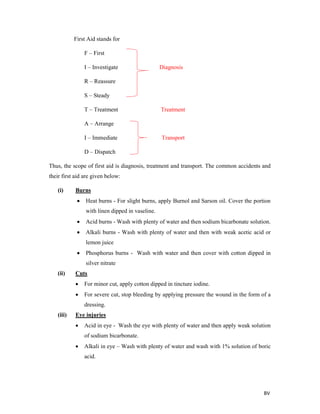
First Aid stands for
F – First
I – Investigate Diagnosis
R – Reassure
S – Steady
T – Treatment Treatment
A – Arrange
I – Immediate Transport
D – Dispatch
Thus, the scope of first aid is diagnosis, treatment and transport. The common accidents and
their first aid are given below:
(i) Burns
 Heat burns - For slight burns, apply Burnol and Sarson oil. Cover the portion
with linen dipped in vaseline.
 Acid burns - Wash with plenty of water and then sodium bicarbonate solution.
 Alkali burns - Wash with plenty of water and then with weak acetic acid or
lemon juice
 Phosphorus burns - Wash with water and then cover with cotton dipped in
silver nitrate
(ii) Cuts
 For minor cut, apply cotton dipped in tincture iodine.
 For severe cut, stop bleeding by applying pressure the wound in the form of a
dressing.
(iii) Eye injuries
 Acid in eye - Wash the eye with plenty of water and then apply weak solution
of sodium bicarbonate.
 Alkali in eye – Wash with plenty of water and wash with 1% solution of boric
acid.
BV
 Solid in eye – Do not rub the eye. Wash it by sprinkling water into the eye.
Remove the particle by means of clean handkerchief or cotton wool.
(iv) Poisons
 Acid - Dilute the acid with plenty of water and then milk of magnesia
[Mg(OH)2,]
 Alkali- Plenty of water followed by lemon juice.
 Unknown nature - Activated charcoal, magnesium. tannic acid in the ratio 2:1:1
may be given. The mixture is known as universal antidote.
 Inhaling poisonous gas - Allow to breathe fresh air and some stimulants such as
hot tea or coffee may be given. To counter chlorine or bromine fumes, smell
ammonia and rinse the mouth with sodium bicarbonate.
(v) Fire
Wrap the person in a fire proof blanket. If any liquid in a beaker has caught fire, cover the
mouth of the beaker. Most of the fire on the working table can be extinguished by throwing
sand on them.
(vi) Electric shock.
Switch off the electrical supply. Use a wooden dry stick to pull the person away from the point.
Admit to the hospital if needed.
First Aid Kit
A first aid box should be provided in every laboratory. The contents of the box regularly
inspected to ensure replenishment. It should contain the following items.
General items Chemicals/ medicines
Cotton
Triangular bandages
Roller bandages of different width
Scissors
Plasters
Dressing gauge
Linen for burns
Forceps
Eye dropper
Antiseptic liquid – Dettol
Vaseline
Common salt
Sodium bicarbonate(1%)
Glycerine
Milk of magnesia
Boric acid
Tincture iodine
Silver nitrate
BV
Camel hair brush Acetic acid
Burnol
Universal antidote
Sulphonamide cream
Aspirin
CONCLUSION
Science laboratory has an important place in science teaching. It helps students to understand
complex, abstract ideas and gives students an opportunity to participate in the methods of
science. Laboratory work involves students in hands-on activities that help them to verify
scientific concepts, principles and laws. The lab work provides permanent knowledge to the
students and help them to use scientific concepts in daily life.
REFERENCES
(1) Theoretical Bases of Teaching and Pedagogic Analysis - Dr. T. K Mathew and
Dr. T. M. Mollykutty.
(2) Innovative Science Teaching - Radha Mohan.

SCIENCE LABORATORY.pdf

  • 1.
    BV EDU 09.8 UNIT 2 Formaland Informal Contexts in Teaching and Learning SCIENCE LABORATORY – Importance, Organisation, Registers, Rules, Accidents and First Aid INTRODUCTION The laboratory is central to science instruction and is commonly regarded as the heart of science teaching. It is the place where students learn to handle apparatus, think independently and draw conclusions on the basis of practical observations. This infuses self confidence and independent attitude in students. One of the important functions of the science laboratory is the deepening of the students understanding that scientific concepts and applications are closely related to his own natural environment. Practical work in science even at the school stage is important because of the fact that we ‘learn by doing. Laboratories provide a well arranged and conducive environment for the students to perform the experiments. It creates a scientific attitude among students. It gives first hand experience to students and offer better learning. IMPORTANCE OF LABORATORY  The achievement of modern science is mainly due to the application of experimental method. It is in the lab that pupils get a training in this important phase of science study.  The pupils get a chance for activity; both physical and intellectual and they are learning by doing.  Laboratory exercises train them in scientific thinking. They develop scientific attitude and scientific methods as a result of lab work.  It helps in the development of manipulative skills.  The experiments done serve as a source of motivation. The students are interested in handling materials and doing experiments.  In the Laboratory, the teacher comes in closer contact with the individual and helps them to bring out their difficulties.
  • 2.
    BV  The knowledgeachieved through experimental work creates a permanent impression the minds of the students.  It develops cooperation, discipline qualities in the individual. ORGANISATION The following points should be kept in mind for the task of organisation and administration of a science laboratory effectively.  Timetables: It is essential that the special requirements of science – with regard to laboratory timetable and use of double/triple periods are made known and stated explicitly. The copies of the complete school timetable, lab timetables, timetable for all science teachers should be displayed on boards.  Notice board: A notice board should be fixed outside the lab with up-to-date information. This should contain lab timetables, list of laboratory rules, experiments in each cycle etc.  Storage system: A well organised storage system enables easy collection of apparatus from the store and its transfer. The basic principles to be applied for effective storage are labelling, accessibility, safety, and indexing and retrieval. Every item must be assigned a specific place for storage and should be labelled properly. The most frequently used items should be most accessible. Leftovers should be cleared up and poisonous chemicals should be placed out of reach. A carefully designed and simple index system become increasingly important; when the number and range of resources in the lab increases  Ancillary staff: It is necessary to have a laboratory assistant who has the following major responsibilities:  Organisation of holiday schedule, attendance and time keeping.  Stock control  Safety and security including safe disposal, first aid, checking of services, reporting the damage of equipment.  Planning laboratory work: Laboratory work should be organised as an unavoidable and integral part of regular instruction. The students use the laboratory to find out first hand observation and experiments to solve problems. The problems can
  • 3.
    BV be formulated duringclassroom discussion and it may be solved with the help of laboratory work. So, the teacher must plan the science course in detail to include several significant laboratory problems. REGISTERS When the apparatus is received, the articles should be properly checked and entered in the stock registers. A proper record of science apparatus is very important to check any article at any time and it also facilitates in giving concrete answers to management during auditing. The type of registers used are: (i) Permanent stock register (ii) Breakable stock register (iii) Consumable stock register (iv) Order register (v) Requirement register Permanent stock register It contains details of items which are not liable to be consumed or broken like magnets, iron stand, wooden blocks, test tube racks. Some articles like ammeter, thermometer, voltmeters are also entered in this register, as they considered are non-consumable. Working and non-working models, charts, telescope, microscopes can be entered in this register. The figure below shows the specimen of Permanent stock register item. Stock Register __________________Department S. No Month and date Particulars Details of company rate Number of breakable items Number on hand Teacher’s signature Breakable stock register It includes articles of glassware like flasks, test tubes, beakers, funnels, pipette, burette etc.
  • 4.
    BV S. No DateDetails of broken items Signature of student How the breakage took place Signature of science teacher Consumable stock register Chemicals and other fluids liable to be consumed this like distilled water, acid, copper sulphate, alcohol, potassium permanganate are entered in this register. Order register It includes the record of the orders sent for the purchase of new apparatus. The entries should include date of order, name of company, articles ordered, articles received, cost of each item etc. It is better to attach the photostat copy of order on the left hand page and the copy of voucher on right hand page. Requirement Register The most appropriate method of collecting suggestions for new resources is to note the ideas in a requirement register. The suggestion should be arranged according to priorities.  All the pages of every stock register should be numbered.  The stock register should be divided into a number of subtopics such as mechanics, heat, light. etc.  All entries should be made alphabetically.  The first few pages of the register should be left blank for index, which will help in tracing any article without waste of time.  Spacing should be given between entries so that additional items can be entered in column provided in the stock register.  Broken and consumed items should be entered in the column provided in the stock register.  The stock register should be initialled by the concerned teacher and counter signed by the head of the institution at the end of the academic year.
  • 5.
    BV RULES Rules are importantbecause the laboratory happens to be a place of potential dangers. Discipline is taught by making the pupils know to what to do in the lab rather than don’t. The science teacher is the supreme authority in the laboratory and he should be strictly obeyed.  No pupil should be allowed to enter the lab in the absence of teacher or lab assistant  Every pupil may have a seat assigned to them.  The arrangement in the lab should be such that there is no need to move a pupil from his seat.  When the pupils are working in groups, they might be allowed to discuss in a low tone.  Unnecessary talking should be strictly forbidden.  The pupils must examine the apparatus given. and report defects if any.  Reagent bottles should be returned shelves immediately after use.  Stoppers are also to be replaced on the bottles.  Waste papers, burnt match sticks should not be thrown in the sink. Waste boxes should be used.  Scribbling figures on furniture and on loose sheets of paper should never be permitted.  The teacher can get the help of pupils to distribute apparatus and materials to clean distribute them after use and to replace them at the end.  Bottles must be labelled clearly.  Useless substances, broken glass, chemicals and solid waste must be deposited.  Do not taste, eat or drink any chemicals.  Avoid skin and eye contact with all chemicals.  Long hair and loose clothing must be pulled back and secured from potential capture.  Report all injuries, accidents, broken equipment to the teacher immediately. ACCIDENTS and FIRST AID Accidents may happen in the laboratory. It is essential that teacher should know the first aid for the common accidents in the lab. The purpose of first aid is to make the patient secure and comfortable and to prevent deterioration in his condition until any necessary medical assistance is available.
  • 6.
    BV First Aid standsfor F – First I – Investigate Diagnosis R – Reassure S – Steady T – Treatment Treatment A – Arrange I – Immediate Transport D – Dispatch Thus, the scope of first aid is diagnosis, treatment and transport. The common accidents and their first aid are given below: (i) Burns  Heat burns - For slight burns, apply Burnol and Sarson oil. Cover the portion with linen dipped in vaseline.  Acid burns - Wash with plenty of water and then sodium bicarbonate solution.  Alkali burns - Wash with plenty of water and then with weak acetic acid or lemon juice  Phosphorus burns - Wash with water and then cover with cotton dipped in silver nitrate (ii) Cuts  For minor cut, apply cotton dipped in tincture iodine.  For severe cut, stop bleeding by applying pressure the wound in the form of a dressing. (iii) Eye injuries  Acid in eye - Wash the eye with plenty of water and then apply weak solution of sodium bicarbonate.  Alkali in eye – Wash with plenty of water and wash with 1% solution of boric acid.
  • 7.
    BV  Solid ineye – Do not rub the eye. Wash it by sprinkling water into the eye. Remove the particle by means of clean handkerchief or cotton wool. (iv) Poisons  Acid - Dilute the acid with plenty of water and then milk of magnesia [Mg(OH)2,]  Alkali- Plenty of water followed by lemon juice.  Unknown nature - Activated charcoal, magnesium. tannic acid in the ratio 2:1:1 may be given. The mixture is known as universal antidote.  Inhaling poisonous gas - Allow to breathe fresh air and some stimulants such as hot tea or coffee may be given. To counter chlorine or bromine fumes, smell ammonia and rinse the mouth with sodium bicarbonate. (v) Fire Wrap the person in a fire proof blanket. If any liquid in a beaker has caught fire, cover the mouth of the beaker. Most of the fire on the working table can be extinguished by throwing sand on them. (vi) Electric shock. Switch off the electrical supply. Use a wooden dry stick to pull the person away from the point. Admit to the hospital if needed. First Aid Kit A first aid box should be provided in every laboratory. The contents of the box regularly inspected to ensure replenishment. It should contain the following items. General items Chemicals/ medicines Cotton Triangular bandages Roller bandages of different width Scissors Plasters Dressing gauge Linen for burns Forceps Eye dropper Antiseptic liquid – Dettol Vaseline Common salt Sodium bicarbonate(1%) Glycerine Milk of magnesia Boric acid Tincture iodine Silver nitrate
  • 8.
    BV Camel hair brushAcetic acid Burnol Universal antidote Sulphonamide cream Aspirin CONCLUSION Science laboratory has an important place in science teaching. It helps students to understand complex, abstract ideas and gives students an opportunity to participate in the methods of science. Laboratory work involves students in hands-on activities that help them to verify scientific concepts, principles and laws. The lab work provides permanent knowledge to the students and help them to use scientific concepts in daily life. REFERENCES (1) Theoretical Bases of Teaching and Pedagogic Analysis - Dr. T. K Mathew and Dr. T. M. Mollykutty. (2) Innovative Science Teaching - Radha Mohan.