Presented by – Sahin Mondal
Lecturer in Education
Department of Education
A.J.K.Mahavidyalaya
Ph-9679948825
Introduction
 Development of models of teaching is the recent
innovation in field of teaching technology.
Concept of Teaching Model
 Teaching model is a kind of detailed plan of teaching a lesson
that could lead to effective learning.
Definition of Teaching Model
 According to Joyce and Weil (1972) –“Teaching model is a pattern
or plan which can be used to shape a curriculum or course to
select instructional materials and to guide a teacher’s actions.”
Features of Teaching Model
 Teaching models are detailed plan.
 They are goal oriented.
 Tell what material would be required to teach.
 Help in bringing out change in behaviors among the students,
which are measureable.
Functions of Teaching Model
 Teaching models help teachers in choosing appropriate
strategy, technique and material for teaching.
 Teaching models are directly related with the behavior change among the student.
 They help in teacher-student interaction.
Elements of Teaching Model
A teaching model has six fundamental elements. These are-
 Focus .
 Syntax.
 Principles of reaction.
 The support system
 The social system.
 Application context.
Types of Teaching Model
Jaycee and Wail (1986) grouped all the teaching models into four
broad categories. These are -
 Information Processing Models.
 Social Interaction Models.
 Personal Development Models.
 Behavior Modification Models.
Concept Attainment Model (CAM)
 The CAM was developed from the work of Jerome Bruner,
Jacquline goodnow and George Austine. It comes under the
category of Information Processing Models. It is also known as
Bruner’s Concept Attainment Model. CAM is a teaching strategy
to teach concepts.
What is Concept Attainment ?
 Concept Attainment is An indirect instruction strategy that
uses a structured inquiry process.
Elements of Concept
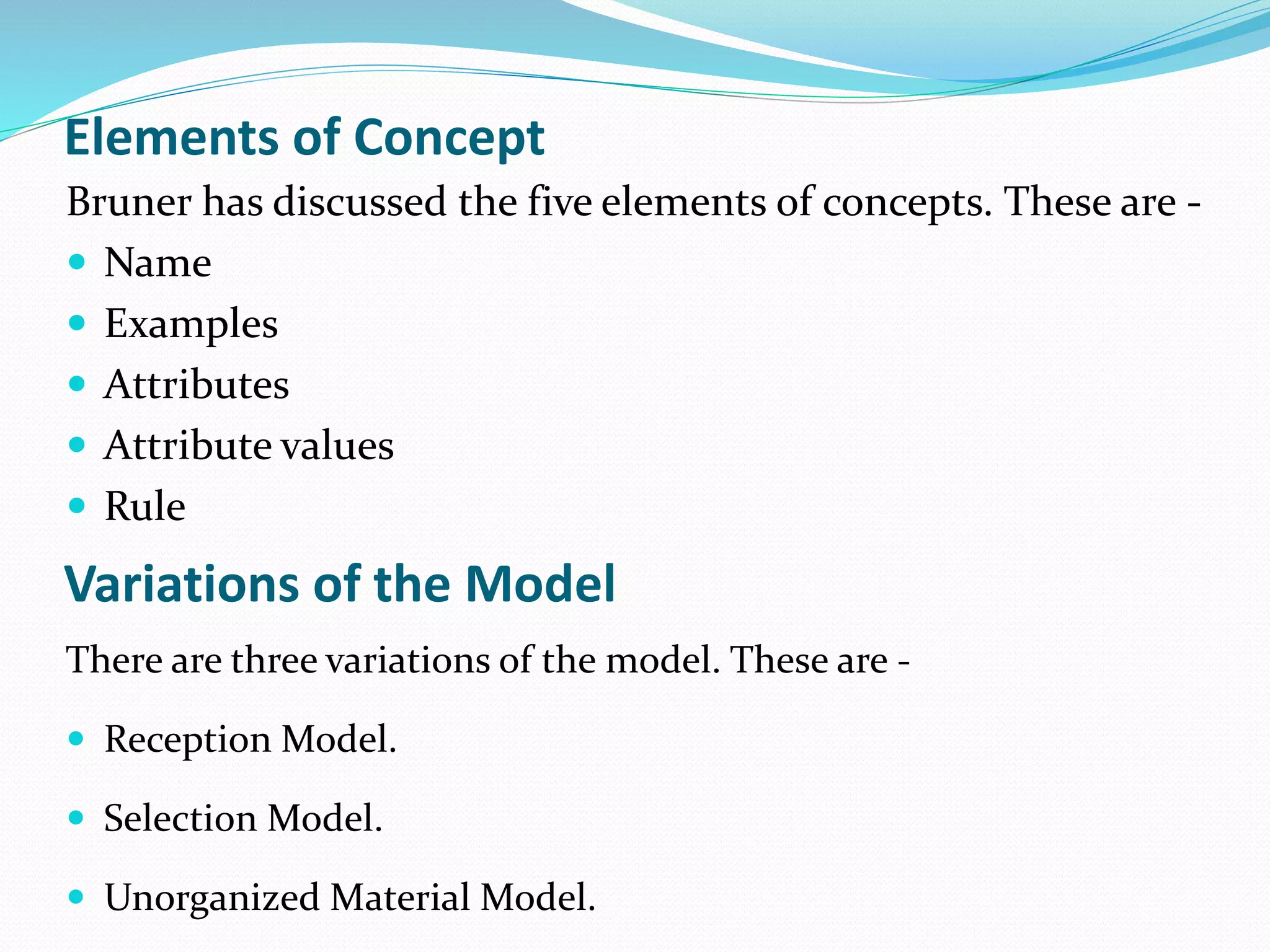
Bruner has discussed the five elements of concepts. These are -
 Name
 Examples
 Attributes
 Attribute values
 Rule
Variations of the Model
There are three variations of the model. These are -
 Reception Model.
 Selection Model.
 Unorganized Material Model.
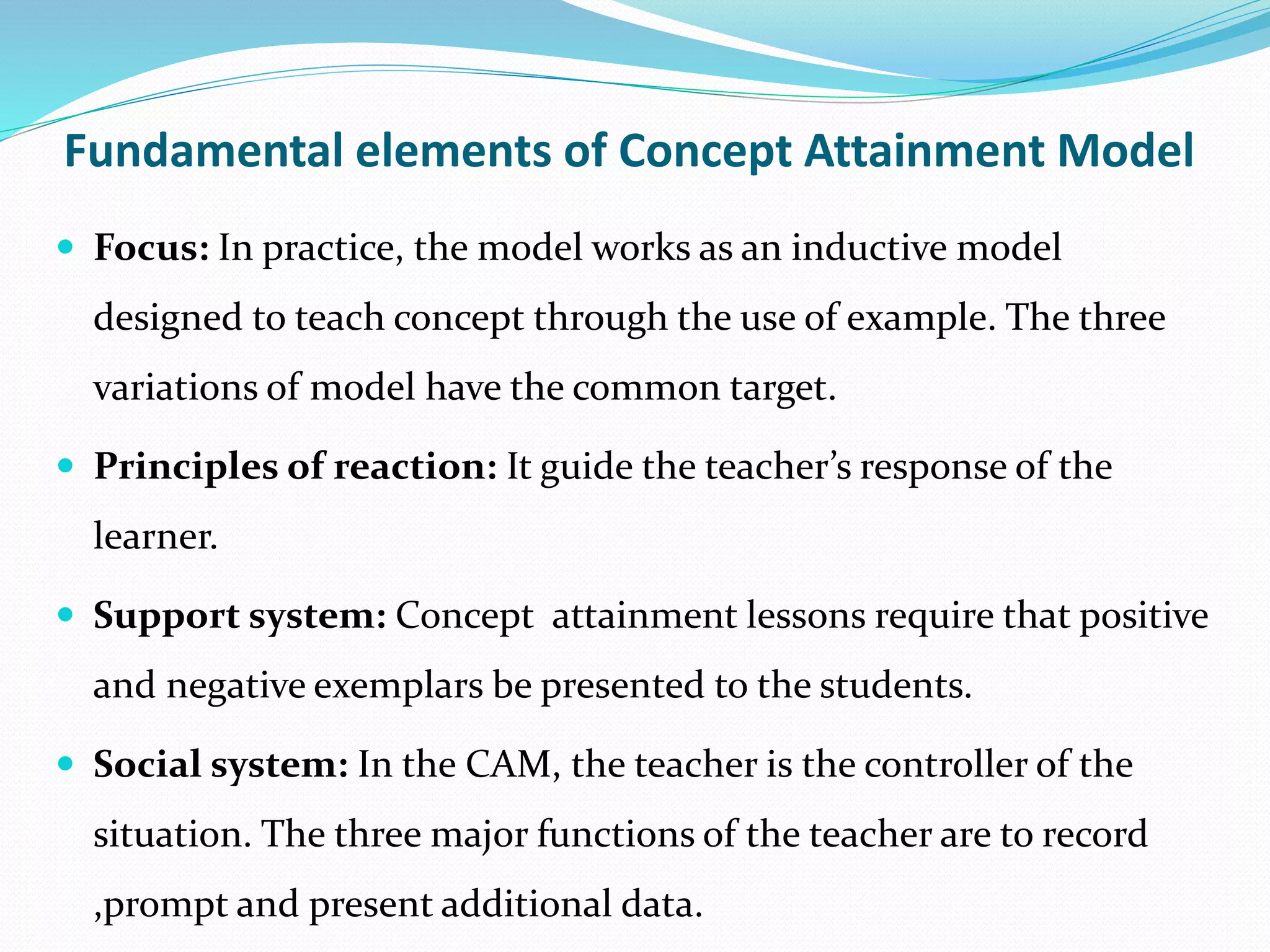
Fundamental elements of Concept Attainment Model
 Focus: In practice, the model works as an inductive model
designed to teach concept through the use of example. The three
variations of model have the common target.
 Principles of reaction: It guide the teacher’s response of the
learner.
 Support system: Concept attainment lessons require that positive
and negative exemplars be presented to the students.
 Social system: In the CAM, the teacher is the controller of the
situation. The three major functions of the teacher are to record
,prompt and present additional data.
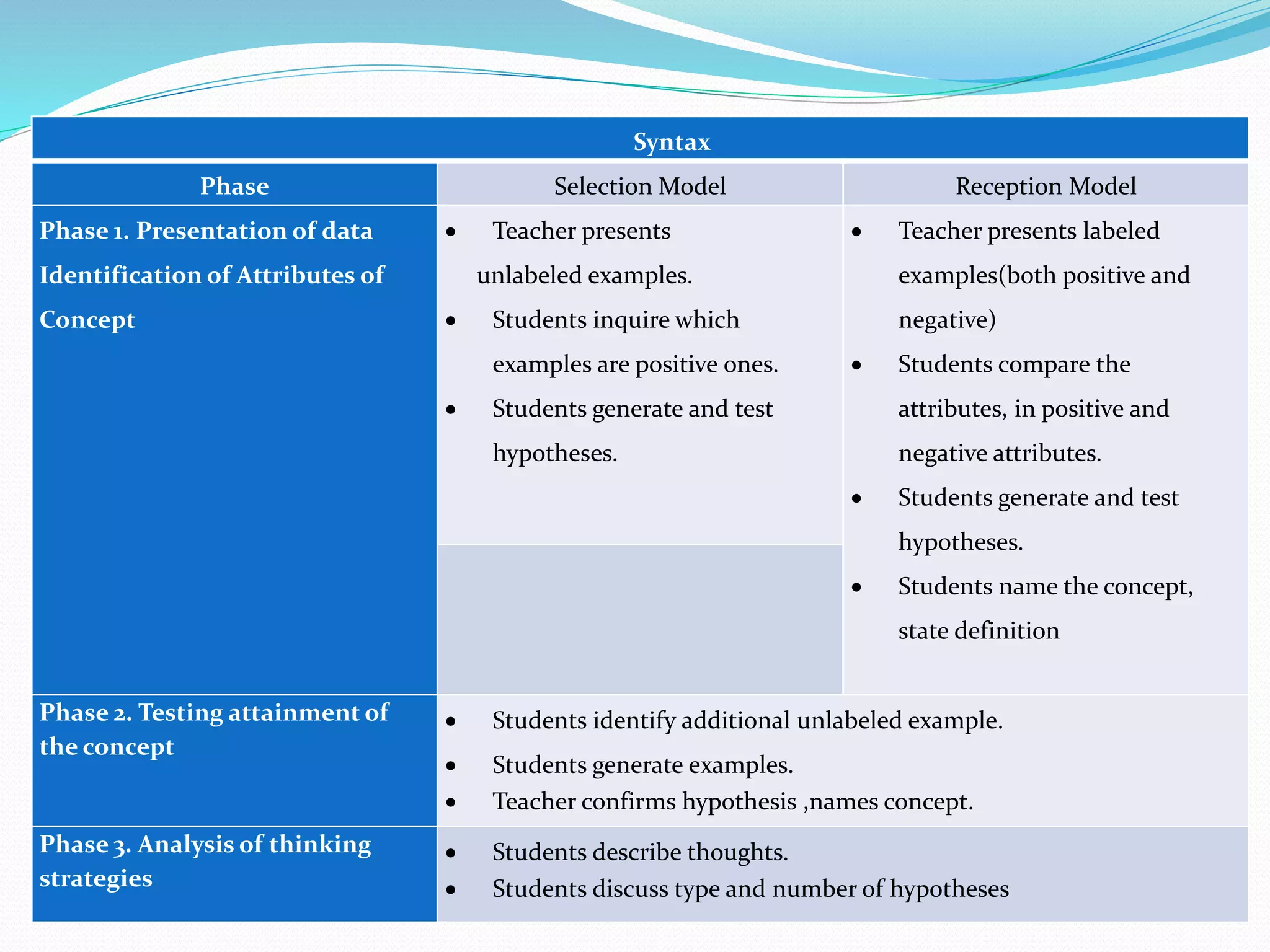
Syntax
Phase Selection Model Reception Model
Phase 1. Presentation of data
Identification of Attributes of
Concept
 Teacher presents
unlabeled examples.
 Students inquire which
examples are positive ones.
 Students generate and test
hypotheses.
 Teacher presents labeled
examples(both positive and
negative)
 Students compare the
attributes, in positive and
negative attributes.
 Students generate and test
hypotheses.
 Students name the concept,
state definition
Phase 2. Testing attainment of
the concept
 Students identify additional unlabeled example.
 Students generate examples.
 Teacher confirms hypothesis ,names concept.
Phase 3. Analysis of thinking
strategies
 Students describe thoughts.
 Students discuss type and number of hypotheses
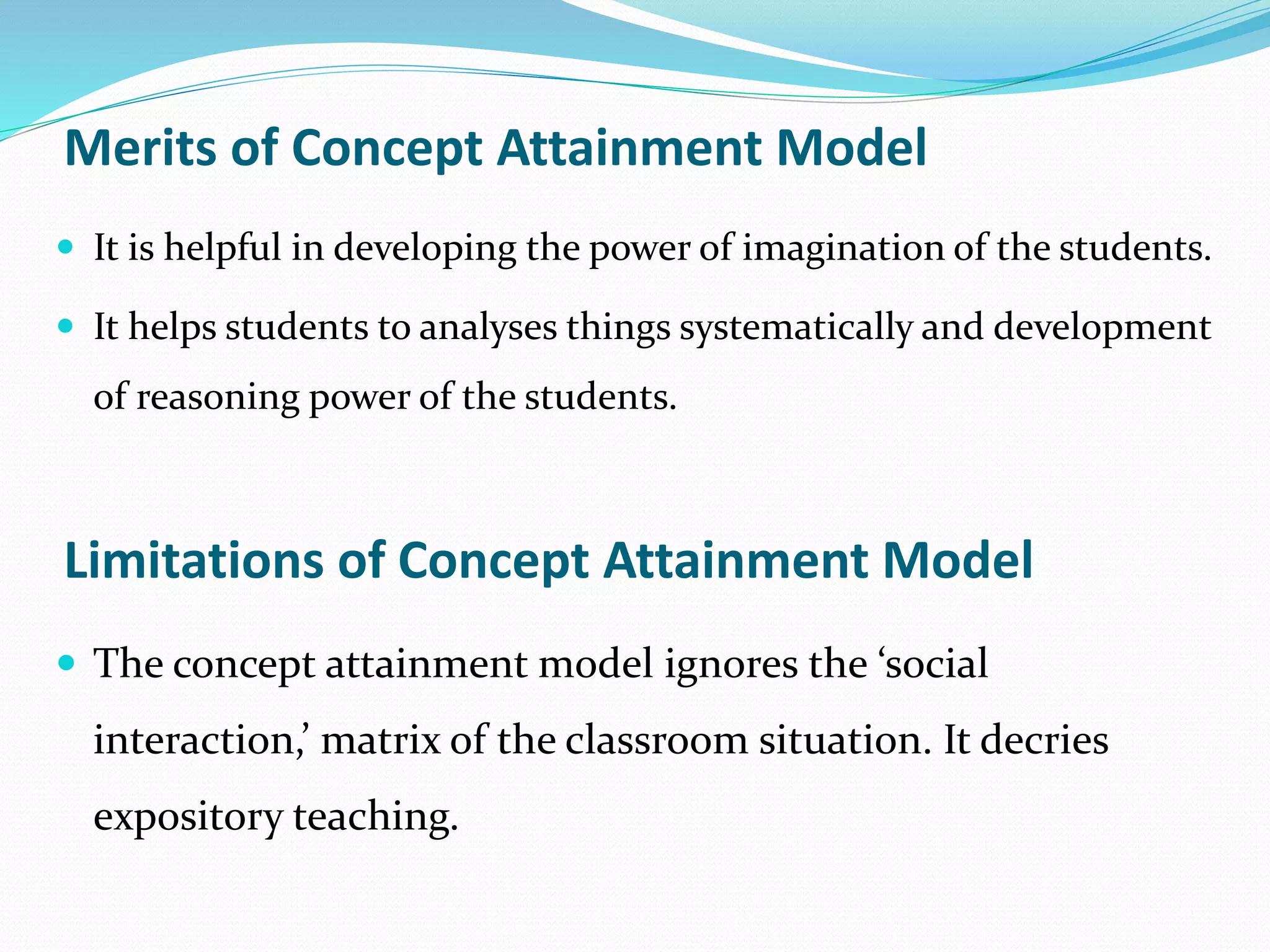
Merits of Concept Attainment Model
 It is helpful in developing the power of imagination of the students.
 It helps students to analyses things systematically and development
of reasoning power of the students.
Limitations of Concept Attainment Model
 The concept attainment model ignores the ‘social
interaction,’ matrix of the classroom situation. It decries
expository teaching.
Applications of CAM in the classroom situation
 This model can be used teaching of language, grammar, science
and fundamentals of mathematics.
 This model is also an evaluation tool.
 The model can be used with students of all grades.
Conclusion
 CAM has a great relevance for teachers who intend to improve the
instructional system. This model guides teachers to go to the depth
of the content. And helps students to attain new concepts. So the
model has a great attribute on teaching -learning process.
Bruner’s Concept Attainment Model

Bruner’s Concept Attainment Model

  • 2.
    Presented by –Sahin Mondal Lecturer in Education Department of Education A.J.K.Mahavidyalaya Ph-9679948825
  • 3.
    Introduction  Development ofmodels of teaching is the recent innovation in field of teaching technology.
  • 4.
    Concept of TeachingModel  Teaching model is a kind of detailed plan of teaching a lesson that could lead to effective learning. Definition of Teaching Model  According to Joyce and Weil (1972) –“Teaching model is a pattern or plan which can be used to shape a curriculum or course to select instructional materials and to guide a teacher’s actions.”
  • 5.
    Features of TeachingModel  Teaching models are detailed plan.  They are goal oriented.  Tell what material would be required to teach.  Help in bringing out change in behaviors among the students, which are measureable.
  • 6.
    Functions of TeachingModel  Teaching models help teachers in choosing appropriate strategy, technique and material for teaching.  Teaching models are directly related with the behavior change among the student.  They help in teacher-student interaction. Elements of Teaching Model A teaching model has six fundamental elements. These are-  Focus .  Syntax.  Principles of reaction.  The support system  The social system.  Application context.
  • 7.
    Types of TeachingModel Jaycee and Wail (1986) grouped all the teaching models into four broad categories. These are -  Information Processing Models.  Social Interaction Models.  Personal Development Models.  Behavior Modification Models.
  • 8.
    Concept Attainment Model(CAM)  The CAM was developed from the work of Jerome Bruner, Jacquline goodnow and George Austine. It comes under the category of Information Processing Models. It is also known as Bruner’s Concept Attainment Model. CAM is a teaching strategy to teach concepts. What is Concept Attainment ?  Concept Attainment is An indirect instruction strategy that uses a structured inquiry process.
  • 9.
    Elements of Concept Brunerhas discussed the five elements of concepts. These are -  Name  Examples  Attributes  Attribute values  Rule Variations of the Model There are three variations of the model. These are -  Reception Model.  Selection Model.  Unorganized Material Model.
  • 10.
    Fundamental elements ofConcept Attainment Model  Focus: In practice, the model works as an inductive model designed to teach concept through the use of example. The three variations of model have the common target.  Principles of reaction: It guide the teacher’s response of the learner.  Support system: Concept attainment lessons require that positive and negative exemplars be presented to the students.  Social system: In the CAM, the teacher is the controller of the situation. The three major functions of the teacher are to record ,prompt and present additional data.
  • 11.
    Syntax Phase Selection ModelReception Model Phase 1. Presentation of data Identification of Attributes of Concept  Teacher presents unlabeled examples.  Students inquire which examples are positive ones.  Students generate and test hypotheses.  Teacher presents labeled examples(both positive and negative)  Students compare the attributes, in positive and negative attributes.  Students generate and test hypotheses.  Students name the concept, state definition Phase 2. Testing attainment of the concept  Students identify additional unlabeled example.  Students generate examples.  Teacher confirms hypothesis ,names concept. Phase 3. Analysis of thinking strategies  Students describe thoughts.  Students discuss type and number of hypotheses
  • 12.
    Merits of ConceptAttainment Model  It is helpful in developing the power of imagination of the students.  It helps students to analyses things systematically and development of reasoning power of the students. Limitations of Concept Attainment Model  The concept attainment model ignores the ‘social interaction,’ matrix of the classroom situation. It decries expository teaching.
  • 13.
    Applications of CAMin the classroom situation  This model can be used teaching of language, grammar, science and fundamentals of mathematics.  This model is also an evaluation tool.  The model can be used with students of all grades. Conclusion  CAM has a great relevance for teachers who intend to improve the instructional system. This model guides teachers to go to the depth of the content. And helps students to attain new concepts. So the model has a great attribute on teaching -learning process.