
Lecture cum Demonstration
Method
Dr. G.Jaganmohana Rao
Faculty of Education
MITE, Kohima
Introduction:
The main aim of teaching is to bring about socially desirable
behavior change in the students and this can only be achieved if the
teaching is effective and based on the principles of teaching.
How the pupils will learn effectively, depends on the methods the
teacher adopts. There is the great world outside and the mind within and
it is the duty of the teacher to bring the two together.
This process of interpreting the world of knowledge to the child’s
mind is called the ‘Method of teaching’. It is just a way of teaching.
Method is the style of presentation of the content to the classroom.
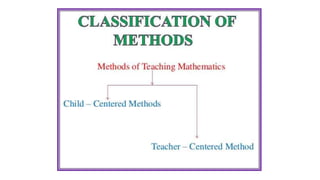
Child – Centered Methods:
 The child occupies a central position.
 Teaching – learning process is geared to the needs, interests,
capabilities & requirements of the child.
 Teacher is passive.
Examples:
Inductive,
Deductive,
Project,
Laboratory,
Problem – solving,
Heuristic,
Teacher – Centered Method:
• Teacher occupies the central position.
• Focus on telling, memorization & recalling information.
• The children are passive.
Examples:
Lecture
Demonstration
Historical
Lecture Cum – Demonstration Method
Lecture-cum-Demonstration Method:
It is one of Traditional method. this is also known as Chalk and talk
method. In this method Teacher is active and learners are passive.
Lecture-cum-demonstration includes the merits of the lecture as well as
demonstration method. Demonstration means ‘to show’. In Lecture
method teacher just tells but in demonstration method teacher shows
and illustrates certain fundamental phenomena.
Characteristics of good demonstration
• Visibility & Clear cut
• Convincing & Rehearsal
• Supplemented with other teaching aids
• Asking relevant questions
• Neat, clean and tidiness
• Simple and speedy
• Teacher to act as performer
Steps in Lecture-cum-demonstration:
Planning and Presentation: While planning a demonstration the following points should be
kept in mind. (Subject matter, Lesson planning, Rehearsal of experiment, Collection and
arrangement of apparatus)
Introduction of lesson: The lesson may be introduced on the following basis
(Student’s personal experience, Student’s environment, Telling story, A simple and
interesting experiment)
Presentation of the subject matter:
The teacher must study the subject matter on broad basis taking into consideration the
interest and experience of students
While demonstration is going on, question should also be asked which help the students to
understand the principles
The teacher should try to illustrate the facts and principles
Language used by teacher should be simple and clear.
Cnt…
Experimentation:
 Demonstration should be properly spaced and striking, clear and convincing
 The demonstration table should have only apparatus
 The experiment should be simple and speedy
 All the apparatus should not be displayed at once
Blackboard work:
A big blackboard behind the demonstration table is necessary in order to
summarize the principles and other matters of demonstration and also to draw
necessary diagrams and sketches.
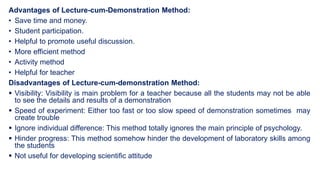
Advantages of Lecture-cum-Demonstration Method:
• Save time and money.
• Student participation.
• Helpful to promote useful discussion.
• More efficient method
• Activity method
• Helpful for teacher
Disadvantages of Lecture-cum-demonstration Method:
 Visibility: Visibility is main problem for a teacher because all the students may not be able
to see the details and results of a demonstration
 Speed of experiment: Either too fast or too slow speed of demonstration sometimes may
create trouble
 Ignore individual difference: This method totally ignores the main principle of psychology.
 Hinder progress: This method somehow hinder the development of laboratory skills among
the students
 Not useful for developing scientific attitude
Thanking You…