
LABORATORY METHOD
PRESENTED BY,
MRS. ARIFA T N
FIRST YEAR MSC NURSING
MIMS COLLEGE OF NURSING ,PUTHUKODE
Introduction
According to Webster,
word ‘laboratory” applied to the work room of
the chemist , A place devoted to experimental study of
natural science, testing, analyzing and preparing
various chemical material
• Apply philosophy of “learning by doing”
• Today, laboratory method is considered as planned
learning activity dealing with original or raw
data in the solution of problems, it is a procedure
involving first hand experience
Definition
“The laboratory is the place equipped for
experimental study”
Laboratory method : “planned learning
activity dealing with original or raw data in
solution of the problems”
The term ‘original data’ includes
materials obtained experimentally and any
other materials resulting from laboratory
procedure
Definition
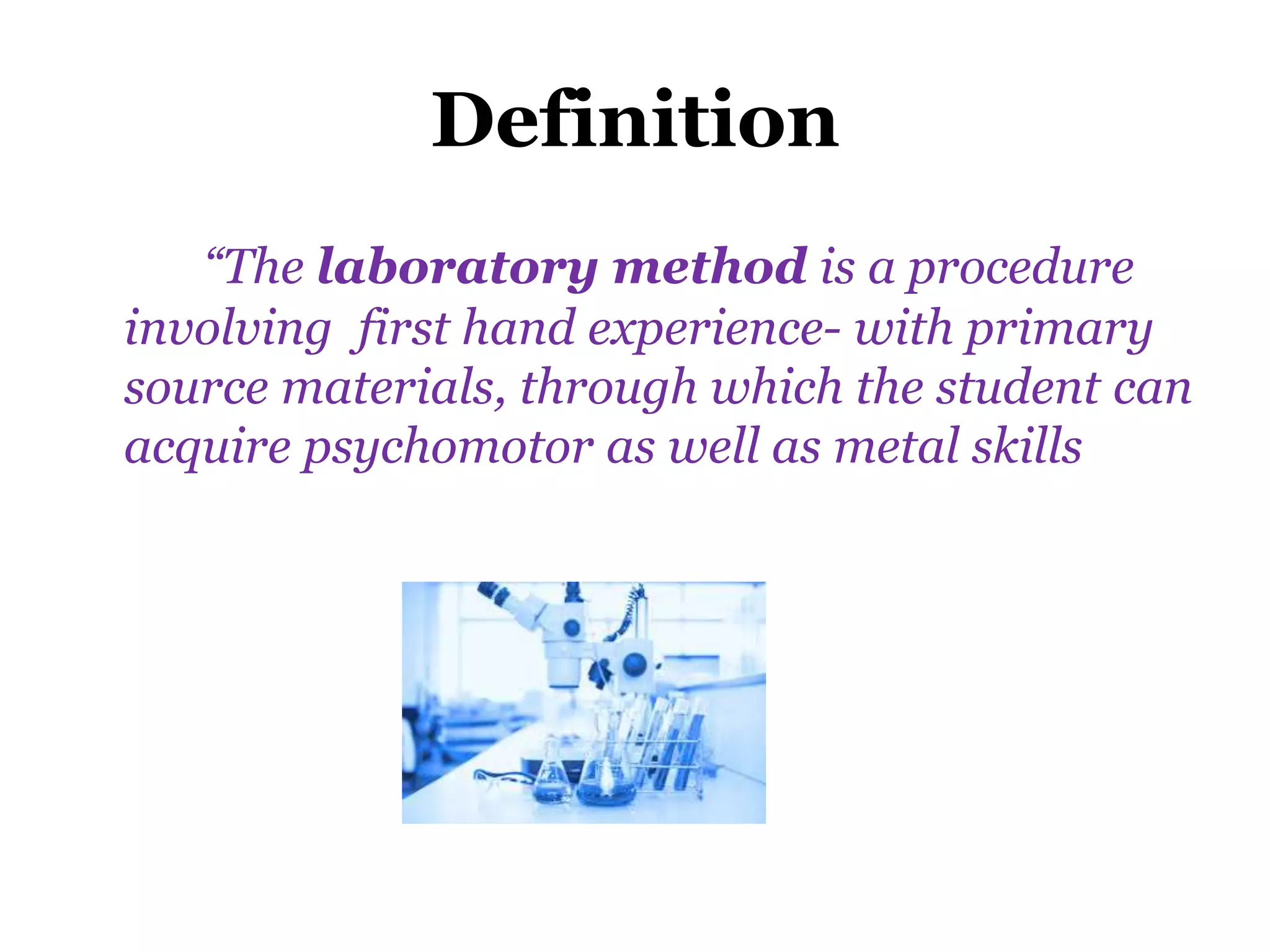
“The laboratory method is a procedure
involving first hand experience- with primary
source materials, through which the student can
acquire psychomotor as well as metal skills
Aims of laboratory
• Participate and select the objectives to be
achieved
• Provide active role to each participant and
teaching learning experience will be more
effective
• Meet the needs of the participant
• provide opportunity to sees the progress on
regular basis
• Helps to acquire new and broad knowledge
by learn through practical experience
Purposes
• To teach psychomotor skills
• To orient a new equipment /procedure
• To educate the student and learner
• To promote learning by doing / imitation
• To utilize the sense of sight and touch
• To prove and discover new facts
• To supplement the class room work
Objectives
• Verify facts taught in theory class
• Develop habits of doing independent work among
students
• Create interest in science careers
• Develop skills in handling specific apparatus
• Improve observation and critical thinking
• Develop habits of reasoning
• Avoid memorizing the subject
• Have a clear understanding of science concepts
• Develop habits of doing systematic work
Functions
Verification
activities
Explorative
activities
Inductive
activities
Deductive
activities
Psychomotor
skill
development
activities
Problem
solving
activities
Verification activities
• Asked to verify major concepts
• Provide opportunity to witness events
previously discussed
Explorative activities
• Encouraged to probe and investigate new
information through open ended problems
• Helps,
– Develop interest in science
– Motivate to study the subject in depth
– Utilize to process new information and to find
scientific relation ship
Inductive activities
• Question are posed to the students and they are
guided to discover a relationship or concept on
their own
Deductive activities
• Based on maxim forum general to specific
• Students are encouraged to apply the previously
learned principles in explaining, predicting or
describing an event these activities contribute to
reinforce major concepts
Psychomotor skill
development activities
• Provided opportunity to practice
psychomotor skills. These skills is required
to conduct experimental work
Problem solving activities
• Students are required to solve problems
and formulate answers. Assistance must
be provided to the designed problematic
students with the aim to impact training in
scientific process or problem solving skills
Techniques and General
principles
Techniques and General
principles
Introductory phase
• Establishment of objectives
and a plan of work.
• Planning for laboratory
period.
• Preparation of the teacher
and students.
Techniques and General
principles
The work period
• Individual/ group of students
• Teacher supervision
• Small team works adequate
recording
• length of the lab period
• Provision for individual
differences
• Additional assignments
Techniques and General
principles
Culminating activities
• Class should meet together
• Presentation of the result
(individual or group)
• Problem solving
• Exhibits various projects
Lab based teaching strategies
• Effective laboratory method requires
– Skill
– Creativity
– Hard work
– Executing
Lab preparation
• To carry out the ;lab sessions smoothly
• Before the semester
• Adequate supplies
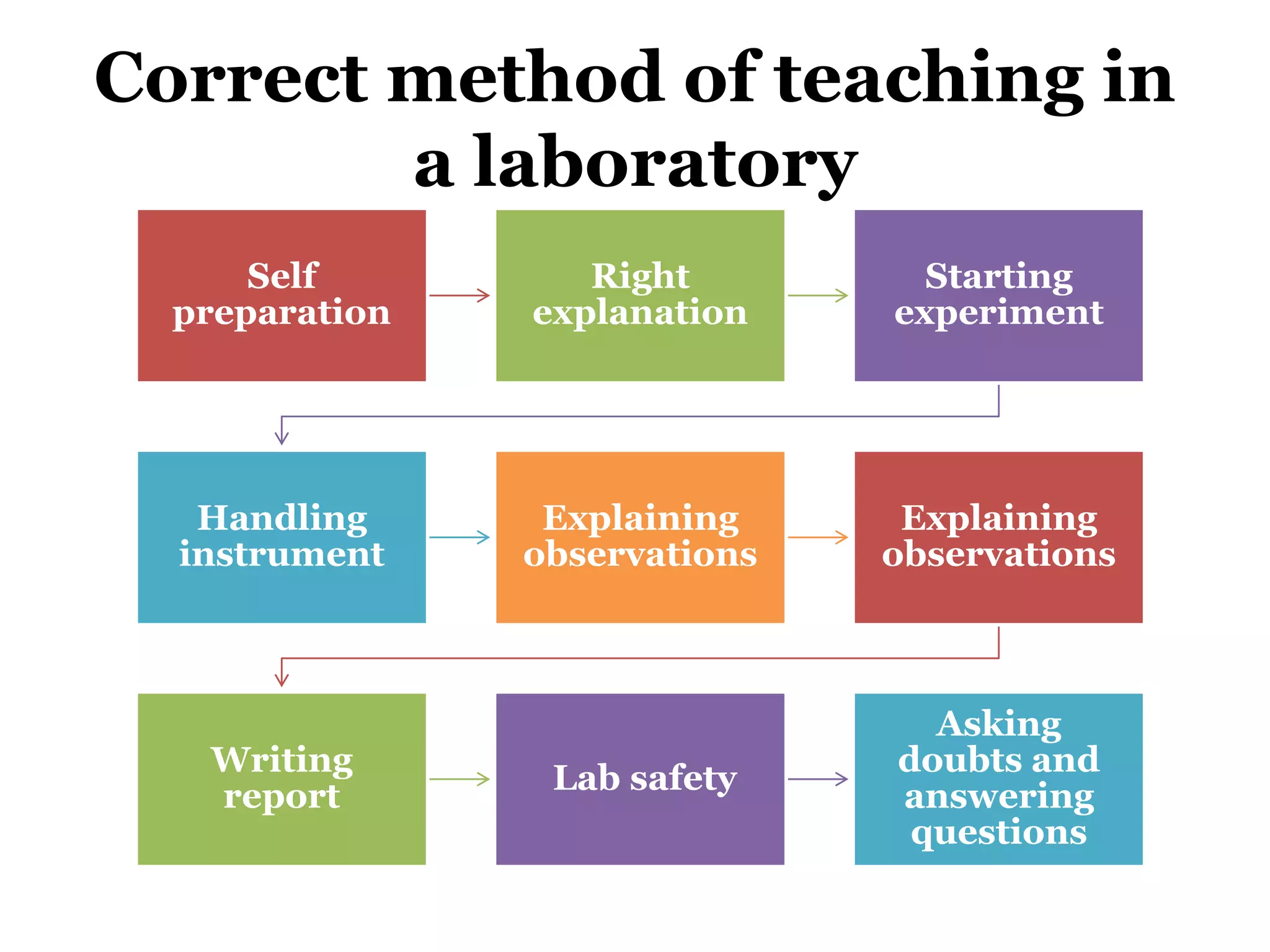
Correct method of teaching in
a laboratory
Self
preparation
Right
explanation
Starting
experiment
Handling
instrument
Explaining
observations
Explaining
observations
Writing
report
Lab safety
Asking
doubts and
answering
questions
Laboratory in nursing
• Used in nursing curriculum
• Community nursing projects
• Experience in clinical laboratory
Guidelines
• Respect for students, patient and other health workers
• Consider individual deference
• Help to establish realistic and worthwhile goals for both
class and clinical experience
• Assess the student, reinforce and help to gain knowledge
• Selection of activities from simple to complex
• Adapt instructions and supervision according to the
capacity of student
• Teacher should relate teach other as a friend and these to help
and guide her
• Conduct discussion and conferences
• Encourage students for their achievements
Advantages
• Provides real opportunity
• Carry out Problem solving
• Develop skills
• Reinforce knowledge and attitudes
• Provide real world view
• Allow use of real models
• Gain mastery over subjects
• Learn to work under guidance
• Provide first hand information
• Excellent method to learn in concrete and abstract
manner
Disadvantages
• Time consuming
• Lack of budget
• Need constant supervision
• Need manpower and enough materials
• Need adequate physical setup and facilities
• Difficulty to control the variables that
influence learning
• Most costly learning method
Summary
Research reference
Nursing student’s perceptions of factors
influencing their learning environment in a
clinical skills laboratory: A qualitative study
• Design: exploratory qualitative design
• Participants :19, 2nd year nursing students
• Method of data collection: focused group
interview and content analysis
• Result: the study documents students
experiences of physical, psychological,
organizational &factors that affect the CSL (
clinical skill laboratory) learning environment
Conclusion
ASSIGNMENT
• Write an assignment on implication of
laboratory method in nursing education and
submit on 25/11/19
Sl
no
Criteria Mark
1 Introduction 1
2 Content 3
3 Organization 1
4 Research findings 2
5 Reference 2
6 Punctuality 1
Total 10
Reference
1. SUDHA.R.NURSING EDUCATION PRINCIPLES AND
CONCEPTS .1ST ED;NEW DELHI’JAYPEE;2013.P.91-92
2. SODHI. K, COMPREHENSIVE TEXT BOOK OF NURSING
EDUCATION.NEWDELHI;JAYPEE;2017.P.65-68
3. KANNIMMAL , GOPICHANDRAN L.ESSENTIALS OF
COMMUNICATION AND EDUCATION TECHNOLOGY
FOR BSc NURSING .2ND ED;NEWDELHI;CBS;2020.168-69
4. BASHEER P.TEXTBOOK OF NURSING
EDUCATION;NEWDELHI;EMMESS;2015.P.128-130
5. SHEEBA T, PRASANNA L.COMMUNICARIOB AND
EDUCATIONAL TECHNOLOGY.3RD
ED;HYDERABAD;PRONTHINI PUBLICATIONS;2017.P.164
6. HARALDSEID,ET.AL.NURSE EDU TODAY;2015
THANK YOU

Laboratory method

  • 1.
    LABORATORY METHOD PRESENTED BY, MRS.ARIFA T N FIRST YEAR MSC NURSING MIMS COLLEGE OF NURSING ,PUTHUKODE
  • 2.
    Introduction According to Webster, word‘laboratory” applied to the work room of the chemist , A place devoted to experimental study of natural science, testing, analyzing and preparing various chemical material • Apply philosophy of “learning by doing” • Today, laboratory method is considered as planned learning activity dealing with original or raw data in the solution of problems, it is a procedure involving first hand experience
  • 3.
    Definition “The laboratory isthe place equipped for experimental study” Laboratory method : “planned learning activity dealing with original or raw data in solution of the problems” The term ‘original data’ includes materials obtained experimentally and any other materials resulting from laboratory procedure
  • 4.
    Definition “The laboratory methodis a procedure involving first hand experience- with primary source materials, through which the student can acquire psychomotor as well as metal skills
  • 5.
    Aims of laboratory •Participate and select the objectives to be achieved • Provide active role to each participant and teaching learning experience will be more effective • Meet the needs of the participant • provide opportunity to sees the progress on regular basis • Helps to acquire new and broad knowledge by learn through practical experience
  • 6.
    Purposes • To teachpsychomotor skills • To orient a new equipment /procedure • To educate the student and learner • To promote learning by doing / imitation • To utilize the sense of sight and touch • To prove and discover new facts • To supplement the class room work
  • 7.
    Objectives • Verify factstaught in theory class • Develop habits of doing independent work among students • Create interest in science careers • Develop skills in handling specific apparatus • Improve observation and critical thinking • Develop habits of reasoning • Avoid memorizing the subject • Have a clear understanding of science concepts • Develop habits of doing systematic work
  • 8.
  • 9.
    Verification activities • Askedto verify major concepts • Provide opportunity to witness events previously discussed
  • 10.
    Explorative activities • Encouragedto probe and investigate new information through open ended problems • Helps, – Develop interest in science – Motivate to study the subject in depth – Utilize to process new information and to find scientific relation ship
  • 11.
    Inductive activities • Questionare posed to the students and they are guided to discover a relationship or concept on their own
  • 12.
    Deductive activities • Basedon maxim forum general to specific • Students are encouraged to apply the previously learned principles in explaining, predicting or describing an event these activities contribute to reinforce major concepts
  • 13.
    Psychomotor skill development activities •Provided opportunity to practice psychomotor skills. These skills is required to conduct experimental work
  • 14.
    Problem solving activities •Students are required to solve problems and formulate answers. Assistance must be provided to the designed problematic students with the aim to impact training in scientific process or problem solving skills
  • 15.
  • 16.
    Techniques and General principles Introductoryphase • Establishment of objectives and a plan of work. • Planning for laboratory period. • Preparation of the teacher and students.
  • 17.
    Techniques and General principles Thework period • Individual/ group of students • Teacher supervision • Small team works adequate recording • length of the lab period • Provision for individual differences • Additional assignments
  • 18.
    Techniques and General principles Culminatingactivities • Class should meet together • Presentation of the result (individual or group) • Problem solving • Exhibits various projects
  • 19.
    Lab based teachingstrategies • Effective laboratory method requires – Skill – Creativity – Hard work – Executing
  • 20.
    Lab preparation • Tocarry out the ;lab sessions smoothly • Before the semester • Adequate supplies
  • 21.
    Correct method ofteaching in a laboratory Self preparation Right explanation Starting experiment Handling instrument Explaining observations Explaining observations Writing report Lab safety Asking doubts and answering questions
  • 22.
    Laboratory in nursing •Used in nursing curriculum • Community nursing projects • Experience in clinical laboratory
  • 23.
    Guidelines • Respect forstudents, patient and other health workers • Consider individual deference • Help to establish realistic and worthwhile goals for both class and clinical experience • Assess the student, reinforce and help to gain knowledge • Selection of activities from simple to complex • Adapt instructions and supervision according to the capacity of student • Teacher should relate teach other as a friend and these to help and guide her • Conduct discussion and conferences • Encourage students for their achievements
  • 24.
    Advantages • Provides realopportunity • Carry out Problem solving • Develop skills • Reinforce knowledge and attitudes • Provide real world view • Allow use of real models • Gain mastery over subjects • Learn to work under guidance • Provide first hand information • Excellent method to learn in concrete and abstract manner
  • 25.
    Disadvantages • Time consuming •Lack of budget • Need constant supervision • Need manpower and enough materials • Need adequate physical setup and facilities • Difficulty to control the variables that influence learning • Most costly learning method
  • 26.
  • 27.
    Research reference Nursing student’sperceptions of factors influencing their learning environment in a clinical skills laboratory: A qualitative study • Design: exploratory qualitative design • Participants :19, 2nd year nursing students • Method of data collection: focused group interview and content analysis • Result: the study documents students experiences of physical, psychological, organizational &factors that affect the CSL ( clinical skill laboratory) learning environment
  • 28.
  • 29.
    ASSIGNMENT • Write anassignment on implication of laboratory method in nursing education and submit on 25/11/19 Sl no Criteria Mark 1 Introduction 1 2 Content 3 3 Organization 1 4 Research findings 2 5 Reference 2 6 Punctuality 1 Total 10
  • 30.
    Reference 1. SUDHA.R.NURSING EDUCATIONPRINCIPLES AND CONCEPTS .1ST ED;NEW DELHI’JAYPEE;2013.P.91-92 2. SODHI. K, COMPREHENSIVE TEXT BOOK OF NURSING EDUCATION.NEWDELHI;JAYPEE;2017.P.65-68 3. KANNIMMAL , GOPICHANDRAN L.ESSENTIALS OF COMMUNICATION AND EDUCATION TECHNOLOGY FOR BSc NURSING .2ND ED;NEWDELHI;CBS;2020.168-69 4. BASHEER P.TEXTBOOK OF NURSING EDUCATION;NEWDELHI;EMMESS;2015.P.128-130 5. SHEEBA T, PRASANNA L.COMMUNICARIOB AND EDUCATIONAL TECHNOLOGY.3RD ED;HYDERABAD;PRONTHINI PUBLICATIONS;2017.P.164 6. HARALDSEID,ET.AL.NURSE EDU TODAY;2015
  • 31.