INTRODUCTION 
Learning by doing is a cardinal principal of teaching science cannot be 
taught as a theory subject. Scientific theory is based on the process of inquiry and 
experimentation. Practical work is an essential component of learning science. 
Dr. D.S. Kothari 
“To learn science is to do science there is no other way of learning science”. 
Advantage of science laboratory 
1. Application of principles of science. 
2. Interest and curiosity. 
3. Intellectual honesty. 
4. Scientific attitude and scientific methodology. 
5. Co-operation and resourcefulness. 
6. Training in handling the equipment. 
Need for a science laboratory 
1. Conducting experiments and demonstrations. 
2. Developing scientific skills among the students. 
3. Developing the skills of scientific experimentation and research. 
4. Enhancing the scientific skills and skills of resourcefulness and co-operation. 
Objectives 
1. Provide opportunity for individuals and group learning. 
2. To simplify the abstract scientific concepts. 
3. To develop scientific skills in the students.
4. To motivate the students. 
5. To develop interest and curiosity. 
Characteristics of a good science laboratories 
1. Space:- 
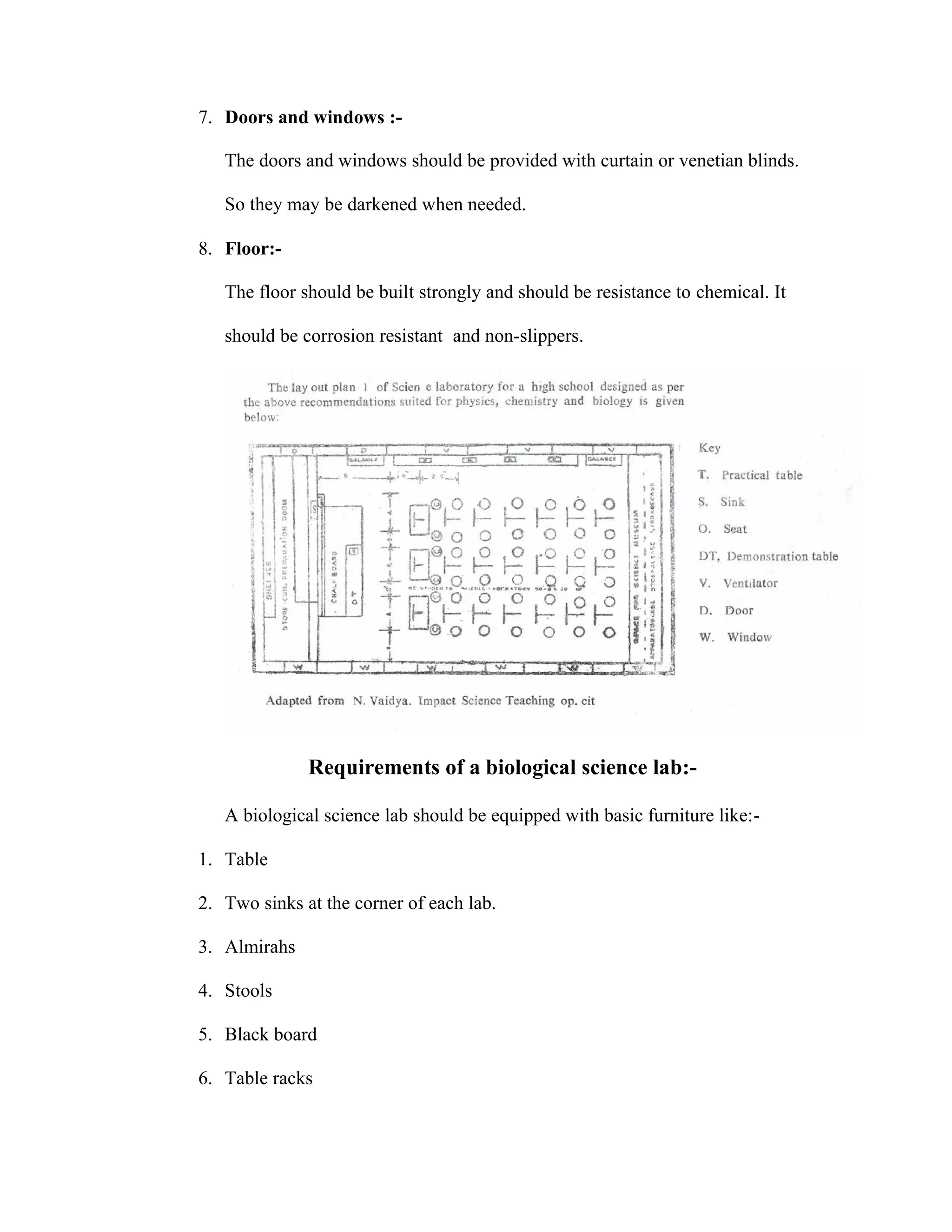
The lab should be spacious and sufficient should be provided for the free 
movement of the students between the work benches. 
2. Location :- 
The lab should be pre ferably located in the ground floor. This makes the 
movement of materials and people easy. 
3. Demonstration table:- 
A big, clearing visible, separate demonstration bench for teacher should be 
provide. 
4. Ventilation:- 
The lab should be well its and ventilated. They should be provided with 
adequate water supply. The lab should be well it with natural light. 
5. Furniture:- 
The furniture should be minimal and movable. Heavy furniture should be 
avoided. 
6. Flexibility:- 
The lab should be planned in such a way that it carries all element of 
flexibility.
7. Doors and windows :- 
The doors and windows should be provided with curtain or venetian blinds. 
So they may be darkened when needed. 
8. Floor:- 
The floor should be built strongly and should be resistance to chemical. It 
should be corrosion resistant and non-slippers. 
Requirements of a biological science lab:- 
A biological science lab should be equipped with basic furniture like:- 
1. Table 
2. Two sinks at the corner of each lab. 
3. Almirahs 
4. Stools 
5. Black board 
6. Table racks
7. Preparation room 
8. An animal house and a green house. 
The other equipment and apparatus required are, 
1. Refrigerator 
2. Centrifuge 
3. Electronic oven 
4. Incubator 
5. A mixer 
6. Auto clave 
7. Chemicals/ Reagents 
8. Charts and models 
9. Slides and specimens 
Care and maintenance of apparatus:- 
1. Every item should be designed in a fixed place. 
2. Registers should be updated regularly. 
3. Items should be kept ready on racks for use. 
4. Heavy items and cans should be kept at low levels. 
5. Wooden items should be regularly polished. 
6. Minimum use of chemicals should be encouraged. 
7. Break age of any item should be noted down. 
Administration of the laboratory work:- 
1. Organization of practical work. 
2. Grouping of students.
3. Preparation for practical work. 
4. Discipline. 
5. Instructions for the students. 
6. Maintenance of observation book and records. 
Organization of practical work:- 
It is essential for a science teacher to complement her classroom lessons to 
the practicals conducted in the lab. It can be categorized into 3 types. 
1. Demonstrations 
2. Practical work done by students. 
3. Project work. 
1. Demonstration:- 
The teachers give demonstration to the students before initiating any 
practical work . They help the students to understand the practical skills. 
2. Practical work:- 
Could be done by students either individually or in groups under the 
guidance of the teacher. 
3. Project work:- 
It could be given to the students to be done either in the lab or out of 
school. 
Guidance for teacher in oranising practical work:- 
1. The experiments should be properly done. Accurate reading should be 
noted down. 
2. In the recording books, the data and the diagrams should be entered.
3. Teacher should check and sign every students practical book. 
4. Teacher should explain the care and accuracy of apparatus to the students. 
5. Teacher should emphasize on economy in usage of chemicals and 
apparatus. 
6. Teacher should be cautions about accidents in the lab. 
7. Teacher should create interest in the lab. 
8. Teacher should create interest in practical. 
Organization of students :- 
Depending upon the available equipment and facilities students could be 
grouped differently. They are two plans for grouping:- 
1. Group plan:- 
In this plan all the students work on the same experiment at the same time. 
2. Individual plan:- 
When the number of students is more and available facilities are less this 
type of plan is followed. It is a cyclic management of experiments. 
Discipline in the science laboratory :- 
1. Lab apparatus and materials are meant only lab use. 
2. Avoid misplacing of chemicals. 
3. Stoppers should be put back on respective bottles. 
4. No test should be done without the instructions. 
5. End of experiment, the apparatus should be cleaned and returned. 
6. The work area should be kept clean and tidy..
General safety rules for the lab :- 
1. In case of any accident immediately report on the supervision of teacher. 
2. Equipments should be handled only after reading the instructions. 
3. Lab apparatus should be used only after receiving the instructions and 
precautions from the teachers. 
4. Never pour back the reagents or chemicals into the bottles. 
5. Chemicals spilled on the skin should be immediately wash with water. 
6. Working area should be cleaned before and after the experiment. 
In case of accidents or injuries, first aid should be immediately provided. First 
aid requirement is important in science laboratory. The science teacher should 
be trained in providing first aid to the injured to the students. 
CONCLUSION 
The modern trend in the teaching of science is to emphasise student 
investigate activity as an integral part of the instructional process. Many 
programmes have been developed in an attempt to integrate in quiry with 
science instruction and to develop student inquiry skills. 
REFERENCE 
1. Methods of teaching biological science. – Dr.P. Ameeta. 
2. Modern trends in science education – Dr. T. T. Joseph. 
3. Wikepedia.

Introduction

  • 1.
    INTRODUCTION Learning bydoing is a cardinal principal of teaching science cannot be taught as a theory subject. Scientific theory is based on the process of inquiry and experimentation. Practical work is an essential component of learning science. Dr. D.S. Kothari “To learn science is to do science there is no other way of learning science”. Advantage of science laboratory 1. Application of principles of science. 2. Interest and curiosity. 3. Intellectual honesty. 4. Scientific attitude and scientific methodology. 5. Co-operation and resourcefulness. 6. Training in handling the equipment. Need for a science laboratory 1. Conducting experiments and demonstrations. 2. Developing scientific skills among the students. 3. Developing the skills of scientific experimentation and research. 4. Enhancing the scientific skills and skills of resourcefulness and co-operation. Objectives 1. Provide opportunity for individuals and group learning. 2. To simplify the abstract scientific concepts. 3. To develop scientific skills in the students.
  • 2.
    4. To motivatethe students. 5. To develop interest and curiosity. Characteristics of a good science laboratories 1. Space:- The lab should be spacious and sufficient should be provided for the free movement of the students between the work benches. 2. Location :- The lab should be pre ferably located in the ground floor. This makes the movement of materials and people easy. 3. Demonstration table:- A big, clearing visible, separate demonstration bench for teacher should be provide. 4. Ventilation:- The lab should be well its and ventilated. They should be provided with adequate water supply. The lab should be well it with natural light. 5. Furniture:- The furniture should be minimal and movable. Heavy furniture should be avoided. 6. Flexibility:- The lab should be planned in such a way that it carries all element of flexibility.
  • 3.
    7. Doors andwindows :- The doors and windows should be provided with curtain or venetian blinds. So they may be darkened when needed. 8. Floor:- The floor should be built strongly and should be resistance to chemical. It should be corrosion resistant and non-slippers. Requirements of a biological science lab:- A biological science lab should be equipped with basic furniture like:- 1. Table 2. Two sinks at the corner of each lab. 3. Almirahs 4. Stools 5. Black board 6. Table racks
  • 4.
    7. Preparation room 8. An animal house and a green house. The other equipment and apparatus required are, 1. Refrigerator 2. Centrifuge 3. Electronic oven 4. Incubator 5. A mixer 6. Auto clave 7. Chemicals/ Reagents 8. Charts and models 9. Slides and specimens Care and maintenance of apparatus:- 1. Every item should be designed in a fixed place. 2. Registers should be updated regularly. 3. Items should be kept ready on racks for use. 4. Heavy items and cans should be kept at low levels. 5. Wooden items should be regularly polished. 6. Minimum use of chemicals should be encouraged. 7. Break age of any item should be noted down. Administration of the laboratory work:- 1. Organization of practical work. 2. Grouping of students.
  • 5.
    3. Preparation forpractical work. 4. Discipline. 5. Instructions for the students. 6. Maintenance of observation book and records. Organization of practical work:- It is essential for a science teacher to complement her classroom lessons to the practicals conducted in the lab. It can be categorized into 3 types. 1. Demonstrations 2. Practical work done by students. 3. Project work. 1. Demonstration:- The teachers give demonstration to the students before initiating any practical work . They help the students to understand the practical skills. 2. Practical work:- Could be done by students either individually or in groups under the guidance of the teacher. 3. Project work:- It could be given to the students to be done either in the lab or out of school. Guidance for teacher in oranising practical work:- 1. The experiments should be properly done. Accurate reading should be noted down. 2. In the recording books, the data and the diagrams should be entered.
  • 6.
    3. Teacher shouldcheck and sign every students practical book. 4. Teacher should explain the care and accuracy of apparatus to the students. 5. Teacher should emphasize on economy in usage of chemicals and apparatus. 6. Teacher should be cautions about accidents in the lab. 7. Teacher should create interest in the lab. 8. Teacher should create interest in practical. Organization of students :- Depending upon the available equipment and facilities students could be grouped differently. They are two plans for grouping:- 1. Group plan:- In this plan all the students work on the same experiment at the same time. 2. Individual plan:- When the number of students is more and available facilities are less this type of plan is followed. It is a cyclic management of experiments. Discipline in the science laboratory :- 1. Lab apparatus and materials are meant only lab use. 2. Avoid misplacing of chemicals. 3. Stoppers should be put back on respective bottles. 4. No test should be done without the instructions. 5. End of experiment, the apparatus should be cleaned and returned. 6. The work area should be kept clean and tidy..
  • 7.
    General safety rulesfor the lab :- 1. In case of any accident immediately report on the supervision of teacher. 2. Equipments should be handled only after reading the instructions. 3. Lab apparatus should be used only after receiving the instructions and precautions from the teachers. 4. Never pour back the reagents or chemicals into the bottles. 5. Chemicals spilled on the skin should be immediately wash with water. 6. Working area should be cleaned before and after the experiment. In case of accidents or injuries, first aid should be immediately provided. First aid requirement is important in science laboratory. The science teacher should be trained in providing first aid to the injured to the students. CONCLUSION The modern trend in the teaching of science is to emphasise student investigate activity as an integral part of the instructional process. Many programmes have been developed in an attempt to integrate in quiry with science instruction and to develop student inquiry skills. REFERENCE 1. Methods of teaching biological science. – Dr.P. Ameeta. 2. Modern trends in science education – Dr. T. T. Joseph. 3. Wikepedia.