LABORATORY
AND
DEMONSTRATION
METHOD
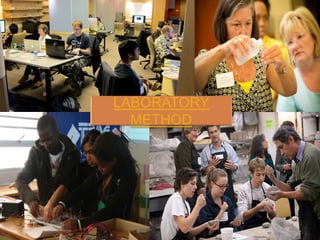
LABORATORY METHOD

   Used to designate a teaching procedure in the physical
    sciences that uses experimentation with apparatus.


   Teaching procedure dealing with firsthand experiences
    regarding materials or facts obtained from investigation
    or experiment.
AIMS
LABORATORY METHOD
By John Walton (1996)
1. To give firsthand experience in the

   laboratory which may increase
   student interest.
2. To provide student participation in
   original research.
3. To   develop skill in the use of
   laboratory        equipment     and
TYPES
LABORATORY METHOD
1.    EXPERIMENTAL – aims to train pupils in
     problem solving with incidental acquisition of
     information and motor skills.
2.   OBSERVATIONAL – the acquisition of facts is
     the dominant aim of the method.
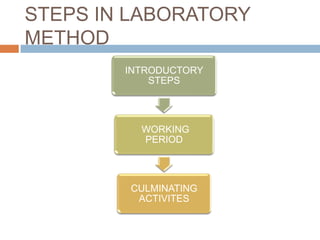
STEPS IN LABORATORY
METHOD
        INTRODUCTORY
            STEPS


          WORKING
          PERIOD


        CULMINATING
         ACTIVITES
STEPS
LABORATORY METHOD
Risk (1965) gives the following steps:

   INTRODUCTORY STEP- determination of the
    work to be done.
    WORK PERIOD- determine the length of the
    work period.
   CULMINATING ACTIVITIES – (next slide)
   CULMINATING ACTIVITIES

        Explaining the nature and importance of the
        problem the group had worked on.
       Reporting data gathered or other findings.
       Presenting illustrative material or special
        contributions.
       Exhibiting various projects and explanation by
        their sponsors.
ADVANTAGES
(LABORATORY METHOD)

1.   It is learning by doing.
2.   Impressions through several senses make
     learning more effective.
3.   Undergoing actual experience.
4.   It is a direct preparation for life.
DISADVANTAGES
LABORATORY METHOD

1.   It is an uneconomical way of learning.
2.   It becomes mechanical at times.
3.   Expensive apparatus.
4.   Loss of time occurs.
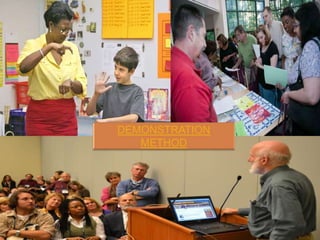
DEMONSTRATION
METHOD
   Widely used to teach students how to use
    equipment and materials, rhythm and musical
    instruments and others.

   Use to develop skills. Recommended for
    teaching a skill because it covers all the
    necessary steps in an effective learning order.
AIMS
DEMONSTRATION METHOD

1.   To teach a skill, concept or principle
2.   To demonstrate delicate and
     dangerous works involving careful
     manipulation.
3.   To let teachers participate in
     demonstration classrooms to help
     improve their own teaching
TYPES
DEMONSTRATION METHOD

1.    EXPOSITORY – designed to impart
     information directly or to illustrate a skill as
     students observe.
2.    QUESTING – designed to foster discovery of
     a concept or its application.
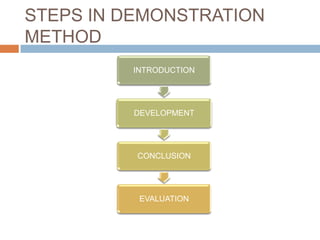
STEPS IN DEMONSTRATION
METHOD
         INTRODUCTION


          DEVELOPMENT


          CONCLUSION


          EVALUATION
ADVANTAGES
DEMONSTRATION METHOD

1.   It follows a systematic procedure.
2.   Possible wastage of time, effort and
     resources will be avoided.
3.   It will not result to trial and error.
4.   Curiosity and keen observing ability are
     instilled.
DISADVANTAGES
DEMONSTRATION METHOD
1.   Tends to foster passiveness and teacher-
     dependence on the part of the students.
2.   Becomes a failure when the number of
     students is greater.
3.   It needs a lot of time for instructions and
     demonstration.
4.   It requires a knowledgable and expert
     demonstrator.
DIFFERENCE OF BOTH
METHODS

The chief difference between the two
is that in the laboratory method, all
the learners perform the experiment
and “learning by doing”. In the
demonstration method, the teacher
does the experiment while the class
observes.
REPORTERS:
   URETA, Renee D.
   TEDIAROS, Shela May M.
   FANCOBILA, Evan Kaye B.
   ALBERCA, Loriefil R.

Laboratory and Demonstration method

  • 1.
  • 3.
    LABORATORY METHOD  Used to designate a teaching procedure in the physical sciences that uses experimentation with apparatus.  Teaching procedure dealing with firsthand experiences regarding materials or facts obtained from investigation or experiment.
  • 4.
    AIMS LABORATORY METHOD By JohnWalton (1996) 1. To give firsthand experience in the laboratory which may increase student interest. 2. To provide student participation in original research. 3. To develop skill in the use of laboratory equipment and
  • 5.
    TYPES LABORATORY METHOD 1. EXPERIMENTAL – aims to train pupils in problem solving with incidental acquisition of information and motor skills. 2. OBSERVATIONAL – the acquisition of facts is the dominant aim of the method.
  • 6.
    STEPS IN LABORATORY METHOD INTRODUCTORY STEPS WORKING PERIOD CULMINATING ACTIVITES
  • 7.
    STEPS LABORATORY METHOD Risk (1965)gives the following steps:  INTRODUCTORY STEP- determination of the work to be done.  WORK PERIOD- determine the length of the work period.  CULMINATING ACTIVITIES – (next slide)
  • 8.
    CULMINATING ACTIVITIES Explaining the nature and importance of the problem the group had worked on.  Reporting data gathered or other findings.  Presenting illustrative material or special contributions.  Exhibiting various projects and explanation by their sponsors.
  • 9.
    ADVANTAGES (LABORATORY METHOD) 1. It is learning by doing. 2. Impressions through several senses make learning more effective. 3. Undergoing actual experience. 4. It is a direct preparation for life.
  • 10.
    DISADVANTAGES LABORATORY METHOD 1. It is an uneconomical way of learning. 2. It becomes mechanical at times. 3. Expensive apparatus. 4. Loss of time occurs.
  • 12.
    DEMONSTRATION METHOD  Widely used to teach students how to use equipment and materials, rhythm and musical instruments and others.  Use to develop skills. Recommended for teaching a skill because it covers all the necessary steps in an effective learning order.
  • 13.
    AIMS DEMONSTRATION METHOD 1. To teach a skill, concept or principle 2. To demonstrate delicate and dangerous works involving careful manipulation. 3. To let teachers participate in demonstration classrooms to help improve their own teaching
  • 14.
    TYPES DEMONSTRATION METHOD 1. EXPOSITORY – designed to impart information directly or to illustrate a skill as students observe. 2. QUESTING – designed to foster discovery of a concept or its application.
  • 15.
    STEPS IN DEMONSTRATION METHOD INTRODUCTION DEVELOPMENT CONCLUSION EVALUATION
  • 16.
    ADVANTAGES DEMONSTRATION METHOD 1. It follows a systematic procedure. 2. Possible wastage of time, effort and resources will be avoided. 3. It will not result to trial and error. 4. Curiosity and keen observing ability are instilled.
  • 17.
    DISADVANTAGES DEMONSTRATION METHOD 1. Tends to foster passiveness and teacher- dependence on the part of the students. 2. Becomes a failure when the number of students is greater. 3. It needs a lot of time for instructions and demonstration. 4. It requires a knowledgable and expert demonstrator.
  • 18.
    DIFFERENCE OF BOTH METHODS Thechief difference between the two is that in the laboratory method, all the learners perform the experiment and “learning by doing”. In the demonstration method, the teacher does the experiment while the class observes.
  • 19.
    REPORTERS:  URETA, Renee D.  TEDIAROS, Shela May M.  FANCOBILA, Evan Kaye B.  ALBERCA, Loriefil R.