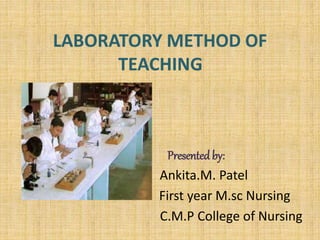
C.M PATEL COLLEGE OF
NURSING
GANDHINAGAR
• SUBJECT: NURSING EDUCATION
Presented by:
Ankita.M. Patel
First year M.sc Nursing
C.M.P College of Nursing
Introduction
 The laboratory method had its beginning in
the teaching of chemistry, whereby students
went to a workroom for purpose of
experimental study involving testing, analyzing
and preparing chemical substances.
 The learning experience are planned so that
the theory & laboratory experience can
complement each other.
 This concept of problem solving became
integral part of variety of practice in nursing
curricula.
Definition:
• Laboratory method is a planned learning
activity dealing with original or raw data in the
solution of problems.
• The term ‘original data’ include material
obtain experimentally.
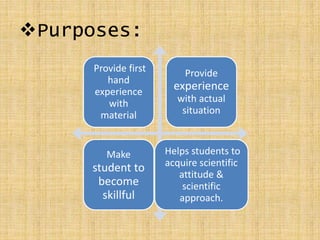
Purposes:
Provide first
hand
experience
with
material
Provide
experience
with actual
situation
Make
student to
become
skillful
Helps students to
acquire scientific
attitude &
scientific
approach.
Types of laboratory:
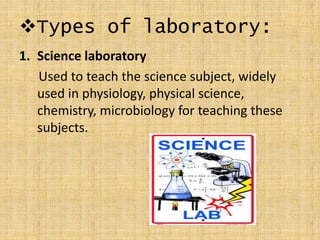
1. Science laboratory
Used to teach the science subject, widely
used in physiology, physical science,
chemistry, microbiology for teaching these
subjects.
2. Nutrition laboratory –
Used to teach the basic knowledge about food
& for practice of cooking food for normal as
well as invalids.
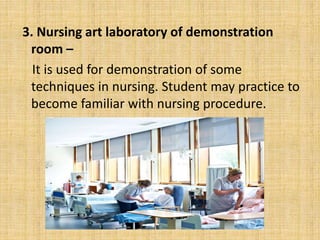
3. Nursing art laboratory of demonstration
room –
It is used for demonstration of some
techniques in nursing. Student may practice to
become familiar with nursing procedure.
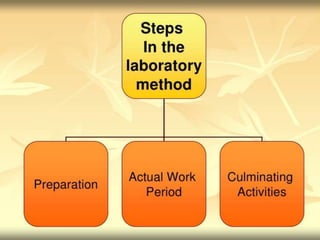
1. Preparation
• It requires establishment of objective &
plan of work.
• Teacher prepare the plan with the
cooperation of the students considering
objective for not wasting time.
• Teacher allow time for the maximum use of
laboratory work.
2. Actual Work period
• It refers to that period when demonstration,
experimentation or practice for a skill in nursing
procedure.
• To ensure an effective work period there must be
adequate equipments & facilities including basic
tools.
• There must be adequate supply of specimens &
material.
• There should be sufficient space, light &
ventilation.
3. culminating activities
• After the lab work, the class should meet
together for discussion of common problems,
for the organizations of findings, for the
presentation of work of individuals or group
problem solving activities.
Advantages
 Student’s point of view:
• Students learn by doing
• Develops the power of observation and reasoning.
• Develops the scientific attitude.
• To provide opportunity to work out experiments under
guidance.
• Gives training in organizing data.
• Since students come in contact with real life situations,
it can be a preparation for solving real life problems.
 Teacher’s point of view:
• Provide teacher an opportunity :
- To observe the students in action.
- To assess student’s worth.
- To correct student’s mistake.
- To guide students in promising direction.
Limitations of laboratory work
Poor planning & lack of direction of teacher may result
in wasting of time & can create complication.
Lack of budget can create insecurity in teacher regarding
laboratory equipments.
Most expensive because separate instrument is used for
each students.
More time consuming compare to demonstration method.
Laboratory method
Laboratory method

Laboratory method

  • 1.
    C.M PATEL COLLEGEOF NURSING GANDHINAGAR • SUBJECT: NURSING EDUCATION
  • 2.
    Presented by: Ankita.M. Patel Firstyear M.sc Nursing C.M.P College of Nursing
  • 3.
    Introduction  The laboratorymethod had its beginning in the teaching of chemistry, whereby students went to a workroom for purpose of experimental study involving testing, analyzing and preparing chemical substances.  The learning experience are planned so that the theory & laboratory experience can complement each other.  This concept of problem solving became integral part of variety of practice in nursing curricula.
  • 4.
    Definition: • Laboratory methodis a planned learning activity dealing with original or raw data in the solution of problems. • The term ‘original data’ include material obtain experimentally.
  • 5.
    Purposes: Provide first hand experience with material Provide experience with actual situation Make studentto become skillful Helps students to acquire scientific attitude & scientific approach.
  • 6.
    Types of laboratory: 1.Science laboratory Used to teach the science subject, widely used in physiology, physical science, chemistry, microbiology for teaching these subjects.
  • 7.
    2. Nutrition laboratory– Used to teach the basic knowledge about food & for practice of cooking food for normal as well as invalids.
  • 8.
    3. Nursing artlaboratory of demonstration room – It is used for demonstration of some techniques in nursing. Student may practice to become familiar with nursing procedure.
  • 11.
    1. Preparation • Itrequires establishment of objective & plan of work. • Teacher prepare the plan with the cooperation of the students considering objective for not wasting time. • Teacher allow time for the maximum use of laboratory work.
  • 12.
    2. Actual Workperiod • It refers to that period when demonstration, experimentation or practice for a skill in nursing procedure. • To ensure an effective work period there must be adequate equipments & facilities including basic tools. • There must be adequate supply of specimens & material. • There should be sufficient space, light & ventilation.
  • 13.
    3. culminating activities •After the lab work, the class should meet together for discussion of common problems, for the organizations of findings, for the presentation of work of individuals or group problem solving activities.
  • 14.
    Advantages  Student’s pointof view: • Students learn by doing • Develops the power of observation and reasoning. • Develops the scientific attitude. • To provide opportunity to work out experiments under guidance. • Gives training in organizing data. • Since students come in contact with real life situations, it can be a preparation for solving real life problems.
  • 15.
     Teacher’s pointof view: • Provide teacher an opportunity : - To observe the students in action. - To assess student’s worth. - To correct student’s mistake. - To guide students in promising direction.
  • 16.
    Limitations of laboratorywork Poor planning & lack of direction of teacher may result in wasting of time & can create complication. Lack of budget can create insecurity in teacher regarding laboratory equipments. Most expensive because separate instrument is used for each students. More time consuming compare to demonstration method.