Iridoids &
Misc.
compounds
Introduction-
Terpenoid
• Terpenes constitute one of the most important groups of
essential oils.
• The group includes constituents such as limonene,
phellandrene, cedrene etc. and their oxygenated derivatives
such as geraniol, citral, carvone, camphor, cineol and many
others.
• These compounds arise at the geranyl pyrophosphate and
fernesyl pyrophosphate levels respectively, in the acetate
mevalonate pathway from the fundamental building block
termed as isoprene (C5H8) unit.
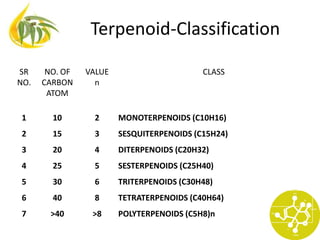
2-Methyl-1,3-butadiene
Terpenoid-Classification
SR
NO.
NO. OF
CARBON
ATOM
VALUE
n
CLASS
1 10 2 MONOTERPENOIDS (C10H16)
2 15 3 SESQUITERPENOIDS (C15H24)
3 20 4 DITERPENOIDS (C20H32)
4 25 5 SESTERPENOIDS (C25H40)
5 30 6 TRITERPENOIDS (C30H48)
6 40 8 TETRATERPENOIDS (C40H64)
7 >40 >8 POLYTERPENOIDS (C5H8)n
Introduction-Iridoids
 Monoterpene
 Cyclopenta[c]pyranoid skeleton
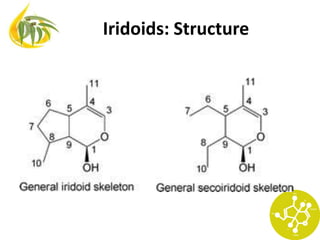
 Iridane skeleton cis-2-oxa-bicyclo-[4,3,0]-nonane
 Type: Secoiridoids by cleavage of the 7,8 bond of the
cyclopentane ring
 Some authors limits the definition up to: Methyl cyclopentane
 Iridoid glycosides (>300)
 Secoiridoid glycoside (>100)
 Non-glycoside compounds (>100)
Iridoids: How derived?
• Named after ants of the Iridomirmex genus, from which were
isolated compounds involved in the defence mechanism of
the insects: iridoidal, iridomyrmecin and related compounds.
• Exists in plants as well: nepetalactone from Nepeta cataria
(Lamiaceae), or teucriumlactone C from Teucrium marum
have marked properties
• Nepeta cataria: effects on cats, so termed as Catnip,
katzenmelisse, herbe-aux-chats
• Iridoid: generally 10 carbons, may even have more or multiple
structure variation up to polycyclic structures
Iridoids: Structure
Iridoids: Occurence
• Biosynthetically homogenous
• Insects: ants
• Plants: dicotyledon: Angiosperm
• Plant family: Dipsacales, Gentianales, Lamiales,
Scrophulariales
• Iridoid glycoside: glucoside- glycosidic linkage between –OH
group on anomeric carbon of D-glucose and the –OH group
in the 1-position of aglycone
• Small no. of structure: 1 sugar portion is oligosaccharide
(e.g. Rehmaniosidesa)
• Glucose is linked to: 11-hydroxylmethyl group (e.g.
ebuloside in caprifoliaceae
• Non-glycosidic iridoid: alkaloid: skytanthine
Iridoids: Occurrence
10 carbon atom
• Polycyclic compounds: Plumericin, Polyesters(valepotriates) or
intramolecular ethers (Rehamaglutin B)
• Non-glycosidic secoiridoids: Syringa spp., Olea spp.
• C-11: carboxymethyl group (loganin, geniposide) or part of
carboxylic acid (monotropein)
• Hydroxymethyl group: Valerianceae, Caprifoliaceae
• Aldehyde or methyl group: Lamioside
• C-11 is absent: Aucubin, Catalpol, Harpagoside
Iridoids: Occurrence
10 carbon atom
• Pyran ring is exceptionally open: gentiobiosides of Iridodidal &
Nepatariaside (precursor of nepetalactone)
• Methyl group at C-8: aucumbin, monotropein, epoxide
(valtrate) & rarely absent (deutzioside)
• Unsaturation at 7,8 position: Geniposide, Aucumbin
• Vinyl group at C-9: gentiopicrin
• Oleoside: ethylidene-hydroxyethylidene at C-9
• Carboxy group is esterified: Oleuropein
Iridoids: biosynthesis
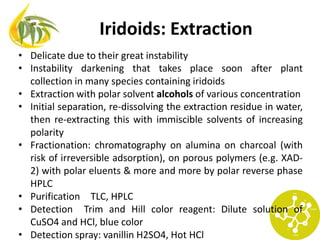
Iridoids: Extraction
• Delicate due to their great instability
• Instability darkening that takes place soon after plant
collection in many species containing iridoids
• Extraction with polar solvent alcohols of various concentration
• Initial separation, re-dissolving the extraction residue in water,
then re-extracting this with immiscible solvents of increasing
polarity
• Fractionation: chromatography on alumina on charcoal (with
risk of irreversible adsorption), on porous polymers (e.g. XAD-
2) with polar eluents & more and more by polar reverse phase
HPLC
• Purification TLC, HPLC
• Detection Trim and Hill color reagent: Dilute solution of
CuSO4 and HCl, blue color
• Detection spray: vanillin H2SO4, Hot HCl
Iridoids: Biological-
Pharmacological properties
• Defensive function in ants
• Anti-inflammatory: weak by oral route and stronger by topical
route
• 1 mg of aucubin, verbenalin or loganin have an activity almost
similar to that of 0.5 mg of indomethacin on the TPA induced
mouse ear edema
Drugs category
Iridoids:
1. Gentian (bitter glycoside)
2. Picrorrhiza (bitter glycoside)
Modified Terpenoids
1. Quassia (bitter, triterpenoid lactone)
2. Tinospora (sesquiterpene glucoside)
3. Artemisia (sesquiterpenoid)
4. Taxus (diterpenoid)
5. Andrographis
1. Gentian
• Syn: yellow gentian root
• Source: dried fermented roots and
rhizomes of Gentiana lutea
• Family: Gentianaceae
• GS: Mountainous regions of Central and
south Europe, Turkey, Yugoslavia
• Now: France, Italy, Germany
• Use: bitter tonic, GIT problems, anti-
inflammatory, wound healing,
choleretic-stimulating bile production,
anti-oxidant, hepato-protective, anti-
fungal, anorexia
Constituents & Structures
• Bitter glycoside, alkaloids, yellow
coloring agent, sugar, pectin, fixed oil
• Seco-iridoid: gentiopicroside
(gentiopicrin-gentiomarine)
• Hydrolysis product: gentiogenin +
glucose
• Biphenolic acid ester of
gentiopicrosideamarogentinhighest
bitter
• Sweroside, swertiamarine
• Yellow color is due to
Xanthonegentistin or gentiamarine,
isogentistin, gentioside, gentisic acid
• Alkaloid: gentianine, gentialutine
2. Picrorrhiza
• Syn: Kutki, Yellow gentian
• Source: dried rhizomes of Picrorrhiza
kurroa
• Family: Scrophulariaceae
• GS: North-west Himalaya region at 3000-
4000 m
• Use: Bitter tonic, Hepatoprotective,
Immunomodulator, curing different types
of jaundice, skin disease, improves eye
sight, Cholagogue- stimulates gallbladder
contraction to promote bile flow
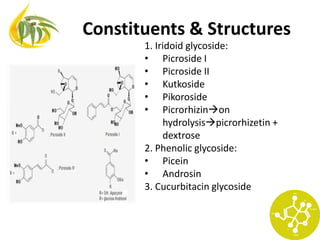
Constituents & Structures
1. Iridoid glycoside:
• Picroside I
• Picroside II
• Kutkoside
• Pikoroside
• Picrorhizinon
hydrolysispicrorhizetin +
dextrose
2. Phenolic glycoside:
• Picein
• Androsin
3. Cucurbitacin glycoside
3. Quassia
• Syn: Bitter wood, Jamaica Quassia
• Source: dried wood of the stem of
Aeschrion excelsa (Picroena or Picrasma
excelsa)
• Family: Simaroubaceae
• GS: West indies, Jamaica, Guadeloupe,
Martinique, Barbados, St. Vincent
• Use: Bitter tonic, Insecticide, vermicide
for thread worms, slightly narcotic & acts
on flies, increase appetite
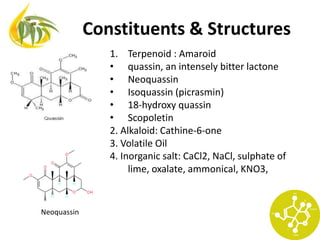
Constituents & Structures
1. Terpenoid : Amaroid
• quassin, an intensely bitter lactone
• Neoquassin
• Isoquassin (picrasmin)
• 18-hydroxy quassin
• Scopoletin
2. Alkaloid: Cathine-6-one
3. Volatile Oil
4. Inorganic salt: CaCl2, NaCl, sulphate of
lime, oxalate, ammonical, KNO3,
Neoquassin
4. Tinospora
• Syn: Guduchi, Gulvel, Heartleaved
moonseed
• Source: dried matured stem of Tinospora
cordifolia
• Family: Menispermaceae
• GS: Himalaya, South India, Srilanka
• Use: Rejuvenator,
Hypoglycemic,Detoxifier,
Immonuomodulatory, astringent,
antipyretic, blood purifier, anti-
neoplastic, cardiotonic, anti-asthamatic,
pyrexia, skin disease
Constituents & Structures
1. Furanoditerpenoids:
• Columbin
• Tinosporaside-lignan
• Tetrahydrofuran
2. Alkaloid:
• Jactrorhizine
• Palmatine
• Berberine
• Tembeterine
3. Sesqui terpene glucoside
4. Phenylpropene disaccharide
Cordifolioside A, B
Tinosporic acid, Tinosporone,
Tinosporal, Choline
5. Artemisia
• Syn: A.cina (Santonica, wormseed)
A. annua (Sweet annie, Qinghaosu)
• Source: dried un-expanded flower heads
of Artemisia cina, A. annua, A.brevifolia,
A.maritima & other spp. Of Artemisia.
• Family: A. cina (Compositae)
A. annua (Asteraceae)
• GS: A. cina (Pakistan, Turkestan),
A. annua (China-native, Europe, US,
Turkey, Australia, Iran, Vietname, India (GJ,
UP, JK, HP, KA)
Constituents & Structures
A. Cina
• Sesquiterpene
lactone:santonin
• Artemisin
• Irone
A. annua
• Artemisinin
• Deoxyartemisinin
• Artemisic acid
• Arteanniun A, B
• Cadinene type
sesquiterpene
Santonin
Artemisin
Artemisinin
USES
• A.cina:
Strong althelmintic against round worms and less
effect against thread worms.
• A.annua
• Artemisinin: Chloroquine resistant Plasmodium falciparum
and particularly cerebral malaria
• Derivative: Artesunate, Artemether: effective
• Artemisic acid: anti-inflammatory, cytotoxic, antibacterial
6. Taxus
• Syn: Yew
• Source & GS: dried bark of
• Taxus baccata (Europe)
• Taxus brevifolia &
• T. canadensis (North america)
• Taxus cuspidata (Japan)
• Taxus wallichiana (Himalaya)
• Family: Taxaceae
Constituents & Structures
Tricyclic diterpenoids:
• Taxane skeleton
• Taxusines
• Taxagifen
• Baccatin-III
• Taxine
• Taxol
• Cephalomannine
• Taxicine
USES
• Paclitaxel: mitotic spindle
poison
• M/a: it promotes assembly
of tubulin dimers into
microtubules which is stabilized
by inhibiting their
depolymerization
• Indication: Advanced ovarian
cancer, metastatic breast cancer
• S/e: neutropenia, peripheral
neuropathy, CVS, alopecia
• Posology: 135-175 mg/m2
• Docetaxel:
• Indication: breast
cancer
• S/e: severe
neutropenia,
hypersensitivity
reaction, water
retention, cutaneous
reaction
• Posology: 100 mg/m2
7. Andrographis
• Syn: Kalmegh, King of bitter, kirayet
• Source: leaves and entire aerial part of
Andrographis paniculata
• Family: Acanthaceae
• GS: growing -India, Pakistan, Srilanka,
Indonesia
• Cultivated-China, Thailand, west indies,
Mauritius
• Use: bitter tonic, febrifuge-reduce fever,
anthelmintic, astringent, cholagoggue,
cholera, diabetes, weakness, blood
purifier, jaundice, GI disturbances,
itching
Constituents & Structures
• Diterpene lactone: kalmeghin
• Andrographolide
• Neoandrographolide
• 14-deoxy-11,12-
didehydroandrographolide
• 14-deoxy-11-oxo-
• Andrographolide
• Andrographiside
Carrot
• Syn: Gajar, Queen annie’s lace
• Source: dried roots of Daucus carota
• Family: Umbelliferae
• GS: Temperate regions of Asia, Africa
& Europe
• Use: food, condiment,
Anthelmintic, flatulence,
Immunomodulatory, antioxidant,
Vitamin A supplement
Constituents & Structures
Diterpenoids
Carotene
Carotol
Daucol
Trans-asarone
Pinene
Limonene
Geraniol
Retinol
Asarone
C
a
R
O
T
E
n
e
Chirata
• Syn: Indian gentian, Indian
balmony, chirayta
• Source: entire herb of Swertia
chirata
• Family: Gentianaceae
• GS: India, Nepal, Bhutan
• Use: ingredient of Mahasudrashan
& Sudarashan churna, chronic fever,
bitter tonic, stimulant, liver
protective, promoting flow of bile,
cures constipation and useful in
treating dyspepsia
Constituents & Structures
Chirata:
• chiritin, gentiopicrin and
amarogentin
• Amarogentin: phenol
carboxylic acid ester of
sweroside: related to
gentiopicrin
• Ophelic acid
• Gentianine
• Gentiocrucine

Terpenoid iridoid

  • 1.
  • 2.
    Introduction- Terpenoid • Terpenes constituteone of the most important groups of essential oils. • The group includes constituents such as limonene, phellandrene, cedrene etc. and their oxygenated derivatives such as geraniol, citral, carvone, camphor, cineol and many others. • These compounds arise at the geranyl pyrophosphate and fernesyl pyrophosphate levels respectively, in the acetate mevalonate pathway from the fundamental building block termed as isoprene (C5H8) unit. 2-Methyl-1,3-butadiene
  • 3.
    Terpenoid-Classification SR NO. NO. OF CARBON ATOM VALUE n CLASS 1 102 MONOTERPENOIDS (C10H16) 2 15 3 SESQUITERPENOIDS (C15H24) 3 20 4 DITERPENOIDS (C20H32) 4 25 5 SESTERPENOIDS (C25H40) 5 30 6 TRITERPENOIDS (C30H48) 6 40 8 TETRATERPENOIDS (C40H64) 7 >40 >8 POLYTERPENOIDS (C5H8)n
  • 4.
    Introduction-Iridoids  Monoterpene  Cyclopenta[c]pyranoidskeleton  Iridane skeleton cis-2-oxa-bicyclo-[4,3,0]-nonane  Type: Secoiridoids by cleavage of the 7,8 bond of the cyclopentane ring  Some authors limits the definition up to: Methyl cyclopentane  Iridoid glycosides (>300)  Secoiridoid glycoside (>100)  Non-glycoside compounds (>100)
  • 5.
    Iridoids: How derived? •Named after ants of the Iridomirmex genus, from which were isolated compounds involved in the defence mechanism of the insects: iridoidal, iridomyrmecin and related compounds. • Exists in plants as well: nepetalactone from Nepeta cataria (Lamiaceae), or teucriumlactone C from Teucrium marum have marked properties • Nepeta cataria: effects on cats, so termed as Catnip, katzenmelisse, herbe-aux-chats • Iridoid: generally 10 carbons, may even have more or multiple structure variation up to polycyclic structures
  • 6.
  • 7.
    Iridoids: Occurence • Biosyntheticallyhomogenous • Insects: ants • Plants: dicotyledon: Angiosperm • Plant family: Dipsacales, Gentianales, Lamiales, Scrophulariales • Iridoid glycoside: glucoside- glycosidic linkage between –OH group on anomeric carbon of D-glucose and the –OH group in the 1-position of aglycone • Small no. of structure: 1 sugar portion is oligosaccharide (e.g. Rehmaniosidesa) • Glucose is linked to: 11-hydroxylmethyl group (e.g. ebuloside in caprifoliaceae • Non-glycosidic iridoid: alkaloid: skytanthine
  • 8.
    Iridoids: Occurrence 10 carbonatom • Polycyclic compounds: Plumericin, Polyesters(valepotriates) or intramolecular ethers (Rehamaglutin B) • Non-glycosidic secoiridoids: Syringa spp., Olea spp. • C-11: carboxymethyl group (loganin, geniposide) or part of carboxylic acid (monotropein) • Hydroxymethyl group: Valerianceae, Caprifoliaceae • Aldehyde or methyl group: Lamioside • C-11 is absent: Aucubin, Catalpol, Harpagoside
  • 9.
    Iridoids: Occurrence 10 carbonatom • Pyran ring is exceptionally open: gentiobiosides of Iridodidal & Nepatariaside (precursor of nepetalactone) • Methyl group at C-8: aucumbin, monotropein, epoxide (valtrate) & rarely absent (deutzioside) • Unsaturation at 7,8 position: Geniposide, Aucumbin • Vinyl group at C-9: gentiopicrin • Oleoside: ethylidene-hydroxyethylidene at C-9 • Carboxy group is esterified: Oleuropein
  • 10.
  • 11.
    Iridoids: Extraction • Delicatedue to their great instability • Instability darkening that takes place soon after plant collection in many species containing iridoids • Extraction with polar solvent alcohols of various concentration • Initial separation, re-dissolving the extraction residue in water, then re-extracting this with immiscible solvents of increasing polarity • Fractionation: chromatography on alumina on charcoal (with risk of irreversible adsorption), on porous polymers (e.g. XAD- 2) with polar eluents & more and more by polar reverse phase HPLC • Purification TLC, HPLC • Detection Trim and Hill color reagent: Dilute solution of CuSO4 and HCl, blue color • Detection spray: vanillin H2SO4, Hot HCl
  • 12.
    Iridoids: Biological- Pharmacological properties •Defensive function in ants • Anti-inflammatory: weak by oral route and stronger by topical route • 1 mg of aucubin, verbenalin or loganin have an activity almost similar to that of 0.5 mg of indomethacin on the TPA induced mouse ear edema
  • 13.
    Drugs category Iridoids: 1. Gentian(bitter glycoside) 2. Picrorrhiza (bitter glycoside) Modified Terpenoids 1. Quassia (bitter, triterpenoid lactone) 2. Tinospora (sesquiterpene glucoside) 3. Artemisia (sesquiterpenoid) 4. Taxus (diterpenoid) 5. Andrographis
  • 14.
    1. Gentian • Syn:yellow gentian root • Source: dried fermented roots and rhizomes of Gentiana lutea • Family: Gentianaceae • GS: Mountainous regions of Central and south Europe, Turkey, Yugoslavia • Now: France, Italy, Germany • Use: bitter tonic, GIT problems, anti- inflammatory, wound healing, choleretic-stimulating bile production, anti-oxidant, hepato-protective, anti- fungal, anorexia
  • 15.
    Constituents & Structures •Bitter glycoside, alkaloids, yellow coloring agent, sugar, pectin, fixed oil • Seco-iridoid: gentiopicroside (gentiopicrin-gentiomarine) • Hydrolysis product: gentiogenin + glucose • Biphenolic acid ester of gentiopicrosideamarogentinhighest bitter • Sweroside, swertiamarine • Yellow color is due to Xanthonegentistin or gentiamarine, isogentistin, gentioside, gentisic acid • Alkaloid: gentianine, gentialutine
  • 16.
    2. Picrorrhiza • Syn:Kutki, Yellow gentian • Source: dried rhizomes of Picrorrhiza kurroa • Family: Scrophulariaceae • GS: North-west Himalaya region at 3000- 4000 m • Use: Bitter tonic, Hepatoprotective, Immunomodulator, curing different types of jaundice, skin disease, improves eye sight, Cholagogue- stimulates gallbladder contraction to promote bile flow
  • 17.
    Constituents & Structures 1.Iridoid glycoside: • Picroside I • Picroside II • Kutkoside • Pikoroside • Picrorhizinon hydrolysispicrorhizetin + dextrose 2. Phenolic glycoside: • Picein • Androsin 3. Cucurbitacin glycoside
  • 18.
    3. Quassia • Syn:Bitter wood, Jamaica Quassia • Source: dried wood of the stem of Aeschrion excelsa (Picroena or Picrasma excelsa) • Family: Simaroubaceae • GS: West indies, Jamaica, Guadeloupe, Martinique, Barbados, St. Vincent • Use: Bitter tonic, Insecticide, vermicide for thread worms, slightly narcotic & acts on flies, increase appetite
  • 19.
    Constituents & Structures 1.Terpenoid : Amaroid • quassin, an intensely bitter lactone • Neoquassin • Isoquassin (picrasmin) • 18-hydroxy quassin • Scopoletin 2. Alkaloid: Cathine-6-one 3. Volatile Oil 4. Inorganic salt: CaCl2, NaCl, sulphate of lime, oxalate, ammonical, KNO3, Neoquassin
  • 20.
    4. Tinospora • Syn:Guduchi, Gulvel, Heartleaved moonseed • Source: dried matured stem of Tinospora cordifolia • Family: Menispermaceae • GS: Himalaya, South India, Srilanka • Use: Rejuvenator, Hypoglycemic,Detoxifier, Immonuomodulatory, astringent, antipyretic, blood purifier, anti- neoplastic, cardiotonic, anti-asthamatic, pyrexia, skin disease
  • 21.
    Constituents & Structures 1.Furanoditerpenoids: • Columbin • Tinosporaside-lignan • Tetrahydrofuran 2. Alkaloid: • Jactrorhizine • Palmatine • Berberine • Tembeterine 3. Sesqui terpene glucoside 4. Phenylpropene disaccharide Cordifolioside A, B Tinosporic acid, Tinosporone, Tinosporal, Choline
  • 22.
    5. Artemisia • Syn:A.cina (Santonica, wormseed) A. annua (Sweet annie, Qinghaosu) • Source: dried un-expanded flower heads of Artemisia cina, A. annua, A.brevifolia, A.maritima & other spp. Of Artemisia. • Family: A. cina (Compositae) A. annua (Asteraceae) • GS: A. cina (Pakistan, Turkestan), A. annua (China-native, Europe, US, Turkey, Australia, Iran, Vietname, India (GJ, UP, JK, HP, KA)
  • 23.
    Constituents & Structures A.Cina • Sesquiterpene lactone:santonin • Artemisin • Irone A. annua • Artemisinin • Deoxyartemisinin • Artemisic acid • Arteanniun A, B • Cadinene type sesquiterpene Santonin Artemisin Artemisinin
  • 24.
    USES • A.cina: Strong althelminticagainst round worms and less effect against thread worms. • A.annua • Artemisinin: Chloroquine resistant Plasmodium falciparum and particularly cerebral malaria • Derivative: Artesunate, Artemether: effective • Artemisic acid: anti-inflammatory, cytotoxic, antibacterial
  • 25.
    6. Taxus • Syn:Yew • Source & GS: dried bark of • Taxus baccata (Europe) • Taxus brevifolia & • T. canadensis (North america) • Taxus cuspidata (Japan) • Taxus wallichiana (Himalaya) • Family: Taxaceae
  • 26.
    Constituents & Structures Tricyclicditerpenoids: • Taxane skeleton • Taxusines • Taxagifen • Baccatin-III • Taxine • Taxol • Cephalomannine • Taxicine
  • 27.
    USES • Paclitaxel: mitoticspindle poison • M/a: it promotes assembly of tubulin dimers into microtubules which is stabilized by inhibiting their depolymerization • Indication: Advanced ovarian cancer, metastatic breast cancer • S/e: neutropenia, peripheral neuropathy, CVS, alopecia • Posology: 135-175 mg/m2 • Docetaxel: • Indication: breast cancer • S/e: severe neutropenia, hypersensitivity reaction, water retention, cutaneous reaction • Posology: 100 mg/m2
  • 28.
    7. Andrographis • Syn:Kalmegh, King of bitter, kirayet • Source: leaves and entire aerial part of Andrographis paniculata • Family: Acanthaceae • GS: growing -India, Pakistan, Srilanka, Indonesia • Cultivated-China, Thailand, west indies, Mauritius • Use: bitter tonic, febrifuge-reduce fever, anthelmintic, astringent, cholagoggue, cholera, diabetes, weakness, blood purifier, jaundice, GI disturbances, itching
  • 29.
    Constituents & Structures •Diterpene lactone: kalmeghin • Andrographolide • Neoandrographolide • 14-deoxy-11,12- didehydroandrographolide • 14-deoxy-11-oxo- • Andrographolide • Andrographiside
  • 30.
    Carrot • Syn: Gajar,Queen annie’s lace • Source: dried roots of Daucus carota • Family: Umbelliferae • GS: Temperate regions of Asia, Africa & Europe • Use: food, condiment, Anthelmintic, flatulence, Immunomodulatory, antioxidant, Vitamin A supplement
  • 31.
  • 32.
    Chirata • Syn: Indiangentian, Indian balmony, chirayta • Source: entire herb of Swertia chirata • Family: Gentianaceae • GS: India, Nepal, Bhutan • Use: ingredient of Mahasudrashan & Sudarashan churna, chronic fever, bitter tonic, stimulant, liver protective, promoting flow of bile, cures constipation and useful in treating dyspepsia
  • 33.
    Constituents & Structures Chirata: •chiritin, gentiopicrin and amarogentin • Amarogentin: phenol carboxylic acid ester of sweroside: related to gentiopicrin • Ophelic acid • Gentianine • Gentiocrucine