Industrial Production ,
Estimation and Utilization of
the following
Phytoconstituents
Presented By-
Mrs. Poonam Nilesh Chougule
Assistant Professor
AMCP- Peth Vadgaon.
 Forskolin,
 Sennoside,
 Artemisinin,
 Diosgenin,
 Digoxin,
 Atropine,
 Podophyllotoxin,
 Caffeine,
 Taxol,
 Vincristine and
 Vinblastine.
Forskolin
 Synonym- Forskohlii, Plectranthus
barbalus
 Biological Source- Forskolin is a
diterpenes is obtained from the dried
roots of Coleus forskohlii
 Family- Labiatae
 Method of cultivation- Vegetative
method-stem cutting.
 Harvesting – In the month of Autumn.
Chemical constituents-
 Forskolin is a diterpenes.
 It contains various diterpenoid
derivatives.
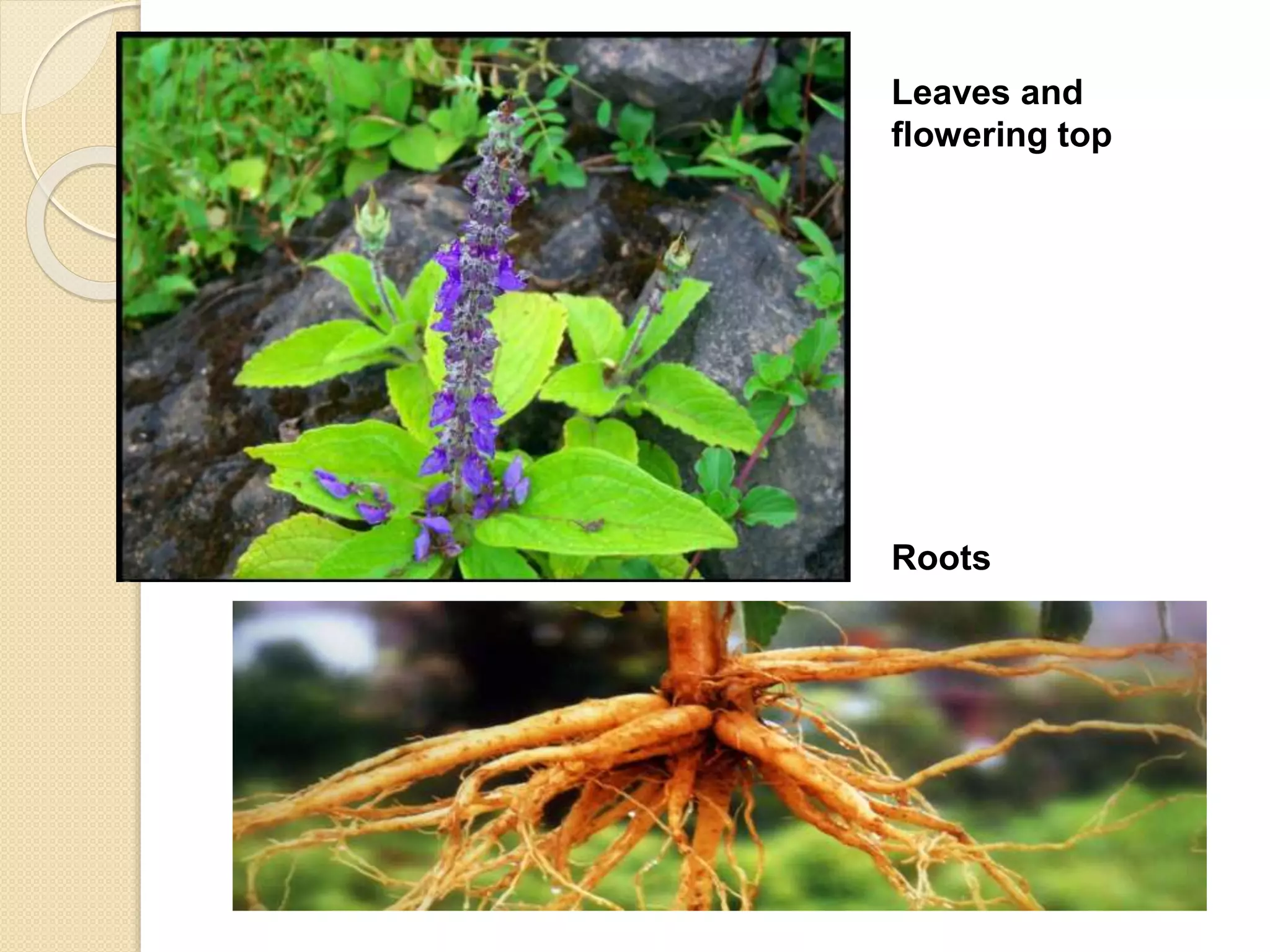
 The leaves give Coleon E
(Methylenequinine), barbatusin and
Coleon F.
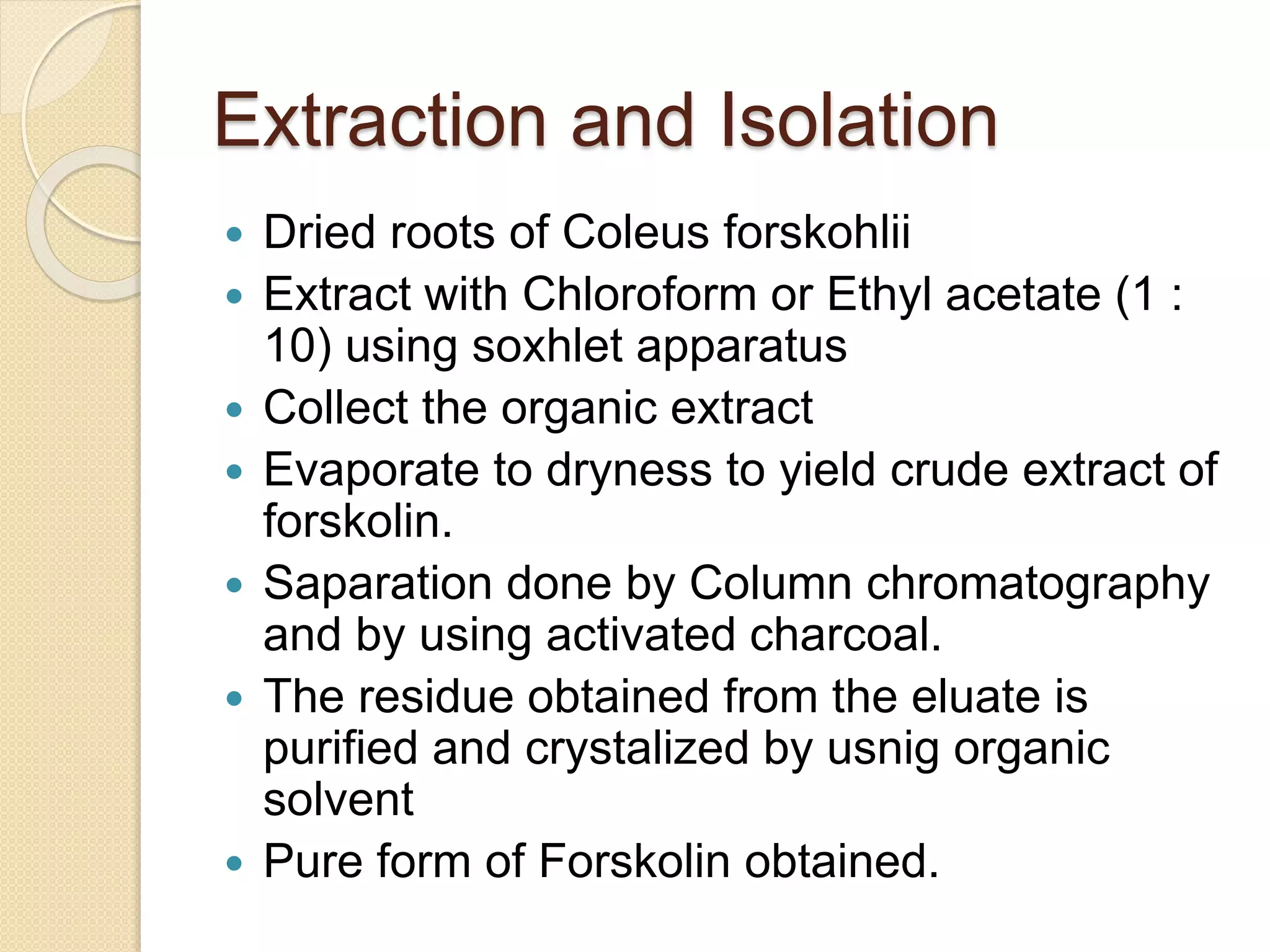
 The root contains Coleonol B,
Coleonol C, Deoxycoleonol.
Leaves and
flowering top
Roots
Extraction and Isolation
 Dried roots of Coleus forskohlii
 Extract with Chloroform or Ethyl acetate (1 :
10) using soxhlet apparatus
 Collect the organic extract
 Evaporate to dryness to yield crude extract of
forskolin.
 Saparation done by Column chromatography
and by using activated charcoal.
 The residue obtained from the eluate is
purified and crystalized by usnig organic
solvent
 Pure form of Forskolin obtained.
Identification test-
 TLC Method-
 Stationary phase- Absorbent- pre-
coated Silica gel
 Mobile phase- Benzene: Ethyl Acetate
(85: 15)
 Sample – Root extract
 Detecting agent- Anisaldehyde
sulphuric acid.
 Observation- Violet to Purple color
spot.
Estimation
 Forskolin is estimated by two methods,
 I . Method 1 - HPLC
 II. Method 2 – HPTLC
 1. HPLC-
 Chromatographic System- HPLC equipped with 1) LC 8A
Pump and II) Photo array detector in combination with class
LC10A Software.
 Chromatographic condition-
 Column- ODS (Octodecylsilane) C ₁₈, 5 micrometer 250*
4.6mm
 Mobile phase- Acetonitrile: Water (50: 50)
 Wavelength- 220 nm
 Flow rate- 1.6ml/ min
 Injection volume- 20 microlitre.
 Standard Preparation:
Dissolve 10mg of forskolin with 15ml of
acetonitrile in 25ml of volumetric flask and
makeup the volume up to 25ml with
acetonitrile.
 Sample Preparation:
Dissolve 250mg of sample with 25ml of
acetonitrile. Filter the solution & makeup
the volume up to 100ml with actonitrile.
 Procedure: Inject the standard and sample
preparation (10μl) & record the
chromatogram. Now calculate the
percentage of Forskolin content from the
Utilization:
 Forskolin has Vasodilator and cardio
stimulant effects. Drug is used for
treatment of glaucoma, CHF and
asthma.
 In Ayurvedic traditional medicine it
prefered for heart diseases and
abdominal colic.
 It also used in the treatment of
hypotension, spasmolytic and platelet
aggregation inhibitory activity.
Digoxin
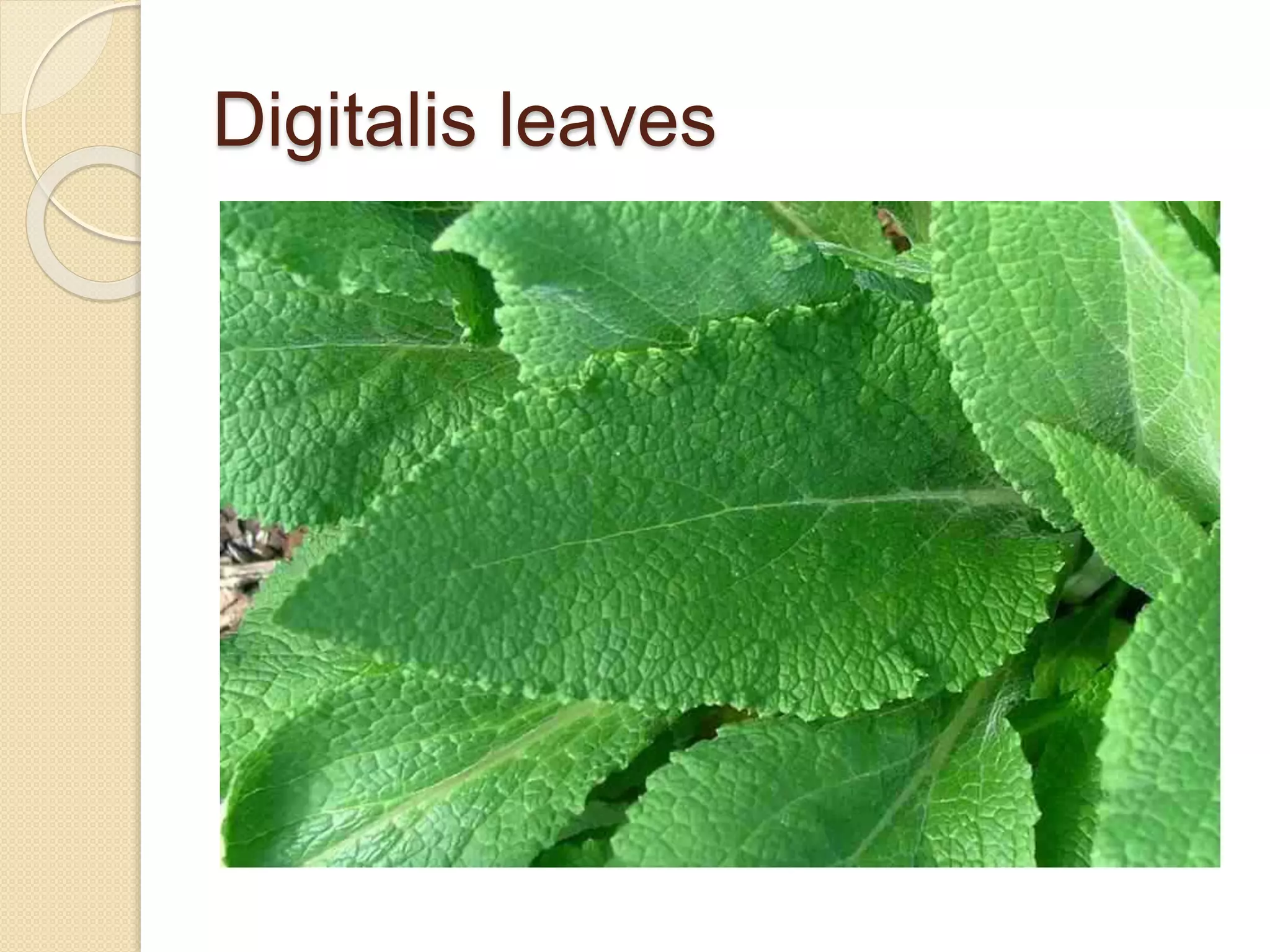
 Synonym- Foxglove leaves, digitalis.
 Biological source-
Digoxin is Cardiac glycoside obtained
from the dried leaves of plant Digitalis
purpurea and Digitalis lanata.
 Family- Scrophulariaceae
 Method of cultivation- Seed
propagation method.
 Harvesting- Hand picking method.
Digitalis leaves
Extraction and Isolation
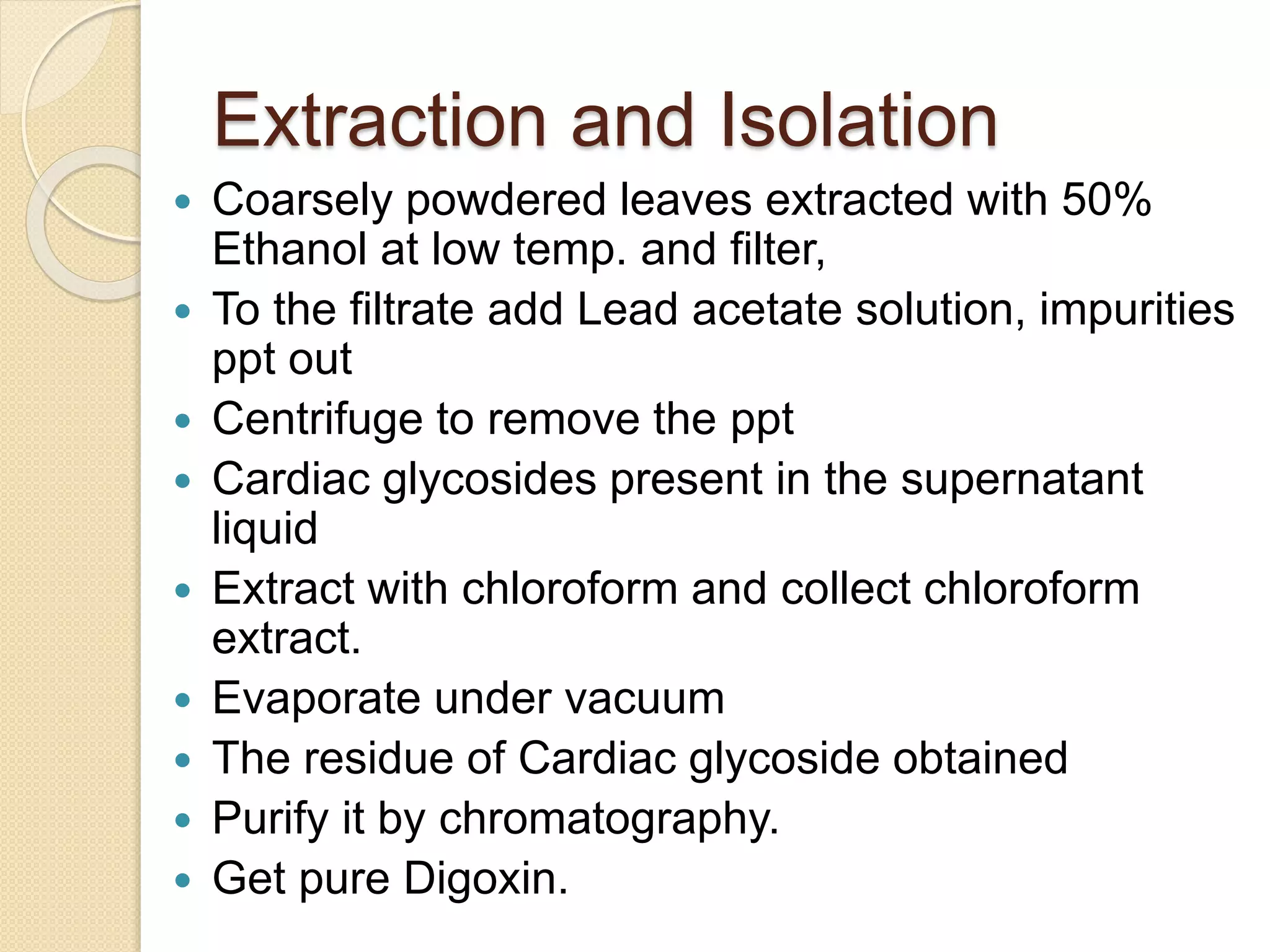
 Coarsely powdered leaves extracted with 50%
Ethanol at low temp. and filter,
 To the filtrate add Lead acetate solution, impurities
ppt out
 Centrifuge to remove the ppt
 Cardiac glycosides present in the supernatant
liquid
 Extract with chloroform and collect chloroform
extract.
 Evaporate under vacuum
 The residue of Cardiac glycoside obtained
 Purify it by chromatography.
 Get pure Digoxin.
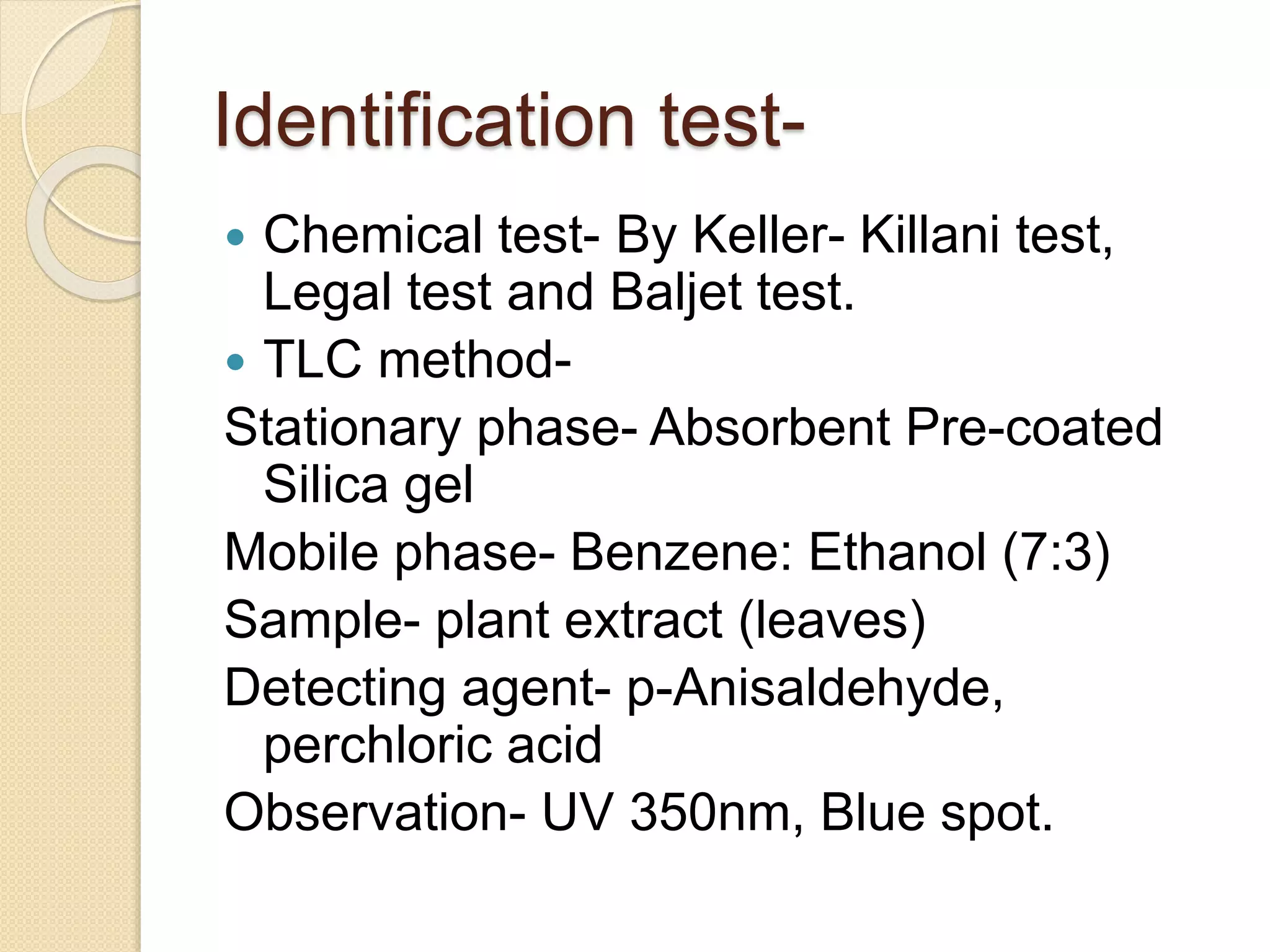
Identification test-
 Chemical test- By Keller- Killani test,
Legal test and Baljet test.
 TLC method-
Stationary phase- Absorbent Pre-coated
Silica gel
Mobile phase- Benzene: Ethanol (7:3)
Sample- plant extract (leaves)
Detecting agent- p-Anisaldehyde,
perchloric acid
Observation- UV 350nm, Blue spot.
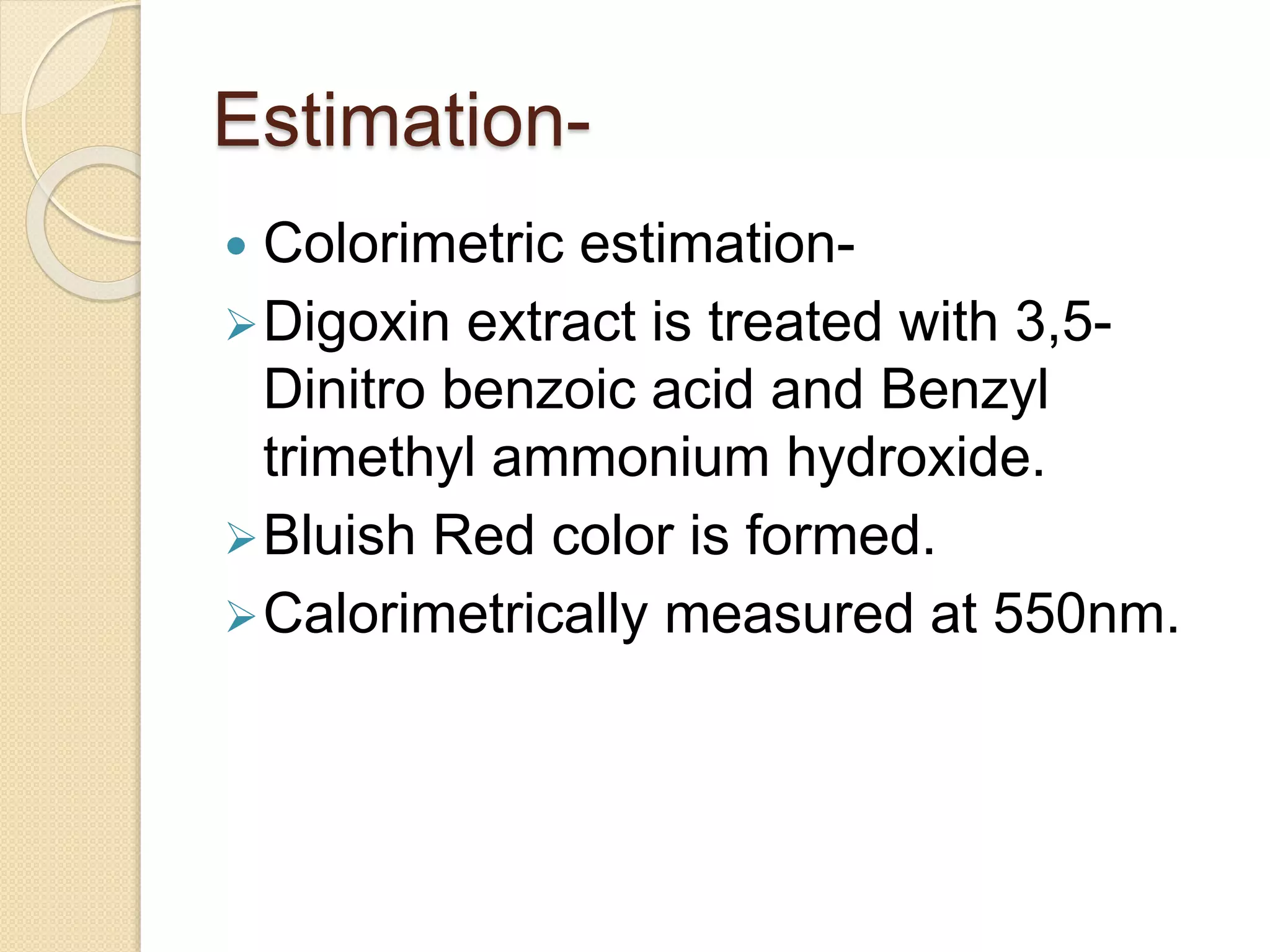
Estimation-
 Colorimetric estimation-
Digoxin extract is treated with 3,5-
Dinitro benzoic acid and Benzyl
trimethyl ammonium hydroxide.
Bluish Red color is formed.
Calorimetrically measured at 550nm.
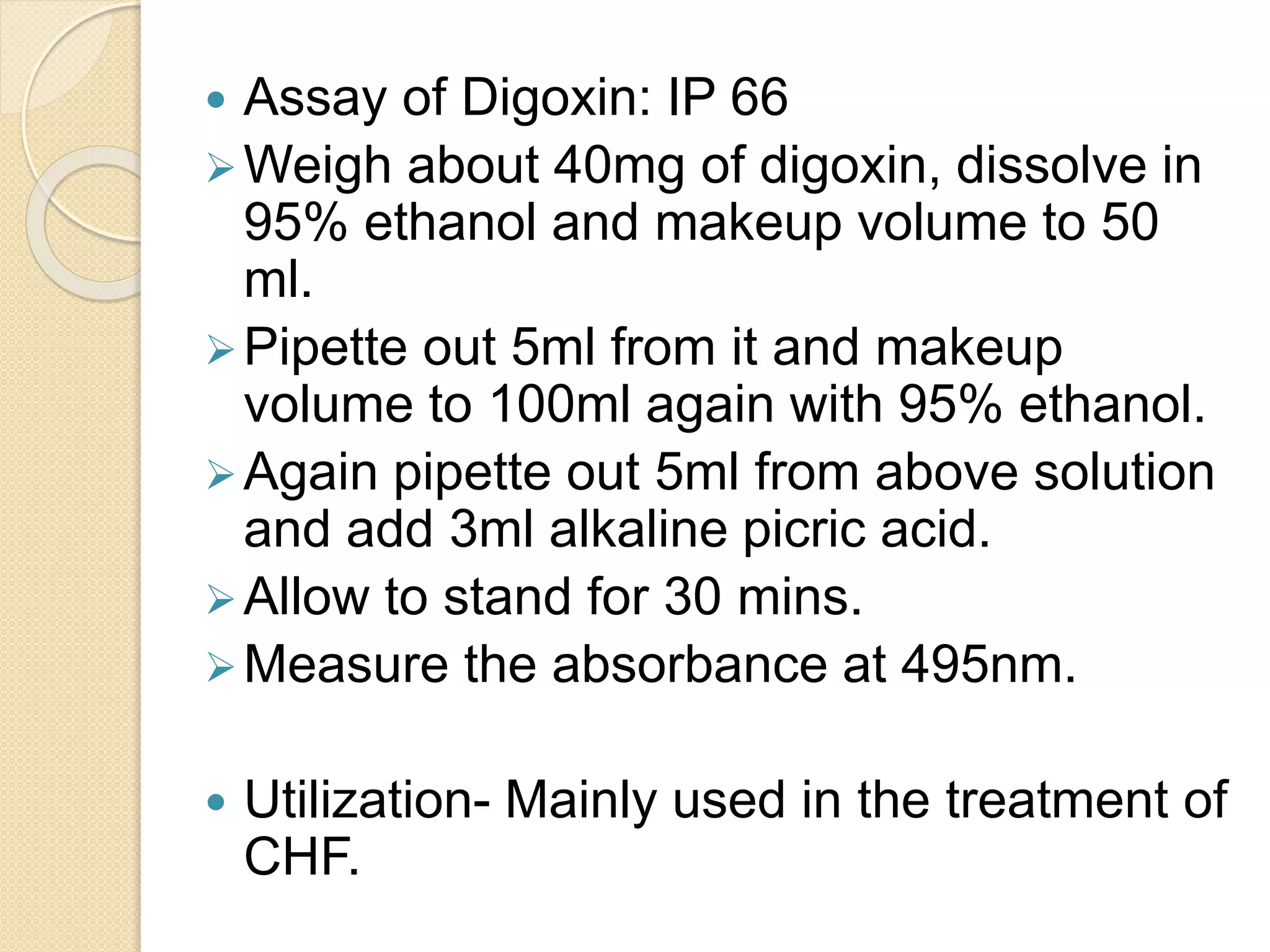
 Assay of Digoxin: IP 66
Weigh about 40mg of digoxin, dissolve in
95% ethanol and makeup volume to 50
ml.
Pipette out 5ml from it and makeup
volume to 100ml again with 95% ethanol.
Again pipette out 5ml from above solution
and add 3ml alkaline picric acid.
Allow to stand for 30 mins.
Measure the absorbance at 495nm.
 Utilization- Mainly used in the treatment of
CHF.
Vinca alkaloids
 Synonym- Periwinkle leaf
 Biological source- Vincristine and
Vinblastine are Dimeric indole alkaloid
obtained from the whole plants of
Catharanthus roseus.
 Family- Apocynaceae
 Chemical constituents- about 90
alkaloids isolated from catharanthus
plant. Important alkaloids are dimer
indole alkaloids Vincristine and
Vinblastine which posses Anti-cancer
activity.
Extraction and Isolation-
 Vinca leaves and herbs are extracted with
aqueous alcoholic acetic acid solution.
 After concentration of aqueous extract the
residue further extracted with 2% HCL.
 NaOH is used to adjust the pH of extract to 4.
 This is again extracted with benzene.
 The pH of solution again raised to 7.
 Again extracted with benzene.
 pH 7 benzene extract are concentrated, dried
and dissolved in benzene- methylene
chloride (65:35) solution.
 This is separated by chromatography
on neutral alumina column with
benzene- methylene chloride solution
as eluent technique.
 Evapouration of the vinblastine- rich
fractions gives vinblastine sulphate
which is recrystalised from alcohol.
 Further elution of the column gives
vincristine which is dried and
crystallized from alcohol.
Identification test
 By TLC method-
Stationary phase- Absorbant pre coated
silica gel
Mobile phase- ACN : Benzene (30:70)
Sample- 1mg in 0.1ml of 25% H2o in
methanol.
Detecting agent- 1% solution of Cerric
ammonia sulfate in 85% phosphoric
acid.
Rf value- 0.39
Estimation-
 HPLC method
 Utilisation-
 Vinblastine sulphate is used for the treatment
of Hodgkins disease.
 Vincristine sulphate is used for acute
haemolytic leukaemia. Highly active in
childhood leukaemia. And also used in breast
cancer.
 Both vincristine and vinblastine are resulting
in tumour cell death during replication of
DNA.
 They are used as intravenously.
Podophyllotoxin
 Synonym- Indian podophyllum,
Himalayan may-apple.
 Biological source- Podophyllotoxin is
resin obtained from the rhizomes and
roots of Podophyllum hexandrum or
podophyllum emodi.
 Family- Berberidaceae
 It grown in forest region of Himalyas
from kashmir to sikkim in Himachal
pradesh.
Chemical Constituents-
 Podophyllum contains 3.5 to 6% of resin
whose active principles are Lignans, its
biosynthethically flavonoids.
 The most important ones present in the
podophyllumresin, podophyllitoxin, α-
peltatin and β-peltatin.
 Indian Podophyllum is derived of α and
β- peltatin.
 Also presence of
dimethylpodophyllotoxin,
dehydropodophyllotoxin and quercetin-a-
tetra-hydroxy flavonol.
Extraction and Isolation
 Podophyllum resin extracted from
dried rhizomes and roots using an
alcoholic percolation method.
 It contains not less than 40% of
podophyllum resin.
 The powdered and dried rhizomes and roots
of podophyllum are extracted with 90%
ethanol in soxhlet extractor.
 Alcohol is removed by distillation and the
alcoholic extract as concentrated till it
become syrup-like consistancy.
 A mixture of water containing 2% HCL is
poured into this syrup at 5ᵒC with continuous
stirring.
 Mixture allow stand for 2hrs below 5ᵒC and
then dissolved in sufficient quantity of 90%
hot alcohol.
 This solution is filtered and alcohol distilled
off.
Utilization-
 It is used as a drastic but slow acting
purgative.
 Podophyllotoxin possesses Anti-
tumour properties and may be used in
the treatment of Cancer.
 It is invariable prescribed with other
purgatives, henbane or belladonna to
prevent gripping action in infants.
 It is used in the semi-solid synthetic
production of Etoposide.
Thank You

Estimation and Utilization Phytoconstituents.

  • 1.
    Industrial Production , Estimationand Utilization of the following Phytoconstituents Presented By- Mrs. Poonam Nilesh Chougule Assistant Professor AMCP- Peth Vadgaon.
  • 2.
     Forskolin,  Sennoside, Artemisinin,  Diosgenin,  Digoxin,  Atropine,  Podophyllotoxin,  Caffeine,  Taxol,  Vincristine and  Vinblastine.
  • 3.
    Forskolin  Synonym- Forskohlii,Plectranthus barbalus  Biological Source- Forskolin is a diterpenes is obtained from the dried roots of Coleus forskohlii  Family- Labiatae  Method of cultivation- Vegetative method-stem cutting.  Harvesting – In the month of Autumn.
  • 4.
    Chemical constituents-  Forskolinis a diterpenes.  It contains various diterpenoid derivatives.  The leaves give Coleon E (Methylenequinine), barbatusin and Coleon F.  The root contains Coleonol B, Coleonol C, Deoxycoleonol.
  • 5.
  • 6.
    Extraction and Isolation Dried roots of Coleus forskohlii  Extract with Chloroform or Ethyl acetate (1 : 10) using soxhlet apparatus  Collect the organic extract  Evaporate to dryness to yield crude extract of forskolin.  Saparation done by Column chromatography and by using activated charcoal.  The residue obtained from the eluate is purified and crystalized by usnig organic solvent  Pure form of Forskolin obtained.
  • 7.
    Identification test-  TLCMethod-  Stationary phase- Absorbent- pre- coated Silica gel  Mobile phase- Benzene: Ethyl Acetate (85: 15)  Sample – Root extract  Detecting agent- Anisaldehyde sulphuric acid.  Observation- Violet to Purple color spot.
  • 8.
    Estimation  Forskolin isestimated by two methods,  I . Method 1 - HPLC  II. Method 2 – HPTLC  1. HPLC-  Chromatographic System- HPLC equipped with 1) LC 8A Pump and II) Photo array detector in combination with class LC10A Software.  Chromatographic condition-  Column- ODS (Octodecylsilane) C ₁₈, 5 micrometer 250* 4.6mm  Mobile phase- Acetonitrile: Water (50: 50)  Wavelength- 220 nm  Flow rate- 1.6ml/ min  Injection volume- 20 microlitre.
  • 9.
     Standard Preparation: Dissolve10mg of forskolin with 15ml of acetonitrile in 25ml of volumetric flask and makeup the volume up to 25ml with acetonitrile.  Sample Preparation: Dissolve 250mg of sample with 25ml of acetonitrile. Filter the solution & makeup the volume up to 100ml with actonitrile.  Procedure: Inject the standard and sample preparation (10μl) & record the chromatogram. Now calculate the percentage of Forskolin content from the
  • 10.
    Utilization:  Forskolin hasVasodilator and cardio stimulant effects. Drug is used for treatment of glaucoma, CHF and asthma.  In Ayurvedic traditional medicine it prefered for heart diseases and abdominal colic.  It also used in the treatment of hypotension, spasmolytic and platelet aggregation inhibitory activity.
  • 11.
    Digoxin  Synonym- Foxgloveleaves, digitalis.  Biological source- Digoxin is Cardiac glycoside obtained from the dried leaves of plant Digitalis purpurea and Digitalis lanata.  Family- Scrophulariaceae  Method of cultivation- Seed propagation method.  Harvesting- Hand picking method.
  • 12.
  • 13.
    Extraction and Isolation Coarsely powdered leaves extracted with 50% Ethanol at low temp. and filter,  To the filtrate add Lead acetate solution, impurities ppt out  Centrifuge to remove the ppt  Cardiac glycosides present in the supernatant liquid  Extract with chloroform and collect chloroform extract.  Evaporate under vacuum  The residue of Cardiac glycoside obtained  Purify it by chromatography.  Get pure Digoxin.
  • 14.
    Identification test-  Chemicaltest- By Keller- Killani test, Legal test and Baljet test.  TLC method- Stationary phase- Absorbent Pre-coated Silica gel Mobile phase- Benzene: Ethanol (7:3) Sample- plant extract (leaves) Detecting agent- p-Anisaldehyde, perchloric acid Observation- UV 350nm, Blue spot.
  • 15.
    Estimation-  Colorimetric estimation- Digoxinextract is treated with 3,5- Dinitro benzoic acid and Benzyl trimethyl ammonium hydroxide. Bluish Red color is formed. Calorimetrically measured at 550nm.
  • 16.
     Assay ofDigoxin: IP 66 Weigh about 40mg of digoxin, dissolve in 95% ethanol and makeup volume to 50 ml. Pipette out 5ml from it and makeup volume to 100ml again with 95% ethanol. Again pipette out 5ml from above solution and add 3ml alkaline picric acid. Allow to stand for 30 mins. Measure the absorbance at 495nm.  Utilization- Mainly used in the treatment of CHF.
  • 17.
    Vinca alkaloids  Synonym-Periwinkle leaf  Biological source- Vincristine and Vinblastine are Dimeric indole alkaloid obtained from the whole plants of Catharanthus roseus.  Family- Apocynaceae  Chemical constituents- about 90 alkaloids isolated from catharanthus plant. Important alkaloids are dimer indole alkaloids Vincristine and Vinblastine which posses Anti-cancer activity.
  • 18.
    Extraction and Isolation- Vinca leaves and herbs are extracted with aqueous alcoholic acetic acid solution.  After concentration of aqueous extract the residue further extracted with 2% HCL.  NaOH is used to adjust the pH of extract to 4.  This is again extracted with benzene.  The pH of solution again raised to 7.  Again extracted with benzene.  pH 7 benzene extract are concentrated, dried and dissolved in benzene- methylene chloride (65:35) solution.
  • 19.
     This isseparated by chromatography on neutral alumina column with benzene- methylene chloride solution as eluent technique.  Evapouration of the vinblastine- rich fractions gives vinblastine sulphate which is recrystalised from alcohol.  Further elution of the column gives vincristine which is dried and crystallized from alcohol.
  • 20.
    Identification test  ByTLC method- Stationary phase- Absorbant pre coated silica gel Mobile phase- ACN : Benzene (30:70) Sample- 1mg in 0.1ml of 25% H2o in methanol. Detecting agent- 1% solution of Cerric ammonia sulfate in 85% phosphoric acid. Rf value- 0.39
  • 21.
    Estimation-  HPLC method Utilisation-  Vinblastine sulphate is used for the treatment of Hodgkins disease.  Vincristine sulphate is used for acute haemolytic leukaemia. Highly active in childhood leukaemia. And also used in breast cancer.  Both vincristine and vinblastine are resulting in tumour cell death during replication of DNA.  They are used as intravenously.
  • 22.
    Podophyllotoxin  Synonym- Indianpodophyllum, Himalayan may-apple.  Biological source- Podophyllotoxin is resin obtained from the rhizomes and roots of Podophyllum hexandrum or podophyllum emodi.  Family- Berberidaceae  It grown in forest region of Himalyas from kashmir to sikkim in Himachal pradesh.
  • 23.
    Chemical Constituents-  Podophyllumcontains 3.5 to 6% of resin whose active principles are Lignans, its biosynthethically flavonoids.  The most important ones present in the podophyllumresin, podophyllitoxin, α- peltatin and β-peltatin.  Indian Podophyllum is derived of α and β- peltatin.  Also presence of dimethylpodophyllotoxin, dehydropodophyllotoxin and quercetin-a- tetra-hydroxy flavonol.
  • 24.
    Extraction and Isolation Podophyllum resin extracted from dried rhizomes and roots using an alcoholic percolation method.  It contains not less than 40% of podophyllum resin.
  • 25.
     The powderedand dried rhizomes and roots of podophyllum are extracted with 90% ethanol in soxhlet extractor.  Alcohol is removed by distillation and the alcoholic extract as concentrated till it become syrup-like consistancy.  A mixture of water containing 2% HCL is poured into this syrup at 5ᵒC with continuous stirring.  Mixture allow stand for 2hrs below 5ᵒC and then dissolved in sufficient quantity of 90% hot alcohol.  This solution is filtered and alcohol distilled off.
  • 26.
    Utilization-  It isused as a drastic but slow acting purgative.  Podophyllotoxin possesses Anti- tumour properties and may be used in the treatment of Cancer.  It is invariable prescribed with other purgatives, henbane or belladonna to prevent gripping action in infants.  It is used in the semi-solid synthetic production of Etoposide.
  • 27.