Phenyl propanoids & related compounds
Phenolic compounds
• Phenols probably constitute the largest group pf plant
secondary metabolites.
• Phenols are utilized as Colouring agents. Flavouring agents,
aromatizers and antioxidants. E.g.
• Simple phenolic compounds
• Tannins
• Coumarins and glycosides
• Anthraquinones and glycosides
• Naphthaquinone and glycosides
• Flavones and related flavonoid glycoside
• Anthocyanidins and anthocyanins
• Lignans and lignin
Monomeric derivatives
• p-Coumaryl alcohol
• Coniferyl alcohol
• Sinapyl alcohol
Lignan: Dimeric derivatives
• Dimeric compounds formed essentially by the union of the two
molecules of a phenylpropene derivative.
• Not synthesized by lignin biosynthetic pathway.
• Unlike lignin, optically active and probably arise by stereospecific,
reductive coupling between the middle carbons of the side chain of
monomer.
• Some 300 lignans have been isolated and categorized into a number
of groups according to structural features.
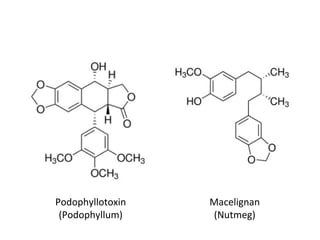
• Important pharmaceutical examples are the lignans of Podophyllum
spp. which appear to be formed from two molecule of coniferyl
alcohol or the corresponding acid with subsequent modification;
apparently, a sinapic acid derivative, as might be expected by the
inspection of the podophyllotoxin molecule, is not involved.
Podophyllotoxin
(Podophyllum)
Macelignan
(Nutmeg)
Introduction-Lignan
• Lignans, cited are not however, necessarily the therapeutically
active constituents of the plant.
• Neo-lignans are also derived from the same unit as lignans but
the C6-C3 moieties are linked head to tail or head to head and
not through the beta-beta’ carbons.
• They occur in the heart wood of trees of the Mangoliaceae,
Lauraceae and Piperaceae.
• Example: Guaicum officinale resin Guaicum sanctum
• Myristica fragrans, Piper cubeba
• Magnolia officinalis Magnolia obovata:
• Magnolol: CNS Action: depressant, muscle relaxant, anti
platelet, antimicrobial, anti-tumour, anticancer, insecticidal
Introduction-Lignin
• It is an important polymeric substance, (C6-C3)n, laid down in a matrix of
cellulose microfibrils to strength certain cell wall.
• It is an essential component of most woody tissues and involves vessels,
tracheids, fibers and sclreids.
• Lignins from different biological sources vary in composition, depending on
the particular monomeric units in which they are composed.
• Variations in lignin constitutes also arise as a result of random
condensations of the appropriate alcohols with mesomeric free radicals
formed from them by the action of a laccase type (oxidase) enzyme.
• As there is no template for this non-enzymatic condensation the lignin
molecules formed vary in structure and so it is not possible to isolate lignin
as a compound of defined composition.
Introduction-Lignin
• In the wall, it appears to occur chemically combined with
hemicellulose and built up in greatest concentration in the
middle lamellae and in the primary walls.
• Lignified cell walls after treatment with Schultze’s macerating
fluid (HNO3+ Potassium chlorate) will show cellulose
reactions.
• Acid Aniline sulphate  bright yellow
• Phloroglucinol + conc. HCl  pink/red
• Chlor-zinc-iodine  yellow
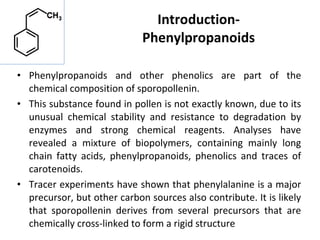
Introduction-Phenylpropanoids
• diverse family of organic compounds that are synthesized by plants
from the amino acid Phenyl alanine.
• Their name is derived from the six-carbon, aromatic phenyl group
and the three-carbon propene tail of cinnamic acid, which is
synthesized from phenylalanine in the first step of phenyl propanoid
biosynthesis.
• Phenylpropanoids are found throughout the plant kingdom, where
they serve as essential components of a number of structural
polymers, provide protection from UV light, defend against
herbivores and pathogens, and mediate plant-pollinator interactions
as floral pigments and scent compounds.
• Concentrations of phenylpropanoids within plants are also altered
by changes in resource availability.
Introduction-
Phenylpropanoids
• Phenylpropanoids and other phenolics are part of the
chemical composition of sporopollenin.
• This substance found in pollen is not exactly known, due to its
unusual chemical stability and resistance to degradation by
enzymes and strong chemical reagents. Analyses have
revealed a mixture of biopolymers, containing mainly long
chain fatty acids, phenylpropanoids, phenolics and traces of
carotenoids.
• Tracer experiments have shown that phenylalanine is a major
precursor, but other carbon sources also contribute. It is likely
that sporopollenin derives from several precursors that are
chemically cross-linked to form a rigid structure
1. Podophylum:
Lignan & Polyketide
• Syn: May apple, Wild mandrake
• Source: dried roots and rhizomes of American:
Podophyllum peltatum & India: Podophyllum
hexandrum (P.emodi)
• Family: Podophyllaceae (Berberidaceae)
• GS: America (US-Virginia, Kentucky, North
carolina, Tennessee, Indiana, Canada)
• Indian: Tibet, China, Afghanistan, Himalayas
• The rhizomes and roots are obtained from wild grown plants
growing at an altitude of 3000 to 4000 m.
• Underground rhizomes remain dormant in winter and
produce aerial shoots in April to May.
• Shoots flower during summer and die in November
• Rhizomes and roots are dug up in spring or autumn, washed,
cleaned and dried in the sun
• The drug collected in the month of may has higher resin
content than the collected in November.
• Actually the roots contain more resin than rhizomes and
hence roots are preferred.
• Constituents:
• P. peltatum
• 2-8% resinous material as podophyllin, Lignan dvt:
podophyllotoxin, alpha & beta peltatin, (Lignan: in form of
glycoside), Desmethyl podophyllotoxin,
desoxypodophyllotoxin, podophyllotoxone,
• Flavonoid: quercetin, kaempferol, essential oil, Starch
• P. hexandrum
• 7-15% Resin as Podophyllin
• 40% podophyllotoxin
• Chemical Test:
• Alcoholic ext. + strong copper acetate- brown ppt with
Indian podophyllum & green color without ppt with
American podophyllum
• USES:
• Cyto-toxic, venereal disease, Warts,
• Podophyllotoxin is semisynthetically converted to
etoposide potent anticancer agent for lung & testicular.
• Its GIT irritant, drastic purgative in moderate uses
Podophyllum species
• American Podophyllum
• Not so
• The CaOx crystals are fewer
and smaller (30-60-100
Micro meter)
• Less resin 2-8 %
• Contains alpha & beta
peltatin
• Podophyllotoxin is less
• Indian Podophyllum
• Vascular bundles are more
elongated radially.
• The CaOx crystals are fewer
and smaller (20-30-60 Micro
meter)
• More resin up to 7-15%
• No constituents
• Podophyllotoxin is more
2. Psoralea Furanocoumarins
• Syn: Bavchi, Malaya tea
• Source: dried ripe fruits and seeds of Psoralea
corylifolia
• Family: Leguminosae
• GS: India, China, Srilanka, Nepal, Vietnam
• Constituents: coumarin like psoralen, isopsoralen,
psoralidin, isopsoralidin, carylifolean,
bavachromanol and psoralenol, Fixed oil 10%,
essential oil 0.05% and resin
• Seeds: Flavonoids: bavachalcone, bavachinin,
isobavachalcone, bavachin and isobavachin
• Seed oil: limonene, aelemene, beta-
caryophyllenoxide, 4-terpineol, linalool, geranyl
acetate, angelicin, psoralen, bakuchiol
• Chemical Test:
• psoralen, dissolved in alcohol + NaOH  UV light
observation yellow fluorescence
• Psoralen, dissolved in small amount of alcohol, 3 times
propylene glycol, 5 times acetic acid, 40 times water UV light
observation blue fluorescence
• Uses:
• Aphrodisiac, antibacterial, astringent, cytotoxic, diaphoretic,
diuretic, stimulant, stomachic , tonic, lower back pain, skin
disease, bed wetting, leprosy, hair loss
Psoralen
Psoralidin
3. Ammi majus
• Syn: Bishop’s weed, Laceflower, Toothpick ammi, Large
bullwort
• Source: dried fruits of Ammi majus
• Family: Umbelliferae
• GS: Europe, Egypt, West africa, India
• Constituents: furanocoumarins, xanthotoxin, imperatorin,
bergapten, isopimpilin
• CT: 1) drug+ waterboilstrainfiltrate+ NaOH no rose
color  distinct from Ammi visanaga
2) Alc. Ext of fruit blue fluorescence under UV light
• Uses: furanocoumarin: stimulate pigment production in skin
when exposed to bright sunlight and hence  treatment of
vitiligo and psoriasis
3. Ammi majus
• Constituents:
furanocoumarins,
xanthotoxin, imperatorin,
bergapten, isopimpilin
4. Phyllanthus (Lignan)
• Syn: Bhumyamlaki, Stone breaker
• Source: dried leaves and stem of
Phyllanthus niruri
• Family: Euphorbiaceae
• GS: trophical zone
• Uses: Kidney stones treatment
Antibacterial, Anti inflammatory
Anti hepatotoxic
Antispasmodic
Anti viral
Liver tonic
Choleretic
Immuno-stimulant
• Constituents
• Lignans: phyllanthin, hypophyllanthine, phyltetralin,
lintetralin, niranthin, nirtetralin, nirphylline, nirurin,
niruriside.
• Terpenes: Cymene, limonene, lupeol and lupeol acetate.
• Flavonoids. Quercetin, Quercitrin, Isoquercitrin, astragalin,
rutin, physetinglucoside.
• Lipids: Ricinoleic acid, dotriancontanoic acid, linoleic acid,
linolenic acid.
• Benzenoids: Methylsalicilate.
• Alkaloids: Norsecurinine, 4 - metoxy - Norsecurinine,
entnorsecurinina, nirurine, phyllantin, phyllochrysine.
• Steroids. Beta-sitosterol.
• Alcanes: Triacontanal, Triacontanol.
• Others. Vitamin C, tanins, saponins.
5. Male fern (polyketide-resin)
• Syn: Filix Mass, Rhizoma filicis Maris
• Source: dried rhizome and its
surrounding frond bases of
Dryopteris filix-mass
• Family: Polypodiaceae
• GS: Europe, England, Germany,
India: JK, HP, SK at high altitude of
5000-10000 ft.
• Use: Potent taenicide, kills worms
and expel it out, absorption from
GIT blindness, in large dose:
irritant poison
• Constituents:
-5% yellow resin: anthelmintic property
-Oleoresin: phloroglucinol dvt.
-Monocyclic dvt.: butyryl phloroglucinol,
aspidinol and acylfilicinic acid
-Bicyclic: albaspidin, flavaspidic acid
-Tricyclic: filicic acid

Polyketide lignan-phenylpropanoids

  • 1.
    Phenyl propanoids &related compounds
  • 2.
    Phenolic compounds • Phenolsprobably constitute the largest group pf plant secondary metabolites. • Phenols are utilized as Colouring agents. Flavouring agents, aromatizers and antioxidants. E.g. • Simple phenolic compounds • Tannins • Coumarins and glycosides • Anthraquinones and glycosides • Naphthaquinone and glycosides • Flavones and related flavonoid glycoside • Anthocyanidins and anthocyanins • Lignans and lignin
  • 4.
    Monomeric derivatives • p-Coumarylalcohol • Coniferyl alcohol • Sinapyl alcohol
  • 5.
    Lignan: Dimeric derivatives •Dimeric compounds formed essentially by the union of the two molecules of a phenylpropene derivative. • Not synthesized by lignin biosynthetic pathway. • Unlike lignin, optically active and probably arise by stereospecific, reductive coupling between the middle carbons of the side chain of monomer. • Some 300 lignans have been isolated and categorized into a number of groups according to structural features. • Important pharmaceutical examples are the lignans of Podophyllum spp. which appear to be formed from two molecule of coniferyl alcohol or the corresponding acid with subsequent modification; apparently, a sinapic acid derivative, as might be expected by the inspection of the podophyllotoxin molecule, is not involved.
  • 6.
  • 7.
    Introduction-Lignan • Lignans, citedare not however, necessarily the therapeutically active constituents of the plant. • Neo-lignans are also derived from the same unit as lignans but the C6-C3 moieties are linked head to tail or head to head and not through the beta-beta’ carbons. • They occur in the heart wood of trees of the Mangoliaceae, Lauraceae and Piperaceae. • Example: Guaicum officinale resin Guaicum sanctum • Myristica fragrans, Piper cubeba • Magnolia officinalis Magnolia obovata: • Magnolol: CNS Action: depressant, muscle relaxant, anti platelet, antimicrobial, anti-tumour, anticancer, insecticidal
  • 8.
    Introduction-Lignin • It isan important polymeric substance, (C6-C3)n, laid down in a matrix of cellulose microfibrils to strength certain cell wall. • It is an essential component of most woody tissues and involves vessels, tracheids, fibers and sclreids. • Lignins from different biological sources vary in composition, depending on the particular monomeric units in which they are composed. • Variations in lignin constitutes also arise as a result of random condensations of the appropriate alcohols with mesomeric free radicals formed from them by the action of a laccase type (oxidase) enzyme. • As there is no template for this non-enzymatic condensation the lignin molecules formed vary in structure and so it is not possible to isolate lignin as a compound of defined composition.
  • 9.
    Introduction-Lignin • In thewall, it appears to occur chemically combined with hemicellulose and built up in greatest concentration in the middle lamellae and in the primary walls. • Lignified cell walls after treatment with Schultze’s macerating fluid (HNO3+ Potassium chlorate) will show cellulose reactions. • Acid Aniline sulphate  bright yellow • Phloroglucinol + conc. HCl  pink/red • Chlor-zinc-iodine  yellow
  • 10.
    Introduction-Phenylpropanoids • diverse familyof organic compounds that are synthesized by plants from the amino acid Phenyl alanine. • Their name is derived from the six-carbon, aromatic phenyl group and the three-carbon propene tail of cinnamic acid, which is synthesized from phenylalanine in the first step of phenyl propanoid biosynthesis. • Phenylpropanoids are found throughout the plant kingdom, where they serve as essential components of a number of structural polymers, provide protection from UV light, defend against herbivores and pathogens, and mediate plant-pollinator interactions as floral pigments and scent compounds. • Concentrations of phenylpropanoids within plants are also altered by changes in resource availability.
  • 13.
    Introduction- Phenylpropanoids • Phenylpropanoids andother phenolics are part of the chemical composition of sporopollenin. • This substance found in pollen is not exactly known, due to its unusual chemical stability and resistance to degradation by enzymes and strong chemical reagents. Analyses have revealed a mixture of biopolymers, containing mainly long chain fatty acids, phenylpropanoids, phenolics and traces of carotenoids. • Tracer experiments have shown that phenylalanine is a major precursor, but other carbon sources also contribute. It is likely that sporopollenin derives from several precursors that are chemically cross-linked to form a rigid structure
  • 14.
    1. Podophylum: Lignan &Polyketide • Syn: May apple, Wild mandrake • Source: dried roots and rhizomes of American: Podophyllum peltatum & India: Podophyllum hexandrum (P.emodi) • Family: Podophyllaceae (Berberidaceae) • GS: America (US-Virginia, Kentucky, North carolina, Tennessee, Indiana, Canada) • Indian: Tibet, China, Afghanistan, Himalayas
  • 15.
    • The rhizomesand roots are obtained from wild grown plants growing at an altitude of 3000 to 4000 m. • Underground rhizomes remain dormant in winter and produce aerial shoots in April to May. • Shoots flower during summer and die in November • Rhizomes and roots are dug up in spring or autumn, washed, cleaned and dried in the sun • The drug collected in the month of may has higher resin content than the collected in November. • Actually the roots contain more resin than rhizomes and hence roots are preferred.
  • 17.
    • Constituents: • P.peltatum • 2-8% resinous material as podophyllin, Lignan dvt: podophyllotoxin, alpha & beta peltatin, (Lignan: in form of glycoside), Desmethyl podophyllotoxin, desoxypodophyllotoxin, podophyllotoxone, • Flavonoid: quercetin, kaempferol, essential oil, Starch • P. hexandrum • 7-15% Resin as Podophyllin • 40% podophyllotoxin
  • 18.
    • Chemical Test: •Alcoholic ext. + strong copper acetate- brown ppt with Indian podophyllum & green color without ppt with American podophyllum • USES: • Cyto-toxic, venereal disease, Warts, • Podophyllotoxin is semisynthetically converted to etoposide potent anticancer agent for lung & testicular. • Its GIT irritant, drastic purgative in moderate uses
  • 19.
    Podophyllum species • AmericanPodophyllum • Not so • The CaOx crystals are fewer and smaller (30-60-100 Micro meter) • Less resin 2-8 % • Contains alpha & beta peltatin • Podophyllotoxin is less • Indian Podophyllum • Vascular bundles are more elongated radially. • The CaOx crystals are fewer and smaller (20-30-60 Micro meter) • More resin up to 7-15% • No constituents • Podophyllotoxin is more
  • 20.
    2. Psoralea Furanocoumarins •Syn: Bavchi, Malaya tea • Source: dried ripe fruits and seeds of Psoralea corylifolia • Family: Leguminosae • GS: India, China, Srilanka, Nepal, Vietnam • Constituents: coumarin like psoralen, isopsoralen, psoralidin, isopsoralidin, carylifolean, bavachromanol and psoralenol, Fixed oil 10%, essential oil 0.05% and resin • Seeds: Flavonoids: bavachalcone, bavachinin, isobavachalcone, bavachin and isobavachin • Seed oil: limonene, aelemene, beta- caryophyllenoxide, 4-terpineol, linalool, geranyl acetate, angelicin, psoralen, bakuchiol
  • 21.
    • Chemical Test: •psoralen, dissolved in alcohol + NaOH  UV light observation yellow fluorescence • Psoralen, dissolved in small amount of alcohol, 3 times propylene glycol, 5 times acetic acid, 40 times water UV light observation blue fluorescence • Uses: • Aphrodisiac, antibacterial, astringent, cytotoxic, diaphoretic, diuretic, stimulant, stomachic , tonic, lower back pain, skin disease, bed wetting, leprosy, hair loss Psoralen Psoralidin
  • 22.
    3. Ammi majus •Syn: Bishop’s weed, Laceflower, Toothpick ammi, Large bullwort • Source: dried fruits of Ammi majus • Family: Umbelliferae • GS: Europe, Egypt, West africa, India • Constituents: furanocoumarins, xanthotoxin, imperatorin, bergapten, isopimpilin • CT: 1) drug+ waterboilstrainfiltrate+ NaOH no rose color  distinct from Ammi visanaga 2) Alc. Ext of fruit blue fluorescence under UV light • Uses: furanocoumarin: stimulate pigment production in skin when exposed to bright sunlight and hence  treatment of vitiligo and psoriasis
  • 23.
    3. Ammi majus •Constituents: furanocoumarins, xanthotoxin, imperatorin, bergapten, isopimpilin
  • 24.
    4. Phyllanthus (Lignan) •Syn: Bhumyamlaki, Stone breaker • Source: dried leaves and stem of Phyllanthus niruri • Family: Euphorbiaceae • GS: trophical zone • Uses: Kidney stones treatment Antibacterial, Anti inflammatory Anti hepatotoxic Antispasmodic Anti viral Liver tonic Choleretic Immuno-stimulant
  • 26.
    • Constituents • Lignans:phyllanthin, hypophyllanthine, phyltetralin, lintetralin, niranthin, nirtetralin, nirphylline, nirurin, niruriside. • Terpenes: Cymene, limonene, lupeol and lupeol acetate. • Flavonoids. Quercetin, Quercitrin, Isoquercitrin, astragalin, rutin, physetinglucoside. • Lipids: Ricinoleic acid, dotriancontanoic acid, linoleic acid, linolenic acid. • Benzenoids: Methylsalicilate. • Alkaloids: Norsecurinine, 4 - metoxy - Norsecurinine, entnorsecurinina, nirurine, phyllantin, phyllochrysine. • Steroids. Beta-sitosterol. • Alcanes: Triacontanal, Triacontanol. • Others. Vitamin C, tanins, saponins.
  • 27.
    5. Male fern(polyketide-resin) • Syn: Filix Mass, Rhizoma filicis Maris • Source: dried rhizome and its surrounding frond bases of Dryopteris filix-mass • Family: Polypodiaceae • GS: Europe, England, Germany, India: JK, HP, SK at high altitude of 5000-10000 ft. • Use: Potent taenicide, kills worms and expel it out, absorption from GIT blindness, in large dose: irritant poison
  • 28.
    • Constituents: -5% yellowresin: anthelmintic property -Oleoresin: phloroglucinol dvt. -Monocyclic dvt.: butyryl phloroglucinol, aspidinol and acylfilicinic acid -Bicyclic: albaspidin, flavaspidic acid -Tricyclic: filicic acid