TERPENes
&
TERPENIODS
Dr. Mishu Singh
Department of Chemistry
Maharana Pratap Govt. P.G. College Hardoi
www.mpgpgcollegehardoi.in
During the 19th century, chemical works on
turpentine led to name "terpene" the
hydrocarbons with the general formula
C10H16 found in that complex plant product.
These terpenes are frequently found in plant
essential oils.
Terpenoids (isoprenoids), a subclass of the
prenyllipids (terpenes, prenylquinones, and
sterols), represent the oldest group of small
molecular products synthesized by plants.
They are universally present in small amounts in
living organisms, where they play numerous vital
roles in plant physiology as well as important
functions in all cellular membranes.
On the other hand, they are also accumulated in
many cases, and it is shown that the extraordinary
variety they then display can be due to ecological
factors playing an evolutionary role.
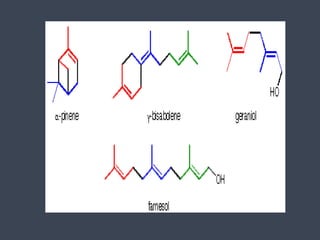
The terpenoids, sometimes called isoprenoids,
maybe defines as a large and diverse class of
naturally occurring organic chemical compounds
derived from varoius but definite number of five-
carbon isoprene units named Hemiterpene or
methylbuta -1,3-diene
The isoprene units may be linked together
"head to tail" to form linear chains or they may
be arranged to form rings.
Isoprene rule
Isoprene unite in Myrcene are joined head to
tail
Isoprene itself does not undergo the building
process but rather activated forms, isopentenyl
pyrophosphate IPP and dimethylallyl
pyrophosphate DMAPP, are the components in
the biosynthesis.
DMAPP,IPP DMAPP,
Isopentenyl pyrophosphate is interconvertible with
2-methylallyl pyrophosphate.
Terpenoids are extraordinarily
diverse but they all originate
through the condensation of the
universal phosphorylated
derivative of hemiterpene
(Isoprene),isopentenyl diphosphate
(IPP) and dimethylallyl
diphosphate (DMAPP) giving
geranyl pyrophosphate (GPP).
CLASSIFICATION OF TERENOIDS
S.NO TYPES MOLECULAR
FROMULA
ISOPRENE
UNITS
EXAMPLE
1 Monoterpenoids 10 C 2 Pinene,limonene,
Carene, Sabinene, Camphene,
Thujene. Camphor, Borneol
2 Sesquiterpenoids 15 C 3 Zingiberene,
Vetivazulene ,Guaiazulene.
Cadinenes, Caryophyllene
3 Diterpenoids 20 C 4 Abietic Acid, Aphidicolin, Cafestol,
Cembrene.
4 Sesterterpenoids 25 C 5 Gascardic Acid, Ophiobolin A,
Ceroplastol.
5 Triterpenoids 30 C 6 Sterols
6 Tetraterpenoids 40 C 8 Carotenoids
7 Polyterpenoid Not Fixed infinite Rubber
MONOTERPENOIDS
 They are the terpenoids that have been known for several
centuries as components of the fragrant oils obtained from
leaves, flowers and fruits.
 Monoterpenes, with sesquiterpenes, are the main constituents
of essential oils.
 While a few, such as camphor, occur in a near pure form,
most occur as complex mixtures, often of isomers difficult to
separate.
 These essential oils have numerous actions, such as
allelochemical functions between plants and between plants
and predators.
 A role in wound healing was also observed.
ACYCLIC MONOTERPENOIDS
They can be considered as derivatives of
2,6-dimethyloctene.
Among natural molecules, the followings are well
known and have several structural isomers
A great number of orchid species in the New World
tropics have coevolved with the insects Euglossini by
producing floral scents, highly attractive to insect males
over great distances, for efficient pollination.
Ipsdienol has been shown to be the main attractive
component of the orchid scent.
Ipsdienol
MONOCYCLIC
MONOTERPENOIDS
They are derived from cyclohexane with an isopropyl
substituent.
Limonene is an important volatile emitted by the
holm oak tree and inhibits seed germination of other
plant species.
BICYCLIC MONOTERPENOIDS
Thuyone is best known for being a toxic chemical
in absinthe, a product extract from Artemisia
absinthium.
Pinene is, as limonene, an
allelochemichal emitted by
the roots of Quercus ilex.
Camphor and pinene are
also allelochemicals
emitted by Salvia
leucophylla .
Iridoids are a class of bicyclic monoterpenes found
in a wide variety of plants and in some animals.
typically found in plants as glycosides, most often
bound to glucose.
They are produced by plants primarily as a defense
against herbivores or against infection by
microorganisms.
It can also be used as a mosquito repellent.
As other terpenes, iridoids may function as protective
substances in the animal kingdom, especially for insects.
They have also antioxidant properties, g-terpene and
hydroxytyrosol being among the most effective.
SESQUITERPENOIDS
Sesquiterpenoids are defined as the group of 15
carbon compounds derived by the assembly of 3
isoprenoid units and they are found mainly in higher
plants but also in invertebrates.
Sesquiterpenes, with monoterpenes, are an important
constituent of essential oils in plants.
They are the most diverse group of isoprenoids.
In plants, they function as pheromones and juvenile
hormones.
Sesquiterpene structures present several acyclic, mono-,
bi-, tri-, and tetracyclic systems.
ACYCLIC COMPOUNDS
The acyclic
representative are also
called farnesans,
term derived from the
basic structure,
farnesol.
Farnesol and nerolidol
are very common and
are isolated from
essential oils of
various sources
Farnesol is widely distributed in many essential oils
such as citronella, neroli, cyclamen, lemon grass,
tuberose, rose, musk, and balsam.
It is used in perfumery to emphasize the odors of
perfumes.
Moreover, it is a natural pesticide for mites and is also
a pheromone for several insects and mammals,
including elephants.
Farnesol was also show to be the “quorum-sensing
molecule” identified in fungi.
Nerolidol is present in neroli, ginger, jasmine,
lavender, tea tree and lemon grass.
The aroma of nerolidol is woody and reminiscent of
fresh bark.
It is used as a flavoring agent and in perfumery.
It was also shown to be produced by the leaves of a
large number of plant species in response to herbivory
insects and then to be transformed into a C11-
homoterpene (4,8-dimethyl-1,3,7-nonatriene) which
attracts predatory insects.
4,8-Dimethyl-1,3,7-nonatriene
CYCLIC COMPOUNDS
Abscisic acid plays a key
role in plants in the
regulation of stomatal
closure by regulating ion
channel activities and
water exchanges across
the plasma membrane of
guard cells.
SOME IMPORTANT SESQUITERPENES
The function of curcumene as insecticide, repellent, and
insect feeding deterrent has been previously reported.
A parent compound, bisabolol is isolated from essential oils
of a variety of plants,
Gossypol, a sesquiterpene dimer found in all the cotton
plants is formed from two cadinane units.
Terpenoids occurs as a mixture of two enantiomers but each
has different biological activities.
For nonruminant animals (rodents, chickens, humans), (–)-
gossypol is significantly more toxic than the (+)
enantiomer. It has anti-cancer properties and inhibits male
fertility in humans. In contrast, cotton plants containing
high levels of (+)-gossypol are resistant to insect damage.
These terpenes must be removed from the plant parts and
oil before use as animal foods.
Bicyclic sesquiterpenes with a
drimane unit are widespread in
plants, liveworts, fungi and certain
marine organisms (sponges).
Some drimanes have been identified
in petroleum and are probably
derived from a microbial source.
They have generally potent
antibacterial and antifungal
activities, and they are toxic to
several invertebrates and also in fish.
Drimane skeleton
 Capsidiol is a
sesquiterpenoid compound
that accumulates in
tobacco Nicotiana
tabacum and chili
pepper Capsicum annuum in
response to fungal infection.
It is considered as a
phytoalexin.
Capsidiol
They have 20 carbon atoms and are derived
from geranylgeraniol pyrophosphate.
They are of fungal or plant origin and are found in resins,
gummy exudates, and in the resinous high-boiling
fractions remaining after distillation of essential oils.
The rosin remaining after distilling pine turpentine, for
instance, is rich in diterpenoids.
In ancient times, conifer exudates were used for caulking
boats and waterproofing ropes.
Resin secretion is also recognized to be part of the
resistance mechanism conifers employ against bark
beetles and their associated pathogenic fungi..
Diterpenoid groups that are physiologically active
include:
Examples:
-vitamin A (retinol),
-phytohormones that regulate plant growth and
germination, e.g. gibberellin,
-fungal hormones like trisporic acid
-disease resistance agents (phytoalexins), e.g. casbene
and podocarpic acid, the anticancer drug,
- taxol, from the bark of the yew tree
- the cancer promoter, phorbol, and natural
cannabinoids
DITERPENOIDS
The diterpenes have exceptionally open chain
compounds derived from geranylgeranyl phosphate
which forms a part of chlorophyll and the side chain of
vitamin E and K, and crocetin which is a diacid
diterpenoid and the lipid part of the crocins, glycosylated
derivatives present in saffron. Diterpenes form the basis
for biologically important compounds such
as retinol, retinal, and phytol.
Geranylgeranyl phosphate
Abietic acid is an irritant compound
present in pine wood (coniferous trees)
and resin.
It is mainly used to make and varnishes
and metal resinates.
These resinates are produced in reacting
abietic acid (or a similar compound)
with a metal salt (gold, indium, nickel,
palladium, platinum, silver etc) and used
in a wide variety of applications where
high purity metals in organic solution
form is needed viz. printing inks,
vitrifiable colors, antifouling agent,
dryers for paints and varnishes .
Abietic acid
Steviol is the aglycone of stevia's
sweet glycosides, one of them being
formed by replacing one hydrogen
atom (bottom) with glucose via an
ester link, and another hydrogen atom
(top) with a disaccharide (glucose and
rhamnose).
The steviol glycosides are responsible
for the sweet taste of the leaves of
the stevia plant (Stevia
rebaudiana, Asteraceae).
 These compounds are 40 to 300
times sweeter than sucrose. They are
developed to be used in sweet drinks.
Steviol
Retene is present in tars obtained by
distillation of resinous wood, it is an
important pollutant eliminated by the
paper factories.
This diterpene is present in geological
sediment where it is formed by
diagenesis from abietic acid, several
intermediates having been recognized.
Thus, with cadalene (sesquiterpene),
retene, whichnis a diterpenoid
dehydrogenation product, is used in
paleobotanic to estimate the importance
of ancient pine forests.
Retene
Gibberellins are a family of compounds, over 130
members exist whose structures and occurrence can
be found on the web.
The most important in plants is gibberellin A1 which
is responsible for stem elongation.
The most widely available compound is gibberellic
acid.
 Among the physiological properties, gibberellins are
involved in stem growth, seed germination and fruit
setting and growth.
Steviol glycosides
SESTERPENOIDS
They are derived from geranylfarnesol pyrophosphate
and have 25 carbon atoms. They were isolated from
insect protective waxes and from fungal sources.
 Three examples of sesterpenes are shown below.
Variously unsaturated and branched sesterpenes, known as
Haslenes, were found in species of diatomaceous algae.
They are widely distributed and abundant in marine
sediments. and were shown to have cytostatic properties.
One of them is shown below.
TRITERPENOIDS
 They form a large group of natural substances
which includes steroids and consequently
sterols.
 Squalene is the immediate biological precursor
of all triterpenoids.
Among the large number of triterpenoid
structures, some of them are shown below.
Steroids are modified triterpenes which derived also
from squalene by cyclization, unsaturation and
substitution.
The nucleus of all steroids is the tetracyclic C17
hydrocarbon 1,2-cyclopentanoperhydrophenanthrene
(gonane or sterane) substituted by methyl groups at C10
and C13, as well as an alkyl side-chain at C17.
Steroids may possess a nucleus derived from the former
one by one or more C-C bond scissions or ring
expansions or contractions.
Gonane and three examples of basic unsubstituted
steroids are shown below.
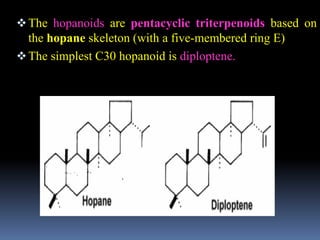
The hopanoids are pentacyclic triterpenoids based on
the hopane skeleton (with a five-membered ring E)
The simplest C30 hopanoid is diploptene.
Other pentacyclic
triterpenoids based on
the lupane skeleton include
a very large number of
naturally occurring
members with different
functional groups which
are found in vegetables and
fruit.
Among them, lupeol is one
of the most ubiquitous
compounds.
Terpene Biosynthesis
Carbon-Carbon Bond Formation
 The key process involves the double bond of
isopentenyl pyrophosphate acting as a
nucleophile toward the allylic carbon of
dimethylallyl pyrophosphate.
+
OPP
OPP
Carbon-Carbon Bond Formation
+
OPP
OPP
–
+
OPP
OPP
After C—C Bond Formation...
The carbocation loses a proton to give a double
bond.
+
OPP OPP
H–
+
Geranyl pyrophosphate formed after loss of proton
can undergo hydrolysis to give geraniol (rose oil).
OPP
OPP
OH
Geraniol
H2O
From 10C to 15 C
+
OPP
OPP
Geranyl pyrophosphate
+
OPP
From 10 Carbons to 15
+
OPP
H–
+
OPP
From 10 Carbons to 15
 This compound is called farnesyl pyrophosphate.
 Hydrolysis of the pyrophosphate ester gives the
alcohol farnesol .
OPP
From 15 Carbons to 20
Farnesyl pyrophosphate is extended by another
isoprene unit by reaction with isopentenyl
pyrophosphate.
OPP
OPP
Cyclization
Rings are formed by intramolecular carbon-
carbon bond formation.
OPP
OPP
+
E double
bond
Z double
bond
+
OH
H–
+
H2O
Limonene
a-Terpineol
Bicyclic Terpenes
+
+
+
b-Pinene
+
a-Pinene
Continued…………..

Terpeniods

  • 1.
    TERPENes & TERPENIODS Dr. Mishu Singh Departmentof Chemistry Maharana Pratap Govt. P.G. College Hardoi www.mpgpgcollegehardoi.in
  • 2.
    During the 19thcentury, chemical works on turpentine led to name "terpene" the hydrocarbons with the general formula C10H16 found in that complex plant product. These terpenes are frequently found in plant essential oils. Terpenoids (isoprenoids), a subclass of the prenyllipids (terpenes, prenylquinones, and sterols), represent the oldest group of small molecular products synthesized by plants.
  • 3.
    They are universallypresent in small amounts in living organisms, where they play numerous vital roles in plant physiology as well as important functions in all cellular membranes. On the other hand, they are also accumulated in many cases, and it is shown that the extraordinary variety they then display can be due to ecological factors playing an evolutionary role.
  • 4.
    The terpenoids, sometimescalled isoprenoids, maybe defines as a large and diverse class of naturally occurring organic chemical compounds derived from varoius but definite number of five- carbon isoprene units named Hemiterpene or methylbuta -1,3-diene The isoprene units may be linked together "head to tail" to form linear chains or they may be arranged to form rings.
  • 6.
    Isoprene rule Isoprene unitein Myrcene are joined head to tail
  • 8.
    Isoprene itself doesnot undergo the building process but rather activated forms, isopentenyl pyrophosphate IPP and dimethylallyl pyrophosphate DMAPP, are the components in the biosynthesis. DMAPP,IPP DMAPP,
  • 9.
    Isopentenyl pyrophosphate isinterconvertible with 2-methylallyl pyrophosphate.
  • 10.
    Terpenoids are extraordinarily diversebut they all originate through the condensation of the universal phosphorylated derivative of hemiterpene (Isoprene),isopentenyl diphosphate (IPP) and dimethylallyl diphosphate (DMAPP) giving geranyl pyrophosphate (GPP).
  • 11.
    CLASSIFICATION OF TERENOIDS S.NOTYPES MOLECULAR FROMULA ISOPRENE UNITS EXAMPLE 1 Monoterpenoids 10 C 2 Pinene,limonene, Carene, Sabinene, Camphene, Thujene. Camphor, Borneol 2 Sesquiterpenoids 15 C 3 Zingiberene, Vetivazulene ,Guaiazulene. Cadinenes, Caryophyllene 3 Diterpenoids 20 C 4 Abietic Acid, Aphidicolin, Cafestol, Cembrene. 4 Sesterterpenoids 25 C 5 Gascardic Acid, Ophiobolin A, Ceroplastol. 5 Triterpenoids 30 C 6 Sterols 6 Tetraterpenoids 40 C 8 Carotenoids 7 Polyterpenoid Not Fixed infinite Rubber
  • 12.
  • 13.
     They arethe terpenoids that have been known for several centuries as components of the fragrant oils obtained from leaves, flowers and fruits.  Monoterpenes, with sesquiterpenes, are the main constituents of essential oils.  While a few, such as camphor, occur in a near pure form, most occur as complex mixtures, often of isomers difficult to separate.  These essential oils have numerous actions, such as allelochemical functions between plants and between plants and predators.  A role in wound healing was also observed.
  • 14.
    ACYCLIC MONOTERPENOIDS They canbe considered as derivatives of 2,6-dimethyloctene.
  • 15.
    Among natural molecules,the followings are well known and have several structural isomers
  • 16.
    A great numberof orchid species in the New World tropics have coevolved with the insects Euglossini by producing floral scents, highly attractive to insect males over great distances, for efficient pollination. Ipsdienol has been shown to be the main attractive component of the orchid scent. Ipsdienol
  • 17.
  • 18.
    They are derivedfrom cyclohexane with an isopropyl substituent. Limonene is an important volatile emitted by the holm oak tree and inhibits seed germination of other plant species.
  • 19.
    BICYCLIC MONOTERPENOIDS Thuyone isbest known for being a toxic chemical in absinthe, a product extract from Artemisia absinthium.
  • 20.
    Pinene is, aslimonene, an allelochemichal emitted by the roots of Quercus ilex. Camphor and pinene are also allelochemicals emitted by Salvia leucophylla .
  • 21.
    Iridoids are aclass of bicyclic monoterpenes found in a wide variety of plants and in some animals. typically found in plants as glycosides, most often bound to glucose. They are produced by plants primarily as a defense against herbivores or against infection by microorganisms. It can also be used as a mosquito repellent. As other terpenes, iridoids may function as protective substances in the animal kingdom, especially for insects. They have also antioxidant properties, g-terpene and hydroxytyrosol being among the most effective.
  • 22.
  • 23.
    Sesquiterpenoids are definedas the group of 15 carbon compounds derived by the assembly of 3 isoprenoid units and they are found mainly in higher plants but also in invertebrates. Sesquiterpenes, with monoterpenes, are an important constituent of essential oils in plants. They are the most diverse group of isoprenoids. In plants, they function as pheromones and juvenile hormones. Sesquiterpene structures present several acyclic, mono-, bi-, tri-, and tetracyclic systems.
  • 24.
    ACYCLIC COMPOUNDS The acyclic representativeare also called farnesans, term derived from the basic structure, farnesol. Farnesol and nerolidol are very common and are isolated from essential oils of various sources
  • 25.
    Farnesol is widelydistributed in many essential oils such as citronella, neroli, cyclamen, lemon grass, tuberose, rose, musk, and balsam. It is used in perfumery to emphasize the odors of perfumes. Moreover, it is a natural pesticide for mites and is also a pheromone for several insects and mammals, including elephants. Farnesol was also show to be the “quorum-sensing molecule” identified in fungi.
  • 26.
    Nerolidol is presentin neroli, ginger, jasmine, lavender, tea tree and lemon grass. The aroma of nerolidol is woody and reminiscent of fresh bark. It is used as a flavoring agent and in perfumery. It was also shown to be produced by the leaves of a large number of plant species in response to herbivory insects and then to be transformed into a C11- homoterpene (4,8-dimethyl-1,3,7-nonatriene) which attracts predatory insects. 4,8-Dimethyl-1,3,7-nonatriene
  • 27.
    CYCLIC COMPOUNDS Abscisic acidplays a key role in plants in the regulation of stomatal closure by regulating ion channel activities and water exchanges across the plasma membrane of guard cells.
  • 28.
  • 29.
    The function ofcurcumene as insecticide, repellent, and insect feeding deterrent has been previously reported. A parent compound, bisabolol is isolated from essential oils of a variety of plants, Gossypol, a sesquiterpene dimer found in all the cotton plants is formed from two cadinane units. Terpenoids occurs as a mixture of two enantiomers but each has different biological activities. For nonruminant animals (rodents, chickens, humans), (–)- gossypol is significantly more toxic than the (+) enantiomer. It has anti-cancer properties and inhibits male fertility in humans. In contrast, cotton plants containing high levels of (+)-gossypol are resistant to insect damage. These terpenes must be removed from the plant parts and oil before use as animal foods.
  • 30.
    Bicyclic sesquiterpenes witha drimane unit are widespread in plants, liveworts, fungi and certain marine organisms (sponges). Some drimanes have been identified in petroleum and are probably derived from a microbial source. They have generally potent antibacterial and antifungal activities, and they are toxic to several invertebrates and also in fish. Drimane skeleton
  • 31.
     Capsidiol isa sesquiterpenoid compound that accumulates in tobacco Nicotiana tabacum and chili pepper Capsicum annuum in response to fungal infection. It is considered as a phytoalexin. Capsidiol
  • 32.
    They have 20carbon atoms and are derived from geranylgeraniol pyrophosphate. They are of fungal or plant origin and are found in resins, gummy exudates, and in the resinous high-boiling fractions remaining after distillation of essential oils. The rosin remaining after distilling pine turpentine, for instance, is rich in diterpenoids. In ancient times, conifer exudates were used for caulking boats and waterproofing ropes. Resin secretion is also recognized to be part of the resistance mechanism conifers employ against bark beetles and their associated pathogenic fungi..
  • 33.
    Diterpenoid groups thatare physiologically active include: Examples: -vitamin A (retinol), -phytohormones that regulate plant growth and germination, e.g. gibberellin, -fungal hormones like trisporic acid -disease resistance agents (phytoalexins), e.g. casbene and podocarpic acid, the anticancer drug, - taxol, from the bark of the yew tree - the cancer promoter, phorbol, and natural cannabinoids
  • 34.
  • 35.
    The diterpenes haveexceptionally open chain compounds derived from geranylgeranyl phosphate which forms a part of chlorophyll and the side chain of vitamin E and K, and crocetin which is a diacid diterpenoid and the lipid part of the crocins, glycosylated derivatives present in saffron. Diterpenes form the basis for biologically important compounds such as retinol, retinal, and phytol. Geranylgeranyl phosphate
  • 38.
    Abietic acid isan irritant compound present in pine wood (coniferous trees) and resin. It is mainly used to make and varnishes and metal resinates. These resinates are produced in reacting abietic acid (or a similar compound) with a metal salt (gold, indium, nickel, palladium, platinum, silver etc) and used in a wide variety of applications where high purity metals in organic solution form is needed viz. printing inks, vitrifiable colors, antifouling agent, dryers for paints and varnishes . Abietic acid
  • 39.
    Steviol is theaglycone of stevia's sweet glycosides, one of them being formed by replacing one hydrogen atom (bottom) with glucose via an ester link, and another hydrogen atom (top) with a disaccharide (glucose and rhamnose). The steviol glycosides are responsible for the sweet taste of the leaves of the stevia plant (Stevia rebaudiana, Asteraceae).  These compounds are 40 to 300 times sweeter than sucrose. They are developed to be used in sweet drinks. Steviol
  • 40.
    Retene is presentin tars obtained by distillation of resinous wood, it is an important pollutant eliminated by the paper factories. This diterpene is present in geological sediment where it is formed by diagenesis from abietic acid, several intermediates having been recognized. Thus, with cadalene (sesquiterpene), retene, whichnis a diterpenoid dehydrogenation product, is used in paleobotanic to estimate the importance of ancient pine forests. Retene
  • 41.
    Gibberellins are afamily of compounds, over 130 members exist whose structures and occurrence can be found on the web. The most important in plants is gibberellin A1 which is responsible for stem elongation. The most widely available compound is gibberellic acid.  Among the physiological properties, gibberellins are involved in stem growth, seed germination and fruit setting and growth.
  • 42.
  • 44.
  • 45.
    They are derivedfrom geranylfarnesol pyrophosphate and have 25 carbon atoms. They were isolated from insect protective waxes and from fungal sources.
  • 46.
     Three examplesof sesterpenes are shown below.
  • 47.
    Variously unsaturated andbranched sesterpenes, known as Haslenes, were found in species of diatomaceous algae. They are widely distributed and abundant in marine sediments. and were shown to have cytostatic properties. One of them is shown below.
  • 48.
  • 49.
     They forma large group of natural substances which includes steroids and consequently sterols.  Squalene is the immediate biological precursor of all triterpenoids.
  • 50.
    Among the largenumber of triterpenoid structures, some of them are shown below.
  • 52.
    Steroids are modifiedtriterpenes which derived also from squalene by cyclization, unsaturation and substitution. The nucleus of all steroids is the tetracyclic C17 hydrocarbon 1,2-cyclopentanoperhydrophenanthrene (gonane or sterane) substituted by methyl groups at C10 and C13, as well as an alkyl side-chain at C17. Steroids may possess a nucleus derived from the former one by one or more C-C bond scissions or ring expansions or contractions. Gonane and three examples of basic unsubstituted steroids are shown below.
  • 54.
    The hopanoids arepentacyclic triterpenoids based on the hopane skeleton (with a five-membered ring E) The simplest C30 hopanoid is diploptene.
  • 55.
    Other pentacyclic triterpenoids basedon the lupane skeleton include a very large number of naturally occurring members with different functional groups which are found in vegetables and fruit. Among them, lupeol is one of the most ubiquitous compounds.
  • 56.
  • 57.
    Carbon-Carbon Bond Formation The key process involves the double bond of isopentenyl pyrophosphate acting as a nucleophile toward the allylic carbon of dimethylallyl pyrophosphate. + OPP OPP
  • 58.
  • 59.
    After C—C BondFormation... The carbocation loses a proton to give a double bond. + OPP OPP H– + Geranyl pyrophosphate formed after loss of proton can undergo hydrolysis to give geraniol (rose oil). OPP
  • 60.
  • 61.
    From 10C to15 C + OPP OPP Geranyl pyrophosphate + OPP
  • 62.
    From 10 Carbonsto 15 + OPP H– + OPP
  • 63.
    From 10 Carbonsto 15  This compound is called farnesyl pyrophosphate.  Hydrolysis of the pyrophosphate ester gives the alcohol farnesol . OPP
  • 64.
    From 15 Carbonsto 20 Farnesyl pyrophosphate is extended by another isoprene unit by reaction with isopentenyl pyrophosphate. OPP OPP
  • 65.
    Cyclization Rings are formedby intramolecular carbon- carbon bond formation. OPP OPP + E double bond Z double bond
  • 66.
  • 67.
  • 68.