GENTIAN
Presented by :-
V. RAVI KISHORE
2nd pharm D
SYNONYMS :-
Yellow Gentian, Gall weed, Bitter wart , Radix Gentianae.
BIOLOGICAL SOURCE :-
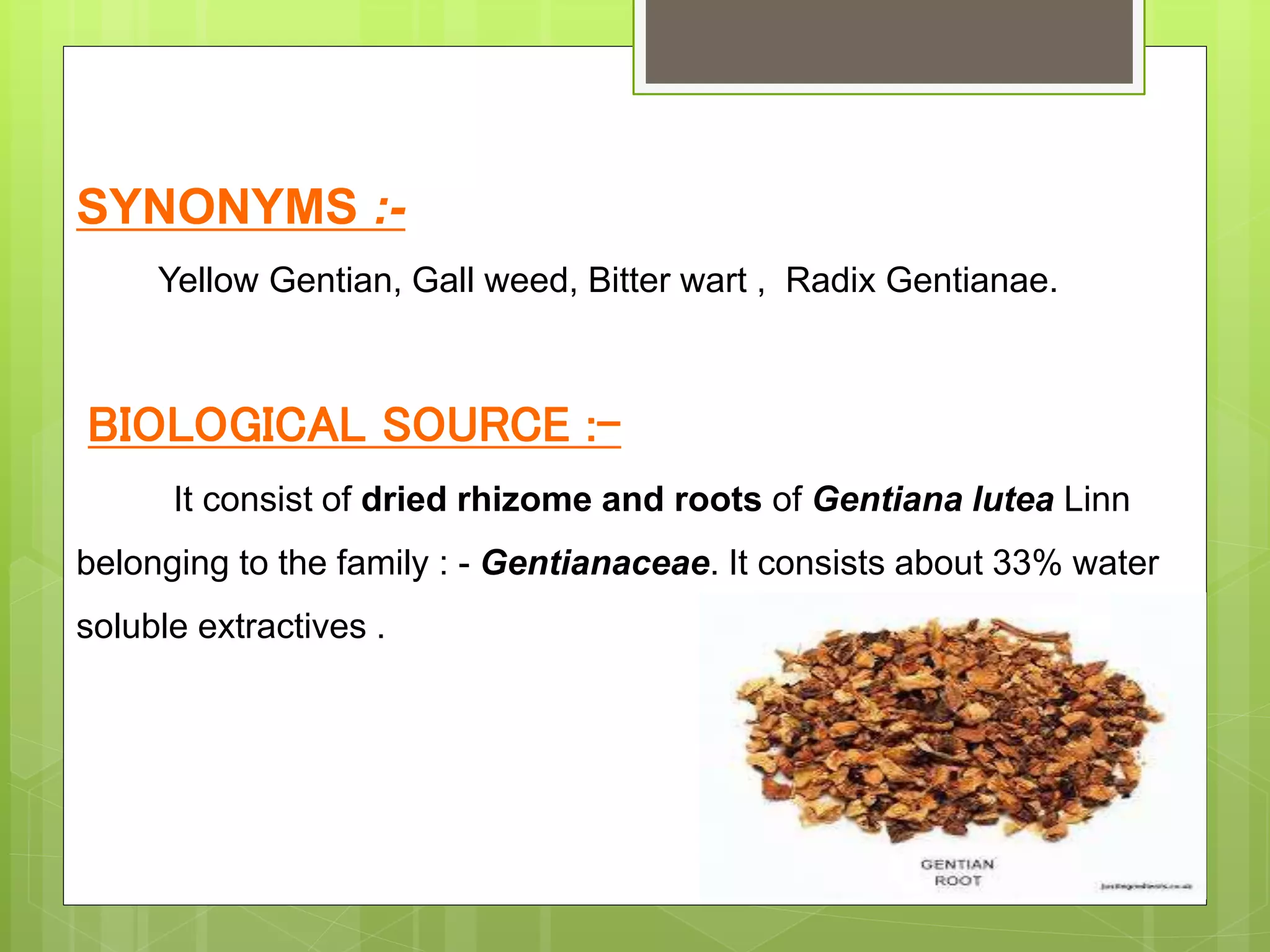
It consist of dried rhizome and roots of Gentiana lutea Linn
belonging to the family : - Gentianaceae. It consists about 33% water
soluble extractives .
Habitat:
It is found in Central and Southern Europe and
Asia .
Cultivation:
 G. lutea requires a moist soil , good drainage and a
suitable soil consisting of loam , peat and grit.
 Seeds are slow to germination ,seedlings frequently
taking several years to appear.
Collection:
 The plant is large perennial herb.
 The drug is collected from 2-5 years old plant in autumn
(Sept – Dec).
 Turf is stripped and the rhizomes are dug up.
 It is cut into pieces of different length and dried quickly
first in air and then in sheds.
 The drug becomes much dark in colour , looses some
of its bitterness and acquires a very distinctive odour.
Morphology:
o Color :- Brownish
o Shape :- Sub-cylindrical , entire or longitudinally
split pieces of rhizomes and roots.
o Size :- 15-20 cm or more in length and 2.5-8 cm
in thickness at crown.
o Odour :- Characteristic odour
o The root is longitudinally wrinkled and the rhizome,
which is sometimes branched, frequently
terminates in one or more buds and appear as
transverse annulations.
o The drug is brittle and breaks with a short fracture .
It has a characteristic odour and the taste is sweet
at first and then intensely bitter afterwards
Microscopic characters:
 A transvers section show an orange brown bark
separated by darker cambium line from the porous ,
very indistinctly radiated wood .
 The rhizome show pith,4-6 rows of thin walled cork cells
between which and the cambium is thick walled
phelloderm and wide zone of brown,thin walled
parenchyma containing oil globules and minute needles
of calcium oxalate .
 Small groups of soft phloem are present but phloem
fibers are absent.
 The wood pith contain abundant parenchyma having
similar cell content to those of the bark .
 The vessels occur either isolate or in small groups and
show mainly reticulate or scalariform thickening .
 They are a few spiral and annular vessels. Group of
soft phloem occur in the xylem.
 The drug contains some starch granules and
sclerenchymatous cells or fibers.
Chemical Constituents:
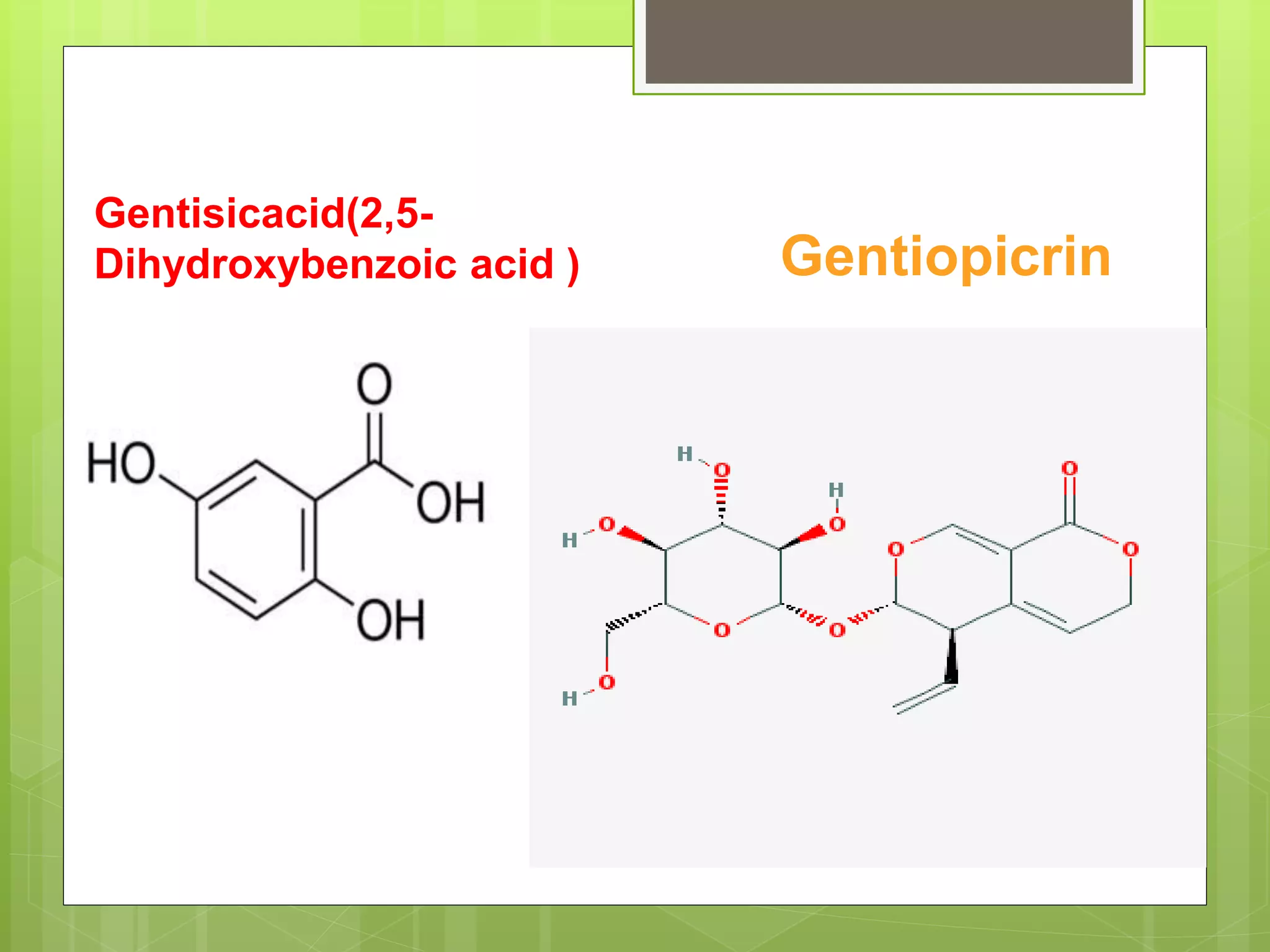
 Gentian consists the bitter glycoside GENTIOPICRIN (~2%) as
a principle active constituent . On hydrolysis , it yields the
aglycone mesogentiogenin and glucose.
 Gentiopicrin is a secoiridoid , gentiopicroside , and it is
decomposed on fermentation and drying of the drug.
 Other bitter compounds are Genticin , Amaropanin,
Amarogentin and Amaoswerin.
 Gentian also contains Gentiin , Gentiamarin , Gentisic
acid(2,5 -dihydoxybenzoic acid), Tannins , Pectin's and calcium
oxalates.
 Gentian should yield 33-40% of water soluble extractive but
highly fermented root yields much less.
Gentisicacid(2,5-
Dihydroxybenzoic acid ) Gentiopicrin
CHEMICAL TESTS :
1. Alcoholic extract when made alkaline. Shows blue or
green fluorescence.
2. Take moistened dry powder in test tube .Cover test
tube with filter paper soaked in dil .NaOH. Keep test
tube in water bath . After sometimes expose filter paper
to UV light . It shows yellowish –green fluorescence.
Uses:
 Potent stomachic and treats GI problems like
indigestion.
 Emmenogoggue.
 This bitter stem less is used to treat wounds.
 To treat arthritis , sore throat , jaundice.
 Gentian extracts are used in variety of foods and
cosmetics.
Adulterants:
 Adulterations occur due to careless collection. The
rhizomes of Rumex alphinus give the test for anthra
quinone derivatives .
 It is a dangerous but easily detected admixture with
the rhizome of Veratrum album .
Contra indications:
 avoided in pregnancy and lactation.
 contra indicated in gastric and duodenal
ulcers.
Adverse effects :
 Raw extract may cause nausea , vomiting
and diarrhea.
Gentian

Gentian

  • 1.
    GENTIAN Presented by :- V.RAVI KISHORE 2nd pharm D
  • 2.
    SYNONYMS :- Yellow Gentian,Gall weed, Bitter wart , Radix Gentianae. BIOLOGICAL SOURCE :- It consist of dried rhizome and roots of Gentiana lutea Linn belonging to the family : - Gentianaceae. It consists about 33% water soluble extractives .
  • 3.
    Habitat: It is foundin Central and Southern Europe and Asia . Cultivation:  G. lutea requires a moist soil , good drainage and a suitable soil consisting of loam , peat and grit.  Seeds are slow to germination ,seedlings frequently taking several years to appear.
  • 4.
    Collection:  The plantis large perennial herb.  The drug is collected from 2-5 years old plant in autumn (Sept – Dec).  Turf is stripped and the rhizomes are dug up.  It is cut into pieces of different length and dried quickly first in air and then in sheds.  The drug becomes much dark in colour , looses some of its bitterness and acquires a very distinctive odour.
  • 5.
    Morphology: o Color :-Brownish o Shape :- Sub-cylindrical , entire or longitudinally split pieces of rhizomes and roots. o Size :- 15-20 cm or more in length and 2.5-8 cm in thickness at crown. o Odour :- Characteristic odour o The root is longitudinally wrinkled and the rhizome, which is sometimes branched, frequently terminates in one or more buds and appear as transverse annulations. o The drug is brittle and breaks with a short fracture . It has a characteristic odour and the taste is sweet at first and then intensely bitter afterwards
  • 7.
    Microscopic characters:  Atransvers section show an orange brown bark separated by darker cambium line from the porous , very indistinctly radiated wood .  The rhizome show pith,4-6 rows of thin walled cork cells between which and the cambium is thick walled phelloderm and wide zone of brown,thin walled parenchyma containing oil globules and minute needles of calcium oxalate .  Small groups of soft phloem are present but phloem fibers are absent.  The wood pith contain abundant parenchyma having similar cell content to those of the bark .
  • 8.
     The vesselsoccur either isolate or in small groups and show mainly reticulate or scalariform thickening .  They are a few spiral and annular vessels. Group of soft phloem occur in the xylem.  The drug contains some starch granules and sclerenchymatous cells or fibers.
  • 9.
    Chemical Constituents:  Gentianconsists the bitter glycoside GENTIOPICRIN (~2%) as a principle active constituent . On hydrolysis , it yields the aglycone mesogentiogenin and glucose.  Gentiopicrin is a secoiridoid , gentiopicroside , and it is decomposed on fermentation and drying of the drug.  Other bitter compounds are Genticin , Amaropanin, Amarogentin and Amaoswerin.  Gentian also contains Gentiin , Gentiamarin , Gentisic acid(2,5 -dihydoxybenzoic acid), Tannins , Pectin's and calcium oxalates.  Gentian should yield 33-40% of water soluble extractive but highly fermented root yields much less.
  • 10.
  • 11.
    CHEMICAL TESTS : 1.Alcoholic extract when made alkaline. Shows blue or green fluorescence. 2. Take moistened dry powder in test tube .Cover test tube with filter paper soaked in dil .NaOH. Keep test tube in water bath . After sometimes expose filter paper to UV light . It shows yellowish –green fluorescence.
  • 12.
    Uses:  Potent stomachicand treats GI problems like indigestion.  Emmenogoggue.  This bitter stem less is used to treat wounds.  To treat arthritis , sore throat , jaundice.  Gentian extracts are used in variety of foods and cosmetics.
  • 13.
    Adulterants:  Adulterations occurdue to careless collection. The rhizomes of Rumex alphinus give the test for anthra quinone derivatives .  It is a dangerous but easily detected admixture with the rhizome of Veratrum album .
  • 14.
    Contra indications:  avoidedin pregnancy and lactation.  contra indicated in gastric and duodenal ulcers. Adverse effects :  Raw extract may cause nausea , vomiting and diarrhea.