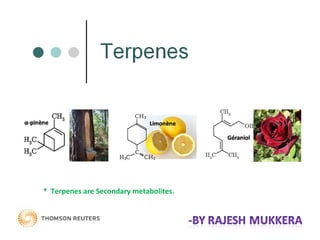
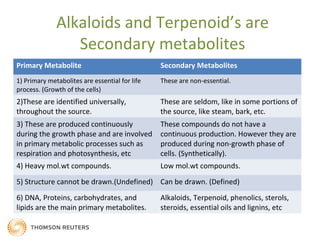
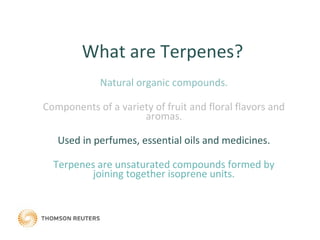
* Terpenes are Secondary metabolites.
Alkaloids and Terpenoid’s are
Secondary metabolites
Primary Metabolite Secondary Metabolites
1) Primary metabolites are essential for life
process. (Growth of the cells)
These are non-essential.
2)These are identified universally,
throughout the source.
These are seldom, like in some portions of
the source, like steam, bark, etc.
3) These are produced continuously
during the growth phase and are involved
in primary metabolic processes such as
respiration and photosynthesis, etc
These compounds do not have a
continuous production. However they are
produced during non-growth phase of
cells. (Synthetically).
4) Heavy mol.wt compounds. Low mol.wt compounds.
5) Structure cannot be drawn.(Undefined) Can be drawn. (Defined)
6) DNA, Proteins, carbohydrates, and
lipids are the main primary metabolites.
Alkaloids, Terpenoid, phenolics, sterols,
steroids, essential oils and lignins, etc
Natural organic compounds.
Components of a variety of fruit and floral flavors and
aromas.
Used in perfumes, essential oils and medicines.
Terpenes are unsaturated compounds formed by
joining together isoprene units.
What are Terpenes?
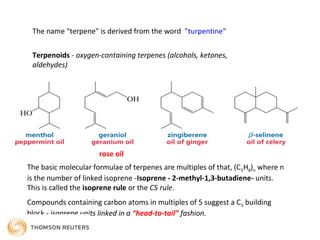
The name "terpene" is derived from the word "turpentine"
Terpenoids - oxygen-containing terpenes (alcohols, ketones,
aldehydes)
rose oil
The basic molecular formulae of terpenes are multiples of that, (C5H8)n where n
is the number of linked isoprene -Isoprene - 2-methyl-1,3-butadiene- units.
This is called the isoprene rule or the C5 rule.
Compounds containing carbon atoms in multiples of 5 suggest a C5 building
block - isoprene units linked in a “head-to-tail” fashion.
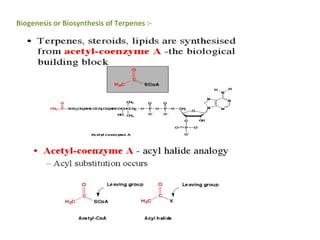
Biogenesis or Biosynthesis of Terpenes :-
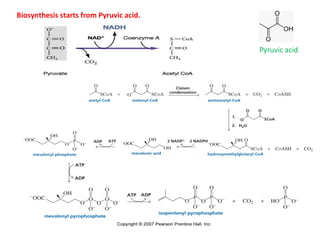
Biosynthesis starts from Pyruvic acid.
Pyruvic acid
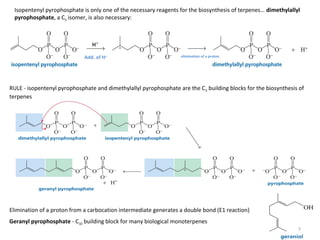
RULE - isopentenyl pyrophosphate and dimethylallyl pyrophosphate are the C5 building blocks for the biosynthesis of
terpenes
Elimination of a proton from a carbocation intermediate generates a double bond (E1 reaction)
Geranyl pyrophosphate - C10 building block for many biological monoterpenes
Isopentenyl pyrophosphate is only one of the necessary reagents for the biosynthesis of terpenes… dimethylallyl
pyrophosphate, a C5 isomer, is also necessary:
Add. of H+ elimination of a proton
7
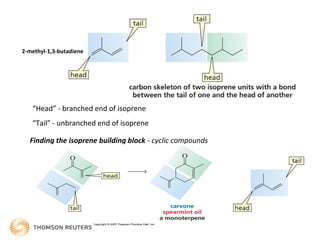
“Head” - branched end of isoprene
“Tail” - unbranched end of isoprene
2-methyl-1,3-butadiene
Finding the isoprene building block - cyclic compounds
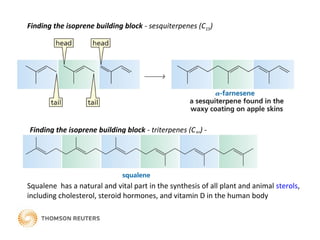
Finding the isoprene building block - sesquiterpenes (C15)
Finding the isoprene building block - triterpenes (C30) -
Squalene has a natural and vital part in the synthesis of all plant and animal sterols,
including cholesterol, steroid hormones, and vitamin D in the human body
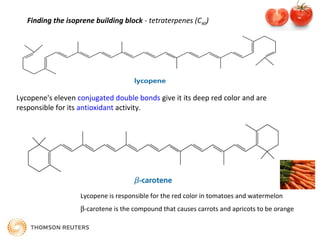
Finding the isoprene building block - tetraterpenes (C40)
Lycopene's eleven conjugated double bonds give it its deep red color and are
responsible for its antioxidant activity.
Lycopene is responsible for the red color in tomatoes and watermelon
β-carotene is the compound that causes carrots and apricots to be orange
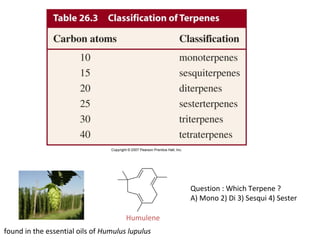
Humulene
found in the essential oils of Humulus lupulus
Question : Which Terpene ?
A) Mono 2) Di 3) Sesqui 4) Sester
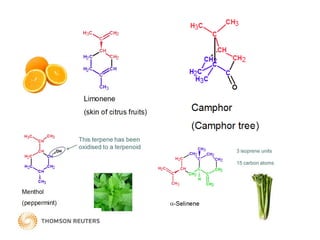
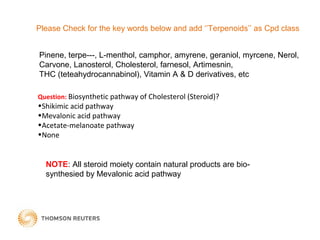
Pinene, terpe---, L-menthol, camphor, amyrene, geraniol, myrcene, Nerol,
Carvone, Lanosterol, Cholesterol, farnesol, Artimesnin,
THC (teteahydrocannabinol), Vitamin A & D derivatives, etc
Please Check for the key words below and add ‘’Terpenoids’’ as Cpd class
Question: Biosynthetic pathway of Cholesterol (Steroid)?
•Shikimic acid pathway
•Mevalonic acid pathway
•Acetate-melanoate pathway
•None
NOTE: All steroid moiety contain natural products are bio-
synthesied by Mevalonic acid pathway
Questions
• Which unit makes up every terpene?
• How many carbons are there in an isoprene
unit?
• What is the systematic name for isoprene?
• What is an oxidised terpene known as?
Answers
• Which unit makes up every terpene?
Isoprene unit
• How many carbons there are in an isoprene unit?
Five
• What is the systematic name for isoprene?
2-methylbuta-1,3-diene
• What is an oxidised terpene known as?
Terpenoid
Terpenes

Terpenes

  • 1.
    * Terpenes areSecondary metabolites.
  • 2.
    Alkaloids and Terpenoid’sare Secondary metabolites Primary Metabolite Secondary Metabolites 1) Primary metabolites are essential for life process. (Growth of the cells) These are non-essential. 2)These are identified universally, throughout the source. These are seldom, like in some portions of the source, like steam, bark, etc. 3) These are produced continuously during the growth phase and are involved in primary metabolic processes such as respiration and photosynthesis, etc These compounds do not have a continuous production. However they are produced during non-growth phase of cells. (Synthetically). 4) Heavy mol.wt compounds. Low mol.wt compounds. 5) Structure cannot be drawn.(Undefined) Can be drawn. (Defined) 6) DNA, Proteins, carbohydrates, and lipids are the main primary metabolites. Alkaloids, Terpenoid, phenolics, sterols, steroids, essential oils and lignins, etc
  • 3.
    Natural organic compounds. Componentsof a variety of fruit and floral flavors and aromas. Used in perfumes, essential oils and medicines. Terpenes are unsaturated compounds formed by joining together isoprene units. What are Terpenes?
  • 4.
    The name "terpene"is derived from the word "turpentine" Terpenoids - oxygen-containing terpenes (alcohols, ketones, aldehydes) rose oil The basic molecular formulae of terpenes are multiples of that, (C5H8)n where n is the number of linked isoprene -Isoprene - 2-methyl-1,3-butadiene- units. This is called the isoprene rule or the C5 rule. Compounds containing carbon atoms in multiples of 5 suggest a C5 building block - isoprene units linked in a “head-to-tail” fashion.
  • 5.
  • 6.
    Biosynthesis starts fromPyruvic acid. Pyruvic acid
  • 7.
    RULE - isopentenylpyrophosphate and dimethylallyl pyrophosphate are the C5 building blocks for the biosynthesis of terpenes Elimination of a proton from a carbocation intermediate generates a double bond (E1 reaction) Geranyl pyrophosphate - C10 building block for many biological monoterpenes Isopentenyl pyrophosphate is only one of the necessary reagents for the biosynthesis of terpenes… dimethylallyl pyrophosphate, a C5 isomer, is also necessary: Add. of H+ elimination of a proton 7
  • 8.
    “Head” - branchedend of isoprene “Tail” - unbranched end of isoprene 2-methyl-1,3-butadiene Finding the isoprene building block - cyclic compounds
  • 9.
    Finding the isoprenebuilding block - sesquiterpenes (C15) Finding the isoprene building block - triterpenes (C30) - Squalene has a natural and vital part in the synthesis of all plant and animal sterols, including cholesterol, steroid hormones, and vitamin D in the human body
  • 10.
    Finding the isoprenebuilding block - tetraterpenes (C40) Lycopene's eleven conjugated double bonds give it its deep red color and are responsible for its antioxidant activity. Lycopene is responsible for the red color in tomatoes and watermelon β-carotene is the compound that causes carrots and apricots to be orange
  • 11.
    Humulene found in theessential oils of Humulus lupulus Question : Which Terpene ? A) Mono 2) Di 3) Sesqui 4) Sester
  • 13.
    Pinene, terpe---, L-menthol,camphor, amyrene, geraniol, myrcene, Nerol, Carvone, Lanosterol, Cholesterol, farnesol, Artimesnin, THC (teteahydrocannabinol), Vitamin A & D derivatives, etc Please Check for the key words below and add ‘’Terpenoids’’ as Cpd class Question: Biosynthetic pathway of Cholesterol (Steroid)? •Shikimic acid pathway •Mevalonic acid pathway •Acetate-melanoate pathway •None NOTE: All steroid moiety contain natural products are bio- synthesied by Mevalonic acid pathway
  • 14.
    Questions • Which unitmakes up every terpene? • How many carbons are there in an isoprene unit? • What is the systematic name for isoprene? • What is an oxidised terpene known as?
  • 15.
    Answers • Which unitmakes up every terpene? Isoprene unit • How many carbons there are in an isoprene unit? Five • What is the systematic name for isoprene? 2-methylbuta-1,3-diene • What is an oxidised terpene known as? Terpenoid