Atropa belladonna
PRESENTED BY:
ROMA M. SHARMA
ASSISTANT PROFESSOR
GES’S SIR DR.M.S.GOSAVI C.O.P.E.R
NASHIK
Atropa belladonna
 SYNONYMS : Belladonna Leaf, Belladonna Folium.
 Biological Source : Belladonna herb consists of dried leaves and
other aerial parts of Atropa belladonna (Europian belladona)and Atropa
acuminate (Indian belladona).
 It belongs to family Solanaceae.
 Geographical Source : It is indigenous to and cultivated in
England and other European countries.
 In India, it is found in the Western Himalayas from Shimla to
Kashmir and adjoining areas of Himachal Pradesh.
MORPHOLOGY
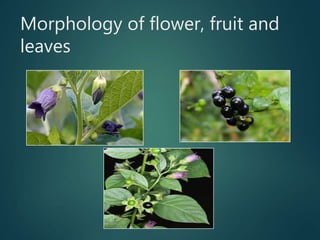
 COLOUR : LEAVES – Green to brownish green.
 FLOWERS – Purple to yellowish brown.
 FRUITS – Green to brown.
 ODOUR : Slight and characteristics
 TASTE : Bitter and acrid.
 SIZE :
LEAVES – 5 to 25 cm long and 2.5 to 12 cm wide.
FLOWERS – Corolla 2.5 cm long and 1.5 cm wide.
FRUITS – About 10 cm in diameter.
 SHAPE :
LEAVES – Ovate, lanceolate, with acute apex, decurrent lamina,
entire margin.
FLOWERS – Campanulate and small reflexed lobes of corolla.
FRUITS – Sub-globular in shape with numerous flat seeds.
Morphology of flower, fruit and
leaves
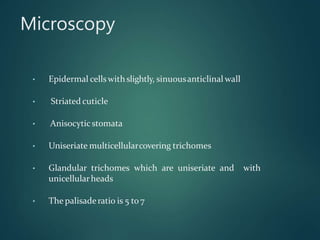
Microscopy
• Epidermal cellswith slightly, sinuousanticlinal wall
• Striated cuticle
• Anisocyticstomata
• Uniseriate multicellularcovering trichomes
• Glandular trichomes which are uniseriate and with
unicellularheads
• The palisaderatio is 5 to 7
T.S. of Belladona
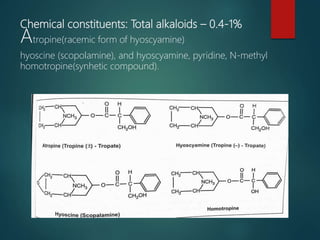
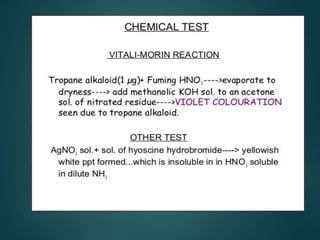
Chemical constituents: Total alkaloids – 0.4-1%
Atropine(racemic form of hyoscyamine)
hyoscine (scopolamine), and hyoscyamine, pyridine, N-methyl
homotropine(synhetic compound).
uses
 (1) It is the parasympatholytic drug with
anticholinergic properties.
 (2)It is used to reduce the secretions such as sweat,
saliva, and gastric juice and also to reduce spasm in
cases of intestinal gripping due to strong purgatives.
 (3) It is also used as an antidote in opium and chloral
hydrate poisoning.
Mechanism of Action:
Atropine and scopolamine are competitive antagonists
with acetylcholine on the common binding
site of muscarinic receptors.
Atropine has limited affects on the CNS, whereas
scopolamine has prominent central effects due to
passage through the blood–brain barrier.
Effects:
Ingestion may cause dry mouth, dysphagia, dysphonia,
tachycardia, urinary retention, mydriasis, headache, and
confusion
THANK YOU