
Plants produce a vast and diverse organic
compounds, which do not appear to participate
directly in growth and development. These
substances, traditionally referred to as secondary
metabolites.
The primary metabolites, in contrast, such as
phytosterols, acyl lipids, nucleotides, amino
acids, and organic acids, are found in all plants
and perform metabolic roles that are essential
and usually evident.
Based on their biosynthetic origins, plant natural
products can be divided into three major
groups: -
The terpenoids,
The alkaloids, and
The phenylpropanoids and allied Phenolic
compounds.
All terpenoids, including both primary metabolites
and more than 25,000 secondary compounds,
are derived from the five-carbon precursor
isopentenyl diphosphate (IPP).
The alkaloids, which contain one or more nitrogen
atoms, are biosynthesized principally from
amino acids.
The Phenolic compounds are formed by way of
either the shikimic acid pathway or the
malonate/acetate pathway.
Primary and secondary metabolites cannot readily be
distinguished on the basis of precursor molecules,
chemical structures, or biosynthetic origins.
For example;
both primary and secondary metabolites are found
among the diterpenes (C20) and triterpenes (C30).
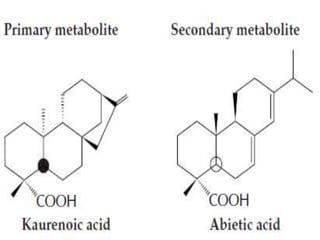
In the diterpene series, both kaurenoic acid and
abietic acid are formed by a very similar sequence of
related enzymatic reactions the former is an
essential intermediate in the synthesis of
gibberellins, i.e., growth hormones found in all
plants , whereas the latter is a resin component
largely restricted to members of the Fabaceae and
Pinaceae.
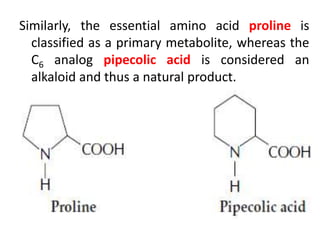
Similarly, the essential amino acid proline is
classified as a primary metabolite, whereas the
C6 analog pipecolic acid is considered an
alkaloid and thus a natural product.
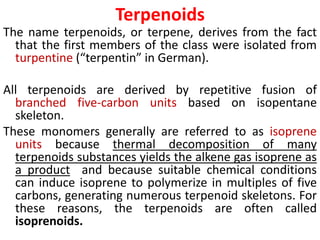
Terpenoids
The name terpenoids, or terpene, derives from the fact
that the first members of the class were isolated from
turpentine (“terpentin” in German).
All terpenoids are derived by repetitive fusion of
branched five-carbon units based on isopentane
skeleton.
These monomers generally are referred to as isoprene
units because thermal decomposition of many
terpenoids substances yields the alkene gas isoprene as
a product and because suitable chemical conditions
can induce isoprene to polymerize in multiples of five
carbons, generating numerous terpenoid skeletons. For
these reasons, the terpenoids are often called
isoprenoids.
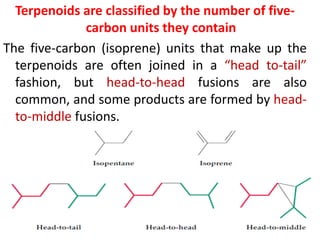
Terpenoids are classified by the number of five-
carbon units they contain
The five-carbon (isoprene) units that make up the
terpenoids are often joined in a “head to-tail”
fashion, but head-to-head fusions are also
common, and some products are formed by head-
to-middle fusions.
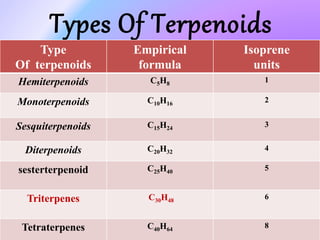
Types Of Terpenoids
Type
Of terpenoids
Empirical
formula
Isoprene
units
Hemiterpenoids C5H8
1
Monoterpenoids C10H16
2
Sesquiterpenoids C15H24
3
Diterpenoids C20H32
4
sesterterpenoid C25H40
5
Triterpenes C30H48
6
Tetraterpenes C40H64
8
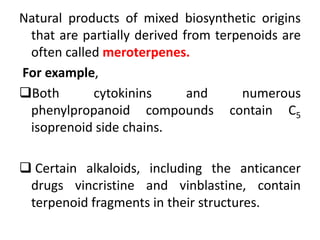
Natural products of mixed biosynthetic origins
that are partially derived from terpenoids are
often called meroterpenes.
For example,
Both cytokinins and numerous
phenylpropanoid compounds contain C5
isoprenoid side chains.
 Certain alkaloids, including the anticancer
drugs vincristine and vinblastine, contain
terpenoid fragments in their structures.
The biosynthesis of all terpenoids from simple,
primary metabolites can be divided into four
overall steps:
1- Synthesis of the fundamental precursor IPP.
2- Repetitive additions of IPP to form a series of
prenyl diphosphate homolog, which serve as the
immediate precursors of the different classes of
terpenoids.
3- Elaboration of these allylic prenyl
diphosphates by specific terpenoid synthases
to yield terpenoid skeletons.
4- Secondary enzymatic modifications to the
skeletons (largely redox reactions) to give rise
to the functional properties and great
chemical diversity of this family of natural
products.
Synthesis of IPP
Although terpenoid biosynthesis in plants, animals,
and microorganisms involves similar classes of
enzymes, important differences exist among
these processes.
In particular, plants produce a much wider variety
of terpenoids than do either animals or
microbes.
difference reflected in the complex organization of
plant terpenoid biosynthesis at the tissue,
cellular, sub cellular, and genetic levels.
The production of large quantities of terpenoid
natural products as well as their subsequent
accumulation, emission, or secretion is almost
always associated with the presence of
anatomically highly specialized structures.
The glandular trichomes and secretory cavities of
leaves and the glandular epiderms of flower
petals generate and store or emit terpenoid
essential oils that are important because they
encourage pollination by insects.
the organization of terpenoid metabolism exists
at the subcellular level.
The sesquiterpenes (C15), triterpenes (C30), and
polyterpenes appear to be produced in the
cytosolic and endoplasmic reticulum (ER)
compartments.
whereas isoprene, the monoterpenes (C10),
diterpenes (C20), tetraterpenes (C40), and
certain prenylated quinones originate largely, if
not exclusively, in the plastids.
the biosynthetic pathways for the formation of the
fundamental precursor IPP differ markedly in
these compartments, with the classical
acetate/mevalonate pathway being active in the
cytosol and ER and the glyceraldehyde
phosphate/pyruvate pathway operating in the
plastids.
Regulation of these dual pathways may be difficult
to assess, given that plastids may supply IPP to
the cytosol for use in biosynthesis, and vice
versa.
Hydroxymethylglutaryl-CoA reductase, an
enzyme in the acetate/mevalonate pathway, is
highly regulated.
The basic enzymology of IPP biosynthesis by way of
the acetate/mevalonate pathway is widely
accepted
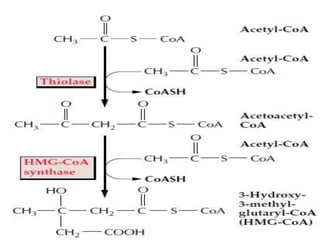
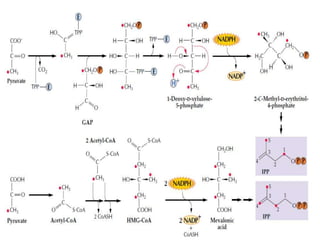
This cytosolic IPP pathway involves the two-step
condensation of three molecules of acetyl-CoA
catalyzed by thiolase and hydroxymethylglutaryl-
CoA synthase.
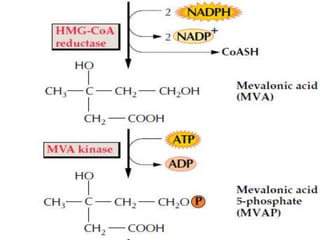
The resulting product, 3-hydroxy-3 methylglutaryl-
CoA (HMG-CoA), is subsequently reduced by
HMG-CoA reductase in two coupled reactions
that form mevalonic acid.
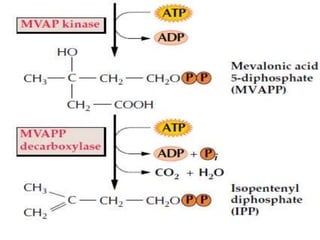
Two sequential ATP-dependent phosphorylations
of mevalonic acid and a subsequent
phosphorylation/elimination assisted
decarboxylation yield IPP.
In plastids, IPP is synthesized from pyruvate
and glyceraldehyde 3-phosphate.
The plastid-localized route to IPP involves a
different pathway, demonstrated in green algae
and many eubacteria as well as plants.
In this pathway, pyruvate reacts with thiamine
pyrophosphate (TPP) to yield a two-carbon
fragment, hydroxyethyl-TPP, which condenses
with glyceraldehyde 3- phosphate.
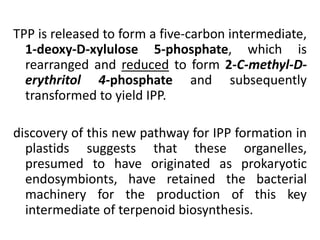
TPP is released to form a five-carbon intermediate,
1-deoxy-D-xylulose 5-phosphate, which is
rearranged and reduced to form 2-C-methyl-D-
erythritol 4-phosphate and subsequently
transformed to yield IPP.
discovery of this new pathway for IPP formation in
plastids suggests that these organelles,
presumed to have originated as prokaryotic
endosymbionts, have retained the bacterial
machinery for the production of this key
intermediate of terpenoid biosynthesis.
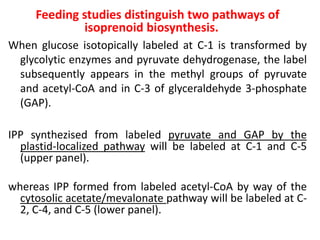
Feeding studies distinguish two pathways of
isoprenoid biosynthesis.
When glucose isotopically labeled at C-1 is transformed by
glycolytic enzymes and pyruvate dehydrogenase, the label
subsequently appears in the methyl groups of pyruvate
and acetyl-CoA and in C-3 of glyceraldehyde 3-phosphate
(GAP).
IPP synthezised from labeled pyruvate and GAP by the
plastid-localized pathway will be labeled at C-1 and C-5
(upper panel).
whereas IPP formed from labeled acetyl-CoA by way of the
cytosolic acetate/mevalonate pathway will be labeled at C-
2, C-4, and C-5 (lower panel).
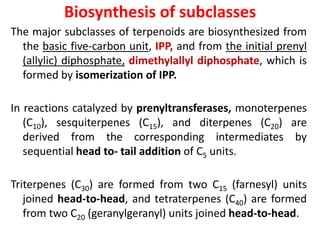
Biosynthesis of subclasses
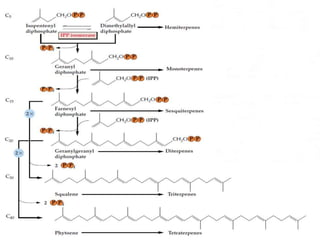
The major subclasses of terpenoids are biosynthesized from
the basic five-carbon unit, IPP, and from the initial prenyl
(allylic) diphosphate, dimethylallyl diphosphate, which is
formed by isomerization of IPP.
In reactions catalyzed by prenyltransferases, monoterpenes
(C10), sesquiterpenes (C15), and diterpenes (C20) are
derived from the corresponding intermediates by
sequential head to- tail addition of C5 units.
Triterpenes (C30) are formed from two C15 (farnesyl) units
joined head-to-head, and tetraterpenes (C40) are formed
from two C20 (geranylgeranyl) units joined head-to-head.
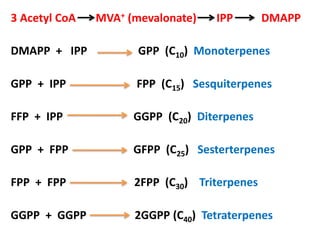
3 Acetyl CoA MVA+ (mevalonate) IPP DMAPP
DMAPP + IPP GPP (C10) Monoterpenes
GPP + IPP FPP (C15) Sesquiterpenes
FFP + IPP GGPP (C20) Diterpenes
GPP + FPP GFPP (C25) Sesterterpenes
FPP + FPP 2FPP (C30) Triterpenes
GGPP + GGPP 2GGPP (C40) Tetraterpenes
Prenyltransferase and terpene
synthase reactions
Prenyltransferase enzymes generate the allylic
diphosphate esters
Geranyl diphosphate (GPP),
Farnesyl diphosphate (FPP), and
Geranylgeranyl diphosphate (GGPP).
Reactions that these compounds undergo (often
cyclizations), which are catalyzed by terpene
synthases, yield a wide variety of terpenoid
compounds.
Repetitive addition of C5 units is carried
out by prenyltransferases.
Isomerization of IPP by IPP isomerase produces
the allylic isomer dimethylallyl diphosphate
(DMAPP), which is considered the first prenyl
diphosphate.
The reactive primer DMAPP undergoes
condensation with IPP to yield the C10
intermediate GPP.
Repetition of the reaction cycle by addition of one
or two molecules of IPP provides FPP (C15) or
GGPP (C20), respectively.
The electrophilic elongation reactions that yield
C10, C15, and C20 prenyl diphosphates are
catalyzed by enzymes known collectively as
prenyltransferases.
GPP, FPP, and GGPP are each formed by specific
prenyltransferases named for their products
(e.g., farnesyl diphosphate synthase).
Terpenoids Biosynthesis

Terpenoids Biosynthesis

  • 2.
    Plants produce avast and diverse organic compounds, which do not appear to participate directly in growth and development. These substances, traditionally referred to as secondary metabolites. The primary metabolites, in contrast, such as phytosterols, acyl lipids, nucleotides, amino acids, and organic acids, are found in all plants and perform metabolic roles that are essential and usually evident.
  • 3.
    Based on theirbiosynthetic origins, plant natural products can be divided into three major groups: - The terpenoids, The alkaloids, and The phenylpropanoids and allied Phenolic compounds. All terpenoids, including both primary metabolites and more than 25,000 secondary compounds, are derived from the five-carbon precursor isopentenyl diphosphate (IPP).
  • 4.
    The alkaloids, whichcontain one or more nitrogen atoms, are biosynthesized principally from amino acids. The Phenolic compounds are formed by way of either the shikimic acid pathway or the malonate/acetate pathway.
  • 5.
    Primary and secondarymetabolites cannot readily be distinguished on the basis of precursor molecules, chemical structures, or biosynthetic origins. For example; both primary and secondary metabolites are found among the diterpenes (C20) and triterpenes (C30). In the diterpene series, both kaurenoic acid and abietic acid are formed by a very similar sequence of related enzymatic reactions the former is an essential intermediate in the synthesis of gibberellins, i.e., growth hormones found in all plants , whereas the latter is a resin component largely restricted to members of the Fabaceae and Pinaceae.
  • 7.
    Similarly, the essentialamino acid proline is classified as a primary metabolite, whereas the C6 analog pipecolic acid is considered an alkaloid and thus a natural product.
  • 8.
    Terpenoids The name terpenoids,or terpene, derives from the fact that the first members of the class were isolated from turpentine (“terpentin” in German). All terpenoids are derived by repetitive fusion of branched five-carbon units based on isopentane skeleton. These monomers generally are referred to as isoprene units because thermal decomposition of many terpenoids substances yields the alkene gas isoprene as a product and because suitable chemical conditions can induce isoprene to polymerize in multiples of five carbons, generating numerous terpenoid skeletons. For these reasons, the terpenoids are often called isoprenoids.
  • 9.
    Terpenoids are classifiedby the number of five- carbon units they contain The five-carbon (isoprene) units that make up the terpenoids are often joined in a “head to-tail” fashion, but head-to-head fusions are also common, and some products are formed by head- to-middle fusions.
  • 10.
    Types Of Terpenoids Type Ofterpenoids Empirical formula Isoprene units Hemiterpenoids C5H8 1 Monoterpenoids C10H16 2 Sesquiterpenoids C15H24 3 Diterpenoids C20H32 4 sesterterpenoid C25H40 5 Triterpenes C30H48 6 Tetraterpenes C40H64 8
  • 11.
    Natural products ofmixed biosynthetic origins that are partially derived from terpenoids are often called meroterpenes. For example, Both cytokinins and numerous phenylpropanoid compounds contain C5 isoprenoid side chains.  Certain alkaloids, including the anticancer drugs vincristine and vinblastine, contain terpenoid fragments in their structures.
  • 12.
    The biosynthesis ofall terpenoids from simple, primary metabolites can be divided into four overall steps: 1- Synthesis of the fundamental precursor IPP. 2- Repetitive additions of IPP to form a series of prenyl diphosphate homolog, which serve as the immediate precursors of the different classes of terpenoids.
  • 13.
    3- Elaboration ofthese allylic prenyl diphosphates by specific terpenoid synthases to yield terpenoid skeletons. 4- Secondary enzymatic modifications to the skeletons (largely redox reactions) to give rise to the functional properties and great chemical diversity of this family of natural products.
  • 14.
    Synthesis of IPP Althoughterpenoid biosynthesis in plants, animals, and microorganisms involves similar classes of enzymes, important differences exist among these processes. In particular, plants produce a much wider variety of terpenoids than do either animals or microbes. difference reflected in the complex organization of plant terpenoid biosynthesis at the tissue, cellular, sub cellular, and genetic levels.
  • 15.
    The production oflarge quantities of terpenoid natural products as well as their subsequent accumulation, emission, or secretion is almost always associated with the presence of anatomically highly specialized structures. The glandular trichomes and secretory cavities of leaves and the glandular epiderms of flower petals generate and store or emit terpenoid essential oils that are important because they encourage pollination by insects.
  • 16.
    the organization ofterpenoid metabolism exists at the subcellular level. The sesquiterpenes (C15), triterpenes (C30), and polyterpenes appear to be produced in the cytosolic and endoplasmic reticulum (ER) compartments. whereas isoprene, the monoterpenes (C10), diterpenes (C20), tetraterpenes (C40), and certain prenylated quinones originate largely, if not exclusively, in the plastids.
  • 17.
    the biosynthetic pathwaysfor the formation of the fundamental precursor IPP differ markedly in these compartments, with the classical acetate/mevalonate pathway being active in the cytosol and ER and the glyceraldehyde phosphate/pyruvate pathway operating in the plastids. Regulation of these dual pathways may be difficult to assess, given that plastids may supply IPP to the cytosol for use in biosynthesis, and vice versa.
  • 18.
    Hydroxymethylglutaryl-CoA reductase, an enzymein the acetate/mevalonate pathway, is highly regulated. The basic enzymology of IPP biosynthesis by way of the acetate/mevalonate pathway is widely accepted This cytosolic IPP pathway involves the two-step condensation of three molecules of acetyl-CoA catalyzed by thiolase and hydroxymethylglutaryl- CoA synthase.
  • 19.
    The resulting product,3-hydroxy-3 methylglutaryl- CoA (HMG-CoA), is subsequently reduced by HMG-CoA reductase in two coupled reactions that form mevalonic acid. Two sequential ATP-dependent phosphorylations of mevalonic acid and a subsequent phosphorylation/elimination assisted decarboxylation yield IPP.
  • 23.
    In plastids, IPPis synthesized from pyruvate and glyceraldehyde 3-phosphate. The plastid-localized route to IPP involves a different pathway, demonstrated in green algae and many eubacteria as well as plants. In this pathway, pyruvate reacts with thiamine pyrophosphate (TPP) to yield a two-carbon fragment, hydroxyethyl-TPP, which condenses with glyceraldehyde 3- phosphate.
  • 24.
    TPP is releasedto form a five-carbon intermediate, 1-deoxy-D-xylulose 5-phosphate, which is rearranged and reduced to form 2-C-methyl-D- erythritol 4-phosphate and subsequently transformed to yield IPP. discovery of this new pathway for IPP formation in plastids suggests that these organelles, presumed to have originated as prokaryotic endosymbionts, have retained the bacterial machinery for the production of this key intermediate of terpenoid biosynthesis.
  • 26.
    Feeding studies distinguishtwo pathways of isoprenoid biosynthesis. When glucose isotopically labeled at C-1 is transformed by glycolytic enzymes and pyruvate dehydrogenase, the label subsequently appears in the methyl groups of pyruvate and acetyl-CoA and in C-3 of glyceraldehyde 3-phosphate (GAP). IPP synthezised from labeled pyruvate and GAP by the plastid-localized pathway will be labeled at C-1 and C-5 (upper panel). whereas IPP formed from labeled acetyl-CoA by way of the cytosolic acetate/mevalonate pathway will be labeled at C- 2, C-4, and C-5 (lower panel).
  • 27.
    Biosynthesis of subclasses Themajor subclasses of terpenoids are biosynthesized from the basic five-carbon unit, IPP, and from the initial prenyl (allylic) diphosphate, dimethylallyl diphosphate, which is formed by isomerization of IPP. In reactions catalyzed by prenyltransferases, monoterpenes (C10), sesquiterpenes (C15), and diterpenes (C20) are derived from the corresponding intermediates by sequential head to- tail addition of C5 units. Triterpenes (C30) are formed from two C15 (farnesyl) units joined head-to-head, and tetraterpenes (C40) are formed from two C20 (geranylgeranyl) units joined head-to-head.
  • 28.
    3 Acetyl CoAMVA+ (mevalonate) IPP DMAPP DMAPP + IPP GPP (C10) Monoterpenes GPP + IPP FPP (C15) Sesquiterpenes FFP + IPP GGPP (C20) Diterpenes GPP + FPP GFPP (C25) Sesterterpenes FPP + FPP 2FPP (C30) Triterpenes GGPP + GGPP 2GGPP (C40) Tetraterpenes
  • 29.
    Prenyltransferase and terpene synthasereactions Prenyltransferase enzymes generate the allylic diphosphate esters Geranyl diphosphate (GPP), Farnesyl diphosphate (FPP), and Geranylgeranyl diphosphate (GGPP). Reactions that these compounds undergo (often cyclizations), which are catalyzed by terpene synthases, yield a wide variety of terpenoid compounds.
  • 30.
    Repetitive addition ofC5 units is carried out by prenyltransferases. Isomerization of IPP by IPP isomerase produces the allylic isomer dimethylallyl diphosphate (DMAPP), which is considered the first prenyl diphosphate. The reactive primer DMAPP undergoes condensation with IPP to yield the C10 intermediate GPP.
  • 31.
    Repetition of thereaction cycle by addition of one or two molecules of IPP provides FPP (C15) or GGPP (C20), respectively. The electrophilic elongation reactions that yield C10, C15, and C20 prenyl diphosphates are catalyzed by enzymes known collectively as prenyltransferases. GPP, FPP, and GGPP are each formed by specific prenyltransferases named for their products (e.g., farnesyl diphosphate synthase).