MEVALONATE PATHWAY
RAMANDEEP KAUR BRAR
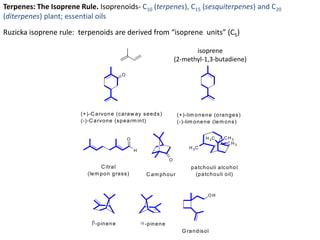
Terpenes: The Isoprene Rule. Isoprenoids- C10 (terpenes), C15 (sesquiterpenes) and C20
(diterpenes) plant; essential oils
Ruzicka isoprene rule: terpenoids are derived from “isoprene units” (C5)
O
O
C am phour
(+)-Carvone (caraw ay seeds)
(-)-Carvone (spearm int)
(+)-lim onene (oranges)
(-)-lim onene (lem ons)
-pinene -pinene
O H
G randisol
CH3H3C
H3C
CH3
patchouli alcohol
(patchouli oil)
H
O
Citral
(lem pon grass)
isoprene
(2-methyl-1,3-butadiene)
3
The precursor to C10 terpenoids (monoterpenes) is geraniol diphosphate, which consists of
two C5 “isoprene units” that are joined “head-to-tail”
OPP
head - tail head - tail
head tail P
O
O
O P O
O
O
PP =
C15 sesquiterpenoids are derived from farnesyl diphosphate, which consists of three
C5 “isoprene units” that are joined “head-to-tail”
OPP
C20 diterpenoids are derived from geranylgeranyl diphosphate, which consists of four C5
“isoprene units” that are joined “head-to-tail”
OPP
4
C25 sesterpenoids are derived from geranylfarnesyl diphosphate, which consists of five
C5 “isoprene units” that are joined “head-to-tail”
C30 triterpenoids and steroids are derived from squalene, which consists of two C15
farnesyl units” that are joined “tail-to-tail”
C40 tetraterpenoids are derived from phytocene, which consists of two C20 geranylgeranyl
units” that are joined “tail-to-tail”
OPP
Despite great diversity in form and function, the terpenoids are
unified in their common biosynthetic origin. The biosynthesis of
all terpenoids from simple, primary metabolites can be divided
into four overall steps:
(a) Synthesis of the fundamental precursor IPP;
(b) Repetitive additions of IPP to form a series of prenyl
diphosphate homologs, which serve as the immediate
precursors of the different classes of terpenoids;
(c) Elaboration of these allylic prenyl diphosphates by specific
terpenoid synthases to yield terpenoid skeletons; and
(d) Secondary enzymatic modifications to the skeletons (largely
redox reactions) to give rise to the functional properties and
great chemical diversity of this family of natural products.
6
O O H
O
O
H
O
O
O
O H
C6H5
NHC6H5
O
O
O
HO
O OH
O
O
H
O
O
O
OH
C6H5
NHC6H5
O
O
O
HO
CH3
CH3
CH3
H3C
H
cedrane
Taxol
CH3
CH3
CH3
H3C
H
HO
Lanosterol
-carotene
7
Isopentyl Diphosphate: The Biological Isoprene Unit.
Mevalonic acid is the biosynthetic precursor to the actual C5 “isoprene units,” which are
isopentyl diphosphate (IPP, tail) and dimethylallyl diphosphate (DMAPP, head)
The Pathway from Acetate to Isopentenyl Diphosphate.
Mevalonate Pathway
H2C SCoA
C
O
SCoA
OO
SCoA
HO 2C
O HH3C O
3-Hydroxy-3-m ethylglutaric acid
(HM G-CoA)
HM G-CoA
reductase
2 NADPH O H
HO 2C
OHH3C
M evalonic acid
C
O
H2C SCoA
H
B:
acetyl CoA
B H
aldol
condensation
HM G-CoA
synthase
acetoacetyl CoA
C
O
H2C SCoA
H
B:
H2C SCoA
C
O
acetyl CoA
SCoA
OO
Claisen
condensation
acetoacetyl CoA
C
O
H3C S-Cys-Enzym e
acetyl CoA
acetoacetyl-CoA
acetyltransferase
C
O
H3C SCoA
Enzym e-Cys-SH
8
Conversion of mevalonic acid to IPP and DMAPP
OH
HO2C
O HH3C
M evalonic acid
ATP AM P
O
OHH3C
P O
O -
O
P O -
O
O -
O
O
H
rearrangm ent
O P O
O -
O
P O -
O
O -
H
dim ethylallyl-PP
(DM APP)
isopentenyl-PP
(IPP)
B:
H+
ATP ADP
O
O PO 3
2-H3C
P O
O -
O
P O -
O
O -
O
O
H
O P O
O -
O
P O -
O
O -H H
B:
O
CH3
P O
O -
O
P O -
O
O -
O
O
H
- PO 4
3-
Carbon-Carbon Bond Formation in Terpene Biosynthesis.
Conversion of IPP and DMAPP to geraniol-PP and farnesyl-PP
electrophilic
head group
nucleophilic
tail group
electrophilic
head group
nucleophilic
tail group
O PP
OPP
H H
O PP
OPP B:
DM APP IPP
- OPP
M g2+
OPP
O PP
H H
B:
OPP
farnesyl pyrophosphate (C15)
geranyl pyrophosphate (C10)
- OPP
M g2+
9
O PP PPO
squalene
synthase
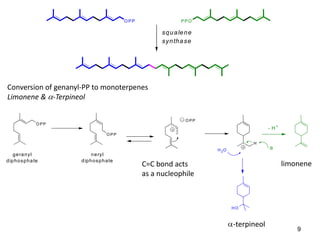
Conversion of genanyl-PP to monoterpenes
Limonene & -Terpineol
O PP
OPP
geranyl
diphosphate
neryl
diphosphate
O PP
- H+
H
:B
HO
H2O
C=C bond acts
as a nucleophile
-terpineol
limonene
10
Steroids
Cholesterol biosynthesis part a: the cyclization
O
H A
HO H O
S q u ale n e O xid e (C30H 50O )S q u ale n e (C30H 50)
+
Squa lene
ep o xid a se
+
Squa lene
cy cla se
HO
+
H O
+
HO +
H em e , O 2
Pro to ste ro l catio n
HO
+
H O
+
A B
C D1
2
3
4
5
6
7
8
9
10
11
12
13
14
15
16
17
HO Ch o le stero l (C27H 46O )
H H
H
H
H
11
P rotosterol ca tio n (C 30H 50O )
CH3
H3C
H O
CH 3
CH3
CH3
H
H
H
+
CH3
H3C
H O
CH 3
CH3
CH3
H
H
H
H
+ H
1,2-h y d rid e
sh ift
1,2-h y d rid e
sh ift
CH3
H3C
H O
CH 3
CH3
CH3
H
H
H+
H
1,2-m eth y l
sh ift
CH3
H3C
HO
CH3
CH3
H
H H3C
H
H
+
CH3
H3C
HO
CH3
H
H H3C
H
H
H3C
+
- H +
B:
1,2-m eth y l
sh ift
CH3
H3C
H O
CH 3
H
CH 3
CH3
H
Lan o ste ro l (C30H 50O )
Cholesterol biosynthesis, part b: the 1,2-shifts
HO HO
Ch o le ste ro l (C27H 46O )
Lan o ste ro l (C30H 50O )
H H
H
H
H
H
H
H
12
Vitamin D
HO
7-D eh y d ro ch o le stero l
H H
H
H
HO
H
H
H
V itam in D 3
sunlight
Bile Acids
Corticosteroids
O
O
OH
H H
OH
H
O
C ortisone
13
Sex hormones
androgens (male)
estrogens (female)
H3C
HO
H
O
H
H
Estrone
H3C
HO
H
OH
H
H
Estradiol
H3C
HO
HH
H
O
Progesterone
H3C
HO
H
O H
H
H
C CH
Ethynylestradiol
H3C
H3C
O
H
OH
H
H
Testosterone
H3C
H3C
HO
H
O
H
H
Androsterone
H3C
H3C
O
H
O
H
H
Androstenedione
H3C
H3C
O
H
OH
H
H
CH3
dianabol
H
Carotenoids derived from phytocene (C40)
Lycopene
-carotene

Mevalonate pathway

  • 1.
  • 2.
    Terpenes: The IsopreneRule. Isoprenoids- C10 (terpenes), C15 (sesquiterpenes) and C20 (diterpenes) plant; essential oils Ruzicka isoprene rule: terpenoids are derived from “isoprene units” (C5) O O C am phour (+)-Carvone (caraw ay seeds) (-)-Carvone (spearm int) (+)-lim onene (oranges) (-)-lim onene (lem ons) -pinene -pinene O H G randisol CH3H3C H3C CH3 patchouli alcohol (patchouli oil) H O Citral (lem pon grass) isoprene (2-methyl-1,3-butadiene)
  • 3.
    3 The precursor toC10 terpenoids (monoterpenes) is geraniol diphosphate, which consists of two C5 “isoprene units” that are joined “head-to-tail” OPP head - tail head - tail head tail P O O O P O O O PP = C15 sesquiterpenoids are derived from farnesyl diphosphate, which consists of three C5 “isoprene units” that are joined “head-to-tail” OPP C20 diterpenoids are derived from geranylgeranyl diphosphate, which consists of four C5 “isoprene units” that are joined “head-to-tail” OPP
  • 4.
    4 C25 sesterpenoids arederived from geranylfarnesyl diphosphate, which consists of five C5 “isoprene units” that are joined “head-to-tail” C30 triterpenoids and steroids are derived from squalene, which consists of two C15 farnesyl units” that are joined “tail-to-tail” C40 tetraterpenoids are derived from phytocene, which consists of two C20 geranylgeranyl units” that are joined “tail-to-tail” OPP
  • 5.
    Despite great diversityin form and function, the terpenoids are unified in their common biosynthetic origin. The biosynthesis of all terpenoids from simple, primary metabolites can be divided into four overall steps: (a) Synthesis of the fundamental precursor IPP; (b) Repetitive additions of IPP to form a series of prenyl diphosphate homologs, which serve as the immediate precursors of the different classes of terpenoids; (c) Elaboration of these allylic prenyl diphosphates by specific terpenoid synthases to yield terpenoid skeletons; and (d) Secondary enzymatic modifications to the skeletons (largely redox reactions) to give rise to the functional properties and great chemical diversity of this family of natural products.
  • 6.
    6 O O H O O H O O O OH C6H5 NHC6H5 O O O HO O OH O O H O O O OH C6H5 NHC6H5 O O O HO CH3 CH3 CH3 H3C H cedrane Taxol CH3 CH3 CH3 H3C H HO Lanosterol -carotene
  • 7.
    7 Isopentyl Diphosphate: TheBiological Isoprene Unit. Mevalonic acid is the biosynthetic precursor to the actual C5 “isoprene units,” which are isopentyl diphosphate (IPP, tail) and dimethylallyl diphosphate (DMAPP, head) The Pathway from Acetate to Isopentenyl Diphosphate. Mevalonate Pathway H2C SCoA C O SCoA OO SCoA HO 2C O HH3C O 3-Hydroxy-3-m ethylglutaric acid (HM G-CoA) HM G-CoA reductase 2 NADPH O H HO 2C OHH3C M evalonic acid C O H2C SCoA H B: acetyl CoA B H aldol condensation HM G-CoA synthase acetoacetyl CoA C O H2C SCoA H B: H2C SCoA C O acetyl CoA SCoA OO Claisen condensation acetoacetyl CoA C O H3C S-Cys-Enzym e acetyl CoA acetoacetyl-CoA acetyltransferase C O H3C SCoA Enzym e-Cys-SH
  • 8.
    8 Conversion of mevalonicacid to IPP and DMAPP OH HO2C O HH3C M evalonic acid ATP AM P O OHH3C P O O - O P O - O O - O O H rearrangm ent O P O O - O P O - O O - H dim ethylallyl-PP (DM APP) isopentenyl-PP (IPP) B: H+ ATP ADP O O PO 3 2-H3C P O O - O P O - O O - O O H O P O O - O P O - O O -H H B: O CH3 P O O - O P O - O O - O O H - PO 4 3- Carbon-Carbon Bond Formation in Terpene Biosynthesis. Conversion of IPP and DMAPP to geraniol-PP and farnesyl-PP electrophilic head group nucleophilic tail group electrophilic head group nucleophilic tail group O PP OPP H H O PP OPP B: DM APP IPP - OPP M g2+ OPP O PP H H B: OPP farnesyl pyrophosphate (C15) geranyl pyrophosphate (C10) - OPP M g2+
  • 9.
    9 O PP PPO squalene synthase Conversionof genanyl-PP to monoterpenes Limonene & -Terpineol O PP OPP geranyl diphosphate neryl diphosphate O PP - H+ H :B HO H2O C=C bond acts as a nucleophile -terpineol limonene
  • 10.
    10 Steroids Cholesterol biosynthesis parta: the cyclization O H A HO H O S q u ale n e O xid e (C30H 50O )S q u ale n e (C30H 50) + Squa lene ep o xid a se + Squa lene cy cla se HO + H O + HO + H em e , O 2 Pro to ste ro l catio n HO + H O + A B C D1 2 3 4 5 6 7 8 9 10 11 12 13 14 15 16 17 HO Ch o le stero l (C27H 46O ) H H H H H
  • 11.
    11 P rotosterol catio n (C 30H 50O ) CH3 H3C H O CH 3 CH3 CH3 H H H + CH3 H3C H O CH 3 CH3 CH3 H H H H + H 1,2-h y d rid e sh ift 1,2-h y d rid e sh ift CH3 H3C H O CH 3 CH3 CH3 H H H+ H 1,2-m eth y l sh ift CH3 H3C HO CH3 CH3 H H H3C H H + CH3 H3C HO CH3 H H H3C H H H3C + - H + B: 1,2-m eth y l sh ift CH3 H3C H O CH 3 H CH 3 CH3 H Lan o ste ro l (C30H 50O ) Cholesterol biosynthesis, part b: the 1,2-shifts HO HO Ch o le ste ro l (C27H 46O ) Lan o ste ro l (C30H 50O ) H H H H H H H H
  • 12.
    12 Vitamin D HO 7-D ehy d ro ch o le stero l H H H H HO H H H V itam in D 3 sunlight Bile Acids Corticosteroids O O OH H H OH H O C ortisone
  • 13.
    13 Sex hormones androgens (male) estrogens(female) H3C HO H O H H Estrone H3C HO H OH H H Estradiol H3C HO HH H O Progesterone H3C HO H O H H H C CH Ethynylestradiol H3C H3C O H OH H H Testosterone H3C H3C HO H O H H Androsterone H3C H3C O H O H H Androstenedione H3C H3C O H OH H H CH3 dianabol H Carotenoids derived from phytocene (C40) Lycopene -carotene