Sanskar College of Pharmacy & Research
Anuradha Singh
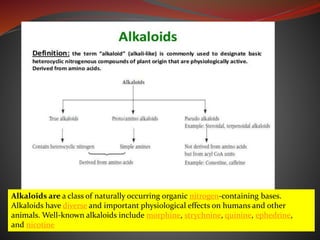
Alkaloids are a class of naturally occurring organic nitrogen-containing bases.
Alkaloids have diverse and important physiological effects on humans and other
animals. Well-known alkaloids include morphine, strychnine, quinine, ephedrine,
and nicotine
Alkaoidal plants Chemical
Category
Chemical
constituents
Uses
Vinca
(Catharanthus roseus)
Indole Vincristine,Vinblastine Anticancer
Rauwolfia
(Rauwofia serpentina )
Indole Reserpine Antihypertensive
Belladonna
( Atropa belladona )
Tropane Atropine parasympatholytic
Opium
(Papaver somniferum )
Isoquinoline Morphine,papaverine Narcotic Analgesic
Chemical Classification of alkaloids
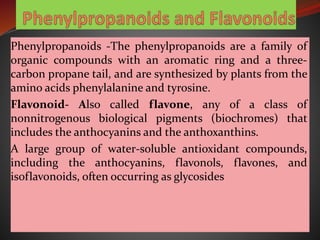
Phenylpropanoids -The phenylpropanoids are a family of
organic compounds with an aromatic ring and a three-
carbon propane tail, and are synthesized by plants from the
amino acids phenylalanine and tyrosine.
Flavonoid- Also called flavone, any of a class of
nonnitrogenous biological pigments (biochromes) that
includes the anthocyanins and the anthoxanthins.
A large group of water-soluble antioxidant compounds,
including the anthocyanins, flavonols, flavones, and
isoflavonoids, often occurring as glycosides
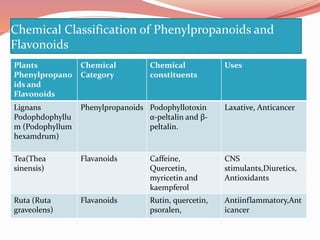
Chemical Classification of Phenylpropanoids and
Flavonoids
Plants
Phenylpropano
ids and
Flavonoids
Chemical
Category
Chemical
constituents
Uses
Lignans
Podophdophyllu
m (Podophyllum
hexamdrum)
Phenylpropanoids Podophyllotoxin
α-peltalin and β-
peltalin.
Laxative, Anticancer
Tea(Thea
sinensis)
Flavanoids Caffeine,
Quercetin,
myricetin and
kaempferol
CNS
stimulants,Diuretics,
Antioxidants
Ruta (Ruta
graveolens)
Flavanoids Rutin, quercetin,
psoralen,
Antiinflammatory,Ant
icancer
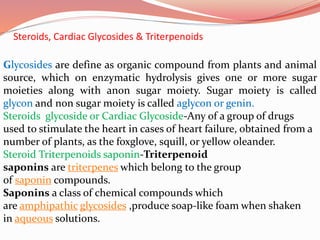
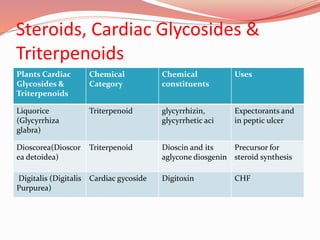
Steroids, Cardiac Glycosides & Triterpenoids
Glycosides are define as organic compound from plants and animal
source, which on enzymatic hydrolysis gives one or more sugar
moieties along with anon sugar moiety. Sugar moiety is called
glycon and non sugar moiety is called aglycon or genin.
Steroids glycoside or Cardiac Glycoside-Any of a group of drugs
used to stimulate the heart in cases of heart failure, obtained from a
number of plants, as the foxglove, squill, or yellow oleander.
Steroid Triterpenoids saponin-Triterpenoid
saponins are triterpenes which belong to the group
of saponin compounds.
Saponins a class of chemical compounds which
are amphipathic glycosides ,produce soap-like foam when shaken
in aqueous solutions.
Steroids, Cardiac Glycosides &
Triterpenoids
Plants Cardiac
Glycosides &
Triterpenoids
Chemical
Category
Chemical
constituents
Uses
Liquorice
(Glycyrrhiza
glabra)
Triterpenoid glycyrrhizin,
glycyrrhetic aci
Expectorants and
in peptic ulcer
Dioscorea(Dioscor
ea detoidea)
Triterpenoid Dioscin and its
aglycone diosgenin
Precursor for
steroid synthesis
Digitalis (Digitalis
Purpurea)
Cardiac gycoside Digitoxin CHF
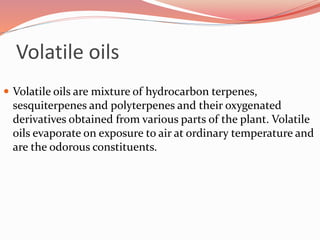
Volatile oils
 Volatile oils are mixture of hydrocarbon terpenes,
sesquiterpenes and polyterpenes and their oxygenated
derivatives obtained from various parts of the plant. Volatile
oils evaporate on exposure to air at ordinary temperature and
are the odorous constituents.
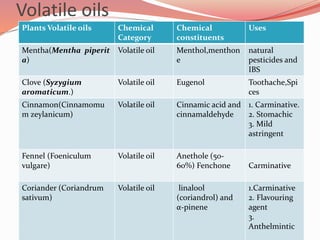
Volatile oils
Plants Volatile oils Chemical
Category
Chemical
constituents
Uses
Mentha(Mentha piperit
a)
Volatile oil Menthol,menthon
e
natural
pesticides and
IBS
Clove (Syzygium
aromaticum.)
Volatile oil Eugenol Toothache,Spi
ces
Cinnamon(Cinnamomu
m zeylanicum)
Volatile oil Cinnamic acid and
cinnamaldehyde
1. Carminative.
2. Stomachic
3. Mild
astringent
Fennel (Foeniculum
vulgare)
Volatile oil Anethole (50-
60%) Fenchone Carminative
Coriander (Coriandrum
sativum)
Volatile oil linalool
(coriandrol) and
α-pinene
1.Carminative
2. Flavouring
agent
3.
Anthelmintic
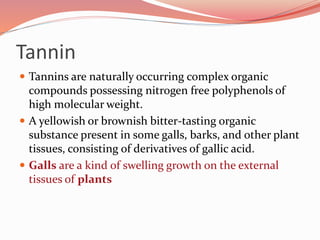
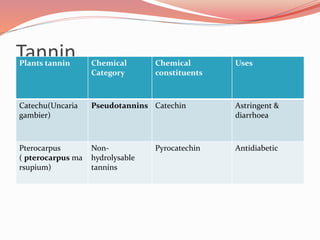
Tannin
 Tannins are naturally occurring complex organic
compounds possessing nitrogen free polyphenols of
high molecular weight.
 A yellowish or brownish bitter-tasting organic
substance present in some galls, barks, and other plant
tissues, consisting of derivatives of gallic acid.
 Galls are a kind of swelling growth on the external
tissues of plants
TanninPlants tannin Chemical
Category
Chemical
constituents
Uses
Catechu(Uncaria
gambier)
Pseudotannins Catechin Astringent &
diarrhoea
Pterocarpus
( pterocarpus ma
rsupium)
Non-
hydrolysable
tannins
Pyrocatechin Antidiabetic
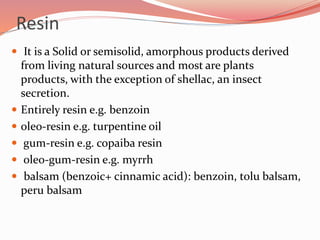
Resin
 It is a Solid or semisolid, amorphous products derived
from living natural sources and most are plants
products, with the exception of shellac, an insect
secretion.
 Entirely resin e.g. benzoin
 oleo-resin e.g. turpentine oil
 gum-resin e.g. copaiba resin
 oleo-gum-resin e.g. myrrh
 balsam (benzoic+ cinnamic acid): benzoin, tolu balsam,
peru balsam
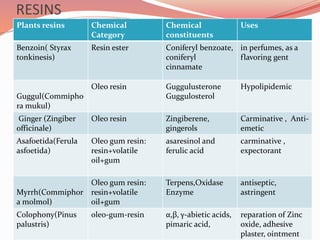
RESINS
Plants resins Chemical
Category
Chemical
constituents
Uses
Benzoin( Styrax
tonkinesis)
Resin ester Coniferyl benzoate,
coniferyl
cinnamate
in perfumes, as a
flavoring gent
Guggul(Commipho
ra mukul)
Oleo resin Guggulusterone
Guggulosterol
Hypolipidemic
Ginger (Zingiber
officinale)
Oleo resin Zingiberene,
gingerols
Carminative , Anti-
emetic
Asafoetida(Ferula
asfoetida)
Oleo gum resin:
resin+volatile
oil+gum
asaresinol and
ferulic acid
carminative ,
expectorant
Myrrh(Commiphor
a molmol)
Oleo gum resin:
resin+volatile
oil+gum
Terpens,Oxidase
Enzyme
antiseptic,
astringent
Colophony(Pinus
palustris)
oleo-gum-resin α,β, γ-abietic acids,
pimaric acid,
reparation of Zinc
oxide, adhesive
plaster, ointment
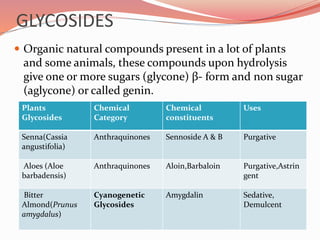
GLYCOSIDES
 Organic natural compounds present in a lot of plants
and some animals, these compounds upon hydrolysis
give one or more sugars (glycone) β- form and non sugar
(aglycone) or called genin.
Plants
Glycosides
Chemical
Category
Chemical
constituents
Uses
Senna(Cassia
angustifolia)
Anthraquinones Sennoside A & B Purgative
Aloes (Aloe
barbadensis)
Anthraquinones Aloin,Barbaloin Purgative,Astrin
gent
Bitter
Almond(Prunus
amygdalus)
Cyanogenetic
Glycosides
Amygdalin Sedative,
Demulcent
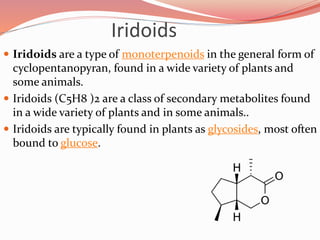
Iridoids
 Iridoids are a type of monoterpenoids in the general form of
cyclopentanopyran, found in a wide variety of plants and
some animals.
 Iridoids (С5Н8 )2 are a class of secondary metabolites found
in a wide variety of plants and in some animals..
 Iridoids are typically found in plants as glycosides, most often
bound to glucose.
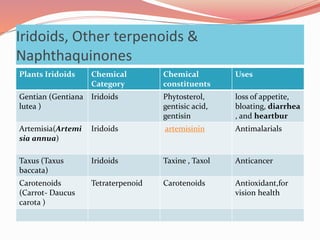
Iridoids, Other terpenoids &
Naphthaquinones
Plants Iridoids Chemical
Category
Chemical
constituents
Uses
Gentian (Gentiana
lutea )
Iridoids Phytosterol,
gentisic acid,
gentisin
loss of appetite,
bloating, diarrhea
, and heartbur
Artemisia(Artemi
sia annua)
Iridoids artemisinin Antimalarials
Taxus (Taxus
baccata)
Iridoids Taxine , Taxol Anticancer
Carotenoids
(Carrot- Daucus
carota )
Tetraterpenoid Carotenoids Antioxidant,for
vision health

Unit 2 504 i

  • 1.
    Sanskar College ofPharmacy & Research Anuradha Singh
  • 2.
    Alkaloids are aclass of naturally occurring organic nitrogen-containing bases. Alkaloids have diverse and important physiological effects on humans and other animals. Well-known alkaloids include morphine, strychnine, quinine, ephedrine, and nicotine
  • 6.
    Alkaoidal plants Chemical Category Chemical constituents Uses Vinca (Catharanthusroseus) Indole Vincristine,Vinblastine Anticancer Rauwolfia (Rauwofia serpentina ) Indole Reserpine Antihypertensive Belladonna ( Atropa belladona ) Tropane Atropine parasympatholytic Opium (Papaver somniferum ) Isoquinoline Morphine,papaverine Narcotic Analgesic Chemical Classification of alkaloids
  • 7.
    Phenylpropanoids -The phenylpropanoidsare a family of organic compounds with an aromatic ring and a three- carbon propane tail, and are synthesized by plants from the amino acids phenylalanine and tyrosine. Flavonoid- Also called flavone, any of a class of nonnitrogenous biological pigments (biochromes) that includes the anthocyanins and the anthoxanthins. A large group of water-soluble antioxidant compounds, including the anthocyanins, flavonols, flavones, and isoflavonoids, often occurring as glycosides
  • 8.
    Chemical Classification ofPhenylpropanoids and Flavonoids Plants Phenylpropano ids and Flavonoids Chemical Category Chemical constituents Uses Lignans Podophdophyllu m (Podophyllum hexamdrum) Phenylpropanoids Podophyllotoxin α-peltalin and β- peltalin. Laxative, Anticancer Tea(Thea sinensis) Flavanoids Caffeine, Quercetin, myricetin and kaempferol CNS stimulants,Diuretics, Antioxidants Ruta (Ruta graveolens) Flavanoids Rutin, quercetin, psoralen, Antiinflammatory,Ant icancer
  • 9.
    Steroids, Cardiac Glycosides& Triterpenoids Glycosides are define as organic compound from plants and animal source, which on enzymatic hydrolysis gives one or more sugar moieties along with anon sugar moiety. Sugar moiety is called glycon and non sugar moiety is called aglycon or genin. Steroids glycoside or Cardiac Glycoside-Any of a group of drugs used to stimulate the heart in cases of heart failure, obtained from a number of plants, as the foxglove, squill, or yellow oleander. Steroid Triterpenoids saponin-Triterpenoid saponins are triterpenes which belong to the group of saponin compounds. Saponins a class of chemical compounds which are amphipathic glycosides ,produce soap-like foam when shaken in aqueous solutions.
  • 10.
    Steroids, Cardiac Glycosides& Triterpenoids Plants Cardiac Glycosides & Triterpenoids Chemical Category Chemical constituents Uses Liquorice (Glycyrrhiza glabra) Triterpenoid glycyrrhizin, glycyrrhetic aci Expectorants and in peptic ulcer Dioscorea(Dioscor ea detoidea) Triterpenoid Dioscin and its aglycone diosgenin Precursor for steroid synthesis Digitalis (Digitalis Purpurea) Cardiac gycoside Digitoxin CHF
  • 11.
    Volatile oils  Volatileoils are mixture of hydrocarbon terpenes, sesquiterpenes and polyterpenes and their oxygenated derivatives obtained from various parts of the plant. Volatile oils evaporate on exposure to air at ordinary temperature and are the odorous constituents.
  • 12.
    Volatile oils Plants Volatileoils Chemical Category Chemical constituents Uses Mentha(Mentha piperit a) Volatile oil Menthol,menthon e natural pesticides and IBS Clove (Syzygium aromaticum.) Volatile oil Eugenol Toothache,Spi ces Cinnamon(Cinnamomu m zeylanicum) Volatile oil Cinnamic acid and cinnamaldehyde 1. Carminative. 2. Stomachic 3. Mild astringent Fennel (Foeniculum vulgare) Volatile oil Anethole (50- 60%) Fenchone Carminative Coriander (Coriandrum sativum) Volatile oil linalool (coriandrol) and α-pinene 1.Carminative 2. Flavouring agent 3. Anthelmintic
  • 13.
    Tannin  Tannins arenaturally occurring complex organic compounds possessing nitrogen free polyphenols of high molecular weight.  A yellowish or brownish bitter-tasting organic substance present in some galls, barks, and other plant tissues, consisting of derivatives of gallic acid.  Galls are a kind of swelling growth on the external tissues of plants
  • 14.
    TanninPlants tannin Chemical Category Chemical constituents Uses Catechu(Uncaria gambier) PseudotanninsCatechin Astringent & diarrhoea Pterocarpus ( pterocarpus ma rsupium) Non- hydrolysable tannins Pyrocatechin Antidiabetic
  • 15.
    Resin  It isa Solid or semisolid, amorphous products derived from living natural sources and most are plants products, with the exception of shellac, an insect secretion.  Entirely resin e.g. benzoin  oleo-resin e.g. turpentine oil  gum-resin e.g. copaiba resin  oleo-gum-resin e.g. myrrh  balsam (benzoic+ cinnamic acid): benzoin, tolu balsam, peru balsam
  • 16.
    RESINS Plants resins Chemical Category Chemical constituents Uses Benzoin(Styrax tonkinesis) Resin ester Coniferyl benzoate, coniferyl cinnamate in perfumes, as a flavoring gent Guggul(Commipho ra mukul) Oleo resin Guggulusterone Guggulosterol Hypolipidemic Ginger (Zingiber officinale) Oleo resin Zingiberene, gingerols Carminative , Anti- emetic Asafoetida(Ferula asfoetida) Oleo gum resin: resin+volatile oil+gum asaresinol and ferulic acid carminative , expectorant Myrrh(Commiphor a molmol) Oleo gum resin: resin+volatile oil+gum Terpens,Oxidase Enzyme antiseptic, astringent Colophony(Pinus palustris) oleo-gum-resin α,β, γ-abietic acids, pimaric acid, reparation of Zinc oxide, adhesive plaster, ointment
  • 17.
    GLYCOSIDES  Organic naturalcompounds present in a lot of plants and some animals, these compounds upon hydrolysis give one or more sugars (glycone) β- form and non sugar (aglycone) or called genin. Plants Glycosides Chemical Category Chemical constituents Uses Senna(Cassia angustifolia) Anthraquinones Sennoside A & B Purgative Aloes (Aloe barbadensis) Anthraquinones Aloin,Barbaloin Purgative,Astrin gent Bitter Almond(Prunus amygdalus) Cyanogenetic Glycosides Amygdalin Sedative, Demulcent
  • 18.
    Iridoids  Iridoids area type of monoterpenoids in the general form of cyclopentanopyran, found in a wide variety of plants and some animals.  Iridoids (С5Н8 )2 are a class of secondary metabolites found in a wide variety of plants and in some animals..  Iridoids are typically found in plants as glycosides, most often bound to glucose.
  • 19.
    Iridoids, Other terpenoids& Naphthaquinones Plants Iridoids Chemical Category Chemical constituents Uses Gentian (Gentiana lutea ) Iridoids Phytosterol, gentisic acid, gentisin loss of appetite, bloating, diarrhea , and heartbur Artemisia(Artemi sia annua) Iridoids artemisinin Antimalarials Taxus (Taxus baccata) Iridoids Taxine , Taxol Anticancer Carotenoids (Carrot- Daucus carota ) Tetraterpenoid Carotenoids Antioxidant,for vision health