CAROTENOIDS
Prepared By :- Moksha Chib
Roll No :- 13 FET1003
Introduction
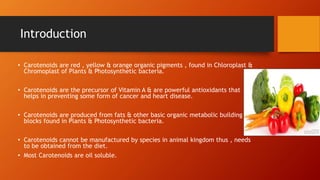
• Carotenoids are red , yellow & orange organic pigments , found in Chloroplast &
Chromoplast of Plants & Photosynthetic bacteria.
• Carotenoids are the precursor of Vitamin A & are powerful antioxidants that
helps in preventing some form of cancer and heart disease.
• Carotenoids are produced from fats & other basic organic metabolic building
blocks found in Plants & Photosynthetic bacteria.
• Carotenoids cannot be manufactured by species in animal kingdom thus , needs
to be obtained from the diet.
• Most Carotenoids are oil soluble.
Chemical Structure
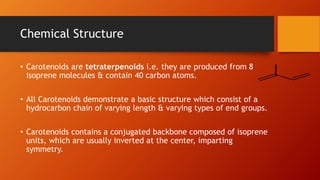
• Carotenoids are tetraterpenoids i.e. they are produced from 8
isoprene molecules & contain 40 carbon atoms.
• All Carotenoids demonstrate a basic structure which consist of a
hydrocarbon chain of varying length & varying types of end groups.
• Carotenoids contains a conjugated backbone composed of isoprene
units, which are usually inverted at the center, imparting
symmetry.
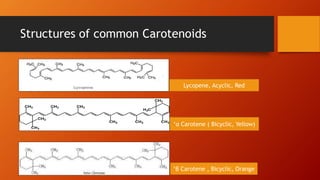
Structures of common Carotenoids
Lycopene, Acyclic, Red
‘α Carotene ( Bicyclic, Yellow)
‘β Carotene , Bicyclic, Orange
Colour
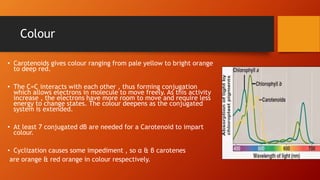
• Carotenoids gives colour ranging from pale yellow to bright orange
to deep red.
• The C=C interacts with each other , thus forming conjugation
which allows electrons in molecule to move freely. As this activity
increase , the electrons have more room to move and require less
energy to change states. The colour deepens as the conjugated
system is extended.
• At least 7 conjugated dB are needed for a Carotenoid to impart
colour.
• Cyclization causes some impediment , so α & β carotenes
are orange & red orange in colour respectively.
Classification of Carotenoids
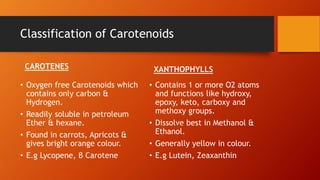
CAROTENES
• Oxygen free Carotenoids which
contains only carbon &
Hydrogen.
• Readily soluble in petroleum
Ether & hexane.
• Found in carrots, Apricots &
gives bright orange colour.
• E.g Lycopene, β Carotene
XANTHOPHYLLS
• Contains 1 or more O2 atoms
and functions like hydroxy,
epoxy, keto, carboxy and
methoxy groups.
• Dissolve best in Methanol &
Ethanol.
• Generally yellow in colour.
• E.g Lutein, Zeaxanthin
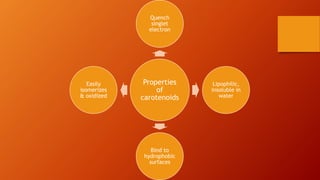
Properties
of
carotenoids
Quench
singlet
electron
Lipophilic,
insoluble in
water
Bind to
hydrophobic
surfaces
Easily
isomerizes
& oxidized
Food Sources
• Carotenoids in food are mainly found in trans form.
• Major food sources are Carrots, Sweet Potato, Dark leafy greens
especially broccoli & spinach , Tomato, Pumpkin, Palm oil & fruits
like apricot, Papaya & Mango.
Food Sources - Green
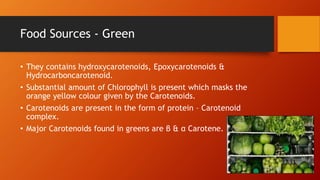
• They contains hydroxycarotenoids, Epoxycarotenoids &
Hydrocarboncarotenoid.
• Substantial amount of Chlorophyll is present which masks the
orange yellow colour given by the Carotenoids.
• Carotenoids are present in the form of protein – Carotenoid
complex.
• Major Carotenoids found in greens are β & α Carotene.
Food Sources – Yellow / Red
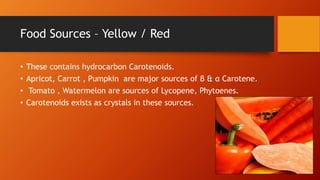
• These contains hydrocarbon Carotenoids.
• Apricot, Carrot , Pumpkin are major sources of β & α Carotene.
• Tomato , Watermelon are sources of Lycopene, Phytoenes.
• Carotenoids exists as crystals in these sources.
Food Sources – Yellow / Orange
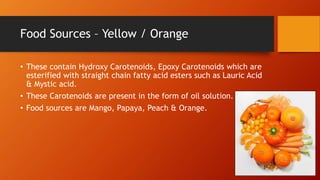
• These contain Hydroxy Carotenoids, Epoxy Carotenoids which are
esterified with straight chain fatty acid esters such as Lauric Acid
& Mystic acid.
• These Carotenoids are present in the form of oil solution.
• Food sources are Mango, Papaya, Peach & Orange.
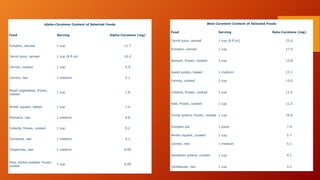
Alpha-Carotene Content of Selected Foods
Food Serving Alpha-Carotene (mg)
Pumpkin, canned 1 cup 11.7
Carrot juice, canned 1 cup (8 fl oz) 10.2
Carrots, cooked 1 cup 5.9
Carrots, raw 1 medium 2.1
Mixed vegetables, frozen,
cooked
1 cup 1.8
Winter squash, baked 1 cup 1.4
Plantains, raw 1 medium 0.8
Collards, frozen, cooked 1 cup 0.2
Tomatoes, raw 1 medium 0.1
Tangerines, raw 1 medium 0.09
Peas, edible-podded, frozen,
cooked
1 cup 0.09
Beta-Carotene Content of Selected Foods
Food Serving Beta-Carotene (mg)
Carrot juice, canned 1 cup (8 fl oz) 22.0
Pumpkin, canned 1 cup 17.0
Spinach, frozen, cooked 1 cup 13.8
Sweet potato, baked 1 medium 13.1
Carrots, cooked 1 cup 13.0
Collards, frozen, cooked 1 cup 11.6
Kale, frozen, cooked 1 cup 11.5
Turnip greens, frozen, cooked 1 cup 10.6
Pumpkin pie 1 piece 7.4
Winter squash, cooked 1 cup 5.7
Carrots, raw 1 medium 5.1
Dandelion greens, cooked 1 cup 4.1
Cantaloupe, raw 1 cup 3.2
Stability of Carotenoids
• Carotenoids generally have good heat stability as they can hanlde
high temp & High pressure processing.
• They work best in pH above 3.5.
• They can be degraded by light , Low pH , Oxygen and enzymes.
• Carotenoids can undergo ISOMERISATION & OXIDATION , stimulated
by Light. However, excessive stimulation may result in undesirable
flavors & loss in colour due to formation of Volatile compounds.
Factors affecting Carotenoids content
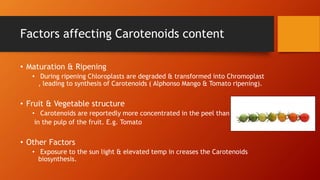
• Maturation & Ripening
• During ripening Chloroplasts are degraded & transformed into Chromoplast
, leading to synthesis of Carotenoids ( Alphonso Mango & Tomato ripening).
• Fruit & Vegetable structure
• Carotenoids are reportedly more concentrated in the peel than
in the pulp of the fruit. E.g. Tomato
• Other Factors
• Exposure to the sun light & elevated temp in creases the Carotenoids
biosynthesis.
Effects of Home Processing & Cooking
• Cooking & Blanching
• As a result of heat treatment during cooking , Carotenoids may undergo
oxidative degradation, Structural transformation or stereoisomerisation.
• Heating process results in chromplast disintegration, Carotenoids being
dissolved in cellular lipids thus leading to a colour shift.
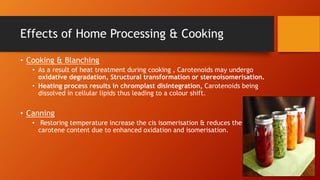
• Canning
• Restoring temperature increase the cis isomerisation & reduces the
carotene content due to enhanced oxidation and isomerisation.
Effects of Home Processing & Cooking
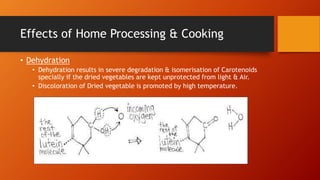
• Dehydration
• Dehydration results in severe degradation & isomerisation of Carotenoids
specially if the dried vegetables are kept unprotected from light & Air.
• Discoloration of Dried vegetable is promoted by high temperature.
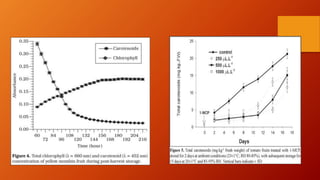
Losses incurred during STORAGE
• Storage at 7-20°C for 16-43 days causes a substantial decrease in
total carotenoid content even when fruits are ripened at optimal
temperatures.
• Losses in α, β carotene and lutein increases in carrots as storage
temp increases above 4°C.
• Both sweet pepper and parsley loose over 20% of their total
carotenoid content at cold room storage (7°C) for 9 days.
• Indian Tuber shows irregular behaviour as its Carotenoids content
increases with storage at 4°C & 25-30°C but decreases with 15-
20°C.
Preservation
• Adeqaute modified atmospheres (MA) & controlled atmospheres
(CA) i.e with low concentration of O2 are known to maintain
carotenoid content.
• Samples are grown under N2 in the dark in the presence of
carbonate sources like NACO3/NaHCO3 and an antioxidant
(Pyragallol) which would ensure exclusion of oxygen.
• Avoiding high temperature and protection from light retains the
carotenoid content.
• Chloroform, dichloromethane, tert-butylmethyl ether which are
distilled solvents free from impurities are also used.
Analysis of Carotenoids
• Analysis of carotenoid can be performed spectrophotometrically
such as identifying β carotene using its specific absorption
coefficient at 450nm or by HPLC.
• Separations are performed on C18/C30 reversed phase HPLC
columns using mixtures of acetonitrile, methanol, chloroform as
mobile phases.
• Detection is performed using diode arrays or mass spectrometric
detection.

Carotenoids

  • 1.
    CAROTENOIDS Prepared By :-Moksha Chib Roll No :- 13 FET1003
  • 2.
    Introduction • Carotenoids arered , yellow & orange organic pigments , found in Chloroplast & Chromoplast of Plants & Photosynthetic bacteria. • Carotenoids are the precursor of Vitamin A & are powerful antioxidants that helps in preventing some form of cancer and heart disease. • Carotenoids are produced from fats & other basic organic metabolic building blocks found in Plants & Photosynthetic bacteria. • Carotenoids cannot be manufactured by species in animal kingdom thus , needs to be obtained from the diet. • Most Carotenoids are oil soluble.
  • 3.
    Chemical Structure • Carotenoidsare tetraterpenoids i.e. they are produced from 8 isoprene molecules & contain 40 carbon atoms. • All Carotenoids demonstrate a basic structure which consist of a hydrocarbon chain of varying length & varying types of end groups. • Carotenoids contains a conjugated backbone composed of isoprene units, which are usually inverted at the center, imparting symmetry.
  • 4.
    Structures of commonCarotenoids Lycopene, Acyclic, Red ‘α Carotene ( Bicyclic, Yellow) ‘β Carotene , Bicyclic, Orange
  • 5.
    Colour • Carotenoids givescolour ranging from pale yellow to bright orange to deep red. • The C=C interacts with each other , thus forming conjugation which allows electrons in molecule to move freely. As this activity increase , the electrons have more room to move and require less energy to change states. The colour deepens as the conjugated system is extended. • At least 7 conjugated dB are needed for a Carotenoid to impart colour. • Cyclization causes some impediment , so α & β carotenes are orange & red orange in colour respectively.
  • 6.
    Classification of Carotenoids CAROTENES •Oxygen free Carotenoids which contains only carbon & Hydrogen. • Readily soluble in petroleum Ether & hexane. • Found in carrots, Apricots & gives bright orange colour. • E.g Lycopene, β Carotene XANTHOPHYLLS • Contains 1 or more O2 atoms and functions like hydroxy, epoxy, keto, carboxy and methoxy groups. • Dissolve best in Methanol & Ethanol. • Generally yellow in colour. • E.g Lutein, Zeaxanthin
  • 7.
  • 8.
    Food Sources • Carotenoidsin food are mainly found in trans form. • Major food sources are Carrots, Sweet Potato, Dark leafy greens especially broccoli & spinach , Tomato, Pumpkin, Palm oil & fruits like apricot, Papaya & Mango.
  • 9.
    Food Sources -Green • They contains hydroxycarotenoids, Epoxycarotenoids & Hydrocarboncarotenoid. • Substantial amount of Chlorophyll is present which masks the orange yellow colour given by the Carotenoids. • Carotenoids are present in the form of protein – Carotenoid complex. • Major Carotenoids found in greens are β & α Carotene.
  • 10.
    Food Sources –Yellow / Red • These contains hydrocarbon Carotenoids. • Apricot, Carrot , Pumpkin are major sources of β & α Carotene. • Tomato , Watermelon are sources of Lycopene, Phytoenes. • Carotenoids exists as crystals in these sources.
  • 11.
    Food Sources –Yellow / Orange • These contain Hydroxy Carotenoids, Epoxy Carotenoids which are esterified with straight chain fatty acid esters such as Lauric Acid & Mystic acid. • These Carotenoids are present in the form of oil solution. • Food sources are Mango, Papaya, Peach & Orange.
  • 12.
    Alpha-Carotene Content ofSelected Foods Food Serving Alpha-Carotene (mg) Pumpkin, canned 1 cup 11.7 Carrot juice, canned 1 cup (8 fl oz) 10.2 Carrots, cooked 1 cup 5.9 Carrots, raw 1 medium 2.1 Mixed vegetables, frozen, cooked 1 cup 1.8 Winter squash, baked 1 cup 1.4 Plantains, raw 1 medium 0.8 Collards, frozen, cooked 1 cup 0.2 Tomatoes, raw 1 medium 0.1 Tangerines, raw 1 medium 0.09 Peas, edible-podded, frozen, cooked 1 cup 0.09 Beta-Carotene Content of Selected Foods Food Serving Beta-Carotene (mg) Carrot juice, canned 1 cup (8 fl oz) 22.0 Pumpkin, canned 1 cup 17.0 Spinach, frozen, cooked 1 cup 13.8 Sweet potato, baked 1 medium 13.1 Carrots, cooked 1 cup 13.0 Collards, frozen, cooked 1 cup 11.6 Kale, frozen, cooked 1 cup 11.5 Turnip greens, frozen, cooked 1 cup 10.6 Pumpkin pie 1 piece 7.4 Winter squash, cooked 1 cup 5.7 Carrots, raw 1 medium 5.1 Dandelion greens, cooked 1 cup 4.1 Cantaloupe, raw 1 cup 3.2
  • 13.
    Stability of Carotenoids •Carotenoids generally have good heat stability as they can hanlde high temp & High pressure processing. • They work best in pH above 3.5. • They can be degraded by light , Low pH , Oxygen and enzymes. • Carotenoids can undergo ISOMERISATION & OXIDATION , stimulated by Light. However, excessive stimulation may result in undesirable flavors & loss in colour due to formation of Volatile compounds.
  • 14.
    Factors affecting Carotenoidscontent • Maturation & Ripening • During ripening Chloroplasts are degraded & transformed into Chromoplast , leading to synthesis of Carotenoids ( Alphonso Mango & Tomato ripening). • Fruit & Vegetable structure • Carotenoids are reportedly more concentrated in the peel than in the pulp of the fruit. E.g. Tomato • Other Factors • Exposure to the sun light & elevated temp in creases the Carotenoids biosynthesis.
  • 15.
    Effects of HomeProcessing & Cooking • Cooking & Blanching • As a result of heat treatment during cooking , Carotenoids may undergo oxidative degradation, Structural transformation or stereoisomerisation. • Heating process results in chromplast disintegration, Carotenoids being dissolved in cellular lipids thus leading to a colour shift. • Canning • Restoring temperature increase the cis isomerisation & reduces the carotene content due to enhanced oxidation and isomerisation.
  • 16.
    Effects of HomeProcessing & Cooking • Dehydration • Dehydration results in severe degradation & isomerisation of Carotenoids specially if the dried vegetables are kept unprotected from light & Air. • Discoloration of Dried vegetable is promoted by high temperature.
  • 17.
    Losses incurred duringSTORAGE • Storage at 7-20°C for 16-43 days causes a substantial decrease in total carotenoid content even when fruits are ripened at optimal temperatures. • Losses in α, β carotene and lutein increases in carrots as storage temp increases above 4°C. • Both sweet pepper and parsley loose over 20% of their total carotenoid content at cold room storage (7°C) for 9 days. • Indian Tuber shows irregular behaviour as its Carotenoids content increases with storage at 4°C & 25-30°C but decreases with 15- 20°C.
  • 19.
    Preservation • Adeqaute modifiedatmospheres (MA) & controlled atmospheres (CA) i.e with low concentration of O2 are known to maintain carotenoid content. • Samples are grown under N2 in the dark in the presence of carbonate sources like NACO3/NaHCO3 and an antioxidant (Pyragallol) which would ensure exclusion of oxygen. • Avoiding high temperature and protection from light retains the carotenoid content. • Chloroform, dichloromethane, tert-butylmethyl ether which are distilled solvents free from impurities are also used.
  • 20.
    Analysis of Carotenoids •Analysis of carotenoid can be performed spectrophotometrically such as identifying β carotene using its specific absorption coefficient at 450nm or by HPLC. • Separations are performed on C18/C30 reversed phase HPLC columns using mixtures of acetonitrile, methanol, chloroform as mobile phases. • Detection is performed using diode arrays or mass spectrometric detection.