Ms. Snehal S. Chakorkar
(M. Pharm.)
For Third Year B. Pharm. Program as per PCI syllabus,
New Delhi
Unit II
Introduction to secondary metabolite
Alkaloids
Vinca, Rauwolfia, Belladonna, Opium
Definition: “Alkaloids often contain one or more rings of
carbon atoms, usually with a nitrogen atom in the ring.
The position of the nitrogen atom in the carbon ring varies
with different alkaloids and with different plant families
and that has a pharmacological effect on humans and
animals.”
Introduction to Alkaloids:
Ex- In some alkaloids, Noscapine Nitrogen is within ring;
while in mescaline (From peyote cactus) , the nitrogen atom
is not within a carbon ring.
Properties of Alkaloids;
1. A nitrogenous organic molecule that has a
pharmacological effect on humans and animals.
2. They are a class of compounds which typically contain
nitrogen and have complex ring structures.
3. Usually alkaloids are derivatives from amino acids.
4. Even though many alkaloids are poisonous (e.g.
strychnine), some are used in medicine as analgesics or
anaesthetics, particularly morphine and codeine.
5. Most alkaloids have a very bitter taste.
6. Although numerous alkaloids exist, they have similar
properties; In general, they are colourless, crystalline
solids, have definite melting points.
For instance, some alkaloids are not basic and others are
brightly coloured (betanidine, beriberine, sanguinarine)
or liquid (nicotine).
7. Generally free bases of alkaloids are soluble in organic
solvents and insoluble in water, where as alkaloidal
salts are soluble in water and partially soluble in
organic solvents.
For example, strychnine hydrochloride is much more
soluble in water than strychnine as a base.
Classification of alkaloids:
There are three main types of alkaloids:
(1) True alkaloids.
(2) Protoalkaloids.
(3) Pseudoalkaloids.
True Alkaloids:
True alkaloids derive from amino acid and they share a heterocyclic
ring with nitrogen.
These alkaloids are highly reactive substances with biological activity
even in low doses.
All true alkaloids have a bitter taste and appear as a white solid, with
the exception of nicotine which has a brown liquid. True alkaloids
form water-soluble salts.
True alkaloids may occur in plants (1) in the free state, (2) as salts and
(3) as N-oxides.
They are compounds in which decarboxylated amino acids are
condensed with a non-nitrogenous structural moiety.
The primary precursors of true alkaloids are such amino acids as L-
ornithine, L-lysine, L-phenylalanine/Ltyrosine, L-tryptophan and L-
histidine.
Examples -cocaine, quinine, dopamine and morphine.
Protoalkaloids
Protoalkaloids are compounds, in which the N atom derived from an
amino acid is not a part of the heterocyclic.
Such kinds of alkaloid include compounds derived from L-tyrosine
and L-tryptophan.
Protoalkaloids are those with a closed ring, being perfect but
structurally simple alkaloids.
These alkaloids have a pyrroline nucleus.
The species from this genus have been used in the treatment of
mental illness, and occasionally to combat pain and neuralgia.
Ex- Hordenine, mescaline and yohimbine.
Pseudoalkaloids
Pseudoalkaloids are compounds, the basic carbon skeletons of which
are not derived from amino acids but they are connected with amino
acid pathways.
They are derived from the precursors or post-cursors (derivatives the
indegradation process) of amino acids. They can also result from the
amination and trans-amination reactions.
The N atom is inserted into the molecule at a relatively late stage, for
example, in the case of steroidal or terpenoid skeletons..
Pseudoalkaloids can be acetate and phenylalanine derived or
terpenoid, as well as steroidal alkaloids.
Examples- capsaicin, ephedrine, solanidine, caffeine and
theobromine.
VINCA
Synonyms: Vinca rosea,
Catharanthus, Madagascar
periwinkle, Barmasi.
Biological Source:
Vinca is the dried entire plant
of Catharanthus roseus Linn.,
belonging to family Apocynaceae.
Geographical Source:
The plant is a native of Madagascar and is found in
many tropical and subtropical countries especially in
India, Australia, south Africa and North and South
America.
The plant is cultivated as garden plant in Europe and
India.
Cultivation and Collection:
The plant is perennial and retains its glossy leaves throughout the
winter. The plant prefers light (sandy), medium (loamy) and heavy
(clay) soils and can grow in heavy clay soil.
The plant prefers acid, neutral and basic (alkaline) soils. It can grow in
full shade (deep woodland) semishade (light woodland) or no shade. It
requires dry or moist soil and can tolerate drought. It is cultivated
either by directly sowing the seeds or sowing the seeds in nursery.
fresh seeds are sown in nursery in the month of February or March.
The seedlings attain a height of 5–8 cm after two months and
then they are transplanted in to the field at a distance of 45cm × 30cm.
Characteristics:
The leaves are green in colour showing petiolate,
entire margin, ovate or oblong, glossy appearance
and with
acute apex.
Flowers are either violet, pinkish white or
carmine red and roots are pale grey in colour. It
has characteristic odour and bitter taste.
The flowers are hermaphrodite (have both male
and female organs) and are pollinated by bees.
Fruit is follicles with numerous black seeds.
Chemical Constituents:
Alkaloids are present in
entire shrub but leaves and roots
contain more alkaloids.
About 90 alkaloids have been isolated from Vinca from which
some like Ajmalicine, Serpentine and Tetrahydroalstonine are
known and are present in other species of Apocynaceae.
The important alkaloids in Catharanthus are the dimer indole
indoline alkaloids Vinblastine and Vincristine and they possess
definite anticancer activity.
Vindoline and Catharanthine areindole monomeric alkaloids. It
also contains monoterpenes, sesquiterpene, indole and indoline
glycoside.
Uses
Vinblastin is an antitumour alkaloid used in the treatment of
Hodgkin’s disease ( lymphoma, which is a blood cancer that starts in
the lymphatic system).
Vincristine is a cytotoxic compound and used to treat leukaemia in
children.
Vinca is used in herbal practice for its astringent and tonic properties
in menorrhagia and in haemorrhages generally.
In cases of scurvy and for relaxed sore throat and inflamed tonsils, it
may also be used as a gargle.
For bleeding piles, it may be applied externally, as well as taken
internally.
It is also used in the treatment of diabetes.
The flowers of the Periwinkle are gently purgative, but lose their
effect on drying. a gentle laxative for children and also for chronic
constipation in grown persons.
Marketed Products:
It is one of the ingredients of the preparation known as Cytocristin
(Cipla) and Vinca minora by komal laboratories.
RAUWOLFIA
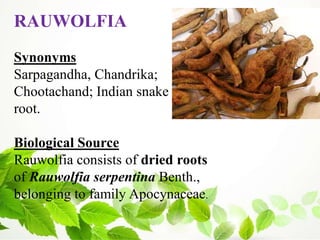
Synonyms
Sarpagandha, Chandrika;
Chootachand; Indian snake
root.
Biological Source
Rauwolfia consists of dried roots
of Rauwolfia serpentina Benth.,
belonging to family Apocynaceae.
Geographical Source
It is an erect, evergreen, small shrub native to the
Orient and occurs from India to Sumatra.
It is also found in Burma, Thailand, Philippines,
Vietnam, Indonesia, Malaysia, Pakistan and Java.
In India it occurs in the sub-Himalayan tracts
from Sirhind eastwards to Assam, especially in
Dehradun, Siwalik range, Rohelkhand, Gorakhpur
ascending to 1,300 m, east and west ghats of Tamil
Nadu, in Bihar (Patna and Bhagalpur), Konkan,
Karnataka and Bengal.
Cultivation and Collection
Rauwolfia grows in tropical forests at an altitude of 1,200– 1,300 m
at temperature 10–40°C.
There should be enough rain or irrigation for its cultivation.
The soil should be acidic (pH 4–6), clayey and manure is applied for
better crop.
Propagation is done by planting seeds, root cuttings or stem cuttings.
The plants should be protected from nematodes, fungus and Mosaic
virus.
The drug is collected mainly from wild plants. Roots and rhizomes
are dug out in October–November when the plant roots are two to
four years old.
The roots are washed and dried in air. The roots containing moisture
up to 12% should be protected from light.
Circular scars of rootlets are present. Bark exfoliation is present in
old samples leaving behind patches of exposed wood.
The fracture is short. A narrow, yellowish-brown bark and a dense
pale yellow wood are present on the smooth transverse surface at
both the ends. Pieces of rhizome closely resemble the root but may
be identified by a small central pith.
They are attached to them with small pieces of aerial stem. Slight
odour is felt in recently dried drug which decreases with age; taste is
bitter
Characteristics:
The roots and rhizomes are almost identical in external
characters.
The drug occurs in cylindrical or slightly tapering,
tortuous pieces, 2–10 cm long, 5–22 mm in diameter.
The roots are rarely branched. Rootlets, 0.5–1 mm in
diameter, are rare. The outer surface is greyish-yellow,
light brown or brown. Young pieces contain slight
wrinkles while old pieces have longitudinal ridges.
Chemical Constituents:
Rauwolfia contains about 0.7–2.4% total alkaloidal bases from
which more than 80 alkaloids have been isolated.
The prominent alkaloids isolated from the drug are reserpine,
rescinnamine, ψ-reserpine, rescidine, raubescine and deserpidine.
The other alkaloidal components are ajmalinine, ajmaline, ajmalicine
(8-yohimbine), serpentine, serpentinine, tetrahydroreserpine,
raubasine, reserpinine, isoajamaline and yohambinine.
Uses
Rauwolfia in used as hypnotic, sedative and antihypertensive.
It is specific for insanity, reduces blood pressure and cures pain due
to affections of the bowels.
It is given in labours to increase uterine contractions and in certain
neuropsychiatric disorders.
Ajmaline, which has pharmacological properties similar to those of
quinidine, is marketed in Japan for the treatment of cardiac
arrhythmias.
Reserpine is an antihypertensive and tranquilizer. Rescinnamine is
the methyl reserpate ester of 3,4,5-trimethoxy cinnamic acid.
The usual antihypertensive dose of rescinnamine is 500 μg,
two times a day.
Higher doses may cause serious mental depression. Deserpidine is
11-des-methoxyreserpine.
It is a wide-range tranquilizer and antihypertensive and is free from
the side effects.
Marketed Products
It is one of the ingredients of the preparations known as Confido,
Lukol, Serpina (Himalaya Drug Company) and Sarpagandhan bati
(Baidyanath).
Synonyms:
Belladonna herb; Belladonna leaf;
Deadly night shade leaves; Banewort; Death’s
herb, Dwale; Poison black cherry; Folia
belladonnae.
Biological Source:
Belladonna consists of
dried leaves and flowering tops of
Atropa belladonna Linn. (European Belladonna),
belonging to family Solanaceae.
BELLADONNA
It contains about 0.35% of total alkaloids calculated as hyoscyamine.
Geographical Source:
United States, Canada, UK, Germany and India.
Cultivation and Collection:
Plants are cultivated by sowing seeds in nurseries and seedlings are
transplanted in April to moist, calcareous and loamy soil.
Weeds are removed and manure is applied for proper growth of the
crop.
During flowering session leaves and flowering tops are cut at least
three times in a year at an interval of two months from one to three
years old plants.
When the plant is four years old, roots are dug out. The collected
drug is dried at 40–50°C.
Belladonna plant infected with the fungus Phytophthora
belladonnae should be destroyed to prevent further infection.
Sometimes the leaves are damaged by flea-bettle insect and the roots
by a fungus.
Characteristics
The drug contains leaves, smaller stems of about 5 mm diameter,
flowers and fruits.
Leaves are stalked, brittle, thin, entire, long-pointed, 5–25 cm long,
2.5–12 cm wide, ovate lanceolate, slightly decurrent lamina, margine-
entire, apex acuminate, colour dull-green or yellowish-green, surface
glabrous, lateral veins join the midrib at an angle of 60°C, curving
upwards and are anastomose.
The upper side is darker than the lower. Each has a petiole about 0.5–4
cm long and a broadly ovate, slightly decurrent lamina about 5–25 cm
long and 2.5–12 cm wide.
If the leaves are broken, they are characterized by the venation and
roughness of the surface due to the presence of calcium oxalate in
some mesophyll cells which causes minute points on the surface of the
leaf on drying.
Chemical Constituents
Belladonna contains 0.3–1.0% total alkaloids, the prominent base is l-
hyoscyamine and other components are atropine, apoatropine, as
choline, belladonnine, cuscohygrine, chrysatropic acid, volatile
bases, such as atroscine, leucatropic acid; phytosterol, N-
methylpyrroline, homatropine, hyoscyamine N-oxide, rutin,
kaempferol-3-rhamnogalactoside and 7-glucoside, quercetin-7-
glucoside, scopoletin, calcium oxalate.
l-hyoscyamine atropine belladonnine
Uses:
The Belladona used as adjunctive therapy in the treatment of peptic
ulcer; functional digestive disorders, including spastic, mucous and
ulcerative colitis; diarrhoea, diverticulitis and pancreatitis.
Due to anticholinergic property, it is used to control excess motor
activity of the GIT and spasm of the urinary tract.
Belladonna is anticholinergic, narcotic, sedative, diuretic mydriatic
and used as anodyne and to check secretion.
Belladonna acts as a parasympathetic depressant hence relieves
spasm of gut or respiratory tract .
Consumption of Belladonna checks excessive perspiration of
patients suffering from tuberculosis.
Marketed Products
It is one of the ingredients of the preparation known as Belladona
plaster (Surgi Pharma) for backache, stiffness of muscles and boil,
swollen joints.
Synonyms
Crude Opium; Raw Opium; Gum Opium;
Afim; Post.
Biological Source
Opium is the air dried milky latex obtained
by incision from the unripe capsules of
Papaver somniferum Linn, or its variety
P. album Decand.,
belonging to family Papaveraceae.
OPIUM
Opium is required to contain not less than 10% of morphine and
not less than 2.0% of codeine.
The thebaine content is limited to 3%.
Geographical Source
It is mainly found in Turkey,
Russia, Yugoslavia, Tasmania,
India, Pakistan, Iran, Afghanistan,
China, Burma, Thailand and Laos.
In India, Opium is cultivated in
M.P. (Neemuch) and U.P. for
alkaloidal extraction and seed
production.
History
The cultivation of opium dates back to 3400 B.C. in Mesopotamia
and by 1300 B.C. Egyptians began the cultivation of opium
thebaicum.
Hippocrates ‘the father of medicine’, (460–357 B.C.) prescribed
drinking the juice of the white poppy mixed with the seed of nettle
and also acknowledged its use as narcotic and styptic in internal
diseases.
Alexander the Great, who introduced opium to India and Persia.
During the 17th century tobacco smoking was introduced in China,
which resulted in its extensive.
In 1800 control on opium supply and prices was brought and in
1805 Friedrich W. Seiturner (German pharmacist) isolated and
identified the chief chemical constituent of opium. The compound
isolated was named morphium (morphine) after Morpheus, the god
of dreams.
Eventually many other constituents like codeine (1832) and
papaverine (1848) were also isolated and identified.
The United States in 19th century made easy availability of the
opium preparations and the ‘patent medicines’.
Later on during the war, the Union Army were provided with enough
amount of opium pills, laudanum, morphine sulphate, etc., which
made opium addiction known as the ‘army disease or the ‘soldier’s
disease’.
By 1870s, substitute for morphine by acetylating morphine
were prepared and in 1898 a German company manufactured
3, 6-diacetylmorphine (Heroin) in bulk quantity.
The Federal Controlled Substances Act of 1970 is the redefined act of
the Harrison Act. In 1999, opium was declared as the Bumper crop of
Afghanistan by producing 75% of world’s heroin.
Cultivation and Collection
Opium is cultivated under license from the
government.
Its seeds are sown in October or March in alluvial soil.
After germination of seeds snow falls. In spring the
thin plant attains the height of 15 cm. Fertilizers are
used for better crop. The poppy of first crop blossoms
in April or May and the capsule mature in June or July.
When the capsules are about 4 cm in diameter, the
colour changes
from green to yellow; they are incised with a knife
about 1 mm deep around the circumference between
midday and evening.
The knife, known as a ‘nushtur’ bears narrow iron spikes which are
drawn down the capsule to produce several longitudinal cuts. The
incision must not penetrate into the interior of the capsule otherwise
latex will be lost.
The latex tube opens into one another. The latex, which is white in
the beginning, immediately coagulates and turns brown.
Next morning it is removed by scrapping with a knife and
transferred to a poppy leaf.
Each capsule is cut several times at intervals of two or three days.
After collection the latex is placed in a tilted vessel so that the dark
fluid which is not required may drain off. By exposure to air the
opium acquires a suitable consistency for packing.
The dried latex is kneaded into balls, wrapped in poppy leaves and
dried in shade.
The principal commercial varieties of Opium are Turkish Opium,
Indian Opium, Chinese Opium, Yugoslavian Opium and Persian
Opium.
Characteristics
Opium occurs in rounded or flattened mass which is
8–15 cm in diameter and weighing from 300 g to 2
kg each.
The external surface is pale or chocolate-brown,
texture is uniform and slightly granular.
It is plastic like when fresh and turns hard and brittle
after sometime.
Fragment of poppy leaves are present on the upper
surface.
Chemical Constituents
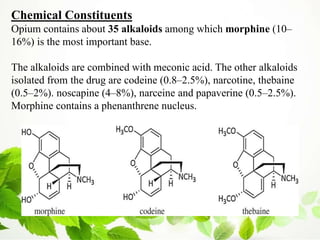
Opium contains about 35 alkaloids among which morphine (10–
16%) is the most important base.
The alkaloids are combined with meconic acid. The other alkaloids
isolated from the drug are codeine (0.8–2.5%), narcotine, thebaine
(0.5–2%). noscapine (4–8%), narceine and papaverine (0.5–2.5%).
Morphine contains a phenanthrene nucleus.
The different types of alkaloids isolated are:
1. Morphine Type
2. Phthalide Isoquinoline Type
3. Benzyl Isoquinoline Type
4. Cryptopine Type
5. Unknown Constituents
1. Morphine Type: Morphine, codeine, neopine, pseudo or
oxymorphine, thebaine and porphyroxine.
Morphine consists of alkaloids which has phenanthrene nucleus
Papaverine group has benzylisoquinoline structure.
The morphine molecule has both a phenolic and an alcoholic
hydroxyl group and acetylated form is diacetyl morphine or heroin.
Codeine is ether of morphine (methyl-morphine).
Other morphine ethers which are used medicinally are ethylmorphine
and pholcodine.
2. Phthalide Isoquinoline Type: Hydrocotarnme, narcotoline,
1-narcotine, noscapine, oxynarcotine, narceine, and
5’-O-demethyl-narcotine.
3. Benzyl Isoquinoline Type: Papaverine, dl-laudanine, laudanidine,
codamine and laudanosine.
4. Cryptopine Type: Protopine, cryptopine.
5. Unknown Constituents: Aporeine, diodeadine, meconidine,
papaveramine and lanthopine.
The drug also contains sugars, sulphates, albuminous compounds,
colouring matter and moisture. In addition to these anisaldehyde,
vanillin, vanillic acid, β-hydroxystyrene,
fumaric acid, lactic acid, benzyl alcohol, 2-hydroxycinchonic acid,
phthalic acid, hemipinic acid, meconin and an odorous compound
have also been reported.
Uses
Opium and morphine have narcotic, analgesic and sedative action
and used to relieve pain, diarrhoea dysentery and cough.
Poppy capsules are astringent, somniferous, soporific, sedative and
narcotic and used as anodyne and emollient.
Codeine is mild sedative and is employed in cough mixtures.
Noscapine is not narcotic and has cough suppressant action acting
as a central antitussive drug.
Papaverine has smooth muscle relaxant action and is used to cure
muscle spasms. Opium, morphine and the diacetyl derivative
heroin, cause drug addiction.
Marketed Products
It is one of the ingredients of the preparation known opium tincture
and Morphine inj. USP.
References Used:
1. W.C.Evans, Trease and Evans Pharmacognosy, 16th edition,
W.B. Sounders & Co., London, 2009.
2. Mohammad Ali. Pharmacognosy and Phytochemistry, CBS
Publishers & Distribution, New Delhi.
3. Text book of Pharmacognosy by C.K. Kokate, Purohit, Gokhlae
(2007), 37th Edition, Nirali Prakashan, New Delhi.
4. Herbal drug industry by R.D. Choudhary (1996), Ist Edn,
Eastern Publisher, New Delhi.
5. Essentials of Pharmacognosy, Dr.SH.Ansari, IInd edition, Birla
publications, New
Delhi, 2007

1.alkaloids

  • 1.
    Ms. Snehal S.Chakorkar (M. Pharm.) For Third Year B. Pharm. Program as per PCI syllabus, New Delhi Unit II Introduction to secondary metabolite Alkaloids Vinca, Rauwolfia, Belladonna, Opium
  • 2.
    Definition: “Alkaloids oftencontain one or more rings of carbon atoms, usually with a nitrogen atom in the ring. The position of the nitrogen atom in the carbon ring varies with different alkaloids and with different plant families and that has a pharmacological effect on humans and animals.” Introduction to Alkaloids: Ex- In some alkaloids, Noscapine Nitrogen is within ring; while in mescaline (From peyote cactus) , the nitrogen atom is not within a carbon ring.
  • 3.
    Properties of Alkaloids; 1.A nitrogenous organic molecule that has a pharmacological effect on humans and animals. 2. They are a class of compounds which typically contain nitrogen and have complex ring structures. 3. Usually alkaloids are derivatives from amino acids. 4. Even though many alkaloids are poisonous (e.g. strychnine), some are used in medicine as analgesics or anaesthetics, particularly morphine and codeine. 5. Most alkaloids have a very bitter taste.
  • 4.
    6. Although numerousalkaloids exist, they have similar properties; In general, they are colourless, crystalline solids, have definite melting points. For instance, some alkaloids are not basic and others are brightly coloured (betanidine, beriberine, sanguinarine) or liquid (nicotine). 7. Generally free bases of alkaloids are soluble in organic solvents and insoluble in water, where as alkaloidal salts are soluble in water and partially soluble in organic solvents. For example, strychnine hydrochloride is much more soluble in water than strychnine as a base.
  • 5.
    Classification of alkaloids: Thereare three main types of alkaloids: (1) True alkaloids. (2) Protoalkaloids. (3) Pseudoalkaloids.
  • 6.
    True Alkaloids: True alkaloidsderive from amino acid and they share a heterocyclic ring with nitrogen. These alkaloids are highly reactive substances with biological activity even in low doses. All true alkaloids have a bitter taste and appear as a white solid, with the exception of nicotine which has a brown liquid. True alkaloids form water-soluble salts. True alkaloids may occur in plants (1) in the free state, (2) as salts and (3) as N-oxides. They are compounds in which decarboxylated amino acids are condensed with a non-nitrogenous structural moiety. The primary precursors of true alkaloids are such amino acids as L- ornithine, L-lysine, L-phenylalanine/Ltyrosine, L-tryptophan and L- histidine. Examples -cocaine, quinine, dopamine and morphine.
  • 7.
    Protoalkaloids Protoalkaloids are compounds,in which the N atom derived from an amino acid is not a part of the heterocyclic. Such kinds of alkaloid include compounds derived from L-tyrosine and L-tryptophan. Protoalkaloids are those with a closed ring, being perfect but structurally simple alkaloids. These alkaloids have a pyrroline nucleus. The species from this genus have been used in the treatment of mental illness, and occasionally to combat pain and neuralgia. Ex- Hordenine, mescaline and yohimbine.
  • 8.
    Pseudoalkaloids Pseudoalkaloids are compounds,the basic carbon skeletons of which are not derived from amino acids but they are connected with amino acid pathways. They are derived from the precursors or post-cursors (derivatives the indegradation process) of amino acids. They can also result from the amination and trans-amination reactions. The N atom is inserted into the molecule at a relatively late stage, for example, in the case of steroidal or terpenoid skeletons.. Pseudoalkaloids can be acetate and phenylalanine derived or terpenoid, as well as steroidal alkaloids. Examples- capsaicin, ephedrine, solanidine, caffeine and theobromine.
  • 9.
    VINCA Synonyms: Vinca rosea, Catharanthus,Madagascar periwinkle, Barmasi. Biological Source: Vinca is the dried entire plant of Catharanthus roseus Linn., belonging to family Apocynaceae.
  • 10.
    Geographical Source: The plantis a native of Madagascar and is found in many tropical and subtropical countries especially in India, Australia, south Africa and North and South America. The plant is cultivated as garden plant in Europe and India. Cultivation and Collection: The plant is perennial and retains its glossy leaves throughout the winter. The plant prefers light (sandy), medium (loamy) and heavy (clay) soils and can grow in heavy clay soil. The plant prefers acid, neutral and basic (alkaline) soils. It can grow in full shade (deep woodland) semishade (light woodland) or no shade. It requires dry or moist soil and can tolerate drought. It is cultivated either by directly sowing the seeds or sowing the seeds in nursery. fresh seeds are sown in nursery in the month of February or March. The seedlings attain a height of 5–8 cm after two months and then they are transplanted in to the field at a distance of 45cm × 30cm.
  • 11.
    Characteristics: The leaves aregreen in colour showing petiolate, entire margin, ovate or oblong, glossy appearance and with acute apex. Flowers are either violet, pinkish white or carmine red and roots are pale grey in colour. It has characteristic odour and bitter taste. The flowers are hermaphrodite (have both male and female organs) and are pollinated by bees. Fruit is follicles with numerous black seeds.
  • 12.
    Chemical Constituents: Alkaloids arepresent in entire shrub but leaves and roots contain more alkaloids. About 90 alkaloids have been isolated from Vinca from which some like Ajmalicine, Serpentine and Tetrahydroalstonine are known and are present in other species of Apocynaceae. The important alkaloids in Catharanthus are the dimer indole indoline alkaloids Vinblastine and Vincristine and they possess definite anticancer activity. Vindoline and Catharanthine areindole monomeric alkaloids. It also contains monoterpenes, sesquiterpene, indole and indoline glycoside.
  • 13.
    Uses Vinblastin is anantitumour alkaloid used in the treatment of Hodgkin’s disease ( lymphoma, which is a blood cancer that starts in the lymphatic system). Vincristine is a cytotoxic compound and used to treat leukaemia in children. Vinca is used in herbal practice for its astringent and tonic properties in menorrhagia and in haemorrhages generally. In cases of scurvy and for relaxed sore throat and inflamed tonsils, it may also be used as a gargle. For bleeding piles, it may be applied externally, as well as taken internally. It is also used in the treatment of diabetes. The flowers of the Periwinkle are gently purgative, but lose their effect on drying. a gentle laxative for children and also for chronic constipation in grown persons.
  • 14.
    Marketed Products: It isone of the ingredients of the preparation known as Cytocristin (Cipla) and Vinca minora by komal laboratories.
  • 15.
    RAUWOLFIA Synonyms Sarpagandha, Chandrika; Chootachand; Indiansnake root. Biological Source Rauwolfia consists of dried roots of Rauwolfia serpentina Benth., belonging to family Apocynaceae.
  • 16.
    Geographical Source It isan erect, evergreen, small shrub native to the Orient and occurs from India to Sumatra. It is also found in Burma, Thailand, Philippines, Vietnam, Indonesia, Malaysia, Pakistan and Java. In India it occurs in the sub-Himalayan tracts from Sirhind eastwards to Assam, especially in Dehradun, Siwalik range, Rohelkhand, Gorakhpur ascending to 1,300 m, east and west ghats of Tamil Nadu, in Bihar (Patna and Bhagalpur), Konkan, Karnataka and Bengal.
  • 17.
    Cultivation and Collection Rauwolfiagrows in tropical forests at an altitude of 1,200– 1,300 m at temperature 10–40°C. There should be enough rain or irrigation for its cultivation. The soil should be acidic (pH 4–6), clayey and manure is applied for better crop. Propagation is done by planting seeds, root cuttings or stem cuttings. The plants should be protected from nematodes, fungus and Mosaic virus. The drug is collected mainly from wild plants. Roots and rhizomes are dug out in October–November when the plant roots are two to four years old. The roots are washed and dried in air. The roots containing moisture up to 12% should be protected from light.
  • 18.
    Circular scars ofrootlets are present. Bark exfoliation is present in old samples leaving behind patches of exposed wood. The fracture is short. A narrow, yellowish-brown bark and a dense pale yellow wood are present on the smooth transverse surface at both the ends. Pieces of rhizome closely resemble the root but may be identified by a small central pith. They are attached to them with small pieces of aerial stem. Slight odour is felt in recently dried drug which decreases with age; taste is bitter Characteristics: The roots and rhizomes are almost identical in external characters. The drug occurs in cylindrical or slightly tapering, tortuous pieces, 2–10 cm long, 5–22 mm in diameter. The roots are rarely branched. Rootlets, 0.5–1 mm in diameter, are rare. The outer surface is greyish-yellow, light brown or brown. Young pieces contain slight wrinkles while old pieces have longitudinal ridges.
  • 19.
    Chemical Constituents: Rauwolfia containsabout 0.7–2.4% total alkaloidal bases from which more than 80 alkaloids have been isolated. The prominent alkaloids isolated from the drug are reserpine, rescinnamine, ψ-reserpine, rescidine, raubescine and deserpidine. The other alkaloidal components are ajmalinine, ajmaline, ajmalicine (8-yohimbine), serpentine, serpentinine, tetrahydroreserpine, raubasine, reserpinine, isoajamaline and yohambinine.
  • 20.
    Uses Rauwolfia in usedas hypnotic, sedative and antihypertensive. It is specific for insanity, reduces blood pressure and cures pain due to affections of the bowels. It is given in labours to increase uterine contractions and in certain neuropsychiatric disorders. Ajmaline, which has pharmacological properties similar to those of quinidine, is marketed in Japan for the treatment of cardiac arrhythmias. Reserpine is an antihypertensive and tranquilizer. Rescinnamine is the methyl reserpate ester of 3,4,5-trimethoxy cinnamic acid. The usual antihypertensive dose of rescinnamine is 500 μg, two times a day. Higher doses may cause serious mental depression. Deserpidine is 11-des-methoxyreserpine. It is a wide-range tranquilizer and antihypertensive and is free from the side effects.
  • 21.
    Marketed Products It isone of the ingredients of the preparations known as Confido, Lukol, Serpina (Himalaya Drug Company) and Sarpagandhan bati (Baidyanath).
  • 22.
    Synonyms: Belladonna herb; Belladonnaleaf; Deadly night shade leaves; Banewort; Death’s herb, Dwale; Poison black cherry; Folia belladonnae. Biological Source: Belladonna consists of dried leaves and flowering tops of Atropa belladonna Linn. (European Belladonna), belonging to family Solanaceae. BELLADONNA It contains about 0.35% of total alkaloids calculated as hyoscyamine. Geographical Source: United States, Canada, UK, Germany and India.
  • 23.
    Cultivation and Collection: Plantsare cultivated by sowing seeds in nurseries and seedlings are transplanted in April to moist, calcareous and loamy soil. Weeds are removed and manure is applied for proper growth of the crop. During flowering session leaves and flowering tops are cut at least three times in a year at an interval of two months from one to three years old plants. When the plant is four years old, roots are dug out. The collected drug is dried at 40–50°C. Belladonna plant infected with the fungus Phytophthora belladonnae should be destroyed to prevent further infection. Sometimes the leaves are damaged by flea-bettle insect and the roots by a fungus.
  • 24.
    Characteristics The drug containsleaves, smaller stems of about 5 mm diameter, flowers and fruits. Leaves are stalked, brittle, thin, entire, long-pointed, 5–25 cm long, 2.5–12 cm wide, ovate lanceolate, slightly decurrent lamina, margine- entire, apex acuminate, colour dull-green or yellowish-green, surface glabrous, lateral veins join the midrib at an angle of 60°C, curving upwards and are anastomose. The upper side is darker than the lower. Each has a petiole about 0.5–4 cm long and a broadly ovate, slightly decurrent lamina about 5–25 cm long and 2.5–12 cm wide. If the leaves are broken, they are characterized by the venation and roughness of the surface due to the presence of calcium oxalate in some mesophyll cells which causes minute points on the surface of the leaf on drying.
  • 25.
    Chemical Constituents Belladonna contains0.3–1.0% total alkaloids, the prominent base is l- hyoscyamine and other components are atropine, apoatropine, as choline, belladonnine, cuscohygrine, chrysatropic acid, volatile bases, such as atroscine, leucatropic acid; phytosterol, N- methylpyrroline, homatropine, hyoscyamine N-oxide, rutin, kaempferol-3-rhamnogalactoside and 7-glucoside, quercetin-7- glucoside, scopoletin, calcium oxalate. l-hyoscyamine atropine belladonnine
  • 26.
    Uses: The Belladona usedas adjunctive therapy in the treatment of peptic ulcer; functional digestive disorders, including spastic, mucous and ulcerative colitis; diarrhoea, diverticulitis and pancreatitis. Due to anticholinergic property, it is used to control excess motor activity of the GIT and spasm of the urinary tract. Belladonna is anticholinergic, narcotic, sedative, diuretic mydriatic and used as anodyne and to check secretion. Belladonna acts as a parasympathetic depressant hence relieves spasm of gut or respiratory tract . Consumption of Belladonna checks excessive perspiration of patients suffering from tuberculosis.
  • 27.
    Marketed Products It isone of the ingredients of the preparation known as Belladona plaster (Surgi Pharma) for backache, stiffness of muscles and boil, swollen joints.
  • 28.
    Synonyms Crude Opium; RawOpium; Gum Opium; Afim; Post. Biological Source Opium is the air dried milky latex obtained by incision from the unripe capsules of Papaver somniferum Linn, or its variety P. album Decand., belonging to family Papaveraceae. OPIUM Opium is required to contain not less than 10% of morphine and not less than 2.0% of codeine. The thebaine content is limited to 3%.
  • 29.
    Geographical Source It ismainly found in Turkey, Russia, Yugoslavia, Tasmania, India, Pakistan, Iran, Afghanistan, China, Burma, Thailand and Laos. In India, Opium is cultivated in M.P. (Neemuch) and U.P. for alkaloidal extraction and seed production.
  • 30.
    History The cultivation ofopium dates back to 3400 B.C. in Mesopotamia and by 1300 B.C. Egyptians began the cultivation of opium thebaicum. Hippocrates ‘the father of medicine’, (460–357 B.C.) prescribed drinking the juice of the white poppy mixed with the seed of nettle and also acknowledged its use as narcotic and styptic in internal diseases. Alexander the Great, who introduced opium to India and Persia. During the 17th century tobacco smoking was introduced in China, which resulted in its extensive. In 1800 control on opium supply and prices was brought and in 1805 Friedrich W. Seiturner (German pharmacist) isolated and identified the chief chemical constituent of opium. The compound isolated was named morphium (morphine) after Morpheus, the god of dreams.
  • 31.
    Eventually many otherconstituents like codeine (1832) and papaverine (1848) were also isolated and identified. The United States in 19th century made easy availability of the opium preparations and the ‘patent medicines’. Later on during the war, the Union Army were provided with enough amount of opium pills, laudanum, morphine sulphate, etc., which made opium addiction known as the ‘army disease or the ‘soldier’s disease’. By 1870s, substitute for morphine by acetylating morphine were prepared and in 1898 a German company manufactured 3, 6-diacetylmorphine (Heroin) in bulk quantity. The Federal Controlled Substances Act of 1970 is the redefined act of the Harrison Act. In 1999, opium was declared as the Bumper crop of Afghanistan by producing 75% of world’s heroin.
  • 32.
    Cultivation and Collection Opiumis cultivated under license from the government. Its seeds are sown in October or March in alluvial soil. After germination of seeds snow falls. In spring the thin plant attains the height of 15 cm. Fertilizers are used for better crop. The poppy of first crop blossoms in April or May and the capsule mature in June or July. When the capsules are about 4 cm in diameter, the colour changes from green to yellow; they are incised with a knife about 1 mm deep around the circumference between midday and evening. The knife, known as a ‘nushtur’ bears narrow iron spikes which are drawn down the capsule to produce several longitudinal cuts. The incision must not penetrate into the interior of the capsule otherwise latex will be lost.
  • 33.
    The latex tubeopens into one another. The latex, which is white in the beginning, immediately coagulates and turns brown. Next morning it is removed by scrapping with a knife and transferred to a poppy leaf. Each capsule is cut several times at intervals of two or three days. After collection the latex is placed in a tilted vessel so that the dark fluid which is not required may drain off. By exposure to air the opium acquires a suitable consistency for packing. The dried latex is kneaded into balls, wrapped in poppy leaves and dried in shade. The principal commercial varieties of Opium are Turkish Opium, Indian Opium, Chinese Opium, Yugoslavian Opium and Persian Opium.
  • 34.
    Characteristics Opium occurs inrounded or flattened mass which is 8–15 cm in diameter and weighing from 300 g to 2 kg each. The external surface is pale or chocolate-brown, texture is uniform and slightly granular. It is plastic like when fresh and turns hard and brittle after sometime. Fragment of poppy leaves are present on the upper surface.
  • 35.
    Chemical Constituents Opium containsabout 35 alkaloids among which morphine (10– 16%) is the most important base. The alkaloids are combined with meconic acid. The other alkaloids isolated from the drug are codeine (0.8–2.5%), narcotine, thebaine (0.5–2%). noscapine (4–8%), narceine and papaverine (0.5–2.5%). Morphine contains a phenanthrene nucleus.
  • 36.
    The different typesof alkaloids isolated are: 1. Morphine Type 2. Phthalide Isoquinoline Type 3. Benzyl Isoquinoline Type 4. Cryptopine Type 5. Unknown Constituents 1. Morphine Type: Morphine, codeine, neopine, pseudo or oxymorphine, thebaine and porphyroxine. Morphine consists of alkaloids which has phenanthrene nucleus Papaverine group has benzylisoquinoline structure. The morphine molecule has both a phenolic and an alcoholic hydroxyl group and acetylated form is diacetyl morphine or heroin. Codeine is ether of morphine (methyl-morphine).
  • 37.
    Other morphine etherswhich are used medicinally are ethylmorphine and pholcodine. 2. Phthalide Isoquinoline Type: Hydrocotarnme, narcotoline, 1-narcotine, noscapine, oxynarcotine, narceine, and 5’-O-demethyl-narcotine. 3. Benzyl Isoquinoline Type: Papaverine, dl-laudanine, laudanidine, codamine and laudanosine. 4. Cryptopine Type: Protopine, cryptopine. 5. Unknown Constituents: Aporeine, diodeadine, meconidine, papaveramine and lanthopine. The drug also contains sugars, sulphates, albuminous compounds, colouring matter and moisture. In addition to these anisaldehyde, vanillin, vanillic acid, β-hydroxystyrene, fumaric acid, lactic acid, benzyl alcohol, 2-hydroxycinchonic acid, phthalic acid, hemipinic acid, meconin and an odorous compound have also been reported.
  • 38.
    Uses Opium and morphinehave narcotic, analgesic and sedative action and used to relieve pain, diarrhoea dysentery and cough. Poppy capsules are astringent, somniferous, soporific, sedative and narcotic and used as anodyne and emollient. Codeine is mild sedative and is employed in cough mixtures. Noscapine is not narcotic and has cough suppressant action acting as a central antitussive drug. Papaverine has smooth muscle relaxant action and is used to cure muscle spasms. Opium, morphine and the diacetyl derivative heroin, cause drug addiction.
  • 39.
    Marketed Products It isone of the ingredients of the preparation known opium tincture and Morphine inj. USP.
  • 40.
    References Used: 1. W.C.Evans,Trease and Evans Pharmacognosy, 16th edition, W.B. Sounders & Co., London, 2009. 2. Mohammad Ali. Pharmacognosy and Phytochemistry, CBS Publishers & Distribution, New Delhi. 3. Text book of Pharmacognosy by C.K. Kokate, Purohit, Gokhlae (2007), 37th Edition, Nirali Prakashan, New Delhi. 4. Herbal drug industry by R.D. Choudhary (1996), Ist Edn, Eastern Publisher, New Delhi. 5. Essentials of Pharmacognosy, Dr.SH.Ansari, IInd edition, Birla publications, New Delhi, 2007