Tachyarrhythmia
NADHI FONSEKA
Reference
 LifeintheFastlane
 Tintinally’s emergency Medicine
 Uptodate
Mechanism
 Increased automaticity in a normal or ectopic site
Usually gradual in onset and termination
 Re-entry in a normal or accessary pathway
Abrupt onset and termination.
Triggered by Ectopics
 After depolarization causing triggered rhythms
Classification-Anatomical
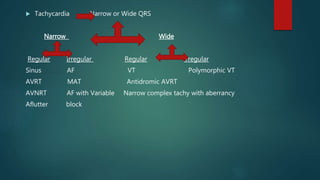
 Tachycardia Narrow or Wide QRS
Narrow Wide
Regular Irregular Regular Irregular
Sinus AF VT Polymorphic VT
AVRT MAT Antidromic AVRT
AVNRT AF with Variable Narrow complex tachy with aberrancy
Aflutter block
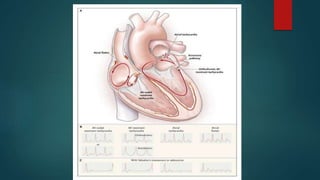
Atrial Tachyarrhythmia
 Sinus Tachycardia
 SNRT
 Atrial fibrillation
 Atrial Tachycardia
-Focal Atrial Tachycardia
-Macro-re-entrant atrial tachycardia = Atrial flutter
Sinus Tachycardia
 Physiological[exercise/emotion] or pathological
-look for underlying cause
-If no underlying cause found consider SNRT or focal Atrial tachycardia
-Sinus tachycardia in a normal heart with no underlying cause is called
inappropriate sinus tachycardia
Atrial fibrillation
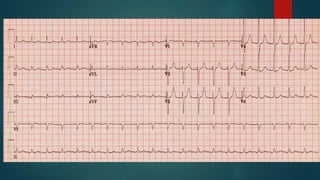
 Most common sustained cardiac arrhythmia
 Usually associated with some underling heart disease
Atrial enlargement, elevated atrial pressure , inflammation
 Multiple ectopic foci continuously discharging with no uniform atrial
depolarization or contraction
 Fibrilatory waves best seen in V1-3 and aVF
 Irregularly irregular ventricular contractions 110-160
Atrial tachycardia
Regular atrial rhythm with P rate > 100
 Focal atrial tachy
-from a automatic focus in atria firing faster than SAN.
-different P wave morphology and axis
Atrial Flutter
 Caused by re-entry circuit over a large area of a atrium[R/L]
 Atrial rate >240[usually 300]. AV block 2:1 usually or more occasionally
 1:1 if sympathetic stimulation or Accessary pathway[unstable/VF]
 Ventricular rate usually 125-175
 Narrow complex tachycardia
 Flutter waves best seen in leads II, III, aVF
 Flutter waves in V1 may resemble P waves
 Irregular with variable AV block
 Loss of isoelectric baseline
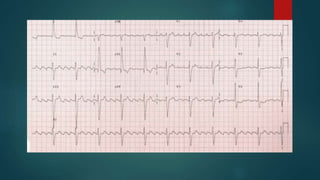
Ectopic atrial tachycardia
 Rate 120
 Abnormal P waves
 Atrial flutter with 3:1 block
 Sinus tachycardia
 P waves hidden within T [camel hump appearance]
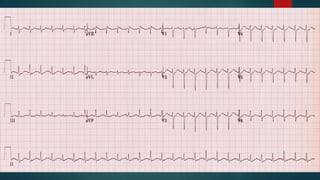
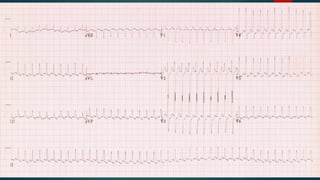
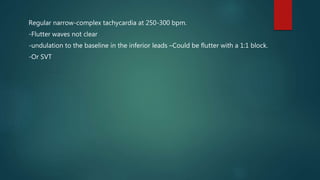
Regular narrow-complex tachycardia at 250-300 bpm.
-Flutter waves not clear
-undulation to the baseline in the inferior leads –Could be flutter with a 1:1 block.
-Or SVT
Atrioventricular tachyarrhythmia
Depends on activation between atria and ventricles or AVN
 AVNRT
 AVRT
 Junctional tachycardia
[commonly called SVT]
 60% of SVT is re-entry within AVN
 20% re-entry involving a bypass tract
 In a normal heart SVT at the typical rates of 160-200 is often tolerated
for hours to days
 Produce narrow complex tachycardia unless aberrant conduction is present
 Abrupt onset and offset
AVNRT
 Occur in normal hearts or hearts with disease
 Commonest cause of palpitations in structurally normal hearts
 Paroxysmal . Could be spontaneous or provoked
 Can terminate spontaneously or may needs intervention
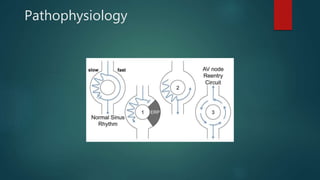
Pathophysiology
ECG
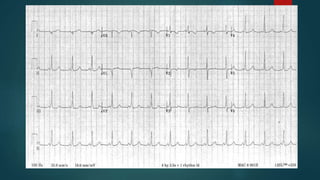
 Regular tachycardia [140-280]
 Narrow QRS [<120] –unless known BBB, accessory pathway or rate related aberrant
conduction
 P waves
-Not visible usually
-if visible inverted in 11,111,aVF or as pseudo s waves
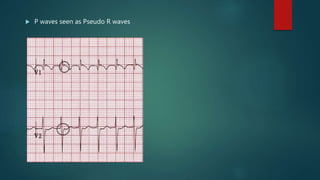
-May be seen as a Pseudo R wave after QRS V1-2
 ST depression with or without CAD-rate related
 P waves seen as Pseudo R waves
AVRT
 Re-entry circuit with 2 parallel limbs
-AVN and a Bypass tract
 Re-entry can occur either direction
-usually anterograde through AVN and retrograde through bypass tract
orthodromic-Narrow complex tachycardia
-If Antidromic – Wide complex tachycardia resembling VT
 Triggered by PAC or PVC
WPW
 Congenital AV accessory pathway –commonest is bundle of Kent
 Incidence 0.3-1 per 1000
 Small risk of SCD
 Accessory pathway can usually conduct both directions
 Tachyarrhythmia can occur from
a re-entry circuit –AVRT
Can completely bypass AVN –AF or Atrial Flutter in WPW
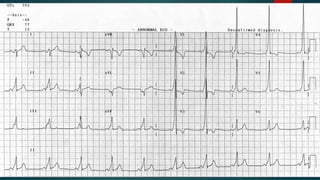
ECG-WPW
In SR
 Short PR < 120
 Delta wave [positive /negative]
 QRS – wide > 110
 ST and T discordant changers
AF and Atrial flutter in WPW
 Accessory pathway allows rapid conduction to Ventricles bypassing AVN
 Rapid Ventricular rate can degenerate into VF/VT
 Rate > 200 bpm
 Irregular rhythm in AF
 Wide QRS complexes
 QRS Complexes change in shape and morphology
 Axis remains stable unlike TdP
In Flutter rate is regular
WPW
 SR
 very short PR interval (< 120 ms)
 Delta wave
 Tall R waves and inverted T waves in V1-3 mimics RVH — these changes
are due to WPW and do not indicate underlying RVH.
Orthodromic AVRT
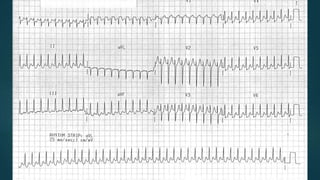
 Regular, narrow complex tachycardia at 225 bpm
 No visible P-waves
 The QRS complexes are narrow because impulses are being transmitted in an
orthodromic direction (A -> V) via the AV node
 This rhythm is indistinguishable from AV-nodal re-entry tachycardia (AVNRT)
 After treatment Shows Underlying WPW in SR
 Age 5 with WPW
 Antidromic AVRT
 Broad complex
 difficult to distinguish from VT.
 > 95% of broad complex tachycardia in children are SVT with aberrancy.
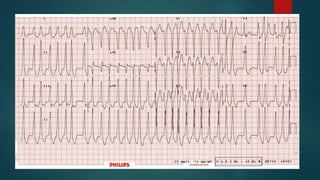
AF with WPW
 Rapid and irregular
 broad complex tachycardia
 This could easily be mistaken for AF with LBBB.
 However, the morphology is not typical of LBBB, the rate is too rapid (up to 300 bpm in
places, i.e. too rapid to be conducted via the AV node) and there is a subtle beat-to-beat
variation in the QRS width which is more typical of WPW (LBBB usually has fixed width
QRS complexes).
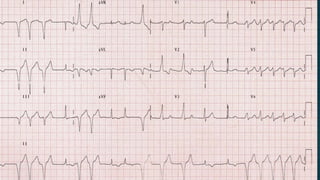
AF in WPW
 Shows intermittent pre-excitation-Produce delta waves
 Other impulses are transmitted via the AV node, producing narrow QRS complexes.
Junctional Tachycardia
 Arise from AVN or bundle of His
Junctional pace maker rate > SAN
 Impulses spread retrograde to Atria and antegrade to Ventricles
 Atria may activate before, during or after ventricles
 If no retrograde conduction and faster Junctional pace maker rate [than
SAN ]can cause AV dissociation
 Uncommon in healthy hearts
 Seen with CHF, IHD and Digoxin Toxicity
Can be classified by rate
 Junctional escape rhythm : 40 – 60 bpm
SAN discharge slow or fail to reach AVN
No retrograde conduction – QRS with no P waves seen
 Accelerated Junctional rhythm : 60 – 100 bpm
Sinus Node overridden
ECG-Junctional Rhythms
 Narrow complex
 Ventricular rate usually 60-100
 Retrograde P waves before , during or after QRS
 P – inverted in inferior leads and upright aVR and V1
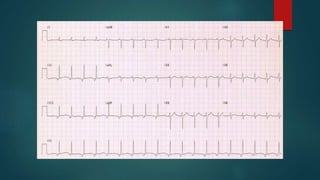
 Junctional tachycardia 115 bpm
-Narrow complex
-Retrograde P waves — inverted in II, III and aVF; upright in V1 and aVR
 Short PR interval (< 120 ms) indicates a junctional rather than atrial focus.
Ventricular Tachyarrhythmia
Contained completely in the ventricle
 VT
-Monomorphic VT
-Polymorphic VT [Eg-torsades de pointes]
 VF
VT
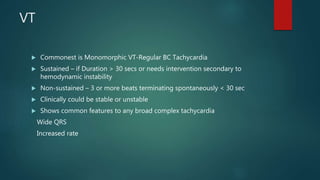
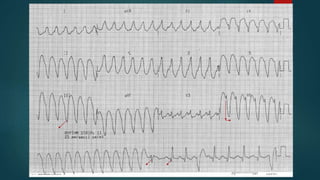
 Commonest is Monomorphic VT-Regular BC Tachycardia
 Sustained – if Duration > 30 secs or needs intervention secondary to
hemodynamic instability
 Non-sustained – 3 or more beats terminating spontaneously < 30 sec
 Clinically could be stable or unstable
 Shows common features to any broad complex tachycardia
Wide QRS
Increased rate
Features suggestive of VT
 Very broad >160ms
 No typical RBBB or LBBB pattern
 Extreme axis deviation
 Capture beats and fusion beats
 Positive or negative concordance with no RS complexes
 Brugada sign
 Taller Left rabbit ear[V1]
 Josephson’s sign
 AV dissociation
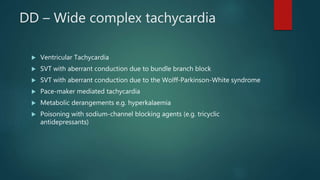
DD – Wide complex tachycardia
 Ventricular Tachycardia
 SVT with aberrant conduction due to bundle branch block
 SVT with aberrant conduction due to the Wolff-Parkinson-White syndrome
 Pace-maker mediated tachycardia
 Metabolic derangements e.g. hyperkalaemia
 Poisoning with sodium-channel blocking agents (e.g. tricyclic
antidepressants)
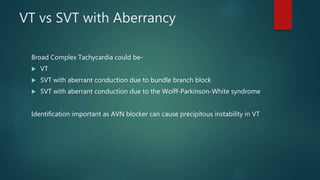
VT vs SVT with Aberrancy
Broad Complex Tachycardia could be-
 VT
 SVT with aberrant conduction due to bundle branch block
 SVT with aberrant conduction due to the Wolff-Parkinson-White syndrome
Identification important as AVN blocker can cause precipitous instability in VT
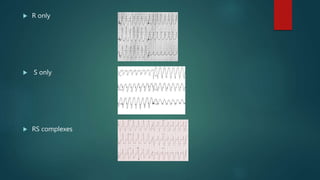
 R only
 S only
 RS complexes
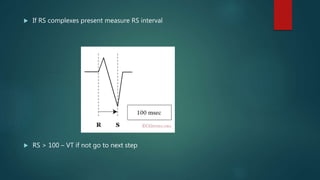
 If RS complexes present measure RS interval
 RS > 100 – VT if not go to next step
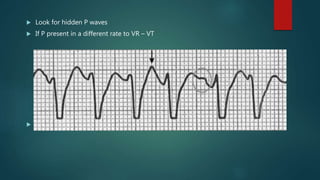
 Look for hidden P waves
 If P present in a different rate to VR – VT
 If not go to next step
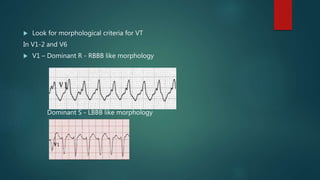
 Look for morphological criteria for VT
In V1-2 and V6
 V1 – Dominant R - RBBB like morphology
Dominant S - LBBB like morphology
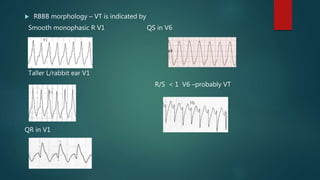
 RBBB morphology – VT is indicated by
Smooth monophasic R V1 QS in V6
Taller L/rabbit ear V1
R/S < 1 V6 –probably VT
QR in V1
QR pattern V1
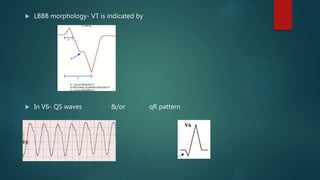
 LBBB morphology- VT is indicated by
 In V6- QS waves &/or qR pattern
 RVOT tachycardia
VT is very rare in normal hearts
Commonest cause is IHD
RVOT is a VT seen in normal hearts and considered benign VT
-causes paroxysms of palpitations related to exercise
-Adenosine sensitive
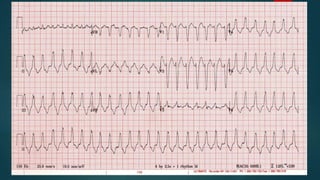
-Broad complex , LBBB morphology with Rightward/inferior axis with AV dissociation
Hyperkalaemia
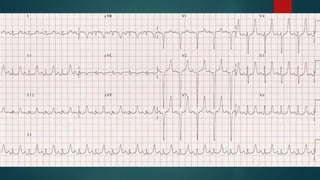
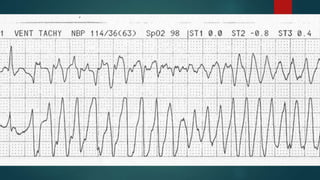
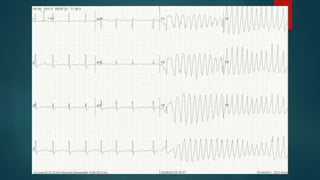
Torsades de pointes- QT and Polymorphic VT
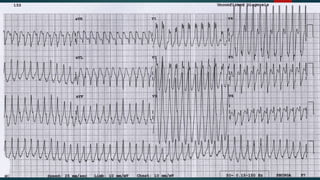
 A polymorphic VT
 QRS axis swings from positive to negative in one lead
 Usually short runs of 5-15 seconds-self limiting
 Rate 200-240 bpm
 Seen with congenital LQTS, myocardial disease with long QT in ECG
or drug/disease/electrolyte induced QT prolongation
 Can cause instability / degenerate to VF
 Long QT precipitates Early after depolarizations – Tall U waves / PVC
 If a PVC occurs on a preceding T [ R on T ] TdP can be initiated
 Onset is often after a long-short-long R-R interval [Pause dependent]
 Bigemini with long QT– High risk of TdP
 Rate > 220 – High risk of VF
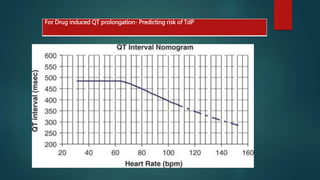
For Drug induced QT prolongation- Predicting risk of TdP
TdP
Secondary to Severe Hypokalaemia
 U waves
 Long QU interval
 R on T -beat 9 on rhythm strip
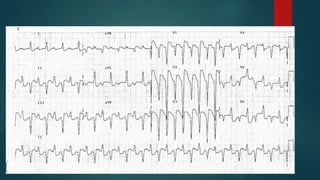
Digoxin Toxicity
 Bidirectional ventricular tachycardia (BVT) is a rare ventricular dysrhythmia
characterised by a beat-to-beat alternation of the frontal QRS axis.
 In the example above, you can see the QRS axis shifts 180 degrees from
left to right with each alternate beat.
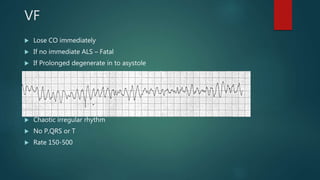
VF
 Lose CO immediately
 If no immediate ALS – Fatal
 If Prolonged degenerate in to asystole
 Chaotic irregular rhythm
 No P,QRS or T
 Rate 150-500
Causes
 IHD
 Electrolyte abnormalities
 Cardiomyopathy
 Long QT (acquired / congenital) causing TdP –> VF
 Brugada
 Drugs (e.g. verapamil in patients with AF+WPW)
 Environmental – electrical shocks, drowning, Hypothermia
 PE
 Tamponade
 Blunt trauma (Commotio Cordis)
Management
Tachycardia with Pulse
Stable
IVC
ECG
Unstable
Sync-Cardioversion
IVC/ECG/Sedate if possible
Stable Narrow-complex
Tachycardia
Regular
Vagal
Adenosine 6-12-12
Converts
Probably AVNRT / AVRT
May need AVN blocking Agent
Dose not Convert
Possible Aflutter/EAT/Junctional
Control Rate CCB or BB
Irregular
Possible AF/Flutter/MAT
Rate Control CCB/BB
Stable Wide-Complex
Tachycardia
Regular
VT/Uncertain Rhythm
-Amiodarone
-Prepare for Cardioversion
-If Known SVT with Aberrancy
Give Adenosine
Irregular
-If Pre-excitation with AF[AF+WPW]
NO AVN Agents[ Adenosine/CC/BB]
Consider
Antiarrhythmic[Amiodarone/Procanamide
-TdP- Mg 1-2 g over 5-60 min
-Polymorphic VT
Sync Cardioversion
-AF with Aberrancy
Follow Narrow-complex Irregular Protocol
Broad Complex tachycardia -If in Doubt
treat as VT
Adenosine
 Do not use –
-broad complex irregular tachycardia[AF+WPW]/ Polymorphic tachycardia
-flutter in WPW
-VT –Precipitous instability
 Can be used in RVOT
 Can be used in Narrow Complex Tachycardia – WPW/AF/Flutter/SVT
AF
 Loan AF is Unlikely to present with instability
 Treat underlying causes [ Sepsis/Hypovolemia/IHD]
 Adenosine, BB, CCB, Digoxin and Amiodarone –Contraindicated in AF+WPW
https://youtu.be/qrhWH2_KKOY

Tachyarrhythmia Management

  • 1.
  • 2.
  • 3.
    Mechanism  Increased automaticityin a normal or ectopic site Usually gradual in onset and termination  Re-entry in a normal or accessary pathway Abrupt onset and termination. Triggered by Ectopics  After depolarization causing triggered rhythms
  • 4.
  • 6.
     Tachycardia Narrowor Wide QRS Narrow Wide Regular Irregular Regular Irregular Sinus AF VT Polymorphic VT AVRT MAT Antidromic AVRT AVNRT AF with Variable Narrow complex tachy with aberrancy Aflutter block
  • 7.
    Atrial Tachyarrhythmia  SinusTachycardia  SNRT  Atrial fibrillation  Atrial Tachycardia -Focal Atrial Tachycardia -Macro-re-entrant atrial tachycardia = Atrial flutter
  • 8.
    Sinus Tachycardia  Physiological[exercise/emotion]or pathological -look for underlying cause -If no underlying cause found consider SNRT or focal Atrial tachycardia -Sinus tachycardia in a normal heart with no underlying cause is called inappropriate sinus tachycardia
  • 9.
    Atrial fibrillation  Mostcommon sustained cardiac arrhythmia  Usually associated with some underling heart disease Atrial enlargement, elevated atrial pressure , inflammation  Multiple ectopic foci continuously discharging with no uniform atrial depolarization or contraction  Fibrilatory waves best seen in V1-3 and aVF  Irregularly irregular ventricular contractions 110-160
  • 10.
    Atrial tachycardia Regular atrialrhythm with P rate > 100  Focal atrial tachy -from a automatic focus in atria firing faster than SAN. -different P wave morphology and axis
  • 11.
    Atrial Flutter  Causedby re-entry circuit over a large area of a atrium[R/L]  Atrial rate >240[usually 300]. AV block 2:1 usually or more occasionally  1:1 if sympathetic stimulation or Accessary pathway[unstable/VF]  Ventricular rate usually 125-175  Narrow complex tachycardia  Flutter waves best seen in leads II, III, aVF  Flutter waves in V1 may resemble P waves  Irregular with variable AV block  Loss of isoelectric baseline
  • 13.
    Ectopic atrial tachycardia Rate 120  Abnormal P waves
  • 15.
     Atrial flutterwith 3:1 block
  • 17.
     Sinus tachycardia P waves hidden within T [camel hump appearance]
  • 19.
    Regular narrow-complex tachycardiaat 250-300 bpm. -Flutter waves not clear -undulation to the baseline in the inferior leads –Could be flutter with a 1:1 block. -Or SVT
  • 20.
    Atrioventricular tachyarrhythmia Depends onactivation between atria and ventricles or AVN  AVNRT  AVRT  Junctional tachycardia [commonly called SVT]
  • 21.
     60% ofSVT is re-entry within AVN  20% re-entry involving a bypass tract  In a normal heart SVT at the typical rates of 160-200 is often tolerated for hours to days  Produce narrow complex tachycardia unless aberrant conduction is present  Abrupt onset and offset
  • 22.
    AVNRT  Occur innormal hearts or hearts with disease  Commonest cause of palpitations in structurally normal hearts  Paroxysmal . Could be spontaneous or provoked  Can terminate spontaneously or may needs intervention
  • 23.
  • 24.
    ECG  Regular tachycardia[140-280]  Narrow QRS [<120] –unless known BBB, accessory pathway or rate related aberrant conduction  P waves -Not visible usually -if visible inverted in 11,111,aVF or as pseudo s waves -May be seen as a Pseudo R wave after QRS V1-2  ST depression with or without CAD-rate related
  • 25.
     P wavesseen as Pseudo R waves
  • 26.
    AVRT  Re-entry circuitwith 2 parallel limbs -AVN and a Bypass tract  Re-entry can occur either direction -usually anterograde through AVN and retrograde through bypass tract orthodromic-Narrow complex tachycardia -If Antidromic – Wide complex tachycardia resembling VT  Triggered by PAC or PVC
  • 27.
    WPW  Congenital AVaccessory pathway –commonest is bundle of Kent  Incidence 0.3-1 per 1000  Small risk of SCD  Accessory pathway can usually conduct both directions  Tachyarrhythmia can occur from a re-entry circuit –AVRT Can completely bypass AVN –AF or Atrial Flutter in WPW
  • 28.
    ECG-WPW In SR  ShortPR < 120  Delta wave [positive /negative]  QRS – wide > 110  ST and T discordant changers
  • 29.
    AF and Atrialflutter in WPW  Accessory pathway allows rapid conduction to Ventricles bypassing AVN  Rapid Ventricular rate can degenerate into VF/VT  Rate > 200 bpm  Irregular rhythm in AF  Wide QRS complexes  QRS Complexes change in shape and morphology  Axis remains stable unlike TdP In Flutter rate is regular
  • 31.
    WPW  SR  veryshort PR interval (< 120 ms)  Delta wave  Tall R waves and inverted T waves in V1-3 mimics RVH — these changes are due to WPW and do not indicate underlying RVH.
  • 33.
    Orthodromic AVRT  Regular,narrow complex tachycardia at 225 bpm  No visible P-waves  The QRS complexes are narrow because impulses are being transmitted in an orthodromic direction (A -> V) via the AV node  This rhythm is indistinguishable from AV-nodal re-entry tachycardia (AVNRT)
  • 35.
     After treatmentShows Underlying WPW in SR
  • 37.
     Age 5with WPW  Antidromic AVRT  Broad complex  difficult to distinguish from VT.  > 95% of broad complex tachycardia in children are SVT with aberrancy.
  • 39.
    AF with WPW Rapid and irregular  broad complex tachycardia  This could easily be mistaken for AF with LBBB.  However, the morphology is not typical of LBBB, the rate is too rapid (up to 300 bpm in places, i.e. too rapid to be conducted via the AV node) and there is a subtle beat-to-beat variation in the QRS width which is more typical of WPW (LBBB usually has fixed width QRS complexes).
  • 41.
    AF in WPW Shows intermittent pre-excitation-Produce delta waves  Other impulses are transmitted via the AV node, producing narrow QRS complexes.
  • 42.
    Junctional Tachycardia  Arisefrom AVN or bundle of His Junctional pace maker rate > SAN  Impulses spread retrograde to Atria and antegrade to Ventricles  Atria may activate before, during or after ventricles  If no retrograde conduction and faster Junctional pace maker rate [than SAN ]can cause AV dissociation  Uncommon in healthy hearts  Seen with CHF, IHD and Digoxin Toxicity
  • 43.
    Can be classifiedby rate  Junctional escape rhythm : 40 – 60 bpm SAN discharge slow or fail to reach AVN No retrograde conduction – QRS with no P waves seen  Accelerated Junctional rhythm : 60 – 100 bpm Sinus Node overridden
  • 44.
    ECG-Junctional Rhythms  Narrowcomplex  Ventricular rate usually 60-100  Retrograde P waves before , during or after QRS  P – inverted in inferior leads and upright aVR and V1
  • 46.
     Junctional tachycardia115 bpm -Narrow complex -Retrograde P waves — inverted in II, III and aVF; upright in V1 and aVR  Short PR interval (< 120 ms) indicates a junctional rather than atrial focus.
  • 47.
    Ventricular Tachyarrhythmia Contained completelyin the ventricle  VT -Monomorphic VT -Polymorphic VT [Eg-torsades de pointes]  VF
  • 48.
    VT  Commonest isMonomorphic VT-Regular BC Tachycardia  Sustained – if Duration > 30 secs or needs intervention secondary to hemodynamic instability  Non-sustained – 3 or more beats terminating spontaneously < 30 sec  Clinically could be stable or unstable  Shows common features to any broad complex tachycardia Wide QRS Increased rate
  • 49.
    Features suggestive ofVT  Very broad >160ms  No typical RBBB or LBBB pattern  Extreme axis deviation  Capture beats and fusion beats  Positive or negative concordance with no RS complexes  Brugada sign  Taller Left rabbit ear[V1]  Josephson’s sign  AV dissociation
  • 51.
    DD – Widecomplex tachycardia  Ventricular Tachycardia  SVT with aberrant conduction due to bundle branch block  SVT with aberrant conduction due to the Wolff-Parkinson-White syndrome  Pace-maker mediated tachycardia  Metabolic derangements e.g. hyperkalaemia  Poisoning with sodium-channel blocking agents (e.g. tricyclic antidepressants)
  • 52.
    VT vs SVTwith Aberrancy Broad Complex Tachycardia could be-  VT  SVT with aberrant conduction due to bundle branch block  SVT with aberrant conduction due to the Wolff-Parkinson-White syndrome Identification important as AVN blocker can cause precipitous instability in VT
  • 54.
     R only S only  RS complexes
  • 55.
     If RScomplexes present measure RS interval  RS > 100 – VT if not go to next step
  • 56.
     Look forhidden P waves  If P present in a different rate to VR – VT  If not go to next step
  • 57.
     Look formorphological criteria for VT In V1-2 and V6  V1 – Dominant R - RBBB like morphology Dominant S - LBBB like morphology
  • 58.
     RBBB morphology– VT is indicated by Smooth monophasic R V1 QS in V6 Taller L/rabbit ear V1 R/S < 1 V6 –probably VT QR in V1 QR pattern V1
  • 59.
     LBBB morphology-VT is indicated by  In V6- QS waves &/or qR pattern
  • 61.
     RVOT tachycardia VTis very rare in normal hearts Commonest cause is IHD RVOT is a VT seen in normal hearts and considered benign VT -causes paroxysms of palpitations related to exercise -Adenosine sensitive -Broad complex , LBBB morphology with Rightward/inferior axis with AV dissociation
  • 63.
  • 64.
    Torsades de pointes-QT and Polymorphic VT  A polymorphic VT  QRS axis swings from positive to negative in one lead  Usually short runs of 5-15 seconds-self limiting  Rate 200-240 bpm  Seen with congenital LQTS, myocardial disease with long QT in ECG or drug/disease/electrolyte induced QT prolongation  Can cause instability / degenerate to VF
  • 66.
     Long QTprecipitates Early after depolarizations – Tall U waves / PVC  If a PVC occurs on a preceding T [ R on T ] TdP can be initiated  Onset is often after a long-short-long R-R interval [Pause dependent]  Bigemini with long QT– High risk of TdP  Rate > 220 – High risk of VF
  • 67.
    For Drug inducedQT prolongation- Predicting risk of TdP
  • 69.
    TdP Secondary to SevereHypokalaemia  U waves  Long QU interval  R on T -beat 9 on rhythm strip
  • 71.
    Digoxin Toxicity  Bidirectionalventricular tachycardia (BVT) is a rare ventricular dysrhythmia characterised by a beat-to-beat alternation of the frontal QRS axis.  In the example above, you can see the QRS axis shifts 180 degrees from left to right with each alternate beat.
  • 72.
    VF  Lose COimmediately  If no immediate ALS – Fatal  If Prolonged degenerate in to asystole  Chaotic irregular rhythm  No P,QRS or T  Rate 150-500
  • 73.
    Causes  IHD  Electrolyteabnormalities  Cardiomyopathy  Long QT (acquired / congenital) causing TdP –> VF  Brugada  Drugs (e.g. verapamil in patients with AF+WPW)  Environmental – electrical shocks, drowning, Hypothermia  PE  Tamponade  Blunt trauma (Commotio Cordis)
  • 74.
  • 75.
  • 76.
    Stable Narrow-complex Tachycardia Regular Vagal Adenosine 6-12-12 Converts ProbablyAVNRT / AVRT May need AVN blocking Agent Dose not Convert Possible Aflutter/EAT/Junctional Control Rate CCB or BB Irregular Possible AF/Flutter/MAT Rate Control CCB/BB
  • 77.
    Stable Wide-Complex Tachycardia Regular VT/Uncertain Rhythm -Amiodarone -Preparefor Cardioversion -If Known SVT with Aberrancy Give Adenosine Irregular -If Pre-excitation with AF[AF+WPW] NO AVN Agents[ Adenosine/CC/BB] Consider Antiarrhythmic[Amiodarone/Procanamide -TdP- Mg 1-2 g over 5-60 min -Polymorphic VT Sync Cardioversion -AF with Aberrancy Follow Narrow-complex Irregular Protocol
  • 78.
    Broad Complex tachycardia-If in Doubt treat as VT
  • 79.
    Adenosine  Do notuse – -broad complex irregular tachycardia[AF+WPW]/ Polymorphic tachycardia -flutter in WPW -VT –Precipitous instability  Can be used in RVOT  Can be used in Narrow Complex Tachycardia – WPW/AF/Flutter/SVT
  • 80.
    AF  Loan AFis Unlikely to present with instability  Treat underlying causes [ Sepsis/Hypovolemia/IHD]  Adenosine, BB, CCB, Digoxin and Amiodarone –Contraindicated in AF+WPW
  • 81.